ISSN 2286-4822 www.euacademic.org
Impact Factor: 3.4546 (UIF) DRJI Value: 5.9 (B+)
Constructs describing e-Learning Models:
A Literature Review
GAURAV CHOPRA Research Scholar, Gurukul Kangri Vishwavidyalaya Haridwar, India Prof. PANKAJ MADAN Head & Dean, Gurukul Kangri Vishwavidyalaya Haridwar, India
Abstract:
Education sector, which is the basis of human resource development of any country, could not remain immune to the penetration of Information Communication and Technology (ICT). ICT which improves the quality of education is becoming the major determinant of student’s success in universities today by supporting the communication among major actors of universities. e-Learning is the result of innovative acclimatization of ICT in delivering education and learning. This study explores the various constructs which can be used in evaluating Learning system. For this a review of popular e-learning models (viz. DeLone & McLean, Technology Acceptance Model (TAM) and Unified Theory of Acceptance and Use of Technology (UTAUT)) had been conducted. It has been found that constructs used in both DeLone & McLean and TAM are crucial for evaluating e-Learning system success and certain constructs are taken from UTAUT and based on this a model is proposed and its various constructs have been tabularized which can be used in future researches for evaluating e-Learning systems.
INTRODUCTION
ICT (Information Communication Technology) increasingly contributing to the success of organizations. Role of ICT has shifted from back office to front of a firm’s interactions with its customers. ICT has penetrated almost all major sectors be it education, supply chain, healthcare. The convenience and unrestricted reach of internet combined with latest technology in terms of software and hardware equipments forced organizations to deploy ICT for their survival in this globalized competitive age (Al-Sabawy, 2013). Digital India campaign of our honorable Prime Minister Shri Narendra Modi reflects the impact that ICT create on the growth of a country.
Information Communication technology has emerging with a new face in education system to provide e-learning. These types of e-learning systems generally based on LMS (Learning Management System) which is software to support various functionality of e-learning (Olufemi, 2008). Examples of LMS can be Moodle or Blackboard. e-Learning functionalities can be enhanced by applying latest software. The content of e-Learning can also be modified by the instructors who are using new tools to make e-learning more users friendly (Rogers 2000). Education sector, which is the basis of human resource development of any country, could not remained immune to the penetration of ICT. Georgina & Olson (2008) founded that universities are investing significant resources in the efficient improvement of ICT infrastructure development. ICT, which improves the quality of education (Turuff, 1999), becoming the major determinant of student’s success in universities today by supporting the communication among major actors of universities (Ahmed et al. 2007; Al-Sabawy, 2013). According to McGill & Klobas (2009), acclimatization of ICT in education sector is a significant improvement of the last decade.
training (VET) activities were based on e-learning systems according to Australian Flexible Learning Framework (2009).
E-LEARNING DEFINITION
e-Learning is the result of innovative acclimatization of ICT in delivering education and learning. e-Learning can be defined as providing learning with the help of computers, laptop, mobile and other electronics channel by using internet (Ozkan & Koseler, 2009). Rosenberg (2001) stressed on three basic elements for e-Learning that is it should be networked, it will reach to the customer through electronic media using internet and it should break the boundary of time and place which is an essential element of classroom learning.
As world is becoming competitive due to globalization and increasing need of knowledge and skills by industries combining with time constraints, e-learning is gaining paramount importance due to its mobility.
e-Learning has increased the importance of Information systems in the last 15 years (Wang, Wang & Shee, 2007). This development has molded the shape of traditional learning by inculcating an element of e-learning (LeePost, 2009)
There are three main approaches have been considered for e-learning system viz. DeLone & McLean Model, Technology Acceptance Model and UTAUT
DeLone and McLean Approach (D&M Model)
D&M model has contributed a lot in the filed of e-Learning. Various studies which have tested effectiveness of e-Learning has used D&M model and added or modified a few constructs in their research model depends on demographic or organizational differentiation in different parts of the world. Some other studies used only limited constructs of it as per their needs.
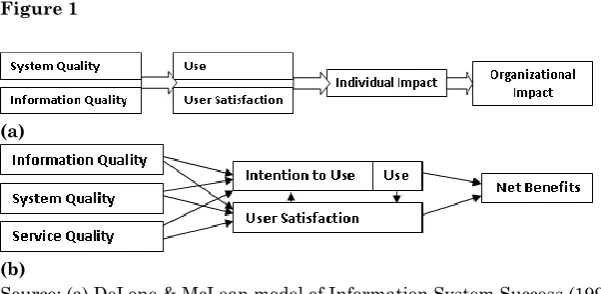
DeLone & McLean reviewed 180 research papers/articles and found six major dimensions to define the success of any information system in 1992 and then modified it after a decade in 2003.
Figure 1
(a)
(b)
Source: (a) DeLone & McLean model of Information System Success (1992) (b) Updated DeLone & McLean’s model of Information System Success (2003)
DeLone & McLean updated their initial model of 1992 and include one important construct of service quality and replaced individual impact and organizational component by Net benefits and shows the relationships among various constructs. This new model was statistically found valid in evaluating information system success by Bernoider (2008). This updated model found very much useful in evaluating the success of e-business, e-government, e-banking and now it is becoming more and more attracted model for e-Learning.
Technology Acceptance Model (TAM)
As e-Learning involves the usage of latest technology to impart learning, we need to consider how much a particular technology is accepted by the end learners. For this purpose it is necessary to understand the technology acceptance model. Lee et al. (2003) mentioned that TAM is gaining huge importance in defining the Information systems. TAM is introduced by Davis in 1986
Figure 2
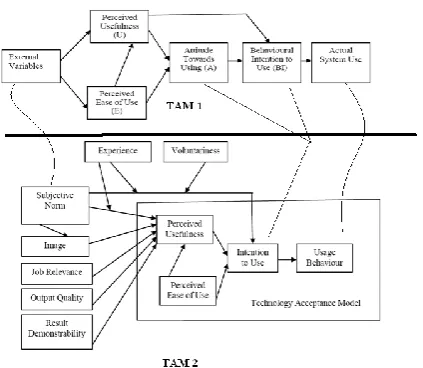
Source: TAM 1- Technology Acceptance Model by Davis (1989)
We can see from the figure that initially TAM used one construct as external factor but it expanded it to five variables in its updated model of TAM 2. It added two more variables in new model viz. Experience and Voluntariness. It also combined two variables of attitude and behavior intention to use into one variable of intention to use and modified actual system use to Usage behavior. In 2008 Venkatesh & Bala further extended the TAM and add two major constructs viz. Anchor (Computer self-efficacy, computer anxiety, computer playfulness and perception of external control) and Adjustment (Perceived enjoyment and Objective usability) which act as antecedent to perceived usefulness.
Unified theory of acceptance and use of technology (UTAUT)
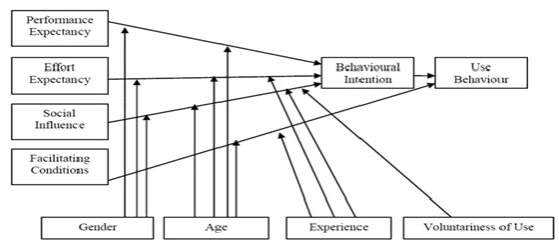
Venkatesh et al. in 2003 reviewed eight models to analyze behavior towards using a particular information system and gave a new model termed as UTAUT. This model added demographic and social variables in addition to intention and use which are part of D&M model and TAM.
Figure 3
Proposed Model
We can see from our literature review that D&M model and TAM, both are necessary for evaluating e-Learning. If we combine the two models it can be a more comprehensive model for e-learning which is applicable in organizational context as well as educational context. In this proposed model constructs can be grouped in to three different variables viz. independent variable, dependent variable and mediating variable. Mediating variable is one which tells if one variable is strongly predicting the final variable then how or why it is causing such prediction. It can also be described as a variable which defines the relation between independent and dependent variable or it is a means which tells how an independent variable influences the dependent variable (Baron & Kenny, 1986).
Figure 4
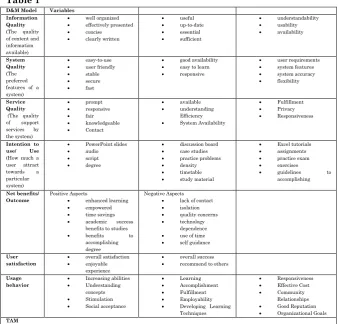
The variables which can explain the respective constructs are given in the following table.
Table 1
D&M Model Variables
Information Quality (The quality of content and information available)
well organized effectively presented concise clearly written
useful up-to-date essential sufficient understandability usability availability System Quality (The preferred features of a system)
easy-to-use user friendly stable secure fast
good availability easy to learn responsive
user requirements system features system accuracy flexibility
Service Quality
(The quality of support services by the system) prompt responsive fair knowledgeable Contact available understanding Efficiency System Availability
Fulfillment Privacy Responsiveness
Intention to
use/ Use
(How much a user attract towards a particular system)
PowerPoint slides audio script degree
discussion board case studies practice problems density timetable study material
Excel tutorials assignments practice exam exercises guidelines to
accomplishing
Net benefits/ Outcome
Positive Aspects
enhanced learning empowered time savings academic success
benefits to studies benefits to
accomplishing degree
Negative Aspects lack of contact isolation quality concerns technology
dependence use of time self guidance
User satisfaction
overall satisfaction enjoyable
experience
overall success recommend to others
Usage behavior
Increasing abilities Understanding
concepts Stimulation Social acceptance
Learning Accomplishment Fulfillment Employability Developing Learning
Techniques
Responsiveness Effective Cost Community
Relationships Good Reputation Organizational Goals
Perceived usefulness
Accomplish quickly Improve
performance
Increasing productivity Easier study/job Overall usefulness
(How much a user believe that using a particular system enhance his/her skills)
Perceived ease of use
e-learning system performance e-learning system
experience Students needs
(How much a user feel comfortable in using the system)
Satisfaction with the decision
Re-use e learning system Other Factors Demographi c factors Age Gender Experience
Student’s status (full-time/part time)
Program of study Level of education Marital status
Computer self efficacy
(How much a user believe in his ability to use computer)
Experience in using computers Time Limit Availability of
Assistance
Demonstration
Source: Davis 1986 & 1989, Lee Post 2009, Al-sabawy 2013, Islam et al. 2011, Saade et al. 2009.
CONCLUSION
This paper tries to describe various e-learning models and theories to design and evaluate e-learning system effectiveness. The main two models which are discussed in this paper are DeLone & McLean Model & Technology Acceptance model and it is found that combination of these two models will give a better analysis tool for e-learning. Any research on e-learning effectiveness can use this model and its elements to design a questionnaire and check its validity in a particular scenario.
REFERENCES
1. Ahmed, Hersi, Tugrul Daim, and Nuri Basoglu (2007). "Information technology diffusion in higher education." Technology in Society 29, no. 4: 469-482.
2. AL-Sabawy, Ahmed Younis (2013). "Measuring e-learning systems success." PhD diss., University of Southern Queensland.
statistical considerations." Journal of personality and social psychology 51, no. 6: 1173.
4. Bernroider, Edward WN (2008). "IT governance for enterprise resource planning supported by the DeLone– McLean model of information systems success." Information & Management 45, no. 5: 257-269.
5. Davis Jr, Fred D. (1986). "A technology acceptance model for empirically testing new end-user information systems: Theory and results." PhD diss., Massachusetts Institute of Technology,.
6. Davis, Fred D. (1989). "Perceived usefulness, perceived ease of use, and user acceptance of information technology." MIS quarterly: 319-340.
7. Delone, William H., and Ephraim R. McLean (2003). "The DeLone and McLean model of information systems success: a ten-year update." Journal of management information systems 19, no. 4: 9-30.
8. DeLone, William H., and Ephraim R. McLean (1992). "Information systems success: The quest for the dependent variable." Information systems research 3, no. 1: 60-95.
9. Georgina, David A., and Myrna R. Olson (2008). "Integration of technology in higher education: A review of faculty self-perceptions." The Internet and Higher Education 11, no. 1: 1-8.
10.Islam, Md Aminul, Noor Asliza Abdul Rahim, Tan Chee Liang, and Hasina Momtaz (2011). "Effect of demographic factors on e-learning effectiveness in a higher learning institution in Malaysia." International Education Studies 4, no. 1: 112.
12.Lee-Post, Anita (2009). "e-Learning Success Model: An Information Systems Perspective." Electronic Journal of e-learning 7, no. 1: 61-70.
13.McGill, Tanya J., and Jane E. Klobas (2009). "A task– technology fit view of learning management system impact." Computers & Education 52, no. 2: 496-508. 14.Olufemi, Olubodun (2008). "Pedagogical approaches and
technical subject teaching through internet media." The Electronic Journal of e-Learning 6, no. 1: 53-66.
15.Ozkan, Sevgi, and Refika Koseler (2009). "Multi-dimensional students’ evaluation of e-learning systems in the higher education context: An empirical investigation." Computers & Education 53, no. 4: 1285-1296.
16.Rogers, Donna L. (2000). "A paradigm shift: Technology integration for higher education in the new millennium." Educational Technology Review: 19-27.
17.Rosenberg, Marc Jeffrey (2001). E-learning: Strategies for delivering knowledge in the digital age. Vol. 3. New York: McGraw-Hill.
18.Saadé, Raafat George, and Dennis Kira (2009). "Computer anxiety in e-learning: The effect of computer self-efficacy." Journal of Information Technology Education 8, no. 1: 177-191.
19.Turoff, Murray (1998). "Education, Commerce, and Communications: The Era of Competition."
20.Venkatesh, Viswanath, and Hillol Bala (2008). "Technology acceptance model 3 and a research agenda on interventions." Decision sciences 39, no. 2: 273-315. 21.Venkatesh, Viswanath, Michael G. Morris, Gordon B.
Davis, and Fred D. Davis (2003). "User acceptance of information technology: Toward a unified view." MIS quarterly: 425-478.