Available online:
https://edupediapublications.org/journals/index.php/IJR/
P a g e | 26M
ORPHOLOGIC
R
EGULARIZATION AND
E
DGE-
P
RESERVING
S
UPER
R
ESOLUTION (SR)
A
PPROACH
B
ASED ON
N
OVEL
B
REGMAN
A
LGORITHM
PRA SHA NT B. RA ULE (M.E. Scholar)1
RA VINDRA P. SHELKIKA R (Associate Professor)2
Electronics and Telecommunication Engineering Department1,2 1,2TPCT’s College of Engineering, District-Osmanabad
,(M.S.),
India.1[email protected] 2[email protected]
A
bstract
Feature extractions are the novel techniques in image processing to store its unique characteristics. Morphological operators are the best for any image processing applications because it helps to preserve some characteristics from image. Although morphological operators is successful in solving the feature extraction but it too has some drawbacks. In this paper we model a non linear regularization method based on multi scale morphology for edge preserving super resolution (SR) image reconstruction. We formulate SR reconstruction problem from low resolution (LR) image as a deblurring and denoising and then solve the inverse problem using Bregman iterations. The proposed Method can be reduce inherent noise generated during low-resolution image formation as well as during SR image estimation efficiently. Using MATLAB simulation results we showed the effectiveness of the proposed method and reconstruction method for SR image.
I.
I
NRODUCTION
The basic goal is to develop an algorithm to enhance the spatial resolution of images captured by an image sensor with a fixed resolution. This process is called the super resolution (SR) method and it has remained an active research topic for the last two decades. A number of fundamental assumptions are made about image formation and quality, it lead to different SR algorithms. These assumptions include the type of motion, the type of blurring, and also the type of noise. It is also important whether to produce
the very best HR image possible or an acceptable HR
image as quickly as possible.SR algorithms may vary
depending on whether only a single low-resolution (LR) image is available (single frame SR) or multiple
LR images are available (multi frame SR).
SR image reconstruction algorithms work either: 1) In the frequency domain or
2) In the spatial domain.
Available online:
https://edupediapublications.org/journals/index.php/IJR/
P a g e | 27where the HR image is estimated based on some prior
knowledge about the image (e.g., degree of smoothness) in the form of regularization.
Bayesian maximum a posteriori (MAP) estimation based methods use prior information in the form of a prior probability density on the HR image and provides a rigorous theoretical framework. MAP based joint formulation is proposed that judiciously combine motion estimation, segmentation, and SR together. The probability based MAP approach is equivalent to the concept of regularization. he first successful edge preserving regularization method for denoising and deblurring is the total variance (TV) (L1 norm) method. Another interesting algorithm, proposed by Farsiu et al., employs bilateral total
variation (BTV) regularization.
To achieve further improvement, Li et al. used a locally adaptive BTV (LABTV) operator for the regularization. All these regularization terms for SR image reconstruction lead to a stable solution, their performance depends on optimization technique as well as regularization term. For example, with gradient descent optimization technique, the LABTV regularization outperforms BTV, which gives better result than TV regularization. On the other hand, based on TV regularization, Marquina and Osher obtained superior result by employing Bregman iteration. So we envisage that even better results would be obtained by combining Bregman iteration and a more sophisticated regularization method that can suppress noise in LR images and ringing artifacts occurred during capturing the details of the HR
image.
A new regularization method based on multi scale morphologic filters is proposed, which are nonlinear in nature. Morphological operators and filters are well-known tools that can extract structures
from images. Since proposed morphologic
regularization term uses non differentiable max and min operators, developed an algorithm based on Bregman iterations and the forward backward operator splitting using sub gradients. The results produced by the proposed regularization are less affected by aforementioned noise evolved during the iterative process.
II.
P
ROBLEM
F
ORMULATION
The observed images of a scene are usually degraded by blurring due to atmospheric turbulence and inappropriate camera settings. The LR images are further degraded because of down sampling by a factor determined by the intrinsic camera parameters. The relationship between the LR images and the HR
image can be formulated as
𝑌𝑘= 𝐷𝐹𝑘𝐻𝑘𝑋 + 𝑒𝑘, ∀𝑘
= 1, 2, … , 𝐾 (1)
where Yk , X, and ek represent lexicographically ordered column vectors of the kth LR image of size M, HR image of size N and additive noise, respectively. FK is a geometric warp matrix and HK is the blurring matrix of size N×N incorporating camera lens/CCD blurring as well as atmospheric blurring. D is the down sampling matrix of size M × N and k is the index of the LR images. Assuming that the LR images are taken under the same
environmental condition and using same sensor, HK
Available online:
https://edupediapublications.org/journals/index.php/IJR/
P a g e | 28simply by H. the LR images are related to the HR
image as
𝑌𝑘= 𝐷𝐹𝑘𝐻𝑋 + 𝑒𝑘, ∀𝑘 = 1, 2, … , 𝐾 (2)
Since under assumption, D and H are the same for all LR images, avoid down sampling and then up sampling at each iteration of iterative reconstruction algorithm by merging the up sampled and shifted-back LR images Yk together. After applying up sampling and reverse shifting, Yk will be aligned
with HR image X. Suppose Yk denotes the up
sampled and reverse-shifted kth LR image obtained through reverse effect of DFK of (2). That means
Yk = F-1DTYK, where DT is the up sampling
operator matrix of size N × M and is an N × N matrix that shifts back (reverse effect of FK ) the
image. The equation from (2), (3), (4) as,
𝑌 = 𝑅𝐻𝑋 + 𝑒 (3)
𝑋̂ = 𝑎𝑟𝑔 min
𝑋 [‖𝑅𝐻𝑋 − 𝑌‖2
2
] (4)
Regularization has used in conjunction with iterative methods for the restoration of noisy degraded images in order to solve an ill-posed problem and
prevent over-fitting. Then the SR image
reconstruction can simply be formulated as
𝑋̂ = 𝑎𝑟𝑔 min
𝑋 [Υ(𝑋) ∶ ‖𝑅𝐻𝑋 − 𝑌‖2 2
< 𝜂] (5)
Where η is a scalar constant depending on the noise
variance in the LR images
III.
P
ROPOSED
W
ORK
A.
MORPHOLOGIC REGULA RIZA TION
Let B be a disk of unit size with origin at its center and SB be a disk structuring element (SE) of
size s. Then the morphological dilation DS (X) of an
image X of size M X N at scale S is defined as
𝐷𝑠(𝑋) =
(
𝑚𝑎𝑥𝑟∈(𝑠𝐵)(1){𝑥𝑟} 𝑚𝑎𝑥𝑟∈(𝑠𝐵)(2){𝑥𝑟}
⋱
𝑚𝑎𝑥𝑟∈(𝑠𝐵)(𝑚𝑛){𝑥𝑟})
(6)
Where (SB)(I ) is a set of pixels covered under SE SB translated to the I -th pixel XI . Similarly, the morphological erosion ES (X) at scale S is defined
as
𝐸𝑠(𝑋) =
( min 𝑟∈(𝑠𝐵) (1){𝑥𝑟}
min 𝑟∈(𝑠𝐵) (2){𝑥𝑟}
. . . min 𝑟 ∈(𝑠𝐵)(𝑚𝑛 ){𝑥𝑟}) (7)
Morphological opening OS (X) and closing CS (X)
by SE SB are defined as follows:
𝑂𝑠(𝑋) = 𝐷𝑠(𝐸𝑠(𝑋) ) (8)
𝐶𝑠(𝑋) = 𝐸𝑠(𝐷𝑠(𝑋) ) (9)
In multi scale morphological image analysis, the difference between the sth scale closing and opening extracts noise particles and image artifacts in scale S
and may be used for denoising purposes.
B.
SUBGRA DIENT
METHODS A ND
BREGM A N ITERA TION
Available online:
https://edupediapublications.org/journals/index.php/IJR/
P a g e | 29by performing gradient descent steps iteratively. The
linearized Bregman algorithm is derived by combining the FPC and Bregman iteration to solve the constrained problem in a more efficient way. An algorithm is developed on Bregman iteration and the proposed morphologic regularization for the SR
image reconstruction problem.
C.
BREGM A N ITERA TION
The proposed penalized splitting approach and corresponds to an algorithm whose structure is characterized by two-level iteration. There is an outer loop, which progressively diminishes the penalization parameter λ in order to obtain the convergence to the global minimum, and an inner loop, which iteratively, using the two-step approach, minimizes the penalization function for the given value of λ. The general scheme of the bound
constrained algorithm is the following.
Initialize Y(0) = n = 0, 𝑌, X(0) = FillUnknown(Y);
While(‖𝑅𝐻𝑋(𝑛)− Y‖22> 𝜂)
{
𝑈(𝑛+1)= X(𝑛 )− 𝛾𝐻𝑇𝑅𝑇(RHX(n)− Y(𝑛)) 𝑋(𝑛+1)= 𝑈(𝑛+1)− 𝜇′|𝛿Υ(X)
𝛿(X)|X(𝑛) 𝑌(𝑛+1)= 𝑌(𝑛)+ (𝑌 − 𝑅𝐻𝑋(𝑛 +1))
𝑛 = 𝑛 + 1
(10)
Here we derive the sub gradients of the dilated and eroded image with respect to its pixel values. Let us
denote the sub gradient of a dilated image Ds(X)
𝛿𝐷𝑠,𝑗 𝛿 𝑥𝑖
=
{
1, if 𝑥𝑖= max 𝑟𝜖(𝑠𝐵)(𝑗)
{𝑥𝑟} 𝑎𝑛𝑑
∀𝑡 ∈ (𝑠𝐵 )(𝑗), 𝑡 ≠ 𝑖, 𝑥𝑡< 𝑥𝑖
0, if 𝑥𝑖< max 𝑟𝜖(𝑠𝐵)(𝑗)
{𝑥𝑟}
𝜖[0,1], elsewhere
(11)
Similarly, the sub gradient of an eroded image Es(X) can be written as follows. We choose the sub gradient equal to 1 out of the range [0, 1]. Then the
sub gradients become
𝛿𝐷𝑠,𝑗 𝛿 𝑥𝑖
= {
1, if 𝑥𝑖= max𝑟𝜖(𝑠𝐵) (𝑗)
{𝑥𝑟}
0, if 𝑥𝑖< max 𝑟𝜖(𝑠𝐵)(𝑗)
{𝑥𝑟} (12)
𝛿𝐸𝑠,𝑗 𝛿𝑥𝑖
= {
1, if 𝑥𝑖= max 𝑟𝜖(𝑠𝐵)(𝑗)
{𝑥𝑟}
0, if 𝑥𝑖< max 𝑟𝜖(𝑠𝐵)(𝑗)
{𝑥𝑟} (13)
Since an analogous chain rule holds for the sub gradients, we can write down the sub gradients of
the regularization function
𝛿Υ(X) 𝛿 (X) ∶=
𝛿
𝛿X∑ 𝛼
𝑠1𝑡[𝐶
𝑠(𝑋) − 𝑂𝑠(𝑋) ] 𝐾
𝑠=1
= ∑ 𝛼𝑠[𝛿𝐶𝑠(X)
𝛿X −
𝛿𝑂𝑠(X) 𝛿X ] 1 𝐾
𝑠=1
= ∑ 𝛼𝑠[𝛿
𝛿X𝐸𝑠(𝐷𝑠(𝑋)) − 𝛿
𝛿X𝐷𝑠(𝐸𝑠(𝑋))] 1 𝐾 𝑠=1 = ∑ 𝛼𝑠[ 𝛿 𝛿𝐷𝑠(𝑋) 𝐸𝑠(𝐷𝑠(𝑋)) 𝛿
𝛿X𝐷𝑠(𝑋) ] 𝐾 𝑠=1 − [ 𝛿 𝛿𝐸𝑠(𝑋) 𝐷𝑠(𝐸𝑠(𝑋)) 𝛿
𝛿X𝐸𝑠(𝑋)] 1 (14)
The respective erosion and dilution functions are
Available online:
https://edupediapublications.org/journals/index.php/IJR/
P a g e | 30𝑞𝑖𝐸𝑠,𝑗:=𝛿𝐸𝑠,𝑗
𝛿𝑑𝑠,𝑖
= {
1, if 𝑑𝑠,𝑖 = max𝑟𝜖 (𝑠𝐵) (𝑗){𝑑𝑠,𝑖
}
0, if 𝑑𝑠,𝑖 < max 𝑟𝜖(𝑠𝐵)(𝑗)
{𝑑𝑠,𝑖}
(15)
𝑞𝑖𝐷𝑠𝑠,𝑗: =𝛿𝐷𝑠,𝑗 𝛿 𝑒𝑠,𝑖
= {
1, if 𝑒𝑠,𝑖= max𝑟𝜖(𝑠𝐵) (𝑗){𝑒𝑠,𝑖
}
0, if 𝑒𝑠,𝑖< max 𝑟𝜖(𝑠𝐵)(𝑗)
{𝑒𝑠,𝑖}
(16)
IV.
S
IMULATION
R
ESULTS
A.
R
ESULTS
F
OR SR1
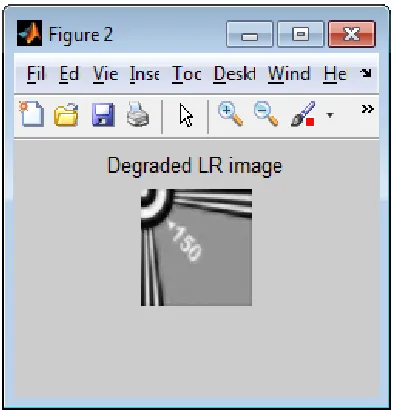
Fig u re 1 Comparison of reconstruction result of the chart image for misestimated motion model and erroneous Gaussian blur parameter. SR image
reconstruction using (a) Grd +BTV
Fig u re 2 Comparison of reconstruction result of the chart image for misestimated motion model and erroneous Gaussian blur parameter. SR image
Available online:
https://edupediapublications.org/journals/index.php/IJR/
P a g e | 31Fig u re 3 Comparison of reconstruction result of the
chart image for misestimated motion model and erroneous Gaussian blur parameter. SR image reconstruction using (c) Breg +Morph (proposed
method)
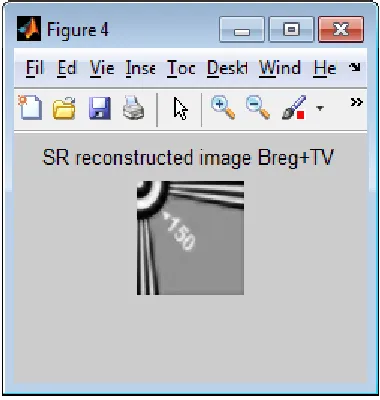
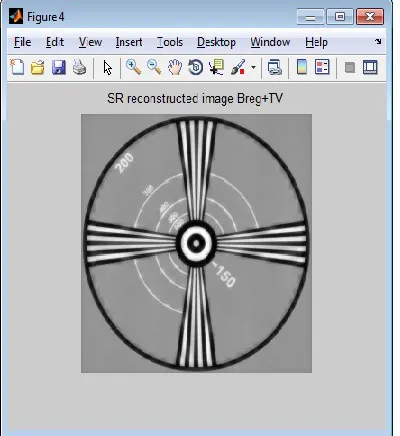
Fig u re 4 Comparison of reconstruction result of the chart image for misestimated motion model and erroneous Gaussian blur parameter. SR image
reconstruction using (c) Breg +TV .
B.
R
ESULTS
F
OR SR2
Fig u re 5 Results of the various SR image
reconstruction methods with a small amount of
noise (σ=2). (a) Original HR image of a chart.
Fig u re 6 Results of the various SR image
reconstruction methods with a small amount of
Available online:
https://edupediapublications.org/journals/index.php/IJR/
P a g e | 32Fig u re 7 Results of the various SR image
reconstruction methods with a small amount of noise (σ=2). (c) Up sampled and merged 10 LR
images.
Figure 8
Results of the various SR image
reconstruction methods with a small amount of
noise (σ=2). SR reconstructed image using the
gradient descent method with TV,BTV, and
LABTV regularization, respectively.
Fig u re 9 Analysis of the performance of SR image reconstruction algorithms applied on different gray images and then average quantitative measures are plotted. (a) PSNR and SSIM of SR algorithms for
noisy LR images with additive Gaussian noise.
Fig u re 9 Analysis of the performance of SR image reconstruction algorithms applied on different gray images and then average quantitative measures are plotted. (b) PSNR and SSIM for different amount of
Available online:
https://edupediapublications.org/journals/index.php/IJR/
P a g e | 33V.
C
ONCLUSION
This paper presented an edge-preserving SR image reconstruction problem as a deblurring
problem with a new robust morphologic
regularization method. Then put forward two major contributions. First, proposed a morphologic regularization function based on multi scale opening and closing, which could remove noise efficiently while preserving edge information. Next, employed Bregman iteration method to solve the inverse problem for SR reconstruction with the proposed morphologic regularization. Compare to previous algorithms proposed algorithm gives better results of quality parameters.Matlab simulations also shows that the proposed work is more efficient compared to all other existing techniques. For quality assessment we are going to use two parameters as PSNR and SSIM.It is known that multi scale morphological filtering can reduce noise efficiently, so a successfully regularization method is used based on multi scale morphology. The experimental results show that it works quite well, in fact better than existing methods. Nonlinearity of the regularization function is handled in a linear fashion during optimization by means of the sub gradient and proximal map concept. The morphologic regularization method proposed here was tested only on SR reconstruction problem; this method is
extended by computing Blocking effect,
Homogeneity and ISNR.
R
EFERENCES
[1] S. Lertrattanapanich and N. K. Bose, “High resolution image formation from low resolution frames using Delaunay triangulation,” IEEE Trans. Image Process., vol. 11, no. 12, pp. 1427–1441,
Dec. 2002.
[2] A. J. Patti and Y. Altunbasak, “Artifact reduction
for set theoretic super resolution image
reconstruction with edge adaptive constraints and higher-order interpolants,” IEEE Trans. Image
Process., vol. 10, no. 1, pp. 179–186, Jan. 2001.
[3] M. Elad and A. Feuer, “Restoration of a single super resolution image from several blurred, noisy and under sampled measured images,” IEEE Trans. Image Process., vol. 6, no. 12, pp. 1646–1658, Dec.
1997.
[4] H. Shen, L. Zhang, B. Huang, and P. Li, “A MAP approach for joint motion estimation segmentation and super resolution,” IEEE Trans. Image Process., vol. 16, no. 2, pp. 479–490, Feb.
2007.
[5] W. T. Freeman and T. R. Jones, “Example-based super resolution,” IEEE Comput. Graphics Appl.,
vol. 22, no. 2, pp. 56–65, Mar. 2002.
[6] J. Yang, J. Wright, T. S. Huang, and Y. Ma, “Image super-resolution via sparse representation,” IEEE Trans. Image Process., vol. 19, no. 11,
pp.2861–2873, Nov. 2010.
Available online:
https://edupediapublications.org/journals/index.php/IJR/
P a g e | 34prior,” IEEE Trans. Pattern Anal. Mach. Intell., vol.
32, no. 6, pp. 1127–1133, Jun. 2010.
[8] W. Dong, L. Zhang, G. Shi, and X. Wu, “Image deblurring and super resolution by adaptive sparse domain selection and adaptive regularization,” IEEE Trans. Image Process., vol. 20, no. 7, pp. 533–549,
Jul. 2011.
[9] M. Protter, M. Elad, H. Takeda, and P. Milanfar, “Generalizing the nonlocal-means to super-resolution reconstruction,” IEEE Trans. Image