Scholarship@Western
Scholarship@Western
Electronic Thesis and Dissertation Repository
9-4-2013 12:00 AM
Interstory: A Study of Reader Participation and Networked
Interstory: A Study of Reader Participation and Networked
Narrative in Media Convergence
Narrative in Media Convergence
Elika Ortega Guzman
The University of Western Ontario Supervisor
Juan Luis Suarez
The University of Western Ontario Graduate Program in Hispanic Studies
A thesis submitted in partial fulfillment of the requirements for the degree in Doctor of Philosophy
© Elika Ortega Guzman 2013
Follow this and additional works at: https://ir.lib.uwo.ca/etd
Part of the Comparative Literature Commons, Film and Media Studies Commons, Modern Languages Commons, and the Spanish and Portuguese Language and Literature Commons
Recommended Citation Recommended Citation
Ortega Guzman, Elika, "Interstory: A Study of Reader Participation and Networked Narrative in Media Convergence" (2013). Electronic Thesis and Dissertation Repository. 1594.
https://ir.lib.uwo.ca/etd/1594
This Dissertation/Thesis is brought to you for free and open access by Scholarship@Western. It has been accepted for inclusion in Electronic Thesis and Dissertation Repository by an authorized administrator of
(Monograph)
by
Élika Ortega Guzmán
Graduate Program in Hispanic Studies
A thesis submitted in partial fulfillment of the requirements for the degree of
Doctor of Philosophy
The School of Graduate and Postdoctoral Studies The University of Western Ontario
London, Ontario, Canada
ii
Abstract
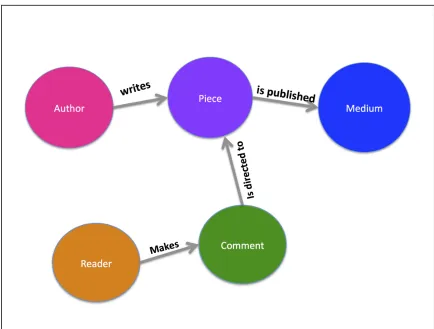
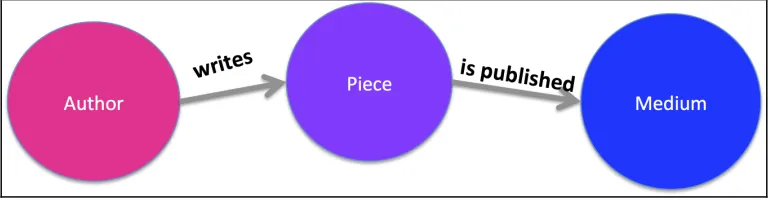
Our current media ecology has seen the proliferation of narrative. Websites, blogs, videos, multimedia mash-ups, but also books, magazines and other print materials are being used frequently together to tell stories. Bearing this phenomenon in mind, I propose the term interstory to characterize a particular narrative tendency. Interstory is a narrative constituted by a network of story pieces published in different media and compiled by readers following the textual and media links laid out by an author/editor. In order to test and elaborate the concept of interstory, I take as a study case Hernán Casciari’s and Christian Basilis’ Orsai. The project contains three blogs, a print magazine, a web magazine, a publishing house, and an iPad application. All of them are joined together by the story of Orsai’s own development and by a solid online/offline community of readers. Because of the media characteristics and large-scale of the object under examination, I propose a methodology for the study of
narrative as a network composed of authors, texts, media of publication, readers, and readers’ input. A graph database has been built to account for these components and facilitate their analysis. This has allowed the exploration of which narrative contents are encompassed by the project, where they are published, when and in what media, what their function is in the overall project, and how the readers’ respond to them. The prominence of readers in this kind of narrative also required the development of a methodology to study reading practices in
Orsai’s different media. From this study it is possible to conclude that narrative is by no means under crisis in the digital age. As a matter of fact, readers are avid participants of narrative enterprises building a highly prosocial environment of interaction. That narrative has been an imperative throughout human history is an explanation of this. Nonetheless, as I show in this thesis, the expectations of readers and the media currently available are indeed having an impact on how narrative is created, distributed and consumed, thus giving way to new and exciting projects, and opening up the possibilities of narrative and literary studies.
Keywords
iii
Acknowledgments
First of all I want to thank my supervisor, Dr. Juan Luis Suárez for all his support, advice, and teachings. Working with him has spinned my academic carreer around and I have learned to view my work as a humanists through a different frame. Collaborating at the CulturePlex Lab has been not only a fascinating but also a life-changing experience. I’m proud to have spent there the last three years and see our work grow and develop into very exciting and innovative research.
A mis mamás no puedo más que expresar gratitud. Su amor, apoyo y paciencia
incondicionales han sido el soporte en el que he construido mi sueños y logrado mis metas. Este logro es tanto de ustedes como mío.
My colleagues at the CulturePlex Laboratory past and present: María, Miriam, Camelia, Roberto, David, Antonio, Natalia, and Nandita, I thank you for all the hours working
together, sharing not only a space, but also projects and goals. I have learned the meaning of collaboration working with all of you. Most especially, I want to thank Javi who has given me incomparable support during this and other projects.
Many thanks to my external examiners: Anabel Quan Haase and Isabel Galina for being interested in my work, for having advice for me always, and taking the time to read this thesis. It is an honor to have you as part of the examination committee.
The whole journey through the PhD program would not have been possible without the help and teachings of many wonderful professors at the Department of Modern Languages and Literatures: Rafael Montano, Joyce Brunh de Garavito, Victoria Wolf, Alena Robin, Silvia Perpiñán, and Marjorie Ratcliffe. Thanks for making the department not only an
iv
queridas comadres, Esperanza e Itziri, siempre ahí. Agnes and Ewelina, it’s been a pleasure to share the last stages of this adventure with you. Nazia, always full of generous advice.
Thanks to all my friends out there, scattered around the world: Keka, Noh, Fabiola, Hilda, Nicolás, Argel, Pau, Desiree, Michel, Leo, Oli, Diana, Sharon, Jorge, Adela, Ernesto, and Silvia. The list could go on forever. Your letters, emails, postcards and tweets have always brightened my days. Thanks to all my past professors: Irene, Nair, Charlie, Ernesto, and Neil. I owe you so much and would not have made it this far if it weren’t for all you have taught me. All those I have shared a history with, those I keep running into.
I also want to acknowledge the unique company of my 9-year-old beagle Talula who, literally, sat beside me during the whole process of researching, writing and revising this thesis.
v
Table of Contents
Abstract ... ii
Acknowledgments ... iii
Table of Contents ... v
List of Tables ... vii
List of Figures ... viii
Introduction ... xi
Chapter 1 ... 1
1 On Fiction ... 1
1.1 A Defense Of The Digital In The Context Of Narrative ... 3
1.2 The Evolution Of Story And Fiction ... 9
1.3 The Cognition of Narrative and Fiction ... 14
1.4 Fictional Involvement ... 18
1.5 Metafiction ... 28
Chapter 2 ... 32
2 On Narrative, Reading and Digital Media ... 32
2.1 Reading, Digital Media, Reading in the Brain ... 34
2.2 What is a Medium? Intermediality and Media Convergence ... 45
2.3 Remediation and Hypermediation ... 56
2.4 Electronic Literature, Digital Narrative and Virtuality ... 61
Chapter 3 ... 68
3 On Interstory ... 68
3.1 Interstory ... 70
3.2 Methodology ... 73
vi
3.4 The Narrative Economics of Orsai ... 84
3.5 Reader Actualization in Orsai ... 92
3.6 Media Immersion and the Structure of Orsai ... 104
3.7 Self-Referentiality and Intertextuality in Orsai ... 107
Chapter 4 ... 122
4 On Readers ... 122
4.1 Methodology ... 123
4.2 The Author and The Reader in Orsai ... 125
4.3 Online/Offline Narrated Identities and Interaction ... 131
4.4 Orsai in the Context of Blogs ... 136
4.5 Readers’ Participation in Orsai ... 139
4.6 Reader Behavior and Prosociality ... 157
Conclusions ... 176
Works Cited ... 182
vii
List of Tables
Table 1 The total numbers of data analyzed (Orsai from September 2010 to January 2013). 74
viii
List of Figures
Figure 1 Complete graph database schema ... 75
Figure 2 Portion of the graph database used in Chapter 2 ... 76
Figure 3 Orsai in 2010. ... 81
Figure 4 Orsai in 2011. ... 82
Figure 5 Orsai in 2012. ... 83
Figure 6 “Sobremesas are back”. ... 91
Figure 7 Readers’ and distributors’ names in Orsai N1. Courtesy of Hernán Casciari. ... 95
Figure 8 Collage of readers’ pictures in Orsai N2. Courtesy of Hernán Casciari. ... 96
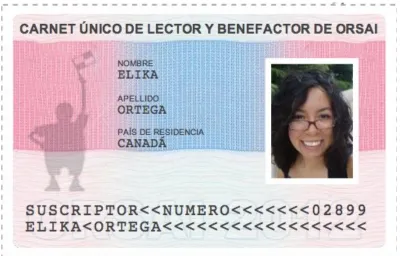
Figure 9 Orsai ID. ... 97
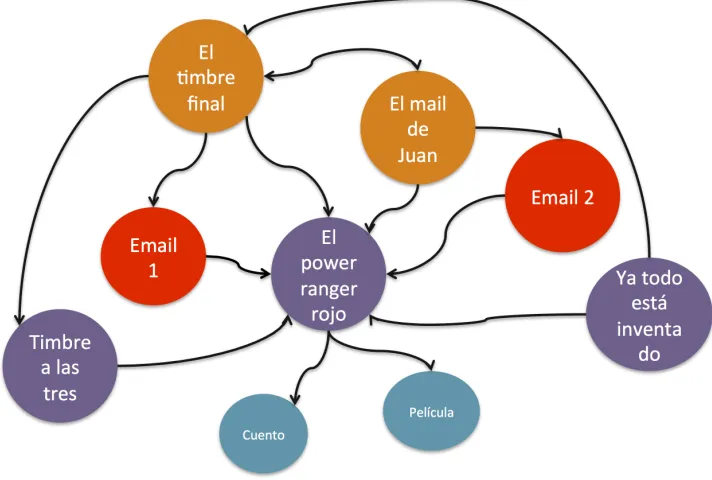
Figure 10 The network of Juan Sklar’s episode. ... 100
Figure 11 Casciari and Basilis the two authors of self-referential texts. ... 113
Figure 12 Self-referential texts in the Web Magazine. ... 114
Figure 13 Self-referential texts in PrintOrsai. ... 115
Figure 14 Self-referential texts in the three blogs. ... 116
Figure 15 Self-referential and non-self-referential genres. ... 118
Figure 16 Percentual distribution of self-referential genres. ... 119
Figure 17 Abstract model used to analyze the readers corpus of comments. ... 125
ix
Figure 19 The video made early in 2011 with readers’ pictures of Orsai. Courtesy of Hernán
Casciari ... 139
Figure 20 Total comments in all four media analyzed. ... 140
Figure 21 Totals of comments published in OrsaiBlog (2010-2012) ... 141
Figure 22 Total comments in OrsaiBlog in 2012. ... 142
Figure 23 Total comments in Redacción since it opened in 2012. ... 142
Figure 24 Total comments in OrsaiBar blog. ... 143
Figure 25 Total comments in the web magazine. ... 144
Figure 26 Latest comments published on OrsaiBlog. ... 146
Figure 27 Latest comments published on Redacción. ... 146
Figure 28 Latest comments published on OrsaiBar blog. ... 147
Figure 29 Latest comments published on each Web Magazine issue. ... 147
Figure 30 Two examples of +150 word comments. ... 150
Figure 31 Percentage of print and PDF copies distributed. ... 151
Figure 32 The complete distribution in time of reader comment activity. ... 153
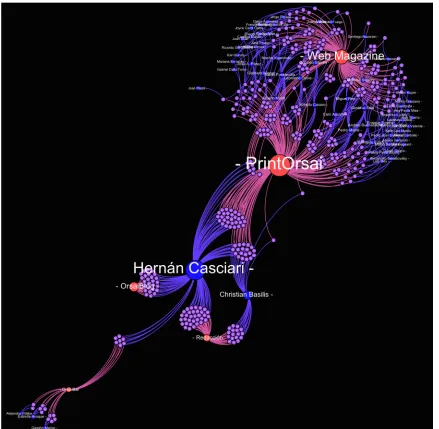
Figure 33 The entire Orsai network. ... 154
Figure 34 Frequency distribution of Gracias. ... 162
Figure 35 Frequency distribution of “Casciari”, “Chiri” and “Lector”. ... 163
Figure 36 Frequency distribution of “PRI”. ... 164
Figure 37 Reader co-occurrence in 50 posts. ... 167
x
Figure 39 Word cloud of most frequent content words in readers’ comments. ... 170
Figure 40 Frequency distribution of “Orsai”, “proyecto”, and “historia”. ... 171
Figure 41 Frequency distribution of “revista”, “blog”, “bar”, and “editorial”. ... 172
xi
Introduction
Long before I started studying literature in 2000 I used to ask myself the question How I could possibly be fooled by narrative fiction so easily? I’m surely not alone when I
remember (or perhaps it is better to say do not remember) entire days inhabiting other times and other places, other locations and other skins. The revolution brought about by the popularization of the Internet has had a similar effect of fascination on me. The World Wide Web has caused a paradoxical expansion and shrinking of the world and offered information and landscapes as distant in space and time as those found in fiction. Jointly, increasing access to the Internet and the explosion of fictional and other kinds of stories poured in it have changed the dynamics of narrative creation, publication, distribution and consumption. Questions about the puzzling effects narrative fiction has always had on readers, about the still perplexing potential of the Internet to foster similar experiences, and about the emerging ways in which they are coming together led me to this research project.
For a long time, I thought issues of narrative and fiction were about literature and reading. Doubtless, literary theory has provided a long tradition of the study of narrative and fictional components that cannot be underestimated. Nevertheless, I am now convinced that fiction and narrative are much broader categories aiding how we understand the world. In the last couple of decades, studies from a wide range of disciplines have turned to narrative as a way of explaining processes of identity formation and dealing with trauma (Psychology),
xii
Because of its object of study and its methodology, this thesis can be located within the field of Digital Humanities. Conceptually, this thesis rests on the postulate that human practices associated with narrative have moved to the digital sphere, and humanities scholars should follow suit. The study of a cultural object such as media convergence’s literary products and the readers’ interactions with them through online platforms is a result of the digital shift. Interstory, the proposed term for a recurrent narrative tendency, constitutes an instance of how literary products are being created, published, distributed, and consumed by audiences under the influence of digital culture and computer mediated communication. The move to digital media has made possible the study of reader interaction with a story. Up until now, the tradition of Reader Response Theory and adjacent approaches have been able to propose only theoretical models for the study of reading responses; conversely, the information found on Web 2.0 platforms such as blogs offers the possibility of studying actual readers’ responses. This work proposes a methodology to carry out such a study, but also to test the limits of the information we are capable of obtaining through these media. Methodologically, this thesis relies on the computation of data, both textual and paratextual, to observe the large-scale dynamics of the case study: Hernán Casciari’s and Christian Basili’s Orsai. The proposed approach owes much to Franco Moretti’s theorizations on distant reading, “where
distance… is a condition of knowledge: it allows you to focus on units that are much smaller or much larger than the text: devices, themes, tropes—or genres and systems” (par. 10). Finally, this study is also an exercise on collaboration – a tenet of Digital Humanities practices – and I have much to thank my colleague Javier de la Rosa who carried out a vast portion of the large-scale computational analysis.
xiii
time when literary production and publishing is under reconfiguration, but also the integration of a set of concepts and methodologies from different disciplines in order to account for the multiple dimensions of the object of study. In that way, the methodological approach has been built from the bottom up observing the features of the case study and then seeking to explain them from fitting perspectives. Ultimately, the purpose of this thesis is threefold: First, I propose a social-cognitive explanation for the pervasiveness of narrative in the digital age. Based on evolutionary studies of art and narrative, I argue that the urge to tell stories is intimately bound to sharing information and empathizing with others.
Consequently, narrative emerges out of social interaction at the same time that it fosters it. Because of their social characteristics, a large portion of digital media is facilitating the emergence of much narrative content. Second, to characterize narrative’s affective influence over readers throughout history as a form, and an antecedent, of what we have come to known as participation in our current media ecology. In that sense, I take the reader, not just as a person who reads written signs, but as someone involved in the recreation of a story regardless of what media is used to tell it. Finally, to suggest that these two points, sociality and reader affective involvement, are at the basis of the striking success of participatory media and the deep engagement narratives emerging out of them cultivates. Furthermore, the two seem to remain constant regardless of whatever technological developments are achieved at any given moment in history.
Five threads traverse this thesis: 1) The issue of narrative and fiction as human imperatives. Narrative constitutes a thought mechanism through which we construct worlds both actual and fictional – and everything in between. In this light, even when it has an aesthetic purpose narrative is not dependent of medium and can be rendered through oral narration, written language, film, photography, among others. 2) The sociality fostered by narrative. The construction of shared worlds provides a space to share information, to interact and to try out possible scenarios. Because of this, we are deeply emotionally and mentally affected by narrative and fiction. This again is not dependent on media, but a medium’s particular affordances might have an effect on how the interactions are carried out (face to face,
xiv
our cognitive architecture. As the result of a really long history of evolution and
development, our brains both limits and enables us, as Norman Holland puts it. With this in mind, new technologies, far from threatening narrative fiction and literature, provide new ways of creating and recreating them that cannot possibly obliterate past traditions. 4) In the context of media convergence, the proliferation of platforms, devices and other avenues to create, distribute and consume narrative are heightening and literalizing the worldmaking powers of fiction and narrative, making them immersive, not just mentally and emotionally, but even physically. 5) Finally, the actualization of narrative, the fact that stories are now commonly overflowing out of the pages and screens where we first access them, is responsible for a metafictional tendency. Metafiction was a concept first developed in the mid-twentieth century to describe fictions that were about fiction writing or fiction reading; or that were self-reflective of the fictional worlds created in them and of the book objects that contained them. I reelaborate Patricia Waugh’s proposition that metafiction is a narrative tendency not just on the side of fiction creation, but apropos new media, on the recreation and the experience of fiction. Because many narrative fictions are now being done on multiple interactive media, mental and textual reader participation now happens in an actual fashion. Interstory is a narrative instantiation of these five threads.
Interstory is a global narrative constituted of a network of story pieces published in different media and brought together by readers following the textual and media links laid out by an author or editor. I use global in this context, not as a geographical referent, but as a
demarcation of the scope of the world created by interstory. The global narrative – the world of the story – takes shape contingently out of the combinations, done by readers, of its smaller components. Interstory, thus, encompasses two levels of narration: one is the small story pieces; the other – the global narrative – is the readers’ sum of them. The cohesion of interstory depends both on a narrative apparatus and on readers’ behavior that explain our deep involvement with their narrated worlds and the sociality their stories foster. The
rendition of narrative in several media platforms and the construction of narrated worlds both mentally and literally make us actual participants in a story’s creation. I offer ample
xv
I begin Chapter 1 with a defense of the study of narrative and fiction in the digital context. I propose that far from dehumanizing us, digital technology is both a different instantiation of past, even ancient technologies, and a product brought about by our own human
development. It is, thus, also deeply ingrained in our brain architecture and our very
humanness. I touch upon the larger scale of narrative and fiction as part of our evolutionary history. Studies on the place of art and fiction have debated over their adaptive or non-adaptive character without reaching a conclusion. Nevertheless, all of the evidence gathered by the most prominent cultural-evolutionary thinkers (Steven Pinker, Richard Dawkins, Bryan Boyd, John Tooby and Leda Cosmides) points to the fact that narrative fiction is ubiquitous in all cultures, learned without instruction and a highly sociable and sought after activity. Much of the research on the evolutionary roots of fictional narrative has focused in its importance as simulation of possible scenarios – utopic thinking – and as practice to distinguish different levels of reality and sources of information. This process, known as metarepresentation in cognitive studies, is responsible for negotiating the source of others’ opinions and our take on it, for example, as well as events that happened in the past, plans that might be carried out in the future, who said what about whom, where and when, etc. Lisa Zunshine has described metarepresentation as the basic skill for fiction making, but it is also a navigation system for day-to-day social interactions.
The process of fiction making and the way we engage with it has been theorized, at least, since Samuel Taylor Coleridge advanced his theorization of “suspension of disbelief” in the nineteenth century. The idea has been theorized in many forms: transportation, confabulation, actualization, simulation, and entrancement, to mention only a few. In Chapter 1 I stop briefly at the most salient theorizations in order to characterize the deep emotional involvement that narrative is capable of arising. I conclude the first chapter with an
xvi
the closeness and vulnerability we feel towards fiction that make stories such an important part of our lives.
In chapter 2, I continue the ideas outlined above in the context of digital media and media convergence. The main purpose of this chapter is to translate the terms and concepts applicable to a general notion of narrative in human history to the particular context of the digital age. The transition of reading from book to digital media and extreme preconceived ideas about it, both positive and negative, are also surveyed. Once again, the goal is to view narrative produced in our times through various different media as a stage that
simultaneously continues and revolutionizes past traditions. From there, I move on to explore the two main concepts behind interstory: intermediality and media convergence.
Intermediality is presented as the complementary interrelation, transgression, intersection and interaction among media in a single work. Media convergence is also a form of media
amalgamation that takes into account the individual and social practices attached to particular instances.
From my discussion of intermediality and media convergence I advance a three-layer concept of medium that allows me to characterize interstory. Medium is presented as semiotic
material, the channel or technology of communication through which it is rendered and the set of practices associated with them. This concept accepts that interactions between media can occur at any of the three layers and, consequently, should lend itself to flexible
xvii
In chapter 3 I present the detailed definition of interstory based on the three-layer concept of medium outlined before. Each of its characteristics: global and narrative fragments, reader participation, multiple mediality, structure, self-reflexivity and metafictionality is to be elaborated in light of Hernán Casciari’s and Christian Basilis’ Orsai. Orsai is an undisputable product of media convergence and has grouped under the same narrative, three blogs, a print magazine, a publishing house and a bar. Casciari and Basilis are in charge of writing the majority of blog posts, but over a hundred guest authors have collaborated in the print magazine. A central argument of this chapter is that even though the print magazine is the anchor project, as a matter of fact, it is Orsai’s story, the account of its constant
developments that constitutes the most prominent narrative. Furthermore, I also suggest that the narrative of Orsai, and not the articles published in the magazine, is the focus of reader interest. Chapter 3 also sees the inclusion of results from computational analysis. Only network analysis is presented here to show the patterns of the network structure of Orsai’s narrative. This analysis shows the pervasiveness of several writing ‘genres’ that I have identified as self-referential, that is, those dealing with the inner workings of Orsai and, indeed, those in charge of keeping Orsai alive. Even though it is an actual project, Orsai is highly narrativized and fictionalized. Self-referential texts, present in all of the project’s media, keep the cohesion of the global narrative and characterize the overall metafictional tone of the project.
Chapter 4 is devoted to Orsai’s readers and the online community formed around the project. I initially describe the parameters of what constitutes a reader in the abstract model of the database, not as someone who reads Orsai, but someone who comments on any of the three blogs or the web magazine. From there I launch an exploration of the patterns of interaction that show different kinds of reader engagement as measured initially from the amount of comments left on each post in the four platforms that allow it. More refined analyses look into commentary depth, and the kind of content they carry, from the short congratulatory and thankful comments, to the much longer readers’ own literary production and critique.
xviii
indeed, the most attractive to readers. Self-referential texts as mentioned above are indeed those in charge of selling the project and promoting each new media development.
Consequently, actual involvement frequently required in these posts, like subscribing to the magazine or supporting its distribution, might be the reason why readers are also more responsive. Towards the end of Chapter 4, a targeted analysis of word frequency distribution is carried out with the objective of digging deeper into reader self-consciousness and it, indeed, shows that much of the exchanges going on in the comments sections of the blogs are about Orsai itself.
Because of digital media and the rapidly changing dynamics in our current media ecology, narratives will likely never be the same they were fifteen or twenty years ago. Nevertheless as I propose in this thesis, this does not mean that the narratives created in our times and taking advantage of computer mediated communications, participatory platforms as well as print materials are incapable of causing experiences analogous to those created on print media exclusively. I have no doubt that we are currently living a transitional time and that narrative manifestations like interstory are but another step in the long history of storytelling. Instances like Orsai, for as valuable and paradigm changing as they might be, will continue to be reconfigured. It is impossible to make predictions of what will happen next. Even a single project like Orsai tends to instability and rapid changes. A snapshot understanding of how narratives are being rendered at this precise moment, like this thesis, might shed light not only into what comes next, but also into what has come before. Ultimately, the success of
Chapter 1
1
On Fiction
Stories make us human. This axiomatic expression has been repeated so much and in so many and different contexts that it has stopped to make us wonder whether there is any truth behind it. I think there is. Nevertheless, for it to be true we have to think of “stories” together with, but separate from the medium that materializes them, be it a print book, an oral performance, or a film. Narrative fiction is not exclusive to books or to literature. Stories and different forms of fiction are everywhere: in planning and remembering, at play, and in conversation. Stories also happen all the time and, though we might not notice, we construct stories of ourselves, and out of every event, action, and even objects. We make sense and organize what goes on around us through stories. As a species we have learned to explain the world to ourselves through stories and continue to do so, perhaps even more urgently, in our rapid and confusing informational age. On this basis, I would like to establish the larger theoretical frame informing this study. I argue that the bases of narrative fiction remain the same in terms of our larger human history, cognition, evolution and social dynamics, even though they might now come in a digital, convergent or intermedial disguise.
The study of narrative fiction in the digital era, therefore, does need to take into account two aspects: that we are living a disruptive and radical shift in terms of means of
publication, writing, and reading apropos the popularization of the Internet; and that the human drive to share stories has its origin in our farther past and has been shaped by our evolved cognitive architecture. Although in many ways we are living through a digital revolution, the digital turn of the last few decades can be considered one among many revolutionary media and technological shifts shaping human history and, along with it, the history of narrative. The development of writing, paper, rolls, codex, and the movable type printing press are examples of media shifts. While all of these developments have had a larger impact on human development as Walter Ong argues in Orality and Literacy,
In this chapter, I bring together evolutionary studies, cognitive science, and literary theory with the purpose of elaborating an interdisciplinary conceptualization of story and fiction away from the more fixed idea of book and literature and closer to a mode of relating socially to others as well as to the world and the worlds in stories. The chapter is divided into five sections. In the first one I offer a defense of digitality and the study of narrative in the context of the debate surrounding “the posthuman”. Largely, this is also a defense of interdisciplinarity and the consilience of science and the humanities that seeks to offer the base approach to the whole thesis and contextualize the inclusion of insights coming from the natural sciences. Next, I survey the most salient evolutionary proposals regarding the fundamental place of fiction in our history as a species. Section three deals with the development of cognitive skills that make fiction possible and why we feel it as close to us as a live experience. In the fourth section I move on to explore ways in which readers become immersed in fictional narratives and learn to navigate the different worlds proposed by stories. Finally, the last section deals with metafiction as it has been
proposed in literary theory. I reelaborate its relevance as a literalization of all the underlying cognitive non-conscious processes that make fiction possible as well as the deep involvement of the reader with narrative.
specified, in most instances my use of story, narrative, and storytelling are synonymous – storytelling emphasizing the processual aspect of it. Fiction, however, is used as a
function or a quality of them. Similarly, I allow myself the use of reader in an flexible manner to refer to the individual re-creating a narrative regardless of its media.
1.1 A Defense Of The Digital In The Context Of Narrative
It is impossible to deny that we are in the midst of a media revolution. For a few decades now digital media has been exerting its influence in the way we communicate, shop, move around the streets, watch television, listen to the radio, read books, and create art and narratives. The rapid technological shifts we are witnessing in the twenty-first century might mislead us into believing that artistic creations mediated by computers are drifting away from our humanness and are, consequently, becoming less an expression of our human potential and more the result of technological obsession. It is also impossible to deny that art and narrative, literature among them too, are adapting to new platforms and adopting new materialities. Their relevance, however, is by no means at stake as they continue to thrive and we continue to be fascinated, involved, and stimulated by them. The ‘move’ of the human to an increasingly technologically mediated way of life has been the source of both rejection and cheerful reception and, from both extremes, proposed as a departure from old human constraints and values.
Post-humanism is a largely debated term and has been associated with many different schools sharing perhaps only one thing, the questioning and critique of what has
historically, especially since the Renaissance, been considered human. On the one hand, there have been the political expressions of this questioning as seen in, for example, Feminism and Post-Colonial Studies. On the other hand, most relevant to this study, technological post-humanism focuses on the interactions of the human and the
and new scientific discoveries shedding light on what constitutes humanity have been changing our ideas on the construction of subjectivity for some time now. Within the notion of post-humanism dealing with human-technology relations, there are two contesting attitudes towards the “posthuman”. In How We Became Posthuman (1999) Katherine Hayles characterizes them as fear and pleasure. On the side of fear is the apocalyptic idea of “‘post’ with its dual connotation of superseding the human and coming after it” (283). On the other hand, the attitude of pleasure poses the posthuman as “the exhilarating prospect of getting out of some of the old boxes and opening up new ways of thinking about what being human means” (285). Because they are distinctively human expressions, art and story are central to this debate. Their manifestations extend well beyond a particular period in human history and, as a consequence, provide an ideal arena to explore up to what extent expressions of humanness are contingent on available means. Nevertheless, the specific means used to render these expressions do not grant or take away their humanness. Narrative fiction, thus, should be studied as a human trait beyond cultures, time, and media and, in the face of our current technological shift, we should seek precisely to offer a new perspective on its longue durée features.
Underlying the negative attitudes towards the posthuman is the liberal humanistic point of view. Technological advances, especially since the second half of the twentieth century with the cyborg and other intelligent machines as its ultimate expression, have been tinted with a sense of negativity and conceptualized as prosthesis not only of the human body, but also of the mind. The implication is that the human can be transformed, transcended, and even eliminated by technological developments. Although many
technological objects such as networked mobile devices have become part of our daily lives, we are far from being transcended by technology. Furthermore, our current
understanding of embodied and extended cognition1 and cognitive architecture2 makes
1 Embodied and extended cognition are two interlinked notions that defy the widely held assumption that
this view obsolete and partial. By means of extended cognition we are capable of thinking through technology, but not exclusively in any particular way because of it. Moreover, extended cognition is not restricted to electronic or intelligent machines, but also takes place through simpler technologies like pencil and paper, books, mechanical tools, etc.
Still following Hayles, theorizations about the meeting of the mind with the body and of the individual with the environment have been gaining currency in recent decades. Far from threatening humanistic ideals or signaling the end of the human, these approaches lay the ground for thinking about the human from more thorough perspectives: mind is always supported by a body, and bodies are surrounded by an environment. The
posthuman, Hayles says, “does not really mean the end of humanity. It signals instead the end of a certain conception of the human, a conception that may have applied, at best, to that fraction of humanity who had the wealth, power, and leisure to conceptualize
themselves as autonomous beings exercising their will through individual agency and choice” (Posthuman 286, emphasis mine). New ways of thinking about the human that include the environment we inhabit with all its technological developments and our cognitive architecture hold the promise of shedding light on our conventional
understanding of, for example, story and literature and how they are both similar and very different.
Hayles’s theorization of the posthuman, based on the notion of the human as embodied being, leads her to draw on evolutionary biology to ground the argument that our current technological moment, as impressive as it might seem, is but a moment in our larger human history. “The body”, says Hayles, “is the net result of thousands of years of
2
sedimented evolutionary history, and it is naive to think that this history does not affect human behaviors at every level of thought and action” (284). The notion of the
posthuman proposed by this thread of post-humanism then is one grounded in its social, natural, and technological environments, in its particular time, and the result of a larger historical and evolutionary process. My discussion of the evolutionary and cognitive aspects of fiction draws from this premise.
At least since the development of language, story has had a ubiquitous presence throughout human history. Whatever phenomena may be developing in the age of information regarding narrative and fiction constitutes a new incarnation of other developments that were tackled and mediated differently in the recent and distant past. The fact that currently electronic media has become a powerful vehicle for stories by no means makes storytelling take a direction opposing the human. In digital media, we are still capable of experiencing fiction as closely as in other media, even if a computer or another device mediates our engagement with it. Stories persist in this age and time and are willfully adapted to the means of expression and communication newly available, just as it was to any other media available at other times in history. Though it is true that digital technologies bring about a radical change in the scope of human communication, it is undeniable that such technologies, at least when it comes to narrative and fiction, still respond to ancestral concerns and fill primeval voids. This feature points to a human need to narrate to others that has easily translated to digital media.
Veldt”. Still, extended identities online have laid the ground for new ways of relating to others. As a matter of fact, for the past decade or so, intelligent machines have been the medium facilitating new forms of human interaction as well as creative production, up to the point where, as David Ceccheto would say, “the signs of technological posthumanism have become so ubiquitous that we have ceased to take notice” (4). The seeming
naturalization of technology in our times should not be seen as a derease in our humannets, but taken as an indication that it does provide a fitting solution to a given shared problem whether it is storytelling or human communication. As Jonathan
Gottschall points out “[t]he virtual world is in important ways more authentically human than the real world. It gives us back community, a feeling of competence, and a sense of being an important person whom people depend on” (196). As paradoxical as it may seem, technologies mediating human interaction remain largely human and, I maintain, the pervasiveness of narratives and stories all over the Internet is proof of this. New networked media is a good fit for story, for its creation and, especially, for sharing it. Just like other technologies – print, film, television, radio or oral tradition – have fulfilled these purposes before, digital media is currently offering attractive and rather successful means of telling stories.
Although the perception of what constitutes human may be changing apropos digital media, storytelling in the networked age carries its “remains” (Badmington 12). These “remains” of the human, far from being just a hint of what it once was, are human constants, that which has persisted and made storytelling possible from its origins.
We Think (2012), Hayles builds upon the concept of coevolution between humans and technology. The first implication of this theorization is that humans have developed technology according to their current capacities and the surrounding environment; and the use of those technologies, in turn, has had a transformative power on human skills and the landscape we inhabit. The result of this is a constant loop developing new solutions for old problems in order to provide a fitter solution to a pressing issue; “attention is an essential component of technical changes… for it creates from a background of technical ensembles some aspect of their physical characteristics upon which to focus, thus bringing into existence a new materiality that then becomes the context for technological innovation” (103). As a consequence, the concepts of both humans and technological objects are, at any time in history, in constant construction, revision, and under challenge. Hayles proposes that technological objects are not fixed but exist within a “complex temporality” since they emerge out of a technical ensemble: the context including geographical, social, technological, political and economical forces in which any technical development is embedded (90). More importantly, this is not a static process; on the contrary, technological objects are “always on the move, towards new configurations, new milieu, and new kinds of technical ensembles” (89). Technical objects reach, as Adrian McKenzie calls it, a “metastability”, a provisional solution to a problem that had been temporarily solved in the past and will be temporarily solved again in the future, each time reconfiguring the technical ensemble leading to further
innovation but never fully leaving behind its predecessors. The “remains” are this way of stretching back to what humans have created in the past.
stories becomes most current when it maximizes its reach, involving as many participants as possible, building up a community around a story, and setting off a social dynamic that keeps the story alive. A similar claim is made by Gottschall regarding the ‘end of the novel’, but applicable to storytelling in general: “[w]e were creatures of story before we had novels, and we will be creatures of story if sawed-off attention spans or technological advances render the novel obsolete. Story evolves, like a biological organism, it
continuously adapts itself to the demands of its environment” (180). Having so many different options, it should seem more evident in our time than ever before that the demands of the environment are not just dictated by the availability of technologies, but more than anything else by people’s choices, which they adopt and develop for narrative and other purposes alike. In the past, similar technological shifts have been mistakenly viewed as opposing extremes of the equation: oral tradition and written language, either manuscript or print, were for too long considered opposing technologies (Ong 10-12) when, in fact, they coexisted for many centuries complementing each other. Even though my work in this thesis does not directly address the debate of the “end of the book”, I do want to propose, first, that networked digital technologies are fulfilling the need to create, share, and keep stories alive quite efficiently at the moment, perhaps at a scale we had never seen before; and, second, that this, more than the disappearance of older
storytelling media, implies an addition to the collection.
1.2 The Evolution Of Story And Fiction
The discussion on narrative and the technologies through which we have created and re-created it over our whole human history begets other questions: What is narrative for? Why does it matter? And how has it evolved in consideration to technological
developments? As outlined by Brian Boyd in his ambitious The Origin of Storytelling
practices of storytelling are so widespread in all cultures speaks of the deep roots it has in our biology, our cognitive processes and basic social dynamics. In their article “Does Beauty Build Adapted Minds? Towards and Evolutionary Theory of Aesthetics, Fiction and the Arts”, John Tooby and Leda Cosmides launch their exploration of aesthetics, fiction and evolutionary psychology acknowledging that “involvement in fictional, imagined worlds appears to be a cross-culturally universal, species-typical phenomenon” (7). Although it is impossible to talk about the function of story, we can see some of the functions it has had throughout history, and as I suggest later in this chapter, the existence of certain story types like metafiction.
Evolutionary studies have seen fiction as a fundamental human trait. This
notwithstanding, the fact that it “appears to be an intrinsically rewarding activity, without
apparent utilitarian payoff” (Tooby and Cosmides, “Minds,” 8 emphasis mine) makes fiction resistant to a straightforward Darwinian explanation. Moreover, the fact that story is so ubiquitous, and naturally acquired makes it even more puzzling for evolutionists. The place of fiction and other imaginative manifestations have occupied a central place in evolutionary studies as expressions of the human mind and its behavioral manifestations. In literary studies, however, this approach has not been as easily incorporated. Following Brian Boyd, I believe that a biocultural approach to literature constitutes an “extensive” way of explaining the existence of art and, more specifically, fiction, an approach that goes beyond the historical circumstances of any given creative endeavor. Echoing the idea of post humanism elaborated before, this approach is bound to offer new
conceptualizations of literature as part of the longer human imperative to narrate that has been shaped and reshaped by the developments of our mind as much as by technological ones.
An important clarification that must accompany this approach is the fact that an
23). Similarly, Norman Holland in his anthological Literature and the Brain, sustains: “our biology both enables us and limits us. Our brains are part of that biology, and our brains enable us to create and re-create literature” (4). Along the same line, in
Experiencing Narrative Worlds, Richard Gerrig assures that “all a reader must do to be transported to a narrative world is to have in place the repertory of cognitive processes that is otherwise required for everyday experience” (239). Along with them, I argue that our evolutionary history and cognitive architecture are the large-scale canvas where individual creative potential is realized.
A biocultural approach constitutes a rather radical change in the way we have looked at particular instantiations of narrative, more concretely literature, as the product of an individual genius, to become a manifestation of human nature coming out of our minds shaped by evolution and our ancestral way of relating to others as much as from our cultural history. Then again, this approach does not disregard the practice of focused, close reading literary criticism as we know it. In her introduction to A Biocultural Approach to Literary Theory and Interpretation (2012), Nancy Easterlin proposes a practice of biocultural theory and interpretation that “combin[es] cultural, historical and literary analysis within a cognitive-evolutionary framework” (x). Just as I have argued before, a biocultural approach too offers an exciting opportunity to see old problems in a new light and in a larger scale that allows us to carry out particularized analysis of specific texts through a different frame.
elicits by “picking the locks” or using other cognitive adaptations in a “test mode”. To support his theory:
Pinker sketched out how many well-known features of the visual arts, music, and literature, take advantage of design features of the mind that were targets of selection not because they caused enjoyment of the arts, but because they solved other adaptive problems such as interpreting visual arrays, understanding language or negotiating the social world. (Tooby and Cosmides, “Minds,” 11 emphasis mine)
The interesting implication of the byproduct theory is that more than equipped to create and recreate art and fiction, humans are vulnerable to it. This is, however, one of the most recurrent reasons why Pinker’s theory continues to be questioned and reelaborated time and again. Within the reigning evolutionary functionalist logic, art involvement is resource expensive, which would make it detrimental to survival and, as a consequence, disappear through millennia of natural selection. Still, the cheesecake theory does not go against positing fiction as a deeply human trait.
Although largely taken as the default one, Pinker’s theory has not been totally
satisfactory for evolutionary scientists who see the universality of storytelling as a token of its origins as a functional adaptation. Tooby and Cosmides assert that “the human mind is permeated by an additional layer of adaptations that were selected to involve humans in aesthetic experience and imagined worlds, even though these activities
superficially appear to be nonfunctional and even extravagantly nonutilitarian” (“Minds,” 11). Brian Boyd shares this view and has heavily contested Pinker’s view by pointing out that the cheesecake metaphor applies, only partly, to the consumption, but not the
production of art, which requires the investment of many more resources than just its enjoyment. “If”, Boyd states, “art involved no benefit, if it only mimicked biological advantage… by delivering unearned pleasure, yet it had high costs in time, energy, and resources, then a predisposition to art would be a weakness that would long ago have been weeded out by the intensity of evolutionary competition” (Origin 83). Furthermore, Boyd defends the adaptive character of fiction building on the fact that a "sign of
make inferences that far outstrip evidence" (Origin 189).
Although the fundamental adaptive function of fiction is still under debate it has become accepted that story is at the heart of our humanity and that our attraction to fiction separates us from all other species. Story also has a social and even documentary relevance, and that makes it “the great repository of our detailed knowledge of human nature in the past. It will be illuminated by, and it will illuminate, our knowledge of an even deeper past” (Boyd, Origin 41). Concerns about the demise of literature in the digital age weaken in light of this, since media – in this or any other time in history – do not seem determinant for the existence of story. As we well know, “before these
technologies [film, television, internet] existed, novels and stories were hungrily consumed by large proportions of the literate population [and] among hunter-gatherers, stories are commonly told around the fire” (Tooby and Cosmides, “Minds,” 8). Story has evolved and changed according to other human developments. The digital turn might be a revolution but it is also another point in our evolutionary, cognitive, technological, and storytelling histories.
My proposal on the creation, distribution and reception of fiction in digital media, stems from and is an addition to both the technogenesis and the biocultural approaches. On the one hand, this work relies on the widely accepted notion that fiction constitutes a creation and recreation, through diverse cognitive processes, of a world different from, yet very close to, our own. Added to this is the fact that digital networked media provides distinct possibilities for the creation of other worlds and thus affect the materiality of story and the way we engage with it. On the other hand, the worldwide reach of digital media is also revolutionizing the function of literature as a social instrument in as much as it favors the creation of communities and social interaction never seen until now. In fact, although there is still much suspicion towards new technologies, I propose that the place of storytelling in our digital age remains largely the same it has been throughout our evolutionary history. As Gottschall would put it, “stories give us pleasure and instruction. They simulate worlds so we can live better in this one. They help bind us into
most basic sense, but it does mean that digital media shifts will be reshaping the ways in which we build fictional worlds and how we come to inhabit them.
1.3 The Cognition of Narrative and Fiction
Another set of questions originating from this approach to narrative and fiction is how exactly do we get so deeply engaged in narrative and why such engagement is so pervasive throughout human cultures. Because I largely deal with metafiction in this thesis, the answers to the latter question will have an emphasis on the capacity for creating worlds other than our ‘real’ one in which we project ourselves and participate in various degrees. Up to now, several approaches have been made to the issue of
fictionalization mostly from psychology and neuroscience and cognitive science, and an array of mechanisms of how this occurs have been proposed: metarepresentation,
blending, world-making, theory of mind, simulation model, among others. They all share a basic outlook: the fact that it is the same mind dealing with everyday ‘real’ information that produces fiction and story.
According to Lisa Zunshine, all of the processes involved in storytelling are carried out unconsciously because they are part of our “evolved cognitive architecture” (Introduction
Cognitive psychology and linguistics have developed parallel to evolutionary studies focused on art and storytelling, and have also shed much light on these problems. In literary studies, psychoanalytic approaches were common before that, but as Isabel Jaén explains, it was not until the 1990’s when the interdisciplinary work produced
“reconnect[ed] the human mind with its biology and environment” (2). In the early 1990's, the work of Reuven Tsur was, no doubt, instrumental in outlining the concerns and premises of the budding interdisciplinary field. The first concern was how cognitive-literary approaches were to “illuminate literature rather than use works of literature to illustrate cognitive theories” (1), that is, how cognitive-literary studies were to maintain their literary focus. Tsur’s approach in Towards a Theory of Cognitive Poetics (1992) rested on the fact that the processes at work in the reception of literature – his work focuses on poetry – are not only led by cognitive mechanisms but also by aesthetic ones. A parallel endeavor, Mark Turner’s Reading Mind (1991) advocated for the study of literature based on language as a product of the human mind. For him, the focus should be on “how the embodied human mind uses its ordinary conceptual capacities to
perform… acts of language and literature (6). Similar to Tsur’s, Turner’s initial approach to literature relied mostly on cognitive linguistics and its most salient concepts such as mental spaces, schemas, categorization, blending, and metaphor and metonymy.
was still very much prejudiced by the idea of ‘high’ literature. This fact may have prevented him from seeing all the parallels with less ‘refined’ forms of verbal
expressions. Turner, on the other hand, even at a time when fMRI and other technologies were not fully developed or applied to research on reading and fiction making, was able to intuit the universality and pervasiveness of the kind of discourse and cognitive processes out of which both everyday utterances and narrative fiction are made.
It is very telling that from different fields, like intuitions have been proposed regarding the creation of fictional worlds and our involvement with them. The fact that comparable insights have emerged from both evolutionary and cognitive studies only strengthens the case for the unbreakable bond between our deepest mental processes and the production of fiction. An evolutionary and cognitive understanding of literature and fiction should help us understand not only the mechanisms at play when engaging in a story. In my view it should also offer insights for us to understand the pervasiveness of certain story types like the buildungsroman, heroic narratives, the utopian story, and metafiction. Gottschall refers to this as the “problem structure” and refers to the fact that fiction is, necessarily, full of conflict. There is no story without conflict, and interestingly, fiction has always been like this and continues to be so in our age of reality television and blog ‘hoaxes’. “The problem structure reveals a major function of storytelling. It suggests that the human mind was shaped for story, so that it could be shaped by story” (Gottschall 56). Fiction in this view is a simulation of life conflict and provides scenarios on which to test our minds to deal with them.
however, the narrative scope of simulation does not end there:
literary narratives are related to simulation [because] stories model and abstract the human social world. Like other simulations (e.g., computer models), fictional stories are informative in that they allow for prediction and explanation while revealing the underlying processes of what is being modeled (in this case, social relations). Understanding stories as
simulations can help explain why they provide a special kind of
experience. The abstraction performed by fictional stories demands that readers and others project themselves into the represented events. The function of fiction can thus be seen to include the recording, abstraction, and communication of complex social information in a manner that offers personal enactments of experience, rendering it more comprehensible than usual. Narrative fiction models life, comments on life, and helps us to understand life in terms of how human intentions bear upon it. (173)
The simulation approach to fiction can offer an interesting look at what has commonly been referred to as a genre: metafiction. Metafiction, I want to advance, is a kind of fiction that deals with fiction itself. Among others, the one outstanding characteristic of metafiction is that it oscillates between the world of the fiction and that of the reader. Metafiction points in the direction of the place of a story in the real world and the involvement of a real reader with it. It can be argued that metafiction fulfills a didactic function where we can try momentarily the implications of getting too involved, or even fooled by fiction – or in the real world by false information. I propose that the “conflict”, in Gottschall’s terms, in metafictional stories is the very process of fictionalization on both the part of the author and the reader, i.e. the creation of a narrated world where they both can interact over the ‘pretext’ of a story. The gap between the fictional world and the real world posited by all fiction – and made even more explicit in metafiction – is too a concern of evolutionary literary studies.
fictional ones because it leads to adequate action in the environment. Nevertheless, fictional and other imaginative sorts of information have not only kept their place through centuries, but also continue to occupy a very prominent position in our daily lives
regardless of the most current medium at any given time. Both Boyd and Tooby and Cosmides agree that people have a preference for fictional narratives, which proves wrong the apparently more logical attraction to true information. In fact, still in our so-called information age, people are usually more drawn to fictional rather than true stories (Boyd Origin 130). And indeed despite all the factual information found on the Internet, it remains largely an entertainment channel. In general, a distinction of our species is that people, Tooby and Cosmides argue, “remain intensely interested in communications that are explicitly marked as false” (“Minds,” 12). The issue arising out of this is precisely the process through which we distinguish ‘true’ from ‘false’ and everything in between, how we learn to do it, and whether or not we engage differently with each one.
1.4 Fictional Involvement
The involvement of a reader with a work of literature has always been a concern of literary theory though in different degrees depending on a given period. For a long time, the emphasis was put largely on the author as the source of a story and its ultimate explanation. This view was dramatically contested in Roland Barthes’ “The Death of the Author” (1968), and more steadily since the advent of Reader Response Theory and the cognitive turn in literary studies. Still, in literary history, the foundational referent of reader involvement is, perhaps, Samuel Taylor Coleridge’s “willing suspension of disbelief”. Coleridge’s proposition, specifically intended for the supernatural and
fantastic elements of his own work, has turned into a basis for thinking about the reading process and the standing of fiction in the real world. Richard Gerrig has worked
and nonsuspension of disbelief” (Holland, Brain 64). Interestingly, however, it is undeniable that Coleridge imagined a picture of an active reader. A completely passive take on the act of reading would imply a reader who is malleable and completely vulnerable to the author’s most eccentric whims; it would not require the reader to willingly suspend her disbelief. Even if Coleridge's idea of willingness suggested a much more conscious process of fictional involvement than it actually is, at its foundation, he seems to be imagining an active reader, one who is bringing some of her own background and expectations into the literary work.
Research focusing on the mechanisms making the sifting of true and fictional information has undoubtedly confirmed that there is much overlapping between the two and that their supposedly ontological divide is culturally constructed. Studies on memory, lie-blindness, counterfactuality, and confabulation have been instrumental for this conclusion. Memory studies suggest that over time even true information becomes inexact and is interfered with other data. Flashbulb memory research, for example, convincingly shows the effect of time on altering memories and suggested that memory is but a reconstruction of actual events (Gottschal 162-169). Lie-blindness, largely studied by Daniel T. Gilbert, is
proposed as the automatic acceptance of everything we perceive, which we come to doubt only on second thought. Norman Holland cites Natalie Angier summarizing this field of research:
In more than 100 studies, researchers have asked participants questions like, Is the person on the videotape lying or telling the truth? Subjects guess correctly about 54 percent of the time, which is barely better than they'd do by flipping a coin. Our lie blindness suggests to some
researchers a human desire to be deceived, a preference for the stylishly accoutered fable over the naked truth. (Brain 62)
daydreaming and utopic thinking, and it resembles Pinker’s idea that products of the imagination serve as a testing tool for possible scenarios. In any case, it is the mechanism through which we blend what is and what is not. Counterfactuality is the world of
possibility. Because it opens up the here-and-now to potential worlds, counterfactuality also helps distinguish true from false information, i.e. what the knowable information is and what potential instantiations it might take. As a result, counterfactuality also aids establishing links between reality levels.
Finally, confabulation is our capacity to fill in the blanks when events seem
unexplainable because of our lack of crucial information equally in life as in fiction. This skill is also commonly used by all of us to make excuses, even pathologically in
individuals with brain damage (Holland, Brain 71). For Gottschall, confabulation is our very own storytelling mind that provides retrospective complex explanations and stories out of only a few cues and "allows us to experience our lives as coherent, orderly, and meaningful" (102). The other side of confabulation is that "it is allergic to uncertainty, randomness, and coincidence…. If the storytelling mind cannot find meaningful patterns in the world, it will try to impose them” (103). It is possible to argue that confabulation, just like memory and lie blindness, boosts our craving for stories and may actually have a fictionalizing effect on true stories, rendering them, using Gottschall's word, "truthy" (103).
Memoirs, historical films and novels, biographies, autobiographies and, more recently, blogs and reality television fall right into the “truthy” category. Stories that have a ‘true’ account underlying them manifest how brittle the boundary between real and fictional information is, but they also take advantage of it because it is easier to believe
unquestionably a story when we know it to be true than when we know it is the product of someone’s imagination. Our involvement with them as an ‘all-true’ account speaks of our tendency to accept information. That a story be true or not does not affect the level of involvement we might experience through fiction. “Although fiction seems to be
confabulator in all of us. Since childhood, through play we fictionalize real happenings and believe, create, and even experience, fictional ones as though they were real. When we face a story and make sense of it through all these mechanisms we are carrying out a highly active pursuit without noticing it.
Ever since the publication of Wolfgang Iser’s The Act of Reading (1978), and the surrounding Reader Response Theories, it has been widely accepted that the text as an object is only realized when a reader engages with it. Readings, therefore, are not static because they depend on an actual reader bringing her background and horizon of expectations into the realization of the text. For Peter Stockwell, texts are artifacts, but “readings” are “natural objects” that change and evolve as they are carried out (2). The idea of a negotiation between reader and text was planted on phenomenological
approaches when most of the non-conscious cognitive processes undergoing the act of reading and story recreation were unknown. Norman Holland having a strong background on Reader Response Theory has bridged gaps like this between approaches. The text, for Holland, is part of the world and because “we cannot know the world as such, [and] we know it only through our own senses with all their various biases and peculiarities” there is no possible access to the story or the poem “free from the activities of [our] brains and sense organs” (Brain 34). Furthermore, Holland also proposes a sort of blending process in reading: “a poem, a story, a play, or a movie occurs somehow between us and the world around us” (38).
space that reader involvement and adjacent phenomena like “entrancement” and “transportation” take place.
“Entrancement” is a kind of experience awakened by narrative and fiction and is
characterized by Victor Nell as the moment when “we not only cease to be aware of self and environment, we begin to believe, to feel as real, the imaginary worlds of literatures” (Holland, Brain 58). For Holland, “getting lost”, transported, in a work of literature means the collapse of a boundary between us and the work of art:
We project the work outward from ourselves when our brains
automatically translate sensations within our bodies outward into a three-dimensional text independent of our bodies. We also project into that literary work “out there”….We fill in gaps in a story. We infer the inner thoughts of characters or the parts of an environment that we cannot see.
We also merge in the other direction, however. We introject. We take in what we take to be the text’s portrayals, so that what is “out there” in the literary work feels as though it were happening “in here” in your mind or mine. (Brain 42-43)
Similarly, Gerrig proposes two mechanisms by means of which reading immersion happens: transportation – “a moving away from the immediate physical environment and relocating oneself in the fictional world”; and performance – “the activity of participating in the fictional world like an actor on a stage” (Ryan, “Electronic Age,” 129) tapping into their own extratextual experience and giving substance to the fictional world. The idea of performance is also recurring in phenomenology, according to Iser, “literary texts initiate ‘performances’ of meaning rather than actually formulating meaning themselves” (27). The underlying reason why we are so easily involved in narrative fiction has been proposed by Tooby and Cosmides as an overlap between fictional worlds and our own:
although fiction often embeds real facts, places, events, and people, they are not necessarily or even usually marked off from the nonexistent ‘facts’… within a fictional narrative, everything (whether true in reality or not) has the same undiscriminated and largely indiscriminable standing, and all proposition are freely interwoven without the least regard to their extrinsic accuracy. (“Minds,” 13)
with narratives, but it is also a consequence of how we learn to construct stories.
Another explanation of the ease with which we become involved in stories has been to characterize fiction as an adult extension of childhood’s pretend play. Cognitive play has been an essential concept to understand the evolutionary value of storytelling and is, most likely, a solid explanation why fiction has never stopped being a central activity in all cultures. Pretend play is a symbolic kind of cognitive play. Full of stories – and thus as Gotschall would have it, conflict – pretend play can be knit into the discussion of human craving for fiction because it constitutes one of our first attempts at creating stories of our own, about us, and about the issues in our surrounding environment. Pretend play is, according to Tooby and Cosmides, a “specialized cognitive machinery that allows us to enter and participate in imagined worlds” (“Minds,” 9 emphasis mine). In general terms, cognitive play is rehearsal for real life. Jonathan Gotschall summarizes the work done on play: “pretend play is for something. It has biological functions….The most common view of play across species is that it helps youngsters rehearse for adult life. From this perspective, children at play are training their bodies and brains for the challenges of adulthood — they are building social and emotional intelligence” (41). Stories, as pretend play, are simulations and practice for real life. Echoing Mar and Oately, Gottschall sustains: “fiction allows our brains to practice reacting to the kinds of challenges that are, and always were, most crucial to our success as a species” (67).