Scholarship@Western
Scholarship@Western
Electronic Thesis and Dissertation Repository
9-24-2014 12:00 AM
Self-Referential Processing: An Investigation of the Mediating
Self-Referential Processing: An Investigation of the Mediating
Role of Alpha Power
Role of Alpha Power
Tanaz Javan
The University of Western Ontario
Supervisor Dr.Paul Frewen
The University of Western Ontario
Graduate Program in Neuroscience
A thesis submitted in partial fulfillment of the requirements for the degree in Master of Science © Tanaz Javan 2014
Follow this and additional works at: https://ir.lib.uwo.ca/etd
Part of the Biological Psychology Commons, and the Clinical Psychology Commons
Recommended Citation Recommended Citation
Javan, Tanaz, "Self-Referential Processing: An Investigation of the Mediating Role of Alpha Power" (2014). Electronic Thesis and Dissertation Repository. 2447.
https://ir.lib.uwo.ca/etd/2447
This Dissertation/Thesis is brought to you for free and open access by Scholarship@Western. It has been accepted for inclusion in Electronic Thesis and Dissertation Repository by an authorized administrator of
i
SELF-REFERENTIAL PROCESSING: AN INVESTIGATION OF THE MEDIATING ROLE OF ALPHA POWER
by
Tanaz Javan
Graduate Program in Neuroscience
A thesis submitted in partial fulfillment of the requirements for the degree of
Master of Science
The School of Graduate and Postdoctoral Studies The University of Western Ontario
London, Ontario, Canada
ii
Abstract
The EEG correlates of valenced self- and other-referential processing (SRP-ORP) are relatively little understood. This study examined the immediate effects of mindfulness meditation (MM) and EEG alpha neurofeedback (NFB) on resting state EEG alpha amplitudes and alpha event related (de-)synchronization (ERD/S) during an experimental implicit and explicit SRP-ORP task. Undergraduate students (n = 93) were randomized to a single session of MM, NFB alpha synchronization training (“alpha-up”), NFB alpha desynchronization training (“alpha-down”), or sham (placebo control) NFB before completing the Visual-Verbal Self-Other Referential
Processing Task (VV-SORP-T). A reduction in resting-state alpha power over posterior cortex was observed across groups relative to pre-treatment baseline, with no differential effects observed between groups. During both SRP and ORP, however, less negative affect (NA) was experienced by participants in the alpha-down group. Alpha ERD was highest during negative ORP relative to other task conditions across groups, with the alpha-down group trending toward showing increased ERD across all conditions of the VV-SORP-T relative to the alpha-up group. Study limitations and future research directions are discussed.
Keywords
iii
Co-Authorship Statement
iv
Acknowledgements
I would like to thank my supervisor Dr. Paul Frewen for his support and guidance. Paul, thank you so much for being a great listener when times seemed to get rough, and for helping me journey through the graduate school. Thanks for teaching me how to navigate my path through the labyrinth of research when everything appeared confusing and difficult. And finally thanks for believing in me and my abilities. I would like to thank my committee members- Dr.Derek Mitchell, Dr. Marc Joanisse, Dr.Brian Corneil, Dr. Stefan Everling and Dr. Susanne Schimd, for their support and guidance during this process. I would like to thank my examiners- Dr. Ruth Lanius, Dr. Ross Norman and Dr. Elizabeth Finger for their interest in my thesis and their
valuable insights. Ruth, thank you so much for your encouragement and support. To the Western University Neuroscience Department, thank you for giving me a chance.
I would like to thank my adopted brother and my lab partner Teddy Chow. Teddy, I started this path waiting to be challenged with the difficulties that are part of this journey but I had never expected to find such a great companion, a brother whom I could rely on the most. I can’t emphasize enough how much your friendship means to me and I am grateful that I have found a lifelong little brother whose shoulders are always ready for me to rely on; thank you buddy.
I would like to thank my friends, Kristibeth Kelly, Maryam Damghani, and Ruby Hiemstra. Thank you all for believing in me, for encouraging me and for being great listeners when I needed you. Finally, I would like to thank my family and friends here and in Iran, my sister Sanaz Javan. Little sister, we have gone through a lot of difficulties, this too shall pass.
Finally I would like to thank my mother, Shahnaz Hemmaty. Mom, it is almost impossible to find words suitable to describe the depth of my gratitude for having you in my life. This journey would not have come to an end without you and your help. You mom, a courageous Kurdish woman, have taught me to stay resilient, to rely on myself, and to believe in myself. The lessons that I have learned from you to this point of my life have enabled me to stand tall in difficult situations and to stay hopeful when everything seems dark and unbearable. Thank you mom.
v
Table of Contents
Abstract...ii
Co-Authorship Statement...iii
Acknowledgments...iv
Table of Content...v
List of Tables...x
List of Figures...xi
List of Abbreviations. ...xii
1 Introduction...1
1.1 Explicit/Direct Measures of Self-Referential Processing...2
1.1.1 Implicit/Indirect Measures of Self-Referential Processing...3
1.2 Visual-Verbal Self-Other Referential Processing Task...7
1.3 Cognitive-Affective Neuroscience of Self-Referential Processing...8
1.3.1 FMRI Studies of Self-Referential Processing...9
1.3.1.1 Verbal SRP: Adjective Rating Tasks...9
vi
1.4 EEG Studies of Self-Referential Processing...13
1.4.1 Cognitive Neuroscience of EEG Alpha Rhythm...13
1.4.2 Event-related Potential Studies of Self-Referential Processing...15
1.4.3 Event-related Oscillations Studies of Self-Referential Processing...17
1.4.4 EEG Resting State Studies of Self-Referential Processing...18
1.5 Experimental Manipulation of Referential Processing through Self-Regulation of the EEG Alpha Rhythm...20
1.6 Study Overview and Hypotheses...23
Chapter 2...24
2 Methods...24
2.1 Participants...24
2.2 Ethics Approval and Informed Consent...26
2.3 Self-Report Measures...26
2.3.1 Depression Anxiety Stress Scale...26
2.3.2 Profile of Mood States...26
2.4 Experimental Manipulation...27
2.4.1 EEG-Alpha Neurofeedback...27
vii
2.4.3 Mindfulness Meditation...28
2.5 Cognitive Task...28
2.5.1 Visual Verbal Self/Other-Referential Processing Tasks...28
2.6 Electrophysiological Measures...31
2.6.1 EEG Recording and processing...31
2.6.2 Event-related Desynchronization...32
2.6.3 Spectral Analysis for Continuous EEG at Baseline...32
2.6.4 Event Related Desynchronization Analysis during VV-SORP-T...33
2.7 Procedures...35
2.8 Statistical Analyses...35
2.8.1 Self-reports scales...35
2.8.2 EEG-Alpha amplitude during continuous EEG baselines...36
2.8.3 Behavioural VV-SORP-T and ERD during task...36
Chapter 3...37
3 Results...37
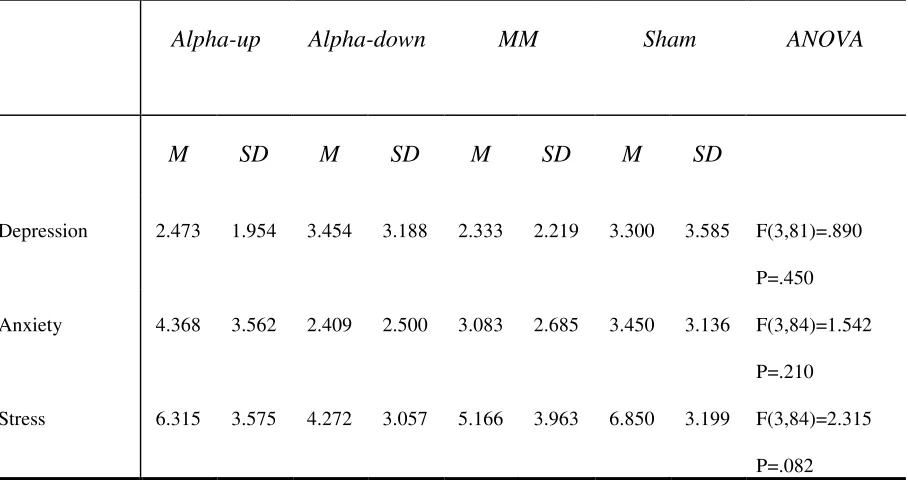
3.1 Self-reported Prior Week Depression, Anxiety, and Stress...37
viii
3.3 EEG Baselines Before versus After Experimental Manipulations...40
3.4 Visual-Verbal Self-Other Referential Processing Task...42
3.4.1 Self-report and Behavioural Performance of the VV-SORP-T...42
3.4.2 Event-related Desynchronization in response to the VV-SORP-T...45
3.5 Correlations between Self-report and Behavioural Performance and Event-related Desynchronization in response to the VV-SORP-T...49
Chapter 4...50
4 Discussion...50
4.1 Effects of Mindfulness Meditation and Neurofeedback on EEG Alpha Amplitude and Self-reported Mood State...51
4.2 VV-SORP-T: Psychological Outcomes...52
4.3 VV-SORP-T: Effects for EEG Alpha Event-related (De) Synchronization (ERD/S)...53
4.4 VV-SORP-T: Effects for Brief Mindfulness Meditation and Neurofeedback Interventions...54
4.5 Limitations and Future Directions...55
4.6 Conclusion...57
ix
x
List of Tables
Table Description
1. Descriptive statistics of Self-Reported Depression, Anxiety, and Stress (DASS)...37
2. Descriptive statistics of Mood Scale (POMS) After Experimental Manipulations...39
3. Descriptive statistics of EEG Alpha Amplitude (8-12 Hz) pre-post experimental
manipulations...41
4. Descriptive statistics and paired comparisons between conditions of the Visual-Verbal
Self/Other-Referential Processing Task...43
xi
List of Figures
Figure Description
1. Illustration of the number of participants retained...25
2. Illustration of one block of the Visual-Verbal Self/Other-Referential Processing Task...31
3. Display of the topography of EEG recorded electrodes positions...34
xii
List of Abbreviations
Abbreviations Meaning Page
SRP EEG FMRI VV-SORP-T RT IAT SELF NEGTATIVE SELF POSITIVE OTHER NEGATIVE OTHER POSITIVE ORP CMS OMPFC ACC DMPFC PCC RSC VACC RTPJ RTMS MIFG ERP ERS ERD MM NFB DASS POMS Self-Referential Processing Electroencephalograph
Functional magnetic resonance imaging Visual-Verbal Self-Other Referential Processing Task
Reaction Time
Implicit Association Test S-N
S-P O-N O-P
Other-Referential Processing Cortical Midline Structures Orbital Medial Prefrontal Cortex Anterior Cingulate cortex Dorsomedial Prefrontal Cortex Posterior Cingulate Cortex Retrosplenial Cortex
Ventral Anterior Cingulate Cortex Temporoparietal Junction
Repetitive Transcranial Magnetic Stimulation Middle Inferior Frontal Gyrus
Event Related potential Event Related Synchronization Event Related Desynchronization Mindfulness Meditation
Neurofeedback
Depression Anxiety Stress Scale Profile of Mood States
1
Introduction
I cannot totally grasp all that I am… For that darkness is lamentable in which the possibilities
in me are hidden from myself: so that my mind, questioning itself upon its own powers, feels
that it cannot rightly trust its own report. St. Augustine, Confessions
An understanding of the underlying nature of the “self” has been one of the chief goals of philosophy and psychology since the advent of each discipline. For present purposes, suffice it to say that what exactly the self is, or how it is defined, however, remains a matter of continuing
debate. As but one influential example, William James categorized self as physical self (our body, immediate family, property), social self (favourably noticed by our kind), spiritual self (
our consciousness, our moral sense) and the pure ego. In thesis, the term self will be similarly taken, as in lay usage, to refer each to a person's ego (or the means through which he or she consciously experiences the world) and his or her physical constitution. However, the present research primarily concerns the attributes by which an individual characterizes him or herself, in positive and negative terms, or those by which he or she would be described by others (i.e., his or her identity, e.g., his or her likes vs. dislikes, involved roles, personality traits, etc., and his or her
self-esteem, i.e., whether such attributes are considered favorably or unfavorably).
More recently, the study of self-referential processing (SRP) has also become a subject of inquiry within cognitive neuroscience. This master’s thesis considers the measurement of
individual differences in SRP from both cognitive-experiential and cognitive-neuroscience
perspectives. I will first review common methods used within psychology for measuring SRP, introducing the particular merits of a recently developed Visual-Verbal Self-Other Referential
Processing Task (VV-SORP-T) as an experimental approach intended to assess the theoretical
construct of “self” as both a set of informational contents as well as a particular form of
information processing that is affectively salient. I will then review the results of past functional
magnetic resonance imaging (FMRI) and electroencephalography (EEG) studies concerning the neural correlates of SRP, which motivate the design of the first EEG study of individual
differences in response to the VV-SORP-T, the results of which are described herein. Finally I
1.1
Explicit/Direct Measures of Self-Referential Processing
Comparing how people evaluate themselves relative to others, and respond to stimuli that are inherently self-relevant (e.g., one's name, voice, or seeing oneself in a mirror or photograph) in comparison with responding to stimuli that are not immediately self-relevant, are methods by which individual differences in peoples’ conscious sense of themselves can be measured. Perhaps the simplest way people can be assessed regarding how they think and feel about themselves is by administering questionnaires or, in short, by asking them. For example, people can be presented with a list of adjectives (e.g., “liked”, “disliked”) and asked how much each word describes how they think or feel about themselves in comparison with others. In fact, as I will review later, such a straightforward adjective rating task is the most often used experimental design in functional MRI and EEG studies of the neural correlates of SRP.
Self-report surveys measure the explicit aspect of self-esteem, defined as the conscious
evaluation of self-worth, essentially reflecting how much people are aware of liking themselves (Rosenberg, 1965). A number of questionnaires have been developed to measure explicit self-esteem as such, for example the Rosenberg Self Esteem Scale (Rosenberg, 1956), the Self-Liking
and Self-Competence Scale (Tafarodians Swann, 2001), and the Self-attributes Questionnaire
(Pelham, & Swan, 1989). Although there are differences among these measures, they all ask participants to evaluate themselves directly. Bosson (2006) suggested that in so far as responses to explicit measures of self-esteem reflect information that is unavailable to others, they provide valuable knowledge about a person’s self-concept that has high face validity. Moreover, the psychometric qualities of these measures have been consistently reported as being of high test-retest reliability and internal consistency (Blascovich & Tomaka,1991; Koestner & Mageau, 2006). For example, Schimmack & Diener, (2003) showed that self-esteem measures correlate positively with psychological well-being, life satisfaction and positive and negative affect.
individuals may seek to present a more socially desirable view of themselves than reflects their true feelings. For example, Mesmer-Magus and colleagues (2006) examined the correlation between social desirability and self-esteem, emotional intelligence and over-calming by asking participants to respond to a survey assessing candidacy for employment. They found that
individuals with high self-esteem have a higher tendency to engage in socially desirable responding, being particularly likely to exaggerate their abilities when they are aware that they were unlikely to be reflected in objective measures such as a resume or application bank
(Mesmer-Magnus, Chockalingam, Satish, & Jacob, 2006). Baumeister (1982) also suggested that differences between low and high scores on explicit self-esteem measures may reflect different strategies used by people. He argued that people with low self-esteem tend to be more cautious and self-protective, leading them to rate themselves lower on self-esteem measures in order to protect themselves from being in a blame-worthy situation, such as one of embarrassment and
humiliation for having overrated themselves. On the other hand, people who score higher on explicit self-esteem measures tend to have a risky self-presentational strategy. Specifically, persons with high self-esteem are confident that they can succeed to be in praise-worthy
situation, and approach personality trait evaluations more ambitiously, and attempt to cultivate their abilities more rigorously. Most substantively, explicit measures of self-esteem rely on the assumption that people are fully aware of the positive and negative aspects of themselves, in other words, that they have full introspective access to their self-attitudes and self-evaluations. This view seems unsubstantiated given that measures of explicit self-esteem also correlate with measures of self-deception. For example, Mar and colleagues (2006) showed that self-esteem is positively correlated with self-deception and negatively correlated with the five factor
personality trait “openness”. Furthermore, there is a lack of support for consistent predictive validity of self-esteem measures in the literature (Baumeister, Campbell, Kryeger & Vohs,
2003).
1.1.1
Implicit/Indirect Measures of Self-Referential Processing
incapable of measuring implicit attitudes accurately for many of the reasons outlined above, and that there is therefore a need to develop indirect measures of implicit social cognition. Several indirect or implicit measures of self-esteem have therefore been developed based on the
assumption that individuals have a valenced evaluation of themselves that partly functions
outside of their awareness and in an automatic fashion (Greenwald & Farnham, 2000; Karpinski & Stienberg, 2006). In other words, these measures attempt to capture the unconscious aspect of self-esteem without asking the participants to directly evaluate themselves (Krizan, 2008). The design of these measures are based on two assumptions; first, that participants can be made unaware of the concept being measured, and second, that they are not aware of the cognitive mechanisms underlying measurement outcomes (Dehouwer, 2006).
Historically, prior to development of contemporary experimental measures of implicit social cognition, tasks such as judgment latency and projective measures were often used in order to provide indirect measures of social behaviours. For example, in an early study
administering a dichotic listening task involving presentation of self-relevant and irrelevant trait adjectives simultaneously to different ears, and requiring participants to attend to one or the other ear and press a response button upon hearing the stimulus or indicating a self-relevance
judgment, results showed that when self-relevant words were presented to the attended channel they demanded less attentional resources, with the opposite true for the unattended channel; these results were considered as an indirect measure of individual differences in implicit cognitive aspects of personality and social behaviour (Bargh, 1982, Perdue & Gurtman,1990). Projective measures involve presenting ambiguous drawings or photographs and asking participants to describe what they see on the assumption that their description reveals something about their internal organization such as, in the case of SRP, the ways in which they think and feel about themselves (McClelland, Koestner, & Weinberger, 1989; Spangler 1992).
typical IAT test, participants are trained via button-pressing to associate two target concepts, for example “flower” and “insect”, and two attributes, for example “pleasant” and “unpleasant”, with particular response keys on different trials (e.g., during certain task blocks flower and
pleasant are assigned to a left response button, whereas during others one of the two concepts is
assigned to a right response button). It has been shown that when highly associated words share the same response key, response time is reduced (e.g., assuming that most people will consider flowers more “pleasant” than insects, when pleasant is assigned to left, response is faster to flower-left than to insect-left). Greenwald et al. (1998) argued that this method reveals attitudes and other automatic associations that one may be unaware of, or is unwilling to express in survey measures. Indeed the IAT has been widely used in studies of prejudice, stereotypes, self-concept and self-esteem (Hofmann, Gawronski, Wschwendner, Le & Schimitt, 2005).
The first IAT tasks measuring self-esteem were developed by Farnham and Greenwald (2000) who paired button-press response options for the word “me” and “other” with positively or negatively valenced words during different task blocks. Farnham and Greenwald found that participants were faster in button-pressing when positive words were associated with “me” than when they were associated with “other”. In addition, Farnham and Greenwald (2000) found that performance levels of this intended implicit measure of self-esteem correlated positively with
individual differences in explicit (i.e., survey) measures of self-esteem. Several other tasks have also been developed such as the Go/No Go Association task (Noesek, Banaji, 2001), name-letter
task (Nuttin, 1985,1987), Implicit Self-Evaluation Survey (Hetts, Sakuma & Pelhem, 1999), Extrinsic Affective Simon task (De Houwer, 2003), and various cognitive priming tasks (e.g.,
Bosson, Swann, & Pennebaker, 2000; Wentura Kulfanek, & Greve 2005). Although Farnham and Greenwald (2000) were able to demonstrate a strong correlation between explicit and
implicit measures of self-esteem, the validation of these findings were questioned by more recent
studies suggesting that the two measures target relatively independent concepts of self-evaluation (Spencer & Zanna, 2003; Bosson et al., 2000, Zeigler-Hill, 2006). For example, a study
self-esteem but high explicit self-self-esteem scored highest on measurements of narcissism, whereas individuals with both high explicit and implicit self-esteem exhibited the highest self-esteem stability (measured by fluctuations in global self-evaluation over a short period of time, Kernis, Grannemann, & Barclay, 1989). In general, Zeilger-Hill’s (2006) results suggest that implicit
measures of self-esteem capture different aspects of self-esteem when compared to explicit measures.
Despite the literature described above, the construct validity of measures of implicit self-esteem remains contentious (Buhrmester, Blanton, & Swann, 2011). Perhaps the strongest doubt on the construct validity of existing measures of implicit self-esteem was cast by Buhrmester and colleagues, who pointed out that current measures of implicit self-esteem, as compared to
measures of explicit esteem, lack the temporal stability one would expect of global self-evaluations, perhaps stemming from a susceptibility to measurement error. In addition, they point out that these measures are less strongly predictive of related outcomes such as psychological wellbeing and depression than are explicit measures of self-esteem. Most
substantively, however, Buhrmester et al. note that implicit measures, by virtue of encompassing an indirect approach to assessing self-esteem, fail to encourage conscious introspection or interoception, processes they regard as fundamental and irrevocable to any psychological understanding of self-esteem (Buhrmester et al., 2011). Related to this, Frewen and Lundberg (2012) point out that current implicit measures do not reliably elicit significant affective
responses; providing that tests of implicit self-esteem are intended to prime self-associations that are evaluative, from a construct validity perspective, they considered it a cause for concern that performing these tasks is rarely affectively salient. In addition, since implicit self-esteem is assumed to reflect the unconscious, automatic evaluation of self, and is therefore measured in a way that is not intended to be introspective in nature, the conclusions concerning self-esteem
1.2
Visual-Verbal Self-Other Referential Processing Task
(VV-SORP-T)
In order to address concerns regarding the construct validity of existing implicit/indirect measures of self-esteem, Frewen and Lundberg (2012) designed a task that combines the direct and indirect measurement of valenced SRP within a single methodology that might better encourage self-reflection and be affectively salient (see Figure 1); they titled their task the
Visual-Verbal Self-Other Referential Processing Task (VV-SORP-T). During performance of the
VV-SORP-T, participants view pictures of themselves during certain trials and same-gender strangers during others, intermixed between valenced words, creating four trial types: self-negative (S-N), self-positive (S-P), other-self-negative (O-N), and other-positive (O-P). Participants
internally-rehearse the words “I am” or “He/she is” when presented with the respective pictures and then read the words, thereby associating the self/other with positivity/negativity on different trials (e.g., “I am”...“negative word]”). Participants are instructed to self-monitor their affective response to the task throughout, and their degree of attention and/or rate of internal
speech/reading speed is measured indirectly via button-press RT. Initial results published by Frewen and Lundberg (2012) showed that participants reported experiencing significantly more positive affect during S-P trials when compared to O-P trials, and greater negative affect during S-N than O-N trials. Additionally, slower reaction time during passive button-pressing was observed during self-referential trials (both S-P and S-N trials) in comparison with
other-referential trials (both O-P and O-N trials). Frewen and Lundberg interpreted the latter results as evidence of greater “reflective processing” having occurred during self-referential processing (SRP) than during other-referential processing (ORP).
As further evidence of the affective salience of completing the VV-SORP-T, the construct validity of the VV-SORP-T has been supported through subsequent
psychophysiological (Frewen, MacKinley, Lundberg, & Nguyen, manuscript in preparation) and FMRI studies (Frewen, Lundberg, Brimson-Theberge, & Theberge, 2013). Referring to
analyses revealed correlations between measures of psychophysiological arousal (HR and SCR responses) and behavioural and subjective responses during performance of the VV-SORP-T. Referring to HR, participants who reported experiencing greater negative affect during S-N relative to O-N trials also exhibited less HR increases during S-N relative to O-N trials, and
participants who endorsed more positive words for self than others evidenced greater HR increases during S-P relative to O-P trials. Additionally, participants who evidenced slower RT during S-P relative to O-P trials also evidenced greater HR increases during S-P relative to O-P trials. Further, referring to SCR, participants demonstrating greater SCR increases during S-P relative to O-P trials reported greater positive affect during S-P relative to O-P trials.
In addition, in an FMRI study, Frewen and colleagues found that the VV-SORP-T is sensitive to the functional neural correlates of individual differences in self-esteem. In brief, response within the following brain regions, among others, varied as a function of VV-SORP-T trial types and/or explicit subjective responses to the task: medial prefrontal cortex, ventral anterior cingulate, anterior insula, temporoparietal cortex, temporal poles, and right amygdala (Frewen, Lundberg, Brimson-Theberge, & Theberge, 2013). In general, the VV-SORP-T seems to provide a complementary approach to measuring both explicit and implicit aspects of self-esteem that deserves additional study. The following section examines SRP and ORP from a cognitive neuroscience perspective in greater detail.
1.3
Cognitive-Affective Neuroscience of Self-Referential
Processing
neuroscience is essentially to administer an adjective-rating task requiring explicit determination of self-relatedness while brain metabolic activity is recorded.
1.3.1
FMRI Studies of Self-Referential Processing (SRP)
1.3.1.1
Verbal SRP: Adjective Rating Tasks
Most recent studies of SRP conducted in cognitive neuroscience have used FMRI due to its excellent balance between spatial and temporal sensitivity (localized activation in the mm range within a time window of a small number of seconds). Particularly in the case of verbal stimuli using the adjective rating approach, a now relatively large FMRI literature shows that SRP is at least partially mediated by activation of brain regions that have been collectively referred to as Cortical Medline Structures (CMS; Northoff et al., 2006) including orbital and adjacent medial prefrontal cortex (OMPFC), the anterior cingulate (ACC), the dorsomedial prefrontal cortex (DMPFC), the posterior cingulate cortex / retrosplenial cortex (PCC/RSC), and the precuneus (Northoff & Bermpolh, 2004; Denny, Kober, Wager, & Ochsner, 2012). Fossati et al. (2003) were the first to explicitly examine SRP of valenced adjectives, comparing explicit ratings of self-descriptiveness with the general desirability of each trait word; self-referential judgments were associated with increased activation of the DMPFC and PCC. Examining cognitive and affective components of self-reflection, Moran et al. (2006) asked participants to
judge whether a favorable (e.g., “honest”) or unfavorable (e.g., “lazy”) adjective is descriptive of their personality. They found that response within MPFC was increased when participants judged the self-relevance of a stimulus, regardless of valence, whereas response within ventral anterior cingulate cortex (vACC) was decreased particularly when negative adjectives were considered self-relevant. Moran and colleagues suggested that the general personal-relevance of stimuli may be processed by MPFC, with vACC assessing the valence of the stimulus.
particularly during SRP of negative words. In another study, Frewen et al. (2011) compared a group of healthy women with women with posttraumatic stress disorder (PTSD) during a verbal –visual self-referential task and found significantly greater response within the pregenual region of ACC during positive SRP only in healthy women. Collectively these studies are beginning to
outline the neural correlates of negative SRP, of relevance to understanding individual differences in self-esteem.
1.3.1.2
Visual SRP: Facial and Bodily Self-Recognition
In comparison with studies utilizing verbal stimuli, studies contrasting response to self-face stimuli in comparison with response to other human self-faces often identify activation of the right hemisphere, including of the temporoparietal junction (rTPJ, e.g., Platek et al., 2006; Sugiura et al., 2005), cingulate and frontoinsular cortex (e.g., Keenan et al, 2000, 2001, 2003). For example, creating a “virtual lesion” in the rTPJ with low frequency repetitive transcranial magnetic stimulation (rTMS) interrupted the capacity to discriminate one’s own face from the face of a famous person (Heinisch, Krüger, & Brüne, 2012). Adding self-evaluative judgments to facial self-recognition, Morita et al. (2008) asked participants to consider how photogenic their face was relative to others. Data form this study showed that viewing a “bad” picture of oneself resulted in experiencing negative affect and embarrassment, an effect that was absent in rating a “bad” picture of others. The authors argued that embarrassment experienced in this situation reflects a negative evaluation of oneself. In fact, the embarrassment experienced by participants correlated positively with trait differences in private self-consciousness (being anxiously aware
of internal feelings and thoughts), but not with public self-consciousness (being anxiously aware of one’s physical appearance). The increased experience of embarrassment correlated negatively with response within the antroventral part of right PFC (i.e., the middle inferior frontal gyrus; mIFG), suggesting that this region may be selectively engaged during negative self-evaluations. In addition, activation in the right precentral gyrus during self-recognition preceded the
activation in mIFG; given that the precentral gyrus is often activated during visual
body-ownership has also been the subject of self-related studies as it provokes a physical, embodied sense of self. Studies have shown that lesions of the rTPJ disturb a person’s coherent sense of his or her body, and can result in rejection of perceived ownership of the contralateral hand (Bottini, Bisiach, Sterzi, & Vallar, 2002). Furthermore, rTMS over the rTPJ can affect the
accurate judgment of one’s body, with participants failing to accurately discriminate between what is and is not part of their body.
Although, these studies have begun to localize the underlying neural substrates involved in SRP, there are important conceptual issues that have been neglected. First, these studies rely heavily on explicit evaluations; many of the studies essentially involve administering a self-esteem questionnaire within a brain scanner, such that all of the aforementioned limitations and biases associated with this approach to understanding valenced SRP remain, for example that healthy participants tend toward selecting positive words as more personally descriptive, confounding stimulus valence with SRP judgments (Mezulis, Abramson, Hyde, & Hankin, 2004). Moreover, most of these studies are concentrated on understanding the neural mediators of basic self-awareness and self-recognition in a presumed affectively “neutral” context, thereby being agnostic regarding the emotional states engendered by self-evaluation. Additionally, most studies require participants to perform the SRP tasks in a fast event-related manner (e.g., observe or recognize their face in a stream of stimuli when presented briefly, for only a few seconds or less). This methodology is limited as a means of understanding the generation of affective states in response to SRP, being that stimulus exposures are presumably simply too fast and change too rapidly for any sustained emotional state provoked by valenced introspection concerning the self to incur.
To address certain of these limitations, the aim of developing the VV-SORP-T was to present the participant with an opportunity to observe themselves being paired with positive and
negative attributes, an emotionally challenging condition. In fact, during a block of the VV-SORP-T, participants are placed in a situation in which recognition is complimented by self-evaluation. A participant thus sees her or his image on the screen being paired with a valenced adjective while rehearsing “I am”. Moreover, this series of stimulus presentations and
accompanying internal mentations is repeated five times within a lengthy (30 second)
(implicitly or explicitly) triggering self-evaluations, accompanied by emotional responses. As such, the VV-SORP-T is perhaps better suited to measuring the neural mediators of emotional processes associated with SRP than the typical adjective rating tasks typically used.
Indeed Frewen et al. (2013) examined the neural correlates valenced SRP via the
VV-SORP-T. They found that spatial patterns of neural activity differed during SRP relative to baseline, as compared to ORP relative to baseline. In general, results cohered with prior literature suggestive of the role of CMS in SRP (Northoff et al., 2006). For example, self-positive trials resulted in activation of ventral MPFC and left middle frontal cortex, and self-negative trials activated the right superior cortex, posterior mid-cingulate and dorsal ACC-MPFC. Right DLPFC and right temporal pole were activated during other-positive trials, while other-negative trials activated a distributed set of brain regions: the right posterior insula, left posterior insula, right middle frontal gyros, left middle frontal gyrus, left precentral gyrus, left posterior mid-cingulate and left cuneus. In addition, relative to fixation, during self-negative trials, ventral MPFC/ACC was activated particularly in participants who reported a strong negative self-evaluation. In contrast, dorsal MPFC showed increased activation in participants who experienced greater positive emotion during positive SRP. These findings are especially
interesting given that the authors were able to overcome the self-positivity bias and measure the corresponding neural activity related to negative self-evaluation, as well as provoke self-reported affective responses to the task that were attended by hypothesized responses within CMS and other brain regions known to be involved in emotional processing (e.g., amygdala, insula).
Given initial support for the VV-SORP-T as a method for probing the brain bases of SRP using FMRI, additional studies employing the VV-SORP-T and similar methodologies using alternative cognitive neuroscience methods could therefore be fruitful. Specifically, although the field of cognitive neuroscience of SRP has been dominated by the use of FMRI, a deeper
understanding might accrue through the additional use of complementary methods such as EEG. Indeed, although EEG is a research methodology with a more established history within
1.4
EEG Studies of Self-Referential Processing (SRP)
Although most recent cognitive neuroscience studies of SRP utilize FMRI, EEG studies have also been recently conducted. One research design has been to correlate the amplitude of specific EEG bandwidths observed during resting state with introspective self-reports of the occurrence of spontaneous self-related thoughts occurring during the same period. The alpha rhythm (8-12 Hz activity) has been studied most often in resting state investigations of SRP given in its recognized role in internal mentation more generally (e.g., mental rotation; Knaysev, 2013). An alternative research design has involved presenting participants with a self-relevant stimulus or requiring them to explicitly perform SRP tasks while specific EEG measures are acquired, for example, event-related potentials (ERP) and/or event-related
synchronization/desynchronization (ERS/D) of particular EEG bandwidths relative to baseline (e.g., again, typically regarding the alpha rhythm or 8-12 Hz activity; Knaysev, 2013). Referring to the latter, event-related oscillations are subdivided into induced and evoked periods,
presenting non-phase-locked versus phase-locked EEG activity in response to the stimulus, respectively (Knyazev, 2013). Given alpha oscillations have been among the most often studied EEG parameter in relation to SRP, I discuss the cognitive neuroscience of alpha oscillations generally next.
1.4.1
Cognitive Neuroscience of EEG Alpha Rhythm
Alpha band (8-12Hz) activity is the dominant oscillation form within the human brain. Alpha oscillations are thought to be mostly involved in inhibitory functions. Unlike other bands (excepting lower beta), which generally respond only with increases in synchronization, the alpha band responds to the presence of a stimulus either by increasing in amplitude (event-related synchronization, ERS) or by decreasing in amplitude (event-(event-related desynchronization, ERD; Klimesch, 2007, 2012).
Much literature has addressed the cognitive and physiological significance of the human alpha rhythm. Alpha power suppression was first observed during eye opening, initially
was observed in a dark room in the absence of any visual stimulation (e.g., Moosmann et al., 2003). More recently it has been suggested that alpha suppression may be task specific (Pfurtscheller, 2003, Klimesch, 2007; Knyazev, 2007). Indeed, findings from several studies observing ERD of the alpha band now show that alpha ERD (7-13.5 Hz) occurs particularly in
response to various externally-driven cognitive tasks, and that different alpha subbands show distinct topographic patterns of stimulus response, with the higher subband (10-13.5 Hz) typically restricted to different cortical regions and more associated with semantic processing demands, and the lower subband (7-10Hz) more distributed across the entire scalp and assumed to be associated with general attention; alpha-band ERS and ERD have also revealed specific patterns of temporal coherence in relation to stimulus response, with ERD typically beginning 200ms after stimulus onset and peaking at 350-600 ms post-stimulus, and ERS occurring around 900 to 2000 ms post-stimulus (see Klimesch, 2007, 2012 for a review). In reference to tasks involving external focus and high cognitive load it has been proposed that ERS has an inhibitory function on the basis that cortical areas thought to be directly involved in task-related processing show alpha ERD while surrounding regions exhibit alpha ERS (Klimesch, 2007).
Although ERD is the dominant response of the alpha band to various stimuli, ERS (i.e., an increase in alpha band amplitude) has been found to relate to certain task demands involving internal focus. For instance, alpha ERS could be observed during retention in memory tasks when the participants are asked to keep the encoded information online until the probe item is displayed, whereas ERD is observed during retrieval (Cooper et al .,2003; Klimesch et al., 1999). Klimesch (1999) interpreted this effect as alpha ERS functioning to inhibit the interference of the previously memorized items when the participant is presented with new items. His interpretation is in agreement with findings related to motor behavior; for example, when Hummel et al. (2002) asked their participants to withhold a motor response an increase in alpha power was observed
top-down process that helps to establish selective patterns of neural oscillations relevant to task demands (Klimesch, 2007).
Of particular relevance to understanding SRP, increased alpha activity has been observed in tasks requiring internally driven cognitive processes such as mental imagery and introspection
(Cooper et al., 2003; Knyazev, 2012). A few studies have also observed alpha band activity induced by emotional stimuli. For example, in comparison with viewing pleasant scenes such as landscapes, viewing movie clips of unpleasant scenes such as a thoracic operation or a cockroach invasion evoked alpha ERD over the right hemisphere (Sarlo et al., 2005). In another study, participants were presented with pictures of hands in painful circumstances versus natural
pictures and asked to judge the experience of pain and unpleasantness experienced in response to these stimuli, with alpha band activity correlating negatively with experienced unpleasantness and the degree of perceived pain over left central and parietal regions. Moreover, less ERD was observed during judgment of pain compared to neutral pictures over the same areas (Mu et al., 2008). These studies suggest a possible role for alpha oscillations in felt experiences of SRP,
although clearly further investigations are required before what possible role alpha oscillations may play in SRP is clarified. Another often studied EEG parameter in cognitive neuroscience is the event-related potential ERP); the next section reviews ERP studies of SRP.
1.4.2
Event-related Potential (ERP) Studies of Self-Referential Processing
(SRP)
The physical basis of the EEG signal derives from small voltages generated through postsynaptic activity of pyramidal neurons in the brain, resulting in the electrical activity measurable from the scalp. Event-related potentials (ERPs) are electrophysiological signals recorded in response to a specific stimulus, thus thought to be a physiological signal of direct relevance to information processing. These responses could be related to various cognitive, emotional, sensory and motor events (Blackwood and Muir, 1990). The timing of the ERP has been rigorously studied, with characteristic positive and negative peaks or components within the waveform thought to be related to distinct aspects of information processing. For example, the P100 and N200 (positive and negative waveforms induced 100 and 200 ms post stimulus,
arousal or spatial attention (Luck, 2005). The P300 ERP component is a particularly well-known response identifiable within the EEG to an unexpected and motivationally relevant stimulus (Polich & Kok, 1995).
Surprisingly there have been only a small number of ERP studies of SRP. For example,
as compared with response to unfamiliar faces, Ninomiya et al. (1998) found that presenting self-faces generates greater P300 amplitudes. Sui, Zhu, and Han (2006) also asked participants to identify the head orientation of self-faces, familiar faces, and an unknown faces, and found that response to self-face stimuli were distinguished by a longer-latency positivity over the
frontocentral area between 220-700 ms. However, these results were not replicated in other studies, with some researchers suggesting that repeated presentation of a subject’s own face will ultimately lead to habituation and a null response relative to control stimuli on the EEG (Caharel et al, 2002). Differential P300 responses have also been demonstrated in response to self-related stimuli in other modalities. For example, Perrin et al. (2005) found that a greater P300 was induced when hearing one’s own name in comparison with hearing other people’s names, and that the amplitude of the P300 correlated with regional blood flow changes in medial prefrontal cortex as assessed by positron emission tomography. However, Holler et al. (2011a, 2011b) failed to replicate greater P300 amplitudes to hearing one’s own name, and attributed their null results to differences in experimental design, whereby P300 responses may be indicative of SRP only in the context of an “oddball” response to novelty, wherein self-relevant stimuli are
presented infrequently relative to non-self stimuli.
Besides the P300 response, differential ERPs to self faces have also been reflected in other temporal components of the ERP, including an increased negativity 130-200 ms post stimulus onset over occipito-temporal sites (i.e., in the N170, which is also referred to as vertex positive potential [VPP] at fronto-central sites; Joyce & Rossion, 2005). For example, Keyes et
al. (2010), using a one-back repetition task involving facial expression discrimination, found that self-faces induced greater peak amplitude of the N170 over posterior sites, and a greater VPP over frontocental sites.
be argued that ERP studies are fundamentally unequipped to the study of SRP. In particular, being that the analysis of ERPs involves, by definition, the analysis of cognitive-affective processes that occur over discrete moments in time, such analyses make no account of slower developing processes (e.g., over the course of tens of seconds to minutes in duration). Indeed the
latter top-down cognitive phenomena, referred to as induced responses, are effectively cancelled out during signal averaging of the ERP (discussed in greater detail in the next section). However, as discussed above, such a time course is fundamental to models of SRP that prioritize slower developing introspective, interoceptive, and affective processes. Toward this end, we consider the results of studies examining event-related oscillations during SRP next.
1.4.3
Event-related Oscillations Studies of Self-Referential Processing (SRP)
In both ERP and event-related oscillations studies, EEG usually is recorded both during and before the task (baseline) in order to measure event-related changes in oscillatory activity. Although the examination of event related changes that are time-locked to stimuli are a powerful tool to study SRP, a portion of the neural activity relevant to SRP but that is not temporally synchronized with stimulus presentation will be canceled out during averaging (e.g.,
self-referential thoughts about a stimulus occurring sometime after its immediate presentation); these responses are labeled induced responses and are considered top-down processes. Although
induced responses do not contribute directly to the perception and processing of the stimulus while it is present, they signify the oscillation of unfolding top-down processes such as attention, emotion and decision making that are relevant to its subsequent processing (David et al., 2006;
Klimesch et al., 2004; Knyazev, 2013). These induced responses have been the subject of investigation in recent EEG studies of SRP, with a replicated effect being that modulation of EEG alpha (8-12 Hz) oscillations often occurs during the explicit processing self-related stimuli.
whereas a reverse pattern was observed in response to judgments regarding the applicability of negative vs. positive traits to a familiar other person. In another study, Mu and Han (2013) compared induced activity related to self-related attentional orientation (i.e., simply priming of SRP by a self-relevant cue, that is, the participants’ name) versus self-related evaluation
(adjective rating task). They found that self-related evaluation resulted in a stronger desynchronization in alpha and gamma bands, whereas self-related attentional orientation (response to the presence of self-name in comparison with a friend’s name) showed an increase in synchronization in these bands. In comparison, Holler et al. (2011a,b) demonstrated greater alpha-band (8 to 13 Hz) dysynchronization within the frontal lobe when participants heard their own name when compared to hearing others’ names.
Across different EEG measures and experimental paradigms, it thus appears that the power of the EEG alpha band may fluctuate during processing of external self-related
information, although the direction of these effects (i.e., ERS vs. ERD) likely depends at least in part on the time course with which it is measured relative to stimulus onset, as well as in
accordance with participants’ task in relation to being presented with self-relevant information. However, generally existing studies have tended to rely on variations of a simple adjective rating task. As such, these studies are limited in their ability to capture the neural underpinnings of the implicit nature of SRP as well as any strong experience of positive or negative affect related to one’s sense of self primed by disagreement between external (i.e., task-driven) and internal self-representations. Finally, although the examination of induced responses allows the neural characterization of cognitive responses that occur over a longer duration in comparison with the evaluation of the ERP, study designs have continued to administer stimuli discretely, such that fundamental issues regarding the time course of SRP remain. Studies of resting state responses somewhat amend for such issues, but have their own unique problems, discussed next.
1.4.4
EEG Resting State Studies of Self-Referential Processing (SRP)
structures). For example, in Knyazev,et al.’s (2011) study, after completing a 6 minute EEG baseline (eyes opened and eyes-closed conditions), participants were asked to report their thought processes during the baseline by responding to a set of questions such as how often they experienced “recollected episodes of own life”, “recollected pleasant episodes of relationships
with my boy/girl-friend” and “thoughts of something pleasant that I expect in the near future”. Applying ICA and sLoreta analysis, the authors showed that greater alpha activity in midline posterior cortex correlated with a greater preponderance of self-related thoughts (Knyazev et al., 2011). Moreover, in a subsequent study these researchers found that such effects interacted with participants’ ethnic background whereby increases across participants in self-reported occurrence of self-referential thoughts were correlated to increases in EEG alpha activity in midline
posterior cortex specifically in Russian participants, but correlated to increases in EEG alpha activity within midline frontal cortex in Taiwanese participants. They considered whether cultural differences in self-construal may be responsible for the differences observed. Taking into account that individuals from Western vs. Eastern backgrounds tend to score higher in extroversion, and that individual differences in extraversion have been found to be associated with increase in alpha power within the posterior hub and decreases within the anterior hub of the DMN, the authors suggested that individuals from a Western background may be exhibiting a pattern of brain activity characteristic of greater extroversion (Knyazev et al., 2013).
Although providing interesting results supportive of the role of alpha oscillations in SRP, the relevance of correlations between free floating spontaneous thoughts to understanding
valenced SRP remains unclear, given that the occurrence of overtly negative vs. positive
thoughts about oneself has not been specifically examined. Although it can be argued that spontaneous thoughts can be emotionally coloured, a proper measure to distinguish the emotional valence of SRP has been absent in these studies. Moreover, the fact that these
restrictive in the time course over which analyses are carried out, resting state studies are arguably overly diffuse, making it difficult to ascertain effects unique to SRP relative to other cognitive processes. Therefore, applying a task such as VV-SORP-T could ideally provide a middle ground that begins to address these issues because it measures SRP under experimentally
provoked circumstances including indirectly through pairing images of oneself to valenced adjectives over 30-second epochs conducive to generating affective experience as assessed by subsequent self-report. Even stronger scientific grounds for assessing the potential role of alpha oscillations in SRP, however, would be provided by a study designed to causally manipulate the amplitude of alpha oscillations and assess outcomes for SRP; several interventions exist for regulating the alpha rhythm in humans, including mindfulness meditation and EEG
neurofeedback, considered next.
1.5
Experimental Manipulation of Self-Referential Processing
(SRP) through Self-Regulation of the EEG Alpha Rhythm
Mindfulness meditation (MM) generally involves maintaining one’s attention toward internal sensations (e.g., breathing) and disengaging from sources of distraction (i.e., mind wandering), with or without the aid of external reminders (e.g., the regular sounding of a bell). Repeatedly practicing MM is known to be associated with improvements in psychological well-being and lowering of experiences of anxiety and depression (see Hofmann et al, 2010 for a review), and is therefore of relevance as an intervention to modulate the valence of SRP.
(2009) also showed that completion of an MM-based intervention enhanced participants’ endorsement of positive relative to negative adjectives in persons with social anxiety disorder. The authors argued that MM encourages a moment-to-moment awareness accompanied by non-judgmental attitudes toward negative thoughts, therefore disengaging MM practitioners from
negative self-evaluation and negative self-focused rumination. Goldin et al. (2009) also found that these subjective effects were associated with decreases in response of CMS, specifically MPFC, DMPFC and PCC, during the adjective rating task.
In addition to findings from FMRI, a plausible neurophysiological mechanism partly through which MM practice may improve well-being is via the regulation of EEG alpha (8-12 Hz) oscillations over posterior, central, and anterior midline cortex (Cahn & Polich, 2006; Jindal, Gupta & Das, 2013), long known to be associated with eyes-closed states of relaxed alertness and inward focus as reviewed above (Chun, Golomb, & Turk-Browne, 2011). The
neurophysiological correlates of MM, particularly in terms of modulating EEG alpha power, have been the subject of several studies. In an extensive review of more than 60 studies Chan and Polich (2006) reported that increases in alpha and frontal-theta power were associated with MM practice. For example, Huang and Lo (2009) compared changes in alpha oscillation after 40 minutes of meditation with 40 minutes of rest in a between groups design and showed that alpha power over frontal cortex significantly increased in the meditators whereas in the control group it was theta power which increased relative to baseline. Takahashi et al. (2005) also examined the effect of 20 minutes of Su-soku meditation, in which participants started counting from one when they exhaled, and inhaled naturally without counting, up to 100 before starting over. Results of this study indicated that meditation was associated with increases in frontal alpha and theta power. Also an inhibition of sympathetic tone and activation of parasympathetic tone measured by heart rate variability was observed. Further, Travis (2001) asked participants to
report their experiences during meditation when they heard a bell rung at 5, 10 and 15 minutes into a MM session, and results showed that whenever participants experienced a sense of
“transcendence” (“self-awareness and pure consciousness”) during the bell rings they were more likely to be exhibiting higher frontal alpha power. In summary it appears that alpha power
Whereas MM practice modulates EEG-alpha activity only indirectly as an outcome of
practicing a form of sustained inward attentional focus, during EEG-alpha neurofeedback (NFB) participants learn to self-regulate their ongoing EEG-alpha oscillations directly as aided by real
time visual and/or auditory feedback. Generally, NFB is the process of recording an individual’s
electrical brain activity and sending this data back to the participant so that he/she can learn to influence it. NFB does not involve any input in the form of electrical impulses or subliminal messages. Participants simply receive feedback from audio output signals that relate to the ongoing physiological state of their central nervous system.
The trainability of the alpha amplitude via NFB has been the subject of several studies. For instance, an increase in alpha power was observed by Dekker et al. (2014) after ten sessions of NFB training on upregulating amplitude of the alpha band. Similar findings were reported by Zoefel, Huster, and Herrmann (2011) who observed an enhancement in alpha sub-bands relative to baseline after training the alpha band, which was in turn predictive of improved performance in an inward directed cognitive task (mental rotation). In fact, only a single session of a NFB EEG-alpha intervention resulted in improved calmness and impacted connectivity within the default-mode network relative to sham (“placebo control”) NFB in a study previously conducted at Western University (Ros, et a., 2013).
Moreover, alpha-NFB interventions have been shown to impact psychological disorders known to be associated with SRP. In a comprehensive review of NFB treatment for psychiatric disorders, Schoenberg and David (2014) showed that significant improvements of depression, OCD symptoms, and autistic symptoms have been reported in studies of NFB directed toward enhancing alpha power. Moreover, a significant reduction in anxiety and a positive enhancement of quality of life have also been reported by studies applying alpha-enhancement protocols to reduce anxiety. For example, Choi et al. (2011) reported a significant reduction in anxiety
1.6
Study Overview and Hypotheses
To our knowledge, this is the first study to investigate neural responses to the VV-SORP-T using EEG. Moreover, it is the first to assess whether the modulation of baseline EEG-alpha activity through MM or NFB as brief, single-session experimental manipulations can positively or negatively affect the subjective, cognitive, and neurophysiological (EEG) response to SRP. In order to further investigate the role of neural oscillations in SRP, particularly regarding that of the alpha band (8-12 Hz), we investigated whether experimentally modulating alpha-band amplitudes, either indirectly, through MM practice, or directly, through EEG neurofeedback, can effect SRP as assessed by response to the VV-SORP-T subjectively (via self-reports),
behaviourally (via RT) and electrophysiologically (i.e., via EEG alpha oscillations observed during the task). Participants were randomized to one of the following 4 groups: 1) MM, 2) NFB-alpha-up (involving training participants to increase resting-state alpha amplitudes), 3)
NFB-alpha-down (involving training participants to decrease resting-state alpha amplitudes), and
4) sham (“placebo”) NFB.
This study was designed to evaluate the possible role of EEG-Alpha oscillations in mediating valenced self- and other-referential processing (SRP-ORP). We predicted that alpha ERD/S would vary across the experimental conditions of the VV-SORP-T, examining whether SRP vs.
Chapter 2
2
Methods
2.1
Participants
Ninety-three University of Western Ontario (UWO) students (33 male, age 18-30) were recruited either from the Department of Psychology undergraduate research participation pool or
were undergraduates registered in a third-year undergraduate course. All students received partial course credit for participating.
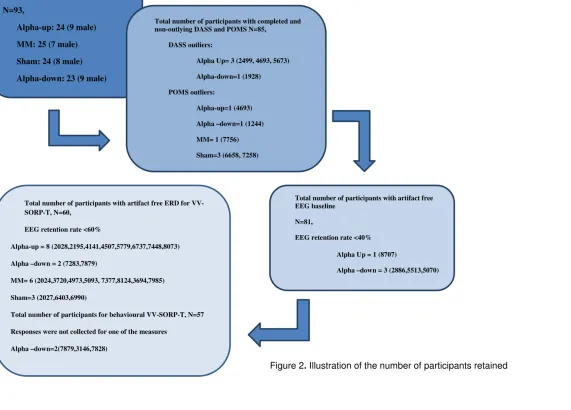
Data were excluded from statistical analysis for one of the three reasons: 1) no reaction time data was collected from the experimental task; 2) they did not complete one of the
Total number of participants N=93,
Alpha-up: 24 (9 male) MM: 25 (7 male) Sham: 24 (8 male) Alpha-down: 23 (9 male)
Total number of participants with completed and non-outlying DASS and POMS N=85,
DASS outliers:
Alpha Up= 3 (2499, 4693, 5673)
Alpha-down=1 (1928)
POMS outliers:
Alpha-up=1 (4693)
Alpha –down=1 (1244)
MM= 1 (7756)
Sham=3 (6658, 7258)
Total number of participants with artifact free EEG baseline
N=81,
EEG retention rate <40%
Alpha Up = 1 (8707)
Alpha –down = 3 (2886,5513,5070) Total number of participants with artifact free ERD for
VV-SORP-T, N=60,
EEG retention rate <60%
Alpha-up = 8 (2028,2195,4141,4507,5779,6737,7448,8073)
Alpha –down = 2 (7283,7879)
MM= 6 (2024,3720,4973,5093, 7377,8124,3694,7985)
Sham=3 (2027,6403,6990)
Total number of participants for behavioural VV-SORP-T, N=57
Responses were not collected for one of the measures
Alpha –down=2(7879,3146,7828)
2.2
Ethics Approval and Informed Consent
The University of Western Ontario Health Sciences Research Ethics Board (HSREB, Study ID: 103335) approved the study. Participants provided written consent to participate after being introduced to the background and the purpose of the study along with potential risks and discomforts involved in participating. There were no adverse events for any participant.
2.3
Self-Report Measures
All the self-report measures were collected online using the Qualtrics Research Suite (Qualtrics, Prov, UT). Participants’ anonymity was maintained through use of a de-identified subject number, entered at the beginning of each survey. All participant survey responses were
collected using a laptop computer with internet connection.
2.3.1
Depression Anxiety Stress Scale (DASS-21; Lovibond & Lovibond,
1995)
The short version of the DASS is a 21-item self-report questionnaire designed to measure depression, anxiety and stress symptoms occurring during the week prior to survey completion. Each item is scored on a 4–point Likert-scale ranging from 0 (“Did not apply to me at all”) to 3 (“Applied to me very much or more of the time”). The 21 items are divided into three 7-item subscales: depression (e.g., “I felt down-hearted and blue”), anxiety (e.g., “I felt I was close to panic”) and stress (e.g., “I found it difficult to relax”). This measure is one of the most widely used for the purpose of measuring depression, anxiety, and stress symptoms via a single scale.
2.3.2
Profile of Mood States (POMS-SF; Curran, S.L. et al, 1995)
“energetic”, and “cheerful”. This measure is commonly used and exhibits acceptable psychometric properties.
2.4
Experimental Manipulation
2.4.1
EEG-Alpha Neurofeedback (NFB
)
In NFB sessions of this study, participants were trained to either enhance their EEG alpha amplitude (“alpha-up” group) or to reduce it (“alpha-down” group). The training site Pz was chosen for the placement of the electrode since EEG-alpha rhythm is typically highest at this site (Ergenoglu et al. 2004). Before electrode placement, the skin of participants’ scalp was cleaned with NuPrep and the electrode was attached to the scalp using Ten20 conductive paste. The ground electrode was placed on the right earlobe and the reference electrode was placed on the
left earlobe. The three electrodes were connected to a Spectrum4 amplifier (J&J Engineering, United States) interfacing with EEGer 4.3 neurofeedback software (EEG Spectrum Systems,
CA). Impedances for all electrodes were maintained at maximum 5kΩ. A 3-minute baseline was recorded followed by the 15-min NFB intervention, both while participants’ eyes were closed. The protocol of the study was set such that participants either heard a reward tone when the alpha amplitude at the Pz site was enhanced (“alpha-up” group) or diminished (“alpha-down” group) beyond a moving last-minute threshold. With an epoch size of 0.5 seconds, the raw EEG signal was IIR (infinite impulse response) band-pass filtered to extract the moving average alpha (8-12Hz) amplitude. Participants heard the reward tone only 65% of the time when their
recorded alpha amplitude was above (“alpha-up” group) or below (“alpha-down” group) the prior minute average threshold.
To ensure that the necessary level of cognitive effort to achieve a positive feedback signal was approximately consistent for all participants during the NFB session, the threshold set up was constantly monitored and was readjusted whenever a participant was receiving
2.4.2
Sham Neurofeedback (NFB)
The procedure and set up for the sham group remained identical to the real NFB sessions. However, participants in the sham group received a pre-recorded session instead of receiving real reward tones related to their own brain activity (Raymond et al., 2005). The intention was to provide a similar intervention experience of having conducted a NFB session to the sham group that was in fact fully independent of their actual recorded alpha amplitude.
2.4.3
Mindfulness Meditation (MM)
Participants in the MM group were instructed to practice MM for 15 minutes. They were asked to sit in a comfortable position, keeping their eyes closed. They were instructed not to change their breathing pattern but merely to become aware of the natural pace and quality of their breathing. They were further instructed to become aware of wandering thoughts and in these cases to bring their attention back to their breathing. In addition, Meditation Breath
Attention Scores (MBAS) were assessed during the MM such that participants’ periodically
indicated, as prompted by a bell sound, whether they were attending toward their breathing, as instructed, or whether they had become distracted from breathing, via a simple keyboard
button-press while keeping their eyes closed (Frewen et al., 2008, 2011, 2014). The results of this self-report are discussed in another master’s thesis (Chow, 2014).
2.5
Cognitive Task
2.5.1
Visual Verbal Self/Other-Referential Processing Tasks (VV-SORP-T)
cognitive task measuring reaction time; and (3) an affect rating questionnaire referring to emotions experienced during the cognitive task, being collected after its completion.
In the first part of the VV-SORP-T task, the adjective rating procedure, participants were asked to read a list of 10 negative and 10 positive words and to rate “… how much each word
describes: (a) how you think about yourself , and (b) how you think about other people, in
general”. Responses to each adjective were provided on an 11-point (0-10) scale between “Not at all” (0), “Moderately” (5), and “Completely” (10). Participants were asked to consider the “other person” as a typical person who they do not know personally but might meet in their day to day life. The 20 words in the list covered social and achievement-related themes such as strong
(positive-achievement), cared for (positive-social), failure (negative-achievement), and rejected
(negative-social). The list was identical to the one used by Frewen and Lundberg (2012). For the cognitive task, using a standard-use electronic camera (4.1 megapixel), a photograph was taken of each participant (above shoulder) against an off-white lab wall. Participants were encouraged to pose in neutral expression, as if for a passport picture. The photographs were then standardized in order to match in all essential respects the features of the NimStim set of facial expressions (Tottenham et al., 2009). The NimStim set of facial
expressions was then used to find a match for each participant in terms of gender, ethnicity, and approximate age; this individual served as the “stranger” used in the cognitive component of the task.
Figure 2 illustrates an example block of the cognitive task procedure of the VV-SORP-T. Stimuli were delivered by E-Prime (Psychological Software Tools,Inc.). Each cognitive task block began with presentation of a fixation cross (+) for 15 seconds. After presentation of the fixation cross, at the onset of each block, the word “ Self” or “Other” was displayed, indicating whether the participant should expect to see a picture of their own face or a picture of the
stranger’s face in the upcoming block. After this, 10 stimuli were presented in on-off order: 5 pictures and 5 words (i.e., picture-word-picture-word-picture...). The words used in each block were the same as those used in the adjective rating survey and were of one valence (i.e., were all positive or were all negative). Likewise, the 5 pictures were all of the same individual. As such, the task was blocked in terms of the factors Reference (self-vs-other photograph) and Valence