Performance Considerations for Robert O’Dwyer’s Eithne (1909):
A Contextual Study and Edited Vocal Score
by
Gavan Ring
Dissertation submitted to Dublin City University in partial fulfilment of the requirements for the degree of
Doctor in Music Performance
Royal Irish Academy of Music
Volume I: Text
Supervisor:
Dr Denise Neary
I hereby certify that this material, which I now submit for assessment on the
programme of study leading to the award of Doctor in Music Performance, is entirely
my own work, that I have exercised reasonable care to ensure that the work is
original, that it does not to the best of my knowledge breach any law of copyright, and
that it has not been taken from the work of others save and to the extent that such
work has been cited and acknowledged within the text of my work.
Signed:______________________________ ID No: 55632153
Contents
Abstract i
Acknowledgements iii
List of Musical Examples iv
List of Figures v
List of Tables vi
List of Abbreviations vii
Volume I:
Introduction 1
Chapter One
Irish Opera c1780-1925: An ‘Uneasy Expression’ 5
Chapter Two
Robert O’Dwyer’s Eithne (1909): Historical and Cultural Context 36
Chapter Three
Cén Chanúint? Linguistic Performance Considerations for Eithne 60
Chapter Four
Preparing the Edited Vocal Score of Eithne 79
Bibliography 133
Appendices
Appendix A: Cló Gaelach Transcription Guide 150
Appendix B: Table of Cuttings Appended to 1909 Autograph Orchestral Score 151
Appendix C: Piano Reduction Sample found in 1909 Autograph Orchestral Score 153
Appendix D: Translation of Eithne’s Libretto 154
Volume II:
Abstract
Robert O’Dwyer’s Eithne (1909) is recognised as the first opera to be performed in the Irish language. Based on the Irish folklore legend, Éan an cheoil bhinn or ‘bird of the sweet music’, the work is at once representative of the late-romantic era in classical music and the broader Irish cultural revival. Despite this apparently strong cultural locus, however, an adequate and fair reception of the musical and dramatic merits of Eithne has been severely obstructed. As a result, the work has not been performed for over one hundred years.
Current research suggests that, rather than on the basis of artistic merit, Eithne’s neglect has been motivated by the partiality of a complex political and cultural environment. The condition of cultural polarisation as a result of the troubled Anglo-Irish saga of sectarian tension beset upon Anglo-Irish society for centuries has greatly inhibited the understanding of classical music as a national art form in the Irish cultural imagination. Furthermore, despite Eithne’s embryonic link with fin-du-siècle Irish cultural revivals, these movements did little to assist a universal cultural acceptance of the work due to factors such as the subconscious isolation of the Irish language as the mother tongue of Irish Catholic nationalism and the seizure of classical music constructs as vital tools in the creation of contemporary (primarily English) literature.
the cultural history of Ireland, redress the taciturn attitude to Irish opera in general and, simultaneously, rescue some very fine works from the backwaters of history.
Acknowledgements
I am very grateful to my supervisor, Dr Denise Neary, who steadfastly guided me through this entire doctorate programme. I would like to sincerely thank Deborah Kelleher, Mary Brennan, Dearbhla Collins, Brenda Hurley, Kathleen Tynan, Philip Shields, Laoise Doherty and all the staff at the Royal Irish Academy of Music who were always there to assist me in every possible way. I would also like to thank Dr Philip Graydon of the DIT Conservatory of Music and Drama for many valued discussions, his keen insight and excellent direction.
Ba mhaith liom sár-bhuíochas a gabháil don Dr Pádraig Ó Liathán ó Roinn na Gaeilge ag Coláiste Phádraig, Droim Conrach de bharr an cabhar iontach a thug sé dom, go h-áirithe ó thaobh aistriúcháineach agus cursaí gramadaí de. Ina theannta, táimse fíor-bhuíoch de Sean Mac Liam, fíor-shaineolaí Roibeard Ó Duibhir, a thug treoir den scoth dom chun an scór guthach a aimsiú.
Special mention is reserved for Jerry, Iseult, Diarmaid, my late grandmother Clare, the Mulligans and all my extended family who have unflinchingly supported me throughout this programme. I would like to especially thank my wonderful mother, Dr Emer Ring, a tireless and gifted educationalist and my greatest academic inspiration.
List of Musical Examples
Chapter One
Example 1.1: Johann Logier, Brian Boroimhe – Act 1, Bars 1-4 14 Example 1.2: Thomas O’Brien Butler, Muirgheis – Act 3, Scene 2, Bar 504 21 Example 1.3: Geoffrey Palmer, Sruth na Maoile – Act 1, Bars 1-4 25
Chapter Three
Example 3.1: Robert O’Dwyer, Eithne – Act 1, Bars 589-590 63
Chapter Four
List of Figures
Chapter One
Figure 1.1: Sruth na Maoile 1923 Programme – Title Page 24
Chapter Two
Figure 2.1: Weekly Irish Times Portrait Sketch of Robert O’Dwyer in 1900 36 Figure 2.2: Title Page of Éan an Cheoil Bhinn agus sgéalta eile 42
Figure 2.3: Completion Signature for Act 2 of Eithne 43
Figure 2.4: Vocal Score Subscription Appeal – An Ghaedhealg san Amharclain 48
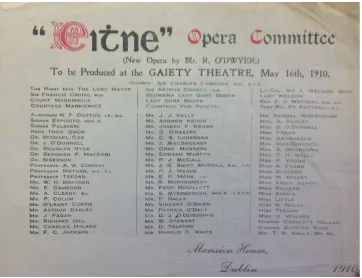
Figure 2.5: Eithne Opera Committee List 50
Chapter Three
Figure 3.1: Cló Gaelach Alphabet in Upper and Lower Case 61
Figure 3.2: Articulation of Non-Palatal (velar) Sounds 68
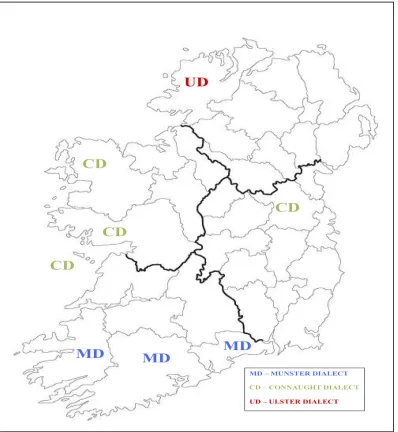
Figure 3.3: Map of the Primary Dialect Divisions of the Irish language in Ireland 70
Figure 3.4: IPA Phonetic Alphabet (revised to 2005) 73
Chapter Four
List of Tables
Chapter Three
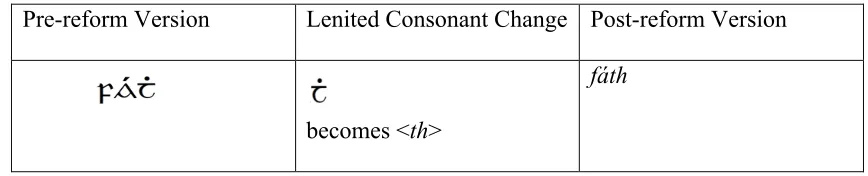
Table 3.1: Replacement of séimhiú in post-reform in the word fáth 65 Table 3.2: Lárchanúint IPA-based transcription examples in An Foclóir Póca 71 Table 3.3: Irish Phonetic and IPA Transcription in Comparison 74 Table 3.4: Binary Palatalisation and Velarisation in Munster Irish in Eithne 76
Chapter Four
List of Abbreviatons
PVS – 1910 piano-vocal score
AOS – 1909 autograph orchestral score EVS – edited vocal score
Introduction
On 10 and 12 November 2008, Opera Theatre Company, in association with the National Library of Ireland (NLI), presented and recorded two concerts at the seminar room at the NLI under the title, ‘Gems of Irish Opera’.1 The programme consisted mainly of excerpts from operatic compositions by indigenous Irish composers William Vincent Wallace (The Amber Witch), Michael William Balfe (The Sleeping Queen), Charles Villiers Stanford (The Veiled Prophet of Khorassan) and Robert O’Dwyer (Eithne). As there are no other historically recorded incidences of any part of Eithne being performed or recorded since 1910, the presentation of these excerpts from Eithne in November 2008 marks the only occasion where parts of the opera have been performed and recorded since the death of O’Dwyer in 1949.
Each excerpt in the programme of ‘Gems of Irish Opera’ was performed in the original intended language, which meant that the excerpts from O’Dwyer’s Eithne were sung in Irish; all other excerpts were performed in their original English. Throughout a comprehensive rehearsal process for ‘Gems of Irish Opera’,2 the parts of the programme presented in English posed few, if any, rehearsal problems for the singers. English was each singer’s native tongue and is a language that features prominently in formal operatic performance instruction and singers of all stages and abilities have various and frequent experiences in dealing with producing the English language for operatic purposes. However, it is vital to stress that the ability to produce !!!!!!!!!!!!!!!!!!!!!!!!!!!!!!!!!!!!!!!!!!!!!!!!!!!!!!!!
1 O’Dwyer, Stanford, Wallace. Gems of Irish Opera 1. Opera Theatre Company Young Associate Artists, Úna Hunt. 2008. Compact disc. NLI Archive 2008/001. Gavan Ring was a member of Opera Theatre Company’s Young Associate Artists and featured in the concerts and recordings. The concerts were presented with pianoforte accompaniment. Balfe’s one act opera, The Sleeping Queen was presented at these concerts in its entirety.
a language effectively for operatic purposes is not made any easier should performers be singing in their native tongue as the processes of enunciation required for operatic singing stretches well beyond the general techniques required for everyday speech.3 The difficulties encountered, however, when preparing and rehearsing the Irish excerpts from Eithne were numerous and striking both from lexical and phonological viewpoints.4
Of the 280 Irish operas written before 1925,5 Axel Klein singles out Eithne as the opera most deserving of a revival.6 While there have been many recent rallying calls for operas such as Eithne to be thrust back into the performance domain, the reality is, however, that a work such as Eithne demands a great deal of performance consideration before it can be resurrected. If Eithne is to be given its deserved revival, it must be in accordance with current professional expectations in opera. Therefore, the production of a modern, edited vocal score is of vital importance.
This thesis posits that in-depth cultural and historical understanding is crucial in terms of appreciating a work such as Eithne, in particular with regard to producing an edited version of the vocal score where the editorial processes involved must be continuously informed by empirical historical understanding. Simultaneously, the production of this edited vocal score must also be influenced by performance consideration. As clarity of enunciation and language accuracy are two of the
!!!!!!!!!!!!!!!!!!!!!!!!!!!!!!!!!!!!!!!!!!!!!!!!!!!!!!!!
3 Richard Miller, On the Art of Singing (Oxford: Oxford University Press, 1996), 51.
4 See Eithne excerpt CD attached to back cover of Volume I – Excerpts taken Gems of Irish Opera 1. NLI Archive 2008/001.
5 Axel Klein, ‘Stage Irish, or the National in Irish Opera, 1780-1925’, The Opera Quarterly, 21 (2005), 34.
6 Axel Klein, ‘Celtic Legends in Irish Opera, 1900-1930’, Proceedings of the Harvard Celtic
cornerstones of any operatic endeavor,7 the principal points of performance consideration for Eithne in this thesis centre on the complicated linguistic issues.
Chapter one deals with the overall cultural and historical context of Irish opera. From the first incidences of western art music in Ireland in the late-seventeenth century to the composition of full-scale Irish language operas in the early-twentieth century, Irish opera’s development from a constrained position within the Irish cultural milieu is extensively surveyed. Chapter two explores the particular, more local, cultural and historical environment surrounding the creation and initial performances of Eithne with added insight into the background of Robert O’Dwyer and the composition process itself.
Chapter three provides a comprehensive examination of the linguistic performance issues inherent in the libretto of Eithne. Irish is a language practically alien to operatic performance studies; as far as singing in Irish for operatic purposes is concerned, there has been no treatise. This stands in remarkable contrast to the core operatic languages of Italian, German, French, English, Russian, Czech (and perhaps to a lesser extent Spanish) where there are numerous treatises on how to best negotiate producing these languages for operatic purposes. The difficulty of this situation is further compounded by the fact that Eithne is written in an antiquated, stylised form of Irish generally referred to as an cló gaelach ‘Gaelic print’, which must first be transcribed before any current phonological performance theory can be applied to the audible, operatic realisation of the language. The conclusions of this chapter have informed the production of the Irish text found in the edited vocal score. Chapter four !!!!!!!!!!!!!!!!!!!!!!!!!!!!!!!!!!!!!!!!!!!!!!!!!!!!!!!!
Chapter One
Irish Opera – An ‘Uneasy Expression’
11.1 Introduction
It is estimated that some 280 operatic stage works with Irish thematic content were written in the period between 1780 and 1925.2 However, both Irish and international musicologists have had little incentive to turn their attention to the idea of Irish opera with the result that literature on the subject is extremely limited.3 Harry White poignantly observes this lack of incentive on an international level in the following passage:
Richard Taruskin’s The Oxford History of Western Music (2005) furnishes a convenient and recent example of Ireland’s complete absence from the history of opera, not because Ireland is musically unimportant, but because historians of musical culture as diverse as Carl Dahlhaus, John Caldwell and Taruskin tacitly are in agreement about how the European musical past is to be reconstructed.4
Despite the aforementioned 280 works contained within the oeuvre of Irish opera, the works which make up this sizeable body of repertoire, both individually and collectively, have held, and continue to hold, a limited place in the Irish cultural context. In relation to Irish opera, Axel Klein has stated that ‘There is scarcely any nation in the world whose music has been so little discovered, documented, or analyzed, to say nothing of performances or recordings, as the proverbial “Land of
!!!!!!!!!!!!!!!!!!!!!!!!!!!!!!!!!!!!!!!!!!!!!!!!!!!!!!!!
1 Harry White, Music and the Irish Literary Imagination (Oxford: Oxford University Press, 2008), 5. 2 Axel Klein, ‘Stage Irish, or the National in Irish Opera, 1780-1925’, The Opera Quarterly, 21 (2005), 34.
3 Ibid., 28.
Song.”’5 Klein further notes that, despite ‘prevailing ignorance,’6 it is no longer possible to maintain that a tradition of Irish opera does not exist and that if some of the works in question were performed it might well serve as a starting point ‘to reexamine the role of opera in the cultural history of Ireland.’7
1.2 Opera and the Irish Cultural Imagination
It has been suggested that the cultural history of Ireland is, to a large degree, independent of the trends and events that have formed the social and cultural destiny of Western Europe.8 While this statement is general, it does, however, reflect a reasonably fair summation of Irish cultural and social discourse within the European context, in particular with regard to the development of western art music.
Owing to a severely fractured cultural dynamic associated primarily with the strife-laden chronicle of Anglo-Irish relations, European art culture and ethnic traditions have never quite shared equal status within the Irish cultural milieu. In significant contrast with the vast majority of other European countries, this anomaly is most evident in the context of music. As a result, a sizeable part of Ireland’s musical heritage has been severely neglected.9
White refers to this musical heritage as a form of art music incorporating ‘the norms of European (English, German, Italian) musical patronage assimilated as part of the
!!!!!!!!!!!!!!!!!!!!!!!!!!!!!!!!!!!!!!!!!!!!!!!!!!!!!!!! 5 Klein, ‘Stage-Irish’, 27.
6 Ibid., 28.
7 Ibid., 63. An Irish Government Arts Council publication on opera policy states that ‘a tradition of Irish opera, of work produced locally by Irish musicians and artists, arguably never developed’. Pamela Smith, Towards a Policy and Action Plan for Opera (Dublin: Arts Council, 2002), 4.
8 Alice Anderson Hufstader, ‘Beethoven’s “Irische Lieder”: Sources and Problems’, The Musical Quarterly, 45 (1959), 343.
colonial status quo … ’10 While White correctly observes the genesis of art music in Ireland as ‘assimilated,’ it is ironic that this very perception of art music as an assimilation, an incompatible add-on perhaps, has prevailed en masse in the Irish cultural imagination and reflects the all too prevalent attitude to art music, and by default opera, in Ireland as the mere ‘uneasy expression of the colonial presence.’11 Given this cultural conceptuality, it was quite remarkable that any semblance of an indigenous art music repertoire came to exist at all.
1.3 Opera and Ireland
The first theatrical activities with a musical association in Ireland may well have taken place in the early 1600s given court society’s appetite for entertainment at Dublin Castle.12 However, the earliest recorded reference to opera in Ireland was in the year 1661 through a royal patent by King Charles II.13 In this patent, John Ogilby, a central figure in the early musical and theatrical scene in Dublin, was to assume the position of Master of the Revels in Ireland and ‘he should be licensed “to build upon such grounds by him to be purchased … in Dublin … such Theatre or Theatres as to him shall seeme most fitt … and therein to represent Comedyes, Tragedyes and Operas.”’14
The 1660 restoration of the monarchy in England saw a centralisation of cultural activity in London and, with a rapidly expanding commercial base aided by a growing !!!!!!!!!!!!!!!!!!!!!!!!!!!!!!!!!!!!!!!!!!!!!!!!!!!!!!!!
10 Harry White, ‘Ireland: (I) Art Music’, Grove Music Online. Oxford Music Online (Oxford University
Press) <http://www.oxfordmusiconline.com/subscriber/article/grove/music/13901> [accessed 9 March 2011].
11 White, Music and the Irish Literary Imagination, 5.
12 Brian Boydell, ‘Venues for Music in 18th Century Dublin’, Dublin Historical Record, 29 (1975), 28. 13 T. J. Walsh, Opera in Dublin 1705-1797: The Social Scene (Dublin: Allen Figgis & Co. Ltd., 1973),
1.
14 William Smith Clark, The Early Irish Stage: The Beginnings to 1720 (Oxford: Oxford University
population, London developed a keen taste for varied social entertainment.15 During the eighteenth century, a similar centralisation occurred in Ireland’s urban centres,
particularly in Dublin.16
With the emergence of the Protestant ascendency in Ireland subsequent to the Battle
of Kinsale,17 Ireland’s urban centres, in particular, began to experience unprecedented
economic expansion towards the end of the seventeenth century and throughout the
eighteenth century. Enticed by a fluid trade market, many merchants invested in
Ireland and the Irish economy grew steadily.18 This economic growth saw the
population of Dublin rise from nearly 60,000 in 1700 to about 140,000 by 1760.19
Dublin became the second-largest city to London in the British Isles and, indeed,
within the British Empire itself.20 Brian Boydell maintains that Dublin settled down to
a period in which the affluence of the colonial governing class formed the ‘ideal
background for the cultivation of the arts’21 where music and, in particular, opera
were to feature prominently.
!!!!!!!!!!!!!!!!!!!!!!!!!!!!!!!!!!!!!!!!!!!!!!!!!!!!!!!!
15 Michael Tilmouth, ‘The Beginnings of Provincial Concert Life in England’, in C. Hogwood & R. Luckett (eds), Music in Eighteenth-Century England (Cambridge: Cambridge University Press, 1983), 1-2.
16 Brian Boydell, A Dublin Musical Calendar 1700-1760 (Dublin: Irish Academic Press, 1988), 11. 17 The Battle of Kinsale in 1601 marked the end of the ‘Nine Years War’ and effectively completed the Tudor conquest of Ireland, which culminated in the Treaty of Mellifont in 1603. The ramifications of this saw a cultural split between Gaelic Catholics and the emergent Anglo-Irish Protestants, which arguably endures to this day. Gerald Dawe, ‘Nine Years War’, in W. J. McCormack (ed.), The Blackwell Companion to Modern Irish Culture (Oxford: Blackwell, 1999), 428.
18 Peter Clark & Raymond Gillespie, ‘Introduction’, in P. Clark & R. Gillespie (eds), Two Capitals: London and Dublin 1500-1840 (Oxford: Oxford University Press, 2001), 2.
19 David M. Dickson, ‘The Place of Dublin in the Eighteenth-Century Irish Economy’, in T. M. Devine & D. M. Dickson (eds), Ireland and Scotland 1600-1850 (Edinburgh: John Donald Publishers, 1983), 177-192.
20 Barra Boydell, ‘Opera: 1660-1800’, in W. J. McCormack (ed.), The Blackwell Companion to Modern Irish Culture (Oxford: Blackwell, 1999), 447.
The core of Dublin’s musical programmes was drawn from the contemporary central European tradition and society in eighteenth-century Dublin, inspired by the fashionable sophistication of the colonial governing class, greatly encouraged and patronised the arts.22 It was a period that saw visits (both working and domiciliary) by figures such as Handel and Geminiani, though the cultivation of opera in Ireland was initially slower to develop.23 Nevertheless, opera in Ireland underwent its genesis and a considerable period of development during the eighteenth century due to the political monopoly enjoyed by the new Protestant Anglo-Irish ascendancy. However, it should be noted that its members appeared not to espouse a significant taste for serious opera in Italian24 as English comic opera and ballad operas were far more popular in Dublin than their Italian counterparts. Full-length ballad opera accounted for approximately thirty per cent of all theatre performed in Dublin during the eighteenth century.25 In fact, the first recorded instance of an operatic performance in Ireland was at Dublin’s Smock Alley Theatre in 1705 with the staging of an English ballad opera, The Island Princess or The Generous Portuguese written by English composers Daniel Purcell and Jeremiah Clarke.26
By 1750, Dublin’s musical season highlights the pre-eminence of the ballad opera genre, revealing a total of fifty-six operatic performances of seventeen different productions, most of which were ballad operas, including at least four performances of The Beggar’s Opera.27 The first Dublin performance of the hugely popular The !!!!!!!!!!!!!!!!!!!!!!!!!!!!!!!!!!!!!!!!!!!!!!!!!!!!!!!!
22 Brian Boydell, Musical Calendar, 11.
23 Brian Boydell, Rotunda Music in Eighteenth-Century Dublin (Dublin: Irish Academic Press, 1992), 15.
24 White, ‘Ireland: (I) Art Music’.
25 John Greene, ‘The Repertory of Dublin Theatres, 1720-1745’, Eighteenth-Century Ireland, 2 (1987), 136.
26 Walsh, Opera in Dublin 1705-1797, 1.
Beggar’s Opera in March 1728 occurred just six weeks after its première in London, an indicator of just how quick the transmission between the capitals actually was.28 Aside from the linguistic barrier, which may have impeded an audience’s understanding of Italian opera, the popularity of English ballad opera undoubtedly reflected its contemporary popularity in London. Furthermore, the image of Italian opera in London was severely damaged by the ridiculous squabbles of rival singers and composers,29 with the result that local composers were gifted a niche outside the largely monopolised area of instrumental music by the Italian school.
The influence of ballad opera on the development of Irish operatic works was to be significant. R. V. Comerford notes that, with regard to the ballad opera model, ethnic melodies ‘such as “Eileen Aroon” had a place alongside the works of internationally celebrated composers at Dublin’s fashionable concerts at least from the 1740s.’30 Therefore, the busy tradition of ballad opera, instigated by the performances of The Island Princess in 1705 and The Beggar’s Opera in 1728, is crucial as, arguably, it paved the way for the eventual, albeit laboured, synthesis of Irish ethnic and European art music in opera.31
1.4 Early Irish Opera: 1780-1795
The primacy of English ballad opera and the platform it created for indigenous English and Irish composers meant that the first musical or theatrical references of an Irish nature in opera manifested themselves by way of the comic or ballad opera model, the first incidences of which occurred late in the eighteenth century.
!!!!!!!!!!!!!!!!!!!!!!!!!!!!!!!!!!!!!!!!!!!!!!!!!!!!!!!! 28 Brian Boydell, Musical Calendar, 21. 29 Ibid., 21.
30 R. V. Comerford, Ireland: Inventing the Nation (London & New York: Bloomsbury Academic, 2003), 184.
Axel Klein suggests that Tommaso Giordani’s32 pantomime The Island of Saints or the Institution of the Shamrock (1785) is the first real instance of an operatic or musical-stage work containing Irish ethnic influences.33 Klein states that ‘The music in all the surviving prints contains the overture and an extensive medley based on Irish traditional melodies such as “Rakes of Westmeath,” “Miners of Wicklow,” “Lacrum Cush,” and others.’34
Much like pantomimes today, the practice of mixing genres for stage works was a common occurrence at the time and more than likely these pantomimes contained material of an operatic nature.35 Klein further explicates that the comic or ballad opera works of John O’Keeffe,36 such as The Irish Mimick (1795), were further examples of the early development of Irish opera with many Irish traditional songs and dances being employed.37
1.5 The Development of Irish Opera: 1795-1895
With the pre-eminence of the Protestant Anglo-Irish during the eighteenth century came the complete suppression of the Catholic Gaelic Irish and although there was peace, this cultural dynamic was never a guarantee of social and political constancy.
!!!!!!!!!!!!!!!!!!!!!!!!!!!!!!!!!!!!!!!!!!!!!!!!!!!!!!!!
32 Tommaso Giordani was an Italian composer and toured with his father’s opera company that
presented six operas in Dublin between 1764 and 1768. In 1768 he moved to London where he remained for 15 years, composing, adapting, and conducting operas at the King’s Theatre and writing other vocal and instrumental works in the galant style. He returned to Dublin, continued to compose and opened the short-lived English Opera House before becoming musical director of the Theatre Royal, Crow Street (1788). Irena Cholij, ‘Tommaso Giordani’, Grove Music Online. Oxford Music Online (Oxford University Press)
<http://www.oxfordmusiconline.com/subscriber/article/opr/t114/e2888> [accessed 15 April 2012].
33 Klein, ‘Stage-Irish’, 29. 34 Ibid., 30.
35 Ibid., 30.
36 John O’Keeffe was born in Dublin in 1747. He was a dramatist and wrote a number of farces and
amusing dramatic pieces, many of which had great success. John W. Cousin, ‘John O’Keeffe’, in
Biographical Dictionary of English Literature (London & Toronto: J. M. Dent & Sons, 1910) <http://ebooks.adelaide.edu.au/c/cousin/john/biog/index.html> [accessed 9 July 2014].
At the end of the eighteenth century, Ireland once again erupted into militarised rebellion against this cultural status quo.38 To compound matters, this unrest also coincided with a spectacular economic crash. Following the disbandment of the Irish parliament,39 the country’s economy tumbled into recession and many of the leading gentry relocated to London. The wealthier classes, who so willingly patronised and helped to cultivate the arts throughout the eighteenth century, were now living primarily outside of Ireland and the consequential waning in expenditure gave rise to serious financial problems throughout the entire country.40 For example, an acre of Dublin land, before the cessation of the Irish parliament, cost more than three times its equivalent in London. However, by 1820 the value of Dublin land had halved and Merrion Square mansions, which sold at nearly £8,000 each in the 1790s plummeted to £2,500 by 1801.41 By the time of the Irish Famine in the late 1840s, the same properties were available for less than £5 each.42
The operatic activity and the continued synthesis of art music and ethnic Irish music, that was slowly but surely becoming a feature in local composition during the eighteenth century, stagnated. Correspondingly, the early-nineteenth century saw the dawn of the romantic age in music; more and more, contemporary art music was
!!!!!!!!!!!!!!!!!!!!!!!!!!!!!!!!!!!!!!!!!!!!!!!!!!!!!!!!
38 The Penal Laws involved the systematic persecution of the Catholic Irish majority in Ireland to induce conformity with the English Protestant status quo. Their introduction, arguably, led to the revolutionary events of 1796-1798, 1803 and 1867 and proved that society on the island of Ireland was far from stable. Louis Cullen, ‘Catholics under the Penal Laws’, Eighteenth-Century Ireland, 1 (1986), 23-26.
39 The 1798 United Irishmen Rebellion and the threat of a French invasion convinced the prime minister William Pitt that an Act of Union was crucial for national security. The Act of Union was passed in August 1800 and came into force on 1 January 1801. It created the United Kingdom, abolished the Irish parliament and united the Church of Ireland and Church of England. Thirty-two Irish peers entered the UK House of Lords and 100 Irish MPs the House of Commons. Ciaran Brady, ‘Union, Act of’, in C. Brady (ed.), Encyclopedia of Ireland: An A-Z Guide to Its People, Places, History and Culture (Oxford: Oxford University Press, 2000), 350.
40 Séamus Nevin, ‘History Repeating: Georgian Ireland’s Property Bubble’, History Ireland, 1 (2012), 24.
being underpinned by the melodies of the rich and varied ethnic traditions of continental Europe.43
Notwithstanding the ever-increasing social and economic decay in Ireland, there are some noteworthy examples of Irish operatic works that align quite strikingly with the contemporary European compositional zeitgeist. Operas such as Johann Bernhard Logier’s Brian Boroihme [sic] (1809) and Thomas Simpson Cooke’s Thierna-na-Oge
or The Prince of the Lakes (1829) are examples of works which sought to merge the indigenous repertoire with European art music. Logier’s Brian Boroimhe, in particular, is a fascinating manifestation of the genre. Logier, of Huguenot extraction, was born in Kassel, Germany, came to Ireland around 1789 and settled in Dublin in 1809; he opened a music shop and developed a range of pedagogical concepts including the chiroplast.44 Ita Hogan singles out his opera Brian Boroimhe in particular as being ‘significant of the growth of Irish nationalism’ and ‘a genuine attempt to present a stirring episode in Irish history.’45 Hogan refers here to Irish nationalism in its most conventional sense; however, it is unclear whether the opera is really ‘significant’ of the growth of this concept of Irish nationalism due to the fact that throughout the nineteenth century Ireland appeared not to overtly use opera for the dissemination of nationalistic expression.46 Nevertheless, the plot is certainly nationalistic in quality, concerning the historic Battle of Clontarf in the year 1014 in which the legendary Irish hero Brian Ború reputedly led a united Irish front against !!!!!!!!!!!!!!!!!!!!!!!!!!!!!!!!!!!!!!!!!!!!!!!!!!!!!!!!
43 Harry White, The Keeper’s Recital: Music and Cultural History in Ireland, 1770-1970 (Cork: Cork
University Press, 1998), 69.
44 Klein, ‘Stage-Irish’, 35. Logier patented the chiroplast in 1814, which was a device to correct and
maintain proper hand positioning for pianists. David Charlton & Michael Musgrave, ‘Johann Bernhard Logier’, Grove Music Online. Oxford Music Online (Oxford University
Press) <http://www.oxfordmusiconline.com/subscriber/article/grove/music/16877> [accessed 24 February 2015].
45 Ita M. Hogan, Anglo-Irish Music 1780-1830 (Cork: Cork University Press, 1966), 137.
46 Joseph J. Ryan, ‘Opera in Ireland before 1925’, in G. Cox & A. Klein (eds), Irish Musical Studies 7:
the Viking invaders. The overture and several arias are interspersed with traditional
music influences and include a number of direct ethnic quotations47 such as the air, ‘The Bard’s Legacy’ (Example 1.1).
Example 1.1: Johann Logier, Brian Boroimhe – Act 1, Bars 1-448
Additionally, the work’s nationalistic credentials are further strengthened by its
chronological proximity to the 1798 Rebellion, the 1801 Act of Union and the 1803
Young Irelanders’ Uprising. Therefore, it is fascinating that a work quite overtly
nationalist in its use of ‘dialect and affectation of patriotism’49 was given such an enthusiastic response, being performed regularly in Ireland until 1834.50 It is quite possible that its popularity may have been suggestive of a nationalistic feeling among
audiences and perhaps it indicates that, if the economic situation itself were a little
more congenial to the development of opera, then opera as a whole may well have
become more ‘significant of the growth of Irish nationalism.’51
!!!!!!!!!!!!!!!!!!!!!!!!!!!!!!!!!!!!!!!!!!!!!!!!!!!!!!!! 47 Klein, ‘Stage-Irish’, 36.
48 Johann Bernhard Logier, The Overture And Music in The New Melo Drama of Brian Boroihme (Dublin: S. Holden, 1809), 26. Lbl R.M. 13 F.16 (6).
49 Dublin Satirist, March 1810, 277; cited in Hogan, Anglo-Irish Music, 137. 50 Klein, ‘Stage-Irish’, 34.
51 Hogan, Anglo-Irish Music, 137.
Despite efforts such as Simpson Cooke’s Thierna-na-Oge or The Prince of the Lakes (1829) and Samuel Lover’s Rory O More (1837), the development of Irish indigenous opera fell victim not only to continued cultural neglect but also to the hugely significant impact of a badly failing economy. Furthermore, those who thought nationalistically throughout most of the nineteenth century were not overly concerned with art music or opera as a medium for the expression of this nationalism. In fact, the collective construction of conventional Irish nationalism during the nineteenth century involved a fairly blatant, if perhaps unconscious, exclusion of art music and opera with the possible exception of the publication of Moore’s melodies, although the ramifications of which, arguably, proved more detrimental than helpful to the relationship between classical music and the construction of Irish nationalism.52 Correspondingly, two of Ireland’s greatest operatic exponents of the mid-nineteenth century, Michael William Balfe and Vincent Wallace, seemed just as congruently uninterested in any significant expression of contemporary Irish nationalism. Balfe’s The Bohemian Girl (1843) and Wallace’s Maritana (1845) regularly, yet rather ingenuously, dubbed part of the ‘Irish Ring’ along with Julius Benedict’s later work The Lily of Killarney (1862), can in no way be described as Irish works or even remotely related to the contemporary Irish cultural context. Comerford also notes that although these works ‘are sometimes referred to as the “Irish Ring,” unlike Wagner’s operas ‘they do not have a distinctive national accent.’53 Both Balfe’s and Wallace’s foremost position as composers abroad, particularly in England, may well have inhibited them from making any significant Irish nationalistic statements in their work as this would surely have affected their livelihoods in a negative fashion. However, while there is little or no evidence to suggest that Wallace and Balfe were overly !!!!!!!!!!!!!!!!!!!!!!!!!!!!!!!!!!!!!!!!!!!!!!!!!!!!!!!!
interested in the expression of a burgeoning realisation of contemporary Irish nationalism in their operas,54 it would be remiss not to mention Balfe’s noteworthy arrangements of Moore’s Irish Melodies (1859). The nationalistic subject matter of Moore’s poetry, as one contemporary critic describes, ‘might have afforded fair scope for prosecution to a hostile Attorney-General.’55 Although it is clear that Balfe wanted atone for the musical misgivings of Sir John Stevenson’s original arrangements of Moore’s melodies,56 the very fact that Balfe decided to take on such a project may suggest that he had more interest in some expression of contemporary Irish nationalism than he is given credit for. However, this type of project was most definitely an exception in the overall delineation of Balfe’s output.
Coincidentally, the next operatic work of any real significance to the Irish cultural context came from the pen of another noted arranger of Moore’s melodies, John William Glover. Although Dublin’s appetite for contemporary European opera remained consistent throughout the nineteenth century,57 Glover’s The Deserted Village (1880) along with Paul McSwiney’s Amergen (1881) were the only significant native works; the pause of almost forty years in any significant development in Irish opera is indicative of the prolonged and continued alienation of opera as a means of Irish national expression and symbolic of a country that did not and could not support a thriving indigenous art music scene economically and infrastructurally. Waves of emigration coupled with a complete centralisation of metropolitan life in Dublin ensured that Irish society, so blighted in any case by severe cultural polarisation, !!!!!!!!!!!!!!!!!!!!!!!!!!!!!!!!!!!!!!!!!!!!!!!!!!!!!!!!
54 William Tyldesley, Michael William Balfe: His Life and His English Operas (Aldershot: Ashgate, 2003), 233.
55 Anon, ‘Preface to the Original Edition’, in Moore’s Irish Melodies: With New Symphonies and
Accompaniments for the Pianoforte by M. W. Balfe (London & New York: Novello, Ewer and Co., 1859), v.
remained firmly on the back foot of any significant progression in the development of art music.
A curious by-product of this Irish cultural context, however, was that a significant portion of the resident urban communities in Ireland (particularly in Dublin) during the eighteenth and nineteenth centuries became loyal to the union of Britain and Ireland, yet definitively did not consider themselves English (not unlike the unionist community in Northern Ireland today). This sort of paradox in national identity then developed and manifested itself in various cultural expressions throughout the eighteenth and nineteenth centuries.58 One of the most noteworthy expressions of this conceptuality came in the form of Charles Villiers Stanford’s opera Shamus O’Brien (1895). The opera is, ironically, the best-known Irish opera of the nineteenth century and, interestingly, its compositional make-up represents the first significant emphasis on a combination of different strands of Irish subject matter. Thus, according to Nicholas Temperley, when national flavour in opera becomes instantly recognisable both musically and thematically,59 an opera such as Shamus O’Brien is arguably the first recognisable example of an Irish ‘national’ opera, albeit coming from a slightly different cultural point of view. Although not in line with the more conventional idea of Irish nationalistic expression of the time, Shamus O’Brien, and indeed its popularity, perhaps reflects a significant part of contemporary Irish society that tends to be overlooked – West Britonism.60 The plot of Shamus O’Brien is a parody of the 1798 Rebellion, which in itself is quite a bold choice (and perhaps a pointed one) by Stanford especially given the proximity of the centenary commemorations in 1898 !!!!!!!!!!!!!!!!!!!!!!!!!!!!!!!!!!!!!!!!!!!!!!!!!!!!!!!!
58 Brian Boydell, ‘Georgian Lollipops, or, The Lighter Side of Classical Music’, in H. Shields (ed.),
and the rise to prominence of contemporary Irish nationalistic and artistic movements,
in particular the Gaelic and Irish Literary Revivals.61
1.6 Irish Opera and Cultural Revivals: 1895-1923
The advent of significant cultural revivals in Ireland towards the end of the nineteenth
century saw the emergence of organisations such as the Gaelic Athletic Association,
the Gaelic League, the foundation of the Abbey Theatre and the pre-eminence of
some of Ireland’s most renowned international writers and literary artists. However,
there was a significant influx of operatic material composed during this broad cultural
revival also. General revival philosophies tended to rail against the
‘shameless-shamrockery’62 in contemporary representations of Ireland in literature and theatre
(Stanford’s Shamus O’Brien probably fitted this bill) and, according to Thomas Bartlett, ‘self-consciously sought to realise a new national art, one that would be
unmistakably Irish, yet cosmopolitan rather than insular and displaying genuine
literary merit.’63 This more ‘cosmpolitan’ artistic outlook on Irish nationalistic
expression led to collaborations between prominent figures such as Douglas Hyde and
Michele Esposito who together set Hyde’s original Irish-language play, An Tincéir agus an tSidheóg (1902) to a one-act opera, The Tinker and the Fairy (1909).64 The work superseded another Irish opera by Esposito, The Post Bag: A Lesson in Irish
(1901). In The Post Bag, Esposito had experimented with Irish traditional music to suit his subject but according to Joseph Ryan, Esposito’s The Tinker and the Fairy
collaboration with Hyde is ‘a work of integrity and focus, and there is something to
!!!!!!!!!!!!!!!!!!!!!!!!!!!!!!!!!!!!!!!!!!!!!!!!!!!!!!!! 61 White, Keeper’s Recital, 109.
62 Thomas Bartlett, Ireland: A History (Cambridge: Cambridge University Press, 2010), 346. 63 Bartlett, Ireland, 346.
lament in the fact that such intelligent cooperation between cultivated artists was not
built upon in the decades that followed.’65
Three works in particular, however, stand out from the operas composed during this
period of cultural revival: Thomas O’Brien Butler’s Muirgheis (1903), Robert O’Dwyer’s Eithne (1909) and Geoffrey Molyneux Palmer’s Sruth na Maoile (1923) and they are all unique in that they are the only known operas in this period composed
in the Irish language.66 Each plot is also taken from some ancient Irish legend and although the story of Muirgheis was fabricated by the librettists, it is nonetheless thematically charged with Celtic mythological elements.67 With regard to fin-du-siècle Irish cultural revivals, of which the resurrection of the Irish language was an integral part, these works can be described as quintessential products. Todd Felton
identifies the rejuvenation of a long dormant Irish cultural tradition while
simultaneously developing a new and distinct national identity for Ireland as central
to revival-based works;68Muirgheis, Eithne and Sruth na Maoile align perfectly with this archetypal revival-centred notion.
Thomas O’Brien Butler composed Muirgheis in 1903 and it was premiered on 7 December of the same year at the Theatre Royal in Dublin.69 Set in Waterville, County Kerry (the ancestral home of Butler’s family70) at ‘the dawn of Christianity,’71 the plot of the work concerns a love triangle between the heroine of the opera,
!!!!!!!!!!!!!!!!!!!!!!!!!!!!!!!!!!!!!!!!!!!!!!!!!!!!!!!! 65 Ryan, ‘Opera in Ireland’, 51.
66 Both Eithne and Muirgheis also have accompanying English texts. It is important to note, however,
that of the three Irish language operas (Muirgheis, Eithne and Sruth na Maoile), only Eithne’s orchestral score remains extant.
67 Klein, ‘Stage-Irish’, 55.
68 Todd Felton, A Journey into Ireland’s Literary Revival (Berkeley: Roaring Forties Press, 2007), 2-3. 69 Thomas O’Brien Butler, Muirgheis Vocal Score (New York: Breitkopf & Härtel, 1910), iii.
70 Russell McMorran, ‘The Butlers of Waterville: From Salmon Weir to Grand Opera’, The Kerry
Magazine: The Kerry Achaeological & Historical Society, 22 (2012), 32.
Muirgheis, her foster sister Máire and a neighbouring chieftain, Diarmuid. Butler was
born in Cahersiveen, County Kerry on 3 November 1861 and studied under Charles
Villiers Stanford at the Royal College of Music in London from 1897 to 189872 and previously for a time in Italy.73 Klein notes that, ‘Butler had not been a very successful student at the Royal College of Music. He did well in harmony but much
less so in composition.’74 Before Muirgheis, Butler composed a number of smaller works, most of which were songs. An example of his reasonable prominence as
composer is highlighted by the inlusion of his piece, Cincoragh, which was set at the
Dublin Feis Ceoil for the Irish Soprano category in 1915.75 Butler died in May of the same year aboard the ill-fated RMS Lusitania. Muirgheis is Butler’s only large-scale
work and was reputedly written while he was living in Kashmir in Northern India.76
Butler’s immediate family were Catholic and perhaps naturally sympathetic with
contemporary nationalist movements.77 Thus, for Butler, cultural revival and the reinvention of Irishness may have seemed an attractive movement with which to
associate himself as a composer. Butler’s tutor, Stanford, subscribed to a
compositional style which was both diatonic and at the same time heavily infused
with the contours of folk music.78 Butler’s own style was somewhat similar and rich with Irish ethnic influence. One of the leading voices of the Gaelic League, Edward
!!!!!!!!!!!!!!!!!!!!!!!!!!!!!!!!!!!!!!!!!!!!!!!!!!!!!!!!
72 Axel Klein, ‘Celtic Legends in Irish Opera, 1900-1930’, Proceedings of the Harvard Celtic Colloquium, 24/25 (2004/2005), 44.
73Kerry Sentinel, 1 October 1898. 74 Klein, ‘Stage-Irish’, 55. 75Cork Examiner, 11 May 1915.
76 Axel Klein, ‘Butler, [Thomas] O’Brien’, in H. White & B. Boydell (eds), The Encyclopaedia of Music in Ireland (2 Vols, Dublin: UCD Press, 2013), i, 142.
77 McMorran, ‘The Butlers of Waterville’, 32. Butler’s ancestral family in Waterville were Protestant. 78 Jeremy Dibble, ‘Stanford, Sir Charles Villiers’, in Grove Music Online. Oxford Music Online
(Oxford University Press)
! 21
Martyn, described Muirgheis as being ‘saturated’ with folk music.79 However, Stanford’s political ideology, which was staunchly Unionist,80 clearly did not have any influence over Butler during his time at the Royal College of Music.
Butler is so explicit in his use of Irish folk song in Muirgheis as to add an unaccompanied ‘Caoine,’81 a traditional Irish song of mourning, sung in the opera by a Banshee (a spirit and omen of death in Celtic mythology) to signify the death of Máire. This ‘Caoine’ is sung twice (Example 1.2).
Example 1.2: Thomas O’Brien Butler, Muirgheis – Act 3, Scene 2, Bar 504
It is possible that Bulter’s original orchestral score for Muirgheis was lost with the sinking of the Lusitania,82 therefore it is difficult to determine with any degree of certainty the expanse and texture of the orchestral arrangement. However, one can
!!!!!!!!!!!!!!!!!!!!!!!!!!!!!!!!!!!!!!!!!!!!!!!!!!!!!!!!
79 Edward Martyn, ‘The Gaelic League and Irish Music’, The Irish Review, 1 (1911), 450. 80 Dibble, ‘Stanford, Sir Charles Villiers’.
81 Butler notes that on the death of his parents or any family members, the family nurse, a certain Mrs
Norah Fitzpatrick, who lived with the family for over forty years ‘wailed this traditional ancient Caoine in her anguish.’ Butler, Muirgheis Vocal Score, 170.
82 Presumably, Butler had an orchestral score on-board the Lusitania (or at the very least a copy of it)
assume from the late-romantic colour of the music in the vocal score, that the orchestral arrangement of Muirgheis may have been in accodrance with what John Spitzer and Neal Zaslaw refer to as ‘a typical, expansive, nineteenth-century orchestration.’83
With regard to the musical style of Muirgheis, Joseph Ryan makes the point that, while the work is noteworthy, it is, however, not without its limitations:
After a respectable overture and strong first act the following two acts move more in the manner of a ballad opera with choruses aplenty of fairies and wedding guests and with a succession of traditional dances. … The composer employs a stringent economy and consciously cultivates an Irish style that, notwithstanding the technical limitations and unevenness, result in a work of some merit.84
Ryan makes further note of the fact that ‘Muirgheis is occasionally referred to as the first native Irish opera; an eminence dependent wholly on the use of an Irish text.’85 Although it appears that it was Butler’s initial intention that Muirgheis be performed in the Irish language in 1903,86 Robert O’Dwyer’s Eithne is regarded as the first opera to be publicly performed in Irish.
!!!!!!!!!!!!!!!!!!!!!!!!!!!!!!!!!!!!!!!!!!!!!!!!!!!!!!!!
83 John Spitzer and Neal Zaslaw, ‘Orchestra’, in Grove Music Online. Oxford Music Online
<http://www.oxfordmusiconline.com:80/subscriber/article/grove/music/20402> [accessed 9 January 2014].
84 Ryan, ‘Opera in Ireland’, 49. 85 Ibid., 51.
Both Robert O’Dwyer’s Eithne87 and Geoffrey Molyneux Palmer’s Sruth na Maoile
were both written for the Irish language festival, Oireachtas na Gaeilge (translated
literally as ‘public assembly of the Irish language’). Modelled on the Eisteddfod
festival in Wales established in 1861 and the Mòd festival in Scotland established in
1891,88 the idea for the Oireachtas na Gaeilge festival was conceived on the basis that
‘an Oireachtas, or public assembly, on behalf of the Irish language, be held annually
by the Gaelic League, at which prizes would be offered for readings, recitations,
songs and dramatic sketches in Irish.’89 It was also part-modelled in antithesis to the
dissatisfaction with the more generically cosmopolitan outlook of the Feis Ceoil.90
Palmer was born in Staines-upon-Thames on 8 October 1882 into an Irish family.
After becoming the youngest student to graduate from The University of Oxford with
a Bachelor of Music, like Butler, he studied with Stanford at the Royal College of
Music from 1904 to 1907.91 He was better known as a composer of Irish-style light
ballads until the 1980s when it was discovered that he set thirty-two poems by James
Joyce to very intricate and inventive music.92 He was the most prolific Irish opera
composer after the First World War composing Finn Varra Maa (1917), Sruth na
!!!!!!!!!!!!!!!!!!!!!!!!!!!!!!!!!!!!!!!!!!!!!!!!!!!!!!!!
87 See chapter two, 36-59. The particular historical and cultural context of Robert O’ Dwyer’s Eithne is dealt with extensively in chapter two.
88 Both the Eisteddfod and Mòd festivals were established on the basis of promoting and celebrating
Welsh and Gaelic (Scotland) linguistic and cultural heritages respectively. Anon, ‘Our History’, <http://www.eisteddfod.org.uk/english/about-us/our-history/> [accessed 22 April 2015]; Anon, ‘History’, <http://www.ancomunn.co.uk/nationalmod/history> [accessed 22 April 2015].
89 Anon, ‘The Oireachtas – A History’, <www.antoireachtas.ie/history.php> [accessed 20 January
2013].
90 Ryan, ‘Opera in Ireland’, 53. The Feis Ceoil is a competitive music festival held in Dublin annually
since 1897. Karol Mullaney-Dignam & Jimmy O’Brien Moran, ‘Feis Ceoil’, in H. White & B. Boydell (eds), The Encyclopaedia of Music in Ireland (2 Vols, Dublin: UCD Press, 2013), i, 327-328.
91Axel Klein, ‘Palmer, Geoffrey Molyneux’, in Grove Music Online. Oxford Music Online (Oxford University Press) <http://www.oxfordmusiconline.com:80/subscriber/article/grove/music/43651> [accessed 9 January 2014].
92 Joyce himself acknowledged Palmer’s songs as being the best settings of his poetry. Richard Ellman
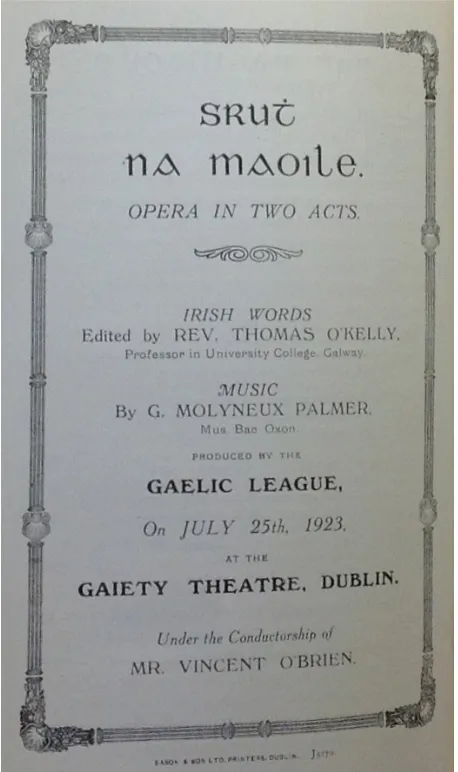
Maoile (1923) and Grania Goes (1924).93 Out of these three works, Sruth na Maoile is probably the largest in scale and is based on the well-known Irish myth, ‘The Children of Lir.’ The Gaelic League first produced the opera on 25 July 1923 at the Gaiety Theatre in Dublin and it was conducted by Vincent O’Brien.94 As part of the cultural by-programme for the 1924 Tailteann Games, Sruth na Maoile was also staged at the Theatre Royal in Dublin in August of the same year.95
Figure 1.1: Sruth na Maoile 1923 Programme – Title Page
!!!!!!!!!!!!!!!!!!!!!!!!!!!!!!!!!!!!!!!!!!!!!!!!!!!!!!!!
93 Klein, ‘Stage-Irish’, 59.
94 Anon, Programme to Sruth na Maoile. Opera in two acts. (Dublin: Eason & Son Printers Ltd., 1923).
Dn MS 5070.
95 Philip O’Leary, Gaelic Prose in the Irish Free State 1922-1939 (Pennsylvania: Pennsylvania State
Palmer’s music in Sruth na Maoile is significantly lighter in texture and compositional make up than either Muirgheis or Eithne.96 However, the use of Irish folk melody is again very strong; in particular, the famous Thomas Moore melody
‘Silent O Moyle’ (the song itself is also a reference to the plight of the Children of
Lir) forms the central melodic motif in the opera (Example 1.3).
Example 1.3: Geoffrey Palmer, Sruth na Maoile – Act 1, Bars 1-497
Sruth na Maoile was very well received; The Irish Times critic, in particular, could not speak more highly of the work:
Mr. Palmer’s work ought to be kept alive and we think that if Dublin people, and the many visitors now in the capital, could know what an extraordinarily beautiful production this is, in every respect – story, scenic, setting, singing and orchestral music – there would be such an audience tonight as would give heart to all who give themselves loyally to making the representation worthy of the composer’s tender and colourful conception.98
!!!!!!!!!!!!!!!!!!!!!!!!!!!!!!!!!!!!!!!!!!!!!!!!!!!!!!!! 96 Ryan, ‘Opera in Ireland’, 46.
97 Geoffrey Molyneux Palmer & Thomas O’Kelly, ‘Sruth na Maoile’, Autograph Vocal Score
(unpublished, 1923), Act 1, 1. Dn MS 5070.
Although critics seemed unanimously happy with the quality of the work, it did not,
however, generate sustainable interest. Given the context of political and cultural
bitterness, in particular with the advent of the Irish Civil War, it is hardly surprising
that the opera failed outright as a commercial venture: Sruth na Maoile, overall, lost a
substantial total of £165 15s. 4d.99 Chronologically in line with the formation of the Irish Free State in 1922, Klein proposes the suggestion that the work had a strong
political dimension, ‘with Ireland symbolised in the fate of the swan children finally
released from a bad spell.’100 Even though Sruth na Maoile premiered during a time of significant cultural and political upheaval (proximate to the formation of the Irish
Free State in 1922, and the subsequent Irish Civil War), the political undercurrent was
not enough to ignite the interest of the Irish Free State society who, according to
Patricia Grimshaw, Stuart Macintyre and Kate Darian-Smith, sought to distance
themselves from any Britishness of local Irish settings.101
According to Klein, ‘Palmer made efforts to bequeath his opera to the Gaelic League
after his death and additionally dedicated it to Eamonn de Valera … In the end Sruth na Maoile did not bear the dedication, but the episode does throw a light on the
composer’s hidden political attitudes.’102 From Palmer’s letters to his librettist Tomás
!!!!!!!!!!!!!!!!!!!!!!!!!!!!!!!!!!!!!!!!!!!!!!!!!!!!!!!! 99 O’Leary, Gaelic Prose, 369. 100 Klein, ‘Stage Irish’, 62.
101 Patricia Grimshaw, Stuart Macintyre & Kate Darian-Smith (eds), Britishness Abroad: Transitional Movements and Imperial Culture (Melbourne: Melbourne University Press, 2007), 1.
Ó Ceallaigh,103 it is clear that Palmer was profoundly discouraged by the Irish Civil
War 1922-1923.104
In R. V. Comerford’s groundbreaking study on the invention of Irish national
consciousness, it is interesting to note his inclusion of a discussion with regard to Irish
opera.105 The absence of the relatively unknown Butler or, indeed, Palmer in this
discussion is somewhat understandable; however, to say nothing of O’Dwyer, who
was arguably one of the more significant figures in the context of music and the
Gaelic League and the Gaelic Revival, is quite surprising. Ironically, Comerford does
mention Stanford and some of his works such as his opera on Thomas Moore’s exotic
poem, The Veiled Prophet of Khorassan (1877) and Shamus O’Brien (1895).106 It is hard to understand why Comerford includes these operas in his treatise with regard to
the invention of Irish national consciousness as, due to their thematic quality, they do
not relate directly to the development of the more generalised version of Irish national
consciousness as posited by Comerford. Comerford’s advancement of Stanford’s
operatic works alone as examples of formative cultural expressions of Irish national
consciousness is an example of the laissez-faire attitude afforded to the idea of multifaceted cultural expression in Irish opera. These expressions, particularly during
the late-nineteeth and early-twentieth centuries, reflect, just as strongly as the literary
tradition, the burgeoning and intense sense of varied national consciousness that
existed within the contemporary Irish cultural context. In short, Irish opera
!!!!!!!!!!!!!!!!!!!!!!!!!!!!!!!!!!!!!!!!!!!!!!!!!!!!!!!!
103 Tomás Ó Ceallaigh or Thomas O’Kelly was a Sligo-born priest, academic, librettist and playwright
who was very active in the formation of the Irish cultural revivals during the early twentieth century. His translation of Yeats’s milestone revival work, Cathleen ni Houlihan in 1902, earned him a respectable reputation which led to his operatic collaborations as a librettist for Molyneux Palmer and Robert O’Dwyer. Ryan, ‘Opera in Ireland’, 46. !
represented a great deal more than works such as Shamus O’Brien and The Veiled
Prophet of Khorassan – as noteworthy as those works may be.
1.7 Irish Opera – A Multplicity of Irishness
Harry White notes that, although ‘the spectrum of historical interpretation in Ireland is
notably wide’, the notion of cultural conflict, or more moderately cultural
polarisation, remains the predominant feature in Irish cultural discourse; because of
this, opera in Ireland, regardless of its political or cultural persuasion, has historically
remained associated with the forced implementation of a colonial culture and thus
borne little or no relation to the indigenous Gaelic culture.107 Notwithstanding the estimated 280 works composed between 1780 and 1925, the development of Irish
opera can only be best described as limited. The cultural divide, which characterised
Anglo-Irish relations for so long, was continually at the nucleus of any subsequent
economic, infrastructural or social obstacle preventing any sustained development of
the genre. Music in Ireland was resolutely following its own individual channel
determined more by what Ryan describes as ‘the need to corroborate the emerging
nationalist sentiment than by any cosmopolitan trend’108 even though the nature of opera is to promote a platform for the ‘emergence of a regional accent and
representation of national characteristics,’ thus making it invariably attractive to a
committed political movement or issue.109 To compound matters, and as White further infers, paradoxically, with the politicising of Moore’s melodies and amalgamation
with the ballad tradition during the nineteenth century, ‘the polarized condition of
ethnic music as the intelligencer of nationalism (as against the colonial status of art
!!!!!!!!!!!!!!!!!!!!!!!!!!!!!!!!!!!!!!!!!!!!!!!!!!!!!!!!
music) was complete.’110 By the time Ireland’s political landscape was to reach a dramatic juncture at the beginning of the twentieth century, the long established cultural attitudes meant that Ireland did not recognise opera as a genre for the dissemination of live political issues, even though significant efforts were being made, in particular with works such as Muirgheis, Sruth na Maoile and Eithne.The difficulty for a contemporary Irish operatic composer, in particular a composer enthusiastic for the synthesis of ethnic and art music traditions, was rooted in this cultural distinction between art music and its ethnic counterpart.
The concept of Irish national identity does, however, present an issue beyond simplistic ethnic/Irish versus art music/English distinctions, particularly in terms of late-nineteenth century Ireland and referencing a work such as Shamus O’Brien in the overall cultural development of Irish native opera. Klein acknowledges this difficulty in defining the Irishness of an opera such as Shamus O’Brien or even Arthur Sullivan’s The Emerald Isle (1901), another 1798 Rebellion parody littered with ethnic Irish connotation.111 In dealing with this issue, Klein advises that ‘the kind of West British patriotism, represented by Stanford in particular, must certainly be seen within the context of its time.’112 To agree with Klein and to further advance this viewpoint, conceding that ‘definitions of nationalism, of course, depend on definitions of nation,’113 it is therefore crucial to imply that the nation or the national is a ‘construct’ and not a ‘given.’114 This implication is vital in grappling with the
!!!!!!!!!!!!!!!!!!!!!!!!!!!!!!!!!!!!!!!!!!!!!!!!!!!!!!!! 110 White, ‘Ireland: (I) Art Music’. 111 Klein, ‘Stage-Irish’, 47. 112 Ibid., 47.
113 Richard Taruskin, ‘Nationalism’, Grove Music Online. Oxford Music Online (Oxford University Press) <http://www.oxfordmusiconline.com/subscriber/article/grove/music/50846> [accessed 9 March 2011].
diversity of viewpoint and expression throughout the development of native Irish opera from 1780 to 1925. Benjamin Dwyer, with particular reference to nineteenth-century musical endeavor in Ireland explicates that, ‘In fin-de-siècle Ireland, the question of identity was complex and often simultaneously contradictory …’.115 A ‘multiplicity of Irish minds,’116 therefore connoting nationalism in Ireland as a multi-dimensional concept and indicative of multiple realities is an important notion if a native operatic tradition is to be finally acknowledged. For example, rather than solely describing Sullivan’s The Emerald Isle as ‘shameless shamrockery’117 or Stanford’s Shamus O’Brien, as suggested by White, as ‘completely disconnected from and unaware of national movements in Ireland such as the literary revival’,118 the alternative expression of Irishness of which these operas are representative must now be acknowledged.
1.8 Irish Opera, Theatre and the Irish Literary Revival
Roy Foster, in his monograph considering the role of theatre in the shaping of the Irish revolutionary mind at the beginning of the twentieth century, makes little or no mention of opera. The only reference Foster makes is in relation to Terence MacSwiney being ‘preoccupied by the need to discover (or invent) a native style of Irish drama, and even of Irish opera, uninfected by English influence.’119 Considering the colonial stigma associated with western art music in Ireland combined with the academic malaise with regard to Irish opera, Foster’s appendix of MacSwiney’s idea
!!!!!!!!!!!!!!!!!!!!!!!!!!!!!!!!!!!!!!!!!!!!!!!!!!!!!!!!
115 Benjamin Dwyer, Different Voices: Irish Music and Music in Ireland (Hofheim: Wolke Verlag, 2014), 44.
116 Richard Kearney, ‘The Transitional Crisis of Modern Irish Culture’, in R.V. Comerford (ed.), Irishness in a Changing Society (Monaco: Princess Grace Irish Library, 1988), 94.
117 Bartlett, Ireland, 346. 118 White, Keeper’s Recital, 109.
for a potential Irish opera being ‘uninfected by English influence’ is, yet again, suggestive of both this colonial attitude and the lack of serious thought afforded to the
concept of opera and its place within the Irish cultural and theatrical context. Yet, bearing in mind the constraints arising from cultural polarisation, the fact that
someone as theatrically and politically significant as MacSwiney would even entertain the possibility of Irish opera surely suggests that the art form, or at least the idea of it, was closer to the Irish nationalist contemporary theatrical and political
imagination than one might be led to believe. Correspondingly, as White extensively argues, rather than assisting a cosmopolitan art music expression of Irish identity,
movements such as the Irish Literary Revival further accentuated the divergence between ethnic and art music traditions by the use of formal musical constructs as vital tools in the creation of contemporary Irish literature.120 Overall, while the Irish Literary Revival provided the means for the realisation of a truly astonishing corpus of literature and theatre that prevails in proportional excellence with any other
western cultural oeuvre,121 it did not successfully assist in heralding a new era of western art music endeavor in Ireland, as White surmises:
Efforts to merge the resources of European art music and the indigenous repertory faltered,
despite the prominence of Irish folk music as a symbol of the Celtic Revival. Music
functioned in Irish poetry and drama as a powerful metaphor for the literary imagination
(notably in Yeats), but the development of Irish music itself was negligible. John F. Larchet’s
incidental music for plays given at the Abbey (including Synge’s Deirdre of the Sorrows, 1910) and Robert O’Dwyer’s Irish opera Eithne (1909) reflect efforts at synthesis which only
partly succeeded.122
!!!!!!!!!!!!!!!!!!!!!!!!!!!!!!!!!!!!!!!!!!!!!!!!!!!!!!!!
120 White, Music and the Irish Literary Imagination, 2-3. 121 Ibid., 2.