Microblog Entity Linking by Leveraging Extra Posts
Yuhang Guo, Bing Qin∗, Ting Liu , Sheng Li
Research Center for Social Computing and Information Retrieval School of Computer Science and Technology
Harbin Institute of Technology, China
{yhguo, bqin∗, tliu, sli}@ir.hit.edu.cn
Abstract
Linking name mentions in microblog posts to a knowledge base, namely microblog entity linking, is useful for text mining tasks on mi-croblog. Entity linking in long text has been well studied in previous works. However few work has focused on short text such as mi-croblog post. Mimi-croblog posts are short and noisy. Previous method can extract few fea-tures from the post context. In this paper we propose to use extra posts for the microblog entity linking task. Experimental results show that our proposed method significantly im-proves the linking accuracy over traditional methods by 8.3% and 7.5% respectively.
1 Introduction
Microblogging services (e.g. Twitter) are attracting millions of users to share and exchange their ideas and opinions. Millions of new microblog posts are generated on such open broadcasting platforms ev-ery day1. Microblog provides a fruitful and instant channel of global information publication and acqui-sition.
A necessary step for the information acquisition on microblog is to identify which entities a post is about. Such identification can be challenging be-cause the entity mention may be ambiguous. Let’s begin with a real post from Twitter.
(1) No excuse for floods tax, says Abbott URL
∗
Corresponding author
1
See http://blog.twitter.com/2011/06/ 200-million-tweets-per-day.html.
This post is about an Australia political lead-er, Tony Abbot, and his opinion on flood tax policy. To understand that this post mentions Tony Abbot is not trivial because the name Ab-bot can refer to many people and organization-s. In the Wikipedia page of Abbott, there list-s more than 20 Abbotts, such as baseball player
Jim Abbott, actor Bud Abbott and company
Abbott Laboratories, etc..
Given a knowledge base (KB) (e.g. Wikipedia), entity linking is the task to identify the referent KB entity of a target name mention in plain text. Most current entity linking techniques are designed for long text such as news/blog articles (Mihalcea and Csomai, 2007; Cucerzan, 2007; Milne and Witten, 2008; Han and Sun, 2011; Zhang et al., 2011; Shen et al., 2012; Kulkarni et al., 2009; Ratinov et al., 2011). Entity linking for microblog posts has not been well studied.
Comparing with news/blog articles, microblog posts are:
short each post contains no more than 140 charac-ters;
fresh the new entity-related content may have not been included in the knowledge base;
informal acronyms and spoken language writing style are common.
Due to these properties, few feature can be ex-tracted from a post. Without enough features, pre-vious entity linking methods may fail. In order to overcome the feature sparseness, we turn to another property of microblog:
redundancy For each day, over 340M short mes-sages are posted in twitter. Similar information may be posted in different expressions.
For example, we find the following post,
(2) Julia Gillard and Tony Abbott on the flood levy just after 8.30am on @612brisbane!
The content of post (2) is highly related to post (1). In contrast to the confusing post (1), the text in post (2) explicitly indicates that the Abbotthere refers to the Australian political leader. This inspires us to bridge the confusing post and the knowledge base with other posts.
In this paper, we approach the microblog entity linking by leveraging extra posts. A straightforward method is to expand the post context with similar posts, which we call Context-Expansion-based Mi-croblog Entity Linking (CEMEL). In this method, we first construct a query with the given post and then search for it in a collection of posts. From the search result, we select the most similar posts for the context expansion. The disambiguation will benefit from the extra posts if, hopefully, they are related to the given post in content and include explicit fea-tures for the disambiguation.
Furthermore, we propose a Graph-based Mi-croblog Entity Linking (GMEL) method. In contrast to CEMEL, the extra posts in GMEL are not directly added into the context. Instead, they are represented as nodes in a graph, and weighted by their similarity with the target post. We use an iterative algorithm in this graph to propagate the entity weights through the edges between the post nodes.
We conduct experiments on real microblog da-ta which we harvested from Twitter. Current enti-ty linking corpus, such as the TAC-KBP data (M-cNamee and Dang, 2009), mainly focuses on long text. And few microblog entity linking corpus is publicly available. In this work, we manually anno-tated a microblog entity linking corpus. This corpus inherit the target names from TAC-KBP2009. So it is comparable with the TAC-KBP2009 corpus.
Experimental results show that the performance of previous methods drops on microblog posts com-paring with on long text. Both of CEMEL and GMEL can significantly improve the performance
over baselines, which means that entity linking sys-tem on microblog can be improved by leveraging ex-tra posts. The results also show that GMEL outper-forms CEMEL significantly.
We summarize our contributions as follows.
• We propose a context-expansion-based and a graph-based method for microblog entity link-ing by leveraglink-ing extra posts.
• We annotate a microblog entity linking corpus which is comparable to an existing long text corpus.
• We show the inefficiency of previous method on the microblog corpus and our method can significantly improve the results.
2 Task defination
The microblog entity linking task is that, for a name mention in a microblog post, the system is to find the referent entity of the name in a knowledge base, or return a NIL mark if the entity is absence from the knowledge base. This definition is close to the en-tity linking task in the TAC-KBP evaluation (Ji and Grishman, 2011) except for the context of the target name is microblog post whereas in TAC-KBP the context is news article or web log.
Several related tasks have been studied on mi-croblog posts. In Meij et al. (2012)’s work, they link a post, rather than a name mention in the post, to relevant Wikipedia concepts. Guo et al. (2013a) and Liu et al. (2013) define entity linking as to first detect all the mentions in a post and then link the mentions to the knowledge base. In contrast, our definition (as well as the TAC-KBP definition) fo-cuses on a concerned name mention across different posts/documents.
3 Method
A typical entity linking system can be broken down into two steps:
candidate generation This step narrows down the candidate entity range from any entity in the world to a limited set.
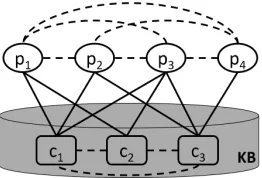
Figure 1: An example of the GMEL graph. p1. . . p4are
post nodes andc1. . . c3are candidate entity nodes. Each
post node is connected to the corresponding candidate n-odes from the knowledge base. The edges between the nodes are weighted by the similarity between them.
In this paper, we use the candidate generation method described in Guo et al.(2013). For the candi-date ranking, we use a Vector Space Model (VSM) and a Learning to Rank (LTR) as baselines. VSM is an unsupervised method and LTR is a supervised method. Both of them have achieved the state-of-the-art performances in the TAC-KBP evaluations.
The major challenge in microblog entity linking is the lack of context in the post. An ideal solu-tion is to expand the context with the posts which contain the same entity. However, automatically judging whether a name mention in two documents refers to the same entity, namely cross document co-reference, is not trivial. Here our solution is to rank the posts by their possibility of co-reference to the target one and select the most possible co-referent posts for the expansion.
CEMEL is based on the assumption that, given a name and two posts where the name is mentioned, the higher similarity between the posts the high-er possibility of their refhigh-erence and that the co-referent posts may contains useful features for the disambiguation. However, two literally similar posts may not be co-referent. If such non co-referent post is expanded to the context, noises may be included.
Take the following post as an example.
(3) AG Abbott says that bullets have crossed the border from Mexico to Texas at least four times. URL
This post is similar to post (1) because they both contains “says” and “URL”. But the Abbott in post (3) refers to the Texas Attorney General Greg Ab-bott. In this mean, the expanded context in post (3)
could mislead the disambiguation for post (1). Such noise can be controlled by setting a strict number of posts to expand the context or weighting the contri-bution of this post to the target one.
Our CEMEL method consists of the following steps: First we construct a query with the terms from the target post. Second we search for the query in a microblog post collection using a common informa-tion retrieval model such as the vector space model. Note that here we limit the searched posts must con-tain the target name mention. Then we expand the target post with top N similar posts and use a typical entity linking method (such as VSM and LTR) with the expanded context.
Figure 1 illustrates the graph of GMEL. Each n-ode of this graph represents an candidate entity (e.g. c1. . . c3) or a post of the given target name (e.g.
p1. . . p4) In this graph, each node represents an
en-tity or a post of the given target name. Between each pair of post nodes, each pair of entity nodes and each post node and its candidate entity nodes, there is an edge. The edge is weighted by the similarity be-tween the two linked nodes. Entity nodes are labeled by themselves and candidate nodes are initialized as unlabeled nodes. For the edges between post node pairs and entity node pairs, we use cosine similari-ty. For the edges between a post node and its can-didate entity nodes, we use the score given by tra-ditional entity linking methods. We use an iterative algorithm on this graph to propagate the labels from the entity nodes to the post nodes. We adapt Label Propagation (LP) (Zhu and Ghahramani, 2002) and Modified Adsorption (MAD) (Talukdar and Pereira, 2010) for the iteration over the graph.
4 Experiment
4.1 Data Annotation
Till now, few microblog entity linking data is pub-licly available. In this work, we manually annotate a data set on microblog posts2. We collect 15.6 mil-lion microblog posts in Twitter dated from January 23 to February 8, 2011. In order to compare with ex-isting entity linking on long text, we select a subset of target names from TAC-KBP2009 and inherit the knowledge base in the TAC-KBP evaluation. The
2
Figure 2: Percentage of the co-reference posts in the top N similar posts
Figure 3: Impact of expansion post number in CEMEL
TAC-KBP2009 data set includes 513 target names. We search for all the target names in the post col-lection and get 26,643 matches. We randomly sam-ple 120 posts for each of the top 30 most frequently matched target names and filter out non-English and overly short (i.e. less than 3 words) posts. Then we get 2,258 posts for 25 target names and manual-ly link the target name mentions in the posts to the TAC-KBP knowledge base.
In order to evaluate the assumption in CEMEL: similar posts tend to co-reference, we randomly s-elect 10 posts for 5 target names respectively and search for the posts in the post collection. From the search result of each of the 50 posts, we select the top 20 posts and manually annotate if they co-reference with the query post.
4.2 Settings
[image:4.612.76.292.57.158.2]We generate candidates with the method described in (Guo et al., 2013b) and use Vector Space Mod-el (VSM) (Varma et al., 2009) and Learning to Rank (LTR) (Zheng et al., 2010) as the ranking model. We
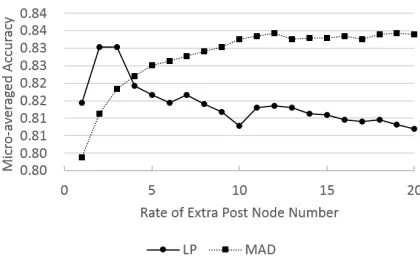
Figure 4: Accuracy of GMEL with different rate of extra post nodes
use Lucene and ListNet with default settings for the VSM and LTR implementation respectively. We use bigram feature for VSM and the feature set of (Chen et al., 2011) for LTR. LTR is evaluated with 10-fold cross validation. Given a target name, the GMEL graph includes all the evaluation posts as well as a set of extra post nodes searched from the post collec-tion with the query of the target name. We filter out determiners, interjections, punctuations, emoticon-s, discourse markers and URLs in the posts with a twitter part-of-speech tagger (Owoputi et al., 2013). The similarity between a post and its candidate en-tities is set with the score given by VSM or LTR and the similarity between other nodes is set with the corresponding cosine similarity. We employ junto3 with default settings for the iterative algorithm im-plementation .
4.3 Results
Figure 2 shows the relationship between similari-ty and co-reference. From this figure we can see that the percentage decreases with the growth of N. When the N is up to 10, about 60% of the similar posts co-reference with the query post and the de-crease speed slows down. The Pearson correlation coefficient between the percentage and the number of top N is -0.843, which shows a significant corre-lation between the two variables (with p-value 0.01 under t-test).
Figure 3 shows the impact of the extra post num-ber for the context expansion in CEMEL. We can see that the accuracies of VSM and LTR are improved
[image:4.612.80.292.226.359.2]Figure 5: Label entropy of GMEL with different rate of extra post nodes
Figure 6: Accuracy of the systems
by CEMEL. The improvements peak with 5-10 ex-tra posts. Then more exex-tra posts will pull down the accuracy.
Figure 4 shows the accuracy of GMEL. The x-axis is the rate of the extra post number over the evalu-ation post number. We can see that the accuracy of MAD increases with the number of extra post nodes at first and then turns to be stable. The accuracy of LP increases at first and drops when more extra posts are added into the graph.
Figure 5 shows the information entropy of the la-bels in LP and MAD. The curves show that the pre-diction of LP tends to converge into a small number of labels. This is because LP prefers smoothing la-belings over the graph (Talukdar and Pereira, 2010). We also evaluate our baselines on TAC-KBP2009 data set (LTR is trained on TAC-KBP2010 data set). The accuracy of VSM and LTR are 0.8338 and 0.8372 respectively, which are comparable with the state-of-the-art result (Hachey et al., 2013).
Figure 6 shows the performances of the systems on the microblog data. We set the optimal expansion post number of CEMEL and use MAD algorithm for GMEL with all searched extra post nodes. From this figure we can see that the results of VSM and LTR baselines are comparable and both of them are sig-nificantly lower than that on TAC-KBP2009 data. CEMEL improves the VSM and LTR baselines by 4.3% and 2.7% respectively. GMEL improves VSM and LTR by 8.3% and 7.5% respectively. The results of GMEL are also significantly better than CEMEL. All of the improvements are significant under Z-test withp <0.05.
5 Conclusion
In this paper we approach microblog entity linking by leveraging extra posts. We propose a context-expansion-based and a graph-based method. Eximental results on our data set show that the per-formance of traditional method drops on the mi-croblog data. The graph-based method outperform-s the context-expanoutperform-sion-baoutperform-sed method and both of them significantly improve the accuracy of tradition-al methods. In the graph-based method the modified adsorption algorithm performs better than the label propagation algorithm.
Acknowledgments
This work was supported by National Natural Science Foundation of China (NSFC) via grant 61273321, 61073126, 61133012 and the National 863 Leading Technology Research Project via grant 2012AA011102. We would like to thank to Wanx-iang Che, Ruiji Fu, Yanyan Zhao, Wei Song and several anonymous reviewers for their constructive comments and suggestions.
References
Zheng Chen, Suzanne Tamang, Adam Lee, and Heng Ji. 2011. A toolkit for knowledge base population. In
SIGIR, pages 1267–1268.
[image:5.612.81.294.242.356.2]Stephen Guo, Ming-Wei Chang, and Emre Kiciman. 2013a. To link or not to link? a study on end-to-end tweet entity linking. In Proceedings of the 2013 Conference of the North American Chapter of the As-sociation for Computational Linguistics: Human Lan-guage Technologies, pages 1020–1030, Atlanta, Geor-gia, June. Association for Computational Linguistics. Yuhang Guo, Bing Qin, Yuqin Li, Ting Liu, and Sheng
Li. 2013b. Improving candidate generation for entity linking. In Elisabeth Mtais, Farid Meziane, Mohamad Saraee, Vijayan Sugumaran, and Sunil Vadera, edi-tors, Natural Language Processing and Information Systems, volume 7934 ofLecture Notes in Computer Science, pages 225–236. Springer Berlin Heidelberg. Ben Hachey, Will Radford, Joel Nothman, Matthew
Hon-nibal, and James R. Curran. 2013. Evaluating en-tity linking with wikipedia. Artificial Intelligence, 194(0):130 – 150. ¡ce:title¿Artificial Intelligence, Wikipedia and Semi-Structured Resources¡/ce:title¿. Xianpei Han and Le Sun. 2011. A generative
entity-mention model for linking entities with knowledge base. In Proceedings of the 49th Annual Meeting of the Association for Computational Linguistics: Hu-man Language Techologies, pages 945–954, Portland, Oregon, USA, June. Association for Computational Linguistics.
Heng Ji and Ralph Grishman. 2011. Knowledge base population: Successful approaches and challenges. In
Proceedings of the 49th Annual Meeting of the Asso-ciation for Computational Linguistics: Human Lan-guage Technologies, pages 1148–1158, Portland, Ore-gon, USA, June. Association for Computational Lin-guistics.
Sayali Kulkarni, Amit Singh, Ganesh Ramakrishnan, and Soumen Chakrabarti. 2009. Collective annotation of wikipedia entities in web text. In Proceedings of the 15th ACM SIGKDD international conference on Knowledge discovery and data mining, KDD ’09, pages 457–466, New York, NY, USA. ACM.
Xiaohua Liu, Yitong Li, Haocheng Wu, Ming Zhou, Furu Wei, and Yi Lu. 2013. Entity linking for tweets. In
Proceedings of the 51th Annual Meeting of the Asso-ciation for Computational Linguistics. Association for Computational Linguistics.
P. McNamee and H.T. Dang. 2009. Overview of the tac 2009 knowledge base population track. In
Proceedings of the Second Text Analysis Conference (TAC2009).
Edgar Meij, Wouter Weerkamp, and Maarten de Rijke. 2012. Adding semantics to microblog posts. In Pro-ceedings of the fifth ACM international conference on Web search and data mining, WSDM ’12, pages 563– 572, New York, NY, USA. ACM.
Rada Mihalcea and Andras Csomai. 2007. Wikify!: link-ing documents to encyclopedic knowledge. InCIKM ’07: Proceedings of the sixteenth ACM conference on Conference on information and knowledge manage-ment, pages 233–242, New York, NY, USA. ACM. David Milne and Ian H. Witten. 2008. Learning to link
with wikipedia. InCIKM ’08: Proceeding of the 17th ACM conference on Information and knowledge man-agement, pages 509–518, New York, NY, USA. ACM. Olutobi Owoputi, Brendan O’Connor, Chris Dyer, Kevin Gimpel, Nathan Schneider, and Noah A. Smith. 2013. Improved part-of-speech tagging for online conver-sational text with word clusters. In NAACL2013, pages 380–390, Atlanta, Georgia, June. Association for Computational Linguistics.
Lev Ratinov, Dan Roth, Doug Downey, and Mike An-derson. 2011. Local and global algorithms for dis-ambiguation to wikipedia. InProceedings of the 49th Annual Meeting of the Association for Computation-al Linguistics: Human Language Technologies, pages 1375–1384, Portland, Oregon, USA, June. Association for Computational Linguistics.
Wei Shen, Jianyong Wang, Ping Luo, and Min Wang. 2012. Linden: linking named entities with knowl-edge base via semantic knowlknowl-edge. InProceedings of the 21st international conference on World Wide We-b, WWW ’12, pages 449–458, New York, NY, USA. ACM.
Partha Pratim Talukdar and Fernando Pereira. 2010. Experiments in graph-based semi-supervised learning methods for class-instance acquisition. In Proceed-ings of the 48th Annual Meeting of the Association for Computational Linguistics, pages 1473–1481, Up-psala, Sweden, July. Association for Computational Linguistics.
Vasudeva Varma, Vijay Bharat, Sudheer Kovelamudi, Praveen Bysani, Santosh GSK, Kiran Kumar N, Kran-thi Reddy, Karuna Kumar, and Nitin Maganti. 2009. Iiit hyderabad at tac 2009. InProceedings of the Sec-ond Text Analysis Conference (TAC 2009), Gaithers-burg, Maryland, USA, November.
Wei Zhang, Yan Chuan Sim, Jian Su, and Chew Lim Tan. 2011. Entity linking with effective acronym expan-sion, instance selection, and topic modeling. In Toby Walsh, editor,IJCAI 2011, pages 1909–1914.
Zhicheng Zheng, Fangtao Li, Minlie Huang, and Xiaoyan Zhu. 2010. Learning to link entities with knowledge base. InNAACL2010, pages 483–491, Los Angeles, California, June. Association for Computational Lin-guistics.