Decaf: Eliminating cofactors through point
compression
Mike Hamburg
Rambus Cryptography Research [email protected]
This is a minor revision of a CRYPTO 2015 paper, c2015 IACR
Abstract. We propose a new unified point compression format for Ed-wards, Twisted Edwards and Montgomery curves over large-characteristic fields, which effectively divides the curve’s cofactor by 4 at very little cost to performance. This allows cofactor-4 curves to efficiently implement prime-order groups.
1
Introduction
“Let G be a group of prime order q.” This defines the requirements for the
main group in many cryptographic systems [1,9,16,18,19], most often with the intention thatGwill be the group of points on an elliptic curve. However,
prac-tical implementations usually do not quite deliver a group of prime order q, at least not without significant caveats. Implementations of prime-order curves usu-ally have incomplete or variable-time addition formulas. For example, OpenSSL 1.0.1f, LibTomCrypt 1.17, PolarSSL 1.3.9 and Crypto++ 5.6.2 all use a branch to decide whether the inputs to their point-addition functions are equal, so that they can call the doubling function instead. Some of these libraries also have branches to detect cases where two points add to the identity point, or where one of them is the identity point. Even if this does not introduce timing varia-tions in ECDH or ECDSA signing, it may introduce timing variavaria-tions in other systems. Furthermore, there is a special case when encoding and decoding the identity point, which is at infinity in the Weierstrass model.
This problem can be mitigated by using complete addition laws. While such laws exist for prime-order curves [6,11], they are faster and much simpler for other elliptic curves such as (twisted) Edwards curves [14,5,4], Hessian curves [15], Jacobi quartics [8] or Jacobi intersections [26,20]. These curves have acofactor, denoted h, where the order of the curve is h·q for some large prime q. The cofactor h is always divisible by 3 for Hessian curves, and by 4 for the other models.
1.1 Pitfalls of a cofactor
Small-subgroup attacks. Here an attacker sends a point whose order dividesh, and a hapless user multiplies it by some scalar and uses the result. This will either result in a point known to the attacker (if the scalar is known to be divisible byh), or worse it may give the attacker information about the scalar. If the scalar is a private key, then leaking a few bits is a minor problem, though it is devastating to password-authenticated key exchange (PAKE) protocols [13].
Leaking a few bits of a scalar is a much more serious problem if the scalar is arithmetically related to a private key. Menezes and Ustaoglu used scalar leaks through the cofactor in their attack [27] on MQV [25] and HMQV [24]. HMQV was designed to avoid this weakness, but not successfully.
A related attack is to replace a pointP withP+T, whereT lies in a small subgroup. If the user multiplies by a scalars, they will get sP+sT instead of sP, where the differencesT gives away the low-order bits ofs. Therefore, it isn’t always enough to reject points in the small subgroup.
The usual defense against these attacks is to multiply certain points byh, and possibly to abort the protocol if the result is the identity. But one must decide which points to take these steps on, and the extra factor of h can complicate the arithmetic. In a prime-order group, this attack is easier to mitigate: at most, one must check for the identity point in the proper places.
Non-injective behavior. Multiplication by a scalar is a 1-to-1 function if the scalar is relatively prime to the group order. In a prime-order group, this is any scalar in [1, q−1], and is true of a random scalar with high probability. The same is not true in a composite-order group. This means that adding a small-order element to e.g. a public key can produce the same result, possibly resulting in identity misbinding. This can be mitigated by making scalars relatively prime toh— exactly the opposite of techniques which clear the cofactor.
Covert channels. Non-injective behavior may make it easier to exfiltrate data through the cofactor component, even in protocols where behavior is otherwise deterministic.
Implementation-defined behavior. Some systems, such as Ed25519 [7], do not specify behavior when the inputs have a nonzero h-torsion component. In par-ticular, Ed25519 signature verification can be different for batched vs singleton signatures, or between different implementations. This can cause disruption in protocols where all parties must agree on whether a signature is valid, such as a blockchain or Byzantine agreement. In other cases, it may make it easier to fingerprint implementations.
1.2 Our contribution
The cofactor pitfalls can be avoided by using a related group of prime order q. The most obvious choice is the order-q subgroup of the elliptic curve. But validating membership in that subgroup is slow and complex, requiring either an extra scalar multiplication, checking for roots of division polynomials, or inverting multiple isogenies.
We propose two new ways to build a group of prime order q based on an Edwards or twisted Edwards curveE of order 4q, thus eliminating the cofactor. In the first proposal of this paper, the group is E/E[4]. That is, two points on the curveE are considered equal if their difference has small order (dividing 4). This requires three changes:
– The function which checks equality of group elements must be modified. – The function which encodes points before sending them must encode these
equal points as equal sequences of bits.
– The function which decodes points must be designed to accept only the possible outputs of the encoding function.
Our second, improved proposal uses a different groupψ(E), which in the usual case will be 2E/E[2]. That is, only the even (2q-order) points ofE are used, and two points are considered the same if they differ by a point of order 2. This requires the same three changes.
The difficult parts are the encoding and decoding routines, which are the main contributions of this paper. We describe the encoding algorithm as “com-pression” because its output is an element of the underlying fieldFrather than
the usual two elements. In fact, it will be a “non-negative” element ofF, which allows us to save an additional bit.
It is important to note that internally, the points used in the first proposal can be any points onE, and in the second proposal they can be any even points onE. Points which differ by a point of order 4 (resp. 2) are considered equal, and will be encoded to binary strings in the same way. This is similar to using projective coordinates: two values in memory may be considered same point and encode to the same binary string, even though the X, Y andZ coordinates are different. This is how using a prime-order ψ(E) instead of E mitigates small-subgroup attacks. Points of small order can appear internally, but they are considered equal to the identity element. Likewise P+T can appear internally with T in a small-order subgroup, but it is considered equal to P and is encoded in the same way.
Designers often use untwisted Edwards, twisted Edwards or Montgomery curves. Montgomery curves give simple Diffie-Hellman protocols, and twisted Edwards curves give a speed boost but have incomplete formulas in fields of order 3 (mod 4). Our second proposal adds flexibility for curve choice. The same wire format can be used for a Montgomery curve as for its 4-isogenous Edwards and twisted Edwards curves. Furthermore, for twisted Edwards curves of cofactor 4, the subgroup we use avoids the incomplete cases in the addition laws.
Our groupψ(E) and encoding algorithm can be used on curves with cofactor greater than 4. It still divides the cofactor by 4, so ψ(E) will not have prime order. Additionally,ψ(E) is not of the form 2E/E[2] ifE has full 2-torsion.
We call this technique “Decaf” after the procedure which divides the effect of coffee by 4. We have built reference and optimized implementations of Decaf, and have posted them online at http://sourceforge.net/p/ed448goldilocks/ code/ci/decaf/tree/. Our code carries out essentially all the operations de-scribed in this paper and appendices on the curveEd448-Goldilocks, reducing the cofactor from 4 to 1.
2
Definitions and notation
Finite field. LetFbe a finite field whose characteristic is neither 2 nor 3.
Even elements. An elementgof an Abelian groupGis said to beevenifg= 2h
for someh∈G. The even elements form a subgroup denoted 2G.
Torsion elements. An elementgof a groupGis ak-torsion element ifk·g= 0G. The k-torsion elements of an Abelian group form a subgroup usually denoted
G[k]. The k-torsion subgroup of an elliptic curve over a finite field has order
dividingk2; in particular, the 2-torsion subgroup has size 1, 2 or 4.
Projective space. Denote by Pn(F) the n-dimensional projective space over F.
Its elements are written as ratios (X : Y : Z : . . .), usually in upper-case. As a traditional short-cut, we usually write the elements of P2(F) as a lower-case
tuple (x, y) equivalent to (x:y: 1), with the understanding that the equations involving these points may have be extended to cover “points at infinity” of the form (X :Y : 0).
Twisted Edwards curves. Twisted Edwards curves have two parameters,a and d. They are specified as
Ea,d :=(x, y)∈P2(F) :a·x2+y2= 1 +d·x2·y2
Another form, extended homogeneous coordinates [22], is used for high perfor-mance and simpler formulas:
We will use “untwisted” to mean a = 1. “Twisted” is the general case, which we sometimes narrow to a = −1. The identity point of any Edwards curve is (0,1) = (0 : 1 : 1 : 0).
An Edwards curve is called “complete” ifdandadare nonsquare inF, which also implies thatais square. A complete Edwards curve has no points at infinity, and supports fast addition formulas which are complete in that they compute the correct answer for any two input points [5].
Montgomery curves. A Montgomery curve has two parameters, calledAandB. It has the form
MB,A:=(u, v)∈P2(F) :Bv2=u·(u2+Au+ 1)
The identity point of this curve is a point at infinity, namely (0 : 1 : 0). The curve is “untwisted” ifB = 1. Over 3 (mod 4) fields, any twisted Montgomery curve can be put into a form withB= 1, but over 1 (mod 4) fields, this is not true. In particular,B 6= 1 is potentially useful to handle the twist of Curve25519, which has cofactor 4.
Jacobi quartic curves. A Jacobi quartic curve has two parameter, calledA and e, and is defined by
Je,A:=(s, t)∈P2(F) :t2=es4+ 2As2+ 1
with an identity point at (0,1). The curve is “untwisted” ife= 1. We will only consider curves withe=a2in this paper; such curves always have full 2-torsion.
The curve parameters. As a corollary of Ahmadi and Granger’s work [2], for any a, d∈F\{0,1}, the following curves are isogenous:
Ea,d; E−a,d−a; Ma,2−4d/a; Ja2,a−2d
Specifically, the Edwards, twisted Edwards and Montgomery curves are all 2-isogenous to the Jacobi quartic, and thus 4-2-isogenous to each other. We will write the 2-isogenies explicitly in Sections 4.1 and 5. Since our point encoding works on this family of isogenous curves, we will consider these specific curves parameterized byaandd.
We will writeEas a shorthand forEa,d,J forJa2,a−2d, andMforMa,2−4d/a.
Coset. In an Abelian group G, the coset of a subgroup H ⊂Gwith respect to an elementg∈GisH+g:={h+g:h∈H}.
Non-negative field elements. Let p > 2 be prime. Define a residue x ∈ F =
Z/pZto be “non-negative” if the least absolute residue forxis in [0,(p−1)/2],
We chose this definition of non-negative because it is easy to evaluate, and it works over every odd-characteristic field. Alternative choices would be to dis-tinguish by the low bit, or for fields 3 (mod 4), by the Legendre symbol. We avoided the Legendre symbol because it restricts field choices and is somewhat expensive to compute.
Encoding. For setsS and T, and encoding fromS to T is an efficient function enc :S→T with efficient left-inverse dec :T →S]{⊥}, which fails by returning
⊥on every element ofT\enc[S]. We are interested in an encoding from an elliptic curve E over the field F to a binary set {0,1}n for some fixed n. We assume
that the implementer has already chosen an encoding from F to binary. Since
encodings can be composed and distributed over products, it suffices to encode to a set such asF, F2or F× {0,1} which has a natural encoding to binary.
Compression. Since most elliptic curve forms are defined as subsets of P2(F),
they admit a straightforward encoding toF2(and thence to binary) with a finite
number of special cases corresponding to points at infinity. We call an encoding “point compression” or simply “compression” if its codomain is smaller thanF2
when naturally encoded to binary. Most of the encoding algorithms in this paper map to the set For to its non-negative elements, and so are point compression
functions. The set of non-negative elements ofFgenerally requires one fewer bit to encode thanFitself.
3
An Edwards-only solution
There is a simple way to remove the a cofactor of 4 from an untwisted Edwards curve. A complete Edwards curveEa,d has a 4-torsion subgroup of size exactly 4, whose coset with respect toP = (x, y) is
E[4] +P =
(x, y); (y/√a,−x√a); (−x,−y); (−y/√a, x√a)
Of this coset, there is exactly one representative point such thaty and xy are both non-negative, andxis nonzero.1We can define the encoding ofP to be the
y-value of this representative. Note that the representation of the identity point is (0,−1), so the identity point encodes to 0∈F.
Similar solutions apply to incomplete Edwards curves. For curves whose 4-torsion group is Z4, there is exactly one representative with y and y/x both
finite and non-negative. For curves with full 2-torsion, there is exactly one rep-resentative withxfinite and bothyand (y2+ax2)/xy non-negative.
The usual addition formulas for incomplete Edwards curves produce the wrong answer (0/0) for operations involving points at infinity, but are otherwise complete. Therefore, if the decoding operation chooses a coset representative in a subgroup that contains no points at infinity (e.g. in the prime-order subgroup),
1
then it is safe to use these curves. However, there is not an obvious way to make this section’s decoding formulas restrict to a subgroup.
Furthermore, this format is not compatible with the fast, simple Montgomery ladder on Montgomery curves. We will remedy these problems using a slightly more complex encoding.
4
A solution from the Jacobi quartic
On the Jacobi quarticJa2,a−2d, the coset of the 2-torsion group with respect to
P = (s, t) is exactly
J[2] +P =(s, t); (−s,−t); (1/as,−t/as2); (−1/as, t/as2)
So a similar solution applies on J modulo its 2-torsion: we can encode a point P by thes-coordinate of the coset representative (s, t), where sis non-negative and finite, andt/sis non-negative or infinite2. Call this encoding enc
J(P), and call the corresponding decoding algorithm decJ. Note that the identity point encodes to 0∈F.
4.1 From the Jacobi quartic to Edwards curves
The curvesEa,d andJa2,a−2d are isogenous by the map
φa(s, t) =
2s
1 +as2,
1−as2
t
with dual ¯φa(x, y) =
x
y,
2−y2−ax2
y2
Note that swapping (a, d) with (−a, d−a) results in the same curve Ja2,a−2d,
and gives an isogenyφ−a to the curveE−a,d−a.
We will need the following lemma, whose trivial proof is omitted:
Lemma 1. Let φ be a homomorphism from an abelian group G to another
abelian group H, and let G0 be a subgroup of G. Then φ acts as a well-defined
homomorphism from G/G0 to φ[G]/φ[G0] which is a subgroup ofH/φ[G0].
Fur-thermore, if kerφ⊆G0, thenφacts as an isomorphism between these groups.
Since the isogeny φa is a group homomorphism whose kernel is inJ[2], we can extend the encoding onJ/J[2] to an encoding onφa[J]/φa[J[2]]:
enc(P) := encJ(φ−a1(P)) with dec(b) :=φa(decJ(b))
The lemma shows that both encoding and decoding are well-defined. In partic-ular, P has two preimages under φa, but they represent the same element of
J/J[2] and have the same encoding under encJ.
Let ψ(E) denote the group φa[J]/φa[J[2]]. If the 4-torsion group of E is cyclic, thenψ(E) is more simply expressed as 2E/E[2].
2
Checking the sign ofs/t works about as well as t/sin our formulas; the choice of
4.2 Encoding
When encoding fromψ(E), we are given a pointP = (x, y) in the image ofφaq onE. We need to efficiently computeswhere (s, t) =φ−1
a (x, y). We know that
x= 2s/(1 +as2) so s= (1±p1−ax2)/ax
Also,
y= (1−as2)/t sot/s= (1−as2)/sy
=∓2p1−ax2/xy
It turns out to be particularly straightforward to compute this encoding from the popular extended homogeneous coordinates. Explicit formulas are given in Appendix A.1.
4.3 Decoding
To decode, we are givensand must compute
(x, y) = 2s 1 +as2,
1−as2
p
a2s4+ (2a−4d)s2+ 1
!
with the square rootttaken so thatt/sis non-negative. This requires the “inverse square root trick” to compute 1/s and t at the same time, with care to avoid division by 0. The exact formulas are given in Appendix A.2. The input must be rejected ifs is negative or if it is not a field element (eg. if it is the binary encoding of a number≥p), or if the square root doesn’t exist.
It is simplest to decode to projective form, so that the denominators need not be cleared. It is also relatively easy to decode to affine form by batching a computation of 1/(1 +as2) with the square root. Decoded points always have a
well-defined affine form on curves with cofactor exactly 4, because those curves have no points at infinity in the image ofφa.
4.4 Completeness
Importantly, if the cofactor of J is exactly 4, then the imageψ(E) contains no points at infinity. An easy way to see this is that ifφa(s, t) were at infinity, then
¯
4.5 Equality
Ordinarily, testing for equality in a quotient groupG/Hrequires testing whether P =Q+H for eachH ∈H. But if the cofactor is exactly 4, then equality testing is actually easier onψ(E) than onE. In this case, two points (X1:Y1:Z1:T1)
and (X2:Y2:Z2:T2) are equal if and only if
X1·Y2=X2·Y1
This is because X/Y is the s-coordinate of the image Qof ¯φa(X : Y : Z :T) on J. The only other point with that s-coordinate has a nontrivial 2-torsion component (it is (0,−1)−Q), but the image ( ¯φa◦φa)[J] is the prime-order subgroupJ[q].
In particular, for a curve of cofactor exactly 4, a point (X : Y : Z : T) is equal to the identity precisely whenX = 0.
4.6 Security
Using Decaf gives the security benefits of a prime-order group without weakening well-studied cryptographic assumptions. In particular:
– The discrete logarithm problem is equivalent onE,J andψ(E). The same is true for computational Diffie-Hellman, gap DH, static DH, strong DH, and should hold for similar computation problems.
– If the Decaf groupψ(E) has prime orderq, then the DDH problem is equiva-lent onE[q],J[q] andψ(E). The same is true for decision linear, and should hold for similar decision problems. These decision problems are easy on groups with a small cofactor, such asE itself.
The straightforward proofs of these reductions are omitted.
4.7 Batch encoding
On a server which needs to generate signatures and/or ephemeral keys at prodi-gious rates, it may be advantageous to batch the point encoding algorithm.
The encoding algorithm listed above cannot be batched easily because of the inverse square root computation. However, the square root can be avoided if we wish to compress 2P instead ofP, that is, ifP is computed as (k/2 modq)·B instead ofk·B. In this case, we can simply evaluate the dual 2-isogeny ¯φ from
E to J:
– Compute 1/(xy) andt/s= (2−y2−ax2)/xy.
– Ift/sis non-negative, then output |s|=|x/y|=|x2/xy|.
– Otherwise output|1/s|=|y/x|=|y2/xy|.
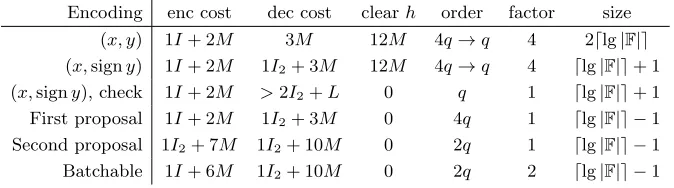
Encoding enc cost dec cost clearh order factor size (x, y) 1I+ 2M 3M 12M 4q→q 4 2dlg|F|e (x,signy) 1I+ 2M 1I2+ 3M 12M 4q→q 4 dlg|F|e+ 1 (x,signy), check 1I+ 2M >2I2+L 0 q 1 dlg|F|e+ 1 First proposal 1I+ 2M 1I2+ 3M 0 4q 1 dlg|F|e −1 Second proposal 1I2+ 7M 1I2+ 10M 0 2q 1 dlg|F|e −1 Batchable 1I+ 6M 1I2+ 10M 0 2q 2 dlg|F|e −1
Fig. 1.Cost of encoding and decoding algorithms.M = multiply,I= inversion,I2= inverse square root,L= Legendre symbol. Squarings are treated as 0.8Mand multiplies by constants as 0.2M, but columns are rounded to the nearestM.
4.8 Performance
Overall, Decaf’s performance is very similar to a traditional point compression scheme. Encoding and decoding take one field exponentiation each.
A comparison to existing point encoding algorithms is shown in Figure 1. It shows:
– The encoding and decoding costs.
– The cost to clear the cofactor if one remains.
– The order of the resulting points on the curve, with 4q → q meaning a cofactor that will most likely be cleared.
– The extra factor induced by encoding and cofactor clearing. – The size in bits of the encoding’s codomain.
If inversion I is implemented using Fermat’s little theorem, it is likely to be slightly more expensive than an inverse square rootI2. In practice,
implementa-tions that need bothIandI2with|F| ≡3 (mod 4) often implement inversion as
x/(±√x2)2, costingM+ 2Smore, and this is usually close to optimal anyway.3
The (x, y) method is uncompressed, and (x,signy) is classically compressed. These methods do not remove the cofactor, so many protocols will remove it at the cost of two doublings≈12M. This changes the order of the internal points from 4q to q. The third row is compression with order checking. The order checking can be accomplished by inverting a 2-isogeny twice: the first inversion requires an inverse square root, but the second requires only checking that the root exists, i.e. computing a Legendre symbol.
The first proposal (Section 3) is a quotient group on an untwisted Edwards curve. It is slightly more expensive on a twisted Edwards curve, and is dangerous for such curves when|F| ≡3 (mod 4) because the internal points can have order
4. The second proposal (Section 4) avoids this problem, and gives an encoding
compatible with several curve models, but at the cost of about 8 extra field multiplications and correspondingly higher complexity.
A downside of methods which include an inverse square rootI2 is that they
cannot use an EGCD-based inversion method. They also cannot be batched using Montgomery’s batch inversion trick, which accomplishesNinversions using one inversion and 3(N −1) multiplications. The batchable encoding method (Section 4.7) replaces the inverse square root in encoding with an inversion but multiplies by an extra factor of 2.
It is seen that our methods cost less in total than point compression plus clearing the cofactor. Even for operations which do not need to clear the cofactor (eg. key generation), the overhead from our encoding is relatively small. Fast key generation operations cost on the order of 3M per bit of the curve’s order, so the difference in encoding costs is well under 1% for cryptographically useful curves.
5
Compatibility with Montgomery curves
The Montgomery ladder on Montgomery curves is a very simple and fast way to implement scalar multiplication for Diffie-Hellman (DH) key exchange. In its simplest form, the ladder discards sign information, making it inherently incompatible with any point encoding format that conveys sign information. Furthermore, it does not distinguish between the curve and its quadratic twist, necessitating the use of twist-safe curves [3]. However, we would like to inter-operate with the Montgomery ladder with minimal changes. For example, if a protocol uses a (u,signv) format, then the ladder can be modified to compute the sign, or the protocol can be changed to discard the sign bit for DH outputs.
We will show how to use Decaf with the Montgomery ladder on the curve
Ma,2−4d/a:av2=u·(u2+ (2−4d/a)·u+ 1)
where conveniently the value of (A+ 2)/4 is 1−d/a. The curveMa,2−4d/a is isogenous toJa2,a−2d by the maps
φ(s, t) =
1
as2,−
t as3
and ¯φ(u, v) =
1−u2
2av ,
a(u+ 1)4+ 8du(u2+ 1) 4a2v2
More simply,φ(s, t) = (as2, ts) +T
2, where the 2-torsion pointT2can be ignored
due to the quotient. This means that Montgomery ladder implementations can take input in Decaf format, simply by starting the ladder atu=as2.
encoding. We give the full details of how to do this in Appendix B. Some of the formulas in that section may be of independent interest.
It is also possible (and complicated) to do these things with existing point formats such as (u,signv), but almost no implementations do. Instead, since the Montgomery ladder is used almost exclusively for Diffie-Hellman, most imple-mentations clear the cofactor and output only u, losing the information about v. This leaves the Montgomery ladder code very simple. It is also easy to do this with the Decaf encoding, by clearing the cofactor4 and outputting|1/√au|.
The implementation should abort on u = 0 and u = ∞, which lie in a small subgroup. This will also reject points on the twist, because even points on the twist have eitheru= 0, u=∞orau nonsquare.
An Edwards or twisted Edwards implementation can interoperate with this simpler behavior simply by computing|s|=|x/y|, instead of encoding any sign information.
6
Hashing to the curve
Some protocols require a map fromFto a curve [10,19,23], either to build a hash
function which is either indifferentiable from a random oracle, or at least suit-able for encoding computational Diffie-Hellman (CDH) challenges in the random oracle model. We could do this by using Elligator 1 or 2 onEorM. Since Decaf only operates subgroups on these curves, we would need to double the output of the map to make sure it is in the subgroup.
However, there is a better solution. We can instead use Elligator 2 on the Jacobi quartic J, since it has a point of order 2. Then we can translate this point to the Edwards and Montgomery curves using the isogeny. That way, the groups and maps implemented by these curves are all compatible. The formulas for Elligator 2 are found in Appendix C. It is important to note that Elligator 2 provides a 1:1 map to a group of order h·q, not of order (h/4)·q. Therefore, the map be up to 4:1 once the isogeny and quotient are applied.
This map is suitable for deriving CDH challenges from a random oracle. That is, it is still suitable for use in derivatives of BLS [10], SPAKE2 [1]5, SPEKE [23]
and possibly Dragonfly [19]6. These protocols do not require a random oracle
map toG. They only require a map from strings to the curve which is at most k-to-1 for small k, hits at least a 1/` fraction of the points for small `, and whose inverse is efficiently sampleable. When a full random oracle map toGis
4
Clearing the cofactor takes one doubling on a cofactor-4 curve, because of the isogeny. Another option would be to quotient out the cofactor, by choosing the lexicograph-ically greater of|p
u/a|and|1/√au|. But this is more complex and doesn’t reject points on the twist.
5
Replacing SPAKE2’sH(password)·(M, N) with an Elligator-like map results in a protocol with the same properties but no static-CDH assumption.
6
required, Brier et al.’s result [12] shows that mapping two independently chosen field elements and adding them is sufficient.
It is still possible to use Elligator 2 as a partial steganographic encoding for public keys, as in EKE. One may invert the isogeny to obtain a point on
J, randomize its 2-torsion components, and apply the inverse map defined by Elligator 2. Unfortunately, this requires an extra randomization step and an extra inverse-square-root operation compared to the original Elligator 2.
7
Removing larger cofactors
Quotient groups can be used to remove larger cofactors. However, it is not im-mediately clear which point should be the distinguished one. Simply using the least lexicographic encoding would work. It would take linear time in hto scan every point in the coset, but still only one inversion because of Montgomery’s batch inversion trick. Such a linear-time scan would be required both to encode and to decode a point.
However, in the case of complete Edwards curvesE with E[8] isomorphic to Z8, there is a simpler way to distinguish one point from a coset. In this case,J
has a small subgroup isomorphic to Z2×Z4. The Z2-component is the kernel
of the isogeny, so that the Z4 component maps to the 4-torsion subgroup of E.
To choose a distinguished point in a cosetS=E[8] +P it suffices to choose one of the two points (x, y) withxy non-negative and y 6= 0. This chooses a point moduloE[2], and then one can run the encoding forE/E[2] to produce the final encoding. It is possible to do this with only one inverse square root. To decode the point, one must decode it to affine form instead of projective, and check that xy is non-negative.
This allows Decaf to operate on Ed25519 or the isogenous curveE1,−121655.
Since over a 1-mod-4 field, Ea,d and E−a,−d are isomorphic by the map x → x√−1, arithmetic on either curve can still take advantage of the faster complete twisted Edwards formulas.
8
Future work
We do not believe that Decaf is the last word in cofactor-reducing compression algorithms. Additionally, an improved encoding scheme with simpler formulas would make this technique more compelling.
9
Conclusion
point compression techniques, though it may improve performance by making faster curves safe. Furthermore, we have shown how to implement an Elligator-like map fromFtoG, which is also compatible with all 4 models.
10
Acknowledgements
The author thanks Mark Marson, Steven Galbraith and the anonymous reviewers for their editorial suggestions.
References
1. Michel Abdalla and David Pointcheval. Simple password-based encrypted key exchange protocols. Topics in cryptology–CT-RSA 2005, pages 191–208, 2005. 2. Omran Ahmadi and Robert Granger. On isogeny classes of edwards curves over
finite fields. Cryptology ePrint Archive, Report 2011/135, 2011. http://eprint. iacr.org/2011/135.
3. Daniel Bernstein. Curve25519: new Diffie-Hellman speed records. Public Key Cryptography-PKC 2006, pages 207–228, 2006.
4. Daniel Bernstein, Peter Birkner, Marc Joye, Tanja Lange, and Christiane Peters. Twisted edwards curves. Progress in Cryptology–AFRICACRYPT 2008, pages 389–405, 2008.
5. Daniel Bernstein and Tanja Lange. Faster addition and doubling on elliptic curves. InAdvances in cryptology–ASIACRYPT 2007, pages 29–50. Springer, 2007. 6. Daniel Bernstein and Tanja Lange. Complete addition laws for elliptic curves,
2009. http://cr.yp.to/talks/2009.04.17/slides.pdf.
7. D.J. Bernstein, N. Duif, T. Lange, P. Schwabe, and B.Y. Yang. High-speed high-security signatures. Cryptographic Hardware and Embedded Systems, CHES 2011, 2011.
8. Olivier Billet and Marc Joye. The jacobi model of an elliptic curve and side-channel analysis. In Applied Algebra, Algebraic Algorithms and Error-Correcting Codes, pages 34–42. Springer, 2003.
9. Dan Boneh, Shai Halevi, Mike Hamburg, and Rafail Ostrovsky. Circular-secure en-cryption from decision diffie-hellman. InAdvances in Cryptology–CRYPTO 2008, pages 108–125. Springer, 2008.
10. Dan Boneh, Ben Lynn, and Hovav Shacham. Short signatures from the weil pairing. InAdvances in Cryptology?ASIACRYPT 2001, pages 514–532. Springer, 2001. 11. Joppe W. Bos, Craig Costello, Patrick Longa, and Michael Naehrig. Selecting
elliptic curves for cryptography: An efficiency and security analysis. Cryptology ePrint Archive, Report 2014/130, 2014. http://eprint.iacr.org/.
12. Eric Brier, Jean-S´ebastien Coron, Thomas Icart, David Madore, Hugues Randriam, and Mehdi Tibouchi. Efficient indifferentiable hashing into ordinary elliptic curves. InAdvances in Cryptology–CRYPTO 2010, pages 237–254. Springer, 2010. 13. Dylan Clarke and Feng Hao. Cryptanalysis of the dragonfly key exchange protocol.
IET Information Security, 8(6):283–289, 2014.
14. H.M. Edwards. A normal form for elliptic curves.Bulletin-American Mathematical Society, 44(3):393, 2007.
16. Eu-Jin Goh, Stanislaw Jarecki, Jonathan Katz, and Nan Wang. Efficient signature schemes with tight reductions to the diffie-hellman problems. Journal of Cryptol-ogy, 20(4):493–514, 2007.
17. Mike Hamburg. Fast and compact elliptic-curve cryptography. Cryptology ePrint Archive, Report 2012/309, 2012. http://eprint.iacr.org/2012/309.
18. Feng Hao and Peter Ryan. J-pake: Authenticated key exchange without pki. Cryp-tology ePrint Archive, Report 2010/190, 2010. http://eprint.iacr.org/. 19. Dan Harkins. Dragonfly: A pake scheme, 2012. http://www.ietf.org/
proceedings/83/slides/slides-83-cfrg-0.pdf.
20. H¨useyin Hı¸sıl, Kenneth Wong, Gary Carter, and Ed Dawson. Faster group op-erations on elliptic curves. Cryptology ePrint Archive, Report 2007/441, 2007. http://eprint.iacr.org/.
21. Huseyin Hisil, Kenneth Koon-Ho Wong, Gary Carter, and Ed Dawson. Jacobi quartic curves revisited. Cryptology ePrint Archive, Report 2009/312, 2009.http: //eprint.iacr.org/2009/312.
22. H¨usseyin Hı¸sıl, Kenneth Wong, Gary Carter, and Ed Dawson. Twisted edwards curves revisited.Advances in Cryptology–ASIACRYPT 2008, pages 326–343, 2008. 23. David P Jablon. Strong password-only authenticated key exchange. ACM
SIG-COMM Computer Communication Review, 26(5):5–26, 1996.
24. Hugo Krawczyk. Hmqv: A high-performance secure diffie-hellman protocol. In Advances in Cryptology–CRYPTO 2005, pages 546–566. Springer, 2005.
25. Laurie Law, Alfred Menezes, Minghua Qu, Jerry Solinas, and Scott Vanstone. An efficient protocol for authenticated key agreement.Designs, Codes and Cryptogra-phy, 28(2):119–134, 2003.
26. P-Y Liardet and Nigel P Smart. Preventing spa/dpa in ecc systems using the jacobi form. InCryptographic Hardware and Embedded Systems?CHES 2001, pages 391– 401. Springer, 2001.
27. Alfred Menezes and Berkant Ustaoglu. On the importance of public-key valida-tion in the mqv and hmqv key agreement protocols. In Progress in Cryptology-INDOCRYPT 2006, pages 133–147. Springer, 2006.
28. Peter Montgomery. Speeding the pollard and elliptic curve methods of factoriza-tion. Mathematics of computation, 48(177):243–264, 1987.
A
Explicit formulas for encoding and decoding
A.1 Encoding
We wish to compute
s= (1±p1−ax2)/ax and t/s=∓2p1−ax2/xy
We know from the curve equation that
(1−ax2)·(1−y2) = 1 +ax2y2−(y2+ax2) = (a−d)x2y2
so that
p
1−ax2/xy=±p
(a−d)/(1−y2)
Observe that in extended homogeneous coordinates,
and therefore
1/x= (aZX−dY T)/(Z2−Y2)
This leads to a relatively simple encoding formula given an inverse-square-root algorithm:
r←1/p(a−d)·(Z+Y)·(Z−Y)
u←(a−d)·r
r← −rif −2·u·Z is negative
s← |u·(r·(aZ·X−d·Y ·T) +Y)/a|
In theory, this formula has an exceptional case because it divides by 0 when y =±1. But if the inverse square root function returns r= 0 in this case, the correct answer s= 0 will emerge.
A.2 Decoding
To decode toEa,d, we must recover
(x, y) = 2s 1 +as2,
1−as2
p
a2s4+ (2a−4d)s2+ 1
!
wherepa2s4+ (2a−4d)s2+ 1/sis non-negative. We can compute this as:
Reject unless s=|s|
X←2·s
Z←1 +a·s2 u←Z2−4d·s2
v←
1/√u·s2 ifu·s2is square and nonzero
0 ifu·s2= 0
[reject] ifu·s2is not square
v← −v ifu·v is negative
w←v·s·(2−Z)
w←w+ 1 ifs= 0
Y ←w·Z
T ←w·X
P←(X :Y :Z:T)
B
The modified Montgomery ladder
We use a modified version of the traditional Montgomery ladder on Montgomery curves [28]. This uses our knowledge ofs0 such that the initial stateu0 =as20.
It converts
(s0, U1:Z1, U2:Z2) where (s0:v0: 1) + (U1:V1:Z1)−(U2:V2:Z2) = 0M
for some unknownv0, V1, V2, to
(s0, U3:Z3, U4:Z4)
where
(U4:V4:Z4) = 2(U2:V2:Z2) and (U3:V3:Z3) = (U1:V1:Z1)+(U2:V2:Z2)
again with theV components unknown. Note that onMa,2−4d/a, the coefficient (A+ 2)/4 = 1−d/a. The ladder works as follows:
E ←U2+Z2
F ←U2−Z2
G←U1+Z1
H ←U1−Z1
K←E2−F2 U3←(EH+F G)2
Z3←a·(s0·(EH−F G))2
U4←E2·F2
Z4←K·(F2+ (1−d/a)·K)
The computation of the common subexpressionsEH, F G, E2 andF2 has been
removed for brevity. The salient feature of this ladder is that it computes as inter-mediate resultsS3 andW3 which are square roots ofX3andZ3/arespectively.
Our implementation allocates is temporary variables in a way that prevents these intermediates from being overwritten until the next iteration of the ladder. This means that they will be available to the encoding algorithm.
B.1 Encoding
At the end of the Montgomery ladder, we need to encode the point stored in U4 : Z4. Recall that a point on Ma,2−4d/a is the image of an isogeny from
Ja2,a−2d:
φ((s, t)) = (as2, st) +T2 with inverse φ−1((u, v) +T2) = (
p
u/a, v/pu/a)
√
u2and its inverse from the ladder state, and whethert2/s2=av2/u2is positive
given that t0/s0 =av0/u0 is known to be positive. Fortunately, the invariants
of the ladder make this possible. From [17], Appendices A.2 and A.3, we know that if
(u0, v0) + (u1, v1) + (u2, v2) = 0 on M
that is, if these points lie on a line, then
2av1v2= (u1u2+ 1)(u1+u2)−u0(u1−u2)2+ 2Au1u2 (1)
and symmetrically, and also
4(u0+u1+u2+A)(u0u1u2) = (1−u0u1−u1u2−u0u2)2 (2)
Adding (2) to 2u0·(1), we have
4au0v1v2= (1−u1u2−u0u2+u0u1)·(1−u1u2+u0u2−u0u1) (3)
and symmetrically. Multiplying and dividing symmetric copies of this equation, we obtain
4au0u1v22/u2= (1−u1u2−u0u2+u0u1)2
so that
v2
u2
= 1−u1u2−u0u2+u0u1
±2√au0u1u2
This equation cannot determine the sign of the square root, but (3) shows it to be consistent for all three points on the line.
This means that it is enough to compute ±1/√au0u1u2. This will allow
us to determine av0/u0 to adjust the sign of the square root. It will allow us
to check whether av2/u2 is negative, in which case we should output 1/
√
au2
instead ofpu2/a. Furthermore, the input points0 is
p
u0/a, and the modified
Montgomery ladder state contains either√au1 or
√
au2, depending on the last
bit of the ladder. This allows us to compute pu2/a or its inverse from the
ladder state and 1/√au0u1u2 with no additional field exponents. In the actual
computation, u1 andu2 are given in projective form, but this does not greatly
complicate matters because the equations are nearly homogeneous.
Special cases Ifu2is zero or infinite, then it is a 2-torsion point and the output is
zero. Likewise ifu0= 0, then the base point is the identity and again the output
will always be zero. Ifu1 is zero or infinite, then the output is either the initial
point or its inverse, depending on whether the last step in the ladder swapped u1andu2. So the output should be eithers0 or|1/as0|.
Twist rejection The above procedure will reject points which are on the twist of
M instead of onM itself, becauseau0u1u2 will not be square for such points.
au0u1u2= 0 a square number. This quirk is unlikely to apply in a real system,
but it is still worth avoiding.
To fix this issue, we can test whether au0u1u2 = 0; if so, the special case
above is used to determine the sign, so the output of the square root doesn’t matter. Therefore, the square root can be changed topu2
0+Au0+ 1 to
deter-mine whether the input point was on the curve or not.
C
Elligator 2
The Jacobi quarticJa2,a−2d is birationally equivalent to the Legendre curve
ay2=x(x−1)(x−d/a)
by the maps
(s, t) =
ax−d
a2y ,
ax2−2dx+d
ax(x−1)
; (x, y) =
as2+t+ 1
2as2 ,
as2+t+ 1−2ds2
2a2s3
Since the Legendre curve has 3 points of order 2, we have a choice of which to use as the point of order 2 in Elligator 2. It turns out to be best for symmetry if we use (d/a,0).
The Elligator 2 mapEtoJa2,a−2dstarts with a fixed quadratic nonresiduen
and an inputr0∈F, and begins by computing a probable nonresiduer:=nr20.
It then returns
(s, t) = +
s
(r+ 1)(a−2d) (dr+a−d)(dr−ar−d),
−(r−1)(a−2d)2
(dr+a−d)(dr−ar−d)−1
!
or
(s, t) = − s
r(r+ 1)(a−2d) (dr+a−d)(dr−ar−d),
r(r−1)(a−2d)2
(dr+a−d)(dr−ar−d)−1
!
for whichever case the square root is defined, prioritizing the second case ifr= 0 and both are square. Here we take +√· to mean the non-negative square root, and−√·to mean its negation. This formulation seems to have two advantages over other ways to formulate Elligator 2 for this curve. First, the two cases are very similar, requiring only very small adjustments for the square vs. nonsquare cases. Second, the formula is invariant under the parameter involution (a, d)↔
The map toJ can easily be computed as follows:
r←nr02
D←(dr+a−d)·(dr−ar−d)
N←(r+ 1)·(a−2d)
c, e←
+1, 1/√N DifN Dis square
−1, nr0/
√
nN Dotherwise
s←c· |N·e|
t← −c·N·(r−1)·((a−2d)·e)2−1
Note that if D or N is 0, the result should be some 2-torsion point ether at (0,±1) or at infinity. In fact, a na¨ıve inverse square root algorithm will return e= 0 in this case, resulting in the point (0,−1) which is indeed a 2-torsion point. Since we are quotienting out the 2-torsion group, this result is satisfactory.
To map to the Edwards or Montgomery curves, one simply applies the isogeny fromJ.
To invert the Elligator 2 map, letc= signsand note that
nr02=r=(2d−a)s
2+c(t+ 1)
(2d−a)s2−c(t+ 1)
If pr/n exists, then it is the inverse; otherwise, there is no inverse. Since the group in question isn’tJ but ratherJ/J[2], to ensure a random sampleE−1(P),