Oblivious Dynamic Searchable Encryption via
Distributed PIR and ORAM
Thang Hoang∗ Attila A. Yavuz∗ Betul F. Durak† Jorge Guajardo‡
Abstract
Dynamic Searchable Symmetric Encryption (DSSE) allows to delegate search/update opera-tions over encrypted data via an encrypted index. However, DSSE is known to be vulnerable against statistical inference attacks, which exploits information leakages from access patterns on encrypted index and files. Although generic Oblivious Random Access Machine (ORAM) can hide access patterns, it has been shown to be extremely costly to be directly used in DSSE setting.
We developed a series of Oblivious Distributed DSSE schemes that we refer to as ODSE, which achieve oblivious access on the encrypted index with a high security and improved efficiency over the use of generic ORAM. Specifically, ODSE schemes are 3 - 57×faster than applying the state-of-the-art generic ORAMs on encrypted dictionary index in real network settings. One of the proposed ODSE schemes offers desirable security guarantees such as information-theoretic security with robustness against malicious servers. These properties are achieved by exploiting some of the unique characteristics of searchable encryption and encrypted index, which permits us to harness the computation and communication efficiency of multi-server PIR and Write-Only ORAM simultaneously. We fully implemented ODSE and conducted extensive experiments to assess the performance of our proposed schemes in a real cloud environment.
1
Introduction
Data outsourcing allows a client to store her data on the cloud to reduce data management and maintenance costs. Despite its merits, cloud services come with severe privacy issues. The client may encrypt the data with standard encryption to protect its privacy. However, standard encryption prevents the client from performing basic operations (e.g., search/update) over the outsourced encrypted data. This significantly degrades the benefits of cloud services.
1.1 State-of-the-art and Limitations
DSSE. The concept of searchable encryption was first proposed by Song et al. [27], which allows to perform search-only operations over encrypted data. Dynamic Searchable Symmetric Encryption (DSSE) was later introduced by Kamara et al. [19], which offers both search and
∗
Oregon State University,{hoangmin,attila.yavuz}@oregonstate.edu †
Rutgers University,[email protected] ‡
Robert Bosch Research and Technology Center,[email protected]
Table 1: Comparison of ODSE schemes and their ORAM-based counterparts when accessing the encrypted indexI.
Scheme
Security Delay (s) Distributed Setting†
Forward privacy
Backward privacy
Hidden access pattern‡
Encrypted
index∗ Search Update
Privacy
level Robustness
Standard DSSE [8] 7 7 7 Computational 0.036 0.62 - -Path-ORAM[29] 3 3 Computational Computational 160.6 - -Ring-ORAM [25] 3 3 Computational Computational 137.4 - -ODSEwoxor 3 3 Computational Computational 2.8 `−1 7
ODSEwo
ro 3 3 Computational Computational 6.3 t 3
ODSEwo
it 3 3
Information theoretic
Information
theoretic 7.1 t 3
This table compares the performance of ODSE schemes with standard DSSE and ORAM-based counterparts under real network setting with the encrypted index of 9×10¹⁰keyword-file pairs. The index was stored on Amazon EC2 clouds (see Section 6 for detailed analysis). The delay of all schemes were measured
in the average-case cost.
We simulated the use of generic ORAM on the DSSE encrypted index with the round-trip optimization in [12] for comparison. We selected Path-ORAM [29] and Ring-ORAM [25] since they are the most efficient ORAM schemes.
∗The encrypted index inODSEwo
it is “encrypted” by SSS to be information-theoretically secure. In other schemes, it is IND-CPA encrypted and therefore, it
is computationally secure.
‡All ODSE schemes perform both search and update protocols to hide the actual operation type.ODSEwo
xorandODSEworoachieve information-theoretic security
for keyword search, and computational security for update, and therefore, their overall security is computational. †`is the total number of servers,t < `is the number of colluding servers (privacy parameter).
update capabilities over encrypted data via an encrypted indexIrepresenting keyword-file rela-tionships in encrypted data F. Many DSSE schemes have been proposed, each offering various performance, functionality and security trade-offs (e.g., [18, 19, 8, 6, 22, 30, 23]).
Information leakage in DSSE.It is known that all DSSE schemes leak significant information through search and access patterns, which are vulnerable to statistical inference attacks [17, 20, 7, 31, 24]. These attacks can reveal sensitive information about encrypted queries and files [20, 7, 24]. There are two sources of information leakages in DSSE: (i) leakages through search and update on encrypted index I, (ii) leakages due to access on encrypted files F. A notable attack by Zhang et al. [31] has indicated that, future research on DSSE should focus on sealing access pattern leakages rather than accepting them by default. Unless these leakages are prevented, a trustworthy deployment of DSSE for privacy-critical applications may not be possible.
Existing Approaches to Reduce Information Leakages in DSSE.Several attempts rely-ing on trivial strategies [10, 16] are either impractical or unable to completely seal all leakages in DSSE access patterns. Generic Oblivious Random Access Machine (ORAM) [14]1 can hide access patterns, and therefore, it can prevent most of the information leakages in DSSE. Garg et al. [12] proposed TWORAM scheme, which optimizes the round-trip communication under O(1) client storage when using ORAM to hide file access patterns2 in DSSE. Despite its merits, prior studies (e.g., [28, 8, 21]) showed that generic ORAM (e.g., [29]) is still costly to be used in DSSE due to its O(logN) communication overhead. Although several ORAMs with O(1) bandwidth complexity have been introduced recently, they are still extremely costly due to the use of fully/partially Homomorphic Encryption (HE). The performance of such schemes has been shown to be worse than that of ORAM with O(logN) bandwidth overhead [2].
1
By generic ORAM, we mean oblivious access techniques that can hide the operation type (i.e., whether it is read or write), as opposed to PIR or Write-Only ORAM.
2
1.2 Research Objective
As mentioned previously, it is imperative to seal information leakages from accessing encrypted files F and encrypted index I to achieve a secure DSSE. Since F is unstructured and the size of individual files inF might be arbitrarily large, to the best of our knowledge, generic ORAM seems to be the only option for oblivious access on F.
The objective of this paper is to design oblivious access techniques on encrypted index I, which are more efficient than the generic ORAM, by exploiting special properties of searchable encryption and I.
1.3 Our Contributions
We propose a series of Oblivious Distributed Encrypted Index I with the direct application on DSSE, which we refer to as ODSE. Our intuition is as follows.
Main idea. We first observe that, in DSSE, keyword search and file update on I are read-only and write-read-only operations, respectively. This observation permits us to leverage specific bandwidth-efficient oblivious access techniques for each operation such as multi-server Private Information Retrieval (PIR) (for search) and Write-Only ORAM (for update) rather than using generic ORAM.
The second observation is that, identifying an appropriate data structure for Iis critical for the adaptation of the bandwidth-efficient cryptographic primitives mentioned above. We found that forward index and inverted index are the ideal choices for the file update and keyword search operations, respectively as proposed in [15]. However, doing search and update on two isolated indexes can cause an inconsistency, which requires the server to perform synchronization. The synchronization operation leaks significant information [15]. To avoid this problem, it is necessary to integrate both search index and update index in an efficient manner. Fortunately, this can be achieved by leveraging a two-dimensional index, which allows keyword search and file update to be performed in two separate dimensions without creating any inconsistency at their intersection. This strategy permits us to perform computation-efficient (multi-server) PIR on one dimension, and communication-efficient (Write-Only) ORAM on the other dimension to achieve oblivious search and update, respectively with a high efficiency. Note that this index has an extra security benefit by offering hidden size pattern via padding with a minimal storage overhead.
We introduce three ODSE schemes called ODSEwoxor, ODSEworo and ODSEwoit , each offering various desirable performance and security properties (see Table 1) as follows.
Desirable Properties.
• Low end-to-end delay and bandwidth overhead: The proposed ODSE schemes incur low-cost computation at the server side (e.g., XOR, basic modular arithmetic operations in finite fields). The experiments showed that ODSE schemes are 3 - 57× faster than the use of efficient generic ORAM schemes (e.g.,[29, 25]) on encrypted index with the round-trip opti-mization proposed in [12] under real network setting (see Table 1 and Section 6 for details).
the search query is information-theoretically secure. The encrypted indexI is computation-ally secure in ODSEwoxor and ODSEworo schemes. ODSEwoit offers information-theoretic security for encrypted indexIand the access patterns on I.
• Robustness against malicious servers:ODSEworo andODSEwoit can tolerate a certain number of malicious servers in the distributed system.
• Full-fledged implementation and open-sourced framework: We fully implemented all the pro-posed ODSE schemes and strictly evaluated their performance in the real-cloud setting. Our implementation accelerated server-side PIR computation by using multi-threading and highly optimized libraries (e.g., NTL). We will release ODSE for public use and wide adaptation.
It is clear that the standard DSSE constructions (e.g., [8]) are much faster, but also less secure than our proposed methods in the sense of leaking more information beyond the access patterns (e.g., forward-privacy, backward-privacy) over the encrypted index. ODSE schemes offer higher security by sealing all these leakages at the cost of performance, but are still more efficient than applying generic ORAM techniques, as shown in Table 1 and further analyzed in Section 6.
2
Preliminaries and Building Blocks
Notation. Operators||and (·)>denote the concatenation and the transpose, respectively. x←$ Sdenotes thatxis randomly and uniformly selected fromS. |S|denotes the cardinality of setS. hxibin denotes the binary representation ofx. Given a security parameterθ,E= (Enc,Dec,Gen) denotes an IND-CPA symmetric encryption comprised of three algorithms: key generationκ← E.Gen(1θ); encryption of messageM with keyκand countercasC ← E.Encκ(M, c); decryption
asM ← E.Decκ(C, c). KDF is a keyed derivation function. ⊕ denotes the XOR operation. We
denote u·v as the inner product of two vectors of the same length. We denote a finite field as
Fp, wherepis a prime. I[i] denotes accessingi-th component ofI. Given a matrixI,I[∗, j . . . j0]
denotes accessing columnsj toj0 ofI.
Shamir Secret Sharing. (t, `)-threshold Shamir Secret Sharing (SSS) scheme [26] is presented in Algorithm 1. Given a secret α ∈ Fp to be shared, the dealer generates a random t-degree
polynomial f and evaluates f(xi) for party Pi ∈ {P1, . . . ,P`}, where xi is a deterministic
non-zero element of Fp to identify party Pi and this information is public (SSS.CreateShare
Algorithm). We denote the share forPi asJαKi. The secret can be reconstructed by combining
at least t+ 1 correct shares with Lagrange interpolation (SSS.Recover Algorithm). It is also possible to recover the secret from a number of incorrect SSS-shares via Reed-Solomon decode or list decoding algorithms [4, 13]. We use this property to extend our schemes into the malicious setting (see Appendix A.2).
SSS is at-private secret sharing scheme, so any combinations oftshares leak no information about the value. SSS offers homomorphic properties including addition, scalar multiplication, and partialmultiplication. We extend the notion of Shamir share of value to indicate the share of vector. Given a vector v= (v1, . . . , vn), JvKi = (Jv1Ki, . . . ,JvnKi) indicates the share of v for
party Pi, in which components inJvKare shares of components in v.
Algorithm 1 Shamir Secret Sharing (SSS) scheme
(JαK1, . . . ,JαK`)←SSS.CreateShare(α, t): Createt-private shares ofα
1: (a1, . . . , at)
$
←Fp
2: fork= 1, . . . , `do 3: JαKk ←α+P
t
u=1au·xuk
4: return(JαK1, . . . ,JαK`)
α←SSS.Recover({A}, t): Recover the value
1: Randomly selectt+ 1 shares{JαKxi}
t+1
i=1 amongA 2: g(x)←LagrangeInterpolation {(xi,JαKxi)}
t+1
i=1
3: returnα, whereα←g(0)
definition of PIR in the distributed setting as follows.
Definition 1 (multi-server PIR [13, 4]). Letb= (b1, . . . , bn)be a database consisting ofnitems
being stored in ` servers. A multi-server PIR protocol consists of three algorithms as follows. Given an itembin bto be retrieved, the client creates queries (ρ1, . . . , ρ`)←PIR.CreateQuery(i)
and distributesρj to serverSj. Each serverSj responds with an answerrj ←PIR.Retrieve(ρj,b).
Upon receiving` answers, the client computes the value of itembby invoking the reconstruction algorithmb←PIR.Reconstruct(r1, . . . , r`).
Correctness: A multi-server PIR is correct if the client can obtain the correct value of b from`
answers via PIR.Reconstruct algorithm with the probability 1.
t-privacy: A multi-server PIR is t-private if ∀j, j0∈ {1, . . . , n}, ∀L ⊆ {1, . . . , `} s.t. |L| ≤t, the probability distributions ofρi∈L : (ρ1, . . . , ρ`)←PIR.CreateQuery(j) and
ρ0i∈L: (ρ01, . . . , ρ0`)← PIR.CreateQuery(j0) are identical.
We recall two efficient multi-server PIR protocols as follows.
• XOR-based PIR: [9] (Algorithm 2). It relies on XOR to perform the private retrieval, in which the databaseb containsnitems bi, each being interpreted as a m-bit string.
• SSS-based PIR:[13, 4] (Algorithm 3). It relies on SSS to improve the robustness of multi-server PIR, in which the databasebcontainsnitemsbi, each being interpreted as an element
ofFp.
Algorithm 2 XOR-based PIR [9]
(ρ1, . . . , ρ`)←PIRxor.CreateQuery(j): Create select query
1: Initialize binary string e←0m and sete[j]←1;ρ i
$
← {0,1}mfor 1≤i < `
2: ρ`←ρ1⊕. . . ρ`−1⊕ e 3: return(ρ1, . . . , ρ`)
ri←PIRxor.Retrieve(ρi,b): Retrieve an item in the DBb
1: ri←Lj∈Jbj whereJ ={j:ρi[j] = 1}
2: returnri
b←PIRxor.Reconstruct(r1, . . . , r`): Reconstruct the item
1: returnb, whereb=L`
Algorithm 3 SSS-based PIR [13, 4]
(JeK1, . . . ,JeK`)←PIR
sss.CreateQuery(j): Create select queries
1: Lete:= (e1, . . . , en), whereej←1,ei←0 for 1≤i6=j≤n
2: fori= 1, . . . , ndo(JeiK1, . . . ,JeiK`)←SSS.CreateShare(ei, t)
3: JeKi←(Je1Ki, . . . ,JenKi), for 1≤i≤`
4: return(JeK1, . . . ,JeK`)
JbKi ←PIR
sss.Retrieve(
JeKi,b): Retrieve the item
1: returnJbKi, whereJbKi ←JeKi·b
b←PIRsss.Reconstruct(
JbK1, . . . ,JbK`, t): Recover the item
1: returnb, whereb←SSS.Recover(JbK1, . . . ,JbK`, t)
ORAM. ORAM allows users to access their own data stored on the cloud without leaking to the storage provider which data blocks have been accessed. We give the security definition of ORAM as follows.
Definition 2(ORAM security [29]). Let~o= (opi, ui,datai)qi=1be a data request sequence, where
opi ∈ {read(ui,datai),write(ui, datai)}, ui is the logical address to be read/written and datai is
the data atui to be read/written. Let AP(~o) be an access pattern observed by the serverS given
a data request sequence σ. An ORAM scheme is secure if for any two data request sequences
~
o and ~o0 of the same length, their access patterns APj(~o) and APj(~o0) are computationally
indistinguishable.
Write-Only ORAM: Blass et al. [5] proposed a Write-Only ORAM scheme in the context of hidden volume encryption. This scheme aims to only hide the write patterns, instead of both read/write operations as in the generic ORAM model. Intuitively, there are 2n memory slots that are used to store n blocks. For each block to be written, the client puts it into a stash and then readsλslots chosen uniformly at random among 2nslots. The client decryptsλslots, flushes data from the stash to empty slots, re-encrypts and write them back. By selecting λ
sufficiently large (e.g.,λ= 80), one can achieve negligible write failure probability without using the stash. In case the stash is used to achieve smallλ(e.g., λ= 4), its size is proven to have an upper bound.
3
Definition and Models
System Model. Our system model comprises a client and ` servers S = (S1, . . . ,S`), each storing a version of the encrypted index. In our system, the encrypted files are stored on a separate server different from S (as in [16]). While encrypted files can be securely accessed via a generic ORAM (e.g., [29, 25]), this paper only focuses on oblivious access on distributed encrypted indexI onS.
We give the definition of ODSE as follows.
Definition 3. An Oblivious Distributed Dynamic Searchable Symmetric Encryption (ODSE) scheme is a tuple of one algorithm and two protocols ODSE= (Setup,Search,Update) such that:
2. R ←Search(w,I, σ): The client inputs a keywordwto be searched and the stateσ; the servers input the distributed encrypted indexI. The protocol outputs to the client a setRcontaining identifier of files in whichw appears.
3. (I0, σ0)←Update(fid,I, σ): The client inputs the updated file fid and a state σ; the servers
input the distributed encrypted indexI. The protocol outputs a new stateσ0 and the updated indexI0 to the client and servers, respectively.
Security Model. We define the security of ODSE in the semi-honest setting as follows.
Definition 4 (ODSE security). Let ~o = (op1, . . . ,opq) be an operation sequence, where opi ∈
Search(w,I, σ),Update(fid,I, σ) , w is a keyword to be searched and fid is a file with
iden-tifier id whose relationship with unique keywords in the distributed encrypted index I need to be updated, and σ denotes with a client state information. Let ODSEj(~o) represent the ODSE
client’s sequence of interactions with server Sj, given an operation sequence ~o.
Correctness: An ODSE is correct if, for any operation sequence ~o, ODSE1, . . . ,
ODSE`} returns data consistent with~o, except with a negligible probability.
t-security: An ODSE is t-secure if ∀L ⊆ {1, . . . , `} s.t. |L| ≤t, for any two operation sequences
~
o and~o0 where |o~|=|~o0|, the views{ODSEi∈L(~o)} and {ODSEi∈L(~o0)} observed by a coalition
of up to t servers are (perfectly, statistically or computationally) indistinguishable.
ODSE operation obliviousness. As defined in Definition 3, keyword search and file update are the two main operations in searchable encryption. Given that these operations might incur different procedures, we can invoke both search and update protocols for any actual action to achieve the operation obliviousness according to Definition 4.
4
The Proposed ODSE Schemes
In this section, we present data structures of ODSE and two ODSE instantiations, each offering different performance and security levels.
4.1 ODSE Data Structures
Letfidandwdenote a file with unique identifieridand a (key)word in a file, respectively. Given
an incidence matrixI, the keyword-file relationships are represented via cell valuesI[i, j]∈ {0,1}. Each keyword and file is assigned to a unique row and column index, respectively. Therefore, each row ofIcontains the search result of a keyword while each column contains the data (unique keywords) of a file. Since Write-Only ORAM is used for file update, the number of columns are doubled. Hence, given that there are M keywords and N files, the size ofI will beM×2N.
We leverage two static hash tablesTw,Tf as in [30] to keep track of the location of keywords
and files in I, respectively. They are of structure: T :=hkey,valuei, where key is a keyword or file ID andvalueis the (row/column) index ofkeyinI, which can be retrieved asvalue←T[key]. We denote Das the set of empty columns that are not assigned to any particular files.
4.2 ODSEwoxor : Fast ODSE
Scheme 1 ODSEwoxor scheme
(I, σ)←ODSEwoxor.Setup(F): Generate distributed encrypted indexI
1: Let Π and Π0 be a random permutation on{1, . . . ,2N}and {1, . . . , M}resp. 2: κ←Gen(1θ);I0[∗,∗]←0;c←(c1, . . . , c2N) whereci←1 for 1≤i≤2N
3: Extract keywords (w1, . . . , wm) from filesF ={fid1, . . . , fidn} 4: Tf[idj]←Π(j) for 1≤j≤n;Tw[wi]←Π0(i) for 1≤i≤m
5: D ←Π(j) forn≤j≤2N
6: I0[xi, yj]←1 if wi∈fidj wherexi←Tw[wi],yj ←Tf[idj] for 1≤i≤m, 1≤j≤n 7: fori= 1, . . . , M doτi←KDFκ(i);I[i, j]← E.Encτi(I
0[i, j], j||c
j) for 1≤j≤2N
8: LetI contain`copies ofIandσ←(κ, Tw, Tf,c,D)
9: return(I, σ) # The client sends each copy of I to each server
R ←ODSEwoxor.Search(w,I, σ): Search keyword w Client:
1: j ←Tw[w]; (ρ1, . . . , ρ`)←PIRxor.CreateQuery(j)
2: Sendρi toSi, for 1≤j≤n
Server: eachSi∈ {S1, . . . ,S`}receivingρido
3: Iˆi←PIRxor.Retrieve(ρi,Ii); Send ˆIi to the client
Client: On receive ( ˆI1, . . . ,Iˆ`) from`servers
4: I←PIRxor.Reconstruct( ˆI
1, . . . ,Iˆ`)
5: τj←KDFκ(j);I0[j0]← E.Decτi(I[j
0], j0||c
j0) for 1≤j0 ≤2N
6: returnR, whereR=
Tf.getKey(j0) : (I0[j0] = 1)∧ (j0∈ D/ )∨(I0[j]∈S)
(I0, σ0)←ODSEwo
xor.Update(fid,I, σ): Update filefid
Client: Initialize ˆI[i]←0 for 1≤i≤2N
1: foreach keywordwi∈fid doIˆ[xi]←1, wherexi←Tw[wi]
2: S ←S∪ {(id,Iˆ)};D ← D ∪Tf[id]
3: LetJ containλrandom-selected column indexes, sendJ to a random serverSl
Server: SlreceivingJ do
4: SendIl[∗, j], for eachj∈ J to the client
Client:
5: foreachj∈ J doτi←KDFκ(i);I0[i, j]← E.Decτi(Il[i, j], j||cj) for 1≤i≤M
6: foreach ˆj∈ J ∩ D doPick a (id,Iˆ) fromS;I0[∗,jˆ]←Iˆ>;D ← D \ {j}ˆ ;Tf[id]←ˆj
7: foreachj∈ J doˆI[i, j]← E.Encτi(I0[i, j], j||++cj) for 1≤i≤M
8: Send{ˆI[∗, j]}j∈J to `servers
Server: eachSi∈ {S1, . . . ,S`}do
9: Ii[∗, j]←ˆI[∗, j], for eachj∈ J
10: return(I0, σ0) whereI0, σ0 areIi andσhave been updated
Setup: ODSEwoxor.Setupalgorithm presents the construction of an encrypted indexI. We encrypt Ibit-by-bit, meaning that each cell is encrypted by a unique row key and a column counter pair (step 7). Each file and keyword is randomly assigned to a unique column and row, respectively. The client state consists of a master keyκ, two hash tables (Tw, Tf), a counter vector cand the
set of empty columns D. The client sends a replica of the encrypted index Ito each server.
Search: We leverage Chor’s PIR on the row dimension ofI for private retrieval of search data (ODSEwoxor.Search protocol), where the keyword index is obtained from Tw. Since the data is
Update: Recall that the content (i.e., keywords) of a file is represented by a column inI. Given a filefidto be updated, we leverage Write-Only ORAM on the column dimension ofIto update
keyword-file pairs in fid into an empty column (ODSEwoxor.Update protocol). Since each server
stores a replica of the encrypted indexI, the client only reads λrandom columns from a single server first (step 3). After updating columns with are updated (step 6), the client re-encrypts and writes them back to all servers (steps 7– 8).
Security properties: ODSEwoxorrequires all`servers to be semi-honest and to answer the client. If there exists a malicious server, meaning that it is either down or returns an incorrect value, the correctness of ODSEwoxor will be compromised. Therefore, we propose a more robust ODSE scheme in the following section.
4.3 ODSEworo: Robust ODSE
We introduceODSEworo scheme which is robust against malicious servers by harnessing SSS-based PIR. The robustness is due to the ability to recover the secret shared by SSS in the presence of incorrect shares, as presented in Section 2. We present ODSEworo in Scheme 2 with the following highlights:
Setup: In ODSEworo, we construct I with IND-CPA encryption. Thus, the setup algorithm of ODSEworo is identical to that ofODSEwoxor.
Scheme 2 ODSEworo scheme
(I, σ)←ODSEworo.Setup(F): Generate encrypted index 1: (I, σ)←ODSEwoxor.Setup(F,I0)
2: return(I, σ)
R ←ODSEworo.Search(w,I, σ): Search keyword w
Client:
1: j ←Tw[w], R ← ∅
2: (JeK1, . . . ,JeK`)←PIR
sss.CreateQuery(j)
3: SendJeKi,toSi, for 1≤j≤n
Server: eachSi∈ {S1, . . . ,S`}receivingJeKi do:
4: fork= 1. . . ,2N0 do 5: forj= 1, . . . , M do
6: hckjibin←I0[j,(k−1)· blog2pc+ 1, . . . , k· blog2pc]
7: ck ←(ck1, . . . , ckM)
8: JbkKi←PIR
sss.Retrieve(
JeKi,ck)
9: SendJbkKi to the client
Client: On receive (JbkK1, . . . ,JbkK`)
M
k=1 from `servers 10: fork= 1. . . ,2N0 do
11: bk ←PIRsss.Reconstruct(JbkK1, . . . ,JbkK`, t)
12: I← hb1ibin||. . .||hb2N0ibin
13: τj←KDFκ(j);I0[j0]← E.Decτi(I[j
0], j0||c
j0) for 1≤j0 ≤2N
14: returnR, whereR=Tf.getKey(j0) : (I0[j0] = 1)∧ (j0∈ D/ )∨(I0[j]∈S)
(I0, σ0)←ODSEwo
ro.Update(fid,I, σ): Update a file
1: (I0, σ0)←ODSEwo
xor.Update(fid,I, σ)
Search: We leverage the SSS-based PIR protocol on the row dimension ofIto conduct keyword search. Each server performs the inner product between the search query and the encrypted index I via scalar multiplication and additive homomorphic properties of SSS. This operation requires row data in I to be represented as elements in Fp. This condition is not satisfied by
default since each row in I is a uniformly random binary string of length 2N due to IND-CPA encryption, which cannot be represented inFp when log2p <2N. Therefore, we split the binary
representation of each row of I into equally-sized substrings si s.t. |si| < log2p. The inner
product is performed iteratively between the search query and divided chunks from all rows in I (steps 4–8,ODSEworo.Search Algorithm).
Update: ODSEworo leverages Write-Only ORAM on the column of I to perform file update. Since I in ODSEworo is constructed similarly to ODSEwoxor (their Setup algorithms are identical), the update protocol of ODSEworo is identical to that ofODSEwoxor.
Security properties: ODSEworo requires at least t+ 1 servers among `to be available and give the answers correctly, instead of all servers. The SSS-based PIR protocol allows ODSEworo to tolerate a certain number of malicious servers in the system, as discussed in Appendix A.2.
Since ODSEworo relies on IND-CPA encryption, the encrypted index and update operation are therefore only computationally secure. In next section, we introduce another robust ODSE scheme which achieves a complete information theoretical (IT)-security.
4.4 ODSEwoit : Robust and IT-Secure ODSE
We introduce aODSEwoit scheme that offers robustness against malicious servers and information-theoretic security for not only I but also any operations (search and update) on it. The main idea is to createIvia SSS, and harness SSS-based PIR to conduct private search. The robustness comes from the ability to recover the secret shared by SSS in the presence of incorrect shares (see Section 5). We describeODSEwoit in Scheme 2 with the following highlights.
Setup: We first generate an unencrypted index I0 as in ODSEwoxor.Setup algorithm ( steps 1– 6). Instead of using IND-CPA encryption to encrypt I0, we create shares of I0 by SSS and distribute them to corresponding servers. Since SSS operates on elements in Fp, we split the
binary representation of each row ofI0 intoblog2pc-bit chunks, and compute SSS share for each. So, the encrypted indexIi is the SSS share ofI0 for serverSi, which is a matrix of sizeM×N0,
whereIi[i, j]∈Fp and N0=N/blog2pc.
Search: We leverage the SSS-based PIR protocol on the row dimension of I to conduct the keyword search. As eachIi stored on Si is a share matrix, the inner product of two shares (i.e.,
Ii and search query) results in a share represented by a 2t-degree polynomial. Therefore, the
Scheme 2 ODSEwoit scheme
(I, σ)←ODSEwoit .Setup(F): Generate distributed encrypted indexI 1: Execute steps 1–6, ODSEwoxor.Setupalgorithm to construct I0 2: fori= 1, . . . , M do
3: forj= 1, . . . ,2N0 do
4: hbijibin←I0[i,(j−1)· blog2pc+ 1, . . . , j· blog2pc] 5: (I1[i, j], . . . ,I`[i, j])←SSS.CreateShare(bij, t)
Scheme 2 ODSEwoit scheme (continued)
R ←ODSEwoit .Search(w,I, σ): Search keywordw Client:
1: j ←Tw[w]; (JeK1, . . . ,JeK`)←PIR
sss.CreateQuery(j)
2: SendJeKi,toSi, for 1≤j≤n
Server: eachSi∈ {S1, . . . ,S`}receivingJeKi do
3: fork= 1. . . ,2N0 doJbkKi←PIR
sss.Retrieve(
JeKi,Ii[∗, k])
4: Send (Jb1Ki, . . . ,Jb2N0Ki) to the client
Client: Receive (JbkK1, . . . ,JbkK`)
2N0
k=1 from`servers
5: fork= 1. . . ,2N0 dobk←PIRsss.Reconstruct(JbkK1, . . . ,JbkK`,2t)
6: I0← hb
1ibin||. . .||hb2N0ibin
7: returnR, whereR=
Tf.getKey(j0) : (I0[j0] = 1)∧ (j0∈ D/ )∨(I0[j]∈S)
(I, σ0)←ODSEwoit .Update(fid,I, σ): Update filefid
Client: InitializeI0[i]←0 for 1≤i≤2N
1: Execute steps 1–2 in ODSEwoxor.Updatealgorithm
2: LetJ containλ0 random block indexes, sendJ to randomt+ 1 servers
Server: eachSi∈ {Sx1, . . . ,Sxt+1} receivingJ do 3: Send (Ii[∗, j], . . . ,Ii[∗, j]) for eachj∈ J to the client
Client:
4: fori= 1. . . , M do
5: bij ←SSS.Recover(hI1[i, j], . . . ,I`[i, j]i, t) for eachj∈ J
6: I0[i, j· blog2pc+ 1, ...(j+ 1)· blog2pc]← hbijibin
7: J0 ←S
j∈J
j· blog2pc+ 1, . . . ,(j+ 1)· blog2pc ∩ D
8: foreach ˆj∈ J0 doPick a (id,Iˆ) fromS;I0[∗,ˆj]←Iˆ>;D ← D \ {ˆj};Tf[id]←ˆj
9: foreachj∈ J do 10: fori= 1. . . , M do
11: hbijibin←I0[i, j· blog2pc+ 1, . . . ,(j+ 1)· blog2pc] 12: (ˆI1[i, j], . . . ,ˆI`[i, j])←SSS.CreateShare(bij, t)
13: Send (ˆIi[∗, j]) toSi for 1≤i≤`
Server: eachSi∈ {S1, . . . ,S`}receiving (ˆIi[∗, j]),j ∈ J do
14: Ii[∗, j]←ˆIi[∗, j], for eachj∈ J
15: return(I0, σ0) whereI0, σ0 areI
i andσhave been updated
client needs to call PIRsss.Reconstruct algorithm with the privacy parameter of 2t (instead oft
inODSEworo) to obtain the correct search result.
Update: Similar to ODSEwoxor, we leverage Write-Only ORAM on the column dimension of the encrypted index for the file update. Recall that Write-Only ORAM will access λ random columns of the unencrypted index I0. In ODSEwoit , each column of the encrypted index Ii on
Si contains the share of blog2pc successive columns of I0. Therefore, the client needs to read
λ0 = d λ
blog2pce random columns of Ii from t+ 1 servers to reconstruct λ columns of I
0. After the update, the client creates new shares for the retrieved columns and writes them back to `
servers. We present this strategy in the ODSEwoit .Updateprotocol.
5
Security
In this section, We present the security of proposed ODSE schemes. We provide the proofs in Appendix A.1.
Theorem 1. ODSEwoxor scheme is correct and computationally(`−1)-secure by Definition 4.
Proof. See Appendix.
Theorem 2. ODSEworo scheme is correct and computationally t-secure by Definition 4.
Proof. See Appendix.
Theorem 3. ODSEwoit scheme is correct and unconditionally (statistically) t-secure according to Definition 4.
Proof. See Appendix.
Robustness against malicious servers. Since ODSEwoit relies on SSS as the building block, it can be robust against malicious servers. The extension is straightforward by using special techniques such as Reed Solomon [4] or list decoding [13] algorithms to handle incorrect shares returned by the server, given that the Lagrange interpolation in SSS.Recover algorithm does not return a consistent value. We give a more detailed description on the malicious setting extension in Appendix A.2.
6
Experimental Evaluation
Implementation details. We implemented all ODSE schemes in C++. Specifically, we used
Google Sparsehashto implementTf andTw hash tables. We utilizedIntel AES-NIlibrary to
implement AES-CTR encryption/decryption in ODSEwoxor and ODSEworo. We leveraged Shoup’s NTL library for pseudo-random number generator and arithmetic operations over finite field. We usedZeroMQlibrary for client-server communication. We used multi-threading technique to accelerate PIR computation at the server. Our implementation is available on github at
https://github.com/osu-crypto/ODSE/
Hardware and network settings. We used Amazon EC2 withr4.4xlargeinstance type to deploy servers. Each server was equipped with 16 vCPUs Intel Xeon E5-2686 v4 @ 2.3 GHz and 122 GB RAM. For client, we used a laptop equipped with Intel Core i5-5287U CPU @ 2.90 GHz and 16 GB RAM. All machines ran Ubuntu 16.04. The client established a network connection with the server via WiFi. We used a home network data plan, which offers the download/upload throughput of 27/5 Mbps.
Dataset. We used subsets of the Enron database to build the encrypted index with different sizes from millions to billions of keyword-file pairs.
100 8 109 1010 1011
40 80 120 160
# keyword-file pairs (log scale)
Dela
y
(sec)
Path-ORAM [29] Ring-ORAM [25]
ODSEwoxor ODSEworo ODSEwoit
Πdyn2lev [8] (search) Πdyn2lev [8] (update)
108 109 1010 1011
0 2 4 6 8
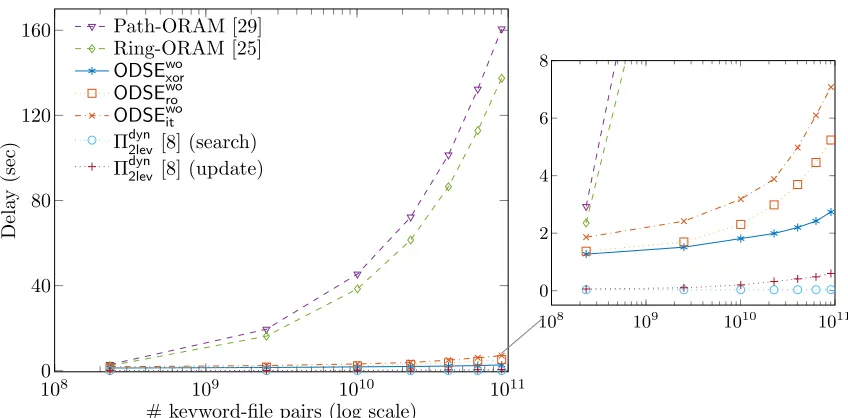
Figure 1: Latency of ODSE schemes and their counterparts.
• ODSE: We performed our experiments in the semi-honest setting, in which servers do not collude with each other. Therefore, we used two servers forODSEwoxor and ODSEworo schemes, and three servers forODSEwoit scheme. We selectedλ= 4 for ODSExorwo andODSEworo, and λ0 = 4 with
Fp where p is a 16-bit prime for ODSEwoit . We note that selecting larger p (up to 64 bits) can
reduce the PIR computation time, but also increase the bandwidth overhead as a trade-off. We chose 16-bit prime field to achieve a balance between computation and communication overhead according to the network constraints used in this study.
• Standard DSSE: We selected one of the most efficient DSSE schemes by Cash et al. in [8] (i.e., Πdyn2lev variant) to showcase the performance gap between ODSE and standard DSSE. We simulated the performance of Πdyn2lev using the same software/hardware environments and optimizations with ODSE (e.g., parallelization, AES-NI acceleration). Note that we did not use the Java implementation of this scheme available in Clusion library [1] for comparison due to its lack of hardware acceleration support (no AES-NI) and the difference between running environments (Java VM vs. native C). So for the simulation of Πdyn2lev, we used numbers that would be better than the Clusion Java implementation.
• Simulation of using generic ORAM on DSSE data structure: We selected Path-ORAM [29] and Ring-ORAM [25] as ODSE counterparts since they are the most efficient generic ORAM schemes being proposed to date. Note that we did not use other recent ORAMs (e.g.,[3, 11]) for comparison since their cost is higher than that of the selected ORAMs due to fully/partially homomorphic encryption. Moreover, there is a very limited numbers of studies focusing on hiding access patterns in DSSE except the TWORAM scheme in [12] which provides an oblivious access strategy to the encrypted files. This context is different from ours, where we only focus on oblivious access on the encrypted index. Therefore, we did not explicitly compare TWORAM with ODSE but instead, used one of their techniques to improve the performance of using generic ORAM on DSSE data structure. Specifically, we applied the selected ORAMs on the dictionary index containing (wi, idj) pairs suggested in [21] along with the round-trip optimization proposed
in [12], to make the comparison as fair as possible.
counter-SU SU SU SU SU SU SU SU 0
1 2 3
# keyword-file pairs (×109)
Dela
y
(sec)
Client computation 0.04 0.1 2.5 10 22 40 62 90
(a)ODSEwoxor
SU SU SU SU SU SU SU SU 0
1 2 3 4
# keyword-file pairs (×109)
Dela
y
(sec)
Communication 0.04 0.1 2.5 10 22 40 62 90
(b)ODSEworo
SU SU SU SU SU SU SU SU 0 1 2 3 4 5
# keyword-file pairs (×109)
Dela
y
(sec)
Server processing 0.04 0.1 2.5 10 22 40 62 90
(c)ODSEwoit
Figure 2: Detailed search (S) and update (U) costs of ODSE schemes.
parts, where both search and update are performed in ODSE schemes to hide the actual type of operation as discussed in Section 3. Clearly, ODSE offers a higher security than standard DSSE at the cost of a longer delay. However, ODSE schemes are still 3 - 57× faster if using generic ORAMs to hide the access patterns under different encrypted index sizes being experimented. Specifically, with an encrypted index containing ten billions of keyword-file pairs, Πdyn2lev cost 36 ms and 600 ms to finish a search and update operation, respectively. ODSEwoxor andODSEwoit took 2.8 seconds and 7.1 seconds respectively, to accomplish both keyword search and file update operations, compared with 160 seconds by using Path-ORAM with the round-trip optimization trick. ODSEwoxor is the most efficient in terms of search, whose delay was less than 1 second. This is due to the fact thatODSEwoxor only computes XOR operations and the size of the search query is minimal (i.e., a binary string). ODSEworo and ODSEwoit are more robust (e.g., malicious tolerant) and more secure (e.g., unconditional security) than ODSEwoxor with the cost of higher search delay. ODSEwoit is slowest among the three ODSE schemes since it requires three servers and, therefore, the client needs to transmit more data. For file updates, ODSEwoxor and ODSEworo achieved a similar delay since they have the same number of servers and incurred the same amount of data to be transmitted. ODSEwoit is slightly slower than ODSEwoxor and ODSEworo since the client transmitted data to three servers, instead of two. We can see that in many cases where it is not necessary to hide the operation types (search/update), using ODSE to conduct individual operations, especially the keyword search, is much more efficient than generic ORAM schemes. In the following, we dissect the total cost to investigate which factors contributed the most to the latency of ODSE schemes.
Detailed cost analysis. Figure 2 presents the total delays of separate keyword search and file update operations, as well as their detailed costs in ODSE schemes. Note that ODSE performs both search and update (one of them is dummy) to hide the actual type of operation performed by the client.
some values such as row keys, select queries (only contain shares of 0 or 1). For the file update, the client performs decryption and re-encryption onλcolumns (inODSEwoxorandODSEworo), or SSS overλ0 blocks (in ODSEwoit ). Since we used cryptographic acceleration (i.e., Intel AES-NI) and highly optimized number theory libraries (i.e., NTL), all these computations only contributed a small fraction of the overall delay as shown in Figure 2.
•Client-server communication:Data transmission is the dominating factor in the delay of ODSE schemes. The communication cost ofODSEwoxoris smaller than that of other ODSE schemes, since the size of search query and the data transmitted from servers are binary vectors. InODSEworo and ODSEwoit , these vectors are of 16-bit components∈Fp. The communication overhead ofODSEworo and ODSEwoit can be reduced by using a smaller finite field, but with the cost of increased PIR computation at the server side.
•Server processing:The cost of PIR operations inODSEwoxor is negligible as it only relies on XOR operations. The PIR computation of ODSEworo and ODSEwoit is reasonable, as it operates on a bunch of 16-bit values. For update operations, the server-side cost is mainly due to memory accesses for column update. ODSEworo and ODSEwoit are highly memory access-efficient since we organized the memory layout for column-friendly access. This layout minimizes the memory access delay not only in update but also in search, since the inner product in PIR also accesses contiguous memory blocks by this organization. In ODSEwoxor, we stored the matrix for row-friendly access to permit efficient XOR operations during search. However, this requires file update to access non-contiguous memory blocks. Therefore, the file update inODSEwoxor incurs a higher memory access delay than that of ODSEworo and ODSEwoit as shown in Figure 2.
Discussion and Limitations. In this paper, we focused on sealing information leakages from the access pattern on the DSSE encrypted index beyond using generic ORAMs. By leverag-ing bandwidth-efficient oblivious access techniques includleverag-ing multi-server PIR and Write-Only ORAM, ODSE achieves a high security with the following asymptotic costs. The communica-tion of ODSE isO(M +N), whereM and N are the (maximum) number of unique keywords and files in the database, respectively. Although the cost is linear, we have shown that, the actual communication overhead of ODSE is much lower than using generic ORAM to access the DSSE encrypted index, whose asymptotic bandwidth cost is poly-logarithmic but is hidden by large constant factors in reality. In practice, this results in up to a 57×improvement in perfor-mance. For instance, the transmission cost of using Path-ORAM on the DSSE encrypted index is O(rlog2(N ·M)), where r is the size of search/update results, which ,in many cases, might be worse than downloading the entire database [21]. The client and server computation costs areO(M) andO(N ·M), respectively. Despite the PIR computation over the entire encrypted index, we showed experimentally that, its delay was reasonable in practice, assuming that all possible optimizations (e.g., parallelization, multi-threading, assembly optimization) have been taken into account.
The main limitation of ODSE is the encrypted index size, which is O(N ·M). Given the database containing 300,000 files and 300,000 keywords used in this experiment, the size of encrypted index is 21 GB.
7
Conclusions
ODSEwoxorachieves the lowest end-to-end delay with the smallest communication overhead among all of its counterparts with the highest resiliency against colluding servers. ODSEwoit achieves the highest level of privacy with information-theoretic security for access patterns and the encrypted index, along with the robustness against malicious servers. Our experiments demonstrated that ODSE schemes are one order of magnitude faster than the most efficient ORAM techniques over DSSE encrypted index. We fully implemented ODSE schemes and their counterparts on an actual cloud environment, and will open-source our software for a public use and wide adaptation.
References
[1] The clusion library. Available athttps://github.com/encryptedsystems/Clusion/, 2017.
[2] I. Abraham, C. W. Fletcher, K. Nayak, B. Pinkas, and L. Ren. Asymptotically tight bounds for composing oram with pir. In IACR International Workshop on Public Key Cryptography, pages 91–120. Springer, 2017.
[3] D. Apon, J. Katz, E. Shi, and A. Thiruvengadam. Verifiable oblivious storage. In International Workshop on Public Key Cryptography, pages 131–148. Springer, 2014.
[4] A. Beimel and Y. Stahl. Robust information-theoretic private information retrieval. InInternational Conference on Security in Communication Networks, pages 326–341. Springer, 2002.
[5] E.-O. Blass, T. Mayberry, G. Noubir, and K. Onarlioglu. Toward robust hidden volumes using write-only oblivious ram. In Proceedings of the 2014 ACM SIGSAC Conference on Computer and Communications Security, pages 203–214. ACM, 2014.
[6] R. Bost. Sophos forward secure searchable encryption. InProceedings of the 2016 ACM Conference on Computer and Communications Security. ACM, 2016.
[7] D. Cash, P. Grubbs, J. Perry, and T. Ristenpart. Leakage-abuse attacks against searchable en-cryption. InProceedings of the 22nd ACM SIGSAC Conference on Computer and Communications Security, pages 668–679. ACM, 2015.
[8] D. Cash, J. Jaeger, S. Jarecki, C. S. Jutla, H. Krawczyk, M.-C. Rosu, and M. Steiner. Dynamic searchable encryption in very-large databases: Data structures and implementation. IACR Cryptol-ogy ePrint Archive, 2014:853, 2014.
[9] B. Chor, E. Kushilevitz, O. Goldreich, and M. Sudan. Private information retrieval. Journal of the ACM (JACM), 45(6):965–981, 1998.
[10] S. Cui, M. R. Asghar, S. D. Galbraith, and G. Russello. Obliviousdb: Practical and efficient searchable encryption with controllable leakage.
[11] S. Devadas, M. van Dijk, C. W. Fletcher, L. Ren, E. Shi, and D. Wichs. Onion oram: A constant bandwidth blowup oblivious ram. In Theory of Cryptography Conference, pages 145–174. Springer, 2016.
[12] S. Garg, P. Mohassel, and C. Papamanthou. Tworam: Round-optimal oblivious ram with applica-tions to searchable encryption. IACR Cryptology ePrint Archive, 2015:1010, 2015.
[13] I. Goldberg. Improving the robustness of private information retrieval. In2007 IEEE Symposium on Security and Privacy (SP’07), pages 131–148. IEEE, 2007.
[15] F. Hahn and F. Kerschbaum. Searchable encryption with secure and efficient updates. InProceedings of the 2014 ACM SIGSAC Conference on Computer and Communications Security, pages 310–320. ACM, 2014.
[16] T. Hoang, A. Yavuz, and J. Guajardo. Practical and secure dynamic searchable encryption via oblivious access on distributed data structure. InProceedings of the 32nd Annual Computer Security Applications Conference (ACSAC). ACM, 2016.
[17] M. S. Islam, M. Kuzu, and M. Kantarcioglu. Access pattern disclosure on searchable encryption: Ramification, attack and mitigation. InAnnual Network and Distributed System Security Symposium – NDSS, volume 20, page 12, 2012.
[18] S. Kamara and C. Papamanthou. Parallel and dynamic searchable symmetric encryption. In Finan-cial Cryptography and Data Security, pages 258–274. Springer, 2013.
[19] S. Kamara, C. Papamanthou, and T. Roeder. Dynamic searchable symmetric encryption. In Pro-ceedings of the 2012 ACM Conference on Computer and Communications Security, pages 965–976. ACM, 2012.
[20] C. Liu, L. Zhu, M. Wang, and Y.-a. Tan. Search pattern leakage in searchable encryption: Attacks and new construction. Information Sciences, 265:176–188, 2014.
[21] M. Naveed. The fallacy of composition of oblivious ram and searchable encryption. Technical report, Cryptology ePrint Archive, Report 2015/668, 2015.
[22] M. Naveed, M. Prabhakaran, and C. A. Gunter. Dynamic searchable encryption via blind storage. InSecurity and Privacy (S&P), 2014 IEEE Symposium on, pages 639–654. IEEE, 2014.
[23] G. S. Poh, J.-J. Chin, W.-C. Yau, K.-K. R. Choo, and M. S. Mohamad. Searchable symmetric encryption: Designs and challenges. ACM Computing Surveys (CSUR), 50(3):40, 2017.
[24] D. Pouliot and C. V. Wright. The shadow nemesis: Inference attacks on efficiently deployable, efficiently searchable encryption. In Proceedings of the 2016 ACM Conference on Computer and Communications Security. ACM, 2016.
[25] L. Ren, C. W. Fletcher, A. Kwon, E. Stefanov, E. Shi, M. van Dijk, and S. Devadas. Ring oram: Closing the gap between small and large client storage oblivious ram. IACR Cryptology ePrint Archive, 2014:997, 2014.
[26] A. Shamir. How to share a secret. Communications of the ACM, 22(11):612–613, 1979.
[27] D. X. Song, D. Wagner, and A. Perrig. Practical techniques for searches on encrypted data. In
Proceedings of the 2000 IEEE Symposium on Security and Privacy, SP ’00, pages 44–55, Washington, DC, USA, 2000. IEEE Computer Society.
[28] E. Stefanov, C. Papamanthou, and E. Shi. Practical dynamic searchable encryption with small leakage. InAnnual Network and Distributed System Security Symposium – NDSS, volume 14, pages 23–26, 2014.
[29] E. Stefanov, M. Van Dijk, E. Shi, C. Fletcher, L. Ren, X. Yu, and S. Devadas. Path oram: an extremely simple oblivious ram protocol. In Proceedings of the 2013 ACM SIGSAC conference on Computer and Communications security, pages 299–310. ACM, 2013.
[30] A. A. Yavuz and J. Guajardo. Dynamic searchable symmetric encryption with minimal leakage and efficient updates on commodity hardware. InSelected Areas in Cryptography – SAC 2015, Lecture Notes in Computer Science. Springer International Publishing, August 2015.
A
Appendix
A.1 Proofs
Proof of Theorem 1. We argue the correctness and security of ODSEwoxor in the semi-honest setting as follows:
Correctness: ODSEwoxor is correct iff the keyword search operation returns correct result and the file update operation is consistent. ODSEwoxor leverages Chor’s PIR protocol for keyword search, which was proven to be correct in [9]. ODSEwoxor leverages Write-Only ORAM for file update, which was proven to achieve negligible inconsistent probability in [5].
Security: ODSEwoxor leverages Chor’s PIR and therefore, achieves (`−1)-privacy for keyword search as proven in [9]. ODSEwoxor leverages Write-Only ORAM for the file update, which incurs random access patterns over the encrypted index [5]. Since the index inODSEwoxoris IND-CPA encrypted, such file update operations achieve the computational security. Notice that Write-Only ORAM is originally proposed in the single-server setting. ODSEwoxor performs Write-Only ORAM on` server with an identical procedure (e.g., memory accesses are the same in `servers), and therefore, the server coalition does not affect the security of Write-Only ORAM. For each actual search/update operation,ODSEwoxor performs both search and update protocol. Therefore, given the security of each search and update operations as discussed above, for any actual access operations, the views of`−1 colluding servers inODSEwoxorare computationally indistinguishable.
Proof of Theorem 2. We argue the correctness and security of ODSEworo in the semi-honest setting as follows:
Correctness: ODSEworo leverages the SSS-based PIR protocol for keyword search, which was proven to be correct in [4]. Similar toODSEwoxor,ODSEworo uses Write-Only ORAM for file update, which was proven to achieve a negligible inconsistent probability in [5].
Security: ODSEworo leverages a SSS-based PIR protocol and therefore, achieves t-privacy for keyword search due to thet-privacy property of SSS, as shown in [4, 13]. Similar toODSEwoxor,ODSEworo leverages Write-Only ORAM over IND-CPA encrypted database, which offers computational security as shown in [5]. For each actual operation, the client performs both search and update protocols. Therefore, the access pattern inODSEworo is a computationally indistinguishable in the presence oftcolluding servers.
Proof of Theorem 3. We argue the correctness and security ofODSEwoit in the semi-honest setting as fol-lows:
Correctness: ODSEwoit leverages a SSS-based PIR protocol over the shares of the encrypted index for keyword search. In this case, the answer from each server is the share represented by a 2t-degree poly-nomial. There are more than 2t+ 1 honest servers in the system and therefore, the client can be able to reconstruct the secret correctly to obtain the search result. ODSEwoit also leverages Write-Only ORAM for file update, which was proven to achieve negligible inconsistent probability in [5]. In overall,ODSEwoit is correct except with a negligible probability.
Security: ODSEwoit leverages a SSS-based PIR protocol and therefore, achieves t-privacy for keyword search due to the t-privacy property of SSS. Recall that Write-Only ORAM incurs random memory access on the encrypted index. Meanwhile, this index in ODSEwoit is information-theoretically secure since it is shared by SSS. Therefore, any access patterns incurred by update operation in ODSEwoit are information-theoretically (statistically) indistinguishable, in the presence of t colluding servers. Given that search and update are individually information-theoretically secure, we conclude that ODSEwoit is information-theoretically secure in the coalition of up totservers.
A.2 Malicious Setting Extension
Let α be the value and JαKi be the share of α for server Pi using (t−`)-SSS. For simplicity, we
assume that all ` servers respond to the client, some of which return malicious answers. The Reed Solomon Decode in [4] can recover theαcorrectly from`sharesJαK, given the number of incorrect shares is:
tm≤t < `
3. (1)
Goldberg et al. in [13] proposed to use List decoding algorithm with verification to tolerate more malicious servers. With this technique, the number of malicious servers is:
tm≤t < `− d √
`te. (2)
To extendODSEworo andODSEwoit schemes presented in Section 4 into the malicious setting, we insert the Reed Solomon decode [4] or List Decoding in [13] into the SSS.RecoverAlgorithm presented in Section 2 after the Lagrange interpolation, and verify if the recovered secret is consistent as follows. If there exists a incorrect answer among`answers due to the malicious server, the Lagrange interpolation might return an inconsistent value, given that the incorrect answer is selected to participate in the reconstruction. To prevent this, the client will invoke correction techniques presented above to detect malicious servers and to obtain the correct value in case the interpolation function does not return a consistent result when performing ont+ 1 random shares several times. As indicated in Eq. (1) and (2), the minimum number of servers inODSEwoit is also increased, compared with the semi-honest setting.
Notice that in the semi-honest setting, the update protocol of ODSEwoit presented inODSEwoit .Update