R E S E A R C H
Open Access
Bifurcation analysis in a delayed computer
virus model with the effect of external
computers
Zizhen Zhang
*and Dianjie Bi
*Correspondence:
School of Management Science and Engineering, Anhui University of Finance and Economics, Bengbu, 233030, P.R. China
Abstract
A delayed Susceptible-Infected-External (SIE) computer virus propagation model is investigated in the present paper. The linear stability conditions are obtained with characteristic root method. The Hopf bifurcation is demonstrated. Furthermore, some explicit formulae for determining the stability and the direction of the Hopf
bifurcation are derived by using the normal form theory and the center manifold theorem. Finally, numerical simulations are carried out to support the theoretical predictions.
Keywords: computer virus propagation model; delay; Hopf bifurcation; stability
1 Introduction
Computer viruses are major threats to Internet security, and they have led to huge eco-nomic losses [–]. Inspired by the compelling analogies between computer viruses and their biological counterparts, many scholars investigate computer viruses spreading on the Internet with epidemic models since the work by Kephart and White []. Wierman and Marchetteet al.[–] proposed the classical SIR computer virus propagation model respectively based on the SIR epidemic model. Considering the feasibility of the loss of immunity for the recovered computers, Ganet al.[] proposed an SIRS computer propa-gation model and studied the stability of the model. Yuanet al.[–] studied the dynam-ics of the SEIR computer virus propagation model based on the fact that some viruses may purposely lay dormant for a period of time prior to infecting other computers for stealth reasons. However, the SEIR model assumes that the recovered computers have a permanent immunization period with a certain probability which is not consistent with real situation. Based on this, Mishraet al.[, ] presented the SEIRS computer virus propagation model. In [], Mishra and Jia paid attention to the combination of computer virus propagation model and quarantine to study the prevalence of the viruses and pro-posed the SEIQRS model for the transmission of malicious objects in computer network. However, all the above computer virus models focused on the internal computers and ne-glected the effect of the external computers on virus spread. In order to study the effect of the external computers on virus spread, Chenet al.[] proposed the following computer
virus model under the influence of external computers: computers and external computers, respectively.δis the rate at which each computer dies out;εis the birth rate of external computers;α,α,γ,γandηare the states transmission
rates. Chenet al.[] studied the global stability of virus-free and viral equilibrium of system ().
As stated in [], some viruses may purposely lay dormant for a period of time prior to infecting other computers for stealth reasons, it may be more realistic to assume that the susceptible computers are infected at timet–τ and then these infected computers have infection ability at timet. Therefore, we incorporate the latent period delay of the computer viruses into system () and get the following computer virus model with time delay:
whereτ is the latent period delay of the computer viruses. The main purpose of this pa-per is to investigate the effect of the latent pa-period delay on system (), especially the Hopf bifurcation caused by the delay. It is well known that the time delay can have important influence on a dynamical system, and dynamical systems with time delay have been inves-tigated extensively in recent years [, , –].
The organization of this paper is as follows. Section considers stability of the positive equilibrium and existence of the Hopf bifurcation. Section is devoted to the properties of the Hopf bifurcation. Some numerical simulations are carried out to verify the theoretical results in Section , and this work is summarized in Section .
2 Stability of the positive equilibrium and existence of Hopf bifurcation By a direct computation, we can get that if
where
A=aaa–aaa,
A=aa+aa+aa–aa,
A= –(a+a+a),
B=aab–aab+aab–aab+aab,
B=ab–ab+ab+ab+ab, B= –(b+b),
and
a= –(δ+γ), a=α, a=γ,
a= –(α+α+δ), a=γ, a=α, a= –(δ+γ),
b= –ηI∗, b= –ηS∗, b=ηI∗, b=ηS∗.
Whenτ= , Eq. () becomes
λ+ (A+B)λ+ (A+B)λ+A+B= . ()
Based on the expressions ofA,Banda,a,a,b,b, we can get
A+B=γ+γ+ δ+ηI∗> .
Therefore if the condition (H) (A+B)(A+B) >A+B> holds, then system () is
locally asymptotically stable whenτ = .
Forτ > , letλ=iω(ω> ) be the root of Eq. (), then
Bωsinτ ω+ (B–Bω)cosτ ω=Aω–A, Bωcosτ ω– (B–Bω)sinτ ω=ω–Aω.
Then we get
ω+cω+cω+c= , ()
where
c=A–B, c=A–B– AA+ BB,
c=A–B– A.
Letω=v, then Eq. () can be transformed into the following form:
v+cv+cv+c= . ()
If the condition (H) holds, then there exists one positive rootvof Eq. () such that
Eq. () has a pair of purely imaginary roots±iω=±i√v.
Taking derivation on both sides of Eq. (), we obtain
dλ according to the Hopf bifurcation theorem in [], we have the following results.
Theorem For system(),we assume that the conditions(H)-(H)hold for the parame-ters.Then the positive equilibrium E∗(S∗,I∗,E∗)is asymptotically stable forτ∈[,τ)and the positive equilibrium E∗(S∗,I∗,E∗)becomes unstable forτ staying in some right
neigh-borhood ofτ,with a Hopf bifurcation occurring whenτ=τ.
3 Direction and stability of the Hopf bifurcation
In this section, we shall obtain the explicit formulae for determining the direction, sta-bility and period of these periodic solutions bifurcating from the positive equilibrium
E∗(S∗,I∗,E∗) of system () at the critical valueτ. For convenience, letτ =τ+υ,υ∈R.
Thenυ= is the Hopf bifurcation value of system ().
Clearly,Lυis a linear continuous operator fromC=C([–, ],R) toR. By the Riesz
rep-resentation theorem, there exists a matrix function with bounded variation components
η(θ,υ),θ∈[–, ] such that
Lυϕ=
–
dη(θ,υ)ϕ(θ), ϕ∈C=C[–, ],R.
In fact we can choose
η(θ,υ) = (τ+υ)
Then system () is equivalent to the abstract differential equation
q∗=iω–a–be
iωτ
beiωτ +
aa
(iω+a)beiωτ
,
q∗= – a
iω+a
.
From Eq. (), we can obtain
q∗(s),q(θ) =D¯¯q∗()q() –
–
θ
¯
D¯q∗()e–iωτ(ξ–θ)dη(θ)q()eiωτξdξ
=D¯ +qq¯∗+qq¯∗–
– ¯
q∗()θeiωτθdη(θ)q()
=D¯ +qq¯∗+qq¯∗+q¯∗()Bmaxe–iωτ
q() =D¯ +qq¯∗+qq¯∗+τe–iωτb+bq+bq¯∗
+bqq¯∗
.
Then we can choose
¯
D= +qq¯∗+qq¯∗+τe–iωτb+bq+bq¯∗
+bqq¯∗
–
such that
q∗,q= , q∗,q¯= .
Next, we use the same notations as those in Hassardet al.[], and we first compute the coordinates to describe the center manifoldCatυ= . Letxt be the solution of Eq. ()
whenυ= . Define
z(t) =q∗,xt
, ()
W(t,θ) =xt(θ) – Rez(t)q(θ) () on the center manifoldC, and we have
W(t,θ) =Wz(t),z¯(t),θ, ()
where
Wz(t),z¯(t),θ=W(z,z¯) =Wz
+Wz¯z+W
¯ z
+· · · ()
andzandz¯are local coordinates for center manifoldCin the direction ofq∗andq¯∗. Note
thatWis real ifxtis real, we only deal with real solutions. For the solutionsxtof Eq. (),
˙
z(t) =q∗,x˙t
=q∗,A()xt+q∗,R()xt
where
Comparing the coefficients in Eq. () and Eq. (), we can get
g= βτDq¯
whereEandEcan be determined by the following equations respectively:
with
ai=ω–a–be–iωτ,
a= –a–be–iωτ,
a= iω–a–be–iωτ,
a= iω–a.
Then we can get the following coefficients:
C() = i ωτ
gg– |g|–|g|
+
g
,
μ= –
Re{C()} Re{λ(τ)}
,
β= Re
C(),
T= –Im{C()}+μIm{λ (τ
)} ωτ
.
()
Theorem For system(),we assume that the conditions(H)-(H)hold for the parame-ters.Then,ifμ> (μ< ),then the Hopf bifurcation is supercritical(subcritical);ifβ<
(β> ),then the bifurcating periodic solutions are stable(unstable);if T> (T< ),then the bifurcating periodic solutions increase(decrease).
4 Numerical simulation
In this section, we present a numerical example to validate the feasibility of the theoretical result obtained above. By extracting some values from [] and considering the conditions for the existence of the Hopf bifurcation, we choose a set of parameters as follows:α= ., α= .,γ= .,γ= .,η= .,δ= . andε= . Then system () becomes
⎧ ⎪ ⎨ ⎪ ⎩
dS(t)
dt = –.S(t) – .S(t–τ)I(t–τ) – .S(t) + .I(t) + .E(t), dLI(t)
dt = .S(t–τ)I(t–τ) – .I(t) – .I(t) – .I(t), dE(t)
dt = –.E(t) – .E(t) + .S(t) + .I(t) + .
()
By Matlab ., we getR= . > and the positive equilibriumE∗(., ., .) of system (). Then we haveA+B= . > ,A+B= . > ,A+B= . > and (A+B)(A+B) = . >A+B= . > . That is, the condition (H) holds. Further, we get only one critical value of the time delayτ= .,ω= .
andf(v) = . > . That is, the conditions (H) and (H) hold. Therefore, according
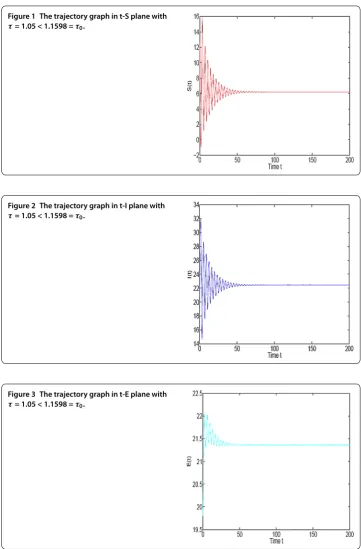
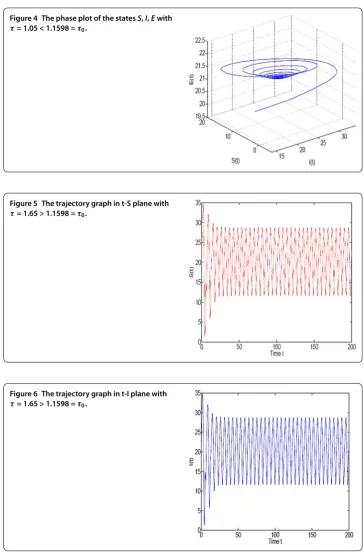
to Theorem , we can conclude thatE∗(., ., .) is locally asymptotically stable whenτ ∈[,τ). As can be seen from Figures -,E∗(., ., .) is lo-cally asymptotilo-cally stable whenτ= . <τ. When the value of the delay passes through
the critical valueτ, a Hopf bifurcation occurs and a family of periodic solutions
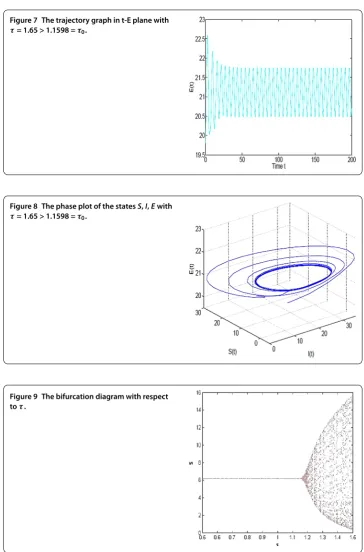
bifur-cate fromE∗(., ., .), which can be shown by Figures -. As shown in Figures -, we chooseτ= . >τ,E∗(., ., .) become unstable and a
Figure 1 The trajectory graph in t-S plane with
τ= 1.05 < 1.1598 =τ0.
Figure 2 The trajectory graph in t-I plane with
τ= 1.05 < 1.1598 =τ0.
Figure 3 The trajectory graph in t-E plane with
τ= 1.05 < 1.1598 =τ0.
should try to shorten the delay as much as possible so that we can control the computer viruses propagation effectively.
5 Conclusions
Figure 4 The phase plot of the statesS,I,Ewith
τ= 1.05 < 1.1598 =τ0.
Figure 5 The trajectory graph in t-S plane with
τ= 1.65 > 1.1598 =τ0.
Figure 6 The trajectory graph in t-I plane with
τ= 1.65 > 1.1598 =τ0.
viruses into the model considered in the literature [] and propose a delayed SIE com-puter virus propagation model in this paper. Compared with the work in [], we mainly consider the effect of the latent period delay on system (). It is shown that the latent pe-riod delay plays an important role on the stability of system (). Whenτ<τ, system () is
Figure 7 The trajectory graph in t-E plane with
τ= 1.65 > 1.1598 =τ0.
Figure 8 The phase plot of the statesS,I,Ewith
τ= 1.65 > 1.1598 =τ0.
Figure 9 The bifurcation diagram with respect toτ.
in-vestigation or experimental studies on the propagation of computer viruses in networks. In addition, the other behaviors of system () out of the assumptions on the parameters have been disregarded. We leave these as our future work.
Competing interests
The authors declare that they have no competing interests.
Authors’ contributions
All authors contributed equally to the writing of this paper. All authors read and approved the final manuscript.
Acknowledgements
The authors would like to thank the editor and the anonymous referees for their work on the paper. This work was supported by the Natural Science Foundation of Higher Education Institutions of Anhui Province (KJ2014A005, KJ2014A006).
Received: 21 August 2015 Accepted: 30 September 2015
References
1. Yuan, H, Chen, G, Wu, J, Xiong, H: Towards controlling virus propagation in information systems with point-to-group information sharing. Decis. Support Syst.48(1), 57-68 (2009)
2. Luiijf, E: Understanding cyber threats and vulnerabilities. Lect. Notes Comput. Sci.7130(1), 52-67 (2012) 3. Huang, CY, Lee, CL, Wen, TH, Sun, CT: A computer virus spreading model based on resource limitations and
interaction costs. J. Syst. Softw.86(3), 801-808 (2013)
4. Kephart, JO, White, SR: Directed-graph epidemiological models of computer viruses. In: Proceedings of the IEEE Computer Society Symposium on Research in Security and Privacy, pp. 343-359 (1991)
5. Wierman, JC, Marchette, DJ: Modeling computer virus prevalence with a susceptible-infected-susceptible model with reintroduction. Comput. Stat. Data Anal.45(1), 3-23 (2004)
6. Piqueira, JRC, Araujo, VO: A modified epidemiological model for computer viruses. Appl. Math. Comput.213(2), 355-360 (2009)
7. Ren, JG, Yang, XF, Zhu, QY, Yang, LX, Zhang, CM: A novel computer virus model and its dynamics. Nonlinear Anal., Real World Appl.13(1), 376-384 (2012)
8. Gan, CQ, Yang, XF, Liu, WP, Zhu, QY, Zhang, XL: Propagation of computer virus under human intervention: a dynamical model. Discrete Dyn. Nat. Soc.2012, Article ID 106950 (2012)
9. Yuan, H, Chen, GQ: Network virus-epidemic model with the point-to-group information propagation. Appl. Math. Comput.206(1), 357-367 (2008)
10. Dong, T, Liao, XF, Li, HQ: Stability and Hopf bifurcation in a computer virus model with multistate antivirus. Abstr. Appl. Anal.2012, Article ID 841987 (2012)
11. Zhang, CM, Zhao, Y, Wu, YJ, Deng, SW: A stochastic dynamic model of computer viruses. Discrete Dyn. Nat. Soc.2012, Article ID 264874 (2012)
12. Mishra, BK, Pandey, SK: Dynamics model of worms with vertical transmission in computer network. Appl. Math. Comput.217(21), 8438-8446 (2011)
13. Mishra, BK, Saini, DK: SEIRS epidemic model with delay for transmission of malicious objects in computer network. Appl. Math. Comput.188(2), 1476-1482 (2007)
14. Mishra, BK, Jia, N: SEIQRS model for the transmission of malicious objects in computer network. Appl. Math. Model.
34(3), 710-715 (2010)
15. Chen, JY, Yang, XF, Gan, CQ: Propagation of computer virus under the influence of external computers: a dynamical model. J. Inf. Comput. Sci.10(16), 5275-5282 (2013)
16. Bianca, C, Guerrini, L: On the Dalgaard-Strulik model with logistic population growth rate and delayed-carrying capacity. Acta Appl. Math.128(1), 39-48 (2013)
17. Bianca, C, Guerrini, L, Riposoj, J: A delayed mathematical model for the acute inflammatory response to infection. Appl. Math. Inf. Sci.9(6), 2775-2782 (2015)
18. Xu, CJ, He, XF: Stability and bifurcation analysis in a class of two-neuron networks with resonant bilinear terms. Abstr. Appl. Anal.2011, Article ID 697630 (2011)
19. Bianca, C, Guerrini, L: Hopf bifurcations in a delayed microscopic model of credit risk contagion. Appl. Math. Inf. Sci.
9(3), 1493-1497 (2015)