
Conservational and Sequential Charm Hadronization in
Heavy Ion Collisions
JiaxingZhao1,∗,ShuzheShi2,NuXu3, andPengfeiZhuang1
1Physics Department, Tsinghua University and Collaborative Innovation Center of Quantum Matter,
Beijing 100084, China
2Department of Physics, McGill University, Montréal, QC H3A 2T8, Canada
3Institute of Modern Physics, Chinese Academy of Sciences, Lanzhou, Gansu 730000, China
Abstract.Heavy quarks are almost initially produced and the number is con-served during the evolution of the hot medium produced in Heavy Ion colli-sions. We firstly take into account the charm conservation effect on charm hadron hadronization via sequential coalescence model. In the frame of sequen-tial coalescence, the charm conservation enhances the earlier hadron production and suppresses the later production. This relative enhancement (suppression) changes significantly the charmed hadron ratios in heavy ion collisions at RHIC and LHC.
Because the charm quark massmc∼1.2 GeV is much larger than the typical temperature of the fireball formed in heavy ion collisions at RHIC and LHC energies, the charm quark number is almost contributed by the initial production and conserved during the whole evo-lution of the colliding system [1]. The precise measurement ofDs,D0and charm baryons in experiment give us a chance to study the charm conservation and charm hadronization mech-anism in Heavy Ion Collisions. Recently, the yield ratio ofD+s/D0is measured in heavy ion collisions at RHIC [2] and LHC [3] energies. However, the theoretical results seems underes-timate the experiment data in the applicable kinematic region [4]. We emphasis that we need consider the effect of charm conservation in charmed hadron production [5–7]. Qualitatively, when the charm conservation is taken into account, the strangeness enhancement inducedD+s enhancement results in aD0suppression, which will lead to a furtherD+s/D0enhancement!
In our previous study [8], we take into account the charm conservation effect via se-quential coalescence model. Its first time to consider charm conservation self-consistently in charm hadron production in Heavy Ion Collisions. And I will introduce the framework of the model and results in this paper.
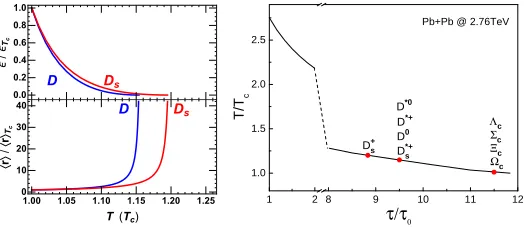
By solving the two-body Dirac equation, which was successfully applied to the relativis-tic description of light meson spectra [9] in vacuum and extended to hidden and open[10] charmed mesons at finite temperature, we obtain the charmed meson binding energym(T) and the radial wave function ψ(r,T). From the definition of meson melting m(Tm) = 0 or hrmi(Tm) → ∞, we extract the meson dissociation temperatures TD+s = 1.2Tc and
TD∗+
s ' TD0 ' TD∗0 ' TD∗+ = 1.15Tc, as showed in Fig.1. Considering the relation
Vqq ' Vqq/¯ 2 between attractive quark-quark and quark-anti-quark potentials, the
dissocia-tion temperature of charmed baryons likeΛc,Σc, Ξc andΩc should be lower than that for
charmed mesons [11]. Because the effect of charm conservation on hadron production de-pends mainly on the order of productions, we take simply the coalescence temperature for charmed baryons asTcin the following calculation.
0.0 0.2 0.4 0.6 0.8 1.0
ϵ
/
ϵTc
D Ds
1.00 1.05 1.10 1.15 1.20 1.25 0
10 20 30 40
T(Tc)
〈
r
〉
/
〈
r
〉Tc
D Ds
1 2 8 9 1 0 1 1 1 2
1 . 0 1 . 5 2 . 0 2 . 5
D * +
s
D * 0
D * +
T
/T
c
τ/τ0
D +
s
D 0
Λc P b + P b @ 2 . 7 6 T e V
Σc Ξc Ωc
Figure 1.(Left) The binding energy and average radius of charm mesonD0andD
s. (Right)The time
evolution of the maximum temperature in central Pb+Pb collisions at √sNN = 2.76 TeV. The dots
indicate the coalescence temperature (time) for charmed hadrons.τ0=0.6 fm/c andTc=165 MeV are
the initial time and critical temperature of the quark matter.
The evolution of quark matter created in high energy nuclear collisions can described by the hydrodynamic equations∂µTµν = 0 [12, 13]. During the evolution of the quark mat-ter, the temperature continuously drops down due to the expansion of the system. When the local temperatureT(x, τh) reaches the value of the dissociation temperature Th for a kind of charmed hadrons, the corresponding hadrons will be produced. Aim to see clearly the hadronziation sequential of charmed hadrons, we showed the time evolution of the tempera-ture at the center of the fireball in central Pb+Pb collisions at LHC energy and the hadroniza-tion timesτhofD+s,D0(D∗+
s ,D∗0,D∗+) and charmed baryonΛc(Σc,Ξc,Ωc) in right hand side of Fig.1.
The coalescence mechanism is successfully used to describe hadron distributions in heavy ion collisions, like the quark number scaling law of hadron collective flow [14, 15], the en-hancement of baryon to meson ratios [16–18], the yield. We built the sequential coalescence model with charm conservation to calculate the charmed hadron spectra.
dNh d2P
Tdη
= C
Z
Pµdσµ n
Y
i=1
d4xid4pi
(2π)3 fi(xi,pi)×Wh(x1, ...,xi,p1, ...,pi), (1)
where the integration is on the coalescence hypersurfaceσµ(τh,X) , the summation is over the constituent quarks with n = 2 for mesons and n = 3 for baryons, and Pµ = (P0,P)
is the four dimensional hadron momentum. The constantC is the statistical factor to take into account the internal quantum numbers in forming a colorless hadron. WhereWhis the Wigner function or coalescence probability fornquarks to combine into a hadron and the quark distributions. It can be constructed directly from the wavefunction solved by the two-body Dirac equation [19, 20]. fiin the spectra (1) is the distribution function of the constituent quarks in phase space. The light quarksuanddare controlled by the Fermi-Dirac distribution
fq(x,p) = Nq/(euµp
µ/T
+1). Considering that strange quarks may not reach fully chemical equilibrium at RHIC energy, the fugacity factorγsis included andγs=1 in LHC energies.
0 2 4 6 8 1
−
10 1
Au+Au @ 200 GeV |y|<1 STAR Preliminary
PYTHIA 0-10%
10-40%
0 2 4 6 8
1
−
10 1
Pb+Pb @ 2.76TeV ALICE |y|<0.5 0-10% = 7TeV s p+p, 0 /Ds D (GeV/c) T p
0 1 2 3 4 5 6
1
−
10 1 10
Au+Au @ 200 GeV |y|<1 STAR Preliminary
PYTHIA 10-80%
0 1 2 3 4 5 6 1
−
10 1 10
Pb+Pb @ 2.76 TeV ALICE |y|<0.5
= 7 TeV s p+p, 0 /Dc Λ (GeV/c) T p
Figure 2.(Left)The yield ratio ofD+s/D0at RHIC and LHC energies. The experimental data in A+A
and p+p collisions are from STAR [2] and ALICE [3, 26] Collaborations, the dotted line is the PYTHIA simulation for p+p collisions [2], and the solid and dashed lines are respectively our sequential and si-multaneous coalescence calculations. (Right)The yield ratio ofΛ+c/D0at RHIC and LHC energies. The
experimental data in A+A and p+p collisions are from STAR [27, 28] and ALICE [29] collaborations, the dotted line is the PYTHIA simulation for p+p collisions [27], and the solid and dashed lines are respectively our sequential and simultaneous coalescence calculations.
take, as a first approximation, a linear combination of fppand fth as the charm quark distri-bution, fc(x,p) = ρc(x)[αfth(p)+βfpp(p)]. The coefficientsαandβcontrol the degree of thermalization of charm quarks, reflect the continuous thermalization charm quarks in hot medium. We have evolute charm quark in hot medium with Langevin equation in further study. We treat the charm quark density in coordinate spaceρc(x) as a superposition of p+p collisions [22],
ρc(x|b)=r(τ)TA(xT)TB(xT−b) coshη
τ dσcppc¯
dη , (2)
whereTA andTB are thickness functions of the two colliding nuclei [23],bis the impact parameter of the collision,dσcppc¯/dηis the rapidity distribution of charm quarks in p+p col-lisions, and the factor 1/τcomes from the Bjorken expansion mechanism [24]. The time dependent charm quark number fractionr(τ) describes the charm conservation during the sequential coalescence,
r(τ)=
1 τ≤τD+
s
1−ND+s/Nc τD+s < τ≤τD0
1−ND/Nc τD0 < τ
(3)
whereND=ND+s +ND0+ND∗s++ND∗0+ND∗+is the totalDmeson number or charm quark
number. If all the charmed hadrons are simultaneously produced at the phase boundary (a unified coalescence temperatureTcor coalescence timeτcin usual coalescence models), the charm fractionr(τ)=1 becomes time independent during the evolution of the quark matter.
Firstly, aim to see clearly the effect of sequential coalescence with charm conservation, we calculated the yield ratio of D+s/D0, as showed in Fig.2. In comparison with the p+p
from PYTHIA value∼0.15 to 0.2−0.3 in a coalescence model [4]. In our model, both the strangeness enhancement and the charm conservation are responsible for the ratio enhance-ment. On one hand, the earlierD+s production is with 100% of charm quarks and the laterD0 production is with only∼90% of charm quarks. Therefore, theD+s enhancement leads to a D0suppression and in turn to a furtherD+
s/D0enhancement. On the other hand, the laterD0 production is with more thermalized(softer) charm quarks, its distribution is then shifted to the lower pT region. As a competition of these two effects, the ratioD+s/D0will be signif-icantly enhanced at highpT and may weakly suppressed at lowpT. Here we calculated the ratio in two cases: One (solid lines) is in the frame of sequential coalescence and the other (dashed lines) is with a simultaneous coalescence at the phase boundary. It’s clear that, the sequential coalescence with charm conservation induces a strong enhancement at high pT and a slight suppression at lowpTand this can explain experiment date quite well.
Then, we turn to study the charmed baryon production. Considering the difference in statistics for two- and three-body states shown in the hadron spectra (1), the baryon to meson ratio in A+A collisions will dramatically enhanced in comparison with p+p collisions in coalescence models. But, in our model, the big difference between the charm quark number fraction r = 0.6 forΛc production and r = 0.9 for D0 production strongly weakens the enhancement of the ratio at anypT, see the solid lines in comparison with the dashed lines. As showed in Fig.2, our prediction about the yield ratio ofΛ+c/D0is agree well with preliminary
experiment data from STAR.
(GeV/c) T p
0 5 10
0
/Dc
Λ
0.0 0.5 1.0 1.5 2.0
2.5 Au+Au, s=200GeV,|y|<1,0-80%
=5.02TeV,|y|<0.5,0-80% s
Pb+Pb, =7TeV,|y|<0.5 s p+p, Pythia
Figure 3.The yield ratio ofΛ+c/D0at RHIC (Red dimond) and LHC (Blue dimond) energies. The black
triangle represent the ratio ofΛ+c/D0inppcollisions at 7TeV. The green line is the PYTHIA simulation
forppcollisions at 200GeV, and the dotted and dashed line are respectively Greco’s and Ko’s results. The red solid line is the result from our model.
Finally, we would like to draw an attention to the behavior ofΛ+c/D0ratio at highp
T. We combine both AA data and pp data from RHIC and LHC, showed in Fig.3. The theoretical results of W. Greco [7], Ko [6] and ours underestimate the experimental data at pT larger than 6GeV obviously. And PYTHIA simulation seems fail to reproduce the experiment data of p +p collisions at 7TeV. That indicate the mechanism of charm fragment to Λc need to modified. Adding the correct contribution of fragmentation at high pT, we believe the experiment data will be explained well in Heavy Ion collisions.
results onDs/D0andΛc/D0ratio consistent with experiment data. The same frame can also be used to describe the bottom hadrons production in Heavy Ion Collisions.
References
[1] K.Zhou, Z.Chen, C.Greiner and P.Zhuang, Phys. Lett.B758, 434(2016). [2] L. Zhou [STAR Collaboration], Nucl. Phys. A967, 620 (2017).
[3] J. Adamet al.[ALICE Collaboration], JHEP1603, 082 (2016). [4] M.He, R.Fries and R.Rapp, Phys. Rev. Lett.110, 112301(2013).
[5] M.Gorenstein, A.Kostyuk, H.Stoecker and W.Greiner, Phys. Lett.B509, 277(2001). [6] Y.Oh, C.Ko, S.Lee and S.Yasui, Phys. Rev.C79, 044905(2009).
[7] S. Plumari, V. Minissale, S. K. Das, G. Coci and V. Greco, Eur. Phys. J. C78, no. 4, 348 (2018).
[8] J. Zhao, S. Shi, N. Xu and P. Zhuang, arXiv:1805.10858 [hep-ph].
[9] H. W. Crater, J. H. Yoon and C. Y. Wong, Phys. Rev. D79, 034011 (2009); H. Crater and P. Van Alstine, Phys. Rev. D70, 034026 (2004).
[10] S. Shi, X. Guo and P. Zhuang, Phys. Rev. D88, no. 1, 014021 (2013); X. Guo, S. Shi and P. Zhuang, Phys. Lett. B718, 143 (2012).
[11] J.Zhao and P.Zhuang, Few Body Syst.58, 100(2017).
[12] H.Song, S.Bass, U.Heinz, T.Hirano and C.Shen, Phys. Rev. Lett.106, 192301(2011). [13] T.Hirano, P.Huovinen and Y.Nara, Phys. Rev.C83, 021902(2011).
[14] D.Molnar and S.Voloshin, Phys. Rev. Lett.91, 092301(2003). [15] V.Greco, C.Ko and P.Levai, Phys. Rev.C68, 034904(2003). [16] R.Hwa and C.Yang, Phys. Rev.C67, 034902(2003).
[17] R.Fries, B.Muller, C.Nonaka and S.Bass, Phys. Rev. Lett.90, 202303(2003). [18] V.Greco, C.Ko and P.Levai, Phys. Rev. Lett.90, 202302(2003).
[19] J. Zhao and B. Chen, Phys. Lett. B776, 17 (2018).
[20] J. Zhao, H. He and P. Zhuang, Phys. Lett. B771, 349 (2017).
[21] L.Adamczyket al.[STAR Collaboration], Phys. Rev. Lett.118, 212301(2017). [22] K. Zhou, N. Xu, Z. Xu and P. Zhuang, Phys. Rev. C89, no. 5, 054911 (2014).
[23] M. L. Miller, K. Reygers, S. J. Sanders and P. Steinberg, Ann. Rev. Nucl. Part. Sci.57, 205 (2007).
[24] J. D. Bjorken, Phys. Rev. D27, 140 (1983).
[25] G. Agakishievet al.[STAR Collaboration], Phys. Rev. Lett.108(2012) 072301. [26] B. Abelevet al.[ALICE Collaboration], Phys. Lett. B718, 279 (2012).
![Figure 2. (Left)The yield ratio of D+s /D0 at RHIC and LHC energies. The experimental data in A+Aand p+p collisions are from STAR [2] and ALICE [3, 26] Collaborations, the dotted line is the PYTHIAsimulation for p+p collisions [2], and the solid and dashed](https://thumb-us.123doks.com/thumbv2/123dok_us/8019430.1333668/3.482.60.410.75.201/figure-energies-experimental-collisions-collaborations-dotted-pythiasimulation-collisions.webp)

