Falcon Codes: Fast, Authenticated LT Codes
Ari Juels
Cornell Tech New York City NY, USAJames Kelley
Brown University Providence RI, USA [email protected]Roberto Tamassia
Brown University Providence RI, USANikos Triandopoulos
RSA Laboratories Cambridge MA, USAAbstract—In this paper, we introduce Falcon codes, a class of authenticated error correcting codes that are based on LT codes [23] and achieve the following properties, for the first time simultaneously: (1) with high probability, they can correct adversarialsymbol corruptions in the encoding of a message, and (2) they allow for very efficient encoding and decoding times, even linear in the message length. We study Falcon codes in a new adversarial model for rateless codes over computational channels, and define a new security notion for corruption-tolerant encoding in this model. We then present three such LT-based coding schemes that achieve resilience to adversarial corruptions via judicious use of simple cryptographic tools while maintaining very fast encoding/decoding times. One variant Falcon code works well with small messages (100s of KB to 10s of MB) but two alternative scalable versions are designed to handle much larger inputs (e.g., messages that are several GBs in size). Our schemes are provably secure against computational adversaries in the standard model. We analyze our new schemes and show that Falcon codes are both asymptotically and practically efficient.
I. INTRODUCTION
Error correcting codes find numerous applications in com-puting by increasing reliability in data storage and data trans-mission over unreliable channels. As such they comprise today a particularly useful tool in distributed and network security with more and more secure protocol designs employing some form of data encoding. Among a rich set of existing codes, due to their simplicity and strong error correcting capacity (i.e., information-theoretic rather than probabilistic), Reed-Solomon codes, or RS codes, are used very widely by applications. In an RS code, the input message is broken up into fixed-sized pieces and the pieces are regarded as coefficients of a polynomial, which is then repeatedly evaluated on different points to produce the output symbols. Although their asymp-totic efficiency can vary depending on the implementation, RS codes typically involve encoding costs that are quadratic in the message size k,1 thus in reality they tend to be costly.
Several alternative codes have been proposed to overcome the quadratic encoding/decoding overheads of RS codes. For instance, using layered encoding, Tornado codes [4] achieve encoding/decoding speeds that are 100 to10000 times faster than RS codes. At the fastest end of the range lie LT codes [23], which achieve O(klogk) encoding/decoding speed and are very practical. Based on LT codes, Raptor codes [41] and Online codes [28] are the first (rateless) code to achievelinear coding times. Each of these LT-based codes is also a fountain code: a rateless code that can generate a practically unlimited
1RS codes with input sizekand output sizen=O(k)are practically of
quadratic inncomplexity: even if in specific configurations they can achieve asymptotically O(nlogn)encoding time, in most practical cases encoding with polynomial evaluation inO(kn)time is faster.
number of output code symbols. But this great efficiency comes at a qualitative drawback: fountain codes have been designed and analyzed over a random channel rather than an adversarial one, essentially being capable to tolerate only data erasures and no (or very limited) data corruption. And even current standardized implementations of these codes are easy to attack by adopting malicious (non-random) corruption strategies.
Indeed, LT codes employ a random sparse bipartite graph to map message symbols, in one partition, into encoded symbols, in the other partition, via simple XORing (see Figure 1). By design, this graph provides enough symbol coverage so that a belief-propagation decoding algorithm can recover the input symbols (with a small, sender-determined probability of failure) despite random erasures of encoded symbols. But this algorithm will also readily propagate (and amplify) any error in the message encoding into the recovered message! Even worse, an adversary could exploit the structure of this graph to (covertly) increase the likelihood of a decoding failure. For instance, one can selectively erase nodes of high degree so that with high-probability not all input symbols are sufficiently covered by the remaining symbols.2 Actually, this specific targeted-erasure attack raises a practical threat that has not been adequately addressed in the literature (cf. Section VII). Unfortunately, this was also neglected by existing RFCs that describe Raptor/RaptorQ codes for object delivery over the Internet: to increase practicality, the encoding graph is either completely deterministic or easily predictable by anyone,3thus trivially enabling such targeted-erasure attacks!
In view of this inconvenient trade-off between practicality and security, in this paper we consider the following natural question: is it possible to have codes that are simultaneously strongly tolerant to adversarial errors and very efficient in practice? Alternatively: what are the counterparts of RS codes within the class of fountain codes? Or, is it possible to devise extensions of Raptor codes that withstand malicious corruptions while maintaining their high efficiency?
This work shows that it is possible to achieve both coding efficiency and strong tolerance of malicious errors for com-putationally bounded adversaries. Specifically, we introduce
2Decoders based on solving the implicit system of linear equations relating
the symbols suffer from the same problems.
3For instance, each encoded symbol contains a list of the indices of its
Falcon codes, a class ofauthenticated error correcting codes4 that are based on LT codes. Falcon codes can tolerate malicious symbol corruptions but also maintain very good performance, even linear encoding/decoding time. This can be viewed as a best-of-two-worlds quality, because existing authenticated codes (e.g., [18], [27], [29]) are typically Reed-Solomon based, thus lacking efficiency, and existing linear-time coding schemes (e.g., [28], [41]) are fountain codes that withstand only random erasures.
Moreover, Falcon codes can be extended in straightforward ways to meet the performance qualities of any other foun-tain code that employs an LT code. Specifically, our coding schemes can meet the performance optimality of Raptor or Online codes, while strictly improving their error correcting properties. Our experimental evaluation of Falcon codes relies exactly on such an implementation that is based on a Raptor code, perhaps the fastest linear-time fountain code at present. In this view, Falcon codes provide a general design framework for devising authenticated error correcting codes, which overall renders them a useful general-purpose security tool.
Contributions. Importantly, as part of this work, we have developed the first adversarial (corruption) model for analyz-ing the security of fountain codes against computationally-bounded adversaries. (Previously existing adversarial models were only applicable to fix-rate codes, such as RS codes.) We first introduce private LT-coding schemes, which model the abstraction of authenticated rateless codes that combine the structure of LT codes along with secret-key cryptography, and we then define a security game in which a stateful and adaptive adversary inflicts corruptions over message encodings that aim at causing decoding errors or failures (where the decoder does not recover any message). As we explain, we impose only minimal restrictions on the adversary: symbol corruptions and erasures can be arbitrary, but inducing trivial decoding failures by destroying (almost) all symbols is disallowed. Finally, we define security for private LT-coding schemes as the inability of the adversary to inflict corruptions that are (non-negligibly) more powerful than corruptions caused by a random erasure channel.
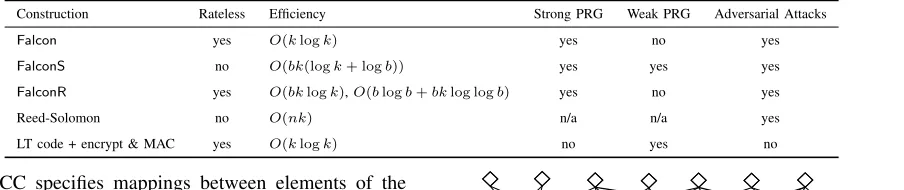
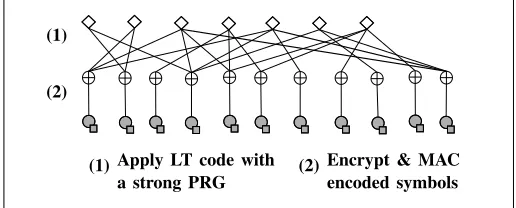
We also provide three constructions of authenticated LT codes that achieve this new security notion in our adversarial model while preserving the efficiency of normal LT codes. Our core scheme, shown schematically in Figure 3, leverages an extremely simple combination of a strong pseudorandom number generator (to randomize and protect the encoding graph), a semantically secure cipher (to encrypt encoded sym-bols and hide the encoding graph), and an unforgeable MAC (to authenticate symbols). To achieve better scalability, we extend this scheme to two more elaborate and highly optimized constructions: one fixed-rate code that applies our core secure encoding in blocks of input symbols, and its rateless extension that can produce unlimited encoded symbols. We provide a detailed comparison of our schemes in Table I.
Finally, we perform an extensive experimental evaluation of our constructions showing that, indeed, they achieve practical efficiency with low overhead. In particular, our schemes can
4By this term, here, we informally refer to error correcting codes that
employ cryptography to withstand adversarial symbol corruptions, typically (but not exclusively) by authenticating the integrity of the encoded symbols.
achieve encoding and decoding speeds up to300MB/s, several times faster than the standard Reed-Solomon encoding coupled with encryption and a MAC. Moreover, the overhead from our cryptographic additions to LT codes results in a slowdown of no more than 60% with typical slowdown close to just 25%. In Table I, we compare our constructions with a standard RS code, as well as the na¨ıve “secure” LT code that only encrypts and MACs the output symbols, according to the following criteria: rateless property, asymptotic efficiency of encoding and decoding (FalconR’s performance depends on the number of blocks, as we discuss in Section IV-C), the need for a strong PRG (FalconS can safely employ a weak, but fast, PRG for increased efficiency), and the achieved security related to adversarial data corruption. All of our constructions can withstand this worst-case behavior.
Although applying Falcon codes to reliable data transmis-sion and storage is out of the scope of this work, we believe that many such applications are feasible. In particular, our schemes can be used as drop-in replacements for any error correcting code used against a computationally-bounded ad-versary and provide immediate efficiency gains. For instance, RS codes are often used to provide fault-tolerance in secure storage; Falcon codes can provide almost the same guarantees as RS codes while providing much higher efficiency. They also readily find application in proof-of-retrievability (PoRs) systems, such as HAIL [2], that provide auditing checks on the retrievability and recoverability of outsourced data via careful data encoding against data-corrupting attackers.
Organization.Section II provides background information on relevant coding theory and cryptography. Section III details our security formulation in a new adversarial setting applied to rateless codes. Section IV details our Falcon code construc-tions, including an authenticated LT code and two extensions that achieve scalability and generality. Section V provides a security analysis of Falcon codes. Section VI details on a comprehensive experimental evaluation of our new codes. We overview related work in the overlap of coding and security in Section VII and conclude with Section VIII.
II. PRELIMINARIES
In what follows, we let λ denote the security parameter, and PPT refer to probabilistic polynomial-time algorithms. We also let [Alg] denote the set of all possible outputs of a PPT algorithmAlg, running on input parametersπ, andτ ←Alg(π)
the particular output derived by a specific random execution of
Alg(π). Analogously, we let x←R S andx←D, respectively, denote the process of sampling xfrom the setS uniformly at random or according to distributionD. Finally, we let◦denote string concatenation and|S|denote the cardinality of a setS.
A. Coding theory
An error correcting code (ECC) is a message encoding scheme that can tolerate some corruption of the encoded data and still allow recovery of the message from the (possibly corrupted) codeword. Codes that are designed to recover only from partial data loss, but not data corruption, are called erasure codes. We first present the definition offixed ratecodes (also calledblockcodes) which are the most common type of ECCs. Later, we will define rateless codes.
TABLE I. COMPARISON OF THREEFALCON CODE VARIANTS WITHREED-SOLOMON ANDLTCODES. HERE,kIS MESSAGE LENGTH,bIS NUMBER OF BLOCKS,ANDnIS THE CODEWORD LENGTH.FalconIS THE BASIC SCHEME ANDFalconSANDFalconRARE THE SCALABLE VARIANTS. FORFalconSAND
FalconR,kINDICATES THE NUMBER OF SYMBOLS PER BLOCK.
Construction Rateless Efficiency Strong PRG Weak PRG Adversarial Attacks
Falcon yes O(klogk) yes no yes
FalconS no O(bk(logk+ logb)) yes yes yes
FalconR yes O(bklogk),O(blogb+bklog logb) yes no yes
Reed-Solomon no O(nk) n/a n/a yes
LT code + encrypt & MAC yes O(klogk) no yes no
fixed-rate ECC specifies mappings between elements of the set of messagesΣk and the set ofcodewordsΣn. (Examples alphabets include Σ = {0,1}l, the set of all l-bit strings, or a finite field F.) For m ∈ Σk and c ∈ Σn, the components mi and ci are called message symbols and code symbols, respectively. Any given message m ∈ Σk is encoded to a corresponding valid codeword c ∈ Σn, and any invalid codeword ˆc, derived as a bounded distortion of c, can be uniquelydecoded back to the original messagem. If the firstk symbols of a valid codeword corresponds to originalkmessage symbols, then the code is said to be systematic. Parametersk and n are called the message length andblock length of the code, respectively. The ratio R=k/nis therateof the code, capturing the amount of information transmitted per codeword and typically controlling the recovery strength of the code as follows. TheHamming distancebetween twon-symbol words xandyis the number of symbols in which they differ, defined as ∆(x, y) = |{i | 1 ≤ i ≤ n, xi 6= yi}|. The (minimum) distanceof an ECC isd, if for all valid codewordsc, c0 ∈Σn
such thatc6=c0, we have∆(c, c0)≥d(capturing the minimum number of changes needed to transform one valid codeword into another). Then, any code with minimum distancedallows for decoding invalid codewords distorted by up tobd/2cerrors back to a unique message;5 typically, the smaller theRis, the larger the d.
Definition 1: Anerror correcting codeCover an alphabet
Σ with rate R and minimum distance d, is a pair of maps
(Encode,Decode), where Encode : Σk →Σn andDecode :
Σn →Σk, such that k=Rn, and for allm∈Σk and for all c∈Σn with∆(c,Encode(m))≤ bd/2c,Decode(c) =m.
Rateless ECCs. This class of error correcting codes, called rateless or fountain codes, employs no fixed block length n. Instead, rateless codes can generate a limitless stream of encoded symbols (i.e., a continuous “fountain”), allowing recovery of the original message (with high probability) from any subset of these symbols that is sufficiently large. Typically, for message length k, (1 +ε)k correct encoded symbols are needed to decode the message with probability at least1−δ. Here,εis called the overhead of the code andδrefers to the decoding failure probabilityof the code, the latter determining the range of possible values that the former may have; in particular, smaller values of δ require larger values of ε and vice versa. We denote this relationship byF(δ, ε).
Definition 2: A (k, δ, ε)-rateless error correcting code C over an alphabet Σ with decoding failure probability δ and overheadεso thatF(δ, ε), is a pair of maps(Encode,Decode), where Encode maps from Σk to Σ∞ (infinite sequences of
5Not considered in this work is list-decoding, which allows mapping any
invalid codeword, distorted with errors beyondthis half-the-distance bound, back to a list of messages that always contains the correct original message.
Fig. 1. LT-encoding: Each code symbol (bottom) is the XOR ofO(logk)
randomly selected message symbols (top).
elements inΣ) and for anym∈Σkand any finite subsequence s of Encode(m)of length at least(1 +ε)k,Decode(s) =m with probability at least 1−δ.
Examples of rateless ECCs include LT codes [23], along with their derived extensions Raptor codes [41] and Online codes [28]. For LT codes, the main focus in this work, the encoding/decoding mappings take an extra input parameter: the degree distribution D. Here, D is used to construct a sparse bipartite graph with input (message) symbols in one partition and code symbols in the other, also called inputand parity nodes—see Figure 1. The degree of each parity node is selected according to D and its corresponding neighbors (message symbols) are selected uniformly at random. The code symbol corresponding to a given parity node is simply the XOR of the message symbols of the neighboring input nodes. The distribution used must be carefully chosen to achieve the desired success probability of1−δfor a given message length k, hence D is parameterized by k and δ, and thus denoted by Dk,δ. The value of δ and, now also, distribution Dk,δ determine the possible values of ε. For LT codes, we denote this relationship byF(δ,Dk,δ, ε). For simplicity, we will omit the subscripts k and δ, leaving the dependence implicit, and will denote the degree distribution as D.
Often, D instantiates to the robust soliton distribution, described in the original paper [23], which ensures that the average node degree is O(logk). This implies that: (1) using a balls-in-bins analysis, with high probability, every input symbol is covered by at least one of the (1 + ε)k code symbols, and thus can be decoded; and (2) encoding and de-coding takeO(klogk)time. Decoding uses a standard belief-propagation algorithm, thus correcting only symbol erasures, but not symbolerrors. The decoding method of [26] augments belief propagation to also correctrandomerrors with erroneous values distributed uniformly inΣ, butnot adversarial errors.
are produced. Overall, Raptor codes have encoding/decoding time that is linear in k, and achieve high data rates with low overhead.6 However, based on LT codes, they are essentially erasure codes and do not tolerate symbol corruption well. Analysis of Raptor codes over noisy channels [32] is also restricted to random (but not necessarily uniform) errors rather than adversarial ones.
B. Cryptographic tools
We overview the cryptographic primitives we employ to enhance LT codes to withstand adversarial errors—namely, message authentication codes (MACs), symmetric ciphers (SCs), and pseudorandom generators (PRGs), with which basic familiarity is assumed.
Keyed by secret k ← Gen1(1λ), a MAC produces a tag t=Mac(k, m)for messagem, which can be used to verify the integrity of m by checking VerMac(k, m, t) = 1. We require that a MAC isexistentially unforgeableso that an adversaryA
cannot forge the tag foranymessage, even for one of its own choosing. Here, A is allowed to query a MAC oracle to get any number of example message-tag pairs before it outputs a target message-tag pair (m∗, τ∗) that does not belong in the queried pairs; then, with all but negligible probability in λit holds that VerMac(k, m∗, t∗)6= 1.
Keyed by secretk←Gen2(1λ), a symmetric cipher SC is an encryption scheme(Enc,Dec)so thatDec(k,Enc(k, m)) =
mfor any messagem(in the appropriate message space). We require that a SC issemantically secureso that a ciphertextc= Enc(k, m)“hides” all the information about a given message m. Here, for any adversaryA computing any function f on the message m given ciphertext c (and any auxiliary input), f(m)can still be computedwithoutthe ciphertext, with all but negligible probability inλ. Intuitively, knowing the ciphertext c leaks no additional information aboutm.
Finally, given a short random seed s ← {R 0,1}λ, a pseu-dorandom generator (PRG) serves as an efficient source of randomness by producing a long sequence of random-looking bits. A PRG is secure if its output is indistinguishable, with all but negligible probability in λ and with respect to any polynomial-time distinguisher, from a string of truly random bits. Equivalently, any algorithm taking random bits as input behaves only negligibly different when given pseudorandom bits instead.
III. SECURITYMODEL
Our main goal is to extend LT codes to endureadversarial corruptions inflicted by a computationally-bounded adversary. Here, we present a new definitional framework forprivate LT-coding schemes, a new class of rateless codes that are based on LT codes and employ the use of secret-key7 cryptography to resist polynomial-time adversarial errors. We introduce a corresponding new security notion we call computationally
6Since only a linear number of symbols are output, Raptor codes only strive
to recover aconstant fractionof the intermediate symbols via LT-decoding. Any gaps in these symbols symbols are recovered by decoding the precode.
7Our schemes use a PRG, a MAC, and a semantically secure cipher;
the latter two can be replaced with public-key equivalents, while the PRG is inherently a secret-key scheme. However, coupling our schemes with a public-key key-agreement protocol (over a noiseless channel) would break their dependence on secret-key cryptography. But, for simplicity of analysis and presentation, we only utilize secret-key schemes.
secure rateless coding. Our security model is general enough to also capture security for block codes.
Motivating scenarios. There are several adversarial settings which motivate our security model. First and foremost, we want to ensure that, with all but negligible probability, when-everDecodeoutputs a message, it is the same message that was encoded. That is, we wish to avoid corruption of the decoded message. Since total corruption or deletion of a message is catastrophic—and presumably users would stop using such an unreliable channel—we consider attacks that do not destroy or maul the entire message, which is standard when analyzing ECCs. For example, a client may encode their data and distribute it among several cloud providers, a subset of which are compromised by the adversary A, limiting corruption to those servers.
An alternative scenario is where A is malicious network router that sees some, but not all of an encoded message.
A can attack an LT-encoded message by erasing only high-degree symbols (i.e., those combining many input symbols) and leave low-degree symbols untouched. The decoder would then receive mostly low-degree symbols and be much more likely (i.e., with probability greater thanδ) to fail and output nothing. This is essentially a stealthy DoS, or at least a quality-of-service attack, and is a violation of the upper-bound on the decoding failure probability. The receiver could wait for more good symbols from the non-malicious routers, but this would break the LT code’s guarantee of needing only(1 +ε)k uncorrupted symbols to decode with probability greater than
1−δ. We seek to be secure even from this targeted erasure attack, an attack which was previously identified in [19], but was left as an open problem.
A. Private LT-coding schemes
Prior work has considered computationally bounded adver-saries only against block codes. In particular, in his seminal paper [22], Lipton first modeled a computationally bounded adversarial channelthat can corrupt at most a constant fraction ρ of the encoded symbols. Later, Lysyanskaya et al. [27] studied an (α, β)-network (or channel) that can arbitrarily corrupt (alter or delete) the n code symbols in an encoded message, and also insert new symbols into the codeword (even multiple versions of selected symbols), subject to two restrictions: (1) at least αn symbols survive corruption and (2) at most βn total symbols are received. Subsequent work by Micali et al.[29] provided a more involved security game that includes several rounds of encoding, bounded symbol corruptions, and decoding between a sender, an adversarial channel, and a receiver.
of “good” encoded symbols that remain intact, and allow the remainder to be bad. In a block code, an upper-bound on badness implies a lower-bound on goodness (and vice versa), but this symmetry breaks in rateless codes.
We first provide the definition of private LT-coding schemes. This extends the definition of private coding schemes given in [29], via changes in the parameters and function specifications, to suit the class of rateless codes that are based on LT codes (instead of block codes). This class generically captures fountain codes that can produce an unlimited number of encoded symbols using the LT-coding technique over a set of “input” symbols (not necessarily the message symbols) using an appropriate degree distribution D (thus encompassing LT codes, Raptor codes and Online codes). Recall that for a degree distribution D for a message length k, we want that, given
(1 +ε)k code symbols, decoding succeeds with probability
1−δ. We denote this relationship withF(δ,D, ε). As in [22], we assume that the sender and receiver have a shared secret key sk. We also use nonces to prevent replays.
Definition 3: A(k, δ,D, ε)-private LT-coding schemeover an alphabet Σ with message lengthk, decoding failure prob-ability δ, overhead ε and degree distribution D such that F(δ,D, ε), and key space K, is a triple of PPT algorithms
(Gen,Encode,Decode), where:
• Gen: on input security parameter 1λ, outputs a random secret keysk∈ K;
• Encode: on input (1) secret keysk, (2) nonce`, (3) de-coding failure probability δ, (4) degree distribution D, (5) overheadε, (6) and the message m∈Σk, outputs an infinite sequence {ci}∞i=1, with ci ∈ Σ, referred to as a codeword or anencodingof m;
• Decode: on input (1) secret key sk, (2) nonce `, (3) decoding failure probabilityδ, (4) degree distribution
D, (5) overhead ε, (6) and a string c ∈ Σ∗, where
|c| ≥(1 +ε)k, outputs a stringm0 ∈Σk with probability at least 1−δ, or fails (with probability at most δ) and outputs ⊥.
We require that for all m∈Σk,Decode(sk, `, δ,D, ε, c) =m with probability at least1−δ, wherec is a finite subsequence of Encode(sk, `, δ,D, ε, m)of length at least(1 +ε)k.
The above definition is general enough to also express two types of “crypto-enabled” block codes. First, any ECC with fixed rateρcan be captured by having a null distributionD, if necessary, and adjusting δ andε according to the code (e.g., for Reed-Solomon codesδ=ε= 0, while for Tornado codes δ, ε > 0). More importantly, we can refine Definition 3 to get block versions of LT-coding schemes that simply produce codewords of fixed size (above the decoding threshold). A
(k, δ,D, ε)-private block LT-coding schemewith block-size n is defined as a (k, δ,D, ε)-private LT-coding scheme where
Encode, given an additional input parameter n, produces codewords c with |c| = n ≥ (1 +ε)k. In what follows, let LT S = (Gen,Encode,Decode, π), denote a (k, δ,D, ε) -private LT-coding scheme with π = (1λ, k, δ,D, ε), its n -symbol refinement by LT Sn = (Gen,Encode,Decode, π, n), and any (rateless or block) LT-coding scheme by LT S∗.
Also, note that the probabilistic decoding requirement ex-pressed by relation F(δ,D, ε)imposes a minimum expansion factor (1 + ε) on message encoding. However, due to its
dependence on the distribution D, the failure bound δ holds when there are “enough” code symbols produced in an absolute sense. In practice, this further restricts message lengthkto be sufficiently large.8
B. Security game
We next present a general security model against compu-tationally bounded adversaries that is applicable to private LT-coding schemes (and their fixed-size block variants). Our goal is to capture tolerance against adversarial symbol corruptions for LT-coding schemes, thus defining a much stronger security notion over the existing one that considers only random symbol corruptions.
We thus consider a transmission channel that is fully controlled by a computationally bounded adversary A. That is, as new code symbols are produced by a private LT-coding scheme LT S, A can maliciously corrupt any new or past such symbols. Moreover, the adversary is allowed toadaptively interact with the channel. That is,Ais allowed to examineany symbols of its choice of the encoding (produced byLT S) of any message of its choice and, additionally, to examine the decoded message (produced byLT S) onany corrupted set of symbols of its choice. Finally, we consider astatefulchannel. That is, A can remember any past selected message, its encoding, symbol corruptions and the corresponding recovered message, and depend current actions on the full such past history. Do note, however, that Ais never given the bipartite graph underlying any of the LT-encodings.
In this powerful adversarial setting, we aim to ensure that any PPTAis only negligibly more powerful than therandom erasure channel (the default operational setting for the LT codes). A random erasure channel chooses whether or not to erase a given symbol with some fixed probability p∈(0,1), independent of its choice for the other symbols. Here, we further restrictpso that1−pis a non-negligible function in the security parameter λ, thus allowing a non-negligible expected fraction of symbols to survive erasure (i.e., we assume it is feasible to communicate over the channel). We call such values of p feasible and denote this channel as RECp. For a block code with message length k and block length n, we assume that p∈(0,1−k/n).
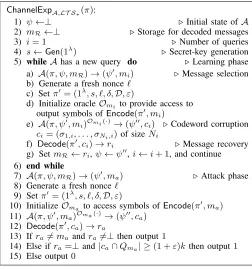
We define security in terms of a game
ChannelExpA,LT S∗(π), shown in Figure 2, that the adversary
A seeks to win. A wins by either: (1) causing a decoding failure, whereDecodeoutputs⊥; or (2) by causing adecoding error, whereDecodeoutputs a message different from the one originally encoded. There are three participants in the game: the encoderEncodeand decoderDecodeof a given LT-coding scheme LT S∗ with parameters π = (1λ, k, δ,D, ε), and the
adversary A. The game consists of a “learning” phase and an “attack” phase. In the learning phase, there is a sequence of at most a polynomial number of rounds where, in the i-th round: (1)Aselects a messagemito be encoded byEncode; (2) Encode initializes itself withmi; (3)A queries different symbols from Encode by having oracle access to symbols of the encoding ofmi; in particular,Ainteracts with oracleOmi
8For example, the degree distribution in [41] for Raptor codes works
which given as input an index j, it returns the j-th encoded symbol produced by Encode (for block codes, if j > n then ⊥← Omi(j)); (4) A outputs a (corrupted) codeword
ci consisting of Ni symbols in Σ∪ {⊥}, where a symbol σi =⊥ if it has been erased; (5) ci is given to Decode for decoding; (6) Decodeoutputs a messageri that is returned to
A. For simplicity, we assume thatAoutputs at least(1 +ε)k symbols, good or bad, at each step (otherwiseDecodetrivially fails and outputs⊥). For a memoryless channel,Amakes no learning queries.
Eventually, A decides to enter the attack phase against schemeLT S∗. The game proceeds with a special final round: Aselects attack messagema, queries encoded symbols ofma using the oracle Oma(·), and tries to cause decoding failure
or a decoding error by computing a corrupted codeword ca that decodes into messagera. IfDecodefailed to decode (i.e., ra =⊥) or decoded to the wrong message (i.e.,ra6=ma), then
A wins; else, A loses. However, we require that, in the case of decoding failure, Amust output at least(1 +ε)kunerased and uncorrupted symbols to win. Otherwise, A can trivially causeDecodeto fail simply outputting only corrupted symbols, or by erasing almost all symbols.9 For a decoding error, we have no such restriction. Let Qm denote the set of symbols queried by AfromOm. Abusing notation, let c∩Qm denote the subset of symbols in codeword c (which was output by
A) that are inQm. Thus, for decoding failure, we require that
|ca∩Qma| ≥(1 +ε)k.
ChannelExpA,LT S∗(π):
1) ψ←⊥ .Initial state ofA
2) mR←⊥ .Storage for decoded messages
3) i= 1 .Number of queries
4) s←Gen(1λ) .Secret-key generation
5) whileAhas a new query do .Learning phase a) A(π, ψ, mR)→(ψ0, mi) .Message selection
b) Generate a fresh nonce`
c) Setπ0= (1λ, s, `, δ,D, ε)
d) Initialize oracleOmi to provide access to output symbols ofEncode(π0, mi)
e) A(π, ψ0, mi)Omi(·)→(ψ00, ci) .Codeword corruption
ci= (σ1,i, . . . , σNi,i)of sizeNi
f) Decode(π0, ci)→ri .Message recovery
g) SetmR←ri,ψ←ψ00,i←i+ 1, and continue
6) end while
7) A(π, ψ, mR)→(ψ0, ma) .Attack phase
8) Generate a fresh nonce`
9) Setπ0= (1λ, s, `, δ,D, ε)
10) InitializeOma to access symbols ofEncode(π 0
, ma)
11) A(π, ψ0, ma)Oma(·)→(ψ00, ca)
12) Decode(π0, ca)→ra
13) Ifra6=ma andra6=⊥then output1
14) Else ifra=⊥and|ca∩Qma| ≥(1 +ε)k then output1 15) Else output0
Fig. 2. Security game for private LT-coding schemes.
As a technical note, we disallow the adversary to query for symbols that are arbitrarily far along in the stream produced by LT S∗ on any input message, thus avoiding the situation
where A queries symbols that are infeasible for Encode to
9Note, forged symbols are superfluous when trying to cause decoding
failure since if a forgery causes a decoding failure, then the corresponding
uncorruptedsymbol would have caused the same failure.
produce sequentially—this could giveAan unrealistic amount of power.10 In the game above, we call a queryOm(i)for the i-th symbol(τ, p)-feasible if,
P(Encodeoutputs at leastisymbols overRECp)≥τ , and, further, we call τ-admissible any A making only τ -feasible queries for a givenp. IfAisτ-admissible for all fea-siblepand, additionally,τis also non-negligible inλ, then we callAadmissible. In what follows, we consider only admissi-ble adversaries. Note that this restriction is related to the earlier restriction that we only consider feasible values ofpforRECp (i.e., 1−pis non-negligible). Ifpis allowed to be negligibly close to 1, then Encode will output an exponential number of symbols with high-probability. By restricting ourselves to feasible p, we ensure thatEncodeoutputs a super-polynomial number of symbols overRECp with only negligible probabil-ity; i.e., P(Encodeoutputs at leastisymbols overRECp) is always negligible for super-polynomial values ofi.
Computationally-secure LT-coding schemes. In normal op-eration over the random erasure channel, the probability that
Decode fails is bounded by δ. We want to ensure that the probability that A wins the above game (either by causing a decoding failure or a decoding error) is at most negligibly greater than δ.
We do this by defining computationally secure (rateless or block) LT-coding schemes. Intuitively, we wish to ensure that the adversary A is only negligibly more likely to cause a decoding error or failure than an adversary who attacks the codeword with random erasures.11 Thus, we first define arandom adversaryRinteracting in a restricted manner with
LT S∗ in the above game. R takes as input the same tuple
of parameters π and a probability p, where 1−p is non-negligible. ThenRproceeds as follows: (1) it directly chooses an attack message ma ∈ Σk and outputs (⊥, ma), so that oracle Oma is initialized; (2) it queriesOma sequentially for
encoded symbols; (3) for each retrieved symbol, it erases the symbol with probability p; otherwise it adds the symbol to a list (if the code has block-size n, thenR erases at most pn symbols); (4) whenRhas more than (1 +ε)k symbols (or at least(1−p)nsymbols) in the list, it outputs the list and exits. Note thatR’s output is distributed identically toRECp.
Let LT S∗ be a private (rateless or block) LT-coding
scheme, and let ExpAdvA,LT S∗(π) be the experiment
ChannelExpA,LT S∗(π) as defined above, where A is a PPT admissible adversary. Also, let ExpRandLT S∗(π, p)
be ChannelExpRp,LT S∗(π) where Rp = R(π, p) and p is the erasure probability. Let AdvA,LT S∗(π, p) =
|P[ExpAdvA,LT S∗(π) = 1]−P[ExpRandLT S∗(π, p) = 1]|. We call a private LT-coding scheme computationally secure if we have that for all PPT admissible Aand for all feasible p∈(0,1),AdvA,LT S∗(π, p)is negligible inλ.
Definition 4: We say that a private (rateless or block) LT-coding scheme LT S∗ is computationally secure (or just
10IfLT S
∗employs a PRG with finite state,Acan simply query symbols at
multiples of the period of the PRG, thus getting identically encoded symbols (as they use the same randomness) which renders decoding impossible.
11We define security relative to a random channel rather than in absolute
secure) if, for all PPT admissible adversaries A where π = (1λ, k, δ,D, ε), and for all feasible p∈(0,1) (or p∈(0,1−
k/n) for block variants), we have that AdvA,LT S∗(π, p) is negligible in λ.
IV. COREFALCONCODES
We now present our core technical constructions of three private LT-coding schemes. Based on LT codes and designed with a variety of efficiency goals, our new schemes define a broad class of rateless (fountain) codes as well as some corresponding block-code refinements which we generically term as Falcon codes. By construction, Falcon codes enjoy a “best-of-both-worlds” property: they are designed to maintain the asymptotic performance of LT codes, thus allowing great degrees of efficiency, including fast encoding/decoding; and at the same time, they are crypto-enhanced to achieve strong error-correction capabilities. Our three LT-coding schemes described below comprise of: a main scheme Falcon that is rateless and particularly simple, a scalable scheme FalconS
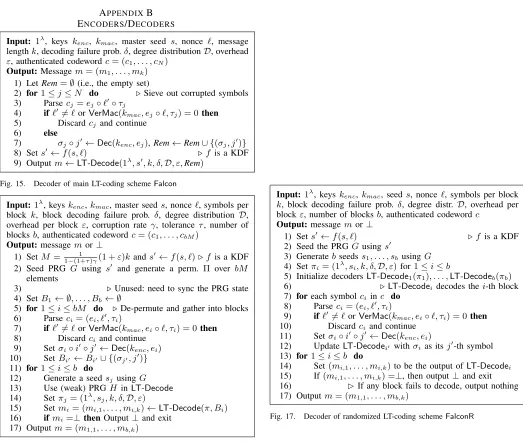
that is block refinement of our main scheme achieving better scalability, and arandomized schemeFalconRthat is a rateless refinement of our scalable scheme. We refer to these as core Falcon codes, which in essence provide a new design frame-work for secure LT-based codes tolerant to malicious errors. We describe all encoders, and the corresponding decoders are found in Appendix B.
A. Main LT-coding Scheme
As explained in Section II, LT codes [23] are a family of erasure codes of high efficiency, both theoretically (O(klogk)
encoding/decoding time for message lengthk) and practically. The encoder works by selecting (through the robust soliton distribution)O(logk)message symbols on average to combine to form a code symbol. The analysis in [23] was originally over the binary erasure channel, though it easily generalizes to larger symbols.
While there has been some work on extending LT codes to withstand errors (e.g., [26], [32]), the studied channels have particular noise characteristics, such as additive white Gaussian or uniformly distributed noise, and adversarial errors are not considered. For Raptor codes, which are derived from LT codes, Internet standard RFC5053 [24] and its amendment RFC6330 [25], suggest using a simple checksum (e.g., CRC32) to detect any random corruptions of the encoded symbols. While this may be sufficient for small, random errors, it will crumble quickly when faced with a malicious attacks.
(1)
(2)
(1) Apply LT code with
a strong PRG (2) Encrypt & MACencoded symbols
Fig. 3. An example encoding via authenticated LT codes.
Authenticated LT Codes.Our main schemeFalconsolves the challenge above by combining three cryptographic ingredients that are applied in a very simple and rather intuitive manner during LT-encoding (cf. Figure 3): a cryptographically strong
PRG, a semantically secure cipher, and an existentially un-forgeable MAC. (A nonce is also used to prevent replays.) First, the key change we perform in Encode compared to standard LT-encoding is to select each parity node’s degree and its neighbors using the secure PRG. Then, after LT-coding, we encrypt all of the encoded (parity) symbols and compute a MAC tag for each encrypted symbol and the nonce (alternatively, we could use authenticated encryption with the nonce as additional authenticated data).12 See also Figure 4. Intuitively, the encryption, MACs, and secure PRG work together to maintain the “goodput” of the channel by ensuring that each (uncorrupted) received symbol is just as “helpful” for decoding as when sent over a random erasure channel.
Note, in Figure 4, we use the subroutineLT-Encodewhich takes as input the seedsfor the PRG, message sizek, decoding failure probability δ, degree distribution D, overhead ε, the message m, and an index i, and then outputs the i-th code symbol. Note that we also use a key-derivation function (KDF) f to generate a seed for the PRG using the master seedsand the nonce `. Any any secure KDF can be used as long as the output is sufficiently long to seed the PRG. If we have message size k, decoding failure probability δ, degree distribution D, and overhead ε, then we denote this as(k, δ,D, ε)-Falcon.
This simple design provides a secure LT code (see Sec-tion V). First observe that the use of MACs ensures that any corruption in an encoded symbol is detected so that the symbol may be discarded. This step implements the standard known technique for reducing errors to erasures, that of authenticating the encoded symbols; we thus, informally, refer to our main scheme and its variants as an authenticated LT code.
Input:1λ, keyskenc,kmac, master seeds, nonce`, message size
k, decoding failure prob. δ, degree distribution D, overhead ε,
messagem
Output:Authenticated codewordc
1) Sets0←f(s, `) . f is a KDF; uses0 to seed the PRG 2) Seti= 0andπ= (1λ, s0, k, δ,D, ε, m)
3) Initialize LT-Encode(π) 4) foras long as requireddo
5) Setσ←LT-Encode(π, i) . i-th LT code symbolσ
6) Setei←Enc(kenc, σ◦i) .Encrypt and MAC
7) Setτi←Mac(kmac, ei◦`)
8) Outputci←ei◦`◦τi
9) i←i+ 1
Fig. 4. Encoder of main LT-coding schemeFalcon.
But although a necessary condition, symbol verification is not sufficient for achieving security: input and parity symbols are interrelated through the underlying bipartite graph, so corruption of certain parity symbols may seriously disrupt recovery of certain input symbols. An adversary can partially infer this graph structure by looking at symbolcontents(since code symbols are simply the XOR of a random subset of message symbols) and target specific symbols for erasure, seeking to maximally disrupt decoding.13 Symbol encryption
12We also include each symbol’s indexiin the stream of symbols to prevent
reorder and deletion attacks. When transmitting over a FIFOerasurechannel (where the receiver learns which symbols were erased in transit), then we can omit a symbol’s index from the encoding.
13E.g., for a message containing a single1bit (the rest being0’s),Acan
ensures that the content of each symbol (and any information about the graph structure contained therein) is hidden from the adversary. Similarly, the strong PRG ensures that the adversary cannot exploit any biases or weaknesses in the PRG (e.g., output that is initially biased, cf. RC4) to aid in guessing what the digraph structure may be. Overall, as the structure of the graph is unpredictable, an adversary will, intuitively, be unable to do better than random corruptions and erasures.
Batching. Note that secure MACing requires input lengths to be at least as large as the security parameter, thus Falcon
operates on message alphabets where each symbol is at least λ bits in size, i.e., for typical applications at least 10 or 16
bytes. Authenticating multiple symbols with a single MAC (as a single “batch”) is a reasonable implementation in many circumstances—for instance, when grouping multiple symbols together to be sent in a single network packet. However, this batching results in corruption amplification during decoding (a single symbol corruption can cause many other possibly valid symbols to be discarded). But, in channels where errors are of low rate or are bursty, authenticating a batch of sym-bols would lead to throughput gains since the cryptographic overhead is reduced. Batching also removes the minimum-size restriction for the symbols as long as the total batch minimum-size is at least λ. Also note that batching increases the decoding overhead εsince (1 +ε)k is not necessarily divisible by the batch size. With a batch of b symbols, the decoder must receive d(1 +ε)k/beb ≤ (1 +ε)k+b−1 symbols, giving an effective overhead of ε0 ≤ε+b−k1. Since the presence or absence of batching does not affect our security analyses (with the exception of the scalable, block code, detailed next), for simplicity, we assume that batches have size1.
Finally, we note that appending MACs to parity symbols increases the space overhead per symbol. For a block code, this decreases the rate by a factor of m/(s+m)wherem is the MAC size andsis the symbol size. Similarly, for a rateless code, the number of raw bits transmitted increases by a factor of1+m/s. For instance, ifs=m(the minimum symbol size), then size of an output symbol is doubled. However, ifms, then this overhead is marginal (e.g., for s = 1024 bytes and m = 16 bytes, the overhead is a factor ≈1.5%). Batching l symbols per MAC decreases the overhead to m/(ls+m).
B. Scalable (Block) LT-coding Scheme
Although simple and efficient, the authenticated LT code presented above suffers from scalability problems in certain cases. In particular, if the input file and the internal state of the encoder do not fit into main memory, then the operating system will need to continually swap pages in and out. Then, on average, O(logk) random disk reads will be needed to produce a single parity symbol, as any such symbol depends on randomly selected message symbols. Magnetic disks have random read latencies around 5–10 milliseconds while SSDs have read latencies on the order of 10s of microseconds. But both of these are orders of magnitude larger than the
10s of nanoseconds require to read from RAM. Hence, the large amount of IO required when paging in and out will drastically slowdown the encoder and decoder (see Figure 13 in Section VI).
We can mitigate this limitation by adopting a simple divide-and-conquer strategy on our main scheme Falcon, towards
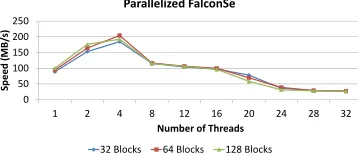
the design of a new scalable scheme FalconS: we divide the input into blocks (of symbols) and then encode each block independently usingFalcon. This immediately increases data locality during message encoding, which provides bet-ter scalability (as only a portion of the input must reside in memory at any given time) and further allows for easy parallelization (see Figures 9, 10, and 14 in Section VI). This method, though, introduces a new security concern: depending on parameterization, an adversary may put all of its effort in corrupting parity symbols coming from a single (or a few selected) block(s), thus significantly increasing its advantage in causing a decoding failure, even if all block encoders have produced symbols beyond the LT-decoding threshold.
To defend against this attack type, we adopt a technique due to Lipton [22]. We apply a random permutation π over all produced parity symbols across all blocks. This ensures that any corruptions performed by an adversary are distributed uniformly bothamongall blocks andwithineach block which, in turn, allows Falconto use a weaker and faster PRG when producing an individual block encoding, since any corruption on this block cannot be targeted, but only random. Apply-ing π over all parity symbols, though, necessitates a fixed upper bound on their total number, thus making FalconS a block code—this can be considered a useful byproduct of our new scheme. But employing (rateless) Falcon within (block)
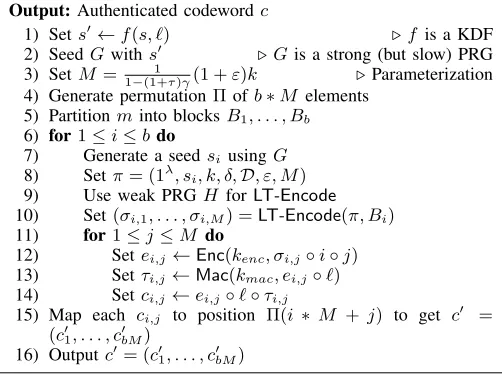
FalconS, as above, requires careful encoding parameteriza-tion. Given an adversarial corruption rateγ—with which an adversary corrupts a γ-fraction of all symbols, or γ-fraction of batches when using batching—and by applying a random permutationπto all of the code symbols from all of the blocks, we have that the number of symbol corruptions per block are binomially distributed. Therefore, we add extra redundancy in each block encoding produced by Falcon, expressed by tolerance rateτ, to absorb any variance in per-block errors— otherwise, block (and also total) decoding fails.14 An analysis bounding the value of τ as well as a proof of the efficiency of our scheme are in Appendix A.
Figure 5 details the above encoding using permutation π explicitly—we call this variant of our scalable (block) scheme
FalconSe—but it is possible for the permutation to be applied implicitly, which we detail next. As before, we use a secure KDF f to derive a session seed forG using the master seed s and nonce `. The algorithm as shown does not simply use
Falconas a black-box subroutine; rather, theFalconencoding algorithm directly integrated. This is done to include the block indexiwith each message symbol which is used to ensure that any re-ordering of symbols by the adversarial channel can be mitigated.15
However, there is a drawback to using an explicit per-mutation π: new parity symbols must be buffered until they are all generated (and then can be permuted!).16 If resources are constrained, this extra buffering can demand too much
14These losses can be mitigated by applying an additional level of erasure
coding to the input before breaking it up into blocks, but any erasure code can only tolerate a certain number of block losses. In any case, we must bound the probability that a block receives “too many” corrupted symbols.
15This is necessary even if the channel is FIFO, since we also allow the
adversary to delete symbols.
16At most, symbols can be output piece-meal by pre-computing π and
Input:1λ, keyskenc,kmac, master seeds, nonce`, symbols per
block k, degree distribution D, block decoding failure prob. δ, corruption rateγ, block-corruption toleranceτ, number of blocks
b, messagem
Output:Authenticated codewordc
1) Sets0←f(s, `) . f is a KDF
2) SeedGwiths0 . Gis a strong (but slow) PRG
3) SetM = 1
1−(1+τ)γ(1 +ε)k .Parameterization
4) Generate permutationΠofb∗M elements 5) Partitionminto blocksB1, . . . , Bb
6) for1≤i≤bdo
7) Generate a seedsiusingG
8) Setπ= (1λ, s
i, k, δ,D, ε, M)
9) Use weak PRGH forLT-Encode
10) Set(σi,1, . . . , σi,M) =LT-Encode(π, Bi)
11) for1≤j≤M do
12) Setei,j←Enc(kenc, σi,j◦i◦j)
13) Setτi,j←Mac(kmac, ei,j◦`)
14) Setci,j←ei,j◦`◦τi,j
15) Map each ci,j to position Π(i∗ M + j) to get c0 =
(c01, . . . , c0bM)
16) Outputc0= (c01, . . . , c0bM)
Fig. 5. Encoder of scalable LT-coding schemeFalconSe.
memory, induce swapping, and greatly reduce performance. In such a situation an implicit permutation would be better (see Figure 13 in Section VI). In this variant, π is generated firstand then parity symbols are produced (byFalconfrom the appropriate block encoder) in the order of their final position (i.e., after π would have been applied). This allows aFalcon
encoder to output parity symbols in a streaming manner (but out-of-order). We call this variant of our scalable scheme
FalconSi. For FalconSi or FalconSe, if we have k message symbols per-block, block decoding failure probabilityδ, degree distributionD, overheadε, an adversarial corruption rate ofγ, corruption-tolerance parameterτ, andbblocks in the encoding, we denote this as (k, δ,D, ε, γ, τ, b)-FalconS, where FalconS
can be either FalconSeor FalconSi.
To minimize the overhead of managing the implicit permu-tation, it is desirable that the PRG state in each encoder—used to generate the bipartite graph—can be easily and quickly reset to produce a desired segment of pseudorandomness (like in the Salsa20 stream cipher [1]). That is, the PRG state would be reset to produce the pseudorandom bits that would have been output if the symbol generation was done in order.17 If this feature is not present, all needed pseudorandom bits can be pre-computed (namely, computing the degree and neighbors of a parity node). Fortunately, the space needed to store the pre-computed bits will often be much less than what would be required to store the output symbols. For example, say we havek= 216input symbols and that the average node degree islogk= 16. Then, a given node will only require, on average,
2∗16 + 2 = 34bytes to store the degree and neighbor indices
(we assume that the degree can fit in 2bytes).
Decoding Failure Probability. Suppose we want to achieve an overall decoding failure probability of δ for this scheme. Decoding fails when any of the individual blocks fail to decode, and this could be from either too many corrupted symbols in a block, so that there are fewer than (1 +ε)k good symbols, or we were unlucky and the code symbols
17This would, of course, require the pre-computation of all node degrees;
otherwise, it is impossible to know “where” a given node’s randomness lies.
did not cover all input symbols. The probability of the first case can be made negligible via the corruption tolerance parameter τ; the second case is intrinsic to the schemes themselves. Note that in this case, the failures areindependent and so are the successes. Hence, the probability of decoding success is (1−δ0)b = 1−δ and solving for δ0, we have
δ0 = 1−√b1−δ
. For example, with b = 100 andδ= 0.05, we have δ0 = 1− 100√1−0.05 ≈0.000512.18 Note that the smaller value ofδ0implies that the decoding overhead for each block ε0 is increased.
C. Randomized Scalable LT-coding Scheme
Our block-oriented code FalconS does indeed achieve better scalability than Falcon. (As we show in Section VI, it can, for instance, provide over a 50% speed-up for an input file 32MB in size.) However, FalconS codes are in-herently no longer rateless codes: any permutation that is explicitly/implicitly applied to all symbols across all blocks precludes the possibility of rateless encoding.19
We now present an alternative approach that is block-oriented, thus still scalable, yet allows for rateless encoding. As before, the idea is to break the input up into blocks, and then apply aFalconcode to each block. However, the key idea now is to produce symbols for the output encoding by applying
Falconcodesin parallelto the blocks, giving the randomized, scalable, and rateless scheme FalconR. In particular, for each block an independent instance of Falconis initialized with a unique random seed generated by a strong PRG. Then, another strong PRG, keyed with another random seed, is used to iteratively select a blockat randomwhose encoder will simply output its next symbol; this random selection is repeated (at least) until each block encoding has reached the required decoding threshold. See Figure 6 below. As before, we use a KDF f to derive a seed for G using the master seed s and nonce `. As with FalconS, we integrate Falcon directly into the FalconR encoder, allowing us to include with each symbol the index of its block, mitigating symbol deletion and reordering attacks. If we havebblocks and encode each using a (k, δ,D, ε)-Falcon code, then we denote this (k, δ,D, ε, b)
-FalconR.
We emphasize the subtle difference between codes
FalconSi and FalconR: in a FalconSi code, the encoder for each block produces its symbols in a random order induced by π, but inFalconR code these are produced in the (correct) orderinduced by the block encoder itself.
FalconR codes retain the rateless property of the original
Falconcodes: new symbols can be produced by continuing to select blocks at random and outputting symbols. The security ofFalconRreduces to the security ofFalconcodes: the random selection of encoders ensures that adversarial corruptions are randomly and uniformly distributed among the blocks pre-venting too many corruptions from landing in any one block. Moreover, the secure encoder used on each block ensures that, for any corruptions that occur in that block, the adversary can do no better than a random channel. Note that while FalconS
18If we apply a[n, b]erasure code across the blocks, then the probability
of decoding success (i.e., that at most n−b blocks fail to decode) is
Pn−b i=0
n i
(1−δ0)n−i(δ0)i, which can be solved for δ0 via numerical methods.
can use a weak PRG when encoding an individual block, here each instance of Falconmust use a strong PRG.
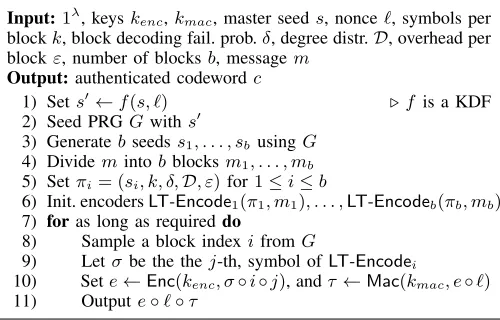
Input:1λ, keyskenc,kmac, master seeds, nonce`, symbols per
blockk, block decoding fail. prob.δ, degree distr.D, overhead per blockε, number of blocksb, messagem
Output:authenticated codewordc
1) Sets0←f(s, `) . f is a KDF
2) Seed PRGGwiths0
3) Generatebseedss1, . . . , sbusingG
4) Dividemintobblocksm1, . . . , mb
5) Setπi= (si, k, δ,D, ε)for1≤i≤b
6) Init. encodersLT-Encode1(π1, m1), . . . ,LT-Encodeb(πb, mb)
7) foras long as requireddo
8) Sample a block indexifromG
9) Letσbe the thej-th, symbol ofLT-Encodei
10) Sete←Enc(kenc, σ◦i◦j), andτ←Mac(kmac, e◦`)
11) Outpute◦`◦τ
Fig. 6. Encoder of randomized LT-coding schemeFalconR.
Efficiency. The asymptotic efficiency of our randomized scheme is not immediately obvious. Enough encoded symbols must be produced for each block, namely at least m code symbols, for some m = Ω(k), where k is the number of input symbols per block. This problem is a generalization of the standard balls-in-bins problem which asks how many balls must be thrown at random into bbins to ensure that each bin has at least one ball. Here, what is relevant is how many balls must be thrown intobbins to get at leastmballs in each bin. In [30], it is shown that, as b goes to infinity, the expected number of balls thrown isb[logb+ (m−1) log logb+Cm+ o(1)], for some constantCm. That is, the expected number is blogb+b(m−1) log logb+O(b). Thus, on average, we gain (at least) an additional log logb factor in the time to encode and decode the file.20The tolerance parameterτofFalconSis no longer needed here; each block uses theFalconencoder and
FalconRis rateless, so more symbols can always be produced.
If, however, we have a small b (e.g., b = 10), then since k must be sufficiently large (and hence, so must m), by the law of large numbers the average number of balls thrown is O(bm). The asymptotic behavior of FalconR as b grows is important since we would like this scheme to scale up to very large files (e.g.,10s of gigabytes or more). Suppose the degree distribution requires12000 code symbols to recover the input with high probability, and that symbols are at least 10 bytes in size, then we get an implicit lower-bound on block size of about128KB (less if symbols in a block are batched together). As a 1GB file will contain approximately 8000such blocks, both the case where there are many blocks and the case where there are few must be considered.
V. SECURITYANALYSES
Our various constructions of Falcon codes seek to reduce an adversarial corrupting channel to arandom erasure channel (REC) (i.e., by using MACs to detect corruption). Through such reductions, our LT-coding schemes inherit many of the properties of the original LT codes (e.g., the overhead ε and failure probability δ). We next provide proof outlines of
20If we use batching, then the same analysis applies if we have the
“transmission unit” be a batch instead of a single symbol.
reductions to REC for our core Falcon code schemes.21 Full proofs are omitted for lack of space.
The adversaryA can win the gameChannelExp by caus-ing a decodcaus-ing failure (Decode outputs ⊥) or a decoding error (Decode outputs an incorrect message). Since these are mutually exclusive events, they are considered separately in the following lemmas. Lemma 1 states that the ability of
A to cause a decoding error in authenticated LT code is directly reducible to the security of the message authentication code. Lemma 2 states that the probability of causing decoding failure is only negligibly different from a random channel. For simplicity, we here use memoryless channels: the proofs extend in a straightforward way to stateful channels by simply utilizing the nonces. Recall that, as stated in Section III, we only consider admissible adversaries A that are compared to random erasure channels with a feasible erasure probabilityp.
Lemma 1: Let M = (Gen1,Mac,VerMac) be an existentially-unforgeable MAC used to authenticate the sym-bols of a (k, δ,D, ε)-Falcon code LT S, where F(δ,D, ε)
holds, and let λbe the security parameter. For all sufficiently large k and for all PPT A, the probability that A wins
ChannelExpA,LT S via a decoding error is negligible in λ.
Intuitively, forAto forceDecodeto make a decoding error,
Decode must accept at least one corrupt code symbol, which can only happen if the MAC for the symbol has been forged. But, we assume that the MAC is existentially unforgeable, hence A could not have forged any symbol, except with negligible probability.
Lemma 2: Let LT S be a (k, δ,D, ε)-Falcon code where the relation F(δ,D, ε) holds, Π = (Gen2,Enc,Dec) be a semantically secure symmetric cipher used by LT S, and let G be a secure PRG used by LT S. Then, for all sufficiently large k and for all PPT admissible A, the probability that A
wins ChannelExpA,LT S via a decoding failure is negligibly different from δ.
Here, we reduce security against decoding failure to the security of the PRG and the semantic security of the cipher. Roughly, the proof proceeds as follows. Since a semantically secure cipher is used to encrypt encoded symbols, the code-wordc leaks no “information” about the underlying encoding of m to A. This means that there exists an A0 that without
access to c, that is,independentofc, but given some informa-tion aboutm, outputs a set of indices of symbols to be erased, such that Decode fails to decode with probability ≈ δ (i.e., negligibly different from δ). Since the symbols to be erased are chosen independently of the encoding c, the remaining symbols form a random graph over the input symbols and, by definition, we have reducedAto REC. The following theorem summarizes the security of our scheme. The result follows directly from the two lemmas above.
Theorem 1: LetLT S be a(k, δ,D, ε)-Falconcode utiliz-ing an existentially-unforgeable MAC scheme M, a semanti-cally secure cipher schemeΠ, and a secure PRGG. Then, for all sufficiently large k, for all PPT A, and for all feasible p, where π = (1λ, k, δ,D, ε), we have that AdvA,LT S(π, p) is
negligible in λ.
21For simplicity and clarity, we use asymptotic security statements, rather
Note that the above theorem and lemmas apply to non-systematic Falcon codes. With a systematic code, A knows that the first k code symbols are equal to the input symbols.
A can then make corruptions that are decidedly non-random against these symbols. That is,Ahas somea prioriknowledge of the underlying encoding graph, and can adjust its strategy accordingly. We leave as an open problem the creation of a secure, systematic Falcon code.
For our scalable FalconS codes (both with an explicit permutation and without), the security of the scheme follows from the results of Lipton’s work on scrambled codes in [22]. In particular, the random permutation of the symbols ensures that the erasures and errors are uniformly distributed among the blocks and within each block as well, which is the definition of a random channel. Note that in this model, the adversary Rγ erases up to aγ-fraction of symbols (or aγ-fraction of batches, if batching is used) rather than erasing with probability γ. Recall that each block has N= 1−(1+1τ)γ(1 +ε)ksymbols.
Theorem 2: Let LT SbN be a (k, δ,D, ε, γ, τ, b)-FalconS code that uses an existentially-unforgeable MAC scheme M, a semantically secure symmetric cipherΠ, a secure PRGGto generate the permutation, divides the input intob blocks, and generatesN symbols per block. Then, for all sufficiently large kand for all PPTAthat corrupt up to aγ-fraction of symbols, letting π = (1λ, k, δ,D, ε), we have Adv
LT SbN,A(π, γ) is
negligible in λ.
Finally, for our randomized Falcon codes, we utilize the main Falcon code as a subroutine and then use a strong PRG to select the block to produce the next symbol. The security of this scheme reduces to that of the PRG and the main Falcon code to get the following theorem. This result, however, does not follow directly from Lipton’s work as above, since the symbols are outputin order from each block. Rather, the PRG ensures that, when receiving symbols, with high-probability, after receiving O(b[logb + (m −1) log logb]) uncorrupted symbols we can decode successfully. Using the main Falcon code ensures that the adversarial corruptions by A using a priori knowledge of the scheme—A knows that the first symbols in the stream are the first symbols encoded by the individual blocks—does not giveAa significant advantage.
Theorem 3: Let LT SR be a (k, δ,D, ε, b)-FalconR code that uses an existentially-unforgeable MAC scheme M, a secure PRG G, a semantically-secure symmetric cipher Π, a secure (k, δ,D, ε)-Falcon code LT S, and divides the input intobblocks. Then, for all sufficiently largekand for all PPT admissibleA, and for all feasiblep, whereπ= (1λ, k, δ,D, ε), we have that AdvLT S,A(π, p)is negligible inλ.
VI. EXPERIMENTS
In this section we detail several experiments performed that demonstrate the practicality of our constructions. The experiments were run on two machines: one with “abundant” resources and the other with more limited CPU power and RAM. We use these two machines to measure the raw speed and efficiency of our schemes without constraints and to show that our scalable schemes do achieve better performance, especially when RAM becomes scarce.
The majority of the experiments were performed on the powerful machine with two 2.6GHz AMD Opteron 6282SE with 16 cores each and 64GB RAM running 64-bit Debian
0 100 200 300 400
1 2 4 8 16 32 64 128 256 512 1024
Sp
eed
(
M
B
/s
)
File Size (MB)
Speed of Reed-Solomon Code and Falcon Code
Falcon Encode Falcon Decode RS Encode RS Decode
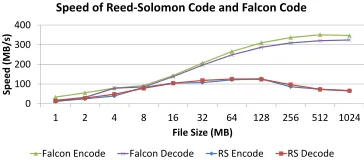
Fig. 7. The encoding throughput ofFalconcompared to RS codes. Linux with the 3.2.0 kernel and gcc version 4.7.2. The “resource-constrained” benchmarks were run on a 2.6GHz, Intel Core i5 processor with 4GB of RAM running 64-bit Arch Linux with the 3.14.19 kernel and gcc version 4.9.1. All implementations are a mix of C and C++ and are single threaded unless otherwise specified—the parallel implementation (detailed below) utilized pthreads—and were compiled with the ’-O2’ optimization flag. All schemes use the Salsa20 stream cipher (see [1]) as the secure PRG, SFMT as the fast/insecure PRG (see [37]), and PBKDF2 for key derivation [15]. The Jerasure v2.0 library [13] was used for the Reed-Solomon erasure code.
We use authenticated encryption for both confidentiality and authentication: specifically, we use AES in Galois/Counter Mode (GCM) provided in the OpenSSL library (version 1.0.1e and 1.0.1i on the Opteron and Core i5 machines, respectively). An alternative implementation would be to use AES in counter mode and pair it with a fast MAC, such as VMAC [20]. In some rough tests on the Core i5, we found the AES-VMAC combination to be the fastest for symbols more than 2KB in size and AES-GCM to be faster for smaller symbols.22 The largest symbol size we consider is 4KB, with almost all tests run on symbols 1KB or smaller. Thus, for simplicity, we use AES-GCM in all tests. We did not use batching and, hence, encrypted and MACed each symbol individually.
The algorithms we benchmark are Falcon Raptor codes: we combine our authenticated LT code with a precoding step (where an erasure code is applied to the input data) to give us a secure Raptor code. Raptor codes are among the most efficient erasure-correcting codes available and we show below that our authenticated raptor codes themselves achieve high efficiency. Our implementations of both Falcon codes and Raptor codes are based on the libwireless code written by Jonathan Perry [36]. We used an LDPC-Triangle code as the precoding step using the implementation from [43]. Unless noted otherwise, all encoding and decoding was performed with 1KB symbols and adding25%redundancy and the numbers given are an average of 10trials.
Main Scheme Falcon.First, we compare our Falconscheme to that of Reed-Solomon codes (RS codes), which is the de facto standard for encoding a file to withstand adversarial corruption. In Figure 7, we see the encoding and decoding speeds for Falcon versus an RS code on various file sizes when run on the Core i5. ForFalcon, the number of symbols was held constant at ≈10000 for all files with symbol sizes ranging from 16 bytes to 128KB. The RS encoder utilized a systematic erasure encoding with k = 204 and n = 255
22For example, on a 16KB input, AES-GCM achieved2.4cycles-per-byte