Available online: https://edupediapublications.org/journals/index.php/IJR/ P a g e | 1220
Reusable Sols Encoder for Dsrc Applications
M. ASHOK BABU,[M.Tech] ; A.V.Subba Rao ; R.Sambasivanayak, H.O.D
1Sri Chundi Ranganayakulu Engineering College, Ganapavaram Guntur DT
2Associate Professor Sri ChundiRanganayakulu Engineering College, Ganapavaram Guntur DT
3Sri Chundi Ranganayakulu Engineering College, Ganapavaram Guntur DT
ABSTRACT: A protocol which is mainly used for intelligent transportation system is the dedicated short range communication (DSRC). By this protocol the information signals which are transmitted are encoded by using either FM0 or Manchester codes. The designing of VLSI architecture is limited by the code diversity between these two codes that supports the both. Hence this paper gives a new VLSI architecture design which can be fully reused by using both the codes. This proposed design is based on similarity oriented logic simplification (SOLS) technique which achieves an
efficient performance compared with
sophisticated works.
1.INTRODUCTION
Dedicated Short Range Communication (DSRC) is a protocol which is used for a short distance range of communication through a dedicated channel. This DSRC introduces intelligent transport system into
our day to day life. The DSRC
communication supports in both vehicle to vehicle communication and vehicle to roadside communication. The vehicle to vehicle communication mainly consider with the collision alarms, hard break warnings etc.
The vehicle to infrastructure communication comprises the Electronic Toll Collection (ETC), highway-rail intersection warning, in vehicle signing etc. However, for the DSRC
communication channel the primary
motivation is collision detection and vehicular safety. In addition to it, it also support in smooth traffic control. The DSRC equipment mainly contains three modules. They are base band processors, RF front end
and the microprocessors. The
microprocessors are responsible for
scheduling the tasks of base band
processing, RF front end and intercept the instructions. The RF front end is responsible for the transmission and reception of data. Finally, the main function of the base band
processing contains modulation, error
Available online: https://edupediapublications.org/journals/index.php/IJR/ P a g e | 1221
Oriented Logic Simplification (SOLS) is
proposed. It improves the hardware
utilization rate of the reusable architecture and then improves the performance and area footage.
2. RELATED TECHNOLOGIES 2.1 DSRC Protocol
Dedicated short range communication
(DSRC) is a quick, short to mid range wireless technology. DSRC is used to enables one way or two way communication between vehicles or between vehicles and roadside. It is used for making streets safer, traveling easier and minimizes the impact on the vehicles. It gives the ability for vehicles and infrastructure to communicate with each other at a rate of 10 times per second. The
most important concern is collision
detection in DSRC communication. Each DSRC facilitate vehicle broadcasts its basic information including speed, trajectory, location etc to a short range of distance i.e, a few hundred meters. All other DSRC equipped vehicles in that domain receives this message. After that receiver vehicles can decoded on this message and a caution or warning may be given to the driver. This can be issued audibly, visually or haptically. The DSRC communication is a direct communication between vehicles and it does not require any networking. Therefore it is also referred to as single hop. This type of communication can also be introduced as uncoordinated broadcast messaging. This network is extended by the each DSRC equipped vehicles to its neighbors and hence it can grow unbounded. It is also an important concern for safety, privacy. Hence, all safety communications are
performed in the control channel only. Two types of messages are involved in the safety communication:
messages that are regularly sent by the vehicle which includes change of speed, location, etc
These are messages that indicate an event like a hard brake.
3. METHODOLOGY 3.1 FM0 Encoding
The encoding which is a type of Non-Return to Zero code is FM0 encoding. This encoding is also used to represent the binary signals in a digital system. In FM0 encoding, the encoded signal experiences a transition for every clock cycle even though the data stream does not encounter transition. The FM0 encoding can be specified by using the three basic rules. They are as follows:
1. For every logic zero input there should be transition within a clock cycle.
2. For logic one input there should be no transition.
3. After every clock cycle irrespective of the input data there should be a transition.
By using two flip-flops and also
Available online: https://edupediapublications.org/journals/index.php/IJR/ P a g e | 1222 FIG. 1 FM0 ENCODING
3.2 Manchester Encoding
Now-a-days one of the most common data
coding methods used is Manchester
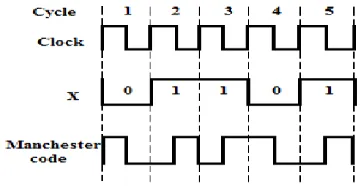
encoding. Manchester coding provides a way of adding the data rate clock to the message to be used at the receiving end. The Manchester codes are used to represent the binary values 1 and 0 in digital system. In Manchester coding, there will always be a transition of the message signal at the mid-point of the data bit frame. On the state of the previous bit frame the bit edge are depended and does not always provide a transition. A logical 1 is determined as a mid-point transition from low to high and a 0 is a mid-point transition from high to low. Fig 2 shows an example for a Manchester encoding.
FIG. 2 MANCHESTER ENCODING
By using an XOR gate the Manchester encoding can be implemented and to obtain the encoded data the clock signal and the data signal are XORed together as shown in the diagram below Fig 3.
FIG. 3 ENCODED DATA WITH XOR
3.3SOLS Technique
DSRC encoders are makes use of both the FM0 and the Manchester encoding. Hence to form a reusable encoder both the encoders can be combined together. Such a reusable encoder can be explained as shown in the figure 4.
FIG. 4 SOLS TECHNIQUE
Moreover, this block diagram can be simplified by using the SOLS technique. Two methods are considered for the SOLS technique, area compact retiming and the balance logic simplification.
3.3.1Area Compact Retiming
Available online: https://edupediapublications.org/journals/index.php/IJR/ P a g e | 1223
Hence the block diagram is rearranged as shown in the fig 5.
FIG. 5 FM0 ENCODER WITH STATES
3.3.2Balance Logic Simplification
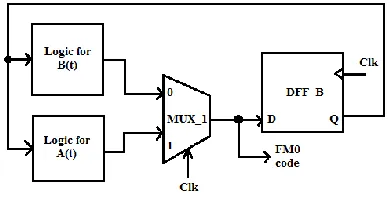
The Manchester encoder deals with this technique. The Manchester encoding can be considered as the XORing between the input signal and the clock. It can also be treated as a Multiplexer where the clock is given as the select input and the data and its complement is given as the data input. This is explained by the below fig 6.
FIG. 6 MANCHESTER ENCODER WITH BALANCE LOGIC
4. RESULTS AND DISCUSSION RTL SCHEMATIC
FIG. 7 RTL SCHEMATIC OUTPUT WAVEFORM
FIG. 8 OUTPUT WAVEFORM 5. CONCLUSION
Available online: https://edupediapublications.org/journals/index.php/IJR/ P a g e | 1224 6. REFERENCES
[1] Yu-Hsuan Lee, Cheng-Wei Pan ;Fully
Reused VLSI Architecture of
FM0/Manchester Encoding Using SOLS Technique for DSRC Applications IEEE trans. Very Large Scale Integr. (VLSI) Syst., vol. pp, issue 99, Feb 2014
[2] Sarika. G. Joshi, Vaishali S
Dhongde.,HDLC Protocol Implementation Using VHDL, IJIRSET.,vol. 3. Special issue 4, April 2014.
[3] F. Ahmed-Zaid, F. Bai, S. Bai, C. Basnayake, B. Bellur, S. Brovold, et al., Vehicle safety communications Applications (VSC-A) final report, U.S. Dept. Trans., Nat. Highway Traffic Safety Admin., Washington, DC, USA, Rep. DOT HS 810 591, Sep. 2011.
[4] J. B. Kenney, Dedicated short-range communications (DSRC) standards in the United States, Proc. IEEE, vol. 99, no. 7, pp. 11621182, Jul. 2011.
[5] A. Karagounis, A. Polyzos, B. Kotsos, and N. Assimakis, A 90nm Manchester code generator with CMOS switches running at 2.4 GHz and 5 GHz, in Proc. 16th Int. Conf. Syst., Signals Image Process., Jun. 2009, pp. 14.
[6] Y.-C. Hung, M.-M. Kuo, C.-K. Tung, and S.-H. Shieh, High-speed CMOS chip design for Manchester and Miller encoder, in Proc. Intell. Inf. Hiding Multimedia Signal Process., Sep. 2009, pp. 538541. [7] M. A. Khan, M. Sharma, and P. R. Brahmanandha, FSM based FM0 and Miller encoder for UHF RFID tag emulator, in Proc. IEEE Adv. Comput. Conf., Mar. 2009, pp. 13171322.
[8] M. A. Khan, M. Sharma, and P. R. Brahmanandha, FSM based Manchester encoder for UHF RFID tag emulator, in Proc. Int. Conf. Comput., Commun. Netw., Dec. 2008, pp. 16.
[9] J. Daniel, V. Taliwal, A. Meier, W. Holfelder, and R. Herrtwich,Design of 5.9
GHz DSRC-based vehicular safety