Structures (Full version)
?Jian Liu1, Sihem Mesnager2, and Lusheng Chen3
1
School of Computer Software, Tianjin University, Tianjin 300072, P. R. China and CNRS, UMR 7539 LAGA, Paris, France
2 Department of Mathematics, University of Paris VIII, University of Paris XIII,
CNRS, UMR 7539 LAGA and Telecom ParisTech, Paris, France
3
School of Mathematical Sciences, Nankai University, Tianjin 300071, P. R. China
Abstract. Secret sharing schemes with general monotone access struc-tures have been widely discussed in the literature. But in some scenarios, non-monotone access structures may have more practical significance. In this paper, we shed a new light on secret sharing schemes realizing general (not necessarily monotone) access structures. Based on an at-tack model for secret sharing schemes with general access structures, we redefine perfect secret sharing schemes, which is a generalization of the known concept of perfect secret sharing schemes with monotone ac-cess structures. Then, we provide for the first time two constructions of perfect secret sharing schemes with general access structures. The first construction can be seen as a democratic scheme in the sense that the shares are generated by the players themselves. Our second construction significantly enhance the efficiency of the system, where the shares are distributed by the trusted center (TC).
Keywords: Secret sharing schemes; general access structures; informa-tion rate; orthogonal arrays; resilient funcinforma-tions.
1
Introduction
Secret sharing schemes were first introduced by Blakley [6] and Shamir [32] in-dependently in 1979. Besides secure information storage, secret sharing schemes have numerous other applications in cryptography such as secure multiparty computations [5,15,16], key-distribution problems [27], multi-receiver authenti-cation schemes [36] etc. Note that minimal codes introduced and studied in the literature have applications in secret sharing (see for instance [1],[13],[17],[18],[19], [20],[22]).
?This work is supported by the National Key Basic Research Program of China under
The secret sharing schemes given in [6] and [32] are for the threshold case, i.e., the qualified groups that can reconstruct the secret key are all the subsets with cardinality no smaller than a threshold. A (t, n) threshold scheme is a method wheren pieces of information of the secret keyK, calledsharesare distributed to n players so that the secret key can be reconstructed from the knowledge of any t or more shares and the secret key can not be reconstructed from the knowledge of fewer than t shares. But in reality, there are many situations in which it is desirable to have a more flexible arrangement for reconstructing the secret key. Given somenplayers, one may want to designate certain authorized groups of players who can use their shares to recover the key. This kind of scheme is called secret sharing scheme for general access structure, which generalizes the threshold case. Formally, a secret sharing scheme for general access structure is a method of sharing a secretK among a finite set of playersP ={P1, . . . ,Pn}
in such a way that
1. if the players in A ⊆ P are qualified to know the secret, then by pooling together their partial information, they can reconstruct the secretK, 2. any set B ⊂ P which is not qualified to know K, cannot reconstruct the
secretK.
The threshold secret sharing schemes have received considerably attention, see e.g. [14,21,29,30]. Secret sharing schemes for general monotone access struc-tures were first studied by Ito, Saito, and Nishizeki [25]. The access structure defined in [25] is a set of qualified groupsΓ which satisfies the monotone property that ifA∈Γ andA⊆B, thenB∈Γ. Secret sharing schemes for general mono-tone access structures have got a lot of attention, and there exist a wide range of general methods of constructing monotone secret sharing schemes [3,4,8,26]. The approaches to the construction of monotone secret sharing schemes based on linear codes can be found in [7,28]. To our best knowledge, all the known se-cret sharing schemes are designed for realizing monotone access structures. We refer to [16] for a survey on monotone secret sharing schemes.
A secret sharing scheme can be represented by a set of recovery algorithms which realizes an access structure such that only qualified groups can reconstruct the secret key by pooling their shares. For example, in the bank teller problem described in Chapter 13 of [33], any two out of three tellers are authorized to reconstruct the secret key. It is quite natural to assume that three tellers are permitted to make a requirement on two of them to execute the recovery algorithm and reconstruct the secret key, then any group with two or more tellers is a qualified group. Hence, the access structure considered in this scenario has monotone property. However, for some scenarios, the requirement on fewer players of a group to recover the secret key is not available, and secret sharing schemes with non-monotone access structures may be more preferable. For a secret sharing scheme, it is reasonable to assume that the access structure is public and in the reconstruction phase, the players are anonymous, that is to say, the players will not disclose which group they belong to.
(e.g., a secure cloud storage server) with a secret key. Once the secret key is recovered, only the users who pool their shares will get the access to download the information. For some reasons, the users of the same group are not willing to download their information together with an outsider who does not belong to this group. So, only when all the users of the same group pool their shares, the secret key can be reconstructed, and if an outsider joins, the reconstruction reveals nothing about the secret key.
The access structure in the above scenario is non-monotone, since there exist A ∈ Γ and B 6∈ Γ such that A ⊆ B. A secret key can always be recovered by all the users in a qualified groupA, but if an outsider, say P, intrudes, the reconstruction by the users in the unqualified (i.e., forbidden) groupB=AS
P reveals nothing about the secret key. Consider that in Scenario 1, different groups of users have independently purchased the access to the database from the net-work center, and the payment of each group is afforded by every user of this group, thus the costs of the users from different groups may be different. Of course, the users belonging to one group do not hope to download their data together with an outsider. We consider data mining as another example for Scenario 1. Suppose different groups of market investigators are employed by different companies respectively to gather some information from the network center. Because of the market competition, the companies do not hope to dis-close what they are gathering to each other, i.e., the market investigators of one company are not willing to reconstruct the secret key and download their information together with an outsider. Thus, the access structures here should be non-monotone.
Secret sharing scheme is also a key tool for secure multiparty computation (MPC) (see [2,15,16]). Secure MPCs solve the problem that n players want to compute some agreed function with their inputs private. For instance, two millionaires want to know who is richer without disclosing their wealths to each other. This millionaire problem, first introduced by Yao [35], is a secure MPC problem which can be solved by monotone secret sharing schemes. A secure MPC protocol can be described as that every player shares his input with all the players by employing some secret sharing scheme, then the players in a qualified group can compute the result of the agreed function, and the players in a forbidden group cannot learn anything about the result and the inputs of the other players, where the qualified and the forbidden groups are determined by the access structure of the employed secret sharing scheme (see [2,15] for more details). In the following scenario, a secure MPC with non-monotone access structure is preferable.
compute the ranking result, and if an outsider joins, the computation reveals nothing about the result.
In the above scenarios, we must guarantee that ifB is a qualified group but A⊇B is not, then the players inAcannot make a requirement on the players in B to reconstruct the secret key or to compute the result of the agreed function. When all the players in a forbidden group follow the protocol accordingly, they can determine nothing about the secret key or the result of the agreed function. Perhaps one can find some other means to solve the problems presented in the above scenarios, and Scenario 2 may have less practical significance, but all these are intended primarily as examples to provide us a direction for possible applications of non-monotone secret sharing schemes. Similar practical scenarios could be found.
In this paper, we mainly discuss secret sharing schemes realizing general (not necessarily monotone) access structures. We first describe a general attack model for secret sharing schemes. Afterwards, a formal definition of unconditional se-curity (called perfect) for secret sharing schemes with general access structures is given, which is a generalization of the known perfect monotone secret sharing schemes. Moreover, we propose two constructions for secret sharing schemes re-alizing general access structures. To the best of our knowledge, this is the first time when constructions of non-monotone secret sharing schemes are proposed. Our first construction is democratic in the sense that the shares are generated by the players themselves instead of distributed by the trusted center (TC). In this construction, TC has to recompute an updated function for every time the se-cret key changes. The second construction is presented for the sake of efficiency, where the shares are computed and distributed by TC. We also show that the well designed secret sharing schemes presented in this paper are perfect.
This paper is organized as follows. Formal definitions and necessary prelim-inaries are introduced in Section 2. In Section 3, we discuss the attack model and the security of secret sharing schemes with general access structures. Per-fect democratic secret sharing schemes are constructed in Section 4, and perPer-fect secret sharing schemes with distributed shares are constructed in Section 5. In the last section, we summarize this paper and indicate some future research directions.
2
Preliminaries
For a secret sharing scheme, we denote a player by Pi, where i = 1,2, . . ., the
set of all the players byP, the set of all the subsets ofP by 2P, and thetrusted centerof the scheme by TC. The groups authorized to reconstruct the secret key are calledqualified, and the groups unauthorized to reconstruct the secret key are calledforbidden. The sets of qualified and forbidden groups are denoted byΓ and ∆ respectively, whereΓ ⊆2P and∆⊆2P. If ΓT
∆=∅, then the tuple (Γ, ∆) is called anaccess structure. Moreover, an access structure is calledcomplete if ΓS
for each setA∈Γ, the superset ofAis also inΓ. An access structure (Γ, ∆) is calledmonotone ifΓ is monotone increasing.
LetS be a secret sharing scheme. We denote the set of all possible secret keys byK, the set of all possible shares of groupA={Pi1, . . . ,Pim} ∈2
P byS(A), i.e.,S(A) =S(Pi1)×· · ·×S(Pim), whereS(Pij) is the set of all possible shares of
Pij and “×” denotes the Cartesian product. For a qualified groupA∈Γ, there
exists a recovery algorithm fA defined on S(A) which satisfies fA(s(A)) =k,
where k∈K is the secret key that TC wants to share and s(A)∈S(A) is the shares of the players in A. Then, a secret sharing scheme S realizing access structure (Γ, ∆) can be viewed as a set of recovery algorithmsF={fA|A∈Γ}
such that only qualified groups can reconstruct the secret key by pooling their shares.
Definition 1. [9] LetS be a secret sharing scheme,Kbe the set of all possible secret keys, and for 1 6 i 6 n, S(Pi) be the set of all possible shares that Pi
might have. Then, the information rateof Pi is defined as
ρi=
log2|K|
log2|S(Pi)|
,
and the information rateof S is defined as
ρ= min{ρi|16i6n}. (1)
In the following, we introduce some definitions and properties ofq-ary func-tions, which will be useful in constructing secret sharing schemes.
Let Fq be a finite field, where q is a power of a prime, then Fnq denotes
then-dimensional vector space over the finite fieldFq. In this paper, we always
assumeq >2. LetF∗q =Fq\ {0}, then (F∗q)n denotes the Cartesian product that n
z }| {
F∗q× · · · ×F
∗
q. The mappings from the vector spaceFnq toFq are calledn-variable
q-ary functions, which can be uniquely represented in thealgebraic normal form
(ANF), see [31]:
F(x) = X
u∈Znq
auxu11x
u2 2 · · ·x
un n ,
where Zq ={0, . . . , q−1}, x= (x1, . . . , xn)∈Fnq, u= (u1, . . . , un)∈ Znq, and
au∈Fq. In fact, given the values of F(w),w= (w1, . . . , wn)∈Fnq, the ANF of
F can be determined as
F(x) = X
w∈Fnq
F(w)
n
Y
i=1
1−(xi−wi)q−1. (2)
For an n-variable q-ary function F, the set Fnq is called the domain set of
F and the vector (F(v0), . . . , F(vqn−1)) is called the value table of F, where
v0, . . . , vqn−1 are all the vectors inFnq which have some prescribed order, e.g.,
the lexicographical order.F is calledbalanced if for any elementa∈Fq, the size
More generally, if F is a mapping from E1 ⊆ Fnq to E2 ⊆ Fq, then E1 is called the domain set ofF, and (F(v0), . . . , F(v|E1|−1)) is called the value table ofF, wherev0, . . . , v|E1|−1are all the vectors inE1with some prescribed order. In addition,F is called balanced onto E2 if for any elementa∈E2, the size of the pre-image set satisfies|F−1(a)|=|E1|/|E2|.
Fori= 1, . . . , m, letFibe a mapping fromEi ⊆Fnq toFq, whereE1, . . . , Em
are disjoint sets, then theconcatenation functionF ofF1, . . . , Fmis the mapping
fromSm
i=1Ei toFq which satisfiesF(x) =Fi(x) forx∈Ei, wherei= 1, . . . , m.
3
The Security of Secret Sharing Schemes with General
Access Structures
For a secret sharing scheme with general access structure (Γ, ∆), we assume that the players inA∈∆are passively collaborating to pool their shares and try to reconstruct the secret key. Note that the collaborating players are assumed to execute the protocol correctly and every player will keep his share private, i.e., the attack is passive. We also assume that the collaborating players are static, which means that the set of collaborating players is fixed during the protocol.
Attack Model The players in A ∈ ∆ are passively collaborating to find some efficient recovery algorithms to reconstruct the secret key.
For a general access structure, the players in groupA∈∆will try to guess the secret key by collaborating, and in this case, even ifA⊇B∈Γ (this case only appears in the non-monotone case), the players inBare passively collaborating, and cannot be required to execute their recovery algorithm and reconstruct the secret key independently fromA. In Section 1, we present two scenarios to show that this assumption is reasonable for the non-monotone case. Note that a secret sharing scheme can be viewed as a set of recovery algorithmsF ={fA|A∈Γ}.
Hence, if the players in A∈∆are passively collaborating, they can only try to guess the secret key by employing some known reconstruction algorithms that fB, B ∈ Γ, where B 6⊆ A. Particularly, for monotone access structures, one
can just assume that all the players belonging to a forbidden group (which is a proper subset of a qualified group) are passively collaborating to reconstruct the secret key.
LetA be any subset of players,B∈Γ, and k∈K, then givens(A)∈S(A), the conditional probability determined by algorithmfB is denoted by PrB(K=
k | S(A) = s(A)), which means that by using algorithm fB, the players in A
can guess the secret key correctly with probability PrB(K=k|S(A) =s(A)).
We use Pr(K =k|S(A) =s(A)) for short if there is no risk of confusion, and use Pr(K =k) to denote the a prior probability distribution on the secret key set K. Considering the above attack model, we present a formal definition of unconditional security for secret sharing schemes with general access structures.
Definition 2. A secret sharing scheme S with access structure(Γ, ∆)and se-cret key setK is perfect ifS satisfies the following two properties.
(ii) For anyA∈∆ and anyB∈Γ, whereB 6⊆A, the conditional probability determined by algorithm fB satisfies
Pr(K=k|S(A) =s(A)) = Pr(K=k)
for every k ∈ K. In other words, by using algorithm fB, the players in A can
learn nothing about the secret key.
Remark 1. For secret sharing schemes with monotone access structures, the con-cept of perfect system has been introduced in [9] and widely studied (see [2,33] for a survey). If a secret sharing scheme S with monotone access structure (Γ, ∆) satisfies (i) for anyA∈Γ, the secret key can be reconstructed correctly, (ii) for anyA∈∆, the players inAcan learn nothing about the secret key, then
S is called perfect. From the above discussion, it is easy to see that the concept of perfect system given in Definition 2 is more general, and for the monotone case, Definition 2 coincides with the standard perfect monotone secret sharing schemes.
For perfect secret sharing schemes with monotone access structures, it is proved that the information rateρ61, see [9,33]. We now show that this result still holds for perfect secret sharing schemes with general access structures. Theorem 1. For any perfect secret sharing scheme with general access struc-ture, the information rate satisfiesρ61.
Proof. Suppose that S is a perfect secret sharing scheme with general access structure (Γ, ∆), then there must exist a setA∈Γ such thatB=A\ {Pi} ∈∆
for some Pi ∈A. In fact, if for any A∈Γ and any Pi ∈A, A0 =A\ {Pi} ∈Γ,
then∅ 6=A0∈Γ andA0\{Pj}=A\{Pi,Pj} ∈Γ. This process can be continued
until we get the contradiction that∅ ∈Γ.
Without loss of generality, we assume that A = {P1, . . . ,Pm} ∈ Γ and
B = A\ {Pm} ∈ ∆. Since B ∈ ∆ and S is perfect, when the players in B
are collaborating to reconstruct the secret key by using the recovery algorithm fA, then the conditional probability of the secret key is
Pr(K=k|S(B) =s(B)) = Pr(K=k), (3) where k∈K. Since A∈Γ, then Eq.(3) implies that for any two distinct secret keys k1, k2 ∈ K, there exist two distinct shares s1(Pm), s2(Pm) ∈ S(Pm) such
that
fA(s(B), s1(Pm)) =k1, fA(s(B), s2(Pm)) =k2. (4) Therefore,|S(Pm)|>|K|, and thusρm61. Hence, from (1), we haveρ61. ut
4
Democratic Secret Sharing Schemes
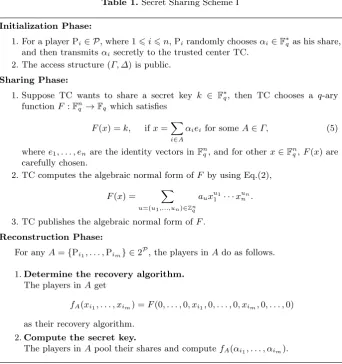
Table 1.Secret Sharing Scheme I
Initialization Phase:
1. For a player Pi∈ P, where 16i6n, Pirandomly choosesαi∈F∗qas his share,
and then transmitsαisecretly to the trusted center TC. 2. The access structure (Γ, ∆) is public.
Sharing Phase:
1. Suppose TC wants to share a secret key k ∈ F∗q, then TC chooses a q-ary
functionF :Fnq →Fq which satisfies
F(x) =k, ifx=X
i∈A
αiei for someA∈Γ, (5)
wheree1, . . . , enare the identity vectors inFnq, and for otherx∈Fnq,F(x) are
carefully chosen.
2. TC computes the algebraic normal form ofF by using Eq.(2),
F(x) = X
u=(u1,...,un)∈Znq
auxu1
1 · · ·x
un
n .
3. TC publishes the algebraic normal form ofF.
Reconstruction Phase:
For anyA={Pi1, . . . ,Pim} ∈2
P
, the players inAdo as follows.
1.Determine the recovery algorithm.
The players inAget
fA(xi1, . . . , xim) =F(0, . . . ,0, xi1,0, . . . ,0, xim,0, . . . ,0)
as their recovery algorithm.
2.Compute the secret key.
The players inApool their shares and computefA(αi1, . . . , αim).
4.1 A General Description
Let ei be the identity vector in Fnq with 1 in the i-th position and zeros
else-where, where q is a power of a prime. By abuse of notation, we write a set A={i1, . . . , im} forA={Pi1, . . . ,Pim} ⊆ P.
In Table 1, we present a construction of democratic secret sharing schemes realizing general access structures.
4.2 Perfect Democratic Secret Sharing Schemes Realizing General Access Structures
As shown in Table 1, given a set of n players P = {P1, . . . ,Pn} with
gen-eral access structures (Γ, ∆) and secret key set K = F∗q, one can always
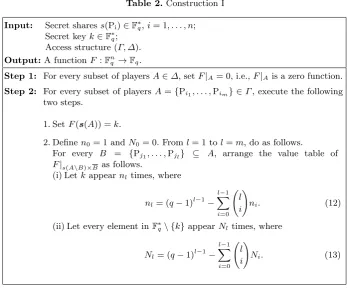
Scheme I depends heavily on the choice of theq-ary functionF. In Table 2, an explicit construction ofq-ary functions is presented. Employing such functions in Secret Sharing Scheme I, one can get perfect democratic secret sharing schemes. We first introduce some useful notations below.
Forx= (x1, . . . , xn)∈Fnq, let supp(x) ={i|xi6= 0}denote the support set
ofx. Then, for ann-variableq-ary functionF and a setA⊆ P,F|A denotes the
restriction ofF to the set
EA={x∈Fqn |supp(x) =A}, (6)
i.e., F|A:EA →Fq satisfies F|A(x) =F(x) forx∈EA. For a setE ⊆Fnq and
an elementa∈Fnq,a+E={a+e|e∈E}. Fors(Pi)∈S(Pi),i∈A, which are
the shares of players in A, define s(A) =P
i∈As(Pi)ei ∈ Fnq, then for B ⊆A,
we denote byF|s(A\B)×B the restriction ofF to the set
Es(A\B)×B=s(A\B) +EB. (7)
Moreover, forB⊆A, we denote byF|s(A\B)×B the restriction ofF to the set Es(A\B)×B ={(x1, . . . , xn)∈Es(A\B)×B|xi6=s(Pi), i∈B}. (8)
Clearly, ifB=∅, thenF|s(A\B)×B =F|s(A\B)×B =F(s(A)).
Proposition 1. ForA⊆ P, the setEA can be partitioned into disjoint subsets
Es(A\B)×B, where B⊆A, i.e.,
EA=
[
B⊆A
Es(A\B)×B, (9)
where for two distinct subsets B1, B2⊆A, Es(A\B
1)×B1 \
Es(A\B
2)×B2 =∅. (10)
Proof. We first prove (10). SinceB1 6=B2, then without loss of generality, we assume that i ∈ B1 but i 6∈ B2. Suppose that there exists x= (x1, . . . , xn) ∈
Es(A\B 1)×B1
T Es(A\B
2)×B2, then we have xi =6 s(Pi) since i ∈ B1. However, i6∈B2 implies thatxi=s(Pi), a contradiction. Hence, (10) holds.
It is obvious thatS
B⊆AEs(A\B)×B ⊆EA. Suppose that|A|=m, then since
the setsEs(A\B)×B, where B⊆A, are disjoint, we have that
[
B⊆A
Es(A\B)×B
= X
B⊆A
|Es(A\B)×B|=
m
X
i=0
m
i
(q−2)i= (q−1)m=|EA|.
(11)
Therefore, (9) holds, and we get the desired result. ut
Table 2.Construction I
Input: Secret sharess(Pi)∈F∗q,i= 1, . . . , n;
Secret keyk∈F∗q;
Access structure (Γ, ∆).
Output:A functionF :Fnq →Fq.
Step 1: For every subset of playersA∈∆, setF|A= 0, i.e.,F|A is a zero function.
Step 2: For every subset of playersA={Pi1, . . . ,Pim} ∈Γ, execute the following
two steps.
1. SetF(s(A)) =k.
2. Definen0= 1 andN0= 0. Froml= 1 tol=m, do as follows.
For every B = {Pj1, . . . ,Pjl} ⊆ A, arrange the value table of
F|s(A\B)×B as follows.
(i) Letkappearnltimes, where
nl= (q−1)l−1−
l−1
X
i=0
l i
!
ni. (12)
(ii) Let every element inF∗q\ {k}appearNltimes, where
Nl= (q−1)l−1−
l−1
X
i=0
l i
!
Ni. (13)
Lemma 1. Construction I outputs ann-variableq-ary functionF.
Lemma 2. LetF be constructed by Construction I. Then, for any subset of play-ers A ∈Γ and any non-empty set B ⊆A, the restriction function F|s(A\B)×B
is balanced onto F∗q.
Proof. LetA ∈Γ and ∅ 6=B ⊆A with|A|=m and |B| =l 6m. According to Step 2 of Construction I, we have that for any subset C⊆B with |C|=s, where 06s6l, the secret key kappears ns = (q−1)s−1−Psi=0−1 sini times
in the value table of F|s(A\C)×C, wheren0 = 1, and every element inF∗q \ {k}
appears Ns= (q−1)s−1−P s−1
i=0
s i
Ni times in the value table ofF|s(A\C)×C,
where N0 = 0. Clearly,ns and Nsdepend only on s. Similar to Proposition 1,
we can prove that
Es(A\B)×B =
[
C⊆B
Es(A\C)×C,
where for two distinct subsets C1, C2 ⊆ B, Es(A\C1)×C1TEs(A\C2)×C2 = ∅. Therefore, F|s(A\B)×B is the concatenation function of F|s(A\C)×C, C ⊆ B.
value table ofF|s(A\B)×B, the secret keykappears
Pl
i=0
l i
ni times and every
element inF∗
q\{k}appears
Pl
i=0
l i
Nitimes. According to Eq.(12) and Eq.(13),
we havePl
i=0
l i
ni =P
l i=0
l i
Ni= (q−1)l−1, which implies thatF|s(A\B)×B
is balanced ontoF∗q. ut
Theorem 2. Let F be constructed by Construction I. Then, Secret Sharing Scheme I is perfect with information rate ρ= 1.
Proof. It is clear that Secret Sharing Scheme I hasρ= 1. We now prove that if F is constructed by Construction I, then Secret Sharing Scheme I is perfect.
For anyA∈Γ, the recovery algorithmfAsatisfiesfA(s(A)) =F(s(A)) =k,
thus the qualified groupA can reconstruct the secret key.
For any forbidden group A ∈ ∆, we assume that the players in A are collaborating to reconstruct the secret key by using some recovery algorithm, say fB, where B ∈ Γ. As discussed in Section 3, we must have B * A, i.e., C = ATB
( B, where C ( B means that C is a proper subset of B (i.e., C ⊆ B but C 6= B). Since C ( B, then B\C 6= ∅. Due to Lemma 2, the restriction function F|s(C)×(B\C) is balanced onto F∗q. Hence, the conditional
probability determined byfB satisfies
Pr(K=γ|S(C) =s(C)) = 1 q−1 =
1
|K| = Pr(K=γ), (14)
where γ ∈ F∗
q, which implies that for every k ∈ K, the secret key k can be
guessed correctly with probability Pr(K=k) = 1/|K|. Therefore, according to Definition 2, we get that Secret Sharing Scheme I is perfect. ut
5
Secret Sharing Schemes with Distributed Shares
In Section 4, we have shown a construction of perfect democratic secret sharing schemes with information rateρ= 1. Note that in Secret Sharing Scheme I, the shares are generated by the players themselves, but when the secret key that TC wants to share is changed, the function F published by TC should be updated accordingly. This may cause the problem of low efficiency if nis large, because TC has to recompute the ANF of the new function F, and this process needs approximately O(nqn) operations over the finite field
Fq.
5.1 A General Description
Recall that for ann-variableq-ary functionF, F|A denotes the restriction ofF
to the setEA ={x∈Fnq | supp(x) =A}, where A ={i1, . . . , im}, and we use
A ={Pi1, . . . ,Pim} ⊆ P to denote a subset of players. In Table 3, we present
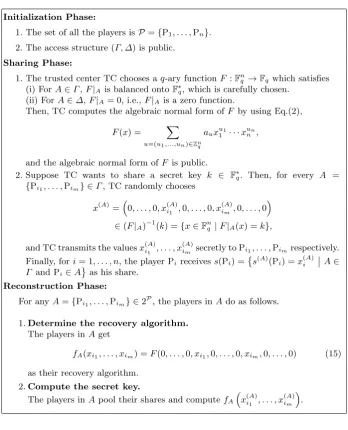
Secret Sharing Scheme II, in which the shares of the players are computed and distributed secretly by TC. It can be seen that, different from Secret Sharing Scheme I, in Secret Sharing Scheme II, the q-ary function determined by TC does not depend on the choice of the secret key.
5.2 Perfect Secret Sharing Schemes from Orthogonal Arrays
Anorthogonal array, denoted byOAλ(t, m, v), is aλvt×marray ofv symbols,
such that in any t columns of the array, every possible t-tuple of the symbols appears exactly λtimes. An orthogonal array is calledsimple if and only if no two rows are identical. A large set of orthogonal arraysLOAλ(t, m, v) is a set of
vm−t/λ simple arrays OA
λ(t, m, v) which satisfies that every possible m-tuple
of the symbols appears in exactly one of the orthogonal arrays in the set. We refer to [34] for background on orthogonal arrays.
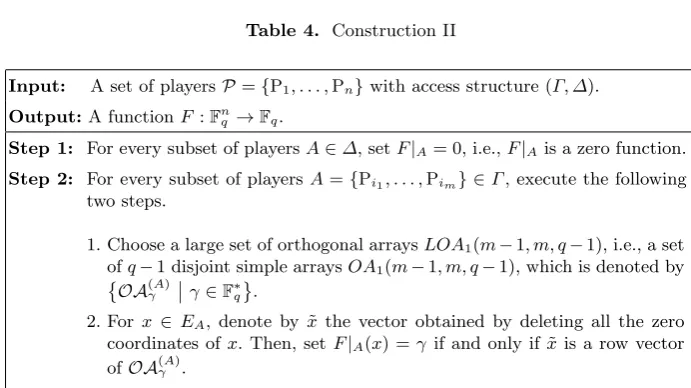
In Table 4, we propose a method to construct q-ary functions by using or-thogonal arrays. By employing such functions in Secret Sharing Scheme II, we can get perfect secret sharing schemes.
Theorem 3. Let F be constructed by Construction II. Then, Secret Sharing Scheme II is perfect.
Proof. For any subset of playersA={Pi1, . . . ,Pim} ∈Γ, the recovery algorithm
fA satisfiesfA
x(iA)
1 , . . . , x (A)
im
=F|A x(A)=k, where
x(A)=0, . . . ,0, x(iA)
1 ,0, . . . ,0, x (A)
im ,0, . . . ,0
,
thus the qualified groupA can reconstruct the secret key.
For any forbidden group A ∈ ∆, we assume that the players in A are collaborating to reconstruct the secret key by using some recovery algorithm, say fB, where B ∈ Γ. As discussed in Section 3, we must have B * A, i.e., C=AT
B (B. Suppose that|C|=t,|B|=m, thent < m. From Step 2.1 of Construction II, we have that forB∈Γ, there exists
OA(B)
γ
γ∈F∗q , which is a set ofq−1 disjoint simple arraysOA1(m−1, m, q−1). Givenγ∈F∗
q, every
possible (m−1)-tuple of F∗q occurs exactly one time inOA
(B)
γ , which implies
that every possible t-tuple of F∗q occurs exactly (q−1)m−1−t times in OA(B)
γ .
Hence, from Step 2.2 of Construction II, we have that given γ ∈ F∗
q, for any
sharess(B)(C)∈(F∗q)t, the conditional probability determined by fB satisfies
PrS(B)(C) =s(B)(C)K=γ
=(q−1)
m−1−t
(q−1)m−1 = 1
(q−1)t = Pr
Table 3.Secret Sharing Scheme II
Initialization Phase:
1. The set of all the players isP={P1, . . . ,Pn}.
2. The access structure (Γ, ∆) is public.
Sharing Phase:
1. The trusted center TC chooses aq-ary functionF :Fnq →Fq which satisfies
(i) ForA∈Γ,F|Ais balanced ontoF∗q, which is carefully chosen.
(ii) ForA∈∆,F|A= 0, i.e.,F|A is a zero function.
Then, TC computes the algebraic normal form ofF by using Eq.(2),
F(x) = X
u=(u1,...,un)∈Znq
auxu1
1 · · ·x
un
n ,
and the algebraic normal form ofF is public.
2. Suppose TC wants to share a secret key k ∈ F∗q. Then, for every A =
{Pi1, . . . ,Pim} ∈Γ, TC randomly chooses
x(A)=0, . . . ,0, x(iA)
1 ,0, . . . ,0, x
(A)
im,0, . . . ,0
∈(F|A) −1
(k) ={x∈Fnq |F|A(x) =k},
and TC transmits the valuesx(iA1), . . . , x
(A)
im secretly to Pi1, . . . ,Pimrespectively.
Finally, fori= 1, . . . , n, the player Pi receivess(Pi) =
s(A)(P
i) =x
(A)
i
A∈
Γ and Pi∈A as his share. Reconstruction Phase:
For anyA={Pi1, . . . ,Pim} ∈2
P
, the players inAdo as follows.
1.Determine the recovery algorithm.
The players inAget
fA(xi1, . . . , xim) =F(0, . . . ,0, xi1,0, . . . ,0, xim,0, . . . ,0) (15)
as their recovery algorithm.
2.Compute the secret key.
The players inApool their shares and computefAx(iA) 1 , . . . , x
(A)
im
.
which implies from Bayes’ theorem that
PrK=γ S(B)(C) =s(B)(C)
=Pr S
(B)(C) =s(B)(C)
K=γ
Pr(K=γ)
Pr S(B)(C) =s(B)(C) = Pr(K=γ) = 1
Table 4. Construction II
Input: A set of playersP={P1, . . . ,Pn}with access structure (Γ, ∆).
Output:A functionF :Fnq →Fq.
Step 1: For every subset of playersA∈∆, setF|A= 0, i.e.,F|A is a zero function.
Step 2: For every subset of playersA={Pi1, . . . ,Pim} ∈Γ, execute the following
two steps.
1. Choose a large set of orthogonal arraysLOA1(m−1, m, q−1), i.e., a set ofq−1 disjoint simple arraysOA1(m−1, m, q−1), which is denoted by
OA(γA)
γ∈F∗q .
2. Forx ∈ EA, denote by ˜x the vector obtained by deleting all the zero coordinates of x. Then, setF|A(x) =γ if and only if ˜xis a row vector
ofOA(γA).
Due to Eq.(16), we have that for everyk∈K, the secret key kcan be guessed correctly with probability Pr(K = k) = 1/|K|. Therefore, from Definition 2,
Secret Sharing Scheme II is perfect. ut
Remark 2. We can prove that by employing q-ary function F constructed in Construction II, Secret Sharing Scheme I is perfect. In fact, let k be the secret key andα1, . . . , αn be the generated shares of P1, . . . ,Pn respectively. When we
add the constraint that ˜x= (αi1, . . . , αim) is a row vector ofOA
(A)
k to Step 2.2
of Construction II, then the functionF satisfiesF(s(A)) =kforA∈Γ. Thus, it can be proved similarly as in Theorem 3 that Secret Sharing Scheme I is perfect. By adding this constraint, the output functions in Construction II form a proper subset of all the output functions in Construction I.
5.3 Perfect Secret Sharing Schemes from Resilient Functions
For two integers n and m, the function F : Fnq → F m
q is called t-resilient if
the output value ofF satisfies for any {i1, . . . , it} ⊆ {1,2, . . . , n}, anyzj ∈Fq,
j= 1, . . . , t, and any γ∈Fq,
Pr(F(x1, . . . , xn) =γ|xi1 =z1, . . . , xit =zt) = Pr(F(x1, . . . , xn) =γ) =
1 qm.
(17)
In [23], t-resilient functions from Fnq to F m
q are characterized in terms of
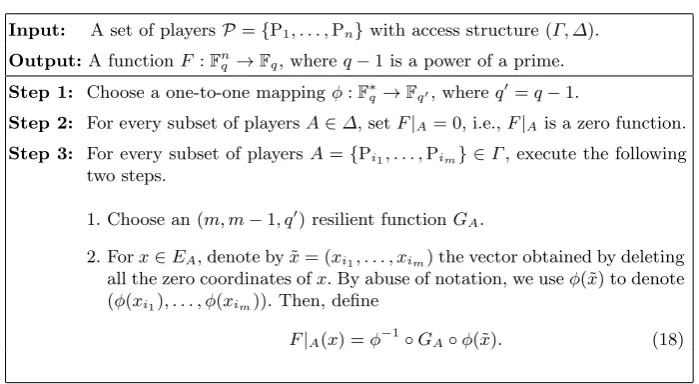
orthogonal arrays. Furthermore, Camion et al. [10] claimed that this charac-terization holds for t-resilient functions from Fn to Fm, where F is a finite
Table 5. Construction III
Input: A set of playersP={P1, . . . ,Pn}with access structure (Γ, ∆).
Output:A functionF :Fnq →Fq, whereq−1 is a power of a prime.
Step 1: Choose a one-to-one mappingφ:F∗q→Fq0, whereq0=q−1.
Step 2: For every subset of playersA∈∆, setF|A= 0, i.e.,F|A is a zero function.
Step 3: For every subset of playersA={Pi1, . . . ,Pim} ∈Γ, execute the following
two steps.
1. Choose an (m, m−1, q0) resilient functionGA.
2. Forx∈EA, denote by ˜x= (xi1, . . . , xim) the vector obtained by deleting
all the zero coordinates ofx. By abuse of notation, we useφ(˜x) to denote (φ(xi1), . . . , φ(xim)). Then, define
F|A(x) =φ −1◦
GA◦φ(˜x). (18)
perfect secret sharing schemes with general access structures by employing t -resilient functions. The idea of constructing perfect secret sharing schemes by using resilient functions can be found in simplified (n, n)-threshold scheme that all the n players pool their shares and compute the secret key k∈ Zm (Zm is
the residue class ring withm elements) by the formula
k=
n
X
i=1
xi modm,
where fori= 1, . . . , n,xi∈Zmis the share of playerPi(see [33, Chapter 13] for
more details). Note that the recovery algorithm F(x) =Pn
i=1xi modm,x= (x1, . . . , xn)∈Znmis indeed an (n−1)-resilient function fromZnm toZm. When
m= 2, this idea appears in [21, Chapter 7] for the construction of binary (n, n )-threshold schemes. Resilient functions can also be employed as building blocks of perfect monotone secret sharing schemes from the description of monotone circuit, see [3,4].
For convenience, we denote t-resilient functions from Fnq to Fq by (n, t, q)
resilient functions. Clearly, an (n, t, q) resilient function must be (n, t0, q) resilient when t0
6 t. In Table 5, we use (n, t, q) resilient functions to construct q-ary functions. By employing such functions in Secret Sharing Scheme II, we can get perfect secret sharing schemes.
Remark 3. In Construction III, the finite fieldFq should satisfy thatq−1 is a
Table 6. All numbers 2< q <264 satisfyingq is a power of a prime andq−1 is a power of a prime
q q−1 q q−1
3 = 31 2 = 21 257 = 2571 256 = 28
4 = 22 3 = 31 8192 = 213 8191 = 81911
5 = 51 4 = 22 65537 = 655371 65536 = 216
8 = 23 7 = 71 131072 = 217 131071 = 1310711 9 = 32 8 = 23 524288 = 219 524287 = 5242871 17 = 171 16 = 24 2147483648 = 231 2147483647 = 21474836471
32 = 25 31 = 311 2305843009213693952 = 261 2305843009213693951
128 = 27127 = 1271 = 23058430092136939511
Note:a1 means thatais a prime.
Theorem 4. Let F be constructed by Construction III. Then, Secret Sharing Scheme II is perfect.
Proof. For any subset of playersA={Pi1, . . . ,Pim} ∈Γ, the recovery algorithm
fA satisfiesfA
x(iA)
1 , . . . , x (A)
im
=F|A x(A)
=k, where
x(A)=0, . . . ,0, x(iA)
1 ,0, . . . ,0, x (A)
im ,0, . . . ,0
,
thus the qualified groupA can reconstruct the secret key.
For any forbidden group A ∈ ∆, we assume that the players in A are collaborating to reconstruct the secret key by using some recovery algorithm, say fB, where B ∈ Γ. As discussed in Section 3, we must have B * A, i.e., C=ATB
(B. Suppose that|C|=t,|B|=m, thent < m. Let x∈EB with
˜
x= (xi1, . . . , xim) ∈(F
∗
q)m, where ˜xis the vector obtained by deleting all the
zero coordinates ofx. From Step 3.1 of Construction III, we have thatGB is an
(m, m−1, q0) resilient function, whereq0=q−1. Let{j1, . . . , jt} ⊆ {i1, . . . , im},
then from Eq.(17), we have that for anyzs∈Fq0,s= 1, . . . , t, and anyβ ∈Fq0,
Pr(GB◦φ(˜x) =β |φ(xj1) =z1, . . . , φ(xjt) =zt)
=Pr(GB◦φ(˜x) =β) =
1 q0 =
1
q−1. (19)
According to Eq.(18), we get that Eq.(19) is equivalent to
Pr(F|B(x) =φ−1(β)|xj1 =φ
−1(z1), . . . , x
jt =φ
−1(z
t))
=Pr(F|B(x) =φ−1(β)) =
1
q−1. (20)
Sinceφis a one-to-one mapping fromF∗q toFq0, then given the sharess(B)(C)∈
(F∗q)t, for anyγ∈F∗q, the conditional probability determined byfB satisfies
PrK=γS (B)
(C) =s(B)(C)= Pr(K=γ) = 1 q−1 =
1
which implies that for every k ∈K, the secret keyk can be guessed correctly with probability Pr(K=k) = 1/|K|. Therefore, from Definition 2, we have that
Secret Sharing Scheme II is perfect. ut
Remark 4. It is proved in [23] that an (m, t, q) resilient function is equivalent to a large set of orthogonal arrays LOAqm−1−t(t, m, q). In fact, in Step 3.2 of
Construction III, the sets {x˜∈(F∗
q)m|F|A(x) =γ, x∈EA},γ∈F∗q, consist of
a large set of orthogonal arraysLOA1(m−1, m, q−1). Hence, Construction III can be seen as a special case of Construction II.
There exist a large amount of constructions of resilient functions over finite fields, e.g. see [11,12,24,37]. We remark that, generally, given the value table of a q-ary function F, it needs approximatelyO(nqn) operations over the finite field
Fq to compute the ANF of F. However, it will be much easier for us to derive
the ANF of F by using the known ANFs of resilient functions. We illustrate this process by a simple example in Appendix B, which provides a perfect secret sharing scheme realizing a non-monotone access structure.
For Secret Sharing Scheme II, it is clear that the information rate is
ρ= min
ρi=
1
|{A∈Γ |Pi∈A}|
16i6n
, (22)
which depends on the access structure. In the worst case, there may exist a player who joins in 2n−1 qualified groups, then according to Eq.(22), the information rate isO(2−n) which is much lower than the upper bound.
We emphasize that in the sharing phase of Secret Sharing Scheme I and Se-cret Sharing Scheme II, the computational complexity depends on the access structure, which is often exponential in the number of players for practical ap-plications. In general, for non-monotone secret sharing schemes, it is hard to decrease the complexity of the sharing phase (excepting some special access structures).
6
Conclusion
For any access structure, the information rate of Secret Sharing Scheme I achieves the upper bound. However, for Secret Sharing Scheme II, the informa-tion rate depends on the access structure, which will be much lower than the upper bound in the worst case. For some access structures, the size of the shares in Secret Sharing Scheme II is exponential in the number of players. As a fur-ther work, it would be very interesting to design efficient perfect secret sharing schemes with general access structures which have high information rate.
References
1. Anderson, R., Ding, C., Helleseth, T., Klve, T.: How to build robust shared control systems. Designs, Codes Cryptography, vol. 15, no. 2, pages 111-124, 1998. 2. Beimel, A.: Secret-sharing schemes: a survey. In: Chee, Y.M. et al. (eds.) IWCC
2011. LNCS, vol. 6639, pp. 11–46. Springer, Heidelberg (2011)
3. Benaloh, J., Leichter, J.: Generalized secret sharing and monotone functions. In: Goldwasser, S. (ed.) CRYPTO’88. LNCS, vol. 403, pp. 27–35. Springer, Heidelberg (1990)
4. Benaloh, J.: General linear secret sharing (extended abstract),http://research. microsoft.com/pubs/68477/glss.ps
5. Ben-Or, M., Goldwasser, S., Wigderson, A.: Completeness theorems for non-cryptographic fault-tolerant distributed computation. In: Proceedings of the 20th annual ACM symposium on Theory of computing, pp. 1–10. ACM Press, New York (1988)
6. Blakley, G.R.: Safeguarding cryptographic keys. In: Proceedings of the National Computer Conference, pp. 313–317. AFIPS Press, New York (1979)
7. Blakley, G.R., Kabatianskii, G.A.: Linear algebra aproach to secret sharing schemes. In: Chmora, A., Wicker, S.B. (eds.) Workshop on Information Protec-tion. LNCS, vol. 829, pp. 33–40. Springer, Heidelberg (1994)
8. Brickell, E.F.: Some ideal secret sharing schemes. In: Quisquater, J.-J., Vandewalle, J. (eds.) EUROCRYPT’89. LNCS, vol. 434, pp. 468–475. Springer, Heidelberg (1990)
9. Brickell, E.F., Stinson, D.R.: Some improved bounds on the information rate of perfect secret sharing schemes. J. Cryptol. 5(3), 153–166 (1992)
10. Camion, P., Canteaut, A.: Construction of t-resilient functions over a finite al-phabet. In: Maurer, U. (ed.) EUROCRYPT’96. LNCS, vol. 1070, pp. 283–293. Springer, Heidelberg (1996)
11. Camion, P., Canteaut, A.: Correlation-immune and resilient functions over a finite alphabet and their applications in cryptography. Des. Codes Crypt. 16(2), 121–149 (1995)
12. Carlet, C.: More correlation-immune and resilient functions over Galois fields and Galois rings. In: Fumy, W. (ed.) EUROCRYPT’97. LNCS, vol. 1233, pp. 422–433. Springer, Heidelberg (1997)
13. Carlet, C., Ding, C., Yuan, J.: Linear codes from perfect nonlinear mappings and their secret sharing schemes. IEEE Trans. Inform. Theory, vol. 51, no.6, pages 2089-2102, 2005.
15. Cramer, R., Damg˚ard, I., Maurer, U.: General secure multi-party computation from any linear secret-sharing scheme. In: Preneel, B. (ed.) EUROCRYPT 2000. LNCS, vol. 1807, pp. 316–334. Springer, Heidelberg (2000)
16. Cramer, R., Damg˚ard, I., Nielsen, J.B.: Secure Multiparty Computation and Se-cret Sharing: An Information Theoretic Approach.https://users-cs.au.dk/jbn/ mpc-book.pdf
17. Cohen, G., Mesnager, S., Patey, A.: On Minimal and quasi-minimal linear codes.
Proceedings of Fourteenth International Conference on Cryptography and Coding, Oxford, United Kingdom, IMACC 2013, LNCS 8308, pages 85-98. Springer, Hei-delberg, 2013.
18. Cohen, G., Mesnager, S.: On Minimal and Almost-Minimal Linear Codes. Pro-ceedings of the 21st International Symposium on Mathematical Theory of Networks and Systems (MTNS 2014), Session ”Coding theory”, pages 928-931, Groningen, Netherlands, 2014.
19. Cohen, G., Mesnager, S.: Variations on Minimal Linear Codes. Proceedings of the 4th International Castle Meeting on coding theory and ApplicationSeries: CIM Series in Mathematical Sciences, Vol. 3, Springer-Verlag, pages 125-131, 2015. 20. Cohen, G., Mesnager, S., Randriambololona, H.: Yet another variation on minimal
linear codes. Journal Advances in Mathematics of Communications (AMC). To appear.
21. Ding, C., Pei, D., Salomaa, A.: Chinese Remainder Theorem: Applications in Com-puting, Coding, Cryptography. World Scientific Publishing Co. Pte. Ltd., Singa-pore (1996)
22. Ding, K., Ding, C.: A Class of two-weight and three-weight codes and their appli-cations in secret sharing. IEEE Transactions on Information Theory61(11), pages 5835-5842, 2015.
23. Gopalakrishnan, K., Stinson, D.R.: Three characterizations of non-binary correlation-immune and resilient functions. Des. Codes Crypt. 5(3), 241–251 (1995) 24. Gupta, K.C., Sarkar, P.: Improved construction of nonlinear resilient S-boxes. IEEE
Trans. Inf. Theory 51(1), 339–348 (2005)
25. Ito, M., Saito, A., Nishizeki,T.: Secret sharing schemes realizing general access structure. Electron. Comm. Jpn. Pt. III, 72(9), 56–64 (1989)
26. Karchmer, M., Wigderson, A.: On span programs. In: Proceedings of the 8th IEEE Structure in Complexity Theory, pp. 102–111. IEEE (1993)
27. Lee, C.-Y., Wang, Z.-H., Harn, L., Chang, C.-C.: Secure key transfer protocol based on secret sharing for group communications. IEICE Trans. Inf. and Syst. E94-D(11), 2069–2076 (2011)
28. Massey, J.: Minimal codewords and secret sharing. In: Proceedings of the 6th Joint Swedish-Russian International Workshop on Information Theory, pp. 276– 279. (1993)
29. McEliece, R.J., Sarwate, D.V.: On sharing secrets and Reed-Solomon codes. Com-mun. ACM 24(9), 583–584 (1981)
30. Pieprzyk, J., Zhang, X.-M.: Ideal threshold schemes from MDS codes. In: Lee, P.J., Lim, C.H. (eds.) ICISC 2002. LNCS, vol. 2587, pp. 253–263. Springer, Heidelberg (2003)
31. Pless, V., Brualdi, R.A., Huffman, W.C.: Handbook of Coding Theory. Elsevier Science Inc., New York (1998)
32. Shamir, A.: How to share a secret. Commun. ACM 22(11), 612–613 (1979) 33. Stinson, D.R.: Cryptography: Theory and Practice (third edition). CRC Press,
34. Stinson, D.R.: Combinatorial Designs: Construction and Analysis. Springer, New York (2004)
35. Yao, A.C.: Protocols for secure computations. In: Proceedings of the 23rd Annual Symposium on Foundations of Computer Science, pp. 160–164. IEEE (1982) 36. Zhang, J., Li, X., Fu, F.-W.: Multi-receiver authentication scheme for multiple
messages based on linear codes. In: Huang, X., Zhou, J. (eds.) ISPEC 2014. LNCS, vol. 8434, pp. 287–301. Springer, Heidelberg (2014)
37. Zhang, X.-M., Zheng, Y.: Cryptographically resilient functions. IEEE Trans. Inf. Theory 43(5), 1740–1747 (1997)
Appendix A: The Proof of Lemma 1
In this appendix, we give a full proof of Lemma 1. First we introduce a simple lemma.
Lemma 3. Forl >1, the numbers nl andNl defined in (12) and (13) satisfy
respectively,
nl= (q−2) nl−1+ (−1)l, (23) Nl= (q−2)Nl−1+ (−1)l+1. (24)
Moreover, forl>1, we have nl>0 andNl>0.
Proof. We only prove that forl>1,nl= (q−2) nl−1+ (−1)l
andnl>0. The
results that for l >1, Nl = (q−2)Nl−1+ (−1)l+1 and Nl >0 can be proved
similarly.
Sincen0= 1, then according to Eq.(12), we can compute thatn1= 0, which satisfies Eq.(23). Assume that for all 16l6L, Eq.(23) holds, then forl=L+1, we have
nL+1= (q−1)L−
L
X
i=0
L+ 1 i
ni = (q−1)L− L
X
i=1
L i
+
L i−1
ni−1
= (q−1)L− L
X
i=1
L
i
ni−1− L
X
i=1
L
i−1
ni
= (q−1)L− L
X
i=0
L
i
ni− L
X
i=1
L
i−1
ni.
(25)
From Eq.(12), we obtain that forl>1,
l
X
i=0 l
i
Put (26) into (25) and apply the inductive assumption, then we have
nL+1= (q−1)L−(q−1)L−1−
L
X
i=1
L
i−1
(q−2)ni−1+ (−1)i
= (q−2)(q−1)L−1−(q−2)
L
X
i=1
L i−1
ni−1−(q−2)
L
X
i=1
L i−1
(−1)i
= (q−2)
(q−1)L−1−(q−1)L−1+nL−(−1)L
(27)
= (q−2) nL+ (−1)L+1,
where Eq.(27) is from Eq.(12) in the case that l = L. Hence, for l = L+ 1, Eq.(23) holds, which implies that for anyl>1,nl= (q−2) nl−1+ (−1)l
.
Suppose that for any 16l 6L, we have nl >0, which is already true for
L= 1. Then, sincenL+1= (q−2) nL+ (−1)L+1
, we havenL+1>0 ifnL>1,
andnL+1= (−1)L+1(q−2) ifnL= 0. IfnL= (q−2) nL−1+ (−1)L= 0, then since q >2, we have nL−1+ (−1)L = 0, which implies that L is odd because nL−1>0. Hence, ifnL= 0, thennL+1= (−1)L+1(q−2) =q−2>1. Therefore, for anyl>1, we havenl>0.
The proof of Lemma 1. We only need to prove that for every x∈ Fnq,
F(x) can be uniquely determined. Firstly, ifx=0, thenF(x) = 0. Suppose that supp(x) ={i1, . . . , im}, where 16m6n, and 16ij6n forj= 1, . . . , m. Let
A={Pi1, . . . ,Pim}. IfA∈∆, thenF(x) = 0. IfA∈Γ andx=
Pm
j=1s(Pij)eij,
thenF(x) =k. Thanks to Proposition 1, the remaining case we need to consider is that there exists a non-empty setB⊆Awith|B|=lsuch thatx∈Es(A\B)×B. In the following, we will show that the value table ofF|s(A\B)×Bcan be arranged in Step 2.2 of Construction I. That is to say, we will prove thatnl>0,Nl>0,
and
nl+ (q−2)Nl=
Es(A\B)×B
= (q−2)l. (28)
The results nl > 0 and Nl > 0 are shown in Lemma 3, so we prove Eq.(28)
below.
alll6L, then forl=L+ 1,
nL+1+ (q−2)NL+1 =(q−1)L−
L
X
i=0
L+ 1 i
ni+ (q−2) (q−1)L− L
X
i=0
L+ 1 i
Ni
!
=(q−1)L+1− L
X
i=0 L+ 1
i
(ni+ (q−2)Ni)
=(q−1)L+1− L
X
i=0 L+ 1
i
(q−2)i (29)
=(q−1)L+1− (q−1)L+1−(q−2)L+1 =(q−2)L+1,
where Eq.(29) is due to the inductive assumption. Hence, for everyl= 1, . . . , m, Eq.(28) holds. Therefore, for x ∈ Es(A\B)×B, the value F|s(A\B)×B(x) can be uniquely determined, and we have the desired result.
Appendix B: An Example of Secret Sharing Scheme II
We illustrate Secret Sharing Scheme II by the following example, where theq-ary functionF is constructed by Construction III in Table 5.
Example 1. LetP={P1,P2,P3,P4}andΓ ={A1={P1,P2,P3}, A2={P1,P2, P4}, A3 = {P3,P4}, A4 = {P1,P2,P3,P4}}. The set of secret keys is K = F∗8 = {1, α, α2, . . . , α6}, where α is a primitive element of F8. Suppose that TC wants to share k = α5 as the secret key. Following Construction III, TC definesφ:F∗8→F7asφ(γ) = logαγ, which means that ifγ=αa ∈F∗8 for some integer a, then logαγ=a. For the access structureΓ, TC chooses
GA1(z1, z2, z3) = 2z1+ 3z2+z3, GA2(z1, z2, z4) =z1+ 2z2+ 3z4,
GA3(z3, z4) = 2z3+ 4z4,
GA4(z1, z2, z3, z4) =z1+z2+z3+z4+ 1
(30)
as the 7-ary linear resilient functions (see [10] for more details). After that, TC computes and secretly transmits the shares
s(P1) ={s (A1) 1 =α, s
(A2)
1 =α
2, s(A4) 1 =α}, s(P2) ={s
(A1)
2 =α
2, s(A2)
2 =α
3, s(A4) 2 =α}, s(P3) ={s
(A1)
3 =α
4, s(A3) 3 =α, s
(A4) 3 =α}, s(P4) ={s(A2)
4 =α
6, s(A3)
4 =α
to P1, P2, P3, P4respectively. From (30), the 8-ary function F is defined as
F|A1(x) =φ −1◦G
A1◦φ(˜x) =x 2 1x
3 2x3, F|A2(x) =φ
−1◦G
A2◦φ(˜x) =x1x 2 2x
3 4, F|A3(x) =φ
−1◦G
A3◦φ(˜x) =x 2 3x
4 4, F|A4(x) =φ
−1
◦GA4◦φ(˜x) =αx1x2x3x4,
wherex∈F48, ˜xdenotes the vector obtained by deleting all the zero coordinates of x, and for every forbidden group A ∈ ∆ = 2P \Γ, F|A = 0. Finally, TC
publishes
F(x) = (1−x74)x21x23x3+ (1−x73)x1x22x 3
4+ (1−x 7 1)(1−x
7 2)x
2 3x
4
4+αx1x2x3x4 =x23x
4 4+x
2 1x
3
2x3+x1x22x 3 4−x
7 1x
2 3x
4 4−x
7 2x
2 3x
4
4+αx1x2x3x4−x21x 3 2x3x74
−x1x22x 7 3x
3 4+x
7 1x 7 2x 2 3x 4 4.
Due to Theorem 4, this secret sharing scheme is perfect. In fact, assume that the players in the forbidden group B = {P1,P3,P4} ∈ ∆ are collabo-rating to reconstruct the secret key. Their recovery algorithm defined in (15) is fB(x1, x3, x4) = (1−x71)x23x44, which equals 0 for any (x1, x3, x4) ∈ (F∗8)3. Suppose that they try to use the recovery algorithms
fA1(x1, x2, x3) =F(x1, x2, x3,0) = x 2 1x
3 2x3, fA2(x1, x2, x4) =F(x1, x2,0, x4) = x1x
2 2x
3 4, fA4(x1, x2, x3, x4) =F(x1, x2, x3, x4) = x
2 3x
4 4+x
2 1x
3
2x3+x1x22x 3 4−x
7 1x 2 3x 4 4
−x72x23x44+αx1x2x3x4−x21x 3 2x3x74
−x1x22x 7 3x
3 4+x
7 1x 7 2x 2 3x 4 4, which are functions defined on (F∗8)3, (
F∗8)3, and (F∗8)4 respectively. For the players P1, P3, and P4, the values ofs
(A1) 2 ,s
(A2) 2 , ands
(A4)
2 are unknown random values, thus according to (21), the secret key can be guessed correctly with probability 1/|K|, i.e., the players inB can learn nothing about the secret key. Similar discussion holds for other forbidden groups.
Moreover, it is clear that the information rate of this scheme is
ρ= min
log
2|K| log2|S(Pi)|
16i64