Simulation of Islanding Detection
Using PLL in Three-Phasegrid-Interface
Power
Srikanth Punna
Assistant Professor, Department of Electrical and Electronics Engineering,Nagole Institute of Science and Technology, Ranga Reddy, Telangana India
ABSTRACT: Phase locked loop and synchronization techniques are one of the most important issues for operating grid-interfaced converters in practical applications, which involve Distributed Power Generation Systems, Flexible AC Transmission Systems (FACTS), and High Voltage Direct Current (HVDC) Transmission, and so on.This paper proposes a systematic PLL modeling anddesign approach to evaluate different frequency-based islandingdetection methods. Two different types of PLL-based islandingdetection solution are discussed, accounting for a majority ofthe existing methods. The first method is to modify the PLL toconstantly move the stable equilibrium point. The second methodis to modify the PLL small-signal characteristics to achieve amonotonic instability behavior under the islanded conditions.The design procedures of these methods are presented using theproposed PLL modeling approach.
KEYWORDS: Converter stability, distributed generation (DG), islanding detection, phase-locked loop (PLL).
I. INTRODUCTION
Distributed generation for renewable energy sources is penetrating theelectric power system due to the rising cost of traditional energy sources andthe environmentally friendly features of renewable energy. Over 60countries around the world have set targets for renewable energy supply [1].The types of renewable energy include solar, wind, hydrogen, biomass,geothermal, hydropower, and biodiesel. Many of these renewable energysources are designed to supply energy into the electric power system.Each power electronics interface should provide quality power to theelectric grid for the loads. This means the harmonics should be low, theinverter should be turned off if the voltage or frequency goes out of range,and the inverter should be able to detect when the centralized generator is nolonger connected; this case is called unintentional islanding. An island mayoccur for many reasons;
such as, a disconnection for servicing, human error,an act of nature, or one of the circuit breakers in the power system trips asshown in Fig. 4 with distributed generation (DG). Under the islandcondition, the distributed resource (DR) is required to disconnect within 2seconds according to IEEE 1547[2]-[3]. A distributed resource shoulddisconnect from the electric grid for many reasons: to prevent the electricpower grid from reconnecting with the distributed resource out of phasecausing a large spike in voltage damaging the loads, a line worker could gethurt, and the utility is liable for power lines even when distributed resourcesuse them to transmit power.
zones (NDZ) andincompatible to certain grid codes, such as low- or zerovoltage ride-through (LVRT or ZVRT) requirements. Activemethods introduce continuous perturbations and may distortthe converter’s output in the case of current perturbation.The performance of active detection methods varies from theoperation conditions, and a large perturbation could lead topower quality and system instability concerns. Frequencybased islanding-detection methods are gaining popularityrecently as the method itself does not violate the LVRTrequirement.
Therefore, it is necessaryand also our intention to investigate the inherent mechanismand the converter output frequency dynamic behaviors usinga systematic approach, which can be eventually applied tomultiple-inverter conditions.This paper is dedicated to the modeling and design procedures for frequency-based islanding detection.
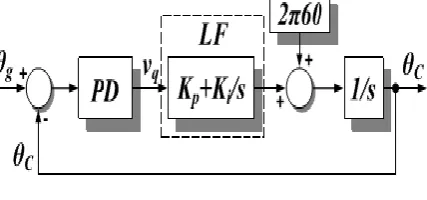
Fig. 1. Synchronous reference frame PLL linear model.
Fig. 2.Typical PLL linear model.
Two typesof PLL-based islanding detection methods will be discussedand compared with the typical PLL. Figs. 1 and 2 show thetypical SRF PLL structure and its linear model. The closedloop response is shown in (1), where the phase-detectorgain kPD equals the input ac voltage amplitude Vg.
II. ISLANDING DETECTION BASED ON PLLLARGE-SIGNAL STABILITY
Fig. 3 shows a three-phase power converter system whereZ L and Zg are the paralleled RLC local load and
gridimpedances, respectively. The islanding event occurs whenthe point-of-common-coupling (PCC) switch opens. Ic is
Fig. 3.Three-phase grid-interface power converter system.
The nonlinear PLL modelunder the islanded condition is shown in Fig. 4. Under theislanded condition, the PLL still tracks the inverter terminalvoltage produced by the inverter’s current flowing to ZL.Therefore, there is a
self-synchronization loop shown in themodel.
Fig. 4.SRF PLL model under the islanded condition.
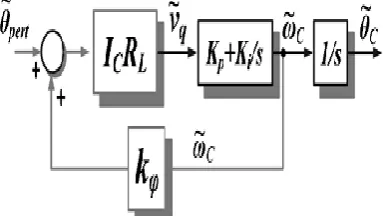
This nonlinear PLL model can be linearized around the linefrequency to obtain the small-signal model [5], as shown in Fig. 5. IcRL is considered as kPD.
Fig.5.Linearized small-signal PLL model under islanded condition.
If the equilibrium point changes, the PLL output will automatically react to this change. Therefore, many islanding-detectionmethods are proposed to actively perturb the equilibrium point.Fig. 6 shows an example of PLL-based islanding detectionusing such a way.An additional large-signal feedback loop is introduced andmultiplied by a gain kpt
(a 0.5 or 1 Hz small triangular signalbetween 0 and kmax). This additional feedback loop constantlyshifts the equivalent
resonant frequency. Thus, the PLL outputfrequency will keep moving all the time.
As shown in Fig. 7, the output frequency will follow theinput injection signal kpt. Eventually, the average value ωav
Fig. 6.Modified PLL with a large-signal feedback for islanding detection.
According to Fig. 7, the PLL output ωC can be directlymonitored to detect the islanding condition, and a low-passfilter
(LFP) is used to eliminate the high-frequency noise.
The islanding-detection protection signal is set when ωC islower than the ωth or the variation range of ωC is beyond
thethreshold.The only design parameter is kpt, because it is a very lowfrequency signal, much lower than the PLL bandwidth. Theoutput of the PLL can be assumed to be at the steady state allthe time.
Fig. 7. First PLL output behavior when the islanding condition occurs.
The change of the grid synchronization performance owingto the additional feedback loop can be investigated by exploring the PLL model at the stiff grid-tied mode, as shownin Fig. 9.
III. ISLANDING DETECTION BASED ON PLLSMALL-SIGNAL STABILITY
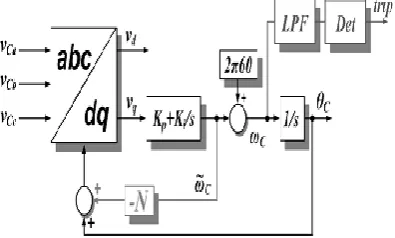
The PLL cannot detect the paralleled RLC load, becausethe PLL is stable according to (5). Therefore, the equilibriumpoint itself can be modified to be unstable. With this idea, thePLL can be modified as shown in Fig. 15. An additional smallsignal feedback term is introduced with a constant gain N.Then, the equivalent small-signal PLL model aroundthe equilibrium point at the islanded condition is shown
in Fig. 16
Fig. 15. Modified PLL with a small-signal feedback for islanding detection.
Fig. 16. Small-signal model of the modified PLL for islanding detection.
IV. SIMULATION RESULTS
The PLL behavior is verified in a 2.5 kW two-level
V. CONCLUSION
REFERENCES
[1] “Renewables 2007 Global Status Report,” Paris:REN21 Secretariatand Washington, DC: Worldwatch Institute, REN21. 2008. [2] IEEE Standard for Interconnecting Distributed Resources withElectric Power System, IEEE standard 1547, 2003
[3] L. Kumpulainen, K. Kauhaniemi, P. Verho, and O. Vähämämäki,“New Requirements for System Protection Caused by DistributedGeneration,” 18th International Conference on Electricity Distribution,Turin, Jun. 2005.
[4] J. M. Lee, “Islanding detection methods for microgrids,” M.S. thesis,Dept. Elect. Comput.Eng., Univ. Wisconsin-Madison, Madison, WI,USA, 2011.
[5] D. Dong, “Ac-dc bus-interface bi-directional converters in renewableenergy systems,” Ph.D. dissertation, Dept. Elect. Comput. Eng., VirginiaPolytechn. Inst. State Univ., Blacksburg, VA, USA, 2012.
[6] T. N. Thacker, “Phase-locked loops, islanding detection and microgrid operation of single-phase converter systems,” Ph.D. dissertation,Dept. Elect. Comput. Eng., Virginia Polytechn. Inst. State Univ.,Blacksburg, VA, USA, 2009.
[7] Z. Ye, A. Kolwalkar, Y. Zhang, P. Du, and R. Walling, “Evaluationof anti-islanding schemes based on nondetection zone concept,” IEEETrans. Power Electron., vol. 19, no. 5, pp. 1171–1176, Sep. 2004.
[8] Z. Ye, R. Walling, L. Garces, R. Zhou, L. Li, and T. Wang, “Studyand development of anti-islanding control for grid-connected inverters,” Dept. Energy, Nat. Renew. Energy Lab., Golden, CO, USA,Tech. Rep. NREL/SR-560–36243.
[9] T. Thacker, F. Wang, R. Burgos, and D. Boroyevich, “Implementationof control and detection algorithms for utility interfaced power conversion systems,” in Proc. IEEE Appl. Power Electron. Conf. Exposit.,Mar. 2006, pp. 1745–1750.