Time Domain Sparse Representation for Multi-Aspect
SAR Data of Targets
Jinrong Zhong*, Gongjian Wen, Conghui Ma, and Baiyuan Ding
Abstract—Sparse representation is the fundamental technology of compressive sensing, sparse three-dimensional (3-D) imaging, and dictionary-based parameter estimation. Typical sparse representation models of radar signal work in the frequency domain, which may encounter high dimension and large data amount of dictionary. This paper presents a time-domain (TD) representation model for multi-aspect SAR data. We generate the multi-aspect two-dimensional (2-D) TD responses of the 3-D scattering center model. Then we cut off the low-energy area of the 2-D TD response and use cutoff responses to construct the dictionary of sparse representation. Such a TD dictionary is a sparse matrix. Moreover, we build and solve the sparse representation model based on the TD dictionary. Compared with the frequency-domain (FD) sparse representation model, the data size of our TD dictionary is remarkably lower, and the solving of TD sparse representation problem is in higher efficiency. We utilize the TD sparse representation to reconstruct 3-D images from multi-aspect SAR data. Experimental results demonstrate the effectiveness and efficiency of the TD sparse representation model.
1. INTRODUCTION
Sparse representation of radar signals [1] is the fundamental for many other techniques, such as compressed sensing [2], sparse 3-D imaging [3], data compression [4], and dictionary-based parameter estimation [5]. Multi-aspect SAR data are a typical collecting geometry of radar [6]. Sparse representation of multi-aspect SAR data is of significance.
The existing sparse representation models [1–5] for radar signal are established in the frequency domain. In other words, these sparse representation methods built the dictionary and solved the model in the frequency domain. Based on frequency-domain (FD) sparse representation model, many achievements [1–5, 7, 8] have been made in the files of 3-D imaging and feature extraction. However, the larger data amount of the dictionary, accompanied with a huge computation, is always a significant challenge.
For the sparse representation problem of multi-aspect SAR data, this paper proposes a time-domain (TD) model, which constructs the dictionary in the time domain and solves the sparse representation problem in time domain too. We use 2-D time responses of the 3-D scattering center model at every aspect to construct the dictionary. Since the energy of 2-D TD responses concentrates on several small regions, we cut off the low-energy areas to make the TD dictionary become a sparse matrix. Moreover, the signal to noise rate (SNR) of the valid regions increases in the time domain. So the time domain sparse representation reduces the data amount of dictionaries substantially and improves the searching efficiency. Apply the proposed TD sparse representation to the multi-aspect SAR data of 3-D imaging. The experimental results demonstrate that TD sparse representation is effective and exhibit its efficiency.
Received 24 April 2015, Accepted 14 July 2015, Scheduled 14 August 2015
* Corresponding author: Jinrong Zhong ([email protected]).
Sensor
Xground
Yground Zground
wz
wy
wx
Dk
~
D~1
(a) (b)
Figure 1. Multiple-aspect SAR collecting geometry. (a) Collecting geometry. (b) Fractions in wavenumber coordinate system.
2. MULTI-ASPECT COLLATED SAR DATA
The multi-aspect collected geometry is depicted in Figure 1. At the observed angle (φ, θ), the radar received signal is r(t;θ, φ) = [Λg(x, y, z;θ, φ)dxdydz]∗ s(t), and s(t) is the sent signal, ∗ the convolution. Using the signal model presented by Austin et al. in [3], interpret multi-aspect SAR data in the 3-D Fourier transformationG(wx, wy, wz) of the reflectivity functiong(x, y, z;φ, θ). As can be seen below, our method does nothing matter with the polarization, and we take single polarization in consideration only. The signal model in Fourier transformation is given by
G(wx, wy, wz) =
N
n=1
g(x, y, z;φ, θ)·e−j(xnwx+ynwy+znwz) (1)
Suppose that the center frequency of k-th aspect is fc,k, the bandwidth Bk, and the aperture ¯
φk, k = 1, . . . , K. By the projection-slice theorem, each aperture is a fraction in G(wx, wy, wz). Denote thek-th fraction’s sample point set asMk={(fj, φi)}Nfk,Mfk
j=1,i=1 . The coordinates in wavenumber domain are wxj,i,k = −4πfjcosθi,kcosφi,k/c, wj,i,ky = −4πfjcosθi,ksinφi,k/c, wzj,i,k = −4πfjsinθi,k/c. Reshape them into a vector HM =∪Kk=1HM,k={m}Mm=1,M =Kk=1Mk, and them-th coordinate is m= (wx,m, wy,m, wz,m).
Denote the multi-aspect SAR dataset as ˜D={D˜k}Kk=1, and ˜Dk = [G(wxj,i,k, wj,i,ky , wj,i,kz )]Mfk,Nfk i=1,j=1 is thekaspect fraction. Transform ˜Dk into a 2-D SAR complex image and denote it asDk∈CM zk×N zk, which can be viewed as 2-D time domain data. M zk and N zk are the row and column numbers.
3. FREQUENCY DOMAIN SPARSE REPRESENTATION
Sample 3-D imaging spaceQ into a series of 3-D locations as candidate locations,
QM ={λ¯1, . . . ,λ¯N}={(xn, yn, zn)}Nn=1 (2)
UsuallyQM is chosen on a uniform rectilinear grid. The grid point number isN. Take the isotropic point scattering center (IPS) model to construct the dictionary and sparse representative the target. The dictionary is built in the frequency domain, using the FD responses of IPS
˜
Y=F(HM,QM) =
e−j(xnwx,m+ynwy,m+znwz,m)
m,n (3)
where m indexes the M measured frequency (or wavenumber) domain down rows, and n indexes the location across columns. Based on ˜Y, the vectored measured data can be approximated as
˜
where ˜d ∈ CM×1 is vectored from the multi-aspect SAR data, and ˜v is the noise. s is a sparse N -dimensional vector and also the scattering amplitude vector. ˆsis the solution of the sparse optimization problem
ˆs= arg mins0 s.t. Ys˜ −d
2 < ε (5)
4. TIME DOMAIN SPARSE REPRESENTATION
The 3-D scattering center models have a natural characteristic: the amplitudes of its 2-D response at every aspect are well distributed in the frequency domain while the amplitudes are uneven in the time domain. We develop a TD sparse representation model, exploiting such a property.
As presented above, for a location ¯λn= [xn, yn, zn]T inQM, the 2-D FD response at thekaspect is
˜
E(HM,k|λ¯n) =
exp
−j
xnwx,ki,j +ynwi,jy,k+znwi,jz,k Mfk,Nfk
i=1,j=1 (6)
˜
Ek,n = ˜E(HM,k|λ¯n) is aMfk×Nfk matrix. Interpolate and transform ˜En to the time domain
Ek,n=F2−1·B·E˜k,n (7)
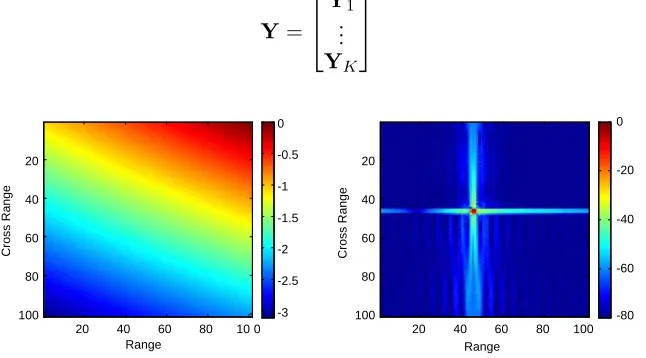
Here,F2−1(·) represents the 2-D inverse fast Fourier transform (IFFT), andBrepresents interpolate the 2-D sector data into rectangular data. Figure 2 shows an example of the 2-D frequency/time domain responses at the k aspect. It can be found that the energy of TD response, Ek,n = [ei,j,k]M zki=1,j×=1N zk, concentrates in a small region. The other big region is lower than −50 dB of the peak-power. This characteristic does not depend on the measurement data, but a natural characteristic scattering center model. We cut off the small amplitude regions
ei,j,k =
0 |ei,j,k|< ξn
ei,j,k else (8)
Here, ξn is an adaptive threshold. Its value is determined by equation ξn = max(|Ek,n|)·10βd/20. max(|Ek,n|) is the maximum amplitude of Ek,n. βd(βd < 0) is an experiential threshold for the whole dictionary. Write such processing in the form of an operator, E∗k,n = Γβd(Ek,n). We stack the cutoff 2-D response E∗k,n into a vector denote as ψk,n = vec(Ek,n∗ ) = [ϕ1,n, . . . , ϕMk,n]T. It is the
component of ¯λn at the k-th aspect. We express the process of getting ψk,n in the form of operators, ψk,n = vec·Γβd·F2−1·B·E˜k,n. Thekpart of the TD dictionary,Yk, consists of all theψk,n atkaspects
for all ¯λn, n = 1, . . . , N. After obtaining all the K parts, we construct the dictionary of QM for the multi-aspect SAR data as
Y=
⎡ ⎣
Y1 .. .
YK
⎤
⎦ (9)
Range
Cross Range
20 40 60 80 10 0 20
40
60
80
100 -3
-2.5 -2 -1.5 -1 -0.5 0
Range
Cross Range
20 40 60 80 100 20
40
60
80
100 -80
-60 -40 -20 0
When βd > −∞, Y is a sparse 2-D matrix. Suppose that Q is the number of nonzero elements and that η = Q/(M ·N) is the proportion of nonzero elements and indicates the sparse degree of the dictionary matrix. The largerβdis, the smallerηis, and the sparser isY, which is beneficial to reducing the data size of dictionaries. In addition, Y being a sparse matrix, is beneficial to reducing the burden of computation.
Interpolate and transform ˜Dk to the time domain, and then stack it into aMk-dimensional vector
dk = [d, . . . , dm, . . . , dMk]T = vec·F2−1·B·D˜k. So, the measured data can be approximated as
d=Ys+v, here, d=
⎡ ⎣
d1 .. .
dNap
⎤
⎦ (10)
wherevis TD noise vector,sa sparse vector, anddthe vectored multi-aspect SAR TD data. According to the time-frequency duality principle, as βd = −∞ (in other words, the time-domain dictionary is not cut off), the FD model (4) and TD model (10) are equivalent. Also, their solutions should be the same. As βd≥ −∞, due to truncation processing, which make the dictionary loss energy and rice the atomic correlation, the solutions of the model (4) and model (10) may be different. But it cannot assert that the convergence and accuracy of model (10) is inferior to model (4). Because the energy of target responses congregates in TD, the SNR rises in the active area. And the truncation not only cut off signals in the dictionary, but also cut off the noise in the measurement data covertly. These factors are conducive to the solution. Solve the sparse optimization problem to obtain ˆs∗,
ˆ
s∗ = arg mins0 s.t. Ys−d22< ε (11)
Since l0-regulated optimization is hard to solve, we take thel1-regulated technique [9, 11] to deal with problem (11)
ˆs∗ = arg min
Ys−d22+λs1
(12)
5. EXPERIMENTAL RESULTS
We use the TD sparse model to representative multi-aspect SAR data simulated by GTD [10] model, then compare the performances of TD model with the FD model. The performances include validity and efficiency. In order to demonstrate the validity of the TD sparse representation, we compare the sparse solutions, scattering center locations and the reconstructed 2-D SAR images with the FD method. In order to demonstrate the efficiency, we compare their dictionaries’ data size and time consumption of solving.
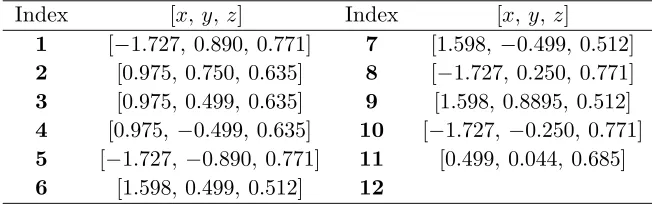
The simulated complex target consists of 11 scattering centers, which are located in range
Q = {x, y, z| −2 < x < 2,−2 < y < 2,0 < z < 1}. The locations of them are listed in Table 1. Use GTD-based scattering center model [10] to produce multiple-aspect SAR data
G(wx, wy, wz) =
P
i=1
Ai·(jf /fc)αi·e−j(xiwx+yiwy+ziwz)+v
Table 1. The locations of target’s 11 scattering centers.
Index [x, y, z] Index [x, y, z]
1 [−1.727, 0.890, 0.771] 7 [1.598, −0.499, 0.512]
2 [0.975, 0.750, 0.635] 8 [−1.727, 0.250, 0.771]
3 [0.975, 0.499, 0.635] 9 [1.598, 0.8895, 0.512]
4 [0.975, −0.499, 0.635] 10 [−1.727, −0.250, 0.771]
5 [−1.727,−0.890, 0.771] 11 [0.499, 0.044, 0.685]
Ai is randomly generated, and frequency-dependent factor αi is set to one of [−1,−1/2,0,1/2,1] randomly. Produce SAR data at five aspects (θk, φk). The azimuths are φk = 5◦, k = 1, . . . ,5, and the elevations areθ1 = 22.5◦,θ2 = 23.5◦,θ3 = 24.5◦,θ4 = 25.5◦,θ5 = 27.5◦. The sample intervals are Δf = 30 MHz and Δφ= 0.1◦. Add zero-mean white Gaussian noise v∼N(0, σ2
v) to make the FD
SNRF d =−10 dB, TD SNRimg = 20 dB. The five SAR images with noise are shown in Figure 3, and
the dynamic range for display are [−40, 0] dB.
Take intervals Δx = 0.1 m, Δy = 0.1 m, Δz = 0.1 m to grid the 3-D space Q into a set of 3-D locations,N = 18491 locations in total. So, the sparse dictionaries’ demotion isM×N = 4420×18491. Construct the TD dictionary with a threshold βd = −50 dB. The proportion of nonzero elements is
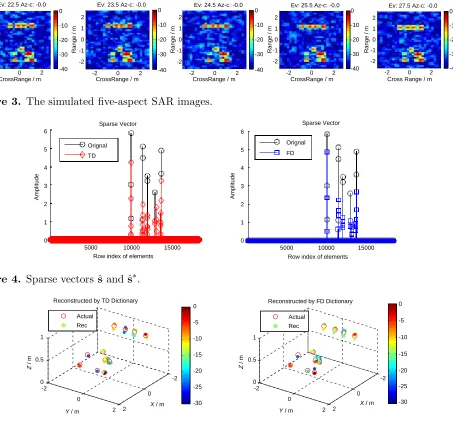
η = 7.1%. It is lower than a FD dictionary in an order of magnitude. Solve the sparse representation problem ˜d = ˜Y·s+ ˜v and d =Y·s+v. The sparse vectorsˆs and ˆs∗ are shown in Figure 4. Their corresponding locations are shown in Figure 5. As an example, we use ˆs∗ to reconstruct the SAR image at (θ1 = 25.5◦, φk = 5◦) by Y·ˆs∗ directly, then use ˆs to rebuild the FD SAR data and turn it into
image-domain. The reconstructed images are shown in Figure 6.
From Figure 4, it can be seen that ˆs∗is convergent to the real sparse vector. There is little difference between sparse vectors ˆsand ˆs∗. Figure 5 confirms such a judgment. Since the scattering centers are not
-2 0 2 -2
-1 0 1 2
CrossRange / m
Range / m
Ev: 22.5 Az-c: -0.0
-40 -30 -20 -10 0
-2 0 2 -2
-1 0 1 2
CrossRange / m
Range / m
Ev: 23.5 Az-c: -0.0
-40 -30 -20 -10 0
-2 0 2 -2
-1 0 1 2
CrossRange / m
Range / m
Ev: 24.5 Az-c: -0.0
-40 -30 -20 -10 0
-2 0 2 -2
-1 0 1 2
CrossRange / m
Range / m
Ev: 25.5 Az-c: -0.0
-40 -30 -20 -10 0
-2 0 2 -2
-1 0 1 2
Cross Range / m
Range / m
Ev: 27.5 Az-c: -0.0
-40 -30 -20 -10 0
Figure 3. The simulated five-aspect SAR images.
5000 10000 15000 0 1 2 3 4 5 6 Sparse Vector
Row index of elements
Amplitude
Orignal
TD
5000 10000 15000 0 1 2 3 4 5 6 Sparse Vector
Row index of elements
Amplitude
Orignal
FD
Figure 4. Sparse vectors ˆs and ˆs∗.
-2 0 2 -2 0 2 0 0.5 1
X / m
Reconstructed by TD Dictionary
Y / m
Z / m -30 -25 -20 -15 -10 -5 0 Actual Rec -2 0 2 -2 0 2 0 0.5 1
X / m
Reconstructed by FD Dictionary
Y / m
Z / m -30 -25 -20 -15 -10 -5 0 Actual Rec
-2 -1 0 1 2 -2
-1 0 1 2
Reconstructed by TD-S Ev: 25.5
Cross Range / m
Range / m
-40 -30 -20 -10 0
-2 -1 0 1 2
-2 -1 0 1 2
Reconstructed by FD-S Ev: 25.5
Cross Range / m
Range / m
-40 -30 -20 -10 0
Figure 6. The reconstructed SAR images.
right on the grid, the nonzero elements are located around the real scattering centers. The color is the value of the nonzero elements, also is the amplitude locations. They are can be viewed as 3-D images of the simulated target. We can see that the two almost identical images are reasonable. Both the TD and FD dictionary sparse representations can availably represent the target. In Figure 6, the reconstructed SAR images are with less noise. The first one is reconstructed by TD sparse representation, and it is 0.958 similar to the original noise-free SAR complex image. The second one is reconstructed by FD sparse representation, and its similarity is 0.958. The formula to calculate the similarity is
μ= (ˆe−e)H ·(ˆe−e)/eH ·e
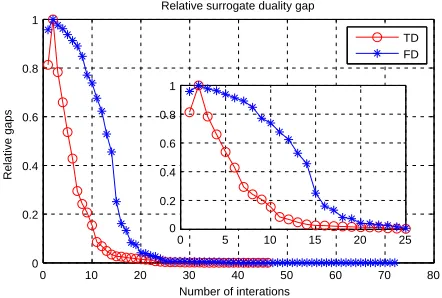
From the results presented above, it can be said that the TD sparse representation is efficacious. Below, we discuss the efficiency. First, as mentioned above, compared with the FD dictionary, the data size of our TD dictionary reduces 92.9%. Second, we examine the computation complexity of solving our sparse representation problem, in comparison with the FD one. In this experiment, we use the method proposed by Kim et al. for l1-regularized least squares in [11] to solve the TD and FD sparse representation problems. The corresponding l1 ls Matlab solver is presented in [12]. The TD
0 10 20 30 40 50 60 70 80 0
0.2 0.4 0.6 0.8 1
Relative surrogate duality gap
Number of interations
Relative gaps
TD FD
0 5 10 15 20 25 0
0.2 0.4 0.6 0.8 1
Figure 7. The relative surrogate duality gaps of TD method and FD method.
but also the iteration number decreases. We plot the relative surrogate duality gaps of TD method and FD method again in Figure 7 with an enlarged subplot. It suggest that the cost function is smoothed. Furthermore, we try to explain the mechanism in detail by theoretical analysis. Suppose that ˜Y is the FD dictionary. As d=e+v, the searching for the minimum will be interfered noise v.
Δ(s) =d−Ys˜
2
2+λ||s||1
We index the iteration times withitand suppose that the desired search direction at current point
sit is∇0it
Δ0
sit+∇0it =e−Y˜
sit+∇0it 2 2+λ
sit+∇0it 1
Due to the noise, there may be another disturbance direction ∇∗it that makes Δ(sit +∇∗it) ≤ Δ(sit + ∇0it). This is probabilistic. The larger is the noise, the greater is the probability. In our TD model, we transform ˜Y into TD first. Y∗ is the un-cutoff time-domain dictionary and Δ(sit) = ||d −Y∗sit||22 +λ||sit||1. Suppose that [Y∗sit]Lit is the low energy area of Y∗sit, in which
the elements will be set to zero. [Y∗sit]Γit is the high energy area, in which the elements maintain the original values. [·]Lit∩[·]Γit =∅. We rewrite Δ1(sit) =||d−Y∗sit||22 as,
Δ1=d−Y∗sit22 =[d]Lit+ [dit]Γit−[Y∗sit]Lit−[Y∗sit]Γit2
=[d]Lit−[Y∗sit]Lit2 2+
[d]Γit−[Y∗sit]Γit2 2+ 2
[d]Lit−[Y∗sit]Lit H
[d]Γit−[Y∗sit]Γit
Here, [·]Lit and [·]Γit are determinate according toY∗sit adaptively. [d]Lit represents that the elements ind
corresponding to the low-energy area [·]Lit remain, and the rest are set to zero. [d]Γit represents that the elements in d corresponding to the area [·]Γit. Since [·]itL∩[·]Γit =∅, ([d]0it−[Ys]0it)H([d]Γit−[Ys]Γit) = 0, so Δ1(sit) =||[d]itL−[Y∗sit]Lit||22+||[d]Γit−[Y∗sit]Γit||22. Then,
Δ(sit) =[d]Lit−[Y∗sit]Lit22+[d]Γit−[Y∗sit]Γit22+λsit1
The SNR of [d]Γit is higher than the SNR of [d]Lit, and the convergence of||[d]Γit−[Y∗sit]Γit||22 should be better than |[d]Lit−[Y∗sit]Lit||22. In our TD method, we set [Ys]Lit =0. [·]Lit can also be expressed as [·]0it.
Δ(sit) =[d]it022+[d]itΓ −[Y∗sit]Γit22+λsit1
If [·]0it+1 is not changed, ||[d]0it||22 =|[d]0it+1||22 is a constant, which will not affect the searching of descent direction. If [·]0it+1 is changed, for a right descent direction ∇it, |[d]0it||22 ≤ [d]0it+1||22 must be true. The convergence of||[d]0it||2
the real solution s, it is important and benefitial to the convergence of Δ(s). Of course, when sit has been very close to the real solutions, the convergence speed of||[d]Γit−[Y∗sit]Γit||22will be slower than the original||d−Y∗sit||22. Because at such case, ||[d]0it−[Y∗sit]0it||22 will also converge to a minimum s. In other words, the descent directions of||[d]0it−[Y∗sit]0it||22 and||[d]Γit−[Y∗sit]Γit||22 may be the same with great probability, and||[d]0it+1−[Y∗sit+1]0it+1||22≤ |[d]0it|22. So, it can be forecasted that the convergence speed of our TD model is slower than the FD one whensitis close tossince some signal is lost as we set [Y∗sit]0it=0. However, at the beginning of the iteration,sitis far froms, and the convergence speed of our TD model is faster. The descent directions keep the same as the noiseless case||e−Ys˜ it||22+λ||sit||1 with great probability when the effect of most of the noise is dispelled. As a comprehensive effect, the convergence speed and time consumption of our TD model are superior to the FD one, which has been exhibited in our experiment. When βd =−∞, there is no truncation, but a large number of elements in the TD dictionary approach zero. Therefore, the TD sparse representation also has such a character.
6. CONCLUSIONS
This paper proposes a concept of TD sparse representation for multi-aspect SAR data and presents the method of constructing TD dictionary and solving TD sparse representation problem. Compared with the FD model, the data size of the TD dictionary consisting of truncated 2-D TD responses is far smaller. And it improves the convergence speed of the optimization algorithm. Experimental results show that the TD sparse representation is available, and its effectiveness is considerably advanced.
REFERENCES
1. Samadi, S., M. C¸ etin, and M. A. Masnadi-Shirazi, “Sparse representation-based synthetic aperture radar imaging,”IET Radar, Sonar, Nav., Vol. 5, No. 2, 182–193, 2011.
2. Herman, M. A. and T. Strohmer, “High-resolution radar via compressed sensing,” IEEE Trans. Signal Process., Vol. 57, No. 6, 2275–2284, 2009.
3. Austin, C. D., E. Ertin, and R. L. Moses, “Sparse signal methods for 3D radar imaging,” IEEE Journal of Selected Topics in Signal Processing, Vol. 5, No. 3, 408–423, 2011.
4. Bhattacharya, S., T. R. Blumensath, B. Mulgrew, and M. Davies, “Synthetic aperture radar raw data encoding using compressed sensing,” Proc. IEEE 2008 Int. Conf. Radar, 1–5, 2008.
5. Austin, C. D., J. N. Ash, and R. L. Moses, “Dynamic dictionary algorithms for model order and parameter estimation,” IEEE Trans. Signal Process., Vol. 61, No. 20, 5117–5130, 2013.
6. Rigling, B. D. and R. L. Moses, “Three-dimensional surface reconstruction from multi-static SAR images,”IEEE Trans. Image Process., Vol. 14, No. 8, 1159–1171, 2003.
7. Corporation, H. P., “Sparse representation denoising for radar high-resolution range profiling,”Int. J. Antennas Propagat., Vol. 13, No. 1, 479–482, 2014.
8. Zhu, S., A. Mohammad-Djafari, H. Wang, B. Deng, L. Xiang, and J. Mao, “Parameter estimation for SAR micromotion target based on sparse signal representation,”EURASIP J. Advances Signal Process., Vol. 13, No. 2, 26–26, 2012.
9. Zhu, X. X. and R. Bamler, “Tomographic SAR inversion by L1-norm regularization: The compressive sensing approach,” IEEE Trans. Geosci. Remote Sens., Vol. 48, No. 10, 3839–3846, 2010.
10. Potter, L. C., D. M. Chiang, R. Carriere, and J. Gerry, “A GTD-based parametric model for radar scattering,”IEEE Trans. Antennas Propagat., Vol. 43, No. 11, 1058–1067, 1995.