Available online: https://edupediapublications.org/journals/index.php/IJR/ P a g e | 1353
Self-actualization of University Teachers in relation to their
Socio-economic Status and Job-satisfaction
Ananta Kumar Jena & Niranjan Thengal
Assistant Professor, Department of Education, Assam University, Silchar-788011 Email: [email protected]
Assistant Professor, Department of Education, Kampur College, Kampur, Nagaon-782426 Email: [email protected]
Abstract
Highly effective teachers are needed to transform a man from a sensuous being to a human being. Only self-actualized teachers can make maximum development of human resource. However, the teachers should themselves be of best human personality to play their role as a teacher. Otherwise even the best curriculum would remain ineffective in the absence of a good teacher. Therefore, they should have the realization about their own potentialities. Realising about one’s own potentiality is termed by Abraham Maslow as ‘self-actualization’. Has self-actualization any relationship with other aspects of life such as socio-economic status, job-satisfaction and so on? In fact, the study aimed to find out the correlation between self-actualization, socio-economic status and job-satisfaction of University Teachers. A sample of 100 University Teachers was selected from the Central as well as State Universities of Assam using simple random sampling technique. Self-actualization Scale, Socio-economic Status Scale and Job-satisfaction Scale was used to collect the data. The study assumed that there is a positive correlation between self-actualization and socio-economic status, and negative correlation between self-actualization and job-satisfaction of University Teachers. Descriptive Statistics like Mean and Standard Deviation and Inferential Statistics like Correlation, Regression, ANOVA and t-test were used to analyze the data. It resulted that there was positive and significant correlation between Self-actualization and Socio-economic status,
and self-actualization and job-satisfaction of University Teachers.
Key words: Job-satisfaction, Self-actualization,
Socio-economic Status, University Teachers
Self-actualisation of University Teachers: An introduction
Available online: https://edupediapublications.org/journals/index.php/IJR/ P a g e | 1354
unlikely to have a strong motivation to achieve Self-actualisation. A self-actualized teacher who can motivate students to achieve higher level goal is more likely to help them become eager to learn and open to new ideas. The best teachers know their students and their subjects well, because they themselves are grounded by self-knowledge (Palmer, 1998). Teachers and students alike become lifelong learners. Abraham Maslow concludes from his studies of self-actualised people that such individuals are creative and freed to give of themselves to humanity. Thus self-actualised teachers tend to be ultimate knowledge seeker, open to new ideas, creative and imaginative. Highly effective teachers are needed to transform a man from a sensuous being to a human being. In other words, self-actualized teachers are needed to develop the potentialities of children. Only self-actualized teachers can make maximum development of human resource. They can motivate the students to realise their own inner potentialities by becoming a part of non-threatening school environment (Rahimi & Hosseini, 2015). As we know that development of human resource mostly lies in the hands of teachers, especially in the hands of University Teachers, hence their self-actualization in relation to socio-economic status and job-satisfaction needs to be studied. Is there any correlation between self actualization, socio-economic status and job-satisfaction? Is so, then to what extent? Or is the correlation positive?
Socio-economic Status of University Teachers Income, education and occupation are the most commonly used indicators or measures of socio-economic status of an individual. According to Burden & Byrd (1999), “Socio-economic status is a measure of a family‟s relative position in a community, determined by a combination of parents‟ income, occupation and level of education”. Similarly, American Psychological Association stated that socio-economic status is often measured as a combination of education, income and occupation. Several studies show that the socio-economic status is positively correlated with achievement. The persons of low socio-economic status generally engage
Available online: https://edupediapublications.org/journals/index.php/IJR/ P a g e | 1355
significant effect on teachers‟ job satisfaction, morale and organizational commitment in elementary schools of Merauke district, Papua, Indonesia. Santhi (2012) conducted a study on the socio - economic status of women employees in the organised sector particularly of women teachers in collegiate service and found that majority of the respondents are dissatisfied with their salary and monetary benefits and facing problems of student-disobedience in class. There is association between the category of college of the women Teachers and the level of satisfaction with their welfare measures in the institutions. Moreover there is association between the years of experience of the women teachers and the kinds of problems faced from their students. Fikadu and Lemma (2016) studied on the socioeconomic Status and Hypertension among Teachers and Bankers in Addis Ababa, Ethiopia and found no association between hypertension and measures of socioeconomic status like education and occupation was found in this study.
Job-satisfaction of University Teachers
Teaching is the noblest as well as the most intricate profession in our society. It is unanimous that qualified, trained and highly motivated teachers are sine-qua-non to ensure quality output. Govinda & Varghese (1993) asserted that teachers‟ qualification and training coupled with a high morale and positive perception of the academic ability of the learners constitute a powerful set of factors determining the learning levels of the children. Even the best curriculum and most perfect syllabus remain ineffective in the absence of a good teacher. Hence, the quality development of students depends upon the effective and efficient teachers. Teachers‟ efficiency on the other hand depends on the several factors such as socio-economic status, pre or in-service training, adequate salary, student community, motivation towards teaching job and so on. However, sometimes the most efficient teachers too can‟t make any difference in students‟ learning unless they satisfy themselves with the job. Therefore, teachers‟ job-satisfaction must be given prominence while discussing their
Available online: https://edupediapublications.org/journals/index.php/IJR/ P a g e | 1356
difference was found on the basis of locality, academic qualification and socio economic status.
Significance of the Study
Self-actualization is a psychological concept developed by Abraham Maslow in his work on the „Theory of Motivation‟. It refers to the fulfilment of one‟s potential, i.e., to become everything that one is capable of becoming. According to Maslow, to achieve self-actualization, one‟s basic needs (D-needs) must be sufficiently gratified. When these basic needs are unmet, self-actualization cannot be achieved. Maslow argues that self-actualization corresponds to ultimate psychological health. For example, if a person‟s safety needs, have not been adequately fulfilled, he may develop paranoiac tendencies and may believe that everybody and everything is threatening him. Yet we can find many examples of people who exhibited at very least aspects of self-actualization who were far from having their lower needs taken care of. Many of our best artists and authors, for example, suffered from poverty, bad upbringing, neuroses and depression. Were not these people engaged in some form of self-actualization? On the other hand, we may find a situation where all the lower level needs have been satisfied, but the highest need (self-actualization) has not. It is not, therefore, always true that the lower needs take precedence over the higher needs. A person may sacrifice his life for honour. Stevernick and Lidenberg (2006) discuss and compare different theories of motivation. They found that not all the people follow a direct hierarchy of needs, at least not as outlined by Maslow. They found that people are willing to sacrifice physical need satisfaction for an improvement in social need satisfaction. Majercsik (2005) interviewed 303 geriatric patients and found that self-actualization was the most important need, safety need next, then esteem, then love, then physiological care. Hogan and Roberts (2004) totally disregard the concept of self-actualization. They list three reasons why they do not even believe that self-actualization is a measurable or existent part of human nature- (i)
self-actualization is just an excuse for selfishness, (ii) self-actualization has no place in evolutionary theory- why would evolution care or support a self-actualizing principle, (iii) they do not believe that there have been any tools to measure self-actualization. In conclusion, to their dissenting of the concept of self-actualization, they state, “the fact that after at least 70 years there are no accepted measures of self-actualization suggests that the concept is empty”. Maslow says that fulfilment of one‟s true potential is self-actualization. However, it is not clear as to what fulfilling potential actually does or how it should be done. When looking at potential through Maslow‟s way of thinking, it can be difficult to decide where a person should go in life. If Maslow‟s theory about people having a desire to become what they can become is true, then those who have potential to become multiple things, will also have a desire to do so; and when all other needs are filled, that desire will itself become a need that must be satisfied. So, if one person has only the potential to become an artist, while another has the potential to become an artist, a musician and an author, is there potential in one person? Or, is there simply different potential between people?
Objective of the Study
To find out the correlation between self-actualization and socio-economic status, and the correlation between self-actualization and job-satisfaction of University teachers.
Hypothesis of the Study
There is a positive correlation between self-actualization and socio-economic status, and negative correlation between self-actualization and job-satisfaction of university teachers.
Methodology
Participants
Available online: https://edupediapublications.org/journals/index.php/IJR/ P a g e | 1357
Design of the Study
Correlational research design was used to study the relationship between and among the variables. The correlation between and among the variables was assessed through Pearson‟s Product Moment Correlation.
Tools used
In the present study, the researcher has used Self-actualization Scale, Socio-economic Status Scale and Job-satisfaction Scale for data collection.
1. Self-actualization Scale
The Self-actualization Scale was developed by Prof. K.N. Sharma Department of Psychology, University of Rajasthan, Jaipur. A three-point rating scale indicating „equal to nil‟, „some‟ and „much‟ degrees of self-actualization characteristics has been provided in front of each of the statements. The statements were mixed randomly. The scoring is simple. The three alternatives- „equal to nil‟, „some‟ and „much‟, have been assigned 1, 2 and 3 weights respectively. The scorer has to count and put the totals of the tick marks on each page in the three respective boxes provided for the purpose. At the end, the grand total of the marks should be multiplied by the above weights, i.e., respective obtained frequencies of the three total response categories x respective weights. The maximum and minimum score on the Scale are 225 and 75 respectively. Since some of the self-actualization dimensions were not highly correlated because of heterogeneity and diversions of their functionality, their
dimensional approach was not found feasible. It has also been seen that because of self-exposition, the scores on the items are obtained on a little higher side of the score continuum. The trend being in general, it does not affect the results. However, the degree of self actualization of a person can be compared to the three degrees obtained by Flanagan‟s method, i.e., Score 187 and above is High actualisation, Score 163—186 is Medium actualisation and Score 82—162 is Low Self-actualisation. The test-retest reliability of the inventory on a sample of 100 8th class students was found to be .85. Since there is no test of self-actualization available except POI which has its own limitations, criterion validation could not be done. However, the content validation of the items has already been made thoroughly.
2. Socio-economic Status Scale
This scale was developed by Dr. Ashok K. Kalia & Dr. Sudhir Sahu and it is available both in English and Hindi languages for Urban/Rural households. The scale comprised of 40 statements in all based on five different dimensions of socio-economic parameters. (The distributions of items and components of SES Scale is given below, see table 3.1). This scale comprised of 40 items on five different areas/dimensions of SES viz. Socio-cultural component, economic component, possession of goods and services, health component and educational component. There is no time limit for filling this scale. However, it takes approximately 20 to 25 minutes for completing it.
Table 1 Distributions of items and components of SES Scale
Part Dimensions of SES Scale Items Total
items
Part-I Socio-cultural component 1 to 15 (+ information on Caste) 15+1
Part-II Economic component 16 to 20 05
Part-III
Possession of goods and services 21 to 30 10
Part-IV
Health component 31 to 35 05
Available online: https://edupediapublications.org/journals/index.php/IJR/ P a g e | 1358
The investigator has established content validity (.75) while preparing the preliminary draft of SES scale. Reliability of the scale is 0.85 for Split-half method and 0.86 for test-retest method. All 42 items (including caste and academic stream) were analysed to measure internal consistency of the SES Scale through Pearson‟s Product Moment Method, Kendall‟s tau b and Spearman‟s rho correlation method. Coefficient of correlation is highly significant in most of the dimensions except only in one dimension, i.e., health component due to presence of some items with negative score. (see appendix- for additional information). With the help of SPSS, principal component analysis method along with Varimax Rotation and Kaiser Normalization was employed on 1200 respondents to restrict in five factors.
3. Job Satisfaction Scale
It is developed by Dr. Amir Singh, Department of Psychology, Govt. Mahendra College, Patiala and Dr. T.R. Sharma (former Dean and Professor), Department of Education, Panjabi University, Patiala. The present scale draws motivation from the works of Hoppock (1935), Morse (1953), Kahan (1951), Herzberg (1959), Kelliberg (1977), Rajbir (1976), Sokhey (1975), Pestongee (1973) and Muthaya (1984). While framing the scale almost all known factors of job satisfaction given above including Ginsberg's triple factors and Kelliberg‟s work values and job rewards were kept in view. The level of job satisfaction was measured in two types of areas- job-intrinsic (factors lying in the jib itself) and job-extrinsic (factors lying outside the job). Job-intrinsic area was further conceptualized as job-concrete (say; excursions, working conditions, etc.) and job-abstract (say; cooperating, democratic functioning, etc.) and job-extrinsic area as consisting of three components, viz., psycho-social aspects, financial aspects and community/nation growth aspect. These 80 statements were got rated for suitability by 30 judges belonging to the fields of psychology, sociology, business, administration, law and trade-union. Depending
upon the unanimity among the judges only 40 items were retained for a pilot study made on nearly 50 professionals. This try-out resulted in deletion, modification and also inclusion of a few items. For the final scale, only 30 statements were retained. Each statement has five alternatives from which a respondent has to choose any one which candidly expresses his response view. The following chart shows the connection of different items with different areas constituting the scale.The scale has both positive and negative statements. Items at Sr. No. 4, 13, 20, 27, and 28 are negative, others are all positive. The scale was personally administered to each of the 320 professionals consisting of an equal number of engineers, doctors, advocates and college teachers selected as per stratified random sampling technique from all over the state of Punjab. The rural and urban areas were given due representation. The scale in its totality or in parts depending upon the requirements can be administered to any category of professionals. It is comprehensive and omnibus in nature. The positive statements carry a weightage of 4, 3, 2, 1, and 0 and the negative statements carry 0, 1, 2, 3 and 4. The total score gives a quick measure of satisfaction/dissatisfaction of a worker towards his job.
Procedure of Data Collection
Available online: https://edupediapublications.org/journals/index.php/IJR/ P a g e | 1359
through Self-actualization Scale, Socio-economic Status Scale and Job Satisfaction Scale, the researcher scored all the tools and used Mean and Standard Deviation and
Inferential Statistics like Correlation, Regression, ANOVA, and t-test to analyze and interpret the data.
Analysis and result
H1 There is a positive correlation between self-actualization and socio-economic status, and negative correlations between self-actualization and job-satisfaction of University teachers.
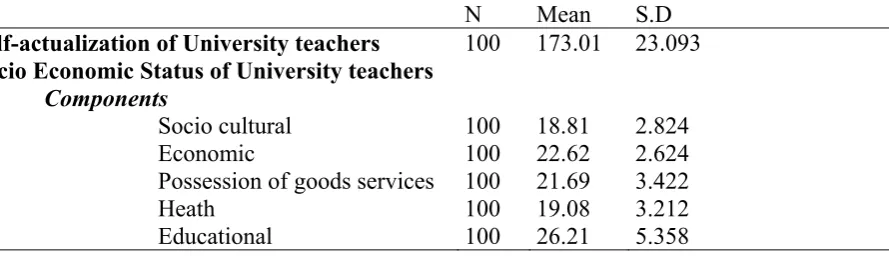
Table 2 Mean and SD of Self-actualization and the various components of Socio- economic Status of
University Teachers
N Mean S.D
Self-actualization of University teachers 100 173.01 23.093
Socio Economic Status of University teachers Components
Socio cultural 100 18.81 2.824 Economic 100 22.62 2.624 Possession of goods services 100 21.69 3.422 Heath 100 19.08 3.212 Educational 100 26.21 5.358
Table 3 Pearson‟s Product Moment Correlation for Self-actualization and Socio-economic Status of
University Teachers
Table 4 R, R2 and adjusted R2 of Self-actualization and the components of Socio-economic Status of
University Teachers
Model R R Square Adjusted R Square
Std. Error of the Estimate
Change Statistics R Square
Change F Change df1 df2 Sig. F Change
1 .530a .280 .242 20.104 .280 7.325 5 94 .000
a. Predictors: (Constant), educational components, economic components, heath components, possession of goods services, Socio cultural components
Table 5 ANOVA of Self-actualization and the components of Socio-economic Status of
University Teachers
Model Sum of Squares df Mean Square F Sig. 1 Regression 14802.499 5 2960.500 7.325 .000b Pearson Correlation
Components ofSocio Economic Status Socio
cultural Economic Possession of goods and services Health Educational Self-actualization
of University teachers .426 .237 .115 .412 .234
Sig. (1-tailed) .000 .000 .036 .000 .000
Available online: https://edupediapublications.org/journals/index.php/IJR/ P a g e | 1360
Residual 37992.491 94 404.175
Total 52794.990 99
a. Dependent Variable: Self-actualization of University teachers
b. Predictors: (Constant), educational components, economic components, heath components, possession of goods services, Socio cultural components
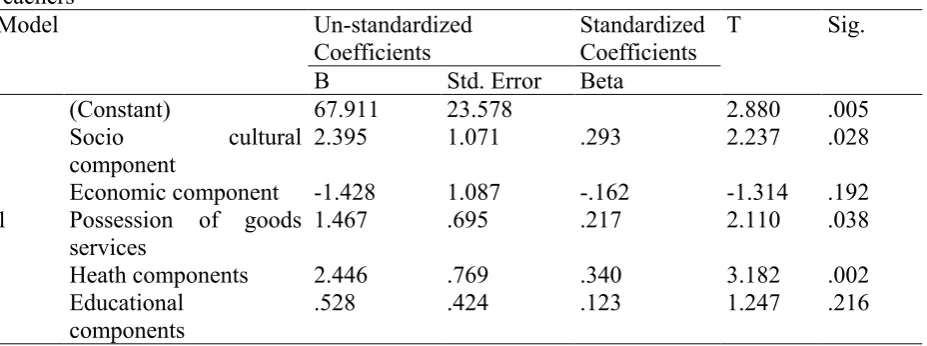
Table 6 β and t of Self-actualization and the components of Socio-economic Status of University
Teachers
Model Un-standardized
Coefficients
Standardized Coefficients
T Sig.
B Std. Error Beta
1
(Constant) 67.911 23.578 2.880 .005
Socio cultural
component
2.395 1.071 .293 2.237 .028
Economic component -1.428 1.087 -.162 -1.314 .192
Possession of goods services
1.467 .695 .217 2.110 .038
Heath components 2.446 .769 .340 3.182 .002
Educational
components .528 .424 .123 1.247 .216
a. Dependent Variable: Self-actualization of University teachers
Table 2 depicts the descriptive analysis of the Mean and SD of Self-actualization and the components of Socio-economic Status of University Teachers. It revealed that Self-actualization of University Teachers N (100), Mean (173.01) and SD (23.09) was better than the Socio-economic Status and its components like Socio-cultural (M=18.81 & SD= 2.82), Economic (M= 22.62 & SD= 2.62), Possession of Goods and Services (M= 21.69 & SD= 3.42), Health (M= 19.08 & SD= 3.12) and Educational (M= 26.21 & SD= 5.36). Here Educational component (M= 26.21) is better over the components of Socio-economic Status viz., Socio-cultural, Economic, Possession of Goods and Services and Health component of University Teachers. In the Table 3, it is seen that the Pearson‟s Product Moment Correlation (r) between Self-actualization of University Teachers and the components of Socio-economic Status like Socio-cultural, Economic, Possession of Goods and Services, Health and Educational were (.426, .237, .115, .412 & .234) respectively. The Regression of Self-actualization on the basic model (R= .530, R2=
Available online: https://edupediapublications.org/journals/index.php/IJR/ P a g e | 1361
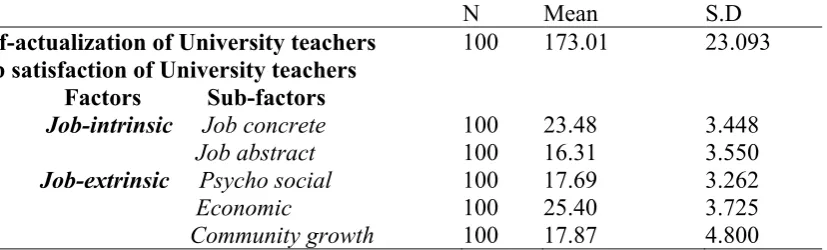
Table 7 Mean and SD of Self-actualization and the various factors of Job-satisfaction of University Teachers
N Mean S.D
Self-actualization of University teachers 100 173.01 23.093
Job satisfaction of University teachers Factors Sub-factors
Job-intrinsic Job concrete 100 23.48 3.448 Job abstract 100 16.31 3.550 Job-extrinsic Psycho social 100 17.69 3.262 Economic 100 25.40 3.725 Community growth 100 17.87 4.800
Table 8 Pearson‟s Product Moment Correlation for Self-actualization and Job-satisfaction of University Teachers
Pearson Correlation
Factors of Job Satisfaction Job
concrete Job abstract
Psycho social
Economic Community Growth Self-actualization
of University teachers
.577 .695 .655 .580 .682
Sig. (1-tailed) .000 .000 .000 .000 .000
N 100 100 100 100 100
Table 9 R, R2 and adjusted R2 of Self-actualization and the factors of Job-satisfaction of University
Teachers
Model R R Square Adjusted R Square
Std. Error of the Estimate
Change Statistics R Square
Change F Change
df1 df2 Sig. F Change
1 .740a .548 .524 15.929 .548 22.816 5 94 .000
a. Predictors: (Constant), community growth, economic, job concrete, job abstract, psycho social
Table 10 ANOVA of Self-actualization and the factors of Job-satisfaction of University Teachers
Model Sum of Squares df Mean Square F Sig.
1
Regression 28944.654 5 5788.931 22.816 .000b Residual 23850.336 94 253.727
Total 52794.990 99
a. Dependent Variable: Self-actualization of University teachers
b. Predictors: (Constant), community growth, economic, job concrete, job abstract, psycho social
Table 11 β and t of Self-actualization and the factors of Job-satisfaction of University Teachers
Model Un-standardized
Coefficients
Standardized Coefficients
t Sig.
B Std. Error Beta
1
(Constant) 89.005 12.491 7.125 .000
Job concrete -.608 .951 -.091 -.639 .524
Job abstract 2.040 1.128 .314 1.809 .074
Available online: https://edupediapublications.org/journals/index.php/IJR/ P a g e | 1362
Economic .918 .657 .148 1.398 .165
Community growth 1.628 .529 .338 3.077 .003
a. Dependent Variable: Self-actualization of University teachers
Table 7 depicts the descriptive analysis of Mean and SD of Self-actualization and the factors of Job-satisfaction of University Teachers. It resulted that Self-actualization of University Teachers N (100), M (173.01) and SD (23.09) was better than the factors of Job-satisfaction of University Teachers in the area of Job-intrinsic like Job concrete (M= 23.48 & SD= 3.448) and Job abstract (M= 16.31 & SD= 3.55), and the factors of Job-satisfaction of University Teachers in the area of Job-extrinsic like Psycho-social (M= 17.69 & SD= 3.262), Economic (M= 25.40 & SD= 3.725) and Community Growth (M= 17.87 & SD= 4.80). Here, the Economic factor is better than the other factors of Job-satisfaction of University Teachers. The Pearson‟s Product Moment Correlation (r) between Self-actualization of University Teachers and the factors of Job-satisfaction like Job-concrete and Job-abstract (Job-intrinsic), Psycho-social, Economic and Community Growth (Job-extrinsic) were (.577, .695, .655, .580 and .682) respectively (see Table 8). Table 9 & 11 depicts the Regression of Self-actualization on the basic model (R= .740, R2= .548 & adjusted R2= .524 p ˂ .05) has significant positive relationship with Job-abstract (β 2.040 p ˂ .05), Psycho-social (β .712 p˂ .05), Economic (β .918 p ˂ .05) and Community Growth (β 1.628 p ˂ .05). But the Job-concrete factor (β -.608 p ˃ .05) has significant negative correlation with Self-actualization of University Teachers (see Table 4.2.10). Table 10 reveals that ANOVA (F= df 5/94 22.816 p ˂ .05) between dependent variable like Self-actualization of University Teachers and the Predictors like Job-concrete, Job-abstract, Psycho-social, Economic and Community Growth were significantly correlated. Hence, the directional hypothesis was rejected as the Job-satisfaction and its factors such as Job-abstract, Psychosocial, Economic, and Community Growth have
significant positive correlation with Self-actualization of University Teachers except the Job-concrete factor, which is negatively correlated with Self-actualization.
Findings
Hypothesis 1 There is a positive correlation
between Self-actualization and
Socio-economic Status, and negative correlation
between Self-actualization and
Job-satisfaction of University Teachers.
It was found that there was positive and significant correlation between Self-actualization and Socio-economic Status of University Teachers. The components of Socio-economic Status like Socio-cultural, Possession of Goods and Services, Health and Educational were positively correlated with Self-actualization except the Economic component that was negatively correlated. Similarly, self-actualization and job-satisfaction of University Teachers was significantly and positively correlated where the sub-factors of Job-extrinsic of Job-satisfaction like psycho-social, economic and community growth were positively correlated but the sub-factor of Job-intrinsic like Job-concrete was negatively correlated with Self-actualization of University Teachers. On the other hand, the sub-factor of Job-intrinsic like Job-abstract was positively correlated with Self-actualization of University Teachers.
Conclusion
Available online: https://edupediapublications.org/journals/index.php/IJR/ P a g e | 1363
socio-cultural, economic, possession of goods and services, health and educational components were the hierarchy of Maslow‟s idea like physical needs, safety needs, belongingness and self-esteem needs. It was found that there was positive correlation between all the needs of Socio-economic Status and Self-actualization. In the present study, the University teachers neglected the economic component. However, there was no such effect on the hierarchy and relationship with the Self-actualization. There existed positive relationship between Self-actualization and Socio-economic Status of University teachers. In a developing country like India, University Teachers are salaried reasonable amount to maintain their Socio-economic Status that directly helps to actualize them. According to Maslow, Self-actualized people are more efficient in their perception and reality. If we see the Self-actualization and the Socio-economic Status of University Teachers, we can find that they had spontaneous, simple and natural feeling towards teaching-learning process, cooperation, and social interaction, participation in national and international cooperation, manages the quality of life with national growth and democratic culture.
Job-satisfaction is a broader concept that is more deeply related with Psycho-social, Physiological and Environmental circumstances that help an individual to work with satisfaction and achieve Self-actualization. In the present study, most of the University Teachers of Assam were more Self-actualized in relation their Job-satisfaction as because they are dedicated and work loving. They always work for the community and national growth such as quality of life, national economy, and they always emphasize on social cooperation and keep coordination with administration rather emphasizing on economy and collection of goods and assets. These are the Educational Implications of the present study:
1. Teachers‟ Socio-economic Status could fulfil the needs, desire and ultimately it could help to achieve Self-actualization. That is why, in Universities and Colleges, the teachers should be paid
with Government approved salary in time, and then only they would be able to fulfil their needs and desire and would be able to take initiation and create good work culture in their work place.
2. Administrators should provide the facilities related to infrastructure, learning resources, equipments and kits and other requisite material of teaching learning process that could help the teachers to develop emotional thinking and Job-satisfaction and ultimately to reach Self-actualization.
References
[1] Best, J. W. & Kahn, J. V. (1995). Research in Education. New Delhi: Prentice Hall of India Pvt. limited.
[2] Burden, P. R. & Byrd, D. M. (1999). Methods for effective teaching (2nd ed.) Boston, MA: Allyn & Bacon.
[3] Fikadu, G. and Lemma, S. (2016). Socioeconomic Status and Hypertension among Teachers and Bankers in Addis Ababa, Ethiopia. International Journal of
Hypertension, 1-7.
http://dx.doi.org/10.1155/2016/4143962 [4] Frankl, V. E. (1963). Man's Search for
Meaning. New York: Beacon Press.
[5] Govinda, R. and Varghese, N. V. (1993). Quality of primary schooling in India-A Case study of Madhya Pradesh, IIEP, UNESCO.
[6] Henry, E. G. (2006). Statistics in Psychology and Education. Surjeet Publications, 7-K, Kolhapur Road, Kamla Nagar, Delhi-110007, India.
[7] Hoppock, R. (1936). Age and job satisfaction. Psychological Monographs, 47, 115-118.
Available online: https://edupediapublications.org/journals/index.php/IJR/ P a g e | 1364
nasional menjelang abad XXI]. Jakarta: Grasindo.
[9] Keller, M. M., Chang, M.-L., Becker, E. S., Goetz, T., & Frenzel, A. C. (2014). Teachers‟ emotional experiences and exhaustion as predictors of emotional labor in the classroom: An experience sampling study. Frontiers in Psychology, 5. https://doi.org/10.3389/fpsyg.2014.01442 [10] Latif., K., Shahid, M. N., Sohail, N. and
Shahbaz, M. (2011). Job Satisfaction among Public and Private College Teachers of District Faisalabad, Pakistan: A Comparative Analysis. Interdisciplinary Journal of Contemporary Research in Business, 3(8), 235-242.
[11] Locke, E. A. (1976). What is Job Satisfaction?. Organizational Behaviour and Human Performance. 4, 309-336.
[12] Majercsik, E. (2005). Hierarchy of needs of geriatric Patients. Gerontology, 51, 170-173.
[13] Maslow, A. (1943). A theory of human motivation. Psychological Review. 50 (4): 370–396.
[14] Maslow, A. (1943). A theory of motivation. Psychological Review, 50, 370-396.
[15] Nyamubi, G. J. (2017). Determinants of Secondary School Teachers‟ Job Satisfaction in Tanzania. Education Research International, 2017, 1-7.
[16] Rahimi, M. & Karkami, F.H. (2015). The role of teachers‟ classroom discipline in their teaching effectiveness and students‟ language learning motivation and achievement: A path method. Iranian Journal of Language Teaching Research, 3(1), 57-82.
[17] Sahertian, P. A. (2000). Konsep Dasar dan Teknik Supervisi Pendidikan. Jakarta: Rineka Cipta.
[18] Santhi, S. N. (2012). The Socio-Economic Status of Women Employees in the Organised Sector Particularly of Women Teachers in Collegiate Service. An Unpublished Thesis Submitted to
Bharathidasan University, Tiruchirappalli, Post Graduate and Research Department of Commerce J.J. College of Arts and Science, Sivapuram, Pudukkottai District-622 422, Tamil Nadu, South India.
[19] Steverink, N., & Lindenberg, S. (2006). Which social needs are important for subjective well being? What happens to them in aging? Psychology and Aging, 21(2),281-290.
[20] Taruna and Pooja (2014). An Analytic Examination of Teachers‟ Job Satisfaction in Senior Secondary Schools. International Journal of Education and Psychological Research (IJEPR), 3(3), 74-78.
[21] Werang, B. R. (2010). Hubungan keterampilan manajerial kepala sekolah dan status sosial-ekonomi guru terhadap kinerja guru SMA Negeri I Merauke- Papua. JAM Jurnal Aplikasi Manajemen, 8(2), 421-429. [22] Werang, B. R., Esy, D. and Irianto, O.