Available online: https://edupediapublications.org/journals/index.php/IJR/ P a g e | 3427
Regioisomers of 1, 3-Dipolar Cycloadducts – A
Computational Study
Manju Choudhary
DEPARTMENT OF CHEMISTRY
ASSISTANT PROFESSOR PARISHKAR COLLEGE OF GLOBAL EXCELLENCE, JAIPUR
ABSTRACT:
Theoretical investigation of regioisomers of 1,3-dipolar cycloadducts
of pyridinium ylides using computational calculations to identify the
stable regioisomer.
2. INTRODUCTION WITH REVIEW OF LITERATURE
1,3-Dipolar cycloaddition is a [3+2] cycloaddition reaction between a 1,3-dipole and a dipolarophile to form a five - membered ring.1,2
N N N
Ph
1,3-dipolar Cycloaddition
N
N N
Ph
OPh
OPh
Scheme-1 1,3-dipolar cycloaddition between an organic azide andalkyne
Therefore 1,3- dipolar cycloaddition reaction is an important route to the
Available online: https://edupediapublications.org/journals/index.php/IJR/ P a g e | 3428 heterocyclic ring.Due to the regio and sterioselectivity of 1,3-dipolar
cycloaddition reaction and mechanistic aspect, the 1,3-dipolar reaction
are used as an important route for synthesis of five membered
heterocycles and have interested both the academia and industry.
1,3-dipolar cycloaddition have an unusually large negative entropy of activation similar to that of the Diels-Alder reaction, suggesting that the transition state is highly ordered, which is a signature of concerted pericyclic reaction.
The 1,3-dipole reacts with the dipolarophile in a concerted and symmetry -allowed π4S-π2S fashion through a thermal six-electron Huckel aromatic
transition state.
1,3-Dipole:
A 1,3-dipole is an organic molecule that can be represented as either
an allyl-type or a propargyl / allenyl - type zwitter ionic octet / sextet structures. Both types of 1,3-dipoles share four electrons in the
π-system over three atoms. The allyl-type is bent whereas the propargyl /
allenyl-type is linear in geometry. Resonance structures can be drawn to delocalize both negative and positive charges onto any terminus of 1,3-dipole.
A more accurate method to describe the electronic distribution on a
1,3-dipole is to assign the major resonance contributor based on experimental or
Available online: https://edupediapublications.org/journals/index.php/IJR/ P a g e | 3429 N NH
H H
N N
H H
N NH
H H
N N
H
N N N N H N N NH
H
Fig-1 Calculated Major resonatic structures of diazomethane and hydrazoic acid
Classification of 1,3-dipole:
On the basis of the heteroatoms present in the dipole, they can be classified in
following types –
Available online: https://edupediapublications.org/journals/index.php/IJR/ P a g e | 3430 Allenyl type
Available online: https://edupediapublications.org/journals/index.php/IJR/ P a g e | 3431 The most commonly used dipolarophiles are alkenes and alkynes.
Heteroatom-containing dipolarophiles such as carbonyls and imines can also undergo 1,3-dipolar cycloaddition. Other examples of dipolarophiles
include fullerenes and nanotubes, which can undergo 1,3-dipolar cycloaddition with azomethine ylide.
More polarizable dipolarophiles are more reactive because diffuse
electron clouds are better suited to initiate the flow of electrons.
Dipolarophiles with high angular strain are more reactive due to
increased energy of the ground state.
Increased steric hindrance in the transition state as a result of
unhindered reactants dramatically lowers the reaction rate.
Hetero-dipolarophiles add more slowly, if at all, compared to C, C-dipolarophiles due to a lower gain in sigma bond energy to offset the
loss of a pi bond during the transition state.
Isomerism of the dipolarophile affects reaction rate due to steric
effects. Trans-isomers are more reactive (trans-stilbene adds to
diphenyl (nitrile imide) 27 times faster than cis-stilbene) because
during the reaction, the 120° bond angle shrinks to 109°, bringing
eclipsing cis-substituents towards each other for increased steric
clash.
A
B C
+
- +
R R
H H
R R
C A
B
Dipole
Dipolarophile
Available online: https://edupediapublications.org/journals/index.php/IJR/ P a g e | 3432 1,3-Dipolar cycloaddition reactions show very little effect of solvent
polarity, in line with the pericyclic mechanism (where polarity does not
change much in going from the reactant to the transition state) because
both, the reactant and its resonating structure are generally non polar.
For example, the rate of reaction between phenyl diazomethane and ethyl acrylate or norbornene (see table below) changes only slightly, upon varying solvents from cyclohexane to methanol.
Table-2 Solvent effect on rate of 1,3-dipolar reaction
MECHANISM:
Originally two proposals were presented to describe the mechanism of
the 1,3-cycloaddition reaction:
i. Concerted pericyclic mechanism (proposed by Huisgen )3
ii. Step-wise diradical mechanism (proposed by Firestone )4
Though, there has been a debate on the mechanism of 1,3-dipolar reaction,
the involvement of concerted mechanism (Scheme - 3) is now generally
Available online: https://edupediapublications.org/journals/index.php/IJR/ P a g e | 3433 a b c d e b a e d c a e d c b dipolarophile
Scheme-3 Concerted mechanism and orbital interaction of 1,3-dipolar reaction
The mechanism of 1,3-dipolar cycloaddition reaction is considered to be
concentered pericyclic cycloaddition, which was proposed by “Rolf –
Huisgen.”
Huisgen Cycloaddition - regioselectivity of 1,3-dipolar cycloadducts :
The Huisgen Cycloaddition is the reaction of a dipolarophile with a
1,3-dipolar compound that leads to 5- membered heterocycles.6,7
Examples of dipolarophiles are alkenes and alkynes and molecules that
possess related heteroatom functional groups (such as carbonyls and
nitriles). 1,3-Dipolar compounds contain one or more heteroatoms and
can be described as having at least one Mesomeric structure that
represents a charged dipole.
Available online: https://edupediapublications.org/journals/index.php/IJR/ P a g e | 3434
Scheme-4 Reaction of dipolarophile with charged 1,3-dipole
Regioselectivity in 1,3-dipolar cycloadducts:
A regioselective reaction is one in which one direction of bond making or
breaking occurs preferentially over other possible direction. Such as, the
1,3-dipolar reaction of pyridinium N-ylide with unsymmetrical 1,3-dipolarophile may
take place via two different approaching orientation of diolarophile to ylide.
N N
Br
CH2COOMe Et3N
N N H H COOMe N O O Ph Me N N COOMe H H Me O O Ph H 1 2 3 4 5 6 7 N N COOMe H H H O O Ph Me 1 2 3 4 5 6 7
Scheme-5 Regioselectivity in cycloaddition of pyridazinium N-ylide
The regioselectivity in the cycloaddition of pyridazinium N-ylides is
determined by the nature of substituents attached to the ylidic carbanion. Thus,
when the substituent is Ar, then the reaction is completely regioselective.
Available online: https://edupediapublications.org/journals/index.php/IJR/ P a g e | 3435 the stereochemistry of the compound, it is possible to conclude that in the
cycloaddition reaction of the pyridinium ylides participate only in the
anti-forms.
Different reaction path modes of 1,3-dipole can be explained by use of the
following FMO approach.
Frontier Molecular Orbital Theory:
The 1,3-dipole reacts with the dipolarophile in a concerted, and symmetry
allowed π4s + π2s through a thermal six-electron Huckel aromatic transition
state.
1,3-Dipolar cycloaddition reaction obey the Dewar-Zimmerman rules and
the Woodward–Hoffmann rules. In the Dewar-Zimmerman treatment, the
reaction proceeds through a 5-center, zero node, 6-electron Huckel transition
state. Whereas, In the Woodward-Hoffmann treatment, frontier molecular
orbital of the 1,3-dipole and the dipolarophile interact in π4s + π2s manner for
an allowed reaction.
On the basis of the interaction of frontier molecular orbital and energy
gap between the HOMO and LUMO of both reactants (dipole and
dipolarophile), 1,3-dipolar reaction is classified in three types.8-11 The
dominant path way is the one which possesses the smallest
Available online: https://edupediapublications.org/journals/index.php/IJR/ P a g e | 3436
Fig-2 The three types of FMO approaches
Type I
The dipole has a high-lying HOMO which overlaps with LUMO of the dipolarophile. A dipole of this class is referred to as a HOMO-controlled dipole
or a nucleophilic dipole, which includes azomethine ylide, carbonyl ylide, nitrile ylide, azomethine imine, carbonyl imine and diazo alkane. These dipoles add to electrophilic alkenes readily. Electron-withdrawing groups (EWG) on the
dipolarophile would accelerate the reaction by lowering the LUMO, while
electron-donating groups (EDG) would decelerate the reaction by raising the
HOMO.
Type II
HOMO of the dipole can pair with LUMO of the dipolarophile; alternatively,
HOMO of the dipolarophile can pair with LUMO of the dipole. This two-way
interaction arises because the energy gap in either direction is similar. A dipole
of this class is referred to as a HOMO-LUMO controlled dipole or an ambiphilic
Available online: https://edupediapublications.org/journals/index.php/IJR/ P a g e | 3437
Type III
The dipole has a low-lying LUMO which overlaps with HOMO of the
dipolarophile (indicated by red dashed lines in the diagram). A dipole of this
class is referred to as a LUMO-controlled dipole or an electrophilic dipole, which
includes nitrous oxide and ozone.
3. EXPERIMENTAL DETAILS (COMPUTATIONAL METHODS)
Computational Chemistry is generally the applicative part of chemical,
mathematical and computing ability to solve the important chemical
problems. Computational chemistry is very important and easy way to
investigate compounds that are too difficult to find or too expensive. It
uses computers to generate important and useful information such as
properties of molecules or different chemical behavior.12
It also helps chemists make predictions before running the actual experiments
so that they can be better prepared for making observations. The basic
Schrodinger equation is used for most of the computational chemistry
scientist by the use of computational chemistry we can calculate:
Geometry optimizations.
Electronic structure determinations.
Thermodynamic calculations: heat of reaction, energy of activation.
Rate constant for chemical reactions.
Potential energy surface.Available online: https://edupediapublications.org/journals/index.php/IJR/ P a g e | 3438
Transition structures.
Frequency calculations.To solve the chemistry problems computational quantum chemistry is used by
the numerical computation of molecular electronic structure by - Ab-initio,
semi-empirical or molecular mechanics techniques.13,14
I. Molecular mechanics : uses classical physics to explain the
environment of atoms and molecular.15
II. Semi-empirical techniques: uses an approximation digit from the
experimental data.
III. Ab-initio: is group of methods in which molecular structures can be
calculated by using the Schrodinger equation.16
Methodology used in each category of above mentioned method:
I. Molecular mechanics:
This method uses classical mechanics to model molecular system.17
It can be used to study micro molecules as well as macromolecules.
Molecular mechanics methods have the following properties:
Each atom is simulated as a single particle.
Each particle is assigned radius polarizability, and a constant charge. Bonded interactions are treated as “SPRINGS” with an equilibrium
distance equal to the experimental or calculated bond length .18-20
II. Semi-empirical techniques:
It is based on the “HARTREE-FOCK FORMALISM” and it also
Available online: https://edupediapublications.org/journals/index.php/IJR/ P a g e | 3439 empirical data. These data are very important for studying large molecules
in the computational chemistry.
In the frame work of the Hartree-Fock calculation, some information
are completely omitted. In order to correct for this loss, Semi-
empirical methods are parameterized, that is their results are fitted by a
set of parameters, normally in such a way as to produce results that
best agree with experimental data, but sometimes to agree with
Ab-initio results. The use of empirical parameters appears to allow some
inclusion of electron co-relation effect in to the methods.21,22
Semi-empirical calculations are much faster than their Ab-initio method.
Because of the use of the zero differential overlap approximation.23,24
Empirical research is a way of gaining knowledge by means of direct
and indirect observation or experience. As with empirical methods, we
can distinguish methods that are:
Restricted to π -electrons. These methods are used for the calculation
of electronically rich excited states of polyenes, for both cyclic and
linear. These methods, such as the Pariser- Parr –Pople method (PPP),
can provide good estimates of the π -electronic excited states, when
parameterized well.25,26
Restricted to all valence electrons. These methods can be grouped in
to several groups:
Methods like ZINDO and SINDO, whose primary aim is to calculate excited states and hence predict electronic spectra.27,28
Methods whose primary aim is to predict the geometries of
coordination compounds, such as AMI/Sparkle, available for
Available online: https://edupediapublications.org/journals/index.php/IJR/ P a g e | 3440 Method that are in the MOPAC, AMPAC, and SPARTAN computer
programs originally from the group of Michael Dewar.29 These are
MINDO, MNDO,30 AMI 31 PM332, RMI33 PN634 and SAMI.
Method such as CNDO/2, INDO, and NDDO that were introduced by
John Pople.35-37 The implementations aimed to fit, not experiment,
but Ab-intio minimum basis set results. These methods are now
rarely used but the methodology is often the basis of later methods.
III. Ab-initio method:
This method directly derived from theoretical principles, with no
Inclusion of experimental data, are called Ab- initio method.38,39 This
does not imply that the solution is an exact one; they are all
approximate quantum mechanical calculations.40 It do not include
any empirical or semi- empirical parameters in their equation. The
simplest type of Ab-initio electronic structure calculation is the
Hartree-Fock, an extension of molecular orbital theory in which the
correlated electron-electron repulsion is not specifically taken but its
average effect is included in the calculation.41,42
IV.Density functional method (DFT):
DFT methods are often considered to be Ab-initio method for determining
the molecular electronic structure, even though many of the most common
functional use parameters derived from empirical data or from more
complex calculations. In DFT, the total energy is express in terms of
the total one- electron density.43-45 DFT is used in physics, chemistry, and
materials science for investigation the electronic structure of
many-body system the particularly in atoms molecules, and condensed
phases.46,47 DFT is a computational quantum mechanical modeling
method. By the help of this theory, the property of many electron
Available online: https://edupediapublications.org/journals/index.php/IJR/ P a g e | 3441 case are the spatially dependent electron density. Therefore, the name
density functional theory arises from the use of functional of the
electron density.48-50 DFT is the most popular and versatile method.
First of all the structure of regioisomers of pyridinium ylide obtainable by
the reaction with acrylonitrile regioisomer-1 and regioisomer-2, (shown in
Scheme 6) is drawn with the Gauss view software and input file is prepared.
Calculation is done with Gaussian 98 software at different levels such as
Semi-empirical, Ab-initio, etc. to get stable regioisomers. Two suitable
regioisomers are taken as input to know which one is more stable. The
Chemcraft software was used to show the result of quantum mechanical
calculation. N Me O Br + C H C N CH2
N C N
O Me N O Me C N + -Acrylonitrile R-I R-II
Scheme-6 1,3-dipolar reaction between pyridinium salt and acrylonitrile
4. RESULTS AND DISCUSSION
The calculation of optimized energy of the above two regioisomers were done
by the changing the different calculation level to find out, which regioisomer
Available online: https://edupediapublications.org/journals/index.php/IJR/ P a g e | 3442 product are possible, one having less energy i.e. more stable product but the
other having higher total energy, less stable product.
Table-3 - Energy of regioisomers on optimization at HF level
Regioiso mer Optimization energy Zero-point energy (Hartree) Sum of electronic and zero-point energies (in a.u.) (Relative energy) Kcal/mol
R-I -598.5180124 .219054 -598.2989584 0
R-II -598.5173278 .219030 -598.2982978 0.4141562
Energy of regioisomers on optimization at B3LYP level: (Table-4)
Regioiso mer Optimization energy Zero-point energy (Hartree) Sum of electronic and zero-point
energies (in a.u.)
Relative
energy
(kcal/mol)
R-I -606.4848422 0.187823 -606.297019
(more stable)
0
R-II -606.48301 0.187792 -606.29522
(less stable)
0.934989
The regioisomer-1 is more stable regioisomer than regioisomer-2, as evident
from energy calculation at different levels according above mentioned.
Available online: https://edupediapublications.org/journals/index.php/IJR/ P a g e | 3443
Fig-4 Regioisomer-I
Fig-5 Regioisomers-II
1.54 A0
1.52 A0
1.31 A0
1.53A0 1.31A0
1.53 A0
1.50Ao
1.47A0
1.50 A0
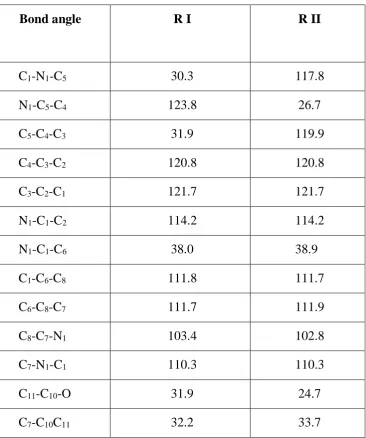
Available online: https://edupediapublications.org/journals/index.php/IJR/ P a g e | 3444 Calculated bond lengths and bond angles are given in tables 5-8 at different
levels.
Bond length and bond-angle of regioisomers at HF level
Table-5 Calculated Bond length (Å) of two regioisomers
Bond length R I R II
R(C1-C2) 1.530 1.531
R(C2-C3) 1.314 1.314
R(C3-C4) 1.479 1.479
R(C4-C5) 1.319 1.319
R(C5-N1) 1.434 1.434
R(N1-C7) 1.496 1.496
R(C1-C6) 1.540 1.529
R(C6-C8) 1.314 1.314
R(C7-C8) 1.524 1.534
R(C1-H) 1.100 1.101
R(C2-H) 1.082 1.082
R(C3-H) 1.082 1.083
R(C4-H) 1.079 1.079
R(C5-H) 1.086 1.086
Available online: https://edupediapublications.org/journals/index.php/IJR/ P a g e | 3445
Table-6 Calculated Bond angle (in degrees) of regioisomers
Bond angle R I R II
C1-N1-C5 30.3 117.8
N1-C5-C4 123.8 26.7
C5-C4-C3 31.9 119.9
C4-C3-C2 120.8 120.8
C3-C2-C1 121.7 121.7
N1-C1-C2 114.2 114.2
N1-C1-C6 38.0 38.9
C1-C6-C8 111.8 111.7
C6-C8-C7 111.7 111.9
C8-C7-N1 103.4 102.8
C7-N1-C1 110.3 110.3
C11-C10-O 31.9 24.7
C7-C10C11 32.2 33.7
Bond length and bond-angle of regioisomers at B3YLP level
Table -7 Calculated Bond length (Å) of two regioisomers
Bond length R I R II
R(N1-C1) 1.502 1.504
Available online: https://edupediapublications.org/journals/index.php/IJR/ P a g e | 3446
R(C2-C3) 1.343 1.344
R(C3-C4) 1.457 1.457
R(C4-C5) 1.351 1.352
R(C5-N1) 1.393 1.391
R(C1-C6) 1.538 1.515
R(C6-C8) 1.339 1.340
R(C8-C7) 1.516 1.535
R(C7-N1) 1.474 1.474
R(C8-H7) 1.080 1.080
R(C3-H1) 1.084 1.081
R(C4-H3) 1.080 1.080
R(C5-H4) 1.085 1.085
R(C1-H5) 1.103 1.104
R(C2-H2) 1.084 1.084
Available online: https://edupediapublications.org/journals/index.php/IJR/ P a g e | 3447
Table-8 Calculated bond angle (in degrees) of two regioisomers
Bond angle R I R II
N1-C1-C2 111.3 110.8
C1-C2-C3 120.2 119.7
C2-C3-C4 121.5 121.6
C3-C4-C5 118.7 118.7
C4-C5-N1 122.0 121.8
C5-N1-C1 119.9 119.8
N1-C1-C6 101.0 101.5
C1-C6-C8 111.7 112.1
C6-C8-C7 111.7 111.6
C8-C7-N1 102.6 101.7
C7-N1-C1 112.3 112.6
C8-C7-H6 111.2 110.9
5. CONCLUSION
1,3-Dipolar cycloaddition of pyridinium N-ylide with alkene dipolarophile has
been investigated at different computational level. In all calculation, the energy
of Regioisomer-I is lower than Regioisomer-II.
According to energy calculation (table-3 and 4) the energy difference between
Available online: https://edupediapublications.org/journals/index.php/IJR/ P a g e | 3448 kcal/mol (at B3LYP level), so it can be concluded that Regioisomer-I is more
stable than Regioisomer-II.
6. REFERENCES
1. Huisgen, R. Angew. Chem. 1963, 75, 604.
2. Liu, Y.; Zhang, Y.; Shen, Y. M.; Hu, H. W.; Xu, J. H. Org. Biomol. Chem.
2010, 8, 2449.
3. Huisgen, R. Angew. Chem. Int. Ed. 2. 1963, 11, 633.
4. Fireston, R. J. Org. Chem. 1968, 33, 2285.
5. Huisgen, R. J. Org. Chem. 1976, 41, 403.
6. Huisgen, R. J. Am. Chem. Soc. 1986, 108, 6401.
7. Blanco-Ania; Daniel. Molecules 2010, 15, 2269.
8. Sauer, J.; Sustmann, R., Angew. Chem., Int. Ed. Engl. 1980, 19, 779.
9. Campos, Kevin, J. Am. Chem. Soc. 1999, 121, 6816.
10. Huisgen, R. Tetrahedron Lett. 1977, 18, 881.
11. Williams, R. Org. Lett. 2003, 5, 3135.
12. Moeinpour F. Chin. J. Chem. Phys. 1955, 23, 1833.
13. Smith S J, Sutcliffe B T, "The development of Computational Chemistry in
the United Kingdom". Reviews in Computational Chemistry, 10 (1997) 271–
316.
14. Schaefer, H F, The electronic structure of atoms and molecules. Reading,
Massachusetts: Addison-Wesley Publishing Co. (1972) 146.
15.Boys S F, Cook G B, Reeves C M & Shavitt I. "Automatic fundamental
calculations of molecular structure" Nature 2 (1956) 178
16. Richards W G, Walker T E H & Hinkley R K A bibliography of ab
Available online: https://edupediapublications.org/journals/index.php/IJR/ P a g e | 3449 17. Preuss H, Int J Quant Chem 2(1968) 651.
18. Zgarbova M, Phys Chem Chem Phys 12 (2010) 10476–10493.
19.Kuhn B, Kollman P A "Binding of a diverse set of ligands to avidin and
streptavidin: an accurate quantitative prediction of their relative affinities by
a combination of molecular mechanics and continuum solvent models" J Med
Chem 43 (2000) 3786–91.
20.Huo S, Massova I & Kollman PA. "Computational alanine scanning of the
1:1 human growth hormone-receptor complex". J Computer
Chem. 23 (January 2002) (1): 15–27. doi:10.1002/jcc.1153. PMID 11913381.
21.Mobley D L, Graves AP, Chodera JD, McReynolds AC, Shoichet B K, Dill
KA "Predicting absolute ligand binding free energies to a simple model
site". J Mol Biol. 371 (4): 1118–34.
22. HuckelE, Zeitschrift fur Physik 70 (1931) 204
23.Coulson C A, Leary B O & Mallion R B, Huckel Theory for Organic
Chemists Academic Press, 1978.
24. Streitwieser A, Molecular Orbital Theory for Organic Chemists, Wiley, New
York, (1961)
25.Hoffmann R, J .Chem. Phys.,39, 1397, (1963)
26.Pariser R & Parr R,J. Chem. Phys., 21, 466, 767, (1953)
27.Pople J A J. Chem. Soc. Faraday Trans., 49, 1375, (1953)
28.Pople J & Beveridge D, Approximate Molecular Orbital Theory, McGraw–
Hill, 1970.
29.Levine I, Quantum Chemistry, Prentice Hall, 4th edition, (1991), pg 579–580
30.Cramer C J, Essentials of Computational Chemistry, Wiley, Chichester,
Available online: https://edupediapublications.org/journals/index.php/IJR/ P a g e | 3450
31.Stewart J P, Reviews in Computational Chemistry, Volume 1 Lipkowitz K B
& Boyd D B, VCH, New York, 45, (1990)
32.Michael Dewar J S & Thiel W, "Ground states of molecules. 38. The MNDO
method. Approximations and parameters". J. Am. Chem. Soc., 99 (15)
(1977): 4899–4907
33.Michael J S, Zoebisch G, Eamonn Healy F, James J. P. Stewart
"Development and use of quantum molecular models. Comparative tests of
theoretical procedures for studying chemical reactions". J. Am. Chem.
Soc., 107 (13) (1985). 3902–3909.
34.James Stewart J P, "Optimization of parameters for semi empirical methods I.
Method". J. Comput. Chem., 10 (2) (1989): 209–220.
35.Rocha G B, Freire R O, Simas A M, James, Stewart J P, "RM1: A
parameterization of AM1 for H, C, N, O, P, S, F, Cl, Br, and I". J. Compute.
Chem. 27 (10) (2006).
36.Stewart James J P, "Optimization of Parameters for Semi empirical Methods
V: Modification of NDDO Approximations and Application to 70 Elements".
J. Mol. Model. (Springer) 13 (12)(2007) 1173–1213.
37.Zerner M Reviews in Computational Chemistry, Volume 2, Eds. Lipkowitz K
B & D. B. Boyd, VCH, New York, 313, (1991)
38.Nanda D N, & Jug K, Theoretica Chimica Acta, 57, 95, (1980)
39.Richard W G, Walker T E H & Hinkley R K. A bibliography of Ab
initio molecular wave functions. Oxford: Clarendon Press. (1971)
40.Preuss H, Int. J. Quantum Chem., 2(1968): 651.
41.Bunker R J, Peyerimhoff S D, "Ab initio SCF calculations for azulene and
naphthalene". Chemical Physics Letters 3(1969) 37.
42.Schaefer Henry F, III Quantum Chemistry. Oxford: Clarendon Press (1984).
43.Streitwieser A, Brauman J I & Coulson C A, Supplementary Tables of
Available online: https://edupediapublications.org/journals/index.php/IJR/ P a g e | 3451
44.Assadi M H N, et al.Paisley E A, Craft H S, Losego M D, Lu H, Gruver man
A, Collazo R, Sitar Z & Maria J P, "Theoretical study on copper's energetic
and magnetism in TiO2 polymorphs". J. Appl. Phys. 23 (2013) 113.
45.Mourik V, Gdanitz Robert J."A critical note on density functional theory
studies on rare-gas dimers". J. Chem. Phys., 16 (22) (2002)
46.Vondrášek J, Bendová L, Klusák V, & Hobza P, "Unexpectedly strong
energy stabilization inside the hydrophobic core of small protein
rubredoxin mediated by aromatic residues: correlated Ab- initio quantum
chemical calculations". J. Am. Chem. Soc.127 (8) (2005) 2615– 2619.
47.Stefan G. "Semi empirical hybrid density functional with perturbative
second-order correlation". J Chem Phys, 3 (2006) 124
48.Urs Z, Michele P & Petros K "Dispersion corrections to density functional for
water aromatic interactions". J Chem Phys, 6 (2004) 120.
49.Stefan G "Accurate description of vander Waals complexes by density
functional theory including empirical corrections" J. Comput. Chem. 25 (12)
(2004) 1463–1473.
50.Lilienfelds V, Anatole O, Tavernelli I, Ursula R & Daniel, "Optimization of
effective atom centered potentials for London dispersion forces in density
functional theory”. Phys Rev Lett, 15 (2004) 93
51.Alexandre T & Matthias S, "Accurate Molecular Vander Waals Interactions
from Ground-State Electron Density and Free-Atom Reference Data" Phys