ISSN(Online): 2320-9801
ISSN (Print): 2320-9798
I
nternational
J
ournal of
I
nnovative
R
esearch in
C
omputer
and
C
ommunication
E
ngineering
(An ISO 3297: 2007 Certified Organization)
Vol. 3, Issue 2, February 2015
Algorithms for Edge Detection and
Enhancement for Real Time Images: A
Comparative Study
Ashita Vermani, Akshyata Ojha
Assistant Professor, Dept. of Electronics & Telecommunication., College of Engineering Roorkee, Roorkee, India
Student, Dept. of Electronics & Telecommunication., College of Engineering Roorkee, Roorkee, India
ABSTRACT: Thermal images are used for detection and identification of edges in any object due to varying atmospheric conditions. In this paper, five algorithms, viz, Robert, Sobal, Prewitt, laplacian and Canny edge detection algorithm are discussed and their performances are compared for optimal edge detection.
Edge detection play a linchpin role in image analysis and able to solve complex problems, it is an important step to identify object segmentation and help in feature extraction. It basically works on grey level of pixels, it is used to track targets, compress data, recognition of object etc. as it significantly reduces amount of data and filters out useless information while preserving important structural properties. Performance of algorithms is decided in considering accuracy and speed.
KEYWORDS: images, optimal edge detection, grey level of pixels, data compression.
I. INTRODUCTION
To detect edges, we must have knowledge about infrared imaging/ thermal imaging. Thermal imaging is done to analyze objects in the dark with the help of black body radiation , all objects emit radiation above absolute zero temperature. With increase in temperature, emitted radiation will increase thus object appear brighter and clearer then cooler object. Thermo graphic cameras detect radiation in IR range and produce image called thermograms. Thermograms represent quantity of IR energy emitted transmitted and reflected by an object, but the controversy is that because of different IR energy sources, accurate temperature of the object can’t be measured.
ISSN(Online): 2320-9801
ISSN (Print): 2320-9798
I
nternational
J
ournal of
I
nnovative
R
esearch in
C
omputer
and
C
ommunication
E
ngineering
(An ISO 3297: 2007 Certified Organization)
Vol. 3, Issue 2, February 2015
Fig1 BLOCK DIAGRAM OF THERMAL IMAGING SYSTEM
Since Emissivity is the ability of material to emit thermal radiation with change in temperature. Its value is between zero to one and black body is the material which radiates IR radiation at its contact temperature, emissivity of true black body is one in practicality. The rate of emission of IR radiation produce fraction of true contact temperature and this fraction is called emissivity. Introduction of thermal imaging system is done for edge detection which has ability to see through smoke. It detects variation in temperature to differentiate between targets and their backgrounds. Because of their low cost, they are used in number of industrial and civil applications. Thermal imagers can scan @ 30 times per second and sense temperature ranging from -40 F to 36000 F.
In fig 1, Lens focuses the IR radiation emitted by the source object [1]. Phase array of IR detector scan the focus light and hereby detector elements create detailed temperature pattern i.e. thermogram. The thermogram then translated into electrical impulses. The impulses then sent to signal processing unit then that translate information into data for the display. The display appears in various colors depending on intensity of infrared emission and the combination of all impulses create image
II. RELATED WORK
ISSN(Online): 2320-9801
ISSN (Print): 2320-9798
I
nternational
J
ournal of
I
nnovative
R
esearch in
C
omputer
and
C
ommunication
E
ngineering
(An ISO 3297: 2007 Certified Organization)
Vol. 3, Issue 2, February 2015
response to noise . X. Jing, Y. Nong, and Y. Shang[11] used Laplacian which is a two dimensional isotropic measure of second spatial derivative of the image.It highlights region of rapid intensity change, it uses two Gaussian and laplacian filter.
III. VARIOUS TECHNIQUES FOR EDGE DETECTION
Edge detection is a basic tool used in image processing. It is a process of identifying and locating sharp discontinuities of an image. Discontinuities are areas of abrupt pixel change by which boundaries of the object are characterized. It is used for feature detection and extraction, which aims to identify points in a digital image where brightness of image changes sharply and find discontinuities. Thus, applying an edge detection algorithm to an image may significantly reduce the amount of data to be processed and may therefore filter out information that may be regarded as less relevant, while preserving the important structural properties of an image. If the edge detection step is successful, the subsequent task of interpreting the information contents in the original image may therefore be substantially simplified.
Traditional approach of edge detection involve convolution of image with 2D filter which is sensitive to large gradient. They give values of zero in uniform region. Edge detection operators have features like Edge Orientation, Noise Environment, Edge Structure.
There are two techniques:
Gradient Based: It detect edges by looking for maximum and minimum of first derivative. It includes sobel
operator, prewitt operator, Roberts operator.
Laplacian Based: It searches zero crossings in the second derivative of image to find edges. It includes laplacian of Gaussian, Canny edge detection.
As we know edges have higher pixel intensity values than surroundings, so once threshold is set we compare the gradient value and detect an edge when threshold is exceeded. When first derivative is maximum, second derivative is zero.
IV. METHODOLOGY
For evaluating the output and generating MATLAB code following steps are taken- 1. Accept a sample image in two dimensional domain
2. Apply mask Gx , Gy to the input image 3. Apply edge detection algorithms
4. Obtain mask manipulation of Gx and Gy separately on the input image 5. Combine result to obtain absolute magnitude of the gradient
6. Trace the absolute magnitude
V. SIMULATION RESULTS
A. Gradient based techniques:
a) Roberts Cross-Gradient Operator: It is used in image processing and computer vision for edge detection. It approximates the gradient of an image by discrete differentiation. Discrete differentiation is done by computing sum of the squares of differences between diagonally adjacent pixels. It quickly compute 2D spatial gradient of input image at that point.
Two kernels used as operator here. One kernel is 900 rotated form of other.
Gx= +1 0 Gy= 0 +1
0 -1 -1 0
ISSN(Online): 2320-9801
ISSN (Print): 2320-9798
I
nternational
J
ournal of
I
nnovative
R
esearch in
C
omputer
and
C
ommunication
E
ngineering
(An ISO 3297: 2007 Certified Organization)
Vol. 3, Issue 2, February 2015
Gradient magnitude |G|=(Gx2+Gy2)1/2
Approximate magnitude |G|=|Gx|+|Gy|
Angle of orientation which will give rise to spatial gradient is α=arctan(Gy/Gx)-3π/4
As shown in fig 2 firstly we convert the image in 2-D then with the help of two kernals image is traced in x-axis and y-x-axis respectively .with the help of both x x-axis and y x-axis gradient magnitude and orientation is computed and final detected image is obtained
Fig 2 Simulation Results for Roberts Cross-Gradient Operator
b) Sobels Operator:
It is discrete differentiation operator, calculates approximation of gradient of image intensity function. This operator works on convolution of image with small separable and integer valued filter in both directions. For high frequency, it produces crude gradient. The two kernels used here are Gx and Gy. For horizontal and vertical derivative
approximation.
Gx=
+1 0 -1
Gy=
+1 +2 +1
*A
+2 0 -2 *A 0 0 0
+1 0 -1 -1 -2 -1
* 2D Convolution operation
Soble kernels= Averaging x differentiation kernel
They compute the gradient with smoothing, x coordinate increase in right direction and y coordinate in down direction. At each point gradient is approximated through
|G|=(Gx2+Gy2)1/2
And the gradient directions α=arctan(Gy/Gx)
α=0 for vertical edge
Intensity function at discrete point is known thus to define derivative of this function, we need to sample image point. Only eight image points are needed to calculate gradient vector and two discrete filters are separable.
ISSN(Online): 2320-9801
ISSN (Print): 2320-9798
I
nternational
J
ournal of
I
nnovative
R
esearch in
C
omputer
and
C
ommunication
E
ngineering
(An ISO 3297: 2007 Certified Organization)
Vol. 3, Issue 2, February 2015
Fig 3 Simulation Results for Sobels Operator
c) Prewitt Operator:
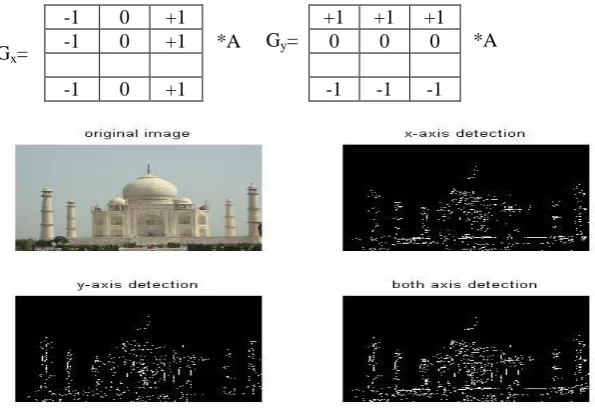
The operator estimates gradient of image intensity giving largest possible increase from light to dark. Only the difference is of kernels. They are decomposed into averaging and differential kernel.
As shown in fig 4 for x axis detection we convolve Gx kernel with input image. The kernals taken are small and thus prevent blurring and other problems. Similarly after calculating y axis gradient by rotating Gx kernel by 900 we evaluate magnitude and orientation -
Gx=
-1 0 +1
Gy=
+1 +1 +1
*A
-1 0 +1 *A 0 0 0
-1 0 +1 -1 -1 -1
Fig 4 Simulation Results for Prewitt Operator
B. Gaussian Based Techniques:
Laplacian of Gaussain: (LOG Operator) It highlights regions of rapid intensity change. Laplacian is applied after application of smoothening and approximating Gaussain filter to image, thus sensitivity to noise is reduced. It takes single grey level image as input and produces another grey level image as output.
ISSN(Online): 2320-9801
ISSN (Print): 2320-9798
I
nternational
J
ournal of
I
nnovative
R
esearch in
C
omputer
and
C
ommunication
E
ngineering
(An ISO 3297: 2007 Certified Organization)
Vol. 3, Issue 2, February 2015
I (x,y)= Pixel intensity values
L(x,y)=∆2I/∆x2 + ∆2I/∆y2
It uses hybrid filter that is the combination of convolution of gaussian and laplacian filter
Three kernels used approximate second derivative which are usually small and very sensitive to noise.
0 1 0 1 1 1 -1 2 -1
1 -4 +1 1 -8 1 2 -4 2
0 1 0 1 1 1 -1 2 -1
As shown in fig 5 applying log operator to the image and with the help of these three kernals the edge of the image can be detected .
Preprocessing step reduces high frequency noise component before differentiation here convolution is associative so we convolve Gaussian smoothing filter with laplacian filter. So there are two advantages, due to small kernels, fewer arithmetic operations are required and LOG operator kernel is pre-calculated so need to evaluate at runtime.
LOG (x,y)= -1/πσ4(1-(x2+y2)/2σ2)e-(x2+y2/2σ2)
Fig 5 Simulation Results for LOG Operator
d) Canny Edge Detection:
It is most commonly used tool. This is usually used as standard edge detection method. Canny used many ways to approximate and optimize the edge detection problems. This detector has low error rate i.e. no response to non edges and the edge are well localized, i.e. difference between edge pixels in detector and actual edge should be minimum. Here the optimal detector provides good detection, good localization and minimal response. Four filters used to detect horizontal, vertical, diagonal in image.
|G|=(Gx2+Gy2)1/2
ISSN(Online): 2320-9801
ISSN (Print): 2320-9798
I
nternational
J
ournal of
I
nnovative
R
esearch in
C
omputer
and
C
ommunication
E
ngineering
(An ISO 3297: 2007 Certified Organization)
Vol. 3, Issue 2, February 2015
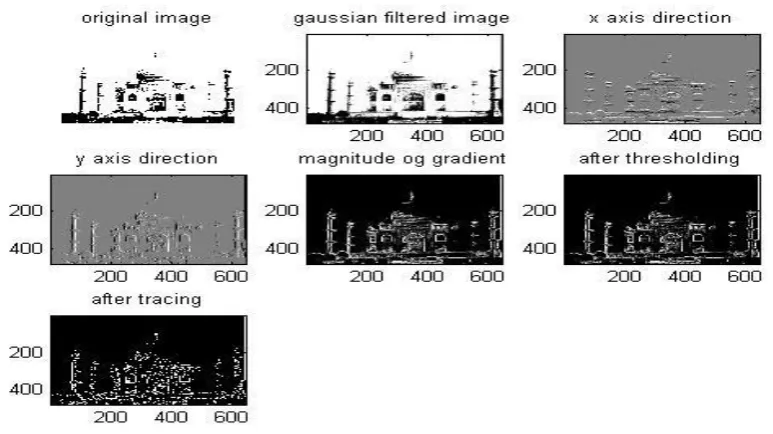
Convolution of raw image with Gaussian filter is used for noise reduction. It estimates image gradient by assuming local maxima in the gradient direction. It uses Hysteresis thresholding in which high thresholds are used to mark out edges roughly and eliminate noise pixels and low threshold are used for suppression.
More over there are two parameters used in this algorithm which are adjustable in nature thus provide flexibility and affect the computation time and effectiveness of algorithm. The parameters are:
1. The size of the Gaussian filter i.e. the smoothening filter used in first stage is small and hence cause less blurring and allow detection of small sharp lines. A larger filter causes more blurring so if we need to detect larger and smoother edges we can also use large blurring radii filter.
2. The use of two thresholds with hysteresis allow more flexibility then in a single threshold approach. However f the threshold is set too high it can miss the important information , on the other if it is set too low it will identify irrelevant information.So we have to fix accordingly.
As shown in fig 6 the 2-D original image first passed through Gaussian filter to reduce noise then x axis gradient and y axis gradient is calculated same as in prewitt and sobal operator. The edge detected image is then subjected to thresholding and then traced.
Fig 6 Simulation Results for Canny Edge Detection
VI. CONCLUSION
ISSN(Online): 2320-9801
ISSN (Print): 2320-9798
I
nternational
J
ournal of
I
nnovative
R
esearch in
C
omputer
and
C
ommunication
E
ngineering
(An ISO 3297: 2007 Certified Organization)
Vol. 3, Issue 2, February 2015
filter and coefficients is fixed so cannot adapt image. Canny’s edge detection is more expensive on the basis of computation however it performs better than all.
REFERENCES
1. M. Shin, D. Goldgof and K.W. Bowyer, "An Objective Comparison Methodology of Edge Detection Algorithms for Structure from Motion Task," Empirical Evaluation Techniques in Computer Vision, K.W. Bowyer and P.J. Phillips, eds., IEEE CS Press, pp. 235-254, 1998. 2. R.A. Hummel, "Feature Detection Using Basis Functions," Computer Graphics and Image Processing, vol. 9, pp. 40-55, 1979
3. W.M. Krueger and K. Phillips, "The Geometry of Differential Operators with Application to Image Processing," IEEE Trans. Pattern Analysis
Machine Intelligence, vol. 11, pp. 1252-1265, 1989
4. V. Lacroix, "A Three-Module Strategy for Edge Detection," IEEE Trans. Pattern Analysis Machine Intelligence, vol. 10, pp. 803-810, 1988 5. J.S. Lim, Two-Dimensional Signal and Image Processing. Prentice Hall, 1990.
6. S. Ando, "Image Field Categorization and Edge/Corner Detection from Gradient Covariance," IEEE Trans. Pattern Analysis Machine Intelligence, vol. 22, pp. 179-190, 2000.
7. A.P. Blicher, "Edge Detection and Geometric Methods in Computer Vision," Technical Report CS-85-1041, Stanford Univ., Dept. of Computer Science, 1985
8. S. Baker, S.K. Nayar and H. Murase, "Parametric Feature Detection," Int',l J. Computer Vision, vol. 27, pp. 27-50, 1998
9. E. De Micheli, B. Caprile, P. Ottonello and V. Torre, "Localization and Noise in Edge Detection," IEEE Trans. Pattern Analysis Machine
Intelligence, vol. 11, pp. 1106-1116, 1989
10. W. Frei and C.C. Chen, "Fast Boundary Detection: A Generalization and a New Algorithm," IEEE Trans. Computer, vol. 26, pp. 988-998, 1977.