ISSN(Online): 2320-9801
ISSN (Print): 2320-9798
International Journal of Innovative Research in Computer
and Communication Engineering
(An ISO 3297: 2007 Certified Organization)
Vol. 3, Issue 3, March 2015
Avoiding Network Performance Degradation
Problem in Zigbee
Jothi.S, Daniel.D, Jackulin Durairani.A, Rekha.A
PG Scholar, Department of CSE, Dr.N.G.P. Institute of Technology, Tamil Nadu, India
Assistant Professor, Department of CSE, Dr.N.G.P. Institute of Technology, Tamil Nadu, India
PG Scholar, Department of CSE, Dr.N.G.P. Institute of Technology, Tamil Nadu, India
PG Scholar, Department of CSE, Dr.N.G.P. Institute of Technology, Tamil Nadu, India
ABSTRACT: Zigbee is Associate in Nursing communication customary that is intended for Associate in Nursing low rate wireless personal space network, it's less price, less complexness and low power consumption in mobile device. Among the zigbee topologies, tree topologies are appropriate for low power and low price detector network as a result of is supports for power saving operation and even for the sunshine weight routing. Zigbee tree routing is IEEE 802.15.4 customary that is employed in several resources, applications and even within the restricted device. Zigbee tree routing doesn't offer any routing table and route discovery to send the packet from supply to the destination. In Zigbee tree routing, packet follows the tree topology that because the basic limitation and it doesn't offer the optimal(correct) routing path to destination .In this paper ,we planned the road tree routing(STR) protocol to decrease the routing price of ZTR with facilitate of neighbor table and conjointly scale back the overhead. The most plan is by employing a hierarchic addressing theme, the road tree routing calculate the remaining hops from discretionary supply to destination. By victimization mathematically analysis, prove that the one hop neighbor info increase overall network performance by requiring the routing path expeditiously and distributing the traffic load targeting the tree links.
KEYWORDS:Zigbee, IEEE 802.15.4, Tree Routing, Shortcut Tree Routing (STR), WSN.
I. INTRODUCTION
A wireless device network (WSN) could also be a wireless network consisting of spatially distributed autonomous devices practice sensors to watch physical or environmental conditions. A WSN system incorporates an entrance that offers wireless property back to the wired world and distributed nodes. The wireless protocol you obtain on depends on your application desires. Some of the on the market standards embody a combine of 4 giga cycle radios supported either IEEE 802.15.4 standards proprietary radios, that are generally 900 rate.
ZIGBEE would possibly even be a worldwide communication ancient of wireless personal house network (WPAN) aimed to minimum-power, cost, reliable, and scalable product and applications. The selection personal house network like Bluetooth, UWB, and Wireless USB are all wholly altogether whole entirely totally utterly completely different, ZigBee would love the low power wireless mesh networking and it supports up to thousands of devices throughout a network. The ZigBee Alliance has extended the applications to the various dynamic network formations, addressing, routing, and network management functions. In a network 64000 devices is supports in zigbee with the multichip tree and mesh topologies besides as topology. Every node is appointed a singular 16-bit short address dynamically exploitation either distributed addressing or random addressing theme. Every parent node assigns a sixteen bit address for his or her children. According to the applying zigbee routing protocol take the optimum routing path.
ISSN(Online): 2320-9801
ISSN (Print): 2320-9798
International Journal of Innovative Research in Computer
and Communication Engineering
(An ISO 3297: 2007 Certified Organization)
Vol. 3, Issue 3, March 2015
proportionately will increase with the amount of traffic sessions. Moreover, route discovery packets unit of activity flooded to the network that interferes with transmission of assorted packets even among the spatially unrelated house with the route discovery. On the choice hand, the route discovery overhead in memory and data live is defend by ZigBee tree routing (ZTR) [4] victimization the distributed block addressing theme.
ZTR, packets unit forwarded to the sink nevertheless the sink is found close to on the tree topology. Thus, ZTR does not offer the correct routing path, whereas it not provides any route discovery overhead. Our prepare is to need the shut best routing path fairly rather just like the reactive routing protocol still on maintain the benefits of ZTR like no route discovery overhead and tiny memory consumption for the routing table. We propose the cutoff tree routing (STR) that significantly increase the path efficiency of ZTR by alone adding the 1-hop neighbor data. Whereas tree links is use to connecting the parent and child nodes in zigbee tree routing, STR exploits the neighbor nodes by focusing that there exist the neighbor nodes shortcutting the tree routing path among the topology. in many words STR, a provide node or associate intermediate node selects following hop node having the tiniest remaining tree hops to the destination despite whether or not or not or not or not or not or not it is a parent, one among youngsters, or neighboring node. In cutoff tree routing each and every individual node select the route path selecting in associate exceedingly very distributed manner, and STR is completely accessible with the ZigBee ancient that applies the various routing that in in among that at intervals which per each node’s standing. Also, it needs neither to any extent more value nor modification of the ZigBee ancient beside the creation and maintenance mechanism of 1-hop neighbor data. The main importance of this paper is:
First, we propose route tree routing to resolve the network performance degradation of zigbee tree routing, that downside the matter area unit (i) detour path downside and (ii) traffic concentration problem.
Second, By exploitation the one hop neighbor info in route tree routing, it increase the routing path potency and traffic load concentration on tree link in zigbee tree routing.
Third, we have a tendency to analyze the comparison of ZTR, STR, and AODV by differentiating the network conditions like network density, ZigBee network constraints, traffic sorts, and therefore the network traffic.
This paper is organized in 3 cases as follows: Case 2describing the motivation on the routing protocols, and Case three describes the zigbee tree routing and its drawbacks, Case four offer route tree routing formula and properties of mathematical analysis in STR. Case five comparison of STR, ZTR and AODV area unit evaluated, and Case six conclusion of the paper.
II. RELATED WORK
A network with none base stations “infrastructure-less “or multi-hop and assortment of two or additional devices equipped with wireless communications and networking capability.
The routing protocols meant for wired networks cannot be used for mobile unexpected networks attributable to the quality of networks. The unexpected routing protocols are often divided into 2 categories :- table-driven(proactive routing protocol) and on-demand(reactive routing protocol).The topology info has Associate in Nursing up to now correct routing path in proactive routing protocol and also the example of proactive routing protocol square measure OLSR[6] and DSDV[7]. In DSDV every mobile station maintains a routing table that lists all out there destinations, the amount of hops to achieve the destination and so the sequences vary assigned by the destination node. The sequence vary is used to inform apart stale routes from new ones and then avoid the evolution of loops. The stage continuously sends their routing tables to their immediate neighbors. A station together transmits its routing table if a giant modification has occurred in its table from the last update sent. So, the update is every time-driven and event-driven.
ISSN(Online): 2320-9801
ISSN (Print): 2320-9798
International Journal of Innovative Research in Computer
and Communication Engineering
(An ISO 3297: 2007 Certified Organization)
Vol. 3, Issue 3, March 2015
nodes move then the stirred nodes neighbor realizes the link failure and sends a link failure notification to its upstream neighbors and so on till it reaches the availability upon that the availability can reinitiate route discovery if needed. Edouard Manet routing protocol would like the optimum routing path for given offer to destination mix Edouard Manet routing protocols requiring all the individual sources to invoke route discovery to an analogous destination.
The advantage of these protocols is to cut back the route discovery overhead by concentrating on the several- to- one and one- to- many traffic and even any-to-any itinerary is supported, a routing path is inefficient by travel tree topology and that they affected from detour path and traffic concentration drawback like zigbee tree routing. During this paper, the cutoff tree routing algorithmic rule is selects the neighbor table if it will decrease the route price to the destination. The projected algorithmic rule forestall quite thirty p. c of hop count compare with the zigbee tree routing with none route discovery overhead and additionally in addition we discover the inefficient routing path in ZTR, it suffer with performance degradation once all the packet square measure targeted in tree links. During this paper, cutoff tree routing increases the network performance and avoid the traffic load concentration drawback.
III.ZIGBEETREEROUTING
All potential parents is require the sub block of address space, which is used to assign the address to their children. The given value for the maximum number of the children’s the parents may have, nwkMaxChildren (Cm), nwkMaxRouters (Rm), and nwkMaxDepth (Lm), where Cm, Lm, Rm is describe as maximum number of children that parents have, the maximum number of routers a parent have as a children, and the maximum tree level of a network, respectively. From eq. (1) and eq. (2) Cskip is compute as a size of sub block address distributed by each parents at the depth d. For example, the kth is defined as router and nth is defined as end device will assigned the network address by their parents at depth d.
A (k) =A (parent) +Cskip (d).(k-1)+1(1≤k≤Rm) eq. (1) A (n) =A (parent) +Cskip (d).Rm+n (1≤n≤Cm-Rm) eq. (2)
A kth router has the positive Cskip that can distribute address space to its child nodes.Since in the network every device is descendant to the coordinator of zigbee and no device in the network is the descendant of end device in zigbee,
Any device with address A at depth d has the destination device with address D if the Eq. 3 is satisfied. A<D<A + Cskip (d-1) eq. (3)
In zigbee tree routing, if the destination is descendant than the device send the data to its children; else it send the data to its parents.
The hierarchical addressing scheme is use to find whether the sink is descendant of each source or intermediate node. In ZTR, each source or intermediate node sends the data to their one of a children if the destination is descendant; otherwise, it sends to its parent.
The zigbee tree routing protocol uses only parent and child relationship for the routing and it ignore the neighbor nodes, as a result the packet is travel through many hops toward the destination even within the 2 hop transmission range, here the detour path problem of zigbee tree routing can be solve by applying direct transmission rule, without any decision of routing protocol it allow the coordinator to send the packet directly to the destination. If the destination is located more than a two hop distance then we can’t apply direct transmission range. In addition to detour path problem, zigbee tree routing as the traffic concentration problem due to the limited tree link and due to this the network is suffer from degradation problem.
A. Drawback find in ZTR:
• Detour path downside of ZTR: The packet is routed through many hops towards the sink although it's inside the vary of sender’s 2-hop transmission vary.
• It cannot give the best routing path: as a result of packet follows the tree topology (i.e. tree link).
ISSN(Online): 2320-9801
ISSN (Print): 2320-9798
International Journal of Innovative Research in Computer
and Communication Engineering
(An ISO 3297: 2007 Certified Organization)
Vol. 3, Issue 3, March 2015
IV.SHORTCUT TREE ROUTING
We projected the cutoff tree routing formula is used to resolve two downside of zigbee tree routing and increase the current zigbee tree routing by exploitation the neighbor table. Cutoff tree routing primarily follows zigbee tree routing formula, but STR chooses neighbor node as a result of ensuing hop node and so it cut back the route value to the destination. By choosing the highest hop count we have a tendency to area unit ready to cut back the remaining hop count value to the destination. The route values are going to be attenuated if the sender sends the data on to the destination. In cutoff tree routing, supported the remaining tree hops each and every node can understand the correct next hop node to the sink. The one hop neighbor information is associates mathematically to decrease the traffic load concentration downside on the tree links equally as provides a cost-effective routing path.
Wherever a packet is routed through many hops toward the destination albeit it's among the vary of sender’s 2-hop transmission vary. to unravel this detour path downside of ZTR, ZigBee specification has outlined the transmission mechanism rule that enables a arranger or a router to transmit a packet on to the destination while not call of the routing protocol. However, this technique cannot basically solve the detour path downside of tree routing. Just in case that the destination is found quite 2-hop distance faraway from a supply node, we tend to cannot apply the transmission mechanism rule. To overcome this downside we tend to project the crosscut tree routing to unravel each downside. The STR algorithmic rule that solves issues of the ZTR by victimization 1-hop neighbor data.
A. Topology Creation
Once the given type of the node has configured then the next step is we have to create a nodes. The old node creation API is similar to the new node which is creating API. The argument is passed as node address in hierarchical address scheme.
B. Routing tree calculation
The network as number of nodes and each node themselves acts as tree roots. Set of nodes in the network form a routing tree to roots. Each and every node selects the shortest next hop to send packet from source to destination. Wherever a packet is routed through many hops toward the destination albeit it's among the vary of sender’s 2-hop transmission vary. to unravel this detour path downside of ZTR, ZigBee specification has outlined the transmission mechanism rule that enables a arranger or a router to transmit a packet on to the destination while not call of the routing protocol. However, this technique cannot basically solve the detour path downside of tree routing. Just in case that the destination is found quite 2-hop distance faraway from a supply node, we tend to cannot apply the transmission mechanism rule. To overcome this downside we tend to project the crosscut tree routing to unravel each downside. The STR algorithmic rule that solves issues of the ZTR by victimization 1-hop neighbor data.
C. Benefit of STR
• Using one hop neighbor choice supported transmission mechanism decree route tree routing technique. • It minimizes the arduous and utilizes low memory.
• Didn't occur detour path downside and route discovery method overhead and additionally a traffic concentration downside.
• To avoid degradation and graded addressing theme.
ISSN(Online): 2320-9801
ISSN (Print): 2320-9798
International Journal of Innovative Research in Computer
and Communication Engineering
(An ISO 3297: 2007 Certified Organization)
Vol. 3, Issue 3, March 2015
V. PERFORMANCEEVALUATION
The STR in varied metrics of the routing performance and overhead. The analysis of the routing performance includes hop count, end-to-end latency, packet delivery quantitative relation, and coat level retransmissions, and so the routing overhead is measured with the number of management packets and memory consumption for routing. The simulation is assessed into three subsections thus on analyze the implications of network density, traffic pattern, network among the framework, and so the network traffic.
In this analysis, the network machine NS-2 and IEEE 802.15.4 PHY/MAC protocols unit of measurement used for comparison STR with ZTR and AODV. The parameter settings unit of measurement uses this configuration, unless otherwise noted among the subsequent subsections. The network association procedure and ZigBee address assignment theme unit of measurement applied to the all map reading protocols. Every knob in each simulation starts association procedure arbitrarily time from 0sec and ends with appointed network address at intervals 50sec.
In ZigBee, entries of neighbor table unit of measurement created and maintained by the link standing message with a 1-hop broadcast every nwkLink- standing quantity seconds, that's able to 15sec in our simulation.
A.Topology Formation
Constructing Project style in NS2 ought to happen every node ought to send hullo packets to its neighbor node that are in its communication vary to update their topology.
B.Tree Construction
The names of relationships between nodes area unit sculptural once family relations. The gender-neutral names "parent" and "child" have for the most part displaced the older "father" and "son" nomenclature, though the term "uncle" continues to be used for different nodes at a similar level because the parent.
A node's "parent" may be a node one step higher within the hierarchy (i.e. nearer to the basis node) and lying on a similar branch.
"Sibling" ("brother" or "sister") nodes share a similar parent node.
A node's "uncles" area unit siblings of that node's parent.
A node that's connected associate degree to any or all lower-level nodes is named an "ancestor". The connected lower-level nodes area unit "descendants" of the ascendant node.
C.Simulation Table
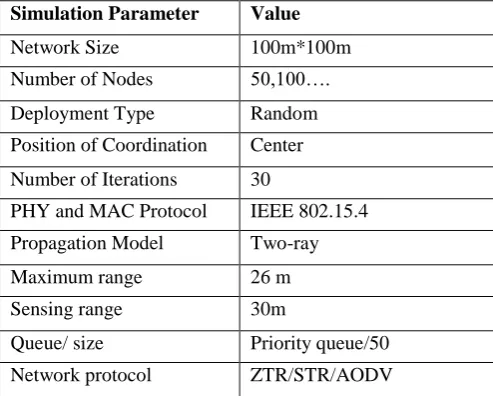
The following TABLE I describes the comparison of ZTR/STR/AODV
TABLE I. Simulation of NS2
Simulation Parameter Value
Network Size 100m*100m
Number of Nodes 50,100….
Deployment Type Random
Position of Coordination Center
Number of Iterations 30
PHY and MAC Protocol IEEE 802.15.4
Propagation Model Two-ray
Maximum range 26 m
Sensing range 30m
Queue/ size Priority queue/50
ISSN(Online): 2320-9801
ISSN (Print): 2320-9798
International Journal of Innovative Research in Computer
and Communication Engineering
(An ISO 3297: 2007 Certified Organization)
Vol. 3, Issue 3, March 2015
Simulation Time 350 sec
Duration 50 sec
Packet Type CBR
Interval of Packet One packet/sec
Start/end time Any to any/many to many
Number of section 10,20…100
D.Overhead
Skyward is any combo of excess or indirect computation time, memory, bandwidth, or alternative resources that are needed to realize a specific goal.
Compare with the adhoc on-demand distance vector routing and zigbee tree routing, shortcut tree routing (STR) is less overhead. In shortcut tree routing by using one hop neighbor choice supported transmission mechanism decrease route tree routing technique. It reduces the energy consumption and utilizes low memory. It is shown in Fig. 1.
Fig. 1. Overhead of ZTR/STR/AODV E.Throughput
Throughput defined from eq. (4) is the number of useful bits per unit of time forwarded by the network from a certain source address to a certain destination; prohibit protocol overhead, and excluding retransmitted data packets. Fig. 2. describes the comparison of ZTR, STR and AODV
No of Packets Received
ISSN(Online): 2320-9801
ISSN (Print): 2320-9798
International Journal of Innovative Research in Computer
and Communication Engineering
(An ISO 3297: 2007 Certified Organization)
Vol. 3, Issue 3, March 2015
Fig. 2. Throughput of ZTR/STR/AODV
F. Packet Delivery Ratio
:
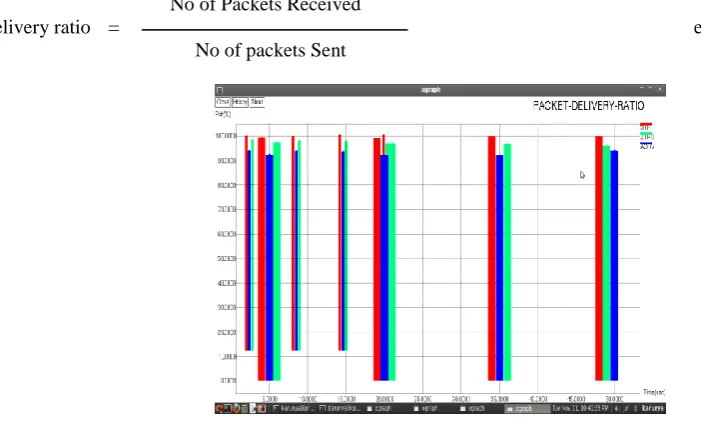
Packet Delivery Ratio is defined as the average of the ratio of the number of data packets received by each receiver over the number of data packets sent by the source from eq. (5). Fig. 3. describes the comparison of ZTR, STR and AODV .
No of Packets Received
Delivery ratio = eq. (5) No of packets Sent
Fig. 3. Packet Delivery Ratio of ZTR/STR/AODV
VI.CONCLUSION AND FUTURE WORK
ISSN(Online): 2320-9801
ISSN (Print): 2320-9798
International Journal of Innovative Research in Computer
and Communication Engineering
(An ISO 3297: 2007 Certified Organization)
Vol. 3, Issue 3, March 2015
the economical routing path. The network simulation shows that STR offers sensible network performance compare with AODV further as ZTR.
In future work we can solve orphan node problem and room shortage problem, which cause network performance degradation.
REFERENCES
1. D. Han and J. Lim, “Smart Home Energy Management System Using IEEE 802.15.4 and ZigBee,” IEEE Trans. Consumer Electronics,vol. 56, no. 3, pp. 1403-1410, Oct. 2010.
2. S. Chen et al., “A Reliable Transmission Protocol for ZigBee-Based Wireless Patient Monitoring,” IEEE Trans. Information Technology in Biomedicine, vol. 16, no. 1, pp. 6-16, Nov. 2012.
3. P. Yi, A. Iwayemi, and C. Zhou, “Developing ZigBee Deployment Guideline under Wi-Fi Interference for Smart Grid Applications,”IEEE Trans. Smart Grid, vol. 2, no. 1, pp. 110-120, Nov. 2011.
4. ZigBee Alliance, ZigBee Specification, 2009. Chakeres, “AODVjr, AODV Simplified,” ACM SIGMOBILEMobile Computing and Comm. Rev., vol. 6, pp. 100-101, 2002.
5. T. Clausen and P. Jacquet, “Optimized Link State Routing Protocol (OLSR),” Internet Request for Comments 3626, Oct. 2003.
6. C.E. Perkins and P. Bhagwat, “Highly Dynamic Destination-Sequenced Distance-Vector Routing (DSDV) for Mobile Computers,”SIGCOMM Computer Comm. Rev., vol. 24, pp. 234-244, 1994.
7. C.E. Perkins and E.M. Royer, “Ad-Hoc on-Demand Distance Vector Routing,” Proc. IEEE Workshop Mobile Computer Systems and Applications, Feb. 1999.
8. D.B. Johnson and D.A. Maltz, “Dynamic Source Routing in Ad Hoc Wireless Networks,” Mobile Computing, vol. 353, pp. 153-181, 1996. 9. V.D. Park and M.S. Corson, “A Highly Adaptive Distributed Routing Algorithm for Mobile Wireless Networks,” Proc. IEEE INFOCOM ’97,
1997.
10. W. Kiess and M. Mauve, “A Survey on Real-World Implementations of Mobile Ad-Hoc Networks,” Ad Hoc Networks, vol. 5, no. 3,pp. 324-339, Apr. 2007.
11. B.-R. Chen, K.-K. Muniswamy-Reddy, and M. Welsh, “Ad-Hoc Multicast Routing on Resource-Limited Sensor Nodes,” Proc.Second Int’l Workshop Multi-Hop Ad Hoc Networks from Theory to Reality, 2006.
12. Taehong Kim, Seong Hoon Kim, Jinyoung Yang, Seong-eun Yoo, Member, IEEE, and Daeyoung Kim, Member, IEEE, “Neighbor Table Based Shortcut Tree Routing in ZigBee Wireless Networks”, March 2014.
13. D. Chen, J. Deng, and P. Varshney, “Selection of a Forwarding Area for Contention-Based Geographic Forwarding in Wireless Multi-Hop Networks,” IEEE Trans. Vehicular Technology, vol. 56, no. 5, pp. 3111-3122, Sept. 2007.
14. N. Arad and Y. Shavitt, “Minimizing Recovery State in Geographic Ad Hoc Routing,” IEEE Trans. Mobile Computing, vol. 8, no. 2, pp. 203-217, Feb. 2009.
15. Y. Han, R. La, A. Murkowski, and S. Lee, “Distribution of Path Durations in Mobile Ad-Hoc Networks - Palm’s Theorem to the Rescue,” Computer Networks, vol. 50, no. 12, pp. 1887-1900, 2006.
16. W. Navidi and T. Camp, “Stationary Distributions for the Random Waypoint Mobility Model,” IEEE Trans. Mobile Computing, vol. 3, no. 1, pp. 99-108, Jan./Feb. 2004.
17. R. Groenevelt, “Stochastic Models for Mobile Ad Hoc Networks,” PhD dissertation, University de Nice, Sophia Antipolis, France, 2005. 18. The Network Simulator ns-2, http://www.isi.edu/nsnam/ns, 2011.
19. M. Marina and S. Das, “On-Demand Multipath Distance Vector Routing in Ad Hoc Networks,” Proc. Ninth Int’l Conf. Network Protocols (ICNP ’01), pp. 14-23, Nov. 2001.
20. J. Yoon, M. Liu, and B. Noble, “Random Waypoint Considered Harmful,” Proc. IEEE INFOCOM, pp. 1312-1321, 2003.
21. S. Mueller, R. Tsang, and D. Ghosal, “Multipath Routing in Mobile Ad Hoc Networks: Issues and Challenges,” Performance Tools and Applications to Networked Systems, pp. 209-234, Springer, 2004.
22. D. Ganesan, R. Govindan, S. Shenker, and D. Estrin, “Highly Resilient, Energy-Efficient Multipath Routing in Wireless Sensor Networks,” ACM SIGMOBILE Mobile Computing and Comm. Rev., vol. 5, no. 4, pp. 11-25, 2001.