ISSN (Print) : 2347 - 6710
International Journal of Innovative Research in Science, Engineering and Technology
Volume 3, Special Issue 3, March 2014
2014 International Conference on Innovations in Engineering and Technology (ICIET’14) On 21st& 22nd March Organized by
K.L.N. College of Engineering, Madurai, Tamil Nadu, India
ABSTRACT— The motivation of this project is to produce three phase voltage with variable frequency and amplitude. This is achieved with the help of matrix converter, which is single stage AC/AC converter. It has more characteristics like sinusoidal input and output currents, voltage, unity displacement factor and limited frequency changer. The various modulation algorithms are used to control matrix converter. Most ideology behind the modulation algorithm is to get output voltages from input desired frequency and amplitude. The modulation algorithm can be applied to both direct and indirect matrix converter. The induction motor fed by three phase direct matrix converter which makes directly AC-AC power conversion is modelled using Space Vector Modulation technique for direct matrix converter in Matlab& Simulink. In this method, gate drive signals for the nine bidirectional switches are calculated to generate variable frequency and amplitude of sinusoidal output voltage from fixed frequency and amplitude of input voltage. This model provides the output upto 86.6% of input voltage and unity power factor. And also it reduces the effective switching frequency in each cycle and reducing the switching loses.
KEY WORDS: Matrix converter, Space Vector Modulation.
I. INTRODUCTION
Three phase matrix converter is an AC-AC power converter with nine bidirectional switches. Which are arranged as 3 × 3 matrix and with any output phase can be connected to any input phase. Some of the advantages over this converter are providing bidirectional power flow, absence of DC link capacitor, sinusoidal input and output current with adjustable displacement angle.
Various modulation strategy for matrix converter has
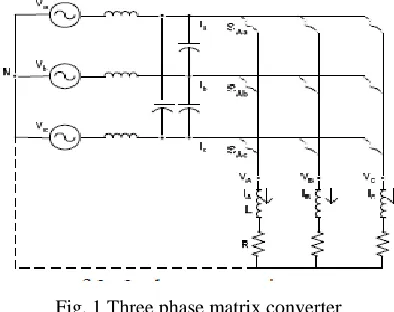
mathematical analysis of the power circuit along with duty cyle calculation is proposed for both low voltage transfer ratio and high voltage transfer ratio. The basic matrix converter is shown in below fig.1.
Fig. 1 Three phase matrix converter
Analysis and mathematical modeling of space vector modulated direct controlled matrix converter IEEE (2010) presented a paper about mathematical model for a space vector modulated (SVM) direct controlled matrix converter. Modelling stability analysis and control of a direct AC/AC matrix converter based systems MelakuMihretIEEE (2011) presented about direct and indirect space vector modulation using matrix converter switching configuration .To design a input filter to maintain a harmonics balance technique.
An effective direct SVM method for matrix converter operating with low voltage transfer ratio, Hong Hee lee IEEE (2012) deals with the Common mode voltage using the direct space vector modulation for power factor compensation. Analysis and mathematical modeling for
Performance Analysis of Three Phase Matrix
Converter for Induction Motor
R. Priyadharshini
#1, K.V.Kandasamy
#2#1Department Of Electronics & Instrumentation Engineering, Velammal Engineering College, Chennai, India.
direct controlled matrix converter. The duty cycles of the switches are modeled using space vector modulation for voltage transfer ratios about 0.5 to 0.866.The matrix converter simulations are loaded by passive RL load and active induction motor are performed.
In this paper design a matrix converter which is a AC-AC power converter which is composed of an array of mxn bidirectionalsemiconductor switches, connecting each phase of the input to each phase of the output using venturini and space vector method which provides sinusoidal input and output waveforms, with minimal higher order harmonics and no sub harmonics. The output is tested for different load condition.
II. SPACE VECTOR MODULATION
The space vector algorithm is based on the representation of the three phase input current and three phase output line voltages on the space vector plane. Space Vector modulation is a special switching sequence which is based on upper switches of a three phase direct matrix converter. SVM which treats a sinusoidal voltage as a phasor or amplitude and it rotates at a constant frequency 𝜔. The amplitude vector which is represented as d-q plane and it denotes the real and imaginary axes.
Fig. 2 Three phase Matrix converter
For any combination output voltage and input current sectors, the four combinations can be identified, which reduce output voltage and input current vectors. Four switching patterns are analyzed and simulated for direct space vector modulation they are asymmetrical single sided, which uses only one of the three zero vectors.
The switching combinations can be classified into three groups they are synchronously rotating vectors, stationary vectors and zero vectors. Matrix converter connects load directly to the voltage source by using nine bidirectional switches, the input phases should not be short circuited due to inductive nature of the load, the output phases should not be kept open. If the switching function of a switch, 𝑠𝑖𝑗 in equation (1)
𝑆𝑖𝑗 =
1 𝑠𝑖𝑗 𝑜𝑝𝑒𝑛
2 𝑠𝑖𝑗 𝑐𝑙𝑜𝑠𝑒 𝑖 ∈ 𝑢, 𝑣, 𝑤 , 𝑗
∈ 𝑎, 𝑏, 𝑐 (1)
For a balanced three phase sinusoidal system the instaneous voltage may be expressed in equation (1)
𝐯𝑢 𝑡
𝐯𝑣 𝑡
𝐯𝑤 𝑡
=
𝑐𝑜𝑠𝑤0 120𝑜
𝑐𝑜𝑠 𝑤0𝑡 − 120𝑜
𝑐𝑜𝑠 𝑤0𝑡 − 240𝑜
(2)
III CONTROL ALGORITHM
The transfer function approach is applied for both Voltage Source Inverter (VSI) and Voltage Source Rectifier (VSR).
]
A. Space vector modulation for rectifier stage
The rectifier part of equivalent circuit for Current Source Rectifier (CSR) with averaged value of IDCmay be
expressed in equation (2)
𝐼𝐷𝐶 =
3
2 𝐼𝑜𝑢𝑡 . 𝑚𝑣. 𝑐𝑜𝑠 𝜃𝑜𝑢𝑡 (3) 𝐼𝑜𝑢𝑡 is a peak value current,𝜃𝑜𝑢𝑡 is a output load
displacement angle, 𝑚𝑣 =𝑉𝑜𝑢𝑡 𝑉𝐷𝐶. The space vector of
the desired output can be approximated by two adjacent. The duty cycle of the VSR are calculated as
𝑑𝛼𝑖 = 𝑚𝑖. 𝑠𝑖𝑛
𝜋
3− 𝜃𝑖 (4)
𝑑𝛽𝑖 = 𝑚𝑖. 𝑠𝑖𝑛𝜃𝑖 (5)
𝑑𝜃𝑖 = 1 − 𝑑𝛼𝑖− 𝑑𝛽𝑖(6)
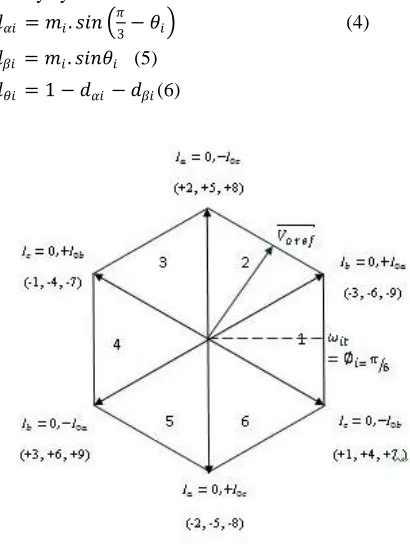
Fig. 3 Input Current Vector
The Rectifier Input Current vector diagram is shown in Fig 3.The nine Rectifier switches have nine permitted combination to avoid an open circuit in DC link.
=𝑚𝑖.
𝑐𝑜𝑠 𝜃𝑖−
𝜋 6
−𝑠𝑖𝑛 𝜋
3− 𝜃𝑖
−𝑠𝑖𝑛 𝜃𝑖
. 𝐼𝑑𝑐 (7)
The switching cycle within the first vector is givenequation (7).
B. Space vector modulation for inverter stage The inverter can be assumed as a separate VSI. The switching method is exactly similar to conventional VSI, but owing to its virtual DC link,𝑉𝐷𝐶should be defined in
following equation (8) and the output voltage vector is represented in fig 4
𝑉𝐷𝐶 =
3
2𝑉𝑖𝑛. 𝑚𝑐. 𝑐𝑜𝑠 𝜃𝑖𝑛 (8)
𝑉𝑖𝑛 is a peak value of input voltage and 𝜃𝑖𝑛is a input
displacement angle. The VSI switches can assume only six allowed combinations which yield nonzero output voltages. The inverter switches have eight permitted combinations to avoid a short circuit. These combinations include three zero and six non zero input currents.
𝑑𝛼𝑣 = 𝑚𝑣. 𝑠𝑖𝑛
𝜋
3− 𝜃𝑣 (9)
𝑑𝛽𝑣 = 𝑚𝑣. 𝑠𝑖𝑛𝜃𝑣 (10)
𝑑𝜃𝑣 = 1 − 𝑑𝛼𝑣− 𝑑𝛽𝑣(11)
Fig. 4 Output Voltage Vector
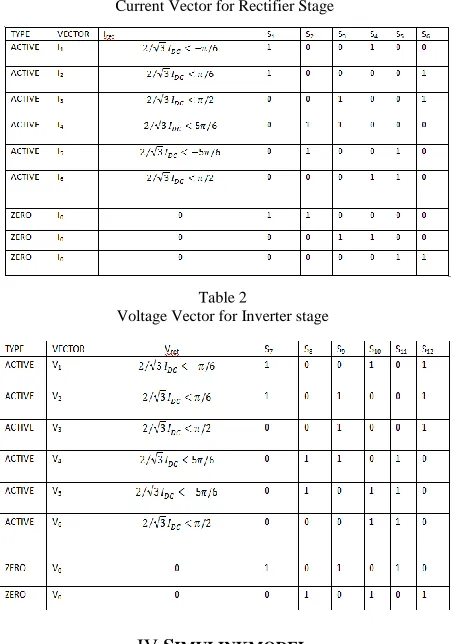
The modulation algorithm is derived similar to VSR and VSI expect in the opposite direction .since, both the VSR and VSI hexagons contain six sextants, there are 36 combinations or operating modes. The Table 1 and Table 2 which describes the current and voltage vector.
𝑖𝑎
𝑖𝑏
=
𝑑𝛼𝑣+ 𝑑𝛽𝑣
−𝑑𝛼𝑣 . 𝑉𝑑𝑐
=𝑚𝑣.
𝑐𝑜𝑠 𝜃𝑣−
𝜋 6
−𝑠𝑖𝑛 𝜋
3− 𝜃𝑣
−𝑠𝑖𝑛 𝜃𝑣
. 𝑉𝑑𝑐 (12)
The duty cycle of VSI are calculated in equation (13). 27 valid switch combinations giving the 27 voltage vectors.
Table 1
Current Vector for Rectifier Stage
Table 2
Voltage Vector for Inverter stage
IV SIMULINKMODEL
Fig. 5 Space Vector Modulation
Fig. 6 Simulink model
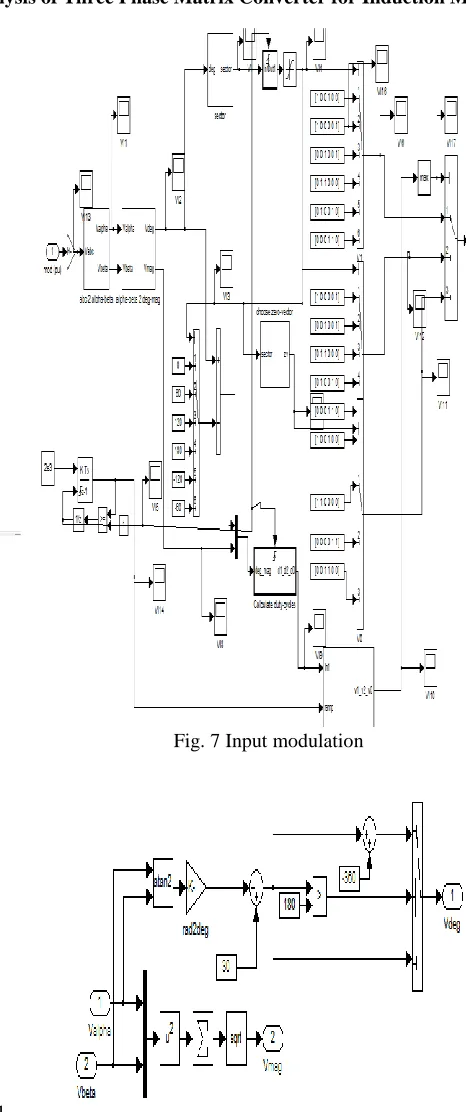
The Fig 6 which shows the simulation model. Simulation model which consist of current modulation and voltage modulation which is shown in Fig 7 and 8through which it is connected to SVM rectification and Inversion model.
Fig. 7 Input modulation
Fig. 8 Formulae for Modulation
V. SIMULATION RESULT
Fig. 9 Output voltage for 50 Hz
Fig. 10 Output Filter
Fig. 11 Rotor Speed
Fig. 12 Output Voltage for 100 Hz
Fig. 13 Pulse Width Modulation.
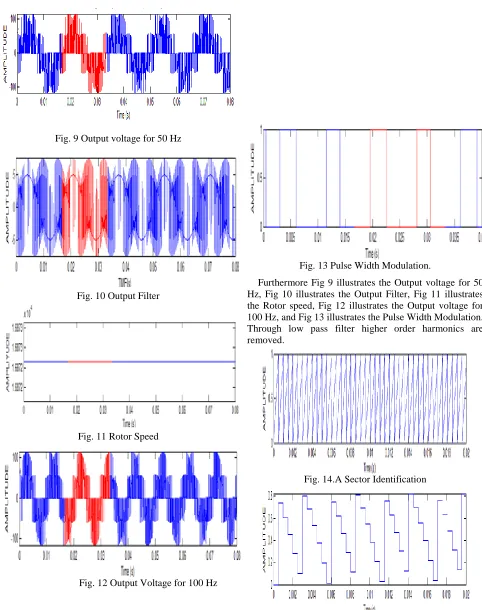
Furthermore Fig 9 illustrates the Output voltage for 50 Hz, Fig 10 illustrates the Output Filter, Fig 11 illustrates the Rotor speed, Fig 12 illustrates the Output voltage for 100 Hz, and Fig 13 illustrates the Pulse Width Modulation. Through low pass filter higher order harmonics are removed.
Fig. 14.A Sector Identification
Fig. 14.B Sector Identification
from the reference output frequency by integrating. The input and output line voltage with loaded passive load.
VI. CONCLUSION
The simulink model of direct matrix converter for control strategies like SVM technique has been developed and its result are analysed. The significant target to achieving frequency and amplitude has been attaining from input by duty cycle calculation and sequential piecewise sampling. As discussed earlier the direct matrix converter has no efficiency than indirect matrix converter. This constraint has been overcome by the mathematical model that resembles the operation of power conversion stage of matrix converter. This makes the upcoming research on matrix converter is easy and prosperous.
REFERENCES
[1] M. Venturini, “A New Sine Wave in Sine Wave out, Conversion Technique Which Eliminates Reactive Elements,” in Proceedings of Powercon 7, pp. E3/1-E3/15, 1980.
[2] M. Venturini and A. Alesina, “The Generalized Transformer A New Bidirectional Sinusoidal Waveform Frequency Converter with Continuously Adjustable Input Power Factor,” IEEE PESC’80, pp.242-252,1985.
[3] H.W. van der Broeck, H. Ch. Skudelny, and G. V. Stanke, “Analysis and realization of a pulse widthmodulator based on voltage space vectors,” IEEE Transactions on Industry Applications, vol.24, no. 1, pp. 142–150, 1988
[4] L. Huber and D. Borojevic, “Space vector modulated threephase to three-phase matrix converter with input power factor correction,” IEEE Transactions on Industry Applications, vol. 31,no. 6, pp. 1234–1246, 1995.
[5] D. Casadei, G. Serra, A. Tani, and L. Zarri, “Matrix converter modulation strategies: a new general approach based on spacevector representation of the switch state,” IEEE Transactions onIndustrial Electronics, vol. 49, no. 2, pp. 370–381, 2002. [6] M. Jussila and H. Tuusa, “Comparison of direct and indirect
matrix converters in induction motor drive,” in Proceedingsof the 32nd Annual Conference on IEEE Industrial Electronics(IECON ’06), pp. 1621–1626, Paris, France, November 2006.
[7] H. Karaca and R. Akkaya, “Modelling and Simulation of Matrix Converter under Distorted Input Voltage Conditions,” IEEE,2010. [8] P. W. Wheeler, J. Rodriguez, J. C. Clare, et al.,“Matrix Converters: A Technology Review,” IEEE Transaction on Industrial Electronics, vol. 49, no.2, pp.276-288,2010.
[9] Odaka A, S.I., Ohgushi H, Tamai Y, Mine H, Ito J, “A Pam Control Method ForMatrix Converter”. In Proc 200 Japan Industry Applications SocietyConference,2005
[10] EbubekirErdem, Yetkin Tatar, and SedatSünter, “Modelling and simulation of matrix converter using space vector algorithm” IEEE,2005.
[11] RuzlainiGhoni, Ahmed.N , “Analysis and mathematical modelling of space vector modulated direct controlled matrix converter”, Journal of theoretical and applied information technology, 2005.
[12] HulusiKaraca and RamazanAkkaya, “Modelling ,simulation and analysis of matrix converter using Matlab and simulink”. International Journal of Modeling and Optimization, Vol. 2, No. 3. 2012