Volume 2, No. 5, Sept-Oct 2011
International Journal of Advanced Research in Computer Science
REVIEW ARTICLE
Available Online at www.ijarcs.info
ISSN No. 0976-5697
A Survey on Routing Protocols of Wireless Sensor Networks
Seyed Reza Taghizadeh*
Department of Industrial Engineering,University of KNTU, Tehran, Iran [email protected]
Dr. Shahriar Mohammadi
Department of Industrial Engineering,University of KNTU, Tehran, Iran [email protected]
Abstract:Wireless Sensor Networks (WSNs) consist of small nodes with sensing, computation, and wireless communications capabilities. Many routing, power management, and data dissemination protocols have been specially designed for WSNs where energy awareness is an essential design issue In this paper, we present a survey of routing techniques in WSNs. We first explain general issues of wireless sensor networks. Then we outline different perspectives on classification of wireless sensor network routing protocols. After that we cite different routing protocols and their features. Some comparison between two or more of them is also shown in form of figures and tables. We also highlight the advantages and disadvantages of each routing technique.
Keywords: wireless sensor networks, WSN routing protocols, network lifetime, routing categories
I. INTRODUCTION
Wireless sensor networks have become the subject of intense research with recent progress in development of tiny processing and sensor systems [2]. One of the most motivating applications of sensor networks is in environmental monitoring systems. Generally, in these systems sensor nodes are distributed in the environment (which is insecure in most of the times), transmitting data to one or multiple data collection bases (sink nodes), which prepare data for system users or analytical applications [2].
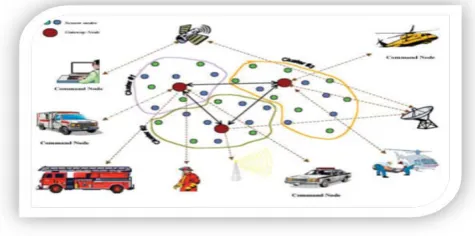
Figure 1 shows a sample sensor network, and its
different usages. In monitoring systems, several
characteristics and scenarios can be defined. For instance in health care monitoring, the reliability and availability of the system has a high priority. Such systems must guarantee the delivery of event notification messages in a timely manner so that no critical message is missed [4]. On the other hand, in non-critical systems such as weather condition monitoring, increasing the life-time of the system is mostly desirable, while it is endurable to decrease the performance of the network in a reasonable manner.
One of the most challenging issues is designing routing protocols and algorithms for sensor. Different factors should be taken into the consideration in such while designing these protocols. For instance, due to energy constraints in tiny wireless systems, it is important to evenly distribute the energy consumption across the distributed system in order to increase the total life time of the network [6]. It is possible to address this issue in several layers of the design. Another factor is delivery time, which is very important in critical systems. In this paper we have first introduced the general issues of wireless sensor network such as general architecture of the nodes and their requirement in chapter 2.
After that, in chapter 3 we have cited different
perspective of wireless sensor network protocol
classification. In chapter 4, we have introduced different routing protocols of WSN, and explained about the most
important ones. Finally chapter 5 contains the conclusion of the paper.
Figure 1: A sample sensor network, and its usages
II. GENERAL INFORMATION
A. Architecture:
Sensor networks are mainly use for collecting information. They are made of hundreds or thousands of nodes. These nodes are disposable and can be used inn different environments. They are cheap but a main concern is the security issues. They have limited computational capability and also limited in power resources. These nodes may not have a unique ID [7]. In most cases, these nodes are stationary. Sensor network node main components and their relations are shown in the figure below:
Figure 2: General architecture of sensor nodes
Senso
ADC
CPU
Transce iB. Implementation:
These nodes are implemented in different size and shapes. In figure 3 some of these nodes are shown, which the first one from the left is implemented by MIT university, second and third ones are implemented by Berkley, and the forth one by UCLA university. Wireless sensor networks use the standard IEEE 802.15.4 for their communications, which is a low bandwidth standard, suitable for low data rates, and consumes a very low power for transmission. In most cases, they do not have a structured topology[8].
Figure 3: Sample sensor nodes
C. Requirements:
To put it in brief, we have made a short and summarized list of sensor network requirements. These requirements are as follow:
a. Varying Network Size
b. Inexpensive Nodes Equipment
c. Long Lifetime (Power)
d. Load-Balancing
e. Self-Organization
f. Re-tasking and Querying Capability
g. Sensible Data Aggregation
h. Consolidation of Redundant Data
i. Application Awareness
j. Communication for Computation
k. Possible Mobility
These requirements are very important since they are the basis of routing protocols design. In fact routing protocols try to meet these requirements so that the overall performance of the networks increases to an acceptable range [6,9]. In another words, routing protocols are judged on the basis of this factors.
III. ROUTING PROTOCOLS CLASSIFICATION
In this chapter we make a clear classification of different routing protocols. The routing protocols can be classified with different perspectives. Here we try to cover different perspectives and explain about each.
A. Route Computation:
In the first perspective we divide the protocols in three different groups: proactive, reactive, and hybrid. Proactive protocols are those which first compute all routes, and then start routing. Reactive protocols compute routes on demand [13]. And the final one is a mixture of two previous categories. Hybrid protocols compute routes at first, but they improve the computed rout while routing.
B. Communication with sink:
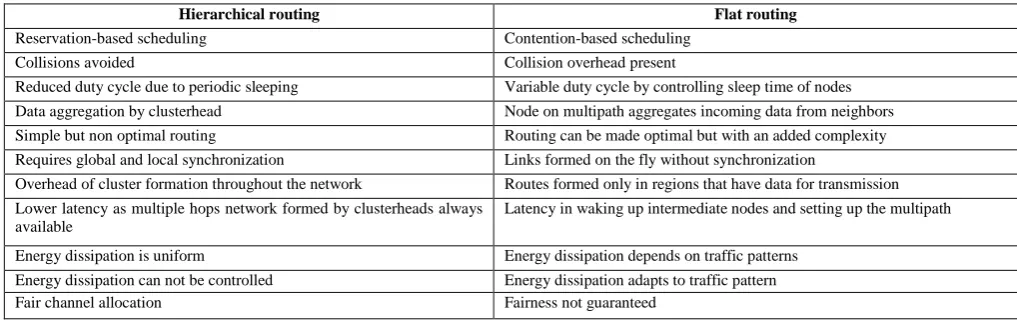
In another perspective we divide the routing protocols into direct, flat, and hierarchical categories. Direct protocols are those which allow the node to communicate with the sink directly. These kinds of protocols are suitable for small scale networks. An outstanding feature of these protocols is fast drainage. The other category is named flat (or sometimes called as equal) which is base on random indirect route. This category is suitable for medium scale networks [3,14]. Protocols of this category encounter a fast drainage around the sink. In hierarchical category (which is also called hierarchical) the routing is done through distinguished nodes. Table 1 shows a comparison between flat and hierarchical routing
Table 1: A comparison between flat and hierarchical routing
Hierarchical routing Flat routing
Reservation-based scheduling Contention-based scheduling
Collisions avoided Collision overhead present
Reduced duty cycle due to periodic sleeping Variable duty cycle by controlling sleep time of nodes
Data aggregation by clusterhead Node on multipath aggregates incoming data from neighbors
Simple but non optimal routing Routing can be made optimal but with an added complexity
Requires global and local synchronization Links formed on the fly without synchronization
Overhead of cluster formation throughout the network Routes formed only in regions that have data for transmission Lower latency as multiple hops network formed by clusterheads always
available
Latency in waking up intermediate nodes and setting up the multipath
Energy dissipation is uniform Energy dissipation depends on traffic patterns
Energy dissipation can not be controlled Energy dissipation adapts to traffic pattern
Fair channel allocation Fairness not guaranteed
C. Location Information:
Considering the location information, the routing protocols are divided into three groups: location aware, location less, and mobility aware [15]. In location aware protocols, each node knows its location, while in location less protocol the location of the node is not important. In
mobility aware protocols nodes may move. It means, the sink source, or even the entire network may change its location.
D. Message Passing:
unicast, multicast, and broadcast [17]. In unicast protocols we have one-to-one message passing. It means that we have only on receiver in each communication. In multicast protocols the receivers are more that one. Once a node transmits a message, all of its neighbors receive it. It’s actually a kind of local broadcast communication [6]. In broadcast protocols the transmitted message is received by all the nodes in the network. In another word, sender sends its message to everyone.
E. Query Model:
Another perspective is perspective of query model. There are again three categories for this perspective: historical, on-time, and persistent [17]. In historical queries, there is an analysis of historical data. For example you can investigate about the watermark which was sold two hours ago in Canada. On-time queries use snapshot views. For example you can ask about the watermark in Canada. Finally by persistent queries you can have a monitoring over
the time, For instance asking about the water mark in Canada for next four hours.
F. Core Mentality:
The final and the most important perspective is about the core mentality that the protocol is based upon. In this viewpoint, networks can be classified as data-centric, hierarchical, location-based, or QoS-base [4,23].
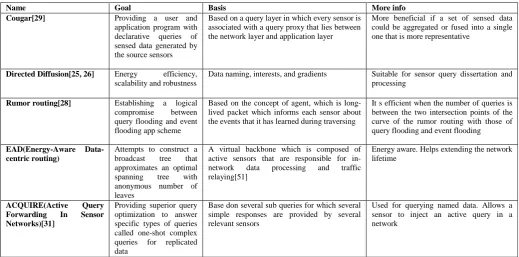
a. Data-Centric Protocols: In data-centric protocols, the sensor nodes broadcast an advertisement for the available data and wait for a request from an interested sink. Flooding is a simple technique that can be used to broadcast information in wireless sensor networks [43]. A derivation of flooding is gossiping, in which nodes do not broadcast. Instead, they send the incoming packets to a randomly selected neighbor. Here, we have mentioned some of these protocols, but only in a brief review. These protocols will be explained more detailed in next chapters.
Table 2 : An overview of data-centric protocols
Name Goal Basis More info
Cougar[29] Providing a user and
application program with declarative queries of sensed data generated by the source sensors
Based on a query layer in which every sensor is associated with a query proxy that lies between the network layer and application layer
More beneficial if a set of sensed data could be aggregated or fused into a single one that is more representative
Directed Diffusion[25, 26] Energy efficiency, scalability and robustness
Data naming, interests, and gradients Suitable for sensor query dissertation and processing
Rumor routing[28] Establishing a logical compromise between query flooding and event flooding app scheme
Based on the concept of agent, which is long-lived packet which informs each sensor about the events that it has learned during traversing
It s efficient when the number of queries is between the two intersection points of the curve of the rumor routing with those of query flooding and event flooding
EAD(Energy-Aware Data-centric routing)
Attempts to construct a broadcast tree that approximates an optimal spanning tree with anonymous number of leaves
A virtual backbone which is composed of active sensors that are responsible for in-network data processing and traffic relaying[51]
Energy aware. Helps extending the network lifetime specific types of queries called one-shot complex queries for replicated data
Base don several sub queries for which several simple responses are provided by several relevant sensors
Used for querying named data. Allows a sensor to inject an active query in a network
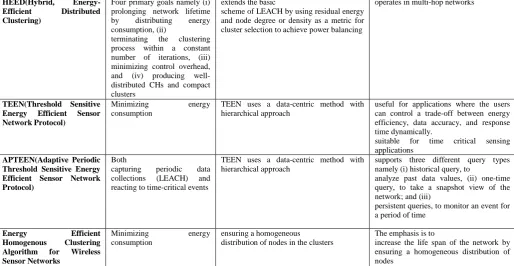
b. Hierarchical Protocols: Hierarchical protocols are based on clusters because clusters can contribute to more scalable behavior as the number of nodes
increases, provide improved robustness, and facilitate more efficient resource utilization for many distributed sensor coordination tasks. Table 3 shows some of these protocols
Table 3 : An overview of Hierarchical protocols
Name Goal Basis More info
PEGASIS(Power-Efficient Gathering in Sensor Information Systems )
Increasing lifetime of the network
chain construction is performed in a greedy way avoids cluster formation and uses only one node in a chain to transmit to the BS (sink)
An extension of the LEACH protocol. PEGASIS is able to increase the lifetime of the network twice as
much the lifetime of the network under the LEACH protocol
LEACH(Low-energy
adaptive clustering hierarchy)[32,35]
Reducing power consumption based on an aggregation (or fusion) technique that combines or aggregates the original data into a smaller size of data that carry only meaningful information to all individual sensors
HEED(Hybrid, Energy-Efficient Distributed Clustering)
Four primary goals namely (i) prolonging network lifetime by distributing energy consumption, (ii)
terminating the clustering process within a constant number of iterations, (iii) minimizing control overhead, and (iv) producing well-distributed CHs and compact clusters
extends the basic
scheme of LEACH by using residual energy and node degree or density as a metric for cluster selection to achieve power balancing
operates in multi-hop networks
TEEN(Threshold Sensitive Energy Efficient Sensor Network Protocol)
Minimizing energy consumption
TEEN uses a data-centric method with hierarchical approach
useful for applications where the users can control a trade-off between energy efficiency, data accuracy, and response time dynamically.
suitable for time critical sensing applications reacting to time-critical events
TEEN uses a data-centric method with hierarchical approach
supports three different query types namely (i) historical query, to
analyze past data values, (ii) one-time query, to take a snapshot view of the network; and (iii)
persistent queries, to monitor an event for a period of time distribution of nodes in the clusters
The emphasis is to
increase the life span of the network by ensuring a homogeneous distribution of nodes
c. Mobility-Based Protocols:
In mobility based protocols, the forwarding decision by a node is primarily based on the position of a packet's destination and the position of the node's immediate one hop
neighbor. These neighbors are updated dynamically and thus nodes chain toward sink changes in periods [18]. In these protocols the position of the destination is contained in the header of the packet.
Table 4 : An overview of Mobility-Based protocols
Name Goal Basis More info
Dynamic Proxy Tree-Based Data Dissemination[39]
was proposed for maintaining a tree connecting a source sensor to multiple sinks that are interested in the source
stationary sensors and several mobile hosts, called sinks
Because of target mobility, a source may change and a new sensor closer to the target may become a source.
Data MULES Based Protocol
proposed to address the need of guaranteeing cost-effective connectivity in a sparse network while reducing the energy consumption
a three-tier architecture based on mobile entities, called mobile ubiquitous LAN extensions (MULE).
they deplete their energy slowly and uniformly. it has low infrastructure cost, Because of the direct communication between the source sensors and the MULES, but may introduce an undesirable delay in reporting the sensed data
SEAD(Scalable Energy-Efficient Asynchronous Dissemination)[37]
was proposed to trade-off between minimizing the forwarding delay to a mobile sink and energy savings
Three main components namely dissemination tree (d-tree) construction, data dissemination, and maintaining linkages to mobile sinks.
can be viewed as an overlay network that sits on
top of a location-aware routing protocol.
d. QoS-based protocols:
In sensor networks, different applications may have different quality-of-service (QoS) requirements in terms of delivery latency and packet loss. Thus, network protocol
design should consider the QoS requirements of specific
applications [19]. In QoS-based protocols, these
requirements are the basis of protocol implementation. We have listed some of these protocols in table 5.
Table 5 : An overview of QoS-Based protocols
Name Goal Basis More info
SPEED[44] soft real-time end-to-end guarantees. strive to ensure a
certain speed for each packet in the network
Requires each node to maintain information about its neighbors and uses geographic forwarding to find the paths.
can provide congestion avoidance
Sequential Assignment Routing(SAR)
Striving to achieve energy efficiency and fault tolerance.
Routing decision in SAR is dependent on three factors: energy resources, QoS on each path, and the priority level of each packet [58,
60, 44].
Failure recovery is done by enforcing routing table
Energy-Aware QoS Routing Protocol[46]
finding a least cost and energy efficient path that meets certain end-to-end delay during
the connection.
Real time traffic is generated by imaging sensors.
In order to support both best effort and real-time traffic at the same time, a class-based queuing model is employed.
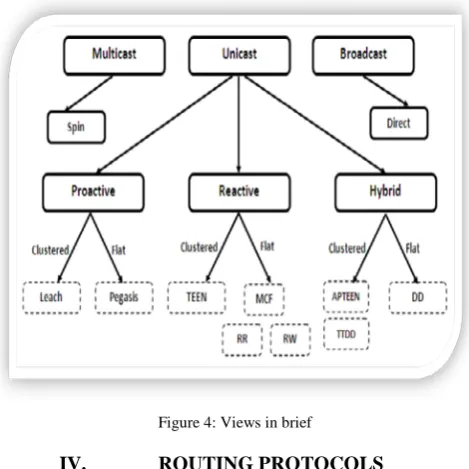
To have a better understanding of routing protocols classification, we have named some typical routing protocols in figure 4, and have shown the category they
belong to. In the next chapter we will explain these protocols and then we will discuss about their security issues\
Figure 4: Views in brief
IV. ROUTING PROTOCOLS
We have lots of different routing protocols in wireless sensor networks. Each of these routing protocols has a specific procedure for itself, and tries to optimize on of the criteria, such as energy conception, delivery time, delay, load on the network, or a lot of other things. In previous chapter we cited some of these protocols, their goal, the basis of their function, and some extra information about each. In this chapter, we explain more about these protocols, and in some cases we also make a comparison between two or more of them.
A. LEACH (Low Energy Adaptive Clustering
Hierarchy):
LEACH is a self organizing algorithm in which cluster heads elect themselves. Current implementation of LEACH is based on random round robin, but in future power based probability will be used in order to increase the overall network lifetime. In LEACH, nodes die in random. It causes a uniform expansion of died nodes all over the network. In this protocol, sink is stationary, and coordination is localized [21]. LEACH is based on an aggregation (or fusion) technique that combines or aggregates the original data into a smaller size of data that carry only meaningful information to all individual sensors [57]. LEACH is completely distributed and requires no global knowledge of network.
LEACH clustering terminates in a finite number of iterations, but does not guarantee good CH distribution and assumes uniform energy consumption for CHs. Another
problem of LEACH is Hot spot problem. It means Nodes on a path from an event-congested area to the sink may drain.
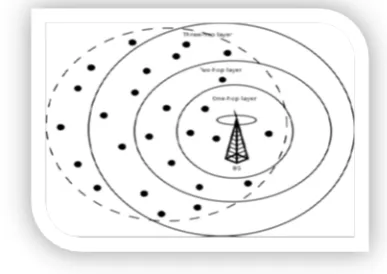
This protocol is not adequate for time-critical applications. Basic algorithm of leach assumes that any node in the network can communicate with the sink. In this situation this protocol could be applied for only small scale networks. Setup phase of leach is subdivided into three phases: advertisement, cluster set-up, and schedule creation. In LEACH everyone uses the same channel, but different clusters use different CDMA codes. Cluster heads can communicate with the sink and they can also form a hierarchical clustering.
Figure 5: A LEACH-protocol-using network
B. ELEACH (Enhanced Low-Energy Adaptive Clustering Hierarchy) [4]:
E-LEACH [4] further improved LEACH in two major aspects. E-LEACH proposes a cluster head selection algorithm for sensor networks that have non-uniform starting energy level among the sensors. However, this algorithm assumes that sensors have global information about other sensors [31]. E-LEACH also determines that, under certain assumptions, the required number of cluster heads has to scale as the square root of the total number of sensor nodes to minimize the total energy consumption. Other aspects of E-LEACH are the same as LEACH.
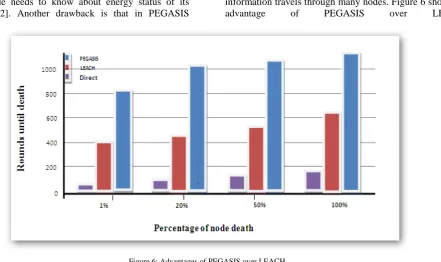
C. PEGASIS (Power-Efficient Gathering in Sensor Information Systems):
a sensor node needs to know about energy status of its neighbors [52]. Another drawback is that in PEGASIS
information travels through many nodes. Figure 6 shows the advantage of PEGASIS over LEACH.
Figure 6: Advantages of PEGASIS over LEACH
D. TEEN (Threshold sensitive Energy Efficient Sensor Network):
TEEN is a LEACH based clustering protocol which uses smart data transmission and thus saves power. TEEN has the ability of dynamic node reconfiguration. This protocol is suitable for time-critical applications. It is also useful for applications where the users can control a trade-off between energy efficiency, and data accuracy. One drawback in TEEN is that cluster heads need to listen constantly [47]. It is also incapable of distinguishing dead nodes. TEEN is not suitable for sensing applications where periodic reports are needed since the user may not get any data at all if the thresholds are not reached.
E. APTEEN (Adaptive Periodic Threshold-sensitive Energy Efficient Sensor Network):
APTEEN is an improved version of TEEN protocol. It has more flexible, logical timeslots. It has all features of TEEN. APTEEN supports multi-type queries. It means all three types of queries that were mentioned earlier (Historical, one-time, and persistent queries) can be use here. It is a hybrid clustering-based routing protocol that allows the sensor to send their sensed data periodically and react to any sudden change in the value of the sensed attribute Contrary to TEEN, APTEEN can distinguish dead nodes, but its power management is not as good as TEEN [57].
F. SPIN (Sensor Protocol for Information via Negotiation):
SPIN protocols are based on two key mechanisms namely negotiation and resource adaptation. This protocol needs only localized information. Two main aspects of this protocol are SPIN-PP (Point-to-Point Communication), and SPIN-BC (Broadcast Communication). SPIN-PP uses a negotiation mechanism to reduce the consumption of the sensors, while uses a resource-aware mechanism for energy savings [33]. In SPIN-PP Data is described by meta-data ADV messages. It means when a node has data to send, it
first sends a message to its neighbors. If neighbor is ready to receive, it sends REQ. on reception, node responds by sending its data. In a lossy network ADV may be repeated periodically if no REQ be received. SPIN-BC solves this problem by waiting a random interval in no REQ was received. SPIN-BC also improves SPIN-PP by using one-to-many communication instead of many one-to-one communications [37]. It is a three-stage handshake protocol for broadcast transmission media. While the family of SPIN protocols applies to lossless networks, it can be slightly updated to apply to lossy or mobile networks. The main drawbacks of this protocol are continuous data update (which is unnecessary in many cases), unclear network lifetime, and its inadequacy for large scale networks [37].
G. Directed Diffusion:
Directed Diffusion is hybrid data centric routing protocol which uses localized interaction. It meets the main requirements of WSNs such as energy efficiency, scalability, and robustness. Directed diffusion has several key elements namely data naming, interests and gradients, data propagation, and reinforcement [46]. The main drawbacks of this protocol are Hotspot problem near the sink, periodic broadcast of interest (which leads in reduction of network lifetime), and complex data aggregation.
H. MCF (Minimum Cost Forwarding):
MCF tries to reduce cost from node to sink on optimal path. It first broadcast ADV message, and gets answers from all sinks. Then it creates cost-fields according to answers. In the next step, it calculates back-off timer proportional to cost per each node [39]. MCF takes advantage of localized communications. There is no load balancing in MCF. It has a high time complexity, and large cost tables, but it is reduces as the time passes. Figure 8 illustrates the cost.
Figure 8: Reduction of cost of MCF, over time
I. TTDD (Two-Tier Data Dissemination):
TTDD uses a grid structure clustering, and also stationary location-aware nodes. It does not support sensor mobility [60]. Each node should be aware of its location information. TTDD builds grid using greedy algorithm. The biggest problem in TTDD is that grid nodes may drain.
J. Rumor Routing:
Rumor routing is a logical compromise between query flooding and event flooding application schemes [28]. There is no need for a shortest path in RR routing protocol. Movement on the net is done by several agents, trying to walk straight. Every node maintains lists of neighbors and events (how to get to the reporting node). The main drawback from Rumor routing protocol is that it does not guarantee the delivery. Therefore, when the agent encounters a sensor on its path, it synchronizes its event list with that of the sensor it has encountered. Also, the sensors that hear the agent update their event lists according to that of the agent [44].
K. TBF (Trajectory-Based Forwarding) [14]:
TBF is suitable for those networks which are sufficient enough and have coordinate systems like GPS so that each node can fine its location and also its neighbors location. When a node receives information, it makes a greedy search to find next hop that is closest to the trajectory fixed by the source sensor. It is also possible to implement multipath routing in TBF to increase the reliability of the network [55]. TBF can be used for different purposes. The most common usages are flooding, resource discovery, network management, and securing the perimeter of the network.
L. GeRaF (geographic Random Forwarding) [18]:
GeRaF is a routing protocol in which a sensor acting as relay is not known a priori by a sender. GeRaF is known as a best-effort delivery protocol, since there is no guarantee that a node can sent its data to the destination. In GeRaF sensors are not required to keep track of the locations of their neighbors and their awake-sleep schedules. When a source sensor has sensed data to send to the sink, it first checks whether the channel is free in order to avoid collisions. If the channel remains idle for some period of time, the source sensor broadcasts a request-to-send (RTS) message to all of its active (or listening) neighbors [21].
When active neighboring sensors receive the RTS message, they assess their priorities based on their locations and that of the sink. The source sensor waits for a CTS message from one of the sensors located in the highest priority region. This process continues till the source receives the CTS message [22]. Then, the source sends its data packet to the selected relay sensor.
M. PSGR (Priority-Based Stateless geo-Routing Protocol:
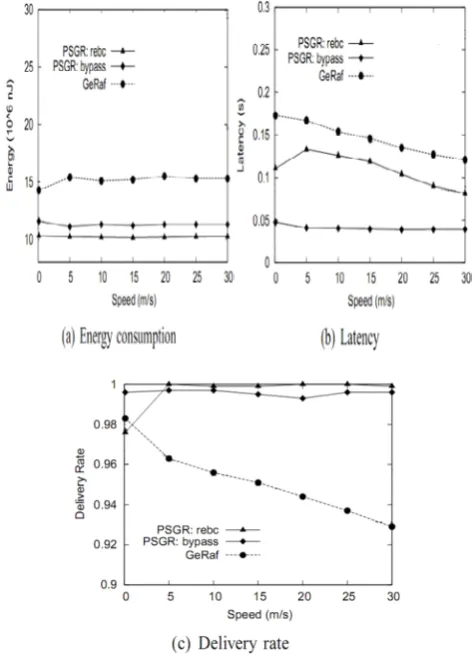
In PSGR sensor nodes are able to locally determine their priority to serve as the next relay node using dynamically estimated network density [64]. This effectively suppresses potential communication collisions without prolonging routing delays. PSGR also overcomes the communication void problem using two alternative stateless schemes, rebroadcast and bypass. PSGR is based on two important concepts: a) dynamic forwarding zone formation based on the sensor node density estimated on-the-fly, and b) autonomous acknowledgement. PSGR is known to be more effective than GeRaF when we have a low speed network. Figure 9 shows a comparison between GeRaF and PSGR. As it can be seen, PSGR is more efficient than GeRaF, in all the scenarios. In bypass mode, PSGR passes the void region as it reaches one.
Figure 9: Comparison of PSGR and GeRaF
N. MECN (Minimum Energy Communication
Network) [19]:
sparse graph in the first phase. This graph has a directed path from each sensor to the sink and consumes the least total power among all graphs having directed paths from each sensor to the sink [58]. The main drawback from this protocol is that it suffers from a severe battery depletion problem when applied to static networks. In other word, this protocol works in such a way that a sensor use the same neighbor to transmit its data, and so this neighbor dies in a short period. This problem could be solved by applying a dynamic topology [63].
O. SMECN (Small Minimum-Energy
Communication Network) [20]:
SMECN [20] is a routing protocol proposed to improve MECN, in which a minimal graph is characterized with regard to the minimum energy property. In SMECN protocol, every sensor discovers its immediate neighbors by broadcasting a neighbor discovery message using some initial power that is updated incrementally [11]. In SMECN protocol, every sensor discovers its immediate neighbors by broadcasting a neighbor discovery message using some initial power that is updated incrementally. As it can be implied from the name, SMECN tries to find the lowest possible amount of energy that nodes can communicate with each other [30].
P. Cougar [29]:
Cougar works in such a way that the user does not know which sensors are contacted, how sensed data are processed to compute the queries, and how final results are sent to the user. In other words, it provides a user and application programs with declarative queries of the sensed data generated by the source sensors [29]. Cougar also employs in-network processing to reduce the total energy consumption, and it is more beneficial if a set of sensed data could be aggregated or fused into a single one that is more significant to the user.
Q. GEAR (Geographic and Energy-Aware Routing) [27]:
GEAR is an energy-efficient routing protocol. In GEAR, the sensors are supposed to have localization hardware equipment, like GPS. They also should know about their remained energy as well as the locations and remained energy of each of their neighbors. GEAR uses a recursive geographic forwarding algorithm to disseminate a packet inside the target region.
R. BVGF (Bounded Voronoi Greedy Forwarding) [49]:
BVGF uses the concept of Voronoi diagram in which the sensors should be aware of their geographical positions. In this type of greedy geographic routing, a sensor will always forward a packet to the neighbor that has the shortest distance to the destination. In BVGF, each sensor has only one next hop to forward its Data [56]. So any data dissemination path will always have the same chain of the next hops. So this protocol suffers from battery power depletion severely, and this is the main drawback of this protocol.
S. HEED (Hybrid, Energy-Efficient Distributed Clustering) [50, 52]:
HEED extends the basic scheme of LEACH by using residual energy and node degree or density as a metric for cluster selection HEED was proposed with four primary goals namely (i) prolonging network lifetime by distributing energy consumption, (ii) terminating the clustering process within a constant number of iterations, (iii) minimizing control overhead, and (iv) producing well-distributed CHs and compact clusters. The HEED clustering improves network lifetime over LEACH.
T. Data MULES Based Protocol [54]:
Data MULE based was proposed to address the need of guaranteeing cost-effective connectivity in a sparse network while reducing the energy consumption of the sensors. The MULE stands for Mobile Ubiquitous LAN Extension, which is a three-layer architecture for mobile entities [71]. The MULE architecture helps the sensors save their energy as much as possible and thus extend their lifetime, but it may cause an unacceptable delay in reporting sensed data, and thus may not be practical.
Figure 10: A three layer architecture
U. SEAD (Scalable Energy-Efficient Asynchronous Dissemination) [37]:
SEAD [37] is self-organizing protocol in which source sensor reports its sensed data to multiple mobile sinks and consists of three main components referred to as dissemination tree construction, data dissemination, and maintaining linkages to mobile sinks.
V. Sequential Assignment Routing (SAR) [55]:
SAR is a table driven multi-path approach to achieve energy efficiency and fault tolerance. It Creates trees rooted at one hop neighbors of the sink, and then forms multiple paths from the sink to sensors. It has a Local Failure Recovery approach. It selects one of the paths according to the energy resources and QoS on the path [55]. SAR is one of the first routing protocols for WSNs that introduces the notion of QoS in the routing decisions. Simulation results have shown that SAR offers less power consumption than the minimum-energy metric algorithm, which focuses only the energy consumption of each packet without considering its priority[17]. But the main drawback from this protocol is its high overhead to maintain tables and states at each sensor.
V. CONCLUSION
this paper, we presented a comprehensive survey of routing techniques in wireless sensor networks which have been presented in the literature. They have the common objective of trying to extend the lifetime of the sensor network, while not compromising data delivery. First we mentioned different perspectives of protocol classification, and explained that wireless sensor network routing protocols are classified based on different perspectives into some categories, such as direct, flat, hierarchical, or routing persistent, on-time and so on. Then we explained different routing protocols, and highlighted the features of each. We also explained the main procedures of their implementation. Meanwhile, some comparisons between some of these routing protocols are shown in forms of figures and tables.
VI. ACKNOWLEDGMENTS
The authors would like to thank the Iran Telecommunication Research Center (ITRC) for serving as a sponsor and financial supporter of the current work.
VII. REFERENCES
[1]. Eliana Stavrou , Andreas Pitsillides. A survey on secure multipath routing protocols in WSNs. Computer Networks 54 (2010) 2215–2238
[2]. X. Huang, Y. Fang, Multiconstrained QoS multipath routing in wireless sensor networks, ACM Wireless Networks 14 (4) (2008) 465–478.
[3]. Shio Kumar Singh , M P Singh , and D K Singh. Routing Protocols in Wireless Sensor Networks – A Survey International Journal of Computer Science & Engineering Survey (IJCSES) Vol.1, No.2, November 2010
[4]. Christopher Ho, Katia Obraczka, Gene Tsudik, and Kumar Viswanath, “Flooding for reliable multicastin multi-hop ad hoc networks”, In Proceedings of the 3rd International Workshop on DiscreteAlgorithms and Methods for Mobile Computing and Communications (DIAL-M’99), 1999, pp. 64–71.
[5]. Y. X:u, J. Heidemann, and D. Estrin, "Geography-informed energy conservation for ad-hoc routing", Proceedings ACM/IEEE MobiCom'01, Rome, Italy, July 2001, pp. 70-84. [6]. J. Yick, B. Mukherjee, D. Ghosal, Wireless sensor network survey, Computer Networks, Elsevier Journal 52 (12) (2008) 2292–2330.
[7]. Y. Yu, R. Govindan, and D. Estrin, "Geographical and energy aware routing: A recursive data dissemination protocol for wireless sensor networks", Technical Report UCLA/CSD-TR-01-0023, UCLA Computer Science Department, May 2001.
[8]. N. Bulusu, J. Heidemann, and D. Estrin, “GPS-less Low Cost Outdoor Localization for Very Small Devices”, IEEE Personal Communication Magazine, vol. 7, no. 5, Oct. 2000, pp. 28-34.
[9]. C.F. Garcia-Hernandez, P.H. Ibarguengoytia-Gonzalez, J. Garcia-Hernandez, J.A. Perez-Diaz, Wireless sensor networks and application: a survey, International Journal of Computer Science and Network Security (IJCSNS) 7 (3) (2007).
[10].A. Ouadjaout, Y. Challal, N. Lasla, M. Bagaa, SEIF: secure and efficient intrusion-fault tolerant routing protocol for wireless sensor networks, in: Proceedings of the Third International Conference on Availability, Reliability and Security (ARES) 2008, March 4–7, 2008,pp. 503–508. [11].B. Chen, K. Jamieson, H. Balakrishnan, and R. Morris,
"Span: An energy-efficient coordination algorithm for topology maintenance in ad hoc wireless networks", Proceedings ACM MobiCom'01, Rome, Italy, July 2001, pp. 85-96.
[12].B. Chen, K. Jamieson, H. Balakrishnan, and R. Morris, "Span: An energy-efficient coordination algorithm for topology maintenance in ad hoc wireless networks", Wireless Networks, vol. 8, no.5,Sept. 2002, pp. 481-494.
[13].S.S. Al-Wakeel, S.A. Al-Swailemm, PRSA: a path redundancy based security algorithm for wireless sensor networks, in: IEEE Wireless Communications and Networking Conference (WCNC 2007), 2007.
[14].B. Nath and D. Niculescu, "Routing on a curve", ACM SIGCOMM Computer Communication Review, vol. 33, no.1, Jan. 2003, pp. 155-160.
[15].L. Doherty, K. S. Pister, and L. E. Ghaoui, "Convex position estimation in wireless sensor networks",Proceedings IEEE INFOCOM'OI, vol. 3, Anchorage, AK, Apr. 2001, pp. 1655-1663.
[16].N. Nasser, Y. Chen, SEEM: secure and energy-efficient multipath routing protocol for wireless sensor networks, Computer Communications, Elsevier 30 (11–12) (2007) 2401–2412.
[17].W. Cheng, K. Xing, X. Cheng, X. Lu, Z. Lu, Route recovery in vertexdisjoint multipath routing for many-to-one sensor networks, in: Proceedings of the Ninth ACM International Symposium on Mobile Ad hoc Networking and Computing, 2008.
[18].M. Zorzi and R. R. Rao, "Geographic random forwarding (GeRaF) for ad hoc and sensor networks:Mutlihop performance", IEEE Transactions on mobile Computing, vol. 2, no. 4, Oct.-Dec. 2003, pp. 337-348.
[19].V. Rodoplu and T. H. Meng, "Minimum energy mobile wireless networks", IEEE Journal on Selected Areas in Communications, vol. 17, no. 8, Aug. 1999, pp. 1333-1344.
[20].L. Li and J. Y. Halpern, "Minimum-energy mobile wireless networks revisited", Proceedings IEEE ICC’01, Helsinki, Finland, June 2001, pp. 278-283.
[21].Shio Kumar Singh, M P Singh, D K Singh, A Survey of Energy-Efficient Hierarchical Cluster-Based Routing in Wireless Sensor Networks. Int. J. of Advanced Networking and Applications, Volume: 02, Issue: 02, Pages: 570-580 (2010)
[22].W. R. Heinzelman, J. Kulik, and H. Balakrishnan, "Adaptive protocols for information dissemination in wireless sensor networks", Proceedings ACM MobiCom '99, Seattle, WA, Aug.1999, pp. 174-185.
[24].J. Kulik, W. Heinzelman, and H. Balakrishnan, "Negotiation-based protocols for disseminating information in wireless sensor networks", Wireless Networks, vol. 8, no. 2/3, Mar.-May 2002, pp. 169-185.
[25].C. Intanagonwiwat, R. Govindan, and D. Estrin, "Directed diffusion: A scalable and robust communication paradigm for sensor networks", Proceedings ACM MobiCom'00, Boston, MA, Aug. 2000, pp. 56-67.
[26].C. Intanagonwiwat, R. Govindan, D. Estrin, J. Heidemann, and F. Silva, "Directed diffusion for wireless sensor networking", IEEE/ACM Transactions on Networking, vol. 11., no. 1, Feb. 2003, pp. 2-16.
[27].R. Vidhyapriya, P.T. Vanathi, Energy efficient adaptive multipath routing for wireless sensor networks, IAENG International Journal of Computer Science 34 (1) (2007).
[28].D. Braginsky and D. Estrin, "Rumor routing algorithm in sensor networks", Proceedings ACM WSNA, in conjunction with ACM MobiCom'02,Atlanta, GA, Sept. 2002, pp. 22-31. [29].Y. Yao and J. Gehrke, "The Cougar approach to in-network
query processing in sensor networks", SGIMOD Record, vol. 31, no. 3, Sept. 2002, pp. 9-18.
[30].Raul Aquino-Santos1, Luis Villasenor-Gonzalez2, Jaime Sanchez2, Jose Rosario Gallardo2, Routing Strategies for Wireless Sensor Networks, Aquino-Santos, R., Villasenor-Gonzalez, L., Sanchez, J., Gallardo, J. R., 2007, in IFIP International Federation for Information Processing, Volume 248, Wireless Sensor and Actor Networks, eds. L. Orozco-Barbosa, Olivares, T., Casado, R., Bermudez, A., (Boston: Springer), pp. 191-202.
[31].N. Sadagopan, B. Krishnamachari, and A. Helmy, "The ACQUIRE mechanism for efficient querying in sensor networks", Proceedings SNPA'03, Anchorage, AK, May 2003, pp. 149-155.
[32].W.R. Heinzelman, A. Chandrakasan, and H. Balakrishnan, “Energy-efficient Communication Protocol for Wireless Microsensor Networks”, in IEEE Computer Society Proceedings of the Thirty Third Hawaii International Conference on System Sciences (HICSS '00), Washington, DC, USA, Jan. 2000, vol. 8, pp. 8020.
[33].T. Olivares, P.J. Tirado, F. Royo, J.C. Castillo and L. Orozoco-Barbosa, “IntellBuilding: A wireless sensor network for intelligent buldings”. Poster. Fourth European Conference on Wireless Sensor networks (EWSN 2007), Parallel and Distributed Systems Report Series, report number PDS-2007-00. ISSN: 1387-2109 . Delft (Ned) , January 2007.
[34].H. Karl y A. Willig, “Protocols and Architectures for Wireless Sensor Networks”. Editorial John Wiley & Sons, Ltd, ISBN 13978-0-470-09510-2, 2006
[35].W.R. Heinzelman, A. Chandrakasan, and H. Balakrishnan, “An Application-Specific Protocol Architecture for Wireless Microsensor Networks” in IEEE Tmnsactions on Wireless Communications (October 2002), vol. 1(4), pp. 660-670.
[36].S. Misra et al. (eds.), Guide to Wireless Sensor Networks, Computer Communications and Networks, DOI: 10.1007/978-1-84882-218-4 4, Springer-Verlag London Limited 2009
[37].B. Karp and H. T. Kung, "GPSR: Greedy perimeter stateless routing for wireless networks", Proceedings ACM MobiCom'00, Boston, MA, Aug. 2000, pp. 243-254.
[38].Ivan Stojmenovic and Stephan Olariu. Data-centric protocols for wireless sensor networks. In Handbook of Sensor Networks, Chapter 13, pages 417–456. Wiley, 2005.
[39].W. Chang, G. Cao, and T. La Porta, "Dynamic proxy tree-based data dissemination schemes for wireless sensor networks", Proceedings IEEE MASS'04, Fort Lauderdale, FL, Oct. 2004, pp. 21-30.
[40].S. Lindsey, C. S. Raghavendra, and K. M. Sivalingam, "Data gathering in sensor networks using the energy delay metric", Proceedings IPDPS'01, San Francisco, CA, Apr. 2001, pp. 2001-2008.
[41].Ming Liu, Jiannong Cao, Guihai Chen, and Xiaomin Wang, “An Energy-Aware Routing Protocol in Wireless Sensor Networks”, Sensors 2009, vol. 9, pp. 445-462.
[42].S. Lindsey, C. S. Raghavendra, and K. M. Sivalingam, "Data gathering algorithms in sensor networks using energy metrics", IEEE Transactions on Parallel and Distributed Systems, vol. 13, no. 9, Sept. 2002, pp. 924-935.
[43].M. Chu, H. Haussecker, and F. Zhao, "Scalable information-driven sensor querying and routing for ad hoc heterogeneous sensor networks", International Journal of High Performance Computing Applications, vol. 16, no. 3, Feb. 2002, pp. 293-313.
[44].T. He et al., “SPEED: A stateless protocol for real-time communication in sensor networks,” in the Proceedings of International Conference on Distributed Computing Systems, Providence, RI, May 2003.
[45].Luis Javier García Villalba, Ana Lucila Sandoval Orozco, Alicia Triviño Cabrera, and Cláudia Jacy Barenco Abbas, “Routing Protocol in Wireless Sensor Networks”, Sensors 2009, vol. 9, pp. 8399- 8421.
[46].K. Akkaya and M. Younis, “An Energy-Aware QoS Routing Protocol for Wireless Sensor Networks,” in the Proceedings of the IEEE Workshop on Mobile and Wireless Networks (MWN 2003), Providence, Rhode Island, May 2003.
[47].S. Lindsey and C.S. Raghavendra, “PEGASIS: Power-efficient Gathering in Sensor Information System”, Proceedings IEEE Aerospace Conference, vol. 3, Big Sky, MT, Mar. 2002, pp. 1125-1130
[48].G. Bertoni, L. Breveglieri, and M. Venturi. ECC Hardware Coprocessors for 8-bit Systems and Power Consumption Considerations. In Third International Conference on Information Technology: New Generations (ITNG 2006), pages 573–574, 2006.
[49].G. Xing, C. Lu, R. Pless, and Q. Huang, "On greedy geographic routing algorithms in sensing covered networks", Proceedings ACM MobiHoc'04, Tokyo, Japan, May 2004, pp. 31-42.
[50].Ossama Younis and Sonia Fahmy, “Distributed Clustering in Ad-hoc Sensor Networks: A Hybrid, Energy-efficient Approach”, September 2002.
MSWiM, in conjunction with ACM MobiCom, San Diego, CA, Sept. 2003, pp. 42-49.
[52].Ossama Younis and Sonia Fahmy” Heed: A hybrid, Energy-efficient, Distributed Clustering Approach for Ad-hoc Networks”, IEEE Transactions on Mobile Computing, vol. 3, no. 4, Oct.-Dec. 2004, pp. 366 369.
[53].G. Bertoni, L. Breveglieri, and M. Venturi. ECC Hardware Coprocessors for 8-bit Systems and Power Consumption Considerations. In Third International Conference on Information Technology: New Generations (ITNG 2006), pages 573–574, 2006.
[54].R.C. Shah, S. Roy, S. Jain, and W. Brunette, "Data MULEs: Modeling a three-tier architecture for sparse sensor networks ", Proceedings SN P A '03, Anchorage, AK, May 2003, pp. 30-41.
[55].I. F. Akyildiz, W. Su, Y. Sankarasubramaniam, and E. Cayirci, “Wireless sensor networks: a survey”, Computer Networks (Elsevier) Journal, Vol. 38, no. 4, Mar. 2002, pp. 393-422.
[56].W. Y. Chang. Wireless Sensor Networks and Applications. In Network-Centric Service- Oriented Enterprise, pages 157– 209. 2008.
[57].Muhammad Mahmudul Islam, Ronald Pose and Carlo Kopp, (2008).Routing Protocols for Adhoc Networks.
[58].Jamal Al-Karaki, and Ahmed E. Kamal, “Routing Techniques in Wireless Sensor Networks: A Survey“, IEEE
Communications Magazine, vol 11, no. 6, Dec. 2004, pp. 6-28.
[59].Z. Huang, W. Du, B. Chen, Deriving private information from randomized data, in: Proceedings of 2005 ACM SIGMOD International Conference on Management of Data (ACM SIGMOD 2005), 2005, pp. 37–48.
[60].Kemal Akkaya and Mohamed Younis, “A Survey on Routing Protocols for Wireless Sensor Networks”, Ad hoc Networks, vol. 3, no. 3, May 2005, pp. 325-349.
[61].T. Zahariadis, H. Leligou, S. Voliotis, S. Maniatis, P. Trakadas, and P. Karkazis, “An energy and trust-aware routing protocol for large wireless sensor networks,” in Proceedings of the 9th WSEAS international conference on Applied informatics and communications. World Scientific and Engineering Academy and Society (WSEAS), 2009, pp. 216–224.
[62].M. Stemm and R. H. Katz, "Measuring and reducing energy consumption of network rfaces in handheld devices", IEICE Transaction on Communications, vol. E80-B, 8, Aug.1997, pp. 1125-1131.
[63].P. Bahl and V. N. Padmanabhan, "Radar: A in-building rf-based user location and tracking system", Proceedings IEEE INFOCOM'OO, vol. 2, Tel-Aviv, Israel, Mar. 2000, pp. 775-784.