On the Evaluation and Comparison of Taggers: the Effect of
Noise in Testing Corpora.
Llufs P a d r 6 and Llu/s M h r q u e z D e p . LSI. T e c h n i c a l U n i v e r s i t y of C a t a l o n i a
c / J o r d i G i r o n a 1-3. 08034 B a r c e l o n a
{padro, lluism}@isi, upc.
e sA b s t r a c t
This paper addresses the issue of Pos tagger evaluation. Such evaluation is usually per- formed by comparing the tagger outt)ut with a reference test corpus, which is ~msumed to be error-free. C u r r e n t l y used c o r p o r a contain noise which causes the obtained performance to be a distortion of the real value. We analyze to what extent this distortion m a y invalidate the com- parison between taggers or the measure of the improve,nent given by a new system. The main conclusion is t h a t a more rigorous testing exper- imentation setting/designing is needed to reli- ably evaluate and c o m p a r e tagger accuracies.
1 I n t r o d u c t i o n and M o t i v a t i o n
P a r t of Speech ( p o s ) Tagging is a quite well defined NLP l>roblem, which consists of assign- ing to each word in a text the proper mor- p h o s y n t a e t i c tag for the given context. Al- though m a n y words are ambiguous regarding their p o s , in m o s t cases they can be completely disambigua.ted taking into account an adequate context. Successful taggers have been built
us-
ing
several approaches, such ms statistical tech- niques, symbolic machine learning techniques, neural networks, etc. The accuracy reported by most current taggers ranges from 96-97% to al- most 1 0 0 ~ in the linguistically motivated Con- straint G r a m m a r environment.Unfortunately, there have been very few di- rect comparisons of alternative taggers I on iden- tical test data. However~ in most current papers it is argued t h a t the performance of some tag- gers is b e t t e r than others as a result of some kind of indirect comparisons between them. We
1()no of the exceptions is the work by (Sanmelsson and Voutilainen, 1997), in which a very strict compm'ison bctwecn taggers is performed.
think t h a t there a.re a n u m b e r of not enough controlled/considered factors t h a t make these conchlsions dubious in most cases.
In this direction, the present paper aims to point out some of tile difficulties arising when evaluating and comparing tagger performances against a reference test corpus, and to make. some criticism a b o u t c o m m o n practices followed by the N L P re.searchers in this issue.
2 N o i s e i n t h e t e s t i n g c o r p u s
From a machine learning perspective, the rele- vant noise in the corpus is t h a t of non system- atically mistagged words (i.e. different annota- tions for words appearing in the same syntac- t i c / s e m a n t i c contexts).
C o m m o n l y used a n n o t a t e d corpora have noise. See, for instance, the following examples from the Wall Street Journal ( w s a ) corpus:
Verb participle forms are sometimes tagged as such (VBN) and also as adjectives (aa) in other sentences with no structural differences:
la) ... failing_VBG to_TO voluntarily_KB submit_VB the_DT requested_VBN
information~NN . . .
Ib) ... a_DT l a r g e J J sample_NN of_IN
married_JJ women/INS with_IN at_IN least_JJS one_CD child_NN . . .
A n o t h e r s t r u c t u r e not coherently tagged are noun chains when the nouns (NN) are ambigu- ous and can be also adjectives (Ja):
2 a ) . . . Mr._NNP Hahn_NgP , _ , the_DT 6 2 - y e a r - o l d J J chairman_NN and_CC
chief_NN executive_JJ oJficer~N of_IN G e o r g i a - P a c i f i c N N P Corp._NNP . . .
2b) ... BurgerlINP King_NNP
's_POS chief_JJ executive_NN officer_NN ,_,
Barry_NNP Gibbons_NNP ,_, stars_VBZ in_IN ads_NNS saying_VBG ...
T h e noise in the test set produces a w r o n g
estimation of accuracy, since correct answers are c o m p u t e d as wrong and vice-versa. In following sections we will show how this uncertainty in the evaluation m a y be, in some cases, larger than the reported i m p r o v e m e n t s from one system to another, so invalidating the conclusions of the comparison.
3 M o d e l S e t t i n g
To s t u d y the appropriateness of the choices m a d e by a p o s tagger, a reference tagging must be selected and assumed to be correct in or- der to c o m p a r e it with the tagger o u t p u t . This is usually (tone by assuming t h a t the disam- biguated test corpora being used contains the right e o s disambiguation. This approach is quite right when the tagger error rate is larger enough than the test corpus error rate, never- theless, the current p o s taggers have reached a performance level t h a t invalidates this choice,
since the tagger error rate is getting too close to the error rate of the test corpus.
Since we want to s t u d y the relationship be- tween the tagger error rate and the test corpus error rate, we have to establish an absolute ref- erence point. Although (Church, 1992) ques- tions the concept of correct analysis, (Samuels- son and Voutilainen, 1997) establish t h a t there exists a -statistically significant- absolute cor- rect disambiguation, respect to which the error rates of either the tagger or the test corpus can be computed. W h a t we will focus on is how distorted is the tagger error rate by the use of a noisy test corpus as a reference.
The cases we can find when evaluating the performance of a certain tagger are presented in table 1. OK/~OK s t a n d for a r i g h t / w r o n g tag (respect to the absolute correct disambigua- tion). W h e n b o t h the tagger and the test cor- pus have the correct tag, the tag is correctly evaluated a.s right. W h e n the test corpus has the correct tag and the tagger gets it wrong, the occurrence is correctly evaluated as wrong. But problems arise when the test corpus has a wrong tag: If the tagger gets it correctly, it is evaluated as wrong when it should be right (false negative). If the tagger gets it wrong, it will be rightly evaluated as wrong if the error commited by the tagger is other than the er- ror in the test corpus, but wrongly evaluated
as right (false positive) if the error is the same.
Table 1 shows the c o m p u t a t i o n of the percent-
c o r p u s t a g g e r e v a l : rigqlt e v a h wrong
O K c O K t (1 - C ) t
O K c ~ O K t - ( 1 - C ) ( 1 - t )
- n O K c O K t - C u
-7ot% ~ot<t C ( 1 - u ) p C ( 1 - u ) ( 1 - p )
Table 1: Possible cases when evaluating a tagger.
ages of each case. The meanings of the used variables are:
C: Test corpus error rate. Usually all estilna- tion is supplied with the corpus.
t: Tagger performance rate on words rightly tagged in the test corpus. It can be seen as P(oKtlOKc).
• U: Tagger performance rate on words wrongly tagged in the test corpus. It can be seen as
[image:2.612.322.533.470.538.2]p: P r o b a b i l i t y t h a t the tagger makes the same error as the test corpus, given that both get a wrong tag.
a:: Real performance of the tagger, i.e. w h a t
would be obtained on an error-free test set. K: Observed performance of the tagger, com-
puted on the noisy test corpus.
For simplicity, we will consider only perfor- mance on ambiguous words. Considering unam~ biguous words will make the analysis more com- plex, since it should be taken into account that neither the behaviour of the tagger (given by u, t, p) nor the errors in the test corpus (given by c) ~re the same on ambiguous and unambiguous words. Nevertheless, this is an issue that must be further addressed.
If we knew each one of the above proportions, we would be able to c o m p u t e the real perfor- mance of our tagger (x) by adding up the oKt rows from table 1, i.e. the cases in which the tagger got the right disambiguation indepen- dently from the tagging of the test set:
.~" = ( 1 - C ) t + C ' ~ , (1)
The equation of the observed performance can also be e x t r a c t e d from table 1, adding up w h a t is evaluated as right:
K = ( l - C ) t + C ( 1 - u ) p (2)
The relationship between the real and the ob- served performance is derived from 1 and 2:
a" = K - C(1 - u ) p + C u
Since only K and C are known (or approxi- mately estimated) we can not c o m p u t e the real performance of the tagger. All we can do is to establish some reasonable t)ounds for t, u and p, and see in which range is x.
Since all variables are probabilities, they are b o u n d e d in [0, 1]. We also can a.ssume 2 t h a t K > C. We can use this constraints and the above equations to b o u n d the values of all vari- ables. From 2, we obtain:
, , = t - N - t ( 1 - C ) ' , P = l ( - t ( 1 - C ) , t - t ( - C ( 1 - u ) t ,
Cp C(1--u) ' 1 - C
Thus, u will be m a x i m u m when p and t are m a x i m u m (i.e. 1). This gives an upper bound
2In the cases we are i n t e r e s t e d in - t h a t is, current systems- 1,he tagger observed performance, It', is over .90%, while the corlms error rate, C, is below 10%.
for u of ( 1 - K ) / C . W h e n t = 0 , u will range
in [ - o o , 1 - K / C ] depending on the value of p. Since we are assuming K > C, the most informa- tive lower bound for u keeps being zero. Simi- larly, p is minimum when t = l and u = 0 . W h e n t = 0 the value for p will range in [ K / C , +co] depending on u. Since K > C, the most infor- mative upper bound for p is still 1. Finally, t will be m a x i m u m when u = 1 and p = 0, and minimum when u = 0 and p = l . Summarizing:
0 < u < r a i n { I , 1 @ } (3) { / ( + C - l }
max O, d' -< p < 1 (4)
i , _ c <
I - C . t < r a i n l, (5)
Since the values of the variables are mutually constrained, it is not possible that, for instance, u and t have simultaneously their upper bound values (if ( 1 - K ) / C < 1 then I ( / ( 1 - C ) > 1 and viceversa). Any b o u n d which is out of [0, 1] is not informative and the a p p r o p r i a t e b o u n d a r y , 0 or 1, is then used. Note that the lower b o u n d for t will never be negative under the assump- tion K > C.
Once we have established these bounds, we c~tn use equation 1 to c o m p u t e the range for the real performance value of our tagger: a: will be minimum when u and t are ininimum, which produces the following bounds:
x,,,in = K-Cp (6)
N + C i r K _ < l - 6 '
a: ... = 1 - ~ i f / t ' > 1 - C (7)
p
As an example, let's suppose we evaluate a tag- ger on a test corpus which is known to contain a b o u t 3% of errors ( C = 0 . 0 3 ) , and obtain a re- ported performance of 93% 3 ( K = 0 . 9 3 ) . In this case, equations 6 and 7 yield a range for the real performance z t h a t varies from [0.93, 0.96] when p = 0 to [0.90,0.96] when p = l .
This results suggest t h a t although we observe a performance of K , we can not be sure of how well is our t.~gger performing w i t h o u t taking into account the values of t, u and p.
It is also obvious t h a t the intervals in the a.bove example are too wide, since t h e y con- sider all the possible p a r a m e t e r values, even when they correspond to very unlikely param-
eter combinations 4. In section 4 we will try to narrow those intervals, limiting the possibilities
to reasonable cases.
4 R e a s o n a b l e B o u n d s for t h e B a s i c P a r a m e t e r s
In real cases, not all p a r a m e t e r combinations will be equally likely. In addition, the bounds for the values of t, u and p are closely related to the similarities between the training and test corpora. T h a t is, if the training and test sets are e x t r a c t e d from the same corpus, they will prob- ably contain the same kind of errors in the same kind of situations. This may cause the training procedure to learn the errors -especially if t h e y are s y s t e m a t i c - and thus the resulting tagger will tend to make the same errors t h a t appear in the test set. On the contrary, if the train- ing and test sets come from different sources
-sharing only the tag s e t - the behaviour of the resulting tagger will not depend on the right or wrong tagging of the test set.
We can t r y to establish narrower bounds for the p a r a m e t e r s t h a n those obtained in section 3. First of all, the value of t is already con- strained enough, due to its high contribution ( 1 - C ) to tile value of K , which forces t to take a value close to K . For instance, apply- ing the boundaries in equation 5 to the case C = 0 . 0 3 and K = 0 . 9 3 , we obtain t h a t t belongs to [0.928, 0.050].
The range for u can be slightly narrowed con- sidering the following: In the case of indepen- dent test and training corpora, u will tend to be equal to t. Otherwise, the more biased to- wards the corpus errors is the language model, the lower u will be. Note than u > t would mean t h a t the tagger disambiguates better the noisy cases t h a n the correct ones. Concerning to the lower bound, only in the case t h a t all the errors in the training and test corpus were s y s t e m a t i c (and thus can be learned) could u reach zero. However, not only this is not a likely Situation, but also requires a perfect-learning tagger. It seems more reasonable t h a t , ill normal cases, er- rors will be r a n d o m , and the tagger will behave
4For i n s t a n c e , it is n o t rea~sonable tha~ u = 0, which
would mean that the tagger never disambiguates cor- rectly a w r o n g w o r d in t h e corpus, or p = 1, which would m e a n t h a t it a l w a y s m a k e s t h e s a m e e r r o r w h e n b o t h are wrong.
r a n d o m l y on the noisy occurrences. This yields a lower bound for u of 1/a, being a the average ambiguity ratio for ambiguous words.
The reasonable bounds for u are thus
1 < u < m i n { t , ~ } a
Finally, the value of p has similar constraints to those of u. If the test and training corpora are independent, tile probability of making the same error, given t h a t both are wrong, will be the r a n d o m 1 / ( a - 1 ) . If tile corpora are not independent, the errors t h a t can be learned by the tagger will cause p to rise up to (potentially) 1. Again, only in the case t h a t all errors where systematic, could p reach 1.
Then, the reasonable bounds for p are:
m a x < p < 1
a - l ' C - -
5 O n C o m p a r i n g T a g g e r P e r f o r m a n c e s
As s t a t e d above, knowing which are the reason-
able limits for the u, p and t p a r a m e t e r s enables
us to compute the range in which the real per- formance of the tagger can vary.
So, given two different taggers T1 and T2, and provided we know the values for the test corpus error rate and the observed performance of both cases (C'1, C'2, K1, K2), we Call compare them by matching the reasonable intervals for the re- spective real performances xl and x2.
From a conservative position, we c a n n o t strongly s t a t e t h a n one of the taggers performs better than the other when the two intervals overlap, since this implies a chance t h a t the real performances of both taggers are the same.
The following real example h ~ been ex- tracted from (Mgrquez and Padr6 , 1997): The tagger T1 uses only bigranl information and has an observed performance on ambiguous words K1 = 0.9135 (96.86% overall). The tagger T2 uses trigrams and a u t o m a t i c a l l y acquired con- text constraints and has an accuracy of K2 = 0.9282 (97.39% overall). Both taggers have been evaluated on a corl)us (wsa) with an estilnated error rate 5 C1 = C 2 =0.03. The average ambigu- ity ratio of the ambiguous words in tile corpus is a = 2.5 t a g s / w o r d .
These d a t a yield the following range of rea-
sonable intervals for the real performance of the
taggers.
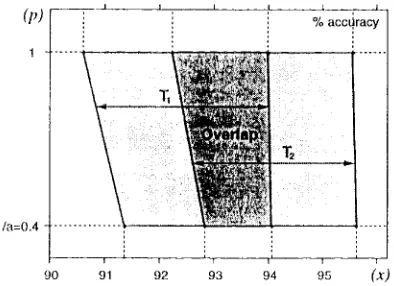
for Pi = ( i / a ) = 0 . 4
Xl C [91.35, 94.05] x2 C [92:82, 95.60]
for pi = l xl 6 [90.75,93.99] z2 E [92.22, 95.55]
The same information is included in figure 1 which presents tile reasonable accuracy intervMs for both taggers, for p ranging from 1 / a = 0 . 4 to 1. (the shadowed part corresponds to the over- lapping region between intervals).
(P) [
1
t ~ t I
: % accuracy
Iia=0.4
9 0 91 92 93 94 95 (X)
Figure J : I{easonable intervals for both taggers
The obtained interwtls have a large overlap region which implies t h a t there are reasonable
p a r a m e t e r combinations t h a t could cause the taggers to produce different observed perfor- mances t h o u g h their real accuracies were very similar. From this conserw~tive approach, we would not be a, ble to conchlde t h a t tile tagger 2) is better t h a n T1, even though the 95% con- fidence intervals for the observed performances did allow us to do so.
6 D i s c u s s i o n
Tile presented analysis of the effects of noise in the test corpus on the evaluation of Pos taggers leads us to conclude t h a t when a tagger is eval- uated as b e t t e r t h a n a n o t h e r using noisy test corpus, there are reasonable chances t h a t they are in fact very similar but one of them is just a d a p t i n g b e t t e r t h a n the other to the noise in the corpus.
probably haw'. a higher en'or rate. Nevertheless, a higher value for C would cause the intervals to be wider and to overlap ev(!ll inol'e.
We believe t h a t tile widespread practice of evaluating taggers against a noisy test corpus has reached its limit, since the performance of current taggers is getting too close to the error rate usually found in test corpora.
An obvious solution - a n d m a y b e not as costly as one might think, since small test sets properly used m a y yield enough statistical evidence- is using only error-free test corpora. A n o t h e r pos- sibility is to further s t u d y the influence of noise in order to establish a criterion -e.g. a thresh- old depending on the a m o u n t of overlapping be- tween intervals to decide w h e t h e r a given tag- ger can be considered b e t t e r t h a n another.
There is still much to be done in this direc- tion. This paper does not intend to establish a new evaluation m e t h o d for p o s tagging, but to point out t h a t there are some issues -such as the noise in test c o r p u s - t h a t have been paid lit- tle a t t e n t i o n and are more i m p o r t a n t t h a n w h a t they seem to be.
Some of the issues t h a t should be f u r t h e r con- sidered are: The e r e c t of noise on unambigu- ous words; the reasonable intervals for overall
real performance; the - p r o b a b l y - different val- ues of C, p, u and t for a m b i g u o u s / u n a m b i g u o u s words; how to estimate the p a r a m e t e r values of the evaJuated tagger in order to constrain as much ~ possible the interwds; the statistical significance of the interval overlappings; a more informed (and less conservative) criterion to re- j e c t / a c c e p t the hypothesis t h a t both taggers are ditferent, etc.
R e f e r e n c e s
Church, K.W. 1999 . Current Practice in Part of Speech Tagging and Suggestions tbr the Future.
In Simmons (ed.), Sbornik praci: In Honor of
Ilcnvy Kudera. Michigan Slavic Studies.
Krovetz, IL 1997. llomonynay and Polysemy in Information t{etrieval. In Proccedin.qs of joint 1@4 CL mceting.
M~r<tuez, I,. and Padrd, 1,. 1997. A Flexible POS 'Fagger IMng an Automatically Ac<luire<I l,an- guage Model. in Proceedings of joint E/ACL
m cetin 9.
Mooney, it.J. 1996. (~'omparative Fxperiments on Disambiguating Word Senses: An Illustration of the time of Bias in Machine I,earning. In Proceed- ings of EMNLP'96 conference.
[image:5.612.87.284.228.371.2]R e s u m
Aquest article versa sobre l'avaluacid de desam- biguadors morfosint£ctics. Normalment, l'ava- luaci6 es fa comparant la sortida del desam- biguador amb un corpus de refer~ncia, que se suposa lliure d'errors. De tota manera, els cor- pus que s'usen habitualment contenen soroll que causa que el rendiment que s'obt~ dels desam- biguadors sigui una distorsid del valor real. En aquest article analitzem fins a quin punt aques- ta distorsid pot invalidar la comparaeid entre desambiguadors o la mesura de la millora apor- tada per un nou sistema. La conclusid princi- pal ~s que cal establir procediments alternatius d'experimentacid m~s rigorosos, per poder ava- luar i comparar fiablement les precisions dels desambiguadors morfosint£ctics.
L a b u r t e n a
Artikulu hau desanbiguatzaile morfosintak-
tikoen ebaluazioaren inguruan datza. Nor-