Automatic Classification of English Verbs Using Rich Syntactic Features
Lin Sun and Anna Korhonen Computer Laboratory University of Cambridge
15 JJ Thomson Avenue Cambridge CB3 0FD, UK
ls418,[email protected]
Yuval Krymolowski Department of Computer Science
University of Haifa 31905, Haifa
Israel
Abstract
Previous research has shown that syntactic features are the most informative features in automatic verb classification. We exper-iment with a new, rich feature set, extracted from a large automatically acquired subcate-gorisation lexicon for English, which incor-porates information about arguments as well as adjuncts. We evaluate this feature set us-ing a set of supervised classifiers, most of which are new to the task. The best classi-fier (based on Maximum Entropy) yields the promising accuracy of 60.1% in classifying 204 verbs to 17 Levin (1993) classes. We discuss the impact of this result on the state-of-art, and propose avenues for future work.
1 Introduction
Recent research shows that it is possible, using cur-rent natural language processing (NLP) and machine learning technology, to automatically induce lex-ical classes from corpus data with promising ac-curacy (Merlo and Stevenson, 2001; Korhonen et al., 2003; Schulte im Walde, 2006; Joanis et al., 2007). This research is interesting, since lexi-cal classifications, when tailored to the application and domain in question, can provide an effective means to deal with a number of important NLP tasks (e.g. parsing, word sense disambiguation, se-mantic role labeling), as well as enhance perfor-mance in many applications (e.g. information ex-traction, question-answering, machine translation) (Dorr, 1997; Prescher et al., 2000; Swier and Steven-son, 2004; Dang, 2004; Shi and Mihalcea, 2005).
Lexical classes are useful because they capture generalizations over a range of (cross-)linguistic properties. Being defined in terms of similar mean-ing components and (morpho-)syntactic behaviour of words (Jackendoff, 1990; Levin, 1993) they generally incorporate a wider range of properties than e.g. classes defined solely on semantic grounds (Miller, 1990). They can be used to build a lexical organization which effectively captures generaliza-tions and predicts much of the syntax and semantics of a new word by associating it with an appropriate class. This can help compensate for lack of data for individual words inNLP.
Large-scale exploitation of lexical classes in real-world or domain-sensitive tasks has not been pos-sible because existing manually built classifications are incomprehensive. They are expensive to extend and do not incorporate important statistical infor-mation about the likelihood of different classes for words. Automatic classification is a better alterna-tive. It is cost-effective and gathers statistical infor-mation as a side-effect of the acquisition process.
(i) correspond closely with features used for manual classification (Levin, 1993). They have proved successful in the classification of German (Schulte im Walde, 2006) and English verbs (Ko-rhonen et al., 2003). Yet promising results have also been reported when using (ii) for English verb clas-sification (Merlo and Stevenson, 2001; Joanis et al., 2007). This may indicate that (i) are optimal for the task when combined with additional syntactic infor-mation from (ii).
We investigate this matter by experimenting with a new, rich feature set which incorporates informa-tion aboutSCFs (arguments) as well as adjuncts. It was extracted from VALEX, a large automatically acquired SCF lexicon for English (Korhonen et al., 2006). We evaluate the feature set thoroughly us-ing set of supervised classifiers, most of which are new in verb classification. The best performing clas-sifier (Maximum Entropy) yields the accuracy of 60.1% on classifying 204 verbs into 17 Levin (1993) classes. This result is good, considering that we per-formed no sophisticated feature engineering or se-lection based on the properties of the target classi-fication (Joanis et al., 2007). We propose various avenues for future work.
We introduce our target classification in section 2 and syntactic features in section 3. The classifica-tion techniques are presented in secclassifica-tion 4. Details of the experimental evaluation are supplied in sec-tion 5. Secsec-tion 6 provides discussion and concludes with directions for future work.
2 Test Verbs and Classes
We adopt as a target classification Levin’s (1993) well-known taxonomy where verbs taking similar diathesis alternations are assumed to share meaning components and are organized into a semantically coherent class. For instance, the class of “Break
Verbs” (class 45.1) is partially characterized by its participation in the following alternations:
1. Causative/inchoative alternation:
Tony broke the window↔The window broke
2. Middle alternation:
Tony broke the window↔The window broke easily
3. Instrument subject alternation:
Tony broke the window with the hammer↔The hammer broke the window
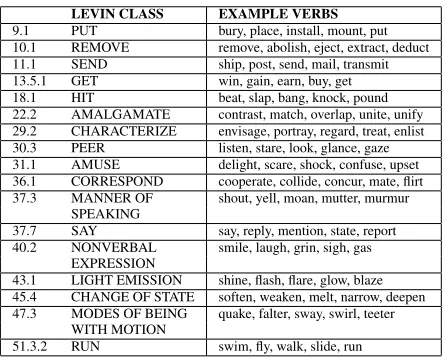
LEVIN CLASS EXAMPLE VERBS 9.1 PUT bury, place, install, mount, put 10.1 REMOVE remove, abolish, eject, extract, deduct 11.1 SEND ship, post, send, mail, transmit 13.5.1 GET win, gain, earn, buy, get 18.1 HIT beat, slap, bang, knock, pound 22.2 AMALGAMATE contrast, match, overlap, unite, unify 29.2 CHARACTERIZE envisage, portray, regard, treat, enlist 30.3 PEER listen, stare, look, glance, gaze 31.1 AMUSE delight, scare, shock, confuse, upset 36.1 CORRESPOND cooperate, collide, concur, mate, flirt 37.3 MANNER OF shout, yell, moan, mutter, murmur
SPEAKING
37.7 SAY say, reply, mention, state, report 40.2 NONVERBAL smile, laugh, grin, sigh, gas
EXPRESSION
43.1 LIGHT EMISSION shine, flash, flare, glow, blaze 45.4 CHANGE OF STATE soften, weaken, melt, narrow, deepen 47.3 MODES OF BEING quake, falter, sway, swirl, teeter
WITH MOTION
[image:2.595.313.535.69.248.2]51.3.2 RUN swim, fly, walk, slide, run
Table 1: Test classes and example verbs
Alternations are expressed as pairs of SCFs. Addi-tional properties related to syntax, morphology and extended meanings of member verbs are specified with some classes. The taxonomy provides a classi-fication of 4,186 verb senses into 48 broad and 192 fine-grained classes according to their participation in 79 alternations involvingNPandPPcomplements. We selected 17 fine-grained classes and 12 mem-ber verbs per class (table 2) for experimentation. The small test set enabled us to evaluate our results thoroughly. The classes were selected to (i) include both syntactically and semantically similar and dif-ferent classes (to vary the difficulty of the classifi-cation task), and to (ii) have enough member verbs whose predominant sense belongs to the class in question (we verified this according to the method described in (Korhonen et al., 2006)). As VALEX was designed to maximise coverage most test verbs had 1000-9000 occurrences in the lexicon.
3 Syntactic Features
Carroll, 2002), and a SCF classifier which iden-tifies 163 verbal SCFs. The basic SCFs abstract over lexically-governed particles and prepositions and predicate selectional preferences.
We used the noisy unfiltered version of VALEX which includes 33SCFs per verb on average1. Some are genuine SCFs but some express adjuncts (e.g.
I sang in the party could be SCF PP). A lexical entry for each verb and SCF combination provides e.g. the frequency of the entry (in active and passive) in corpora, thePOStags of verb tokens, the argument heads in argument positions, and the prepositions in PPslots. We experimented with three feature sets:
1. Feature set 1:SCFs and their frequencies
2. Feature set 2: Feature set 1 with two high frequency PPframes parameterized for prepositions: the simplePP (e.g.they apologizedto him) andNP-PP(e.g.he removed the shoesfrom the bag) frames.
3. Feature set 3: Feature set 2 with three additional high frequencyPPframes parameterized for prepositions: the NP-FOR-NP(e.g.he bought a bookfor him),NP-TO-NP (e.g.he gave a kissto her), andOC-AP,EQUI,AS(e.g.he condemned himasstupid) frames.
In feature sets 2 and 3, 2-5PP SCFs were refined ac-cording to the prepositions provided in the VALEX SCFentries (e.g.PP at,PP on, PP in) because Levin specifies prepositions with someSCFs / classes. The scope was restricted to the 3-5 highest ranked PP SCFs to reduce the effects of sparse data.
4 Classification
4.1 Preparing the Data
A feature vector was constructed for each verb. VALEXincludes 107, 287 and 305SCFtypes for fea-ture sets 1, 2, and 3, respectively. Each feafea-ture corre-sponds to aSCFtype, and its value is the relative fre-quency of the SCFwith the verb in question. Some of the feature values are zero, because most verbs take only a subset of the possibleSCFs.
4.2 Machine Learning Methods
We implemented three methods for classification: the K nearest neighbours (KNN), support vector ma-chines (SVM), and maximum entropy (ME). To our knowledge, onlySVMhas been previously used for
1The SCFaccuracy of this lexicon is 23.7 F-measure, see
(Korhonen et al., 2006) for details.
verb classification. The free parameters were opti-mised for each feature set by (i) defining the value range (as explained below), and by (ii) searching for the optimal value on the training data using 10 fold cross validation (section 5.2).
4.2.1 K Nearest Neighbours
KNN is a memory-based classification method based on the distances between verbs in the feature space. For each verb in the test data, we measure its distance to each verb in the training data. The verb class label is the most frequent label in the top K closest training verbs. We use the entropy-based Jensen-Shannon (JS) divergence as the dis-tance measure:
JS(P, Q) =1 2 ˆ
D(PkP+Q
2 ) +D(Qk
P+Q
2 ) ˜
The range of the parameterK is 2-20.
4.2.2 Support Vector Machines
SVM(Vapnik, 1995) tries to find a maximal mar-gin hyperplane to separate between two groups of verb feature vectors. In practice, a linear hyperplane does not always exist. SVM uses a kernel function to map the original feature vectors to higher dimen-sion space. The ’maximal margin’ optimizes our choice of dimensionality to avoid over-fitting. We use Chang and Lin (2001) ’sLIBSVM library to im-plement theSVM. Following Hsu et al. (2003), we use the radial basis function as the kernel function:
K(xi, xj) = exp (−γ||xi−xj||2), γ >0
γ and the cost of the error termC(the penalty for margin errors) are optimized. The search ranges of Hsu et al. (2003) are used:
C= 2−5,2−3, . . . ,215,217;γ= 2−17,2−15, . . . ,21,23
4.2.3 Maximum Entropy
ME constructs a probabilistic model that maxi-mizes entropy on test data subject to a set of feature constraints. If verbx is in class10.1 and takes the SCF49(NP-PP) with the relative frequency of0.6in feature functionf, we have
f(x, y) = 0.6ify= 10.1andx= 49
The expected value of a featuref with respect to the empirical distribution (training data) is
˜
E(f)≡Px,yp(x, y)f(x, y)˜
E(f)≡Px,yp(x)p(y˜ |x)f(x, y) ˜
p(x)is the empirical distribution ofxin the train-ing data. We constrainE(f)to be the same asE˜(f)
E(f) = ˜E(f)
The model must maximize the entropyH(Y|X) H(Y|X)≡ −Px,yp(x)p(y˜ |x) logp(y|x)
The constraint-optimization problem is solved by the Lagrange multiplier (Pietra et al., 1997). We used Zhang (2004)’s maximum entropy toolkit for implementation. The number of iterationsi(5-50) of the parameter estimation algorithm is optimised.
5 Experiments
5.1 Methodology
We split the data into training and test sets using two methods. The first is ’leave one out’cross-validation
where one verb in each class is held out as test data, and the remaining N-1 (i.e. 11) verbs are used as training data. The overall accuracy is the average accuracy of N rounds. The second method is re-sampling. For each class, 3 verbs are selected ran-domly as test data, and 9 are used as training data. The process is repeated 30 times, and the average result is recorded.
5.2 Measures
The methods are evaluated using first accuracy – the percentage of correct classifications out of all the classifications:
Accuracy= trueP ositives trueP ositives+f alseN egatives
When evaluating the performance at class level, pre-cision and recall are calculated as follows:
P recision= trueP ositives trueP ositives+f alseP ositives Recall= trueP ositives
trueP ositives+f alseN egatives
F-score is the balance over recall and precision. We report the average F-score over the 17 classes. Given there are 17 classes in the data, the accuracy of ran-domly assigning a verb into one of the 17 classes is 1/17≈5.8%.
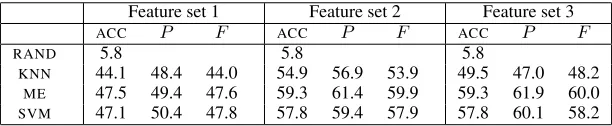
5.3 Results from Quantitative Evaluation Table 2 shows the average performance of each clas-sifier and feature set according to ’leave one out’ cross-validation2. Each classifier performs
consid-erably better than the random baseline. The simple
2Recall is not shown as it is identical here with accuracy.
KNN method produces the lowest accuracy (44.1-54.9) andSVMandMEthe best (47.1-57.9 and 47.5-59.3, respectively).
The performance of all methods improves sharply when moving from the feature set 1 to the refined feature set 2: both accuracy and F-measure improve by over 10%. When moving from feature set 2 to the sparser feature set 3 (which includes a higher number of low frequencyPPfeatures)KNNworsens clearly (c. 5% in accuracy and F-measure) while the improvement in other methods is very small. This suggests that KNN deals worse than other methods with sparse data.
The resampling results in table 3 reveal that some classifiers perform worse than others when less training data is available3. KNN produces consid-erably lower results, particularly with the sparse feature set 3: 28.2 F-measure vs. 48.2 with cross-validation. Also SVM performs worse with fea-ture set 3: 54.6 F-measure vs. 58.2 with cross-validation. MEthus appears the most robust method with smaller training data, producing results compa-rable with those in cross-validation.
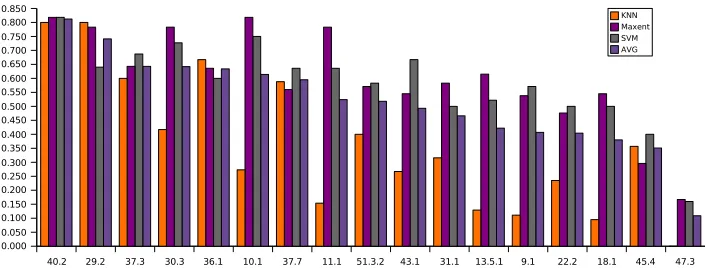
Figure 1 shows the F-measure for 17 individual classes when the methods are used with feature set 3. Levin classes 40.2, 29.2, and 37.3 (see table 2) (the ones taking fewer prepositions with higher fre-quency) have the best average performance (65% or more), and classes 47.3, 45.4 and 18.1 the worst (40% or less). ME outperforms SVM with 9 of the 17 classes.
5.4 Qualitative Evaluation
We did some qualitative analysis to trace the ori-gin of error types produced byME with feature set 3. Examination of the worst performing class 47.3 (MODES OF BEING INVOLVING MOTION verbs) il-lustrates well the various error types. 10 of the 12 verbs in this class are classified incorrectly:
• 3in class 43.1 (LIGHT EMISSIONverbs): Verbs in 47.3 and 43.1 describe intrinsic properties of their subjects (e.g.a jewel sparkles,a flag flutters). Their similar al-ternations andPP SCFs make it difficult to separate them on syntactic grounds.
• 2in class 51.3.2 (RUNverbs): 47.3 and 51.3.2 share the meaning component of motion. Their members take sim-ilar alternations andSCFs, which causes the confusion.
3Recall that the amount of training data is smaller with
Feature set 1 Feature set 2 Feature set 3
ACC P F ACC P F ACC P F
RAND 5.8 5.8 5.8
KNN 44.1 48.4 44.0 54.9 56.9 53.9 49.5 47.0 48.2 ME 47.5 49.4 47.6 59.3 61.4 59.9 59.3 61.9 60.0 SVM 47.1 50.4 47.8 57.8 59.4 57.9 57.8 60.1 58.2
Table 2: ’Leave one out’ cross-validation results forKNN,ME, andSVM
Feature set 1 Feature set 2 Feature set 3
ACC P F ACC P F ACC P F
RAND 5.8 5.8 5.8
[image:5.595.153.459.71.134.2]KNN 37.3 39.9 36.5 42.7 47.2 42.6 27.1 34.2 28.2 ME 47.1 47.3 47.0 58.1 59.1 58.1 60.1 60.5 59.8 SVM 47.3 50.2 47.7 56.8 59.5 57.1 54.4 56.5 54.6
Table 3: Re-sampling results forKNN,ME, andSVM
• 2in class 37.7 (SAYverbs) and 1 in class 37.3 (MANNER OF SPEAKINGverbs): 47.3 differs in semantics and syn-tax from 37.7 and 37.3. The confusion is due to idiosyn-cratic properties of individual verbs (e.g.quake, wiggle).
• 1in class 36.1 (CORRESPONDverbs): 47.3 and 36.1 are semantically very different, but their members take simi-lar intransitive andPP SCFs with high frequency.
• 1 in class 45.4 (OTHER CHANGE OF STATE verbs): Classes 47.3 and 45.3 are semantically different. Their similarPP SCFs explains the misclassification.
Most errors concern classes which are in fact se-mantically related. Unfortunately there is no gold standard which would comprehensively capture the semantic relatedness of Levin classes. Other er-rors concern semantically unrelated but syntactically similar classes – cases which we may be able to ad-dress in the future with careful feature engineering. Some errors relate to syntactic idiosyncracy. These show the true limits of lexical classification - the fact that the correspondence between the syntax and se-mantics of verbs is not always perfect.
6 Discussion and Conclusion
Our best results (e.g. 60.1 accuracy and 59.8 F-measure of ME) are good, considering that no so-phisticated feature engineering / selection based on the properties of the target classification was per-formed in these experiments. The closest compari-son point is the recent experiment reported by Joanis et al. (2007) which involved classifying 835 English verbs to 14 Levin classes usingSVM. Features were specifically selected via analysis of alternations that
are used to characterize Levin classes. Both shal-low syntactic features (syntactic slots obtained us-ing a chunker) and deep ones (SCFs extracted using Briscoe and Carroll’s system) were used. The accu-racy was 58% with the former and only 38% with the latter. This experiment is not directly compa-rable with ours as we classified a smaller number of verbs (204) to a higher number of Levin classes (17) (i.e. we had less training data) and did not se-lect the optimal set of features using Levin’s alter-nations. We nevertheless obtained better accuracy with our best performing method, and better accu-racy (47%) with the same method (SVM) when the comparable feature set 1 was acquired using the very same subcategorization acquisition system.
It is likely that using larger and noisierSCF data explains the better result, suggesting that rich syn-tactic features incorporating information about both arguments and adjuncts are ideal for verb classifica-tion. Further experiments are required to determine the optimal set of features. In the future, we plan to experiment with different (noisy and filtered) ver-sions of VALEX and add to the comparison a shal-lower set of features (e.g.NPandPPslots inVALEX regardless of the specific SCFs). We will also im-prove the features e.g. by enriching them with addi-tional syntactic information available inVALEX lex-ical entries.
Acknowledgement
Figure 1: Class level F-score for feature set 3 (cross-validation)
References
E. J. Briscoe and J. Carroll. 1997. Automatic extraction of subcategorization from corpora. InProceedings of the5thACL Conference on Applied Natural Language
Processing, pages 356–363, Washington DC.
E. J. Briscoe and J. Carroll. 2002. Robust accurate statis-tical annotation of general text. InProceedings of the
3rd LREC, pages 1499–1504, Las Palmas, Gran
Ca-naria.
C. Chang and J. Lin, 2001. LIBSVM: a library for sup-port vector machines.
H. T. Dang. 2004. Investigations into the Role of Lexi-cal Semantics in Word Sense Disambiguation. Ph.D. thesis, CIS, University of Pennsylvania.
B. J. Dorr. 1997. Large-scale dictionary construction for foreign language tutoring and interlingual machine translation. Machine Translation, 12(4):271–322.
W. Hsu, C. Chang, and J. Lin. 2003. A practical guide to support vector classification.
R. Jackendoff. 1990. Semantic Structures. MIT Press, Cambridge, Massachusetts.
E. Joanis, S. Stevenson, and D. James. 2007. A general feature space for automatic verb classification. Natu-ral Language Engineering, Forthcoming.
A. Korhonen, Y. Krymolowski, and Z. Marx. 2003. Clustering polysemic subcategorization frame distri-butions semantically. InProceedings of the 41st An-nual Meeting on Association for Computational Lin-guistics, pages 64–71.
A. Korhonen, Y. Krymolowski, and T. Briscoe. 2006. A large subcategorization lexicon for natural language processing applications. InProceedings of LREC.
B. Levin. 1993. English Verb Classes and Alternations. Chicago University Press, Chicago.
P. Merlo and S. Stevenson. 2001. Automatic verb clas-sification based on statistical distributions of argument structure. Computational Linguistics, 27(3):373–408.
G. A. Miller. 1990. WordNet: An on-line lexi-cal database. International Journal of Lexicography, 3(4):235–312.
S. D. Pietra, J. D. Pietra, and J. D. Lafferty. 1997. Induc-ing features of random fields. IEEE Transactions on Pattern Analysis and Machine Intelligence, 19(4):380– 393.
D. Prescher, S. Riezler, and M. Rooth. 2000. Using a probabilistic class-based lexicon for lexical ambiguity resolution. In18th International Conference on Com-putational Linguistics, pages 649–655, Saarbr¨ucken, Germany.
S. Schulte im Walde. 2000. Clustering verbs semanti-cally according to their alternation behaviour. In Pro-ceedings of COLING, pages 747–753, Saarbr¨ucken, Germany.
S. Schulte im Walde. 2006. Experiments on the au-tomatic induction of german semantic verb classes. Computational Linguistics, 32(2):159–194.
L. Shi and R. Mihalcea. 2005. Putting pieces together: Combining FrameNet, VerbNet and WordNet for ro-bust semantic parsing. InProceedings of the Sixth In-ternational Conference on Intelligent Text Processing and Computational Linguistics, Mexico City, Mexico.
R. Swier and S. Stevenson. 2004. Unsupervised seman-tic role labelling. InProceedings of the 2004 Confer-ence on Empirical Methods in Natural Language Pro-cessing, pages 95–102, Barcelona, Spain, August.
V. N. Vapnik. 1995. The nature of statistical learning theory. Springer-Verlag New York, Inc., New York, NY, USA.