IITP at IJCNLP-2017 Task 4: Auto Analysis of Customer Feedback using
CNN and GRU Network
Deepak Gupta∗, Pabitra Lenka†, Harsimran Bedi∗, Asif Ekbal∗, Pushpak Bhattacharyya∗ ∗Indian Institute of Technology Patna, India
†International Institute of Information Technology Bhubaneswar, India ∗{deepak.pcs16, harsimran.mtcs16, asif, pb}@iitp.ac.in
Abstract
Analyzing customer feedback is the best way to channelize the data into new mar-keting strategies that benefit entrepreneurs as well as customers. Therefore an au-tomated system which can analyze the customer behavior is in great demand. Users may write feedbacks in any lan-guage, and hence mining appropriate in-formation often becomes intractable. Es-pecially in a traditional feature-based su-pervised model, it is difficult to build a generic system as one has to under-stand the concerned language for find-ing the relevant features. In order to overcome this, we propose deep Convo-lutional Neural Network (CNN) and Re-current Neural Network (RNN) based ap-proaches that do not require handcraft-ing of features. We evaluate these tech-niques for analyzing customer feedback sentences on four languages, namely En-glish, French, Japanese and Spanish. Our empirical analysis shows that our mod-els perform well in all the four languages on the setups of IJCNLP Shared Task on
Customer Feedback Analysis. Our model achieved the second rank in French, with an accuracy of 71.75% and third ranks for all the other languages.
1 Introduction
Exploration and exploitation of customer feed-backs have become highly relevant and crucial for all the customer-centric business firms in today’s world. Product manufacturers would like to know what their customers are liking or complaining about in order to improve their services or launch improved versions of products. Service providers
would like to know how happy or unhappy a cus-tomer is with their service. According to a survey1
96% of unhappy customers do not complain but they advise 15% of their friends to not have any business dealings with the particular firm. With the huge amount of feedback data available, it is impossible to manually analyze each and every re-view. So there arises a need to automate this entire process to aid the business firms in customer feed-back management.
A customer review analysis can be associated with its sentiment polarity (‘positive’, ‘negative’, ‘neutral’ and ‘conflict’) or with its interpretation (‘request’, ‘comment’, ‘complaint’). There ex-ists a significant number of works for sentiment classification (Pang et al., 2002; Glorot et al.,
2011; Socher et al., 2013; Gupta et al., 2015;
Deepak Gupta and Bhattacharyya, 2016), emo-tion classificaemo-tion (Yang et al., 2007; Li and Lu,
2009; Padgett and Cottrell, 1997) and customer review analysis (Yang and Fang,2004;Mudambi and Schuff, 2010;Hu and Liu, 2004). However, the meaning of customer reviews (request, com-plaint, comment etc.) remains a relatively not much explored area of research.
Our present work deals with classifiyng a cus-tomer review into one of the six predefined cate-gories. This can be trated as a document classifi-cation problem.
The classes are comment, request, bug, com-plaint, meaninglessandundetermined. The feed-back classification is performed across four differ-ent languages, namely English (EN), French (FR), Japanese (JP) and Spanish (ES). In Table 1 we depict few instances of customer feedbacks with their label(s) in different languages. One of critical issues in traditional supervised model is to come up with a good set of features that could be
ef-1https://goo.gl/8KVwBh
fective in solving the problem. Hence it is chal-lenging to build a generic model that could per-form reasonably well acoross different domains and languages. In recent times, the emergence of deep learning methods have inspired researchers to develop solutions that do not require careful feature engineering. Deep Convolutional Neural Network (CNN) and Recurrent Neural Network (RNN) are two very popular deep learning tech-niques that have been successfully used in solving many sentence and document classification (Kim,
2014; Xiao and Cho, 2016) problems. We aim at developing a generic model that can be used across different languages and platforms for cus-tomer feedback analysis.
The remainder of our paper is structured as fol-lows: Section2offers the related literature survey for customer feedback analysis, where we discuss about the existing approaches. Section3describes our two proposed approaches, one based on CNN and the other based on amalgamation of RNN with CNN. Section4provides the detailed information about the data set used in the experiment and the experimental setup. Results, analysis and discus-sion are elucidated in Section5. We put forward the future work and conclude the paper with Sec-tion6. The source code of our system can be found here.2
2 Related Work
Analysis of customer feedback has been of signif-icant interest to many companies over the years. Given the large amount of feedbacks available, in-teresting trends and opinions among the customers can be investigated for many purposes. In this sec-tion, we discuss the related literature in the analy-sis of customer feedbacks.
Bentley and Batra (2016) developed a Office customer voice (OCV) system that classifies cus-tomer feedback on Microsoft Office products into known issues. The classification algorithm is built on logistic regression classifiers of the Python sci-kit framework. They have also employed a custom clustering algorithm along with topic modeling to identify new issues from the feedback data. A do-main specific approach described in (Potharaju et al.,2013) infers problems, activities and actions from network trouble tickets. The authors devel-oped a domain specific knowledge base and an
on-2https://github.com/pabitralenka/
Customer-Feedback-Analysis
tology model using pattern mining and statistical Natural Language Processing (NLP) and used it for the inference. Brun and Hag`ege (2013) of-fers a pattern to extract suggestions for improve-ments from user reviews. They combine linguis-tic knowledge with an opinion mining system to extract the suggestive expressions from a review. The presence of a suggestion indicates that the user is not completely satisfied with the product.
Over the years, many companies have devel-oped feedback management systems to help other companies gain useful insight from the customer feedback data. Customer satisfaction survey done by Freshdesk3defines metrics for measuring
cus-tomer satisfaction. They use a five class cate-gorization (‘positive’, ‘neutral’, ‘negative’, ‘an-swered’ and ‘unan‘an-swered’), thereby combining sentiment and responsiveness. Survey Monkey4
also facilitates us to create survey forms and ana-lyze them for customer satisfaction. It also uses a five-class categorization (‘excellent’, ‘good’, ‘av-erage’, ‘fair’ and ‘poor’), a commonly used rating mechanism. Customer Complaints Management5
provides services and softwares to help business firms to manage and retain their customers. Identifying a category for customer feedback re-quires deep semantic analysis of the lexicons to identify the emotions expressed. Authors in (Asher et al.,2009) have provided detailed annota-tion guidelines for opinion expressions where each opinion lies in the four top level categories of ‘Re-porting’, ‘Judgement’, ‘Advise’ and ‘Sentiment’. With the advent of deep learning, in recent years there has been a phenomenal growth in the use of neural network models for text analysis.Yin et al.
(2016) have provided practical and effective com-prehensive relevance solutions in Yahoo search engine. They have designed ranking functions, semantic matching features and query rewriting techniques for base relevance. Their network model incorporates a deep neural network and it is tested with the commercial Yahoo search engine.
In this shared task the organizers have intro-duced a customer feedback analysis model where the task is to classify a feedback into one of the six categories. In following section we describe our proposed deep learning based classification model
3https://freshdesk.com/
4https://www.surveymonkey.com/ 5http://www.newgensoft.com/
Feedback Class(es)
nouveau bug : le rayon led anti yeux rouges se declanche intempestivement apr`es avoir envoy´e la photo ! bug あと、タイムラインで他の人がお気に入りの記事を表示しないように設定できるようにしたい request
Saw advertisements through an Internet travel booking site for hotel and zoo tickets in a package deal. comment La decoraci´on en el hotel es excelente y las habitaciones tienen un toque chic. comment it is fast, but the controls are lousy, plus it keeps installing on my desktop shortcuts to place I don’t want. complaint Mi pareja y yo hicimos una escapada rom´antica a Barcelona de cuatro d´ıas. meaningless Pour moi et avec modesties d’´eloges, nero multimedia me rassure en ce sens que je peux: undetermined
編集で付けようとしても、どうしてもその人のだけ消えてしまう bug, comment
Table 1: Some instances of customer feedback in different languages annotated with their class(es)
for customer feedback analysis.
3 Network Architecture for Feedback Classification
In this section we describe our proposed neural network architecture for feedback classification. We propose two variants, the first one is convo-lution operation inspired CNN and the second one is the amalgamation of CNN with RNN.
3.1 Feedback classification using CNN
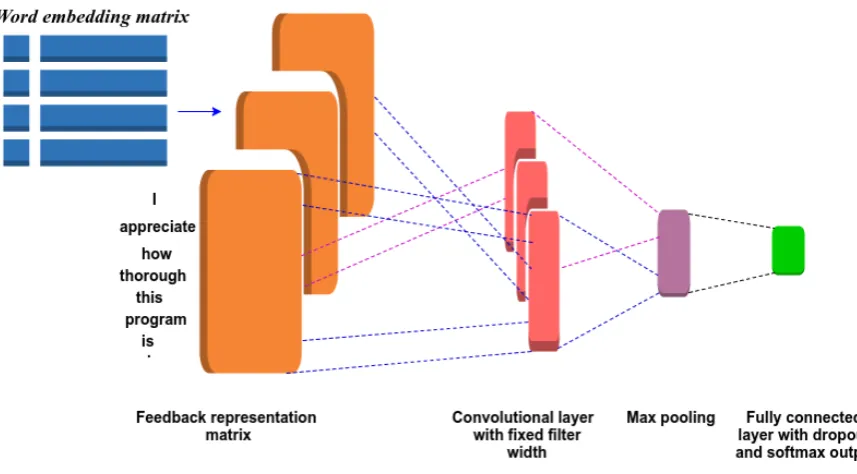
In this model a feedback sentence is subjected to CNN and the model predicts the most probable feedback class along with the confidence (proba-bility) score. The model architecture is depicted in Fig1. The input and output of the model are as follows:
INPUT: A feedback F, labeled with any of the six classes: (comment, request, bug, complaint, meaningless,andundetermined)
OUTPUT:Class(es) of the correspondingF Our model uses similar network architectures used by Kim(2014) for performing the feedback classification task. We depict our model archi-tecture in Figure1. The architecture of a typical CNN is composed of a stack of distinct layers where each layer performs a specific function of transforming its input into a useful representation. A CNN comprises ofsentence representation, one or more convolutional layers often interweaved withpooling layer(max-pooling being extremely popular), followed by fully-connected layer lead-ing into asoftmaxclassifier. The components of CNN are described as follows:
3.1.1 Feedback Sentence Representation
As CNNs deal with fixed length inputs, we en-sure that every input feedback sentence has the same length. To achieve this, input feedback sen-tences are padded according to the need. Each
feedback sentence is padded to the maximum sen-tence length6. Padding of feedback sentences to
the same length is useful because it allows us to efficiently batch our data while training. Let a feedback sentenceFconsisting of ‘n’ words be the input to our model such thatx = [x1, x2, . . . xn]
wherexiis theith word in the feedback sentence.
Each token xi ∈ F is represented by its
dis-tributed representation pi ∈ Rk which is the k
-dimensional word vector. The distributed repre-sentationpis looked up into the word embedding matrixW which is initialized either by a random process or by some pre-trained word embeddings like Word2Vec (Mikolov et al., 2013) or GloVe
(Pennington et al., 2014). We then concatenate (row wise) the distributed representationpifor
ev-eryithtoken in the feedbackF and build the back sentence representation matrix. The feed-back sentence representation matrix p1:n can be
represented as:
p1:n=p1⊕p2⊕ · · · ⊕pn (1)
where⊕is the concatenation operator. Each row of the sentence representation matrix corresponds to the word vector representation of each token. The result of the embedding operation yields a 3-dimensional tensor.
3.1.2 Convolutional Layer
The convolutional layer is the core building block of a CNN. The common patterns (n-grams) in the training data are extracted by applying the convo-lution operation. These patterns are then passed to the next hidden layer to extract more complex pat-terns, or directly fed to a standard classifier (usu-ally a softmaxlayer) to output the final predic-tion. The convolution operation is performed on the feedback representation matrix via linear
fil-6maximum feedback sentence length: EN=116, FR=73,
Figure 1: Convolution neural network based feedback classification model
ters (feature detectors). Owing to the inherent se-quential structure of the text data, we use filters with fixedwidth. Then we simply vary theheight
of the filter, i.e. the number of adjacent rows (to-kens) considered together. Here theheightof the filter is the region size of the filter.
We consider a filter parameterized by the weight matrixwwith a region sizeh. Thereafter we de-note the feedback representation matrix by S ∈
Rn×k, wherekis the dimension of the word
vec-tor. The generated outputouti ∈Rn−h+ 1 of the
convolutional operator is obtained by repeatedly applying the filter on sub-matrices ofS:
outi =w·S[i:i+h−1], (2)
The sub-matrix ofS fromith row to i+h−1th row is represented byS[i:i+h−1], wherei= 1. . . n−h+ 1 and h is the height of the filter. A bias term b ∈ R and an activation function f to eachouti is added which generates thefeature
mapc∈Rn−h+ 1for this filter where:
ci =f(outi+b) (3)
But the dimensions of the feature map produced by each filter will differ as a function of the num-ber of words in the feedback sentence and the filter region size. Thus we apply a pooling function over eachfeature mapto generate a vector of the fixed length.
3.1.3 Pooling Layer
The output of the convolutional layer is the in-put to the pooling layer. The primary utility of the pooling layer lies in progressively reducing the spatial dimensions of the intermediate representa-tions. The operation performed by this layer is also called down-sampling, as there is a loss of information due to the reduction of dimensions. However, such a loss is beneficial for the network for two reasons:
1. Decreases the computational overhead of the network; and
2. Controls over-fitting.
The pooling layer takes a sliding window or a cer-tain region that is moved in stride across the in-put which transforms the values into representa-tive values. There are several pooling operations in practice such asmax pooling, min pooling, av-erage poolinganddynamic pooling. We have ap-plied themax poolingoperation (Collobert et al.,
2011) on the feature map which transforms the representation by taking the maximum value from the values observable in the window. Max pooling has been favored over others due to its better per-formance. It also provides a form of translation invariance and robustness to position. However,
3.1.4 Fully-connected Layer
Fully-connected layers are typically used in the fi-nal stages of the CNN to connect to the output layer. It looks at what high level features most strongly correlate to a particular class. The fea-tures generated from the pooling layerpform the penultimate layer and are fed to a fully connected softmax layer to generate the classification. The softmaxclassifier gives an intuitive output (nor-malized class probabilities) and also has a proba-bilistic interpretation. The output of thesoftmax function is the probability distribution over tags (comment, request, bug, complaint, meaningless,
andundetermined).
wherezkandwkare the bias and weight vector of
thekthlabels.
3.2 Feedback Classification using CNN coupled with RNN
We propose a second method for feedback classi-fication that combines both CNN and RNN. The typical architecture of these combinations is com-posed of aconvolutional feature extractorapplied on the input, then a recurrent network on top of the CNN’s output, then an optionalfully connected layeris added to RNN’s output and finally fed into thesoftmax layer. We use convolutional layer as it learns to extract higher-level features that are in-variant to local translation. By stacking up mul-tiple convolutional layers, the network can extract higher-level, abstract, (locally) translation invari-ant features from the input sequence.
Apart from this advantage, it is noticed that sev-eral layers of convolution are required to capture long-term dependencies, due to the locality of the convolution and pooling. In order to capture long-term dependencies even when there is only a sin-gle layer present in the network, the recurrent layer comes handy. However, the recurrent layer in-creases the computational overhead due to its lin-early growing computational complexity with re-spect to the length of the input sequence. So we have used a combination of convolutional and re-current layers in a single model to ensure that it can capture long-term dependencies from the in-put more efficiently for the feedback classification task. Our model is similar to the one proposed
in Xiao and Cho(2016). They have used LSTM unit, however we have employed GRU (Cho et al.,
2014).
new memory content, respectively. ci is the
con-volution output at timet. We take the last hidden states of both directions and concatenate them to form a fixed-dimensional vector, which are later fed into the next layer.
4 Datasets and Experimental Setup
4.1 Datasets
The data sets used in our experiments are pro-vided by the organizers of the shared task on Cus-tomer Feedback Analysisof IJCNLP-2017. Data sets consist of representative real world samples of customer feedback from Microsoft Office cus-tomers in four languages, namelyEnglish, French, Japanese and Spanish. We obtain the English translations of test data of other three languages (French, JapaneseandSpanish) which were trans-lated using Google translate7. Each feedback in
the data is annotated with one or multiple tags from the set of six tags (comment, request, bug, complaint, meaningless and undetermined). We show the dataset statistics for each language in Ta-ble2.
4.2 Data Preprocessing
Some of the feedback sentences are annotated with multiple classes. Before feeding them to the net-work, we preprocessed the data by replicating the particular instance with all the possible classes.
4.3 Regularization
In order to prevent the model from over-fitting, we employed a dropout regularization (set to 50%) proposed bySrivastava et al.(2014) on the penulti-mate layer of the network. It “drops out” a random set of activations in the network. Dropout prevents feature co-adaptation by randomly setting some portion of hidden units to zero during the forward propagation when passing it to the softmax output layer in the end to perform classification. It also
Training Development Test
Language CO CP RQ BG ME UD Total CO CP RQ BG ME UD Total CO CP RQ BG ME UD Total EN 1758 950 103 72 306 22 3211 276 146 19 20 48 3 512 285 145 13 10 62 4 519 ES 1003 536 69 14 9 0 1631 244 39 12 5 1 0 301 229 53 14 2 1 0 299 FR 1236 529 38 53 178 10 2044 256 112 6 8 36 1 419 255 104 11 8 40 2 420 JP 826 531 97 89 0 45 1588 142 73 22 18 0 9 264 170 94 26 14 0 9 313 Total 4823 2546 307 228 493 77 8474 918 370 59 51 85 13 1496 939 396 64 34 103 15 1551
Table 2: Data set statistics of all the languages. Notations used are defined as follows,CO:comment,
CP:complaint,RQ:request,BG:bug,ME:meaninglessandUD:undetermined,
forces the network to be redundant i.e. it should be able to provide the correct classification or output for a specific input even if some of the activations are dropped out.
4.4 Network Training and Hyper-parameters
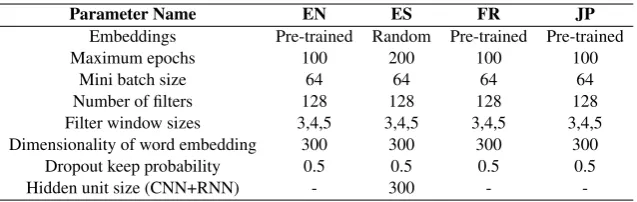
We have applied the rectified linear units (ReLu) (Nair and Hinton,2010) as the activation function in our experiment. We use the development data to fine-tune the hyper-parameters. In order to train the network, the stochastic gradient descent (SGD) over mini-batch is used and Backpropagation al-gorithm (Hecht-Nielsen,1992) is used to compute the gradients in each learning iteration. We have not enforced L2 norm constraints on the weight vectors as Zhang and Wallace(2015) found that the constraints had a minimal effect on the end re-sult. We have used cross-entropy loss as the loss function. The hyper-parameters of the best system in each language are listed in Table6.
4.5 Experiments
We conduct experiments in two different ways: CNN based and CNN+RNN based. Further we perform the experiments with original test data
and English translated test data. In each set-ting we experiment with all the four languages8.
Through the experimental results we wanted to establish the fact that whether a simple machine translation would work or there is a need of native tools for the other languages. The following are the descriptions of our submission in the shared task.
1. CNN: The results obtained from the CNN model described in Section3.1.
(a) With original test data: We train the CNN model using the dataset provided for training and used the respective test data to obtain the results. This setting
8In the “English translated test data” setting, the
experi-ments were performed with three languages (FR: French, JP: Japanese and ES: Spanish )
of experiments are employed on all four languages (EN, FR, JP and ES).
(b) English translated test data: We train the CNN model using the English train-ing dataset and use the English trans-lated test data of other languages (FR, JP and ES) to obtain the results.
2. CNN+RNN: The results obtained from the CNN+RNN model described in Section3.2.
(a) With original test data: Similar to CNN we train the CNN+RNN model us-ing the dataset provided for trainus-ing and use the respective test data to obtain the results. This setting of experiments are employed on all the four languages (EN, FR, JP and ES).
(b) English translated test data:
Again similar to CNN, we train the CNN+RNN model using the English training dataset and use the English translated test data of other languages (FR, JP and ES) for the evaluation.
We use the pre-trained Google word embedding9
to initialize the word embedding matrix for En-glish. The word embedding matrix for other three languages are initialized randomly10.
5 Results and Discussions
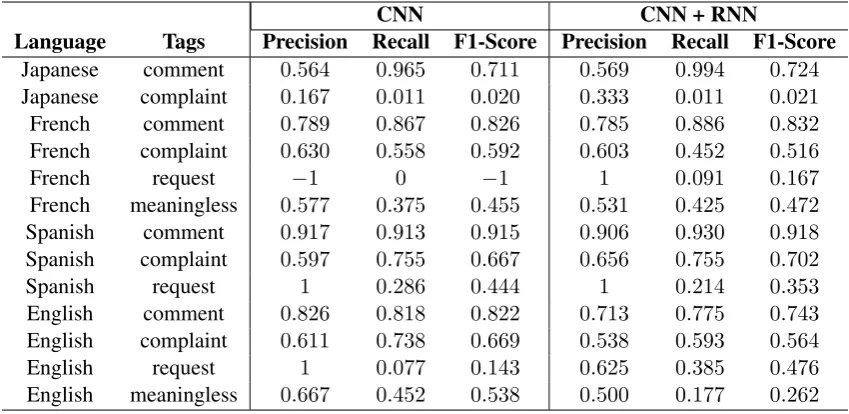
We have submitted our results using both the mod-els as discussed in Section 4.5. Table 3 sum-marizes the performance of both the modelswith original test data. Table4summarizes the perfor-mance of both the models on English translated test data. Table7shows the exact accuracy com-parison with the models which achieve the best ac-curacy as compared to our model and also with the
9https://code.google.com/archive/p/
word2vec/
10due to some computational issues, we were unable to use
CNN CNN + RNN
Language Tags Precision Recall F1-Score Precision Recall F1-Score
Japanese comment 0.564 0.965 0.711 0.569 0.994 0.724 Japanese complaint 0.167 0.011 0.020 0.333 0.011 0.021 French comment 0.789 0.867 0.826 0.785 0.886 0.832 French complaint 0.630 0.558 0.592 0.603 0.452 0.516
French request −1 0 −1 1 0.091 0.167
French meaningless 0.577 0.375 0.455 0.531 0.425 0.472 Spanish comment 0.917 0.913 0.915 0.906 0.930 0.918 Spanish complaint 0.597 0.755 0.667 0.656 0.755 0.702
Spanish request 1 0.286 0.444 1 0.214 0.353
English comment 0.826 0.818 0.822 0.713 0.775 0.743 English complaint 0.611 0.738 0.669 0.538 0.593 0.564
English request 1 0.077 0.143 0.625 0.385 0.476
English meaningless 0.667 0.452 0.538 0.500 0.177 0.262
Table 3: Performance results of the modelwith original test dataat the tags level. We did not provide the results of those tags which were not detected by our model.
CNN CNN + RNN
Language Tags Precision Recall F1-Score Precision Recall F1-Score
Japanese comment 0.808 0.741 0.773 0.706 0.776 0.739 Japanese complaint 0.571 0.766 0.655 0.552 0.511 0.530
Japanese request -1 0 -1 0.667 0.154 0.250
Japanese bug -1 0 -1 0.500 0.071 0.125
French comment 0.837 0.863 0.849 0.766 0.875 0.817 French complaint 0.679 0.692 0.686 0.651 0.538 0.589
French request 1.000 0.091 0.167 -1 0 -1
French meaningless 0.433 0.325 0.371 0.435 0.250 0.317 Spanish comment 0.915 0.895 0.905 0.901 0.913 0.907 Spanish complaint 0.636 0.792 0.706 0.603 0.660 0.631
Spanish request -1 0 -1 0.500 0.071 0.125
Table 4: Performance results of the model withEnglish translated test dataat the tags level. We did not provide the results of those tags which were not detected by our model.
baseline scores. Our systems easily predicted the true labels of sentences which had either positive connotation words like “great”, “pleasant”, “nice”, “good”, etc or negative connotation words like “not”, “slow”, “unable”, “horrible”, etc and classi-fied them intocommentandcomplaintclasses re-spectively. The negative connotation words also appeared in the feedback sentences of bug class. But owing to the larger amount of training data in thecomplaintclass as compared to thebug class, the negative connotation words appeared signifi-cantly in the complaint class. As a result, our systems had difficulty in predicting the true labels for the feedback sentences associated with thebug
class. Our systems were unable to detect some
tags due to the class imbalance problem in the training as well as test data. The scores of our sys-tems could have been much better, provided that we should have more labeled training data. The system performance can be improved by the lan-guage specific pre-trained word embeddings.
5.1 Error Analysis
cate-Error Type Language Feedback Reference Predicted
Ambiguous EN Make a paid version so we don’t have to deal with the ads request complaint
Ambiguous ES La verdad, ir, ir, no va mal. comment complaint
Ambiguous FR Une bouilloire et du th´e et du caf´e dans la chAmbiguousre(ainsi que sucre et lait). La salle de bain ´etait grande. comment complaint
Ambiguous JP その後大浴場でサンセットを見てゆっくり入浴 comment complaint
Missing Target Entity EN Work with any type of PDF comment meaningless Missing Target Entity ES El agua salpicaba el suelo del ba˜no. complaint comment Missing Target Entity FR de la grosse arnaque ! complaint meaningless
Missing Target Entity JP 英語の勉強にもなりそう comment meaningless
Too short EN I gave up. comment complaint
Too short ES Decepcionante complaint meaningless
Too short FR Brunch en famille meaningless comment
Too short JP 使えん complaint meaningless
Table 5: Some of the feedback instances from different languages where our model failed to predict the correct tags.
Parameter Name EN ES FR JP
Embeddings Pre-trained Random Pre-trained Pre-trained
Maximum epochs 100 200 100 100
Mini batch size 64 64 64 64
Number of filters 128 128 128 128
Filter window sizes 3,4,5 3,4,5 3,4,5 3,4,5 Dimensionality of word embedding 300 300 300 300
Dropout keep probability 0.5 0.5 0.5 0.5
Hidden unit size (CNN+RNN) - 300 -
-Table 6: Network hyper-parameters for the best system (ref: -Table7) in each language
Accuracy
Language Best System Our Best System Best Baseline
EN 71.00% 70.00% (CNN) 48.80% ES 88.63% 85.62% (CNN+RNN) 77.26% FR 73.75% 71.75% (CNN-Trans) 54.75% JP 75.00% 63.00% (CNN-Trans) 56.67%
Table 7: Performance comparison with the best system in the shared task and the best baselines (3-gram features based SVM classifier). CNN-Trans: CNN model with English translated test data
gories:
• Ambiguous Feedback: Ambiguous feed-back sentences have several possible mean-ings or interpretations. Our system fails to comprehend such doubtful or uncertain na-ture of customer feedback.
• Missing Target Entity in Feedback: We found some feedback which were pretty straight without having a particular subject entitled to it. These type of feedback sen-tences fail to address about what is being re-ferred to in the sentences. These sentences do not sound complete. Let’s take an
exam-ple : “Work with any type of PDF”. It does not specify any comprehensive meaning. So the questions like “What will work?”, “What is being talked about?” are bound to come up when the feedback sentences have an un-stated subject. This, in turn, generates mis-classification.
• Too Short Feedback: There are several shorter-length feedback sentences, which are generic and do not provide any good evi-dence. Sometimes, these type of feedback sentences fail to convey any proper meaning to the end user who deals with it. The sys-tems also experience difficulty to correctly tag those feedback sentences.
6 Future Work and Conclusion
perform classification of customer feedback sen-tences into six different categories. Our proposed model performed well for all the languages. We have performed thorough error analysis to under-stand where our system fails. We believe that the performance can be improved by employing pre-trained word embeddings of the individual lan-guages. Future work would focus on investigating appropriate deep learning method for classifying the short feedback sentences.
References
Nicholas Asher, Farah Benamara, and Yvette Yannick Mathieu. 2009. Appraisal of opinion expressions in discourse. Lingvisticæ Investigationes, 32(2):279– 292.
Michael Bentley and Soumya Batra. 2016. Giving voice to office customers: Best practices in how office handles verbatim text feedback. 2016 IEEE International Conference on Big Data (Big Data), pages 3826–3832.
Caroline Brun and Caroline Hag`ege. 2013.Suggestion mining: Detecting suggestions for improvement in users’ comments. Research in Computing Science, 70:199–209.
Kyunghyun Cho, Bart van Merrienboer, Caglar Gul-cehre, Dzmitry Bahdanau, Fethi Bougares, Holger Schwenk, and Yoshua Bengio. 2014. Learning phrase representations using rnn encoder–decoder for statistical machine translation. InProceedings of the 2014 Conference on Empirical Methods in Nat-ural Language Processing (EMNLP), pages 1724– 1734, Doha, Qatar. Association for Computational Linguistics.
Ronan Collobert, Jason Weston, L´eon Bottou, Michael Karlen, Koray Kavukcuoglu, and Pavel Kuksa. 2011. Natural language processing (almost) from scratch.J. Mach. Learn. Res., 12:2493–2537. Asif Ekbal Deepak Gupta, Ankit Lamba and Pushpak
Bhattacharyya. 2016. Opinion mining in a code-mixed environment: A case study with government portals. In International Conference on Natural Language Processing, pages 249–258. NLP Asso-ciation of India.
Xavier Glorot, Antoine Bordes, and Yoshua Bengio. 2011. Domain adaptation for large-scale sentiment classification: A deep learning approach. In Pro-ceedings of the 28th international conference on ma-chine learning (ICML-11), pages 513–520.
Deepak Kumar Gupta, Kandula Srikanth Reddy, Asif Ekbal, et al. 2015. Pso-asent: Feature selection using particle swarm optimization for aspect based sentiment analysis. InInternational Conference on Applications of Natural Language to Information Systems, pages 220–233. Springer, Cham.
Robert Hecht-Nielsen. 1992. Neural networks for perception (vol. 2). chapter Theory of the Back-propagation Neural Network, pages 65–93. Harcourt Brace & Co., Orlando, FL, USA.
Minqing Hu and Bing Liu. 2004. Mining and summa-rizing customer reviews. InProceedings of the tenth ACM SIGKDD international conference on Knowl-edge discovery and data mining, pages 168–177. ACM.
Yoon Kim. 2014. Convolutional neural networks for sentence classification. In Proceedings of the 2014 Conference on Empirical Methods in Natural Language Processing (EMNLP), pages 1746–1751, Doha, Qatar. Association for Computational Lin-guistics.
Mu Li and Bao-Liang Lu. 2009. Emotion classifica-tion based on gamma-band eeg. InEngineering in Medicine and Biology Society, 2009. EMBC 2009. Annual International Conference of the IEEE, pages 1223–1226. IEEE.
Tomas Mikolov, Ilya Sutskever, Kai Chen, Greg S Cor-rado, and Jeff Dean. 2013. Distributed representa-tions of words and phrases and their composition-ality. In C. J. C. Burges, L. Bottou, M. Welling, Z. Ghahramani, and K. Q. Weinberger, editors, Ad-vances in Neural Information Processing Systems 26, pages 3111–3119. Curran Associates, Inc. Susan M Mudambi and David Schuff. 2010. What
makes a helpful review? a study of customer reviews on amazon. com.
Vinod Nair and Geoffrey E. Hinton. 2010. Rectified linear units improve restricted boltzmann machines. InProceedings of the 27th International Conference on International Conference on Machine Learning, ICML’10, pages 807–814, USA. Omnipress. Curtis Padgett and Garrison W Cottrell. 1997.
Repre-senting face images for emotion classification. In Advances in neural information processing systems, pages 894–900.
Bo Pang, Lillian Lee, and Shivakumar Vaithyanathan. 2002. Thumbs up?: sentiment classification using machine learning techniques. InProceedings of the ACL-02 conference on Empirical methods in natural language processing-Volume 10, pages 79–86. As-sociation for Computational Linguistics.
Jeffrey Pennington, Richard Socher, and Christo-pher D. Manning. 2014. Glove: Global vectors for word representation. InEmpirical Methods in Nat-ural Language Processing (EMNLP), pages 1532– 1543.
Richard Socher, Alex Perelygin, Jean Wu, Jason Chuang, Christopher D Manning, Andrew Ng, and Christopher Potts. 2013. Recursive deep models for semantic compositionality over a sentiment tree-bank. In Proceedings of the 2013 conference on empirical methods in natural language processing, pages 1631–1642.
Jost Tobias Springenberg, Alexey Dosovitskiy, Thomas Brox, and Martin A. Riedmiller. 2014. Striving for simplicity: The all convolutional net. CoRR, abs/1412.6806.
Nitish Srivastava, Geoffrey E Hinton, Alex Krizhevsky, Ilya Sutskever, and Ruslan Salakhutdinov. 2014. Dropout: a simple way to prevent neural networks from overfitting. Journal of machine learning re-search, 15(1):1929–1958.
Yijun Xiao and Kyunghyun Cho. 2016. Efficient character-level document classification by com-bining convolution and recurrent layers. CoRR, abs/1602.00367.
Changhua Yang, Kevin Hsin-Yih Lin, and Hsin-Hsi Chen. 2007. Emotion classification using web blog corpora. In Web Intelligence, IEEE/WIC/ACM In-ternational Conference on, pages 275–278. IEEE. Zhilin Yang and Xiang Fang. 2004. Online service
quality dimensions and their relationships with sat-isfaction: A content analysis of customer reviews of securities brokerage services. International Journal of Service Industry Management, 15(3):302–326. Dawei Yin, Yuening Hu, Jiliang Tang, Tim Daly,
Mi-anwei Zhou, Hua Ouyang, Jianhui Chen, Chang-sung Kang, Hongbo Deng, Chikashi Nobata, Jean-Marc Langlois, and Yi Chang. 2016. Ranking rele-vance in yahoo search. InProceedings of the 22Nd ACM SIGKDD International Conference on Knowl-edge Discovery and Data Mining, KDD ’16, pages 323–332, New York, NY, USA. ACM.