Universal Dependencies v1:
A Multilingual Treebank Collection
Joakim Nivre
∗Marie-Catherine de Marneffe
◦Filip Ginter
•Yoav Goldberg
†Jan Hajiˇc
‡Christopher D. Manning
Ryan McDonald
/Slav Petrov
/Sampo Pyysalo
.Natalia Silveira
Reut Tsarfaty
?Daniel Zeman
‡∗Uppsala University ◦The Ohio State University •University of Turku [email protected] [email protected] [email protected] †Bar-Ilan University ‡Charles University in Prague Stanford University [email protected] {hajic,zeman}@ufal.mff.cuni.cz {manning,natalias}@stanford.edu
/Google Inc. .University of Cambridge ?The Open University of Israel
{ryanmcd,slav}@google.com [email protected] [email protected]
Abstract
Cross-linguistically consistent annotation is necessary for sound comparative evaluation and cross-lingual learning experiments. It is also useful for multilingual system development and comparative linguistic studies. Universal Dependencies is an open community effort to create cross-linguistically consistent treebank annotation for many languages within a dependency-based lexicalist framework. In this paper, we describe v1 of the universal guidelines, the underlying design principles, and the currently available treebanks for 33 languages.
Keywords:treebanks, dependency, annotation, multilingual, cross-linguistic, universal.
1.
Introduction
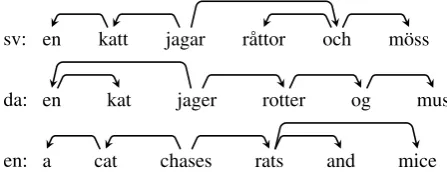
Multilingual research on syntax and parsing has for a long time been hampered by the fact that annotation schemes vary enormously across languages, which has made it virtu-ally impossible to perform sound comparative evaluations and cross-lingual learning experiments. A striking illus-tration of this problem can be found in Figure 1, which shows three parallel sentences in Swedish, Danish and En-glish, annotated according to the guidelines of the Swedish Treebank (Nivre and Megyesi, 2007), the Danish Depen-dency Treebank (Kromann, 2003), and Stanford Typed De-pendencies (de Marneffe et al., 2006), respectively. The syntactic structure is identical in the three languages, but the percentage of shared dependency relations across pairs of languages is at most 40% (and 0% across all three lan-guages). As a consequence, a parser trained on one type of annotation and evaluated on another type will be found to have at least a 60% error rate when it functions perfectly.
The Universal Dependencies (UD) project seeks to tackle this problem by developing cross-linguistically consistent treebank annotation for many languages, aiming to cap-ture similarities as well as idiosyncracies among typolog-ically different languages (e.g., morphologtypolog-ically rich lan-guages, pro-drop lanlan-guages, and languages featuring clitic doubling). In this way, we hope to be able not only to support comparative evaluation and cross-lingual learning but also to facilitate multilingual natural language process-ing and enable comparative lprocess-inguistic studies. To serve all these purposes, the framework needs to have a solid lin-guistic foundation and at the same time be transparent and accessible to non-specialists.
Several separate initiatives exist to build consistent re-sources for many languages, and the UD project is a merger of some of the initiatives. It combines the (universal) Stan-ford dependencies (de Marneffe et al., 2006; de Marneffe and Manning, 2008; de Marneffe et al., 2014), the universal
sv: en katt jagar r˚attor och m¨oss
det nsubj conj
dobj
conj
da: en kat jager rotter og mus
nsubj
? dobj cc conj
en: a cat chases rats and mice
det nsubj dobj cc
conj
Figure 1: Divergent annotation of parallel structures
Google dependency scheme (Universal Dependency Tree-banks) (McDonald et al., 2013), the Google universal part-of-speech tags (Petrov et al., 2012), and the Interset inter-lingua for morphosyntactic tag sets (Zeman, 2008) used in the HamleDT treebanks (a project that transforms existing treebanks under a common annotation scheme, Zeman et al. 2012). UD is thus based on common usage and existing de facto standards, and is intended to replace all the previ-ous versions by a single coherent standard.1 The general
philosophy is to provide a universal inventory of categories and guidelines to facilitate consistent annotation of similar constructions across languages, while allowing language-specific extensions when necessary.
In this paper, we present version 1 of the universal guide-lines and explain the underlying design principles. We give an overview of the 37 treebanks that constitute the latest release (v1.2), representing 33 different languages, and conclude with a few words about the future of the project. Guidelines for specific languages can be found at
http://universaldependencies.org.
1
Toutefois , les filles adorent les desserts `a le chocolat .
toutefois , le fille adorer le dessert `a le chocolat .
ADV PUNCT DET NOUN VERB DET NOUN ADP DET NOUN PUNCT
Definite=Def Gender=Fem Number=Plur Definite=Def Gender=Masc Definite=Def Gender=Masc
Number=Plur Number=Plur Person=3 Number=Plur Number=Plur Number=Sing Number=Sing
Tense=Pres
Figure 2: UD annotation for a French sentence. (Translation: However, girls love chocolate desserts.)
2.
History
UD comprises two layers of annotation with diverse ori-gins. The Google universal tag set used in the morpho-logical layer grew out of the cross-linguistic error analysis based on the CoNLL-X shared task data by McDonald and Nivre (2007). It was initially used for unsupervised part-of-speech tagging by Das and Petrov (2011), and has been adopted as a widely used standard for mapping diverse tag sets to a common standard. The morphological layer also builds on Interset (Zeman, 2008), which started as a tool for conversion between morphosyntactic tag sets of mul-tiple languages. It dates back to 2006 when it was used in the first experiments with cross-lingual delexicalized parser adaptation (Zeman and Resnik, 2008). The Stanford depen-dencies, used in the syntactic layer, were developed for En-glish in 2005 and eventually emerged as the de facto stan-dard for dependency analysis of English. They have since been adapted to a number of different languages (Chang et al., 2009; Bosco et al., 2013; Haverinen et al., 2013; Seraji et al., 2013; Lipenkova and Souˇcek, 2014).
These resources have featured in other attempts at uni-versal standards. The Google Uniuni-versal Dependency Tree-bank (UDT) project (McDonald et al., 2013) was the first attempt to combine the Stanford dependencies and the Google universal part-of-speech tags into a universal anno-tation scheme: treebanks were released for 6 languages in 2013 (English, French, German, Spanish, Swedish and Ko-rean) and for 11 languages in 2014 (Brazilian Portuguese, English, Finnish, French, German, Italian, Indonesian, Japanese, Korean, Spanish and Swedish). The first pro-posal for incorporating morphology was made by Tsarfaty (2013). The second version of HamleDT (Rosa et al., 2014) provided Stanford/Google annotation for 30 languages by automatically harmonizing treebanks with different native annotations. These efforts were followed by the develop-ment of the universal Stanford dependencies (USD), revis-ing Stanford Dependencies for cross-lrevis-inguistic annotations in light of the Google scheme (de Marneffe et al., 2014).
UD is the result of merging all these initiatives into a single coherent framework, based on the universal Stanford dependencies, an extended version of the Google universal tag set, a revised subset of the Interset feature inventory, and a revised version of the CoNLL-X format (which we call CoNLL-U). The first version of the annotation guide-lines were released in October 2014. There have been three releases of treebanks, for 10 languages (January 2015), 18 languages (May 2015), and 33 languages (November 2015), respectively.
3.
Annotation Guideline Principles
The syntactic annotation in UD is based on dependency, which is widely used in contemporary NLP, both for tree-bank annotation and as a parsing representation. It is also based onlexicalism, the idea that words are the basic units of grammatical annotation. Words have morphological properties and enter into syntactic relations, which is what the UD annotation is primarily meant to capture. To ar-rive at an adequate grammatical representation, it is impor-tant to note that syntactic wordhood does not always coin-cide with whitespace-separated orthographic units, and an-other important design consideration is that there should be a transparent relation between the original textual represen-tation and the linguistically motivated word segmenrepresen-tation. We call this therecoverabilityprinciple.
To obtain a cross-linguistically consistent and transpar-ent annotation, we want to maximize the parallelism be-tween languages and make sure that the same construction is annotated in the same way across languages. At the same time, we do not want to go too far and, in particular, we do not want to annotate things that do not exist in a language simply because they exist in other languages. The idea is to use a universal pool of structural and functional categories that languages select from. Moreover, it should be possible to refine the analysis by adding language-specific subtypes of universal categories.
Figure 2 uses the French sentence Toutefois, les filles
adorent les desserts au chocolat (However, the girls love
chocolate desserts) to exemplify the different UD annota-tion layers, which are described in more detail in the fol-lowing sections.
3.1.
Word Segmentation
Following the lexicalist view, the basic annotation units in UD are syntactic words (not phonological or ortho-graphic words). Concretely, clitics are split off (e.g., Span-ish d´amelo‘give me it’ = d´a me lo) and contractions are undone (e.g., French au = `a le; see Figure 2) when this is necessitated by the syntactic analysis, but for recover-ability the original tokens are included as well. UD cur-rently does not allow words with spaces, and even though the lexicalist view could be taken to imply that multiword expressions should be treated as single words, multiword expressions are annotated using special dependency rela-tions, rather than by collapsing multiple tokens into one.
3.2.
Morphology
Open class words Closed class words Other
ADJ adjective ADP preposition/postposition PUNCT punctuation
ADV adverb AUX auxiliary SYM symbol
INTJ interjection CONJ coordinating conjunction X unspecified POS
NOUN noun DET determiner
PROPN proper noun NUM numeral
VERB verb PART particle
PRON pronoun
SCONJ subordinating conjunction
Table 1: Part-of-speech tags in UD v1. (Bold indicates addition to the original Google tag set, including AUX and PROPN which were added in UDT.)
Lexical Inflectional
(Nominal) (Verbal) PronType Gender VerbForm NumType Animacy Mood
Poss Number Tense
Reflex Case Aspect
Definite Voice Degree Person
Negative
Table 2: Morphological features in UD v1.
tag as well as a set of features which encode lexical and grammatical properties associated with the word form (see Figure 2).
Table 1 lists the 17 part-of-speech tags, which come from a revised version of the Google universal POS, divided into open class words, closed class words, and other symbols. This tag inventory is meant to be fixed and used for all languages, but not all categories have to be used in all languages. For example, the distinction between common nouns (NOUN) and proper nouns (PROPN) is not gram-maticalized in all languages.
Table 2 lists the current inventory of morphological fea-tures, based on the Interset system. Each feature is asso-ciated with a set of values (e.g., Number can take the val-ues Sing[ular], Plur[al], Dual, Ptan [plurale tantum], and Coll[ective]). Languages select the subset of features and values that are relevant, but it is also possible to add new features and values if needed.
3.3.
Syntax
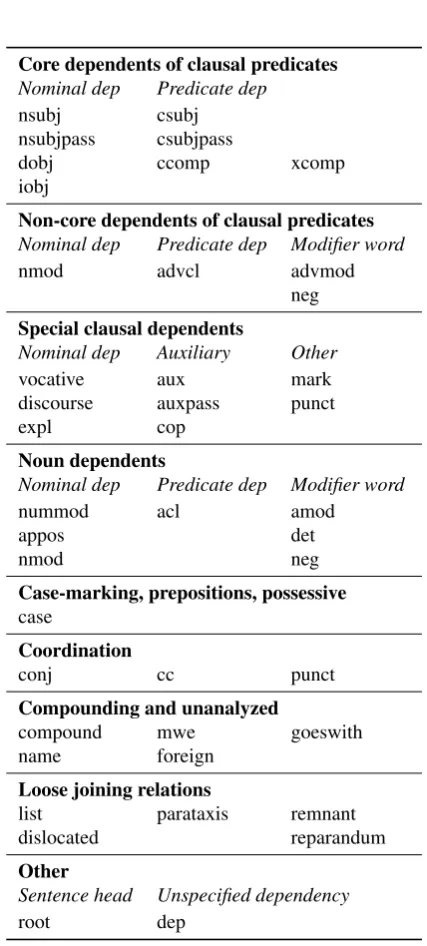
In v1, UD contains 40 grammatical relations between words, listed in Table 3.
Grammatical Relations
The organization of the relations distinguishes between three types of structure: nominals, clauses and modifier words. The scheme also makes a distinction between core arguments (e.g., subject and object) and other dependents, but does not attempt to distinguish complements vs. ad-juncts. By design, UD indicates in the dependency la-bels whether dependents are phrases or clauses, thus
distin-Core dependents of clausal predicates
Nominal dep Predicate dep
nsubj csubj
nsubjpass csubjpass
dobj ccomp xcomp
iobj
Non-core dependents of clausal predicates
Nominal dep Predicate dep Modifier word
nmod advcl advmod
neg
Special clausal dependents
Nominal dep Auxiliary Other
vocative aux mark
discourse auxpass punct
expl cop
Noun dependents
Nominal dep Predicate dep Modifier word
nummod acl amod
appos det
nmod neg
Case-marking, prepositions, possessive case
Coordination
conj cc punct
Compounding and unanalyzed
compound mwe goeswith
name foreign
Loose joining relations
list parataxis remnant
dislocated reparandum
Other
Sentence head Unspecified dependency
root dep
guishingnsubjandcsubj,dobjandccomp,advmodand ad-vcl. It also recognizes a non-canonical voice subject (where the proto-agent argument is not subject, e.g., in passives). Following Lexical-Functional Grammar (Bresnan, 2001), UD includes a distinction between ccompand xcompfor clausal complements that are standalone (have an internal subject) versus those having obligatory control (omission) of the dependent predicate’s subject (have an external sub-ject). The non-core clausal dependents are all modifiers. UD does not attempt to differentiate finite from non-finite clauses, but differentiates attachment to predicates from at-tachment to nominals: an adverbial clauseadvclmodifies a predicate whereas anacl(“clausal modifier of noun”) mod-ifies a nominal.
The UD scheme has a rich taxonomy of noun dependents inherited from the Stanford dependencies, as well as re-lations to capture phenomena appearing in non-edited or informal texts (such as goeswith to connect multiple to-kens that correspond to a single standard word (e.g., “hand some” for “handsome”) orreparandumto indicate disflu-encies overridden in a speech repair).
UD differentiates compounding from modification or complementation, and there are three relations for com-pounding. We use mwe for fixed grammaticized expres-sions with function words, left-headed (e.g., instead of: mwe(instead, of), de facto: mwe(de, facto)). We use namefor names constituted of multiple proper nouns, left-headed. That is, namewould be used between the words ofHillary Rodham Clintonbut not to replace the usual re-lations in a phrasal or clausal name like The Lord of the Rings. And we usecompoundto label other types of multi-word lexemes, with headedness according to the language and/or compound type. Thus, compound is used for any kind of X0 compounding: noun compounds (e.g., phone book), but also verb and adjective compounds that are more common in other languages (such as Persian or Japanese light verb constructions); for numbers (e.g.,three thousand
books gives compound(thousand, three)); for particles of
phrasal verbs (e.g.,put up:compound(put, up)).
Relations between Content Words
Each word depends either on another word in the sentence or on a notional “root” of the sentence, following three prin-ciples: content words are related by dependency relations; function words attach to the content word they further spec-ify; and punctuation attaches to the head of the phrase or clause in which it appears, as illustrated in Figure 2. Giving priority to dependency relations between content words in-creases the probability of finding parallel structures across languages, since function words in one language often cor-respond to morphological inflection (or nothing at all) in other languages.
These principles lead to the following treatment of cop-ula and auxiliaries: they are not the head of a clause, but depend on a lexical predicate, as in (1a) and (2a). Such treatment maximizes the parallelism between dependency trees in different languages: compare (1a) and (1b) where Russian does not have an overt copula. Similarly, com-pare (2a) and (2b) where the future tense in French can be marked morphologically.
(1) a. Ivan is the best dancer
nsubj
(2) a. Ivan will participate in the show
nsubj
aux nmod
root
b. French:
Ivan participera au spectacle
Ivan will participate in the show
nsubj nmod
root
To have relations between content words, any case-marking element (including prepositions, postpositions, and clitic case markers) is treated as a dependent of the noun it at-taches to or introduces. As can be seen in (3a) and (3b), nmodlabels the relation between the two content words of-ficeandChair, whereas the preposition or the possessive marker is acasedepending on its complement. In general, nmod expresses some form of oblique or adjunct relation which can be further specified by thecaseor be morpho-logically marked as in (3c). Coordination follows a similar treatment: the leftmost conjunct is the head, and other con-juncts as well as the coordinating conjunction depend on it, as in (4).
(3) a. the Chair ’s office
det
nmod case
b. the office of the Chair
det
nmod case
det
c. Greek:
to grafe´ıo tou pro´edrou
the-NOM office-NOM the-GEN Chair-GEN
det
nmod det
(4) gold , silver and bronze
punct conj
cc conj
These principles provide parallelism between different con-structions across and within languages, as emphasized in (3) where the different constructions of possessive (posses-sive clitic, preposition or morphologically marked) are all parallel. For instance in English, we also obtain parallel representations between prepositional phrases and subordi-nate clauses, which are in practice often introduced by a preposition, as in (5).
(5) a. Sue left after the rehearsal
nsubj
nmod
b. Sue left after we did
nsubj
advcl
mark nsubj
The choice to make content words the backbone of the syntactic representations may seem to be at odds with the strong tendency in modern syntactic theory to give prior-ity to functional heads, a tendency that is found in both constituency-based and dependency-based approaches to syntax (Brug´e et al., 2012; Osborne and Maxwell, 2015). We believe, however, that this conflict is more apparent than real. The UD view is that we need to recognize both lexical and functional heads, but in order to maximize parallelism across languages, only lexical heads are inferable from the topology of our tree structures. Functional heads are in-stead represented as specifying features of content words, using dedicated relation labels, features which can alter-natively be specified through morphological processes. In the dependency grammar tradition, this is very close to the view of Tesni`ere (1959), according to whom dependencies hold between nuclei that always contain a content word, and where function words combine with content words to form dissociated nuclei. Moreover, it seems highly com-patible with the view dominant in typologically grounded syntactic theories such as that of Dixon (2009).
Enhanced Representation
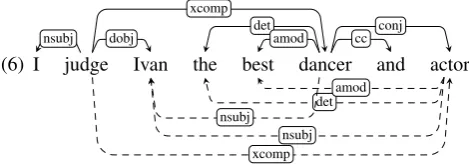
The basic dependency structure is assumed to form a (pos-sibly non-projective) tree but UD also allows additional dependencies in anenhanceddependency representation.2
The idea behind the enhanced dependency representation is to explicitly mark external subjects and the external role in relative clauses as well as to propagate relations over con-junctions, as shown in (6) where additional dependencies are indicated with dashed arrows below the sentence.
(6) I judge Ivan the best dancer and actor
nsubj dobj
In addition to universal relations, UD allows the use of language-specific subtypes to capture special phenomena in different languages. For instance, while the universal UD scheme has a single relationaclfor adnominal clauses, sev-eral languages make use of the subtypeacl:relclto distin-guish relative clauses as an important subtype of adnominal clauses. By design, we can always map back to the core la-bel set by stripping the specific relations that appear after the colon. For a complete list of currently used language-specific relations, we refer to the UD website.
2Complete guidelines for the enhanced representations have
not been worked out yet, and only one treebank (Finnish) uses them so far, but see Schuster and Manning (2016) for a concrete proposal for English.
Language Sentence Token Word Lemma PoS Feat Dep LDep
Ancient Greek 16221 244993 244993 15721 13 33 26 0
Ancient GreekPROIEL 16633 206966 206966 9256 13 41 31 0
Arabic 7664 282384 282384 – 16 36 30 1
Basque 8993 121443 121443 11085 16 69 30 0
Bulgarian 11138 156319 156319 14900 16 44 31 0
Croatian 3957 87765 87765 8884 14 38 39 0
Czech 87913 1503738 1506490 59008 17 82 35 5
Danish 5512 100733 100733 13355 17 46 36 5
Dutch 13735 200654 200654 21505 16 59 29 2
English 16622 254830 254830 17784 17 34 40 7
Estonian 1315 9491 9491 3634 15 59 23 3
Finnish 13581 181022 181022 24177 15 84 33 11
FinnishFTB 18792 159531 159829 21573 14 64 23 2
French 16446 389764 401491 – 17 – 35 2
German 15894 293088 298242 – 15 – 32 1
Gothic 5450 56128 56128 3353 13 36 30 0
Greek 2411 59156 59156 6201 11 30 27 1
Hebrew 6216 115535 158855 – 16 39 29 14
Hindi 16647 351704 351704 15586 16 43 26 1
Hungarian 1299 26538 26538 6477 16 70 32 22
Indonesian 5593 121923 121923 – 16 – 30 0
Irish 1020 23686 23686 3964 16 63 28 10
Italian 12677 252967 271180 18576 17 36 35 4
JapaneseKTC 9995 267631 267631 5241 16 – 30 0
Latin 3269 47303 47303 7457 12 35 26 0
LatinITT 15295 259684 259684 3374 14 50 29 2
LatinPROIEL 14982 165201 165201 7059 13 40 32 0
Norwegian 20045 311277 311277 23651 17 31 34 2
Old Church Slavonic 6346 57507 57507 2964 13 41 29 0
Persian 5997 151624 152871 – 15 30 31 7
Polish 8227 83571 83571 12904 13 46 27 0
Portuguese 9359 212545 212545 19499 17 46 29 2
Romanian 633 12094 12094 3917 17 53 38 11
Slovenian 7996 140418 140418 16946 16 60 31 1
Spanish 16013 423346 431587 35923 16 45 31 1
Swedish 6026 96819 96819 10260 15 27 35 4
Tamil 600 9581 9581 2023 14 41 24 2
TOTAL 430512 7438959 7529911
Table 4: Statistics on treebanks released in UD v1.2. Sen-tence: number of sentences. Token: number of unseg-mented tokens. Word: number of segunseg-mented tokens (syn-tactic words). Lemma: number of unique lemmas. PoS: number of unique part-of-speech tags. Feat: number of unique Feature=Value pairs. Dep: number of unique dency relations. LDep: number of language-specific depen-dency relations. (Note that not all treebanks have lemmas and features.)
3.4.
Format and Tools
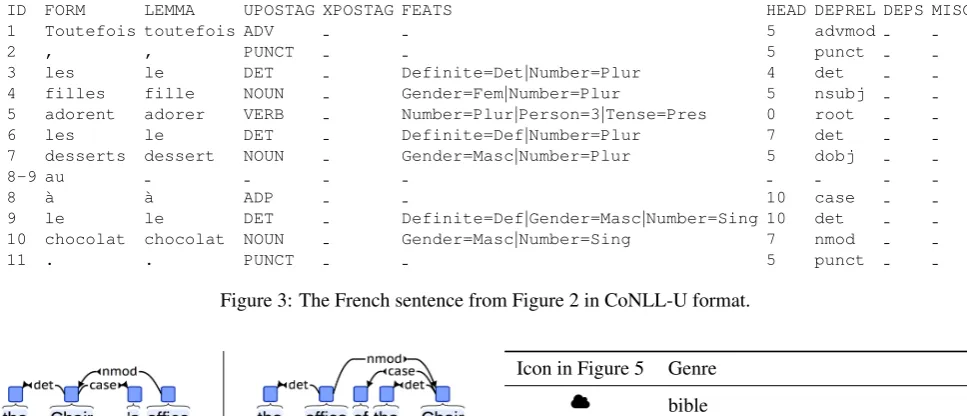
The data is encoded in the CoNLL-U format, which is an evolution of the widely used CoNLL-X format (Buchholz and Marsi, 2006), where each word/token is represented in tab-separated columns on one line and sentence boundaries are marked by blank lines. The 10 columns on a word/token line are used to specify a unique id (integer for words, ranges for multiword tokens), word form, lemma, univer-sal speech tag, optional language-specific part-of-speech tag, morphological features, head, dependency re-lation, additional dependencies in the enhanced represen-tation and miscellaneous information. The format is illus-trated in Figure 3, with the French sentence from Figure 2. To support work on treebanks in this format, we have introduced Python and JavaScript libraries for reading and validating CoNLL-U.3 The UD documentation efforts are supported by the Annodoc system4 (Pyysalo and Ginter, 2014), with annotation visualizations generated using brat
3
http://github.com/universaldependencies/
ID FORM LEMMA UPOSTAG XPOSTAG FEATS HEAD DEPREL DEPS MISC
1 Toutefois toutefois ADV 5 advmod
2 , , PUNCT 5 punct
3 les le DET Definite=Det|Number=Plur 4 det
4 filles fille NOUN Gender=Fem|Number=Plur 5 nsubj
5 adorent adorer VERB Number=Plur|Person=3|Tense=Pres 0 root
6 les le DET Definite=Def|Number=Plur 7 det
7 desserts dessert NOUN Gender=Masc|Number=Plur 5 dobj
8-9 au
8 `a `a ADP 10 case
9 le le DET Definite=Def|Gender=Masc|Number=Sing 10 det
10 chocolat chocolat NOUN Gender=Masc|Number=Sing 7 nmod
11 . . PUNCT 5 punct
Figure 3: The French sentence from Figure 2 in CoNLL-U format.
Figure 4: Examples of annotation visualization from UD documentation.
(Stenetorp et al., 2012).5 Figure 4 shows an example of
the visualization. The treebanks can also be queried on-line using the SETS6 and PML TreeQuery7 tools (Luoto-lahti et al., 2015; ˇStˇep´anek and Pajas, 2010). These tools allow querying any of the UD treebanks, freely combining restrictions on the existence or absence of wordforms, lem-mas, POS tags, morphological features, dependency labels, and subtrees. The results are shown in a graphical form in the browser, with the relevant tokens highlighted, or as a summary table with frequency counts.
4.
Existing Treebanks
The release of UD treebanks in November 2015 (v1.2) comprises 37 treebanks representing 33 languages, listed in Table 4. All treebanks contain annotation of parts-of-speech and dependency relations. Most treebanks in addi-tion provide lemmas and morphological features. There is variation in the treebank sizes. The treebanks are listed with descriptive statistics in Table 4, which gives the number of sentences (ranging from 600 sentences to almost 90,000), unsegmented tokens (ranging from about 9,000 tokens to well over 1.5 million tokens), segmented tokens (syntactic words), unique lemmas, unique part-of-speech tags, unique morphological Feature=Value pairs, unique dependency re-lations, and unique language-specific dependency relations. Zeros in the table indicate annotation layers that are still missing rather than language-specific properties. Simi-larly, some treebanks have not yet produced the syntactic word segmentation, resulting in identical numbers of un-segmented and un-segmented tokens.
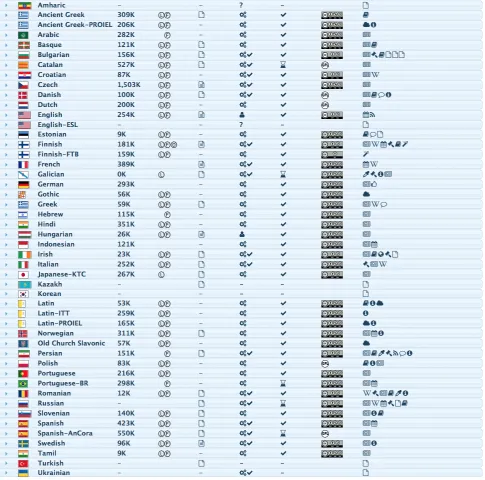
Figure 5 is a screenshot from the web documentation of the UD treebanks in March 2016 (treebanks included in v1.2, as indicated by the check mark in the 7th column, as well as in progress and scheduled to be released in the
5http://brat.nlplab.org/ 6
http://bionlp-www.utu.fi/dep_search
7
http://lindat.mff.cuni.cz/services/pmltq/
Icon in Figure 5 Genre
bible blog fiction
grammar examples legal text
medical text news non-fiction reviews spoken
social (other user-generated content) web
wikipedia
Table 5: Genres present in the UD treebanks.
future). Table 5 gives the mapping for genre icons used in Figure 5. Most treebanks are constituted of different gen-res. While newswire is quite present, there are other genres well represented in several languages such as web data (re-views, blogs), fiction and legal documents. As indicated in Figure 5, the extent to which the data has been manually an-notated or automatically converted from existing treebanks varies, and there is a continuing effort to further improve the consistency of the annotation across languages.
5.
Conclusion
The UD project aims at developing cross-linguistically con-sistent treebank annotation for many languages in order to support multilingual parsing research, as well as practical development of multilingual NLP systems and comparative linguistic studies of syntax. To date, we have produced a first version of the universal guidelines and released 37 tree-banks where the guidelines have been applied to 33 differ-ent languages. According to Wikipedia,8 these languages
cover almost 35% of native speakers in the world (adding Chinese would bring us up to almost 60%). Although there is still a strong bias towards contemporary Indo-European
8https://en.wikipedia.org/wiki/List_of_
Figure 5: UD treebanks at a glance. Columns show the number of unsegmented tokens in each treebank, whether the treebank contains features (F), lemmas (L) and secondary dependencies (D), the status of the online documentation (partial or complete ), the type of conversion to the UD scheme (automatic , automatic with some manual corrections , or fully checked manually ), the release status, the treebank license type, and the data genres.
languages in the sample, we are starting to see the emer-gence of treebanks for other language families as well as treebanks for classical languages.
We plan to continue with treebank releases twice a year to keep up the momentum of the project. In the near fu-ture, our main priority is to improve the consistency and completeness of annotations for all languages, but we are also eager to expand the sample of languages and welcome all new contributors to the project. As a medium-term goal we envisage an improved version of the universal guide-lines, based on an analysis of issues that have arisen in the work on improving consistency across languages. Ide-ally, the next version of the guidelines should also cover
the enhanced dependencies. In parallel to the development of guidelines and annotated corpora, finally, we hope to be able to release tools for tokenization, morphological analy-sis and syntactic parsing for all languages, as well as large-scale parsebanks (automatically parsed corpora).
Acknowledgements
Choi, C¸ a˘grı C¸ ¨oltekin, Kaja Dobrovoljc, Timothy Dozat, Binyam Ephrem, Tomaˇz Erjavec, Rich´ard Farkas, Jen-nifer Foster, Iakes Goenaga, Koldo Gojenola, Bruno Guil-laume, Nizar Habash, Dag Haug, Hiroshi Kanayama, Jenna Kanerva, Simon Krek, Juha Kuokkala, Veronika Laippala, Alessandro Lenci, Krister Lind´en, Nikola Ljubeˇsi´c, Olga Lyashevskaya, Teresa Lynn, Aibek Makazhanov, Catalina M˘ar˘anduc, H´ector Mart´ınez Alonso, Anna Missil¨a, Simon-etta Montemagni, Verginica Mititelu, Yusuke Miyao, Shin-suke Mori, Hanna Nurmi, Petya Osenova, Lilja Øvrelid, Petr Pajas, Elena Pascual, Marco Passarotti, Jussi Piitu-lainen, Barbara Plank, Prokopis Prokopidis, Loganathan Ramasamy, Sebastian Schuster, Wolfgang Seeker, Moj-gan Seraji, Maria Simi, Kiril Simov, Aaron Smith, Jan ˇStˇep´anek, Alane Suhr, Takaaki Tanaka, Anders Trærup Jo-hannsen, Francis Tyers, Sumire Uematsu, Veronika Vincze, Rob Voigt, and Jonathan Washington. The work has been partially funded by the Czech Science Foundation grant GA15-10472S, Czech MEYS grant LM2015071, and SWE-CLARIN.
References
Bosco, C., Montemagni, S., and Simi, M. (2013). Con-verting Italian treebanks: Towards an Italian Stanford dependency treebank. In LAW & Interoperability with Discourse.
Bresnan, J. (2001). Lexical-Functional Syntax. Blackwell, Oxford.
Laura Brug´e, et al., editors. (2012).Functional Heads. The
Cartography of Syntactic Structures, Volume 7. Oxford
University Press.
Buchholz, S. and Marsi, E. (2006). CoNLL-X shared task on multilingual dependency parsing. InCoNLL, pages 149–164.
Chang, P.-C., Tseng, H., Jurafsky, D., and Manning, C. D. (2009). Discriminative reordering with Chinese gram-matical relations features. InSSST, pages 51–59. Das, D. and Petrov, S. (2011). Unsupervised
part-of-speech tagging with bilingual graph-based projections. InACL, pages 600–609.
de Marneffe, M.-C. and Manning, C. D. (2008). The Stan-ford typed dependencies representation. InWorkshop on
Cross-framework and Cross-domain Parser Evaluation.
de Marneffe, M.-C., MacCartney, B., and Manning, C. D. (2006). Generating typed dependency parses from phrase structure parses. InLREC.
de Marneffe, M.-C., Dozat, T., Silveira, N., Haverinen, K., Ginter, F., Nivre, J., and Manning, C. D. (2014). Univer-sal Stanford dependencies: A cross-linguistic typology. InLREC, pages 4585–4592.
Dixon, R. M. (2009). Basic Linguistic Theory. Volume 1:
Methodology. Oxford University Press.
Haverinen, K., Nyblom, J., Viljanen, T., Laippala, V., Ko-honen, S., Missil¨a, A., Ojala, S., Salakoski, T., and Ginter, F. (2013). Building the essential resources for Finnish: the Turku dependency treebank. Language Re-sources and Evaluation. In press. Available online. Kromann, M. T. (2003). The Danish Dependency
Tree-bank and the DTAG treeTree-bank tool. InTLT, pages 217– 220.
Lipenkova, J. and Souˇcek, M. (2014). Converting Rus-sian dependency treebank to Stanford typed dependen-cies representation. InEACL.
Luotolahti, J., Kanerva, J., Pyysalo, S., and Ginter, F. (2015). SETS: scalable and efficient tree search in de-pendency graphs. InNAACL Demo, pages 51–55. McDonald, R. and Nivre, J. (2007). Characterizing the
er-rors of data-driven dependency parsing models. In
Pro-ceedings of EMNLP-CoNLL, pages 122–131.
McDonald, R., Nivre, J., Quirmbach-Brundage, Y., Gold-berg, Y., Das, D., Ganchev, K., Hall, K., Petrov, S., Zhang, H., T¨ackstr¨om, O., Bedini, C., Bertomeu Castell´o, N., and Lee, J. (2013). Universal dependency annotation for multilingual parsing. InACL.
Nivre, J. and Megyesi, B. (2007). Bootstrapping a Swedish treeebank using cross-corpus harmonization and annota-tion projecannota-tion. InTLT, pages 97–102.
Osborne, T. and Maxwell, D. (2015). A historical overview of the status of function words in dependency grammar. In Proceedings of the Third International
Conference on Dependency Linguistics (Depling 2015),
pages 241–250.
Petrov, S., Das, D., and McDonald, R. (2012). A universal part-of-speech tagset. InLREC.
Pyysalo, S. and Ginter, F. (2014). Collaborative develop-ment of annotation guidelines with application to Uni-versal Dependencies. InSLTC.
Rosa, R., Maˇsek, J., Mareˇcek, D., Popel, M., Zeman, D., and ˇZabokrtsk´y, Z. (2014). HamleDT 2.0: Thirty de-pendency treebanks stanfordized. InLREC, pages 2334– 2341.
Schuster, S. and Manning, C. D. (2016). Enhanced english universal dependencies: An improved representation for natural language understanding tasks. In Proceedings of the 10th International Conference on Language Re-sources and Evaluation.
Seraji, M., Jahani, C., Megyesi, B., and Nivre, J. (2013). Uppsala Persian dependency treebank annotation guide-lines. Technical report, Uppsala University.
Stenetorp, P., Pyysalo, S., Topi´c, G., Ohta, T., Ananiadou, S., and Tsujii, J. (2012). Brat: a web-based tool for NLP-assisted text annotation. InACL Demo, pages 102– 107.
ˇStˇep´anek, J. and Pajas, P. (2010). Querying diverse tree-banks in a uniform way. InLREC.
Tesni`ere, L. (1959). El´ements de syntaxe structurale´ . Edi-tions Klincksieck.
Tsarfaty, R. (2013). A unified morpho-syntactic scheme of Stanford dependencies. InACL.
Zeman, D. and Resnik, P. (2008). Cross-language parser adaptation between related languages. In IJCNLP-08
Workshop on NLP for Less Privileged Languages, pages
35–42.
Zeman, D., Mareˇcek, D., Popel, M., Ramasamy, L., ˇStˇep´anek, J., ˇZabokrtsk´y, Z., and Hajiˇc, J. (2012). Ham-leDT: To parse or not to parse? InLREC, pages 2735– 2741.