IJEDR1501060
International Journal of Engineering Development and Research (www.ijedr.org)331
A Novel Message Scheduling Framework for
Optimum Delivery Ratio and Minimum Delay in
Endemic Routing
B.Sofiya Parveen, T.Sudha,
PG Student, Assistant Professor Electronics and communication engineering,Ganadipathy Tulsi’s Jain Engineering College, Vellore,Tamil Nadu.
_______________________________________________________________________________________________________
Abstract - Delay tolerant network is an approach should be used in computer network architecture and it may lack of continuous network connectivity. Epidemic routing is the approach in DTN. For efficient transmission of message in the network the main resource is message delivery ratio should be high and delay should be minimum, by doing this effective scheduling strategy should determine. In proposed concept a new scheduling framework for endemic and two-hop forwarding routing in heterogeneous DTN. Such as forwarding decision can be made at a node for optimum message delivery ratio and minimum delay.
Keyword - DTN, Routing, Message Scheduling.
________________________________________________________________________________________________________
I. INTRODUCTION
The main concept of delay tolerant network is the lack of an end-to-end path for node. For frequent disconnection due to in mobility of nodes is the network delay tolerant network.A node wait until the link should be available to another hop. Hop will forward the message until it reaches the destination node[2]. This model constitutes a adhoc routing such as “spray routing” Rapid routing and claim-carry-check routing. Explain in detailed about endemic routing and two-hop forwarding [1].
This paper proposed a novel scheduling framework for optimum delivery ratio and minimum delay in DTN under endemic and two-hop forwarding effective decision and efficient transmission of a packet is full in DTN network. Geographic routing protocols allow stateless routing in mobile ad hoc networks (MANETs) by taking advantage of the location information of mobile nodes and thus are highly scalable[5].
Evaluation of forwarding/Dropping each buffered message according to the collected information of a network. Forwarding decision can be made at a node by the optimum message delivery ratio and minimum delay.
Here the message scheduling technique will optimize the delivery ratio and the delivery delay of the message. Here the novel message scheduling will be decided which message have to forward and drop when the buffer is full. In proposed concept the packets are deliver in endemic routing the using modules are Network State Estimation Module (NSEM), Utility Calculation Module(UCM).Summary Vector Module(SVEM) and decision.
II. RELATED WORK OF PROPOSED SYSTEM
1. Network Configuration Module
In network configuration module, a Local network is constructed using sender node, intermediate nodes and Receiver node. Then connection establishment is made between them for file transformation over the network. Given power limitations, the advent of short-range wireless networks, and the wide physical conditions over which adhoc networks must be deployed, in some scenarios it is likely that this assumption is invalid[6].
In This it develop techniques to deliver messages in the case where there is never a connected path from source to destination or when a network partition existant the time a message is originated. To this end introduce epidemic routing, where random pair wise exchanges of Messages among mobile hosts ensure eventual message delivery. The goals of
Epidemic Routing are to:
1. Maximize message delivery rate. 2. Minimize message latency.
IJEDR1501060
International Journal of Engineering Development and Research (www.ijedr.org)332
Fig1: Message Scheduling Framework 2. Data Transfer Module
In this module the sender sends the file.To its all neighbor nodes, which are said to be the intermediate nodes. All the intermediate nodes will receive the file From the sender. The intermediate nodes maintain the incoming data details such as file name, file size, file type and destination. There are two widely employed DTN routing schemes, namely; the epidemic and controlled flooding schemes. With the Epidemic scheme, whenever two nodes encounter each other, they exchange all messages they do not have in common. Therefore, the message copies are spread like an “epidemic” throughout the network to every node using the maximum amount of resources. With controlled flooding, a limited number of copies of each message are generated and disseminated throughout the network hop forwarding or source. Average elapsed time for all the message data transfer between the nodes is T^=Σi=1toj*Ti/ j. Where j is the total number of messages that have been seen by the nodes. Ti is the time taken by the Message to reach the destination.
1. Sender sends the file to its all intermediate nodes. 2. All the intermediate nodes will receive the file.
3. The intermediate nodes maintain incoming data details such as, File size.
File name.
File type and destination.
3.Buffer Management Module
In this module the buffer details are maintained by the intermediate nodes. The buffer size will alter according to the arrival of the files. The buffer details include total buffer size, occupied size and Available size. The neighbor node details are also maintained by the intermediate nodes.The buffer management scheme that divides the buffer into a number of queues Different priorities. When the entire buffer is full, some of the messages in the lowest priority queue are dropped to give room for new messages. Specifically, their method estimates the number of copies of message i
Based on the number of buffered messages that were created before message i. Although interesting, the method may become inaccurate when the number of network nodes is getting larger, especially for newly generated message. Moreover, it is assumed that every node is aware of all messages that has encountered during contacts with other nodes, which raises practicability issue. Maintaining such message forwarding history is expected to cause very high overhead. It is clear that it leaves a large room to improve, where a solution for DTN message scheduling that can well estimate and manipulate the perceived nodal status is absent. The buffer size will alter according to the arrival of the files. The buffer details include total buffer size, occupied size and available size.
Fig:2 Buffer Management 4. Message Scheduling
This module is used for the purpose of Message scheduling. The message scheduling framework consists of 4 processes. 4.1.Summary Vector Exchange Module
(SVEM):
The network information summarized as a summary vector is exchanged between the sender and the intermediate nodes,this includes the following data:
1) Statistics of inter encounter time every node pair maintained by the nodes.
2) Statistics regarding the buffered messages, including their IDs, remaining time to live (Ri), destinations for each incoming message.
IJEDR1501060
International Journal of Engineering Development and Research (www.ijedr.org)333
The NSEM is used to obtain the estimated mi (Ti), ni (Ti), and si (Ti) Where, mi (Ti) Number of nodes who have seen message i ni (Ti)-Number of copies of the message i si (Ti)-Number of nodes who have seen message i and their buffers were not full.
4.3.Utility Calculation Module (UCM):
UCM is used to optimize the average delivery ratio or delivery delay i.e., estimates per-message utility value.
4.4.Decision
The decision of forwarding or dropping the buffered messages is made based on the buffer occupancy status and the utility value of the messages. ad hoc routing protocols that make forwarding decisions based on the geographical position of a packet's destination. Other than the destination's position, each node need know only its own position and the position of its one-hop neighbors in order to forward packets[4][8].
Fig:3 Decision of forwarding and dropping.
4.Data Retrieval
In this Module the file which is transferred by the intermediate nodes will be received by the receiver nodes. The receiver can save the received file to the desired location. Thus the file is successfully reached the destination node. A given message exchange and routing protocol can be evaluated along a number of different axes. Performance metrics include the average latency in delivering messages, the average amount of system storage and communication bandwidth consumed in delivering a message, and the amount of energy consumed in transmitting the message. Save the receive file to the desired location. Thus the file is successfully reached the destination node.
ALGORITHM
Fig:4 Algorithm for scheduling
III. PERFORMANCE METRICS
Three important performance metrics are evaluated:
IJEDR1501060
International Journal of Engineering Development and Research (www.ijedr.org)334
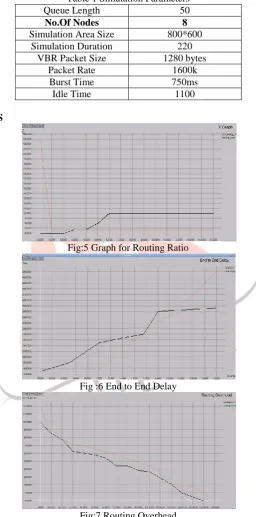
2.Average end-to-end delay of data packets-This includes all possible delays caused by buffering during route discovery latency, queuing at the interface queue, retransmission delays at the MAC, and propagation and transfer times. guarantee end-to-end requirements in a localized way, which is desirable for scalability and adaptability to large scale dynamic sensor networks[7]. 3.Normalized routing load-The number of routing packets transmitted per data packet delivered at the destination. Each hop-wise transmission of a routing packet is counted as one transmission.
The first two metrics are the most important for best-effort traffic. The routing load metric evaluates the efficiency of the routing protocol. Note, however, that these metrics are not completely independent. For example, lower packet delivery fraction means that the delay metric is evaluated with fewer samples. In the conventional wisdom, the longer the path lengths, the higher the probability of a packet drops. Thus, with a lower delivery fraction, samples are usually biased in favor of smaller path lengths and thus have less delay.
Table 1 Simulation Parameters
Queue Length 50
No.Of Nodes 8
Simulation Area Size 800*600
Simulation Duration 220
VBR Packet Size 1280 bytes
Packet Rate 1600k
Burst Time 750ms
Idle Time 1100
IV. RESULT AND ANALYSIS
Fig:5 Graph for Routing Ratio
Fig :6 End to End Delay
Fig:7 Routing Overhead
V. CONCLUSION
IJEDR1501060
International Journal of Engineering Development and Research (www.ijedr.org)335
explicitly specified in case of link break. Leveraging on such natural backup in the air, broken route can be recovered in a timely manner.
VI. FUTURE SCOPE
With no nodes distributed between the Source and the Destination, where the destination is out of the range of the source a VDVH(Virtual Distance void Handling) technique along with POR may be adopted.
VII. REFERENCE
[1] Qinghua Li, Student Member, IEEE, Wei Gao, Member, IEEE,Sencun Zhu, and Guohong Cao, Fellow, ’’Defending against Flood Attacks in Disruption Tolerant Networks’’ IEEE TRANSACTIONS ON DEPENDABLE AND SECURE COMPUTING, VOL. 10, NO. 3, MAY/JUNE 2013.
[2] T. Spyropoulos, K. Psounis, and C.S. Raghavendra, “Efficient Routing in Intermittently Connected Mobile Networks: The Multiple-Copy Case,” IEEE Trans. Networking, vol. 16, no. 1, pp. 63-76, Feb. 2008.
[3] J. Broch, D.A. Maltz, D.B. Johnson, Y.-C. Hu, and J. Jetcheva, “A Performance Comparison of Multi-Hop Wireless Ad Hoc Net-work Routing Protocols,” Proc. ACM MobiCom, pp. 85-97, 1998.
[4] M. Mauve, A. Widmer, and H. Hartenstein, “A Survey on Position-Based Routing in Mobile Ad Hoc Networks,” IEEE Network, vol. 15, no. 6, pp. 30-39, Nov./Dec. 2001.
[5] S. Das, H. Pucha, and Y. Hu, “Performance Comparison of Scalable Location Services for Geographic Ad Hoc Routing,” Proc. IEEE INFOCOM, vol. 2, pp. 1228-1239, Mar. 2005.
[6] R. Flury and R. Wattenhofer, “MLS: An Efficient Location Service for Mobile Ad Hoc Networks,” Proc. ACM Int’l Symp. Mobile Ad Hoc Networking and Computing (MobiHoc), pp. 226-237, 2006.
[7] E. Felemban, C.-G. Lee, E. Ekici, R. Boder, and S. Vural, “Probabilistic QoS Guarantee in Reliability and Timeliness Domains in Wireless Sensor Networks,” Proc. IEEE INFOCOM, pp.2646-2657, 2005.