Open Access
Proceedings
Bayesian genomic selection: the effect of haplotype length and
priors
Trine Michelle Villumsen*
1,2and Luc Janss
1Address: 1University of Aarhus, Faculty of Agricultural Sciences, Department of Genetics & Biotechnology, Research Centre Foulum. DK-8830, Box
50, Tjele, Denmark and 2University of Copenhagen, Faculty of Life Sciences, Department of Large Animal Sciences, 1870 Frb. C., Denmark
Email: Trine Michelle Villumsen* - [email protected] * Corresponding author
Abstract
Breeding values for animals with marker data are estimated using a genomic selection approach where data is analyzed using Bayesian multi-marker association models. Fourteen model scenarios with varying haplotype lengths, hyper parameter and prior distributions were compared to find the scenario expected to give the most correct genomic estimated breeding values for animals with marker information only. Five-fold cross validation was performed to assess the ability of models to estimate breeding values for animals in generation 3. In each of the five subsets, 20% of phenotypic records in generation 3 were left out. Correlations between breeding values estimated on full data and on subsets for the "leave-out" animals varied between 0.77–0.99. Regression coefficients of breeding values from full data on breeding values from subsets ranged from 0.78– 1.01. Single-SNP marker models didn't perform well. Correlations were 0.77–0.89 and predicted breeding values were biased. In addition the models seemed to over fit the genomic part of the variation. Highest correlations and most unbiased results were obtained when SNP markers were joined into haplotypes. Especially the scenarios with 5-SNP haplotypes gave promising results (distance between adjacent SNPs is 0.1 cM evenly over the genome). All correlations were 0.99 and regression coefficients were 0.99–1.01. Models with 5-SNP markers seemed robust to hyper parameter and prior changes. Haplotypes up to 40 SNPs also gave good results. However, longer haplotypes are expected to have less predictive ability over several generations and therefore the 5-SNP haplotypes are expected to give the best predictions for generations 4–6.
Introduction
We present an approach for genomic selection (GS) where the data is analysed using Bayesian multi-marker associa-tion models. The analysed data is the QTLMAS XII com-mon data set described in [1]. The aim is to get accurate genomic estimated breeding values (GEBV) for all
indi-viduals with marker information. We focus on how hyper and prior parameters and haplotype length affect the GEBV. A cross validation in generation 3 is used to evalu-ate the optimal model.
from 12th European workshop on QTL mapping and marker assisted selection Uppsala, Sweden. 15–16 May 2008
Published: 23 February 2009
BMC Proceedings 2009, 3(Suppl 1):S11
<supplement> <title> <p>Proceedings of the 12th European workshop on QTL mapping and marker assisted selection</p> </title> <sponsor> <note>Publication of this supplement was supported by EADGENE (European Animal Disease Genomics Network of Excellence).</note> </sponsor> <note>Proceedings</note> <url>http://www.biomedcentral.com/content/pdf/1753-6561-3-S1-info.pdf</url> </supplement> This article is available from: http://www.biomedcentral.com/1753-6561/3/S1/S11
© 2009 Villumsen and Janss; licensee BioMed Central Ltd.
Scenarios
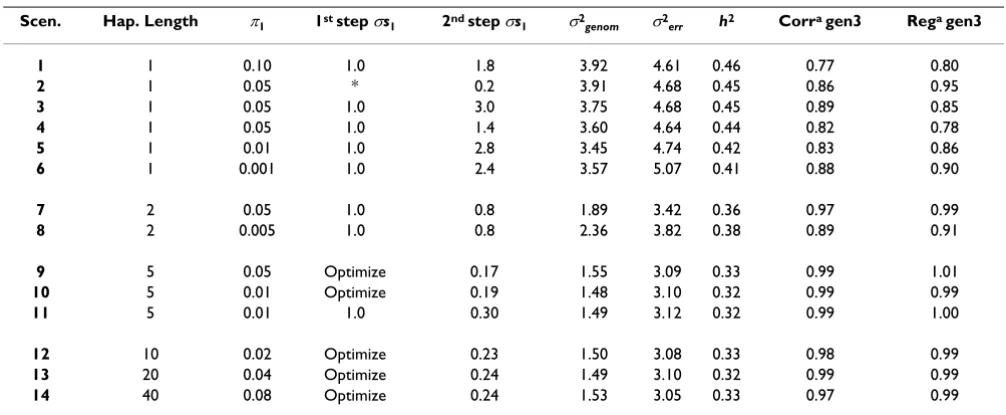
Fourteen scenarios were analysed. The models had haplo-type lengths of 1, 2, 5, 10, 20, and 40 SNPs. A two-mixture truncated normal distribution was used as prior for scal-ing factors that model the explained standard deviation per marker. We varied the proportion of markers to model the genetic effect and the prior parameter that determines the expected size of their scaling factors. The characteris-tics for each scenario are given in Table 1.
Analysis model
The model uses phenotypes and genotypes from all indi-viduals. Linkage phases of haplotypes are assumed to be known without error. The Bayesian model estimates allele
substitution effects at all m markers, with qi alleles at
marker i, as:
y = 1μ + Σi φi Σj xijβij + e i = 1, m and j = 1, qi
Here y is a vector of observations, μ is a general mean, xij
is a design vector indicating how many copies of the jth
allele of marker i are present in each observation, βij is the
allele substitution effect of the jth allele of marker i, and e
is a vector of model residuals, e~N(0, Iσe2). Allele effects
are modelled as random with βij~N(0,1) and φi is a scaling
factor that models the variance explained by ith marker.
The scaling factor can be interpreted as a standard devia-tion. A Bayesian variable selection method utilises a prior mixture distribution to select if certain model compo-nents are included in the model. To implement a selection on the level of markers, we chose a prior mixture
distribu-tion on the scaling factor φi. The specification of the
remaining prior distributions is:
The prior mixture distribution for scaling factors φi follows
the Bayesian variable selection method proposed by [2]
where a large portion (π0) of φi's is forced to come from a
distribution with small variance σs02, while only a small
fraction (π1 = 1 - π0) of φi's is allowed to have big effects
coming from a distribution with large variance σs12. The
model is augmented with mixture indicators γ= {γi},
indi-cating whether the ith scaling factor comes from the first
component of the mixture (γi = 0) or from the second
component of the mixture (γi = 1).
Obtaining parameter estimates
A MCMC sampler was used to generate samples from the
joint posterior distribution of the model parameters f(μ,
φ, β, γ, σe2|y). The fully conditional distributions for μ, ϕ i's
and βij's are all Normal and the sampling of ϕi's is an
alter-nation between two two normal distributions. The
condi-tional posterior distributions of the mixture indicators (γ)
are Bernouilli [2] and the conditional posterior distribu-tion for residual variance is scaled inverse chi-square [3]. For all parameters single-variate Gibbs samplers were implemented. To obtain genomic predictions, MCMC chains were run in two steps. Aim of the first step was to
get a good estimate of the hyper parameter σs1. MCMC
chains for the full data were run with 10,000 cycles of which 3,000 burn-in; parameter samples were saved for
μ
Table 1: Starting parameters and estimates for the scenarios.
Scen. Hap. Length π1 1st step σs1 2nd step σs1 σ2genom σ2err h2 Corra gen3 Rega gen3
9 5 0.05 Optimize 0.17 1.55 3.09 0.33 0.99 1.01
10 5 0.01 Optimize 0.19 1.48 3.10 0.32 0.99 0.99
11 5 0.01 1.0 0.30 1.49 3.12 0.32 0.99 1.00
12 10 0.02 Optimize 0.23 1.50 3.08 0.33 0.98 0.99
13 20 0.04 Optimize 0.24 1.49 3.10 0.32 0.99 0.99
14 40 0.08 Optimize 0.24 1.53 3.05 0.33 0.97 0.99
each 100th cycle. In the second step GEBV were estimated
with a fixed setting for σs1 and leaving out certain
pheno-types (see "Cross validation" below). For the models with
haplotype length >= 5 the optimal σs1 estimated from the
first step were used as known σs1. For models with
haplo-type length 1–2, due to failure in estimating σs1 at the first
step, best σs1 was assumed equal to the largest ϕi obtained
from the first step. MCMC chains were run with 10,000 cycles, of which 3,000 burn-in for haplotype length 1–2 and 5,000 cycles of which 2,000 burn-in for larger length of haplotypes.
Genomic predictions
GEBV were estimated for all individuals with marker information. The GEBV were constructed in each MCMC
cycle as functions of the scaling factors φi and allele effects
βij. Let xijE be extended versions of the design vectors with
allele information for all individuals, then posterior
sam-ples of GEBV (g*) for all these individuals are:
g* = Σi φi* Σj xijE β ij*
where asterix (*) indicates samples from the posterior
dis-tribution. By constructing g as a function of joint (φi, βij)
samples within the MCMC, the covariances between φi
and βij are automatically taken into account, and also the
posterior standard deviations of g can be obtained. The
final estimate for GEBV is the posterior mean obtained as
the mean of a set of g* samples. Predictive abilities of
genomic prediction models were assessed as the correla-tion between GEBV from full data and GEBV from subsets for the "leave-out" animals.
Cross validation
To evaluate combinations of hyper parameter, prior distri-bution and haplotype length a five-fold cross validation was performed. In each of five data subsets phenotypic records were discarded for 2 out of 10 full sibs in genera-tion 3, equal to 300 discarded records in each subset. Each record was only discarded once, deleting the records for full sibs 1–2 in the first cross validation data set, the records for full sibs 3–4 in the second cross validation data set, etc. Assuming that ordering of full sibs is random within family; this is equivalent to a (stratified) random deletion of records. Only records in generation 3 were dis-carded, because this is closest to generations 4 to 6 where GEBV were estimated from marker information only. For each subset a genomic prediction was performed using
the same best estimate of σs1 and number of cycles as for
the genomic prediction on full data. From each subset
GEBV of the 300 individuals with discarded phenotypic records were joined into a new dataset. This is called the "joined predicted" data. In the "joined predicted" dataset GEBV for all 1500 individuals in generation 3 were based on marker information only, because the GEBV for each
individual was retrieved from an analysis in which its own data was discarded.
For generation 3 correlations between GEBV from the full and joined predicted dataset and regression coefficient of GEBV from full data on GEBV from joined predicted data was computed. The best scenario is the one with highest correlation and the regression closest to one.
Results
Table 1 summarizes the starting parameters and the
esti-mates in 14 scenarios. For all scenarios σs0 is 0.01. The
sce-narios differ in haplotype length and in the settings for π1
and σs1 parameters, or in some cases included an
estima-tion of σs1 from the data. Genomic variance (σ2genom),
error variance (σ2
err) and heritability (h2) are presented.
The correlation between GEBV from full and joined pre-dicted data and the regression of GEBV from full data on GEBV from joined predicted data in generation 3 are also given.
For single marker models the correlations in generation 3 between GEBV obtained in full and joined predicted data are 0.77–0.89, highest for Scenario 3. For Scenario 2–4 the
only differences are in the setting of σs1. The largest ϕi of
the markers was used as σs1 in Scenario 3 while the second
largest was used in Scenario 4. In Scenario 2, a value close
to the automatic optimized σs1 in the scenarios with
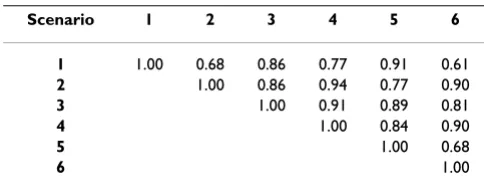
marker haplotypes was used to test if results were improved. The regression coefficient is 0.78–0.95, which indicates some bias. The lowest bias is found in Scenario 2. Table 2 shows that correlations between GEBV (for individuals in generation 3) obtained for full data in the six scenarios are 0.68–0.94, indicating that models are sensitive to prior and hyper parameter settings. The pre-sented single marker models do not perform well.
In the scenarios 7 and 8 with 2-marker haplotypes the
only difference is the setting of π1. The estimates of
vari-ances are different, but heritabilities are similar. Correla-tion and regression coefficients are higher than for single-SNP analyses. The correlation between GEBV from full data in the two scenarios is 0.96. The scenarios with 2-SNP haplotypes perform better than single-SNP models.
Table 2: Correlations of GEBV in generation 3 between scenarios for single-SNP models, based on full data.
Scenarios 9 to 11 with 5-SNP haplotypes perform simi-larly, independent of prior and hyper parameter settings.
Scenario 11 tests whether a large σs1 (using the largest ϕi
from the first step) results in the same results as the
opti-mized σs1. Variances and heritabilities are almost the
same, correlations and regression coefficients are almost one. In generation 3, the correlations between GEBV from full data in the three scenarios were all 0.99. The 5-SNP haplotypes fit data well and without bias, and is robust to changes in priors and hyper parameter.
Scenarios with 10, 20, and 40-marker haplotypes had
sim-ilar optimal σs1, same variances and heritabilities.
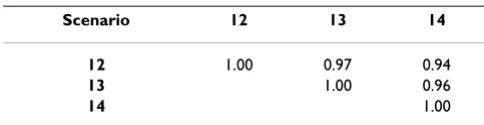
Corre-lations and regression coefficients are all close to one. All three models are expected to give good GEBV estimates. Table 3 shows that correlations between the GEBV esti-mated from the full data are 0.94–0.97.
Discussion
In this study we evaluated a Bayesian genomic prediction model with different grouping of SNPs into haplotypes and different settings of hyper and prior parameters. We assess the predictive abilities of the models using a cross validation in generation 3, assuming that the model which reached the best predictions in generation 3 would also be the model with the best predictions for genera-tions 4 to 6.
Single-SNP models did not perform well. As shown in the cross validation, the correlations for the single-SNP mod-els are the lowest observed among the given scenarios and the regression coefficients indicate bias. This was also found by [4]. Also the variance components in the single SNP models indicate bias and incorrect fitting of the data, with larger genomic variance and larger residual variance. This indicates that there must be a negative covariance between genomic fits and residuals, which is a sign of over fit. Overall, the single SNP models appeared variable and difficult to setting optimal prior and hyper parameter. We show that results from the single SNP model are relatively sensible for the prior and hyper parameter settings, and
estimation of the hyper parameter σs1 from the data also
failed for the single SNP models, probably due to colline-arity between SNPs. A possible explanation for poor per-formance of the single-SNP model is that markers may not be in complete linkage disequilibrium with a QTL. In
order to improve the single SNP model, probably lower
settings for the σs1 parameter are needed.
Models based on haplotypes of 5 SNPs and more gave much better results. For these models, regressions indi-cated absence of biases and estimates of variance compo-nents were better: residual variance was smaller, which indicates a better model fit, and the total fitted variance was close to the raw variance in the trait. In these models there is no numerical problem in estimating parameter
σs1 from the data. Using the σs1 estimated from the data is
expected to give accurate and unbiased predictions.
Models based on 5-marker haplotypes are expected to give the best estimates of GEBV in generation 4–6. In the eval-uation shown here the 10 to 40-SNP models perform equally well, but it should be noted that this is based on predictions in generation 3. For predicting breeding val-ues in generations 4–6, however, these larger haplotypes may lose predictive ability quicker as shown by [4]. There-fore we expect the 5 SNP haplotypes to retain the best pre-dictive ability over the generations 4–6. For estimation of GEBV in generation 4–6, Scenario 11 performs best with a correlation on 0.99 and a regression of exactly 1.00. GEBV from Scenario 11 are submitted for the workshop.
For scenario 11 the correlation between GEBV and true breeding value (TBV) in generation 4–6 turned out to be 0.92; the regression of TBV on GEBV from the full data was 0.98 indicating a small overestimation of GEBV. The
amount of variance in TBV explained by GEBV, R2 was
0.84. Hence, the selected model predicted the data well and gave nearly unbiased GEBV. The results can be found in table 2 in [1].
The better results here from using haplotypes than single-SNP is different from [5] in which IBD probabilities between haplotypes were used and where the use of such haplotypes gave similar results as the use of single SNPs. All results are in table 2 in [1]. There are however a number of differences between our approach and [5] in the use of Linkage and Linkage Disequilibrium (LD) pos-sibly resulting in differences in the use of population-wide and family-specific effects. Our results show that signifi-cant improvements can be made from using haplotypes and that it is worthwhile to further investigate the use of haplotypes for making genomic predictions.
Conclusion
We expect the most correct GEBV to be estimated in Scenario11, because the correlation between full and joined data is 0.99 and the regression coefficient is 1.00. The haplotype models perform better than single-SNP models and are less sensitive to prior and hyper parameter settings.
Table 3: Correlations of GEBV in generation 3 between scenarios for 10, 20 and 40-SNP models, based on full data.
Scenario 12 13 14 12 1.00 0.97 0.94
13 1.00 0.96
Publish with BioMed Central and every scientist can read your work free of charge
"BioMed Central will be the most significant development for disseminating the results of biomedical researc h in our lifetime."
Sir Paul Nurse, Cancer Research UK
Your research papers will be:
available free of charge to the entire biomedical community
peer reviewed and published immediately upon acceptance
cited in PubMed and archived on PubMed Central
yours — you keep the copyright
Submit your manuscript here:
http://www.biomedcentral.com/info/publishing_adv.asp
BioMedcentral
List of abbreviations used
GEBV: genomic estimated breeding values; GS: genomic selection; TBV: true breeding value.
Competing interests
The authors declare that they have no competing interests.
Authors' contributions
TMV carried out the analyses and drafted the manuscript. LJ helped to draft the manuscript and to interpret and present the results in the manuscript. Both TMV and LJ read and approved the final manuscript.
Acknowledgements
This article has been published as part of BMC Proceedings Volume 3 Sup-plement 1, 2009: Proceedings of the 12th European workshop on QTL mapping and marker assisted selection. The full contents of the supplement are available online at http://www.biomedcentral.com/1753-6561/ 3?issue=S1.
References
1. Lund MS, Sahana G, de Koning D-J, Carlborg Ö: Comparison of analyses of the QTLMAS XII common dataset. I: Genomic selection. BMC Proceedings 2009, 3(Suppl 1):S1.
2. George EI, McCulloch RE: Variable selection via Gibbs sampling.
J Am Stat Assoc 1993, 88:881-889.
3. Sorensen D, Gianola D: Likelihood, Bayesian, and MCMC Methods in Quantitative GeneticsSpringer, New York, NY, USA; 2002.
4. Villumsen TM, Janss L, Lund MS: The importance of haplotype length and heritability using genomic selection in dairy cat-tle. J Anim Breed Genet 2008 in press. Published online: 24 Sep 2008; doi 10.1111/j.1439-0388.2008.00747.x