c e-ISSN: 2348-6848, p- ISSN: 2348-795X Volume 2, Issue 12, December 2015
International Journal of Research (IJR)
Available at http://internationaljournalofresearch.orgReduction in Commutation Torque Ripple in Sensor less BLDC
Motor Fed by Pvcells Using Fuzzy Logic controller
V. Rama Chandra Reddy
M.Tech (PE&ED), K.O.R.M College of Engineering, Kadapa, A.P, INDIA
V. Madhusudhan & B. Mouli Chandra
Principal & Professor of Electrical Engineering, K.O.R.M.CE, KADAPA Assoc Professor & HOD of Electrical Engineering K.O.R.M.CE, KADAPA
Abstract –
Brushless Direct Current (BLDC) motors are widely used due to high reliability, simple frame, straight forward control, and low friction. BLDC motor has the advantage of high speed adjusting performance and power density. Speaking of the motor drive, the most important part is commutation control. On the other hand, they show a high torque ripple characteristics caused by no ideal commutation currents. This limits their application area especially for the low-voltage applications. Renewable energy sources are being increasingly implemented in many applications due to the growing concern of environmental pollution. The PV (Photovoltaic) system appears to
be most promising one because it is
environmentally clean in nature and it directly converts solar energy into electrical energy.The solar panel is used to obtain the energy needed to run BLDC motor. The voltage obtained from solar panel is stored in battery due to the non-constant nature of solar energy. The voltage from battery is not sufficient to run BLDC motor & hence boost converter is used to boost the voltage required to run BLDC motor.
In order to minimize torque ripple for the entire speed range, a comprehensive analysis of commutation torque ripple was made according to
phase advancing(PA) commutation control
method. This approach is based on the terminal voltage sensing and converting the voltages into d-q reference frame and the commutation signals are generated by comparing it with reference values. The gating signals are obtained by switching
sequence of BLDC motor and it is done using fuzzy logic controller(FLC).The design analysis and simulation of the proposed system is done using MATLAB version 2013a and the simulation results of proportional- integral (PI) controller and fuzzy logic controller(FLC) method is compared.
I. INTRODUCTION
BRUSHLESS DC MOTOR (BLDCM) has been widely used in fields that require high reliability and precise control, due to its simple structure, high power density, high efficiency, high starting torque, long operating life and extended speeding range. BLDC motors are used in industries such as automotive, aerospace, consumer, industrial automation and instrumentation.
c e-ISSN: 2348-6848, p- ISSN: 2348-795X Volume 2, Issue 12, December 2015
International Journal of Research (IJR)
Available at http://internationaljournalofresearch.orgmodified SEPIC converter with non-galvanic isolation is chosen in this paper. The increased DC voltage is inverted to AC by means of control logic circuits conventional. The stator armature windings of (BLDC) Brushless DC Motor makes easy to dissipate heat away from the windings. BLDC Motor finds wide range of applications from hard disk drives to hybrid electric vehicles owing to the following advantages over brushed DC motors viz.,
a) Higher speed ranges and efficiency.
b) Higher dynamic response & Power density c) Better speed Vs. Torque characteristics
d) Noiseless with 4 quadrant operation and maintenance free.
e) Tenacious & low electromagnetic pollution f) Regenerative braking.
It is otherwise known as (ECM) electronically commutated motor and having trapezoidal back emf waveforms and are fed with rectangular stator currents. To reduce the cost without compromising the performance is a tough task. Constant circuit complexity are the important factors for design tradeoffs between technology and design hardware. The combined analysis of energy, environmental issues with respect to driver is a paradigm shift. Since the rotor has no winding they are not subjected to centrifugal forces. The rotor position is sensed by two methods
a) Hall sensor - temperature sensitive, reduce system reliability but suitable for low cost, low speed & low resolution.
b) Back emf- promising device widely used because reliable.
As the name implies, BLDC motors do not use brushes for commutation, because BLDC motors are electronically commutated motor. BLDC motors have many advantages over brushed DC motors and induction motors.
In [1] commutation torque ripples according to three most common commutation control methods are analyzed and compared. Uses three commutation control methods for full speed range operation. Conventional six-step and phase- advancing (PA) methods are adopted below the
base speed, and the phase-advancing with overlapping (PAO) method is used for over the base speed to obtain higher speed operation with low torque ripple.
A hysteresis and deadbeat current control have been proposed to minimize the commutation torque ripple in [3]. Both methods use inner current control loops to regulate commutation current. In order to keep incoming and outgoing phase currents changing at the same rate during commutation, the duty cycle is regulated at low speed and the deadbeat current control is adopted at high speed. In [2] an overlapping technique, which extends the phase conduction period over 120 electrical degree, was adopted to reduce the torque spike by exciting a new conducting phase in advance.
The direct torque control (DTC) scheme is suggested in [6]. The proposed DTC, however, needs arithmetic calculations for the extracting torque and flux compensation term that can add further computational overload to low cost CPUs. The duty ratio compensating torque fluctuation in PWM ON PWM method was discussed in [7]. This type of duty control, however, needs real-time measurements and calculation of phase current, angular position, and speed. In [5], a buck converter was used with a new modulation pattern to reduce the commutation torque ripple, but the bandwidth of the buck converter was not considered, so this structure can only handle torque pulsation at the low speed.
A super-lift Luo topology and SEPIC converter were employed in [9] and [8], respectively. But these structures need complex control or additional power switches
II. PROPOSED SYSTEM –TORQUE
RIPPLE REDUCTION IN BLDC MOTOR USING FUZZY LOGIC CONTROLLER
A. System Configuration
c e-ISSN: 2348-6848, p- ISSN: 2348-795X Volume 2, Issue 12, December 2015
International Journal of Research (IJR)
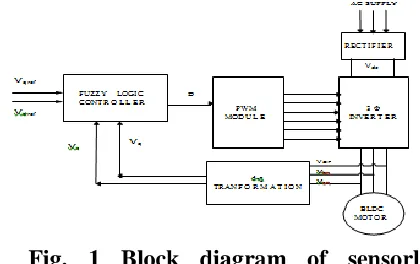
Available at http://internationaljournalofresearch.orgdiagram of sensorless BLDC motor drive system. The BLDC motor is driven by a conventional three-phase inverter. DC power is supplied by rectifying the 3 phase ac supply. Control configuration shown is composed of a single-speed loop. Speed control output is directly fed to the PWM module as the duty ratio D, i.e., D
∈[0,1].The commutation detection block enables sensorless operation of the motor, comparing the measured back EMF with half dc-link voltage. The PWM duty is updated six times during an electrical period and maintained constant during a mode.
Fig. 1 Block diagram of sensorless Brushless DC motor drives system using Fuzzy Logiccontroller
The ripple contents of stator current, electromagnetic torque and rotor speed are minimized with FLC method. . The advantage of Fuzzy Logic Controller is that it does not require any mathematical model and only based on the linguistic rules. The use of the d-q-0 reference frame for BLDCM is based on the fact that, in a three-phase Y-connected motor with non- sinusoidal air gap flux distribution, the d-q-0 transformation of the three line-to-line back EMF’s results in the finding of the d- and q- components identical to those of three phase back EMF’s transformation.
During start-up and other severe motoring operations, the motor draws large currents, produce voltage dips, oscillatory torques and can even generate harmonics in the power system. It is therefore important to be able to model the asynchronous machine in order to predict these phenomena. Various models have been developed
and the q- d axis model for the study of transient behavior has been well tested and proven to be reliable and accurate.
Fig. 2 Voltage waveforms according to the commutation control method i) line- to – lie back emf , ii) phase back emf,
iii) switching function
The measured phase back EMF waveforms in natural a-b-c reference frame are transformed to the d-q-0 reference frame by using the equations.
where θe = ωet , ωe is an electrical angular frequency and ϕ is an angular displacement between the stator current and rotor flux linkage and is generally equal to zero, and C is the transformation matrix of three phase to synchronously rotating d-q-0 reference frame.
B. Phase advancing method for commutation control: inverter topology and firing scheme
c e-ISSN: 2348-6848, p- ISSN: 2348-795X Volume 2, Issue 12, December 2015
International Journal of Research (IJR)
Available at http://internationaljournalofresearch.orgFig.3 Common voltage-fed inverter topology and motor model
The bypass diodes of the common VFI make this configuration inherently capable of regeneration. This capability is desirable in the case of controlled regenerative braking, but it also has two undesirable consequences. If a fault develops in the dc supply, the motor will feed current into the fault so long as the permanent magnets continue to rotate. In addition, if the motor is operating at high speed, a loss of transistor firing signals will result in uncontrolled regenerative braking until the motor slows to the speed where the back emf magnitude drops below the level of the dc supply voltage. Guarding against the consequences of such failures would require additional components. Above base speed, the back emf exceeds the dc supply voltage and the firing must be advanced (i.e., a phase is energized during the transition portion of the back emf where the available dc supply voltage can drive current into the motor). In the vicinity of base speed, operation is a mixture of phase advance and current regulation. At a speed only slightly greater than base speed, the current regulation becomes ineffective and all the control is accomplished by phase advance. In this work we consider only speeds at which all control is achieved through phase advance. The phase B and C back emfs have the same shape but are delayed
from phase A by 120o and 240o, respectively. The firing of phase B and C transistors is analogous but with the appropriate delays applied. The switching frequency during pure phase advance is at the fundamental electrical frequency consistent with motor speed. Pulse width modulation is not necessary. Transistor Q1 is fired θa degrees ahead of the instant that the phase A back emf, ean,
reaches its positive maximum. θa is called the “advance angle.” Transistor Q4 is fired θa degrees ahead of the instant that reaches its most negative value. Although that can be varied from 0 to 60o,it is found that the limiting range is from -60 to +120o.An advance angle near 30o, the exact value being parameter and speed dependent, results in zero average power. An advance less than this value results in regenerative braking and a greater value results in motoring operation.
III. FUZZY LOGIC CONTROLLER
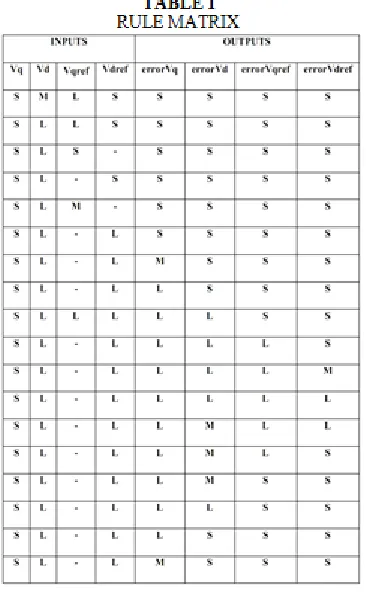
The Fuzzy Logic Controller initially converts thecrisp error and change in error variables into fuzzyvariables and then are mapped into linguistic labels.Membership functions are associated with each labelas shown in which consists of four inputs and fouroutputs. The inputs are Vq, Vd, Vdref, Vqref and theoutputs are error_vd(erVd), error_vdref(erVrd),error_vq(erVq), error_vqref (erVrq). Linguistic labelsare divided into three groups:
I. Small(S) II. Medium(M) III. Large (L)
Each of the inputs and the output contain membership functions with all these three linguistics. Triangular function is used as membership function.
Each of the inputs and the output contain membershipfunctions with all these three linguistics. Triangularfunction is used as membership function.
Fig.4 triangular membership functions used for the linguistic
c e-ISSN: 2348-6848, p- ISSN: 2348-795X Volume 2, Issue 12, December 2015
International Journal of Research (IJR)
Available at http://internationaljournalofresearch.orgThe mapping of the fuzzy inputs into the required output is derived with the help of a rule base as given in Table II. There are four inputs and for outputs are framed to form 18 rules. The rules are formulated based on the parameters of the motor and the based on method to reduce the ripple content in torque. The output of the fuzzy controller block is derived as duty cycle which is fed to the PWM module. Thus the PWM module feed the inverter with required switching pattern.
TABLEII
PARAMETERS OF BLDC MOTOR USED IN SIMULATION
IV.SIMULATION RESULTS
Simulation results for six step commutation current and torque is shown in fig 5. and fig 6.
Fig.5. current waveform
Fig.6.six step commutation torque
Simulation Results For Phase Advancing(θou =θol=π/12) Current is shown in fig 7.
Fig 7.current waveform
Simulation Results For Phase Advancing (θou=θol=π/12) Torque is shown in fig 8.
Fig 8.torqe waveform
c e-ISSN: 2348-6848, p- ISSN: 2348-795X Volume 2, Issue 12, December 2015
International Journal of Research (IJR)
Available at http://internationaljournalofresearch.orgFig 9.current waveform
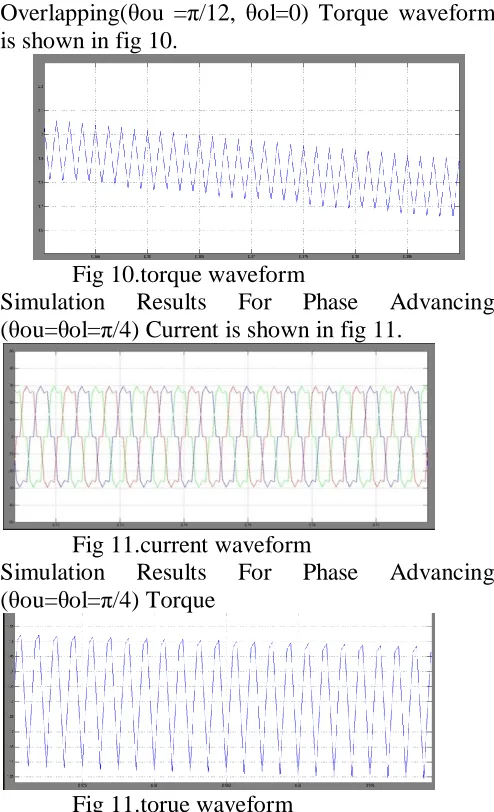
Simulation Results For Phase Advancing And Overlapping(θou =π/12, θol=0) Torque waveform is shown in fig 10.
Fig 10.torque waveform
Simulation Results For Phase Advancing (θou=θol=π/4) Current is shown in fig 11.
Fig 11.current waveform
Simulation Results For Phase Advancing (θou=θol=π/4) Torque
Fig 11.torue waveform
Simulation Results For Phase Advancing And Overlapping(θou =π/4, θol=0) Current waveform is shown in fig 12.
Fig 12.current waveform
Simulation Results For Phase Advancing And Overlapping(θou =π/4, θol=0) Torque waveform is shown in fig13.
Fig 13.torque waveform
Simulation Results For BLDC Solar Input For Current waveform is shown in fig 14.
Fig 14.current waveform
Simulation Results For BLDC Solar Input For Torque waveform is shown in fig 15
Fig 15.torque waveform V.CONCLUSION
c e-ISSN: 2348-6848, p- ISSN: 2348-795X Volume 2, Issue 12, December 2015
International Journal of Research (IJR)
Available at http://internationaljournalofresearch.orgrelying on original three commutation control methods, motor has been discussed. a complete analysis of the commutation. The proposed sensor less drive method for the low torque ripple was once created and applied for automotive fan functions.
REFERENCES
[1]H. R. Bolton and R. A. Ashen, “Influence of
motor design and feed-current waveform on
torque ripple in brushless DC drives,” IEE
Proc. Electr. Power Appl., vol. 131, no. 3, pp.
82–90, May 1984.
[2]Y. Murai, Y. Kawase, K. Ohashi, K. Nagatake,
and K. Okuyama, “Torque ripple improvement
for brushless DC miniature motors,” IEEE
Trans. Ind. Appl., vol. 25, no. 3, pp. 441–450,
May/Jun. 1989.
[3]R. Carlson, M. L. -Mazenc, and J. C. dos S.
Fagundes, “Analysis of torque ripple due to
phase commutation in brushless DC
machines,” IEEE Trans. Ind. Appl., vol. 28, no.
3, pp. 632–638, May/Jun. 1992.
[4]J. S. Lawler, J. M. Bailey, J. W. McKeever,
and J. Pinto, “Limitation of the conventional phase advance method for constant power
operation of the brushless DC motor,” in Proc.
IEEE Southeast Con, 2002, pp. 174–180.
[5]S. Jianwen, D. Nolan, M. Teissier, and D.
Swanson, “A novel microcontoller-based sensorless brushless DC (BLDC) motor drive
for automotive fuel pumps,” IEEE Trans. Ind.
Appl., vol. 39, no. 6, pp. 1734– 1740,
Nov./Dec. 2003.
[6]W. Chang-hee, S. Joong-Ho, and I. Choy, “Commutation torque ripple reduction in brushless DC motor drives using a single DC
current sensor,” IEEE Trans. Power Electron.,
vol. 19, no. 2, pp. 985–990, Mar. 2004.
[7]T. -H. Kim and M. Ehsani, “Sensorless control of the BLDC motors from near-zero to high
speeds,” IEEE Trans. Power Electron., vol. 6,
no. 6, pp. 1635–1645, Nov. 2004.
[8]G. H. Jang and M. G. Kim, “Optimal commutation of a BLDC motor by utilizing the
symmetric terminal voltage,” IEEE Trans.
Magn., vol. 42, no. 10, pp. 3473–3475, Oct.
2006.
[9]D.-K. Kim, K.-W. Lee, and B. I. Kwon, “Commutation torque ripple reduction in a position sensorless brushless DC motor drive,”
IEEE Trans. Power Electron., vol. 21, no. 6,
pp. 1762–1768, Nov. 2006.
[10] Z. Xiaofeng and L. Zhengyu, “A new
BLDC motor drives method based on buck
converter for torque ripple reduction,” in Proc.
IEEE Power Electron. Motion Contr., Conf.,
2006, pp. 1–4.
Author
V. Rama Chandra Reddy studying M. Tech in Kandula Obulareddy College of engineering, Department of Power Electronics and Electrical Drives.
Guide
Dr.V.Madhusudhan M.Tech., Ph.D. He is presently working as professor of Electrical Electronics Engineering and principal of KORM College of engineering, Kadapa.
HOD
Dr. B.Mouli Chandra M.tech
Ph.D. He is presently
working as a Associate professor and HOD of Electrical and Electronics
Engineering of KORM
College of engineering,