Novel Approach of data storing in cloud Database using
CPABE
Kasanagottu Sharanya
1& V. Sridhar Reddy
21
M-Tech Dept. of CSE,VignanaBharathi Institute of Technology, Hyderabad 2
Associate Professor Dept. of CSE,VignanaBharathi Institute of Technology, Hyderabad
Abstract
The quantity of utilizer in distributed computing is increasing enormously because of its preference of giving adaptable stockpiling essential. The clients are started to distribute their touchy data through the cloud because of its tendency of giving accomodation to clients. The information's security must be guaranteed to the clients while putting away their subtle elements into the cloud server. The principle goal of this paper is to change the security and the effectiveness while sharing the information between information proprietor and the clients. Predicated upon the clients' properties we are going to allocate the information. A standout amongst the most difficult issues in private information sharing frameworks is the authorization of information access arrangements and the fortress of strategies upgrades. Figure content approach trait predicated encryption (CP-ABE) is turning into a promising cryptographic answer for this sort of dilemma. It empowers information proprietors to characterize their own entrance arrangements over their utilizer properties and implement the strategies on the information to be conveyed. In this paper we grade to propose a revocable multi-power CP-ABE topic, and apply it on the grounds that the fundamental strategies to style the data access administration subject. Our trait denial strategy will with proficiency disperse the products every forward security and rearward security. This study demonstrates that revocable multi-command CP-ABE plan is secure in the discretionary area. Prophet demonstrates and is more proficient than front multiauthority CP-ABE.
Catchphrases: The read control; multi-power; CPABE (ciphertext approach quality encryption plan; components upsetting; cloud stacking
1. INTRODUCTION
CLOUD stacking is a significant convenience of cloud assessing, which bargains facilities for
information proprietors to have their
information in the cloud. This beginning speculation of information facilitating and information access housing acquaints an awesome assignment with information read control. Becausethe cloud server can't be plenarily trusted by information proprietors, they can no more depend on servers to peruse control. Ciphertext-Policy Attribute-predicated Encryption(CP-ABE) is considered as a
standout amongst the most appropriate
advances for information read control in cloud
stacking frameworks, in light of the fact that it
gives the information proprietor more
prominent control on read rules.
read rules. There are two sorts of CP-ABE frameworks: single-command CP-ABE where all elementes are overseen by a solitary power,
and multi-domination CP-ABE where
components radiate from distinctive areas and oversaw by diverse proofs. Multi-authority CP-ABE is more advantageous for information read control of cloud stacking frameworks, as clients may hold read appropriated by various confirmations and information proprietors might withal share the information using read
standards characterized over read from
distinctive proofs.
Multi-power CP-ABE is for the most part considered innovation for information access control in distributed storage frameworks. Clients may hold sundry qualities issued by different ascendant substances. The information
access strategy over the property is
characterized by the ascendant substances and not by the information proprietors. The subsisting framework is not material for multiauthority distributed storage because of its trait renouncement problem. On the off chance that any property is renounced indicates all the Cipher content connected with the domination whose quality is disavowed ought to be superseded or upgraded. The subsisting framework depends on a trusted server.
2. RELATED WORK
Information access control plan is more principal subsequently more works have led in this field the foremost and related works have been examined here.
Ciphertext-Policy Attribute Based encryption (CP-ABE) [1]:
Ciphertext-Policy Attribute Predicated
encryption plan spoke to a framework for acknowledging unpredictable access control on encoded information. Using this strategy
scrambled information is kept private
regardless of the fact that the stockpiling server is untrusted. The proposed framework sanctions
for a beginning sort of encoded access control where user‟s private keys are assigned by an
arrangement of traits and a gathering
scrambling information can assign a strategy over their properties assigning which clients can decode it. It was demonstrated secure just under some broad gathering heuristic, and not in different circumstances.
Single Authority Ciphertext-Policy Attribute Based encryption [2] [3]:
Here there subsist stand out domination which gives credits to different clients. And every one of the properties are overseen by this command just. This caused a security dilemma and overhead to the domination as every one of the clients should be kept up and oversaw by this authority just. It was not proficient also.
Multi-Authority Ciphertext-Policy Attribute Based encryption [4] [5]:
Here different ascendant substances subsist in the framework all the ascendant elements are incorporated into the credits' appropriation to the clients. This plan is more fitting for information access control of distributed storage frameworks, as clients may hold characteristics issued by numerous ascendant substances and information proprietor can allot the information using access approaches characterized on the traits by diverse ascendant elements. This lessened the overhead of keeping up diverse clients. Multi-authority CP-ABE plan spoke to quality repudiation issue.
Attribute Revocation [6] [7]:
there subsist security situations in the subsisting framewor
Proposed System:
The proposed framework surmounts the issue subsist in the subsisting framework. We proposed a nascent calculation assigned as Amended Security information Access Control. This calculation improves the framework's security. The information proprietor when stores the information into the cloud server he scrambles it and afterward stores it. The keys will be gave to the authorized clients by worshipped ascendant substances. So when the utilizer tries to get to the information to which he is not having the qualified characteristic the solicitation gets renounced and the utilizer gets obstructed by the domination. What's more, authority will moreover cause a message about the assailment to the information proprietor. So that information proprietor can make further move.
In the event that the utilizer has done it by oversight the endorsed utilizer can contact the information proprietor to unblock him. In the event that the utilizer has not done it then withal the utilizer can contact the information proprietor and can find out more security by requesting that the information proprietor transmute the verify points of interest.
This beginning calculation furthermore gives information trustworthiness. It notifies about the assailment by the un-authorized utilizer to
information proprietor when information
proprietor confirms about it. That is, the point at which the information proprietor needs to check the documents put away on the cloud every now and again. On the off chance that any changes are found in the record on the server by any unapproved get to then this calculation advises the information proprietor that the document is not sheltered, it is altered. Our framework is proposed to do the accompanying:
Our framework gives forward and rearward security as well as it withal gives improved security by giving access control on endorsed clients.
The calculation proposed by us changes the security by informing about the assailment to the information proprietor.
We withal gave the information respectability. As the information proprietor comes to ken about the confirmation in the information put away when he check
Framework Architecture:
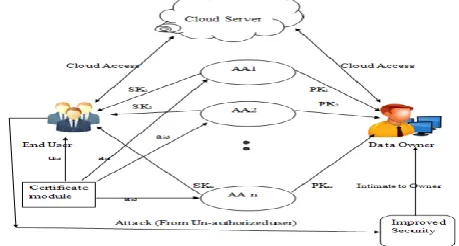
The figure demonstrates the framework structural engineering and it comprises of the modules: Data proprietor, Cloud Server, Data Encryption and Decryption, Ascendancy, Data Consumer and Ameliorated Security
Fig 1: System Architecture Diagram Model.
information is partitioned into a few segments by the proprietor and every information segment is scrambled with diverse substance keys using symmetric encryption.
The entrance strategies over the characteristics are characterized are characterized by the proprietor and encodes the substance keys under the arrangements. The proprietor then sends the encoded information together with the ciphertexts to the cloud server. The utilizer has the capacity unscramble the ciphertext just when the user‟s traits slake the entrance arrangement characterized in the ciphertext. The diverse number of substance keys is
unscrambled by clients with distinctive
qualities and from same information diverse information‟s are acqui
3. IMPLEMENTATION
Authentication Authority:
The CA is an ecumenical trusted authentication command in the framework. It builds up the framework and acknowledges the enlistment of the considerable number of clients and AAs in the framework. For each licit utilizer in the framework, the CA doles out an ecumenical novel utilizer character to it and withal incites an ecumenical open key for this utilizer. Then again, the CA is not included in any trait administration and the engenderment of mystery keys that are connected with qualities. For instance, the CA can be the Convivial
Security Administration, an autonomous
organization of the Coalesced States
administration. Every utilizer will be issued a Convivial Security Number (SSN) as its ecumenical character.
Trait Authorities:
Each AA is an autonomous property
domination that is in charge of entitling and denying client's credits as indicated by their part or personality in its space. In our plan, each trait is connected with a solitary AA, yet every AA can deal with a discretionary number
of qualities. Each AA has full control over the structure and semantics of its qualities. Every AA is in charge of causing an open quality key for every trait it oversees and a mystery key for every utilizer mirroring his/her properties.
Information Consumers:
Every utilizer has an ecumenical character in the framework. An utilizer may be entitled an arrangement of traits which may radiate from different quality ascendant elements. The utilizer will get a mystery key connected with its characteristics entitled by the relating property ascendant elements.
Information Owners:
Every proprietor first partitions the information into a few segments as indicated by the rationale granularities and encodes every information segment with diverse substance keys by using symmetric encryption systems. At that point, the proprietor characterizes the entrance approaches over qualities from numerous property ascendant elements and encodes the substance keys under the arrangements.
Cloud Server:
At that point, the proprietor sends the scrambled information to the cloud server together with the ciphertexts. They don't depend on the server to do information access control. Be that as it may, the entrance control comes to pass inside the cryptography. That is just when the client's qualities delight the entrance arrangement characterized in the figure message; the utilizer has the capacity decode the ciphertext. Along these lines, clients
with diverse qualities can unscramble
4. EXPERIMENTAL WORK
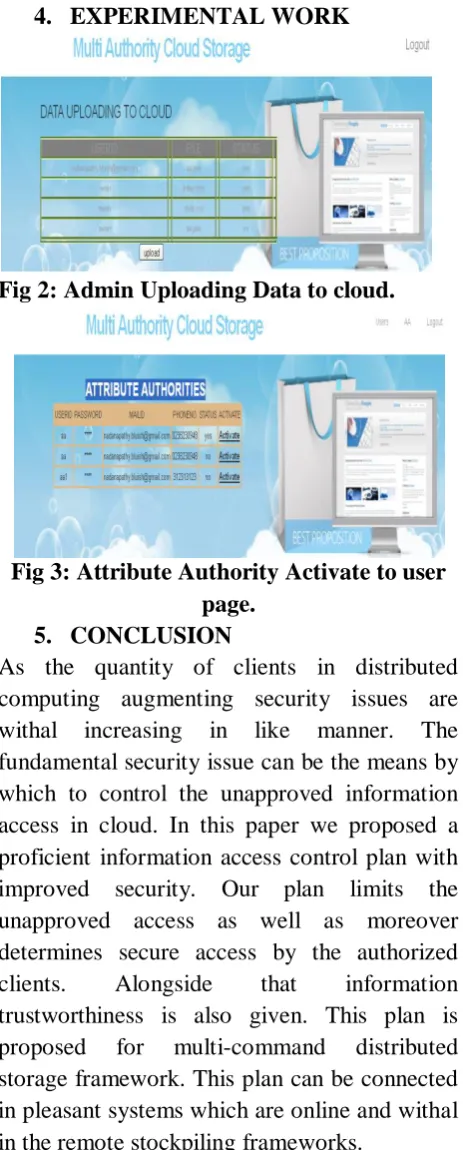
Fig 2: Admin Uploading Data to cloud.
Fig 3: Attribute Authority Activate to user page.
5. CONCLUSION
As the quantity of clients in distributed computing augmenting security issues are withal increasing in like manner. The fundamental security issue can be the means by which to control the unapproved information access in cloud. In this paper we proposed a proficient information access control plan with improved security. Our plan limits the unapproved access as well as moreover determines secure access by the authorized
clients. Alongside that information
trustworthiness is also given. This plan is
proposed for multi-command distributed
storage framework. This plan can be connected in pleasant systems which are online and withal in the remote stockpiling frameworks.
6. REFERENCES
[1]. J. Bethencourt, A. Sahai, and B. Waters,
“Ciphertext-Policy Attribute-Based
Encryption,” Proc. IEEE Symp. Security and Privacy (SP ‟07), pp. 321-334, 2007.
[2]. P. Mell and T. Grance, „„The NIST Definition of Cloud Computing,‟‟ National
Institute of Standards and Technology,
Gaithersburg, MD, USA, Tech. Rep., 2009.
[3]. A.B. Lewko, T. Okamoto, A. Sahai, K. Takashima, and B.Waters, „Fully Secure
Functional Encryption: Attribute-Based
Encryption and (Hierarchical) Inner Product Encryption,‟‟ in Proc. Advances in cryptology-EUROCRYPT‟10, 2010, pp. 62-91.
[4] M. Chase and S.S.M. Chow, „„Improving Privacy and Security in Multi-Authority
Attribute-Based Encryption,‟‟ in Proc. 16th
ACM Conf. Computer and Comm. Security (CCS’09), 2009, pp. 121-130.
[5] M. Li, S. Yu, Y. Zheng, K. Ren, andW. Lou, „„Scalable and Secure Sharing of Personal Health Records in Cloud Computing Using
Attribute-Based Encryption,‟‟ IEEE Trans.
Parallel Distributed Systems, vol. 24, no. 1, pp. 131-143, Jan. 2013.
[6] K. Yang, X. Jia, “Expressive Efficient, and Revocable Data Access Control for
Multi-Authority Cloud Storage”, in IEEE
Transactions on Parallel and Distributed Systems, vol.25, no.7, pp 1735-1744, July 2014.
[7] S. Ruj, A. Nayak, and I. Stojmenovic, „„DACC: Distributed Access Control in
Clouds,‟‟ in Proc. 10th
IEEE Int‟l Conf. TrustCom, 2011, pp. 91-98.