Mitigating Leakage in Secure Cloud-Hosted Data Structures:
Volume-Hiding for Multi-Maps via Hashing
Sarvar Patel
∗Giuseppe Persiano
†Kevin Yeo
‡Moti Yung
§Abstract
Volume leakage has recently been identified as a major threat to the security of cryptographic cloud-based data structures by Kellaris et al. [CCS’16] (see also the attacks in Grubbset al. [CCS’18] and Lacharit´e et al. [S&P’18]). In this work, we focus on volume-hiding implementations of encrypted multi-mapsas first considered by Kamara and Moataz [Eurocrypt’19]. Encrypted multi-maps consist of outsourcing the storage of a multi-map to an untrusted server, such as a cloud storage system, while maintaining the ability to perform private queries. Volume-hiding encrypted multi-maps ensure that the number of responses (volume) for any query remains hidden from the adversarial server. As a result, volume-hiding schemes can prevent leakage attacks that leverage the adversary’s knowledge of the number of query responses to compromise privacy.
We present both conceptual and algorithmic contributions towards volume-hiding encrypted multi-maps. We introduce the first formal definition of volume-hiding leakage functions. In terms of design, we present the firstvolume-hiding encrypted multi-mapdprfMMwhose storage and query complexity are both asymptotically optimal. Furthermore, we experimentally show that our construction is practically efficient. Our server storage is smaller than the best previous construction while we improve query complexity by a factor of 10-16x.
In addition, we introduce the notion of differentially private volume-hiding leakage functionswhich strikes a better, tunable balance between privacy and efficiency. To accompany our new notion, we present adifferentially private volume-hiding encrypted multi-mapdpMMwhose query complexity is the volume of the queried key plus an additional logarithmic factor. This is a significant improvement compared to all previous volume-hiding schemes whose query overhead was the maximum volume of any key. In natural settings, our construction improves the average query overhead by a factor of 150-240x over the previous best volume-hiding construction even when considering small privacy budget of= 0.2.
1
Introduction
In this paper, we studystructured encryption(STE), first introduced by Chase and Kamara [CK10], which is a cryptographic primitive used to study the security of cloud-hosted data structures. Structured encryption schemes enable the owner of a data structure to encrypt the data structure and outsource the storage of encrypted data structure to a potentially untrusted third-party such as a cloud storage system. Additionally, STE schemes allow the data owner to perform data structure operations on the outsourced encrypted data structure without revealing any information to the server beyond some well-defined and “sensible” leakage function.
An important example of a STE scheme is theencrypted multi-map(EMM) [CGKO11, KM19] primitive which enables the storage of keys associated to a sequence of (possibly) multiple values. Furthermore, multi-maps allows its owner to query for a key and receive all values associated with the key. EMM’s form the basis of many important applications. Two such applications are searching over a corpus of encrypted documents
∗
[email protected]. Google LLC. †[email protected]. Universit`a di Salerno. ‡[email protected]. Google LLC. §
and performing queries over encrypted relational databases. As a result, the construction of both efficient and private encrypted multi-maps is a very important problem. We now explain these applications in more detail.
Searchable encryption is a primitive first introduced by Song et al. [SWP00] and has continued to be well-studied in the past decade. One can see some of the following as examples of works in searchable encryption [Goh03, BDCOP04, BBO07, CGKO11, KPR12, CJJ+13, CJJ+14, CT14, NPG14, SPS14, Bos16,
ANSS16, MM16, BMO17, PPY17, DP17, KM17, ASS18, AKM18, DPP18]. Searchable encryption enables a data owner with a corpus of documents to encrypt and store the corpus to an untrusted third-party while maintaining the ability to privately search for documents containing specified keywords. In many cases, searchable encryption uses EMMs as the main underlying primitive to map keywords to documents that contain keywords. Although,EMMs have also been used in many other ways.
Encrypted databases are another important application of EMMs. The goal is to encrypt databases whose storage will be outsourced to an untrusted third party while enabling the data owner to privately per-form database operations. We note that earlier attempts [PRZB11] at encrypted databases used property-preserving encryption schemes such as deterministic [BBO07] and order-property-preserving [BCLO09, BCO11] en-cryption schemes. Work by Naveed et al.[NKW15] show that encrypted databases built from property-preserving encryption have security vulnerabilities. Recently, Kamara and Moataz [KM18] present an en-crypted SQL database scheme that foregoes the use of property-preserving encryption. Instead, they rely on EMMs to perform SQL operations privately.
As a result of the above important applications, it is clear that constructingEMMs that are both efficient and private is important. While efficiency is clear to evaluate, assessing the privacy of an EMM (and STE schemes in general) is a challenging problem. So far, our only measure of privacy is a “sensible” or “reasonable” leakage function, which is both a vague and subjective qualifier. There has been a lot of work that attempt to understand various leakage profiles and determine whether certain leakage profiles may be abused to compromise privacy. The first leakage-abuse attacks was presented by Islam et al. [IKK12]. Many follow up works [CGPR15, NKW15, GMN+16, KKNO16, PW16, ZKP16, GSB+17, LMP18, GLMP]
consider either different leakage profiles and/or weaker assumptions. These attacks significantly further our understanding of the dangers of various types of leakage profiles. Furthermore, these attacks present guidance on the necessary requirements of private STE schemes. Therefore, an important line of research is to construct STE schemes with smaller leakage that protect against these attacks.
In an attempt to mitigate the risk of leakage profiles, the seminal work of Kamara and Moataz [KM19] introduce the notion of volume-hiding EMM schemes. These schemes ensure that the number of values (volume) associated with a single key is never leaked to the adversary. Several of the above leakage-abuse attacks rely on the knowledge of volume to compromise privacy. As a result, volume-hiding schemes can foil such attacks. In this work, we continue the study of volume-hiding constructions by presenting schemes with better query and storage efficiency.
1.1
Our Contributions
In this work, we make both conceptual and algorithmic contributions in the area of volume-hidingEMMs. In particular, we present formal definitions for volume-hidingEMMs and introduce the notion of differentially private volume-hidingEMMs. Furthermore, we present efficient constructions for both types ofEMMs.
Throughout this section, we will phrase the efficiency improvements of our constructions using multipli-ers. As an example, a 2x improvement in communications means that our new construction uses half the communication of the previous best construction.
Theorem 1(Informal). Consider any multi-mapMMwithntotal values and let`be the maximum number of values associated with a key of MM. Then there exists a volume-hiding encrypted multi-map with com-munication complexity of O(`), server storage of O(n) and client storage of size f(λ), for every function
f(λ) = ω(1). The leakage of the encrypted multi-map consists of only the query equality pattern and the values `andn.
Our construction is lossless (that is, it always returns all the values associated with a key) and is asymp-totically optimal in terms of storage and communication complexity. Indeed, in a losseless construction each of the n values must be stored at least once and our construction results in server storage of about 2n. More precisely, it can be instantiated to use (2 +α)nstorage, for every constant α >0. Moreover, due to volume-hiding, it must be that each query returns at least`records and our construction will always return exactly 2`records. Finally, the client storage typically must include at least a private key. Our construction requires storing a private key in addition to justω(1) values. We show experimentally that our volume-hiding scheme is concretely efficient and improves on previous best volume-hiding scheme. In particular, our scheme uses less server storage and improves query overhead by a factor of 10-16x over [KM19] when encrypting multi-maps of size 1-67 MB in the plaintext and consisting of 216-222total values.
Differentially Private, Volume-Hiding EMMs. As another contribution, we directly address a state-ment appearing in [KM19]: “it is hard to imagine any non-lossy construction being able to hide response length of a query and have query complexityo(t), wheretis the maximum response length.” We introduce the notion of a differentially private volume-hiding leakage function as a weakening of volume-hiding. Kellaris et al. [KKNO17] studied the related notion of differentially private volume-hiding for ORAM.
We present the following differentially private, volume-hiding encryption scheme whose query complexity for many keys are much smaller than the maximum volume:
Theorem 2 (Informal). Consider any multi-map MM with n total values and let, for every key, `(key)
denote the number of values, the volume, associated with key. Then there exists an encrypted multi-map with communication complexity O(`(key) +f(λ)), for any function f(λ) =ω(logλ), with server storage of
O(n), and client storage of size g(λ), for any function g(λ) = ω(1). The scheme is lossless except with probability negligible in λ. The leakage of the encrypted multi-map consists of only query equality pattern, the number of total values nas well as differentially private leakage of volumes of the queried keys.
We note that, unlike volume-hiding schemes, our differentially private scheme is able to achieve query complexity that is only dependent on the volume of the queried key. In particular, the query complexity will be at most the volume of the query key plus an additional logarithmic factor. In typical scenarios, most keys have smaller volume than the maximum volume. Using experiments, we show that our schemes can reduce query overhead by a factor of 150-240x over the previous best volume-hiding scheme [KM19] when encrypting multi-maps consisting of 216-222values and occupy 1-67 MB in the plaintext.
By defining our new security notion of differential privacy volume-hiding, we attempt to strike a tunable balance between efficiency and privacy. The previous notion of volume-hiding considered strong privacy that resulted in large query complexity. When defending future, feasible attacks, volume-hiding might be too strong resulting in unnecessary query overhead. We thus look at the differential privacy framework to obtain a more efficient protocol at the cost of weakening the security notion in a meaningful way. We observe that all previous volume attacks on STE schemes [IKK12, NKW15, KKNO16, GLMP18, LMP18] are generic and do not exploit weaknesses of specific constructions. Rather, they are attacks to the ideal world functionality. Therefore, our generic framework will provide protection against all of these, as well as future, attacks to ideal world functionalities.
1.2
Comparison to Previous Works
Query Complexity
Server Storage for General MMs
Lossy with Non-Negligible Probability
Server Storage for Concentrated MMs
Computational Assumption
Naive Padding Θ(`) Θ(m·`) Θ(m·`) One-Way
Functions Pseudorandom
Transform [KM19] Θ(`) Θ(m·`) X Θ(m·`)
One-Way Functions Dense Subgraph
Transform [KM19] Θ(`·logn) Θ(n) Θ(n)
One-Way Functions Dense Subgraph
and Planting Transform [KM19]
Θ`· n
polylog(m)
Θ(n) Θ(n−√m·polylog(m)) Planted Densest Subgraph Problem
Ours (dprfMM) 2` (2 +α)n (2 +α)n One-Way
Functions
Ours (dpMM) 2`(k) +ω(logλ) (2 +α)(m+n) (2 +α)(m+n) One-Way Functions
Table 1: This table compares previous volume-hiding encryption schemes for multi-maps from [KM19] with the constructions of this paper. For notation,` represent the volume of the largest key of the input multi-map,mdenotes the number of unique keys andndenotes the total number of values over all keys. For any queried key k, we denote by `(k) as the number of values associated with the queried key k. The valueα
may be any positive constant. Finally, we refer to 2−λ as the probability of losing data in our differentially
private solution.
efficiencies are taken from the suggested concrete parameters sections of [KM19]. We denote the number of keys bym, the total number of values byn, and the maximum number of values associated with a key by`. Naive Padding. The simplest approach to volume-hiding encryption schemes is naive padding. Given any multi-map, a new multi-map can be constructed where each key has ` values. For keys with less than `
values, additional dummy values are padded until there are `values. We note that the resulting storage is
m·`. In many cases, (m·`)n wheren is the number of total values. For example, whenm=n/2 and
`=n/2, the storage of naive padding ism·`= Θ(n2) which is quadratically larger than the number of total values. Additionally, naive padding results in larger overhead if the multi-map follows naturally appearing distributions such as Zipf’s distribution. In practice, plaintext multi-maps typically use storage on the order of the number total values n. Therefore, naive padding uses too much storage in almost all cases and our storage goal for volume-hiding EMMs should be close ton.
ORAMs. Another naive approach is to use oblivious RAMs (ORAMs), which were introduced by Goldreich and Ostrovsky [GO96]. ORAMs are a powerful primitive that enable access to storage hosted by a potentially untrusted server such as a cloud storage provider without leaking any information beyond the number of accesses. As a result, there has been a lot of work in ORAM [GM11, KLO12, SvDS+13, PPRY18, AKL+18]
leading to logarithmic overhead constructions. Furthermore, ORAM lower bounds [LN18, PY19] have shown that these are the best possible constructions. A simple approach is to take any STE scheme and replace each access using an ORAM access to suppress leakage. Furthermore, one can make an STE scheme volume-hiding by making fake ORAM accesses until`records have been retrieved. The resulting scheme would have Θ(`·logn) overhead using the best theoretical constructions and Θ(`·log2n) using the more concretely efficient ORAM constructions. In either case, the overhead of ORAM is too large for practical use cases. Pseudorandom Transform. From a high level, the pseudorandom transform [KM19] takes an input multi-map and generates a new multi-multi-map such that the number of values associated with each key is generated using a pseudorandom function. As a result, there may exist keys whose volume in the new multi-map is smaller compared to the input multi-map. Therefore, the construction is lossy as truncation occurs and several values are removed from the new multi-map. The authors show that the number of truncated keys is small when the input multi-map is Zipf’s distributed. Furthermore, the authors of [KM19] show that the storage overhead is (m·`)/2 which is better than naive padding. Unfortunately, this transform is not practical as there are no guarantees for data loss (truncation) on general multi-maps and the storage overhead is closer to naive padding ofm·`than our goal ofn.
where each of themkeys are in one part and there arebempty bins in the other part. Each of themkeys are assigned` bins chosen uniformly at random. Each of the, at most`, values associated with a key is placed into one of the key’s assigned bin such that at most one value appears in each bin. After this is done for all keys, the bins are padded with dummy values to the size of the maximum bin. By balls-and-bins analysis, the size of the bins must be Ω(logn) size. As a result, the query overhead becomes at least Θ(`·logn). On the other hand, the storage overhead becomes Θ(n). We note that this construction is strictly worse in query overhead than our construction as it requires an extra lognoverhead while achieving the same asymptotic storage overhead of Θ(n). Furthermore, we experimentally show that our constructions achieve 10-16x query overhead improvements.
Densest Subgraph Transform for Concentrated Multi-Maps. The last construction of [KM19] con-sidered concentrated multi-maps. That is, multi-maps where a large number of keys share many same values. In this case, they modify the previous construction such that this concentrated set of values will appear only once in a single set of bins. As a result, the storage overhead becomes Θ(n−√m·polylog(m)). Unfortu-nately, this construction requires assuming that the planted densest subgraph problem is hard, which has been not heavily studied. Due to the lack of cryptanalysis, it is very difficult to find concrete parameters that can be used in practice where security can be trusted. Furthermore, the resulting query complexity is very large. As a result, this construction does not seem to be usable in practice at the moment.
Final Comparison. To make a final comparison, it is clear that our volume-hiding construction is more concretely efficient and practical compared to all previous works. In particular, it achieves the best storage overhead of just (2 +α) times the number of total values. Additionally, the query overhead is only 2`. In contrast, the schemes from [KM19] either might lose a lot of information for general multi-maps and have large storage overhead (pseudorandom transform), require computational assumptions that have not been well studied (densest subgraph for concentrated multi-maps) or require a much larger query overhead of Θ(`·logn) (densest subgraph for general multi-maps) than our construction. Furthermore, our differentially private volume-hiding construction uses slightly more server storage while enabling significantly smaller query overhead.
1.3
Our Techniques
In this section, we outline our techniques that enable us to construct better volume-hiding, encryption schemes for multi-maps. We start by considering a simple construction. Consider any keykand its associated valuesv1, . . . , v`(k)where `(k) is the number of values associated with keyk. The server stores a dictionary
in the following manner. The value vi will appear at location FK(k || i) in the dictionary where F is a
pseudorandom function (PRF), K is the key of the PRF and k || i is the concatenation of the key k to the indexi. Assuming the output range of the PRFF is large (like Ω(n2) wheren is the total number of
values), there would be no collisions in the dictionary. To query for a key k, the client would simply send the values FK(k || 1), . . . , FK(k || `(k)) and the server would return the associated encrypted values from
the dictionary.
Going towards the problem of volume-hiding, it is not clear how to modify this EMM construction to hide the volumes of all the keys. The first naive approach would be to send`PRF values for any key where`is the maximum value of any key. Unfortunately, this does not work. Consider a keykwhere`(k)< `. If the client sends the valuesFK(k||1), . . . , FK(k||`), the server will see that the valuesFK(k||`(k) + 1), . . . , FK(k||`)
do not exist in the server-held dictionary. As a result, the server can quickly determine the volume of key
k is exactly `(k). One way to mitigate this leakage is to simply populate the dictionary with the missing values for all keys k. However, this is similar to the naive padding approach which would result inm·`
storage which is much larger than our goal ofn(the number of total values) in most cases.
Therefore, we seem to have contrasting problems now. We wish to make sure that all PRF values for those with no value,FK(k||`(k) + 1), . . . , FK(k||`), point to some non-empty entry in the dictionary. On
place each of then values into a location that is determined byF. The remaining empty locations can be simply padded with dummy values without, hopefully, incurring a huge storage overhead like before. This is the exact problem that is considered in hashingwhere the goal is to place n items into a space of Θ(n) locations such that each item can be easily retrieved by looking into only a small number of locations specified by a PRFF. One approach to this problem would be to simply place a value into its location specified by the PRFF. Each location will be padded to the size of the largest bin. The classical balls-and-bins analysis shows the size of the largest will contain Ω(logn) items. To query, a key will be download its` associated bins which would incur an Ω(`·logn) query complexity. We note an approach similar to this idea is used by the densest subgraph transform in [KM19].
To avoid the additional logarithmic overhead, we will use cuckoo hashing introduced by Pagh and Rodler [PR04] for our constructions. In particular, we will use a variant presented by Kirschet al.[KMW09] where an additional stash exists to exponentially decrease the probability of failure. From a high level, cuckoo hashing consists of two tables of size (1 +α)nfor a small constant 0< α <1. For valuevi associated with
keyk, the valueviwill be placed into one of the three locations: FK(k||i||0) in table one orFK(k||i||1)
in table two or in the stash. The stash will be stored by the client. The remaining empty locations in each table will be filled by dummy values and all values in both tables will be encrypted. Let us now reconsider a query for a keykwhere`(k)< k. The client can send the values{FK(k||i||0), FK(k||i||1)}i∈[`] and the
server will return all 2`encrypted values in the tables. We prove that this construction is volume-hiding as the server will be unaware whether a location is filled with a real or dummy value.
Additionally, we present a concrete optimization that further improves the communication costs of our volume-hiding encryption scheme for multi-maps. In the above scheme, the client must send the output of 2`
PRF evaluations. However, the PRF evaluations may be easily arranged to correspond to a consecutive set of inputs. As a result, we are able to use delegatable PRFs [GGM86, KPTZ13] where the 2`PRF evaluations can be sent using smaller communication. In our specific application, the client will always be sending the prefix of exactly 2` evaluations. We are able to convey these 2` PRF evaluations using exactly one PRF evaluation in such a way that the server can securely expand the single PRF evaluation to the required 2` PRF evaluations. This optimization reduces the bandwidth from the client to the server from 2` PRF outputs to just one PRF output.
Finally, we describe our modifications to construct a differentially private volume-hiding EMM. A first attempt at differentially private volume-hiding would be to send `(k) +X PRF evaluations for any key k
with `(k) values and X is drawn from the Laplacian distribution. The problem is that Lap(1/) may be negative resulting in a lossy construction. Instead, we will pick some public parameterf(λ) such that the probability thatX drawn from the Laplacian is smaller thanf(λ) occurs with probability at most 2−λ. By
picking large enoughλandf(λ) =ω(logλ), we can guarantee that our construction is non-lossy except with small probability that is not observable in practice. Note, the query complexity of our differentially private volume-hiding EMM is`(k) +ω(logλ) which is, on average, significantly smaller than the largest volume `. The only caveat is that we now need to know the volume of any queried key. To do this, we will store a count table which, for each keyk with positive volume, stores the volume of the key`(k). The count table will be stored on the server using cuckoo hashing.
2
Definitions
2.1
Encrypted Multi-Maps
We start by considering the multi-map (MM) primitive, which maintains a set ofmkey to value vector pairs MM={(keyi, ~vi)}i∈[m] where eachkeyi is from thekey universeK and~vi is a tuples (or vector) of values
from thevalue universeV. For convenience, we suppose that all keys are unique. That is,keyi6=keyj when
i6=j. Note, this assumption is without loss of generality as if there are two equal keyskeyi=keyj, then the two tuples of values can be combined into a single tuple of values. For anykeyi, we denote by the number of values associated with keyi by `(keyi) (that is, `(keyi) := |~vi|). Note, the number of values associated
with different keys can be different. We denote the maximum number of values associated by ` (that is,
` := maxi∈[m]`(keyi) = maxi∈[m]|~vi|). Note, we will refer to ` as thewidth of the multi-map. We denote
the total number of values byn:=P
i∈[m]`(keyi) = P
i∈[m]|~vi|.
In terms of functionality, a multi-map provides a query operation which takes as inputkeyfrom the key universe K. The output of the query operation with input key for a multi-map MM will be the tuple of values associated with the keystored inMM. For example, ifkey=keyi for somei∈[m], then the query operation will return the tuples~vi. On the other hand, ifkey6=keyi for alli∈[m], then the output of the
query operation will be⊥.
Moving towards encrypted multi-maps, we now present a formal definition of structured encryption for multi-maps. Our STE definition will consider query algorithms withrrounds of interaction where the data structure must correctly answer to queries using r rounds of communication between the client and the server. However, we will only consider non-interactive (r = 1) or two-rounds of interaction (r= 2) in this paper. We focus on schemes with few rounds of interaction due to their practicality and efficiency as they only use a small number of roundtrips of communication between the client and server per query.
Definition 1(r-Interactive, Structured Encryption for MMs). Ar-interactive structured encryption scheme for multi-maps ΣMM = (Setup,Query,Reply,Result) where r ≥1 consists of the r+ 2 following polynomial
time algorithms:
1. (K,EMM)←Setup(1λ,MM) is an algorithm executed by the client Cthat takes as input the security
parameter λas well as the input multi-map MM . The output of Setupis a private key K as well as the encrypted multi-map EMM. The private key K will be held by the client C while the encrypted multi-map EMM is sent to the serverS.
2. Fori∈ {0, . . . , r−1}, we define the query algorithm asRequesti ←Queryi(K,key,Responsei−1)that is executed by the clientCthat takes as input the private keyK, thekeyfrom the key universe Kas well as the server’s response, Responsei−1 from the previous query. For the first query (i= 0),Response−1
will be ⊥. The output is a search requestRequesti which will be sent to the server S.
3. For i ∈ {0, . . . , r−1}, we define the reply algorithm as Responsei ← Replyi(Requesti,EMM) that is executed by the server S that takes as input Requesti and the encrypted multi-mapEMM. The output
of Reply will be Responsei which is the server’s response for thei-th query.
4. ~v←Result(K,Responser−1)is an algorithm executed by the clientCthat takes as inputResponser−1as
well as the private keyK. The output will be the tuple of values~vassociated withkeyused to generate
Request0, . . . ,Requestr−1 by the clientC.
For non-interactive encryption schemes with r = 1, we will simply drop all subscripts and superscripts related toQuery andReplyas there will only be one algorithm for each.
2.2
Adaptive Security and Leakage Functions
The security notion of structured encryption for multi-maps is parameterized by two leakage functions,
Query,Reply andResult)Queryis the only one that can potentially leak information to the serverSthrough
its outputRequest. We next formally present the security notion using the simulation-based game definitions. In particular, we will consider the adaptive variant where the query operations may be chosen adaptively by the adversary after seeing the leakage from previous queries.
Let Σ = (Setup,{Queryi,Replyi}i=0,...,r−1,Result) be a structured encryption scheme for multi-maps with
r rounds of interaction. To define adaptive security, we consider the following real and ideal experiments where A is a stateful, honest-but-curious PPT adversary, S = (SimSetup,SimQuery) is a stateful, PPT simulator andLSetup andLQuery are the leakage functions for the setup and query process respectively.
RealΣ,A(1λ) :
1. The adversaryAselects an input multi-mapMMand gives it to the challenger.
2. The challengerC executes (K,EMM)←Setup(1λ,MM) and sendsEMMto the adversaryA.
3. The adversary Awill adaptively pick a polynomial number of queries key1, . . . ,keypoly(λ). For each query keyj, the challenger C executes the {Queryi,Replyi}i=0,...,r−1 with A. A receives Requesti ←
Queryi(K,keyj,Responsei−1) for alliandkeyj. 4. Finally, the adversary Aoutputs a bitb∈ {0,1}.
IdealΣ,A,S(1λ) :
1. The adversaryAgenerates an input multi-mapMM.
2. The simulator receivesLSetup(MM) and returns an encrypted multi-mapEMM.
3. The adversaryAwill adaptively pick a polynomial number of querieskey1, . . . ,keypoly(λ).
For each query keyj, the simulator S computes Requesti using only LQuery(key1, . . . ,keyi,MM) as input, for alli∈ {0, . . . , r−1}. Requesti is forwarded to the adversaryA.
4. Finally, the adversary Aoutputs a bitb∈ {0,1}.
Definition 2 (Adaptive Security for r-Interactive, Structured Encryption for MMs). The r-interactive, structured encryption scheme for multi-mapsΣisadaptively (LSetup,LQuery)-secureif there exists a stateful, PPT simulatorS such that for all PPT adversaries A:
|Pr[RealΣ,A(1λ) = 1]−Pr[IdealΣ,A,S(1λ) = 1]| ≤negl(λ).
2.3
Typical Leakage Functions
In this section, we describe typical leakage function that have been considered for structured encryption for multi-maps. We will follow the terminology introduced by Kamaraet al.[KMO18].
• Query Equality: This leakage reports the equality pattern leaking whether two queries are to the same key or not. Formally, for a sequence of queried keys key1, . . . ,keyt, qeq(key1, . . . ,keyt) = M
consists of at×tmatrix such thatM[i][j] = 1 if and only ifkeyi=keyj.
• Response Length: This leakage consists of the number of values (volume) associated with queried
keys. Formally, for a sequence of queried keyskey1, . . . ,keytand a multi-mapMM, That is,rlen(MM,key1, . . . ,keyt) = (|MM[keyi]|)i∈[t] whereMM[keyi] refers to the tuple of values associated withkeyi.
• Domain Size: This leakage pattern refers to the total number of values in the multi-map. Formally, for any multi-mapMM,dsize(MM) =n=P
key∈K|MM[key]|.
From a high level, the goal of volume-hiding STE schemes is to suppress response length leakage. We will formally define volume-hiding leakage functions in the next section.
2.4
Volume-Hiding Leakage Functions
Roughly speaking, avolume-hidingleakage function ensures that the number of values associated with any single key, thevolume of the key, is not revealed and that only the maximum volume of a key is leaked.
We start with the following definition.
Definition 3. Thesignatureof a multi-mapMMis the sequence of pairs((key, `(key)))key∈K where`(key)
is the length of tuple of values associated with keyin the multi-map.
We next define the gameVHGameAη,L(n, `) for leakage functionsL= (LSetup,LQuery), adversaryA, and
η∈ {0,1}.
VHGameAη,L(n, `):
1. A generates two signatures S0 = {(key, `0(key))}key∈K and S1 ={(key, `1(key))}key∈K with n total values and maximum volume`. That is,
• P
key∈K`0(key) =Pkey∈K`1(key) =n;
• maxkey∈K`0(key) = maxkey∈K`1(key) =`.
2. The challenger C receives signatures S0 and S1 from the adversary A and generates a multi-map
MM with the signature Sη. Specifically, the challengerC generates `η(key) arbitrary values for each
key∈ K. The challengerC then sendsLSetup(MM) to the adversaryA.
3. The adversary adaptively picks keyskey1, . . . ,keytfor query operations. For eachkeyi, the challenger
C will computeLQuery(MM,key1, . . . ,keyi) which is sent to the adversary. 4. Finally, the adversary Aoutputs a bitb∈ {0,1}.
We denote bypA,L
η (n, `) the probability thatAoutputs 1 when playing gameVHGame
A,L
η (n, `).
Definition 4(Volume-Hiding Leakage Functions). A leakage functionL= (LSetup,LQuery)isvolume-hiding
if and only if for all adversariesAand for all valuesn≥`≥1,
pA0,L(n, `) =pA1,L(n, `).
Given the above definition of volume-hiding leakage functions, we can now define volume-hiding, STE schemes for multi-maps.
Definition 5 (Volume-Hiding,r-Interactive, Structured Encryption for MMs). A r-interactive, structured encryption scheme for multi-maps,Σ, isvolume-hidingif there exists a leakage functionL= (LSetup,LQuery)
such that
1. Σis adaptively L-secure according to Definition 2;
2. L is a volume-hiding leakage function according to Definition 4.
2.5
Differentially Private Volume-Hiding Leakage Functions
To properly define the notion of volume-hiding within the framework of differential privacy, we consider a
sanitizerSan. A sanitizer San is a randomized algorithm that takes a signatureS and samples a sanitized signature. Roughly speaking, we will say that a pair (L,San), consisting of a leakage functionLand a sanitizer San, is (, δ)-differentially privateif the probabilities that an adversaryAoutputs 1 in gamesVHGame0and
VHGame1, respectively played on the sanitized versionsSan(S0) andSan(S1) of twoneighboring signatures
S0 andS1, are related throughandδ. Let us now proceed more formally.
Definition 6. SignaturesS0= (key, `0(key))key∈K andS1= (key, `1(key))key∈Kareneighborsif there exist key0,key1∈ Ksuch that
1. for allkey∈ {/ key0,key1},`0(key) =`1(key);
2. `0(key0) =`1(key0) + 1;
3. `0(key1) =`1(key1)−1.
We define gamedpVHη, forη= 0,1, as in the previous section with the only difference that the multi-set
Dis constructed by applying the sanitizerSanto signatureSη.
dpVHAη,L,San(n):
1. Aoutputs neighboring signatures S0= (key, `0(key))key∈K andS1= (key, `1(key))key∈K withntotal values. That is,P
key∈K`0(key) =Pkey∈K`1(key) =n.
2. The challenger C receives signatures S0 and S1 from A and samples a sanitized signature SSan = {(key, `San(key)}key∈K by running SanonSη.
3. The challengerCconstructs a multi-mapMMwith signatureSSan by picking`San(key) arbitrary values
for eachkey∈ K. C then sendsLSetup(MM) to A.
4. The adversary A adaptively picks keys key1, . . . ,keyt for query operations. For eachkeyi, the chal-lengerC computes and sendsLQuery(MM,key1, . . . ,keyi) to the adversary.
5. Finally, the adversary Aoutputs a bitb∈ {0,1}.
We denote bypLη,,AS,San the probability that adversaryAoutputs 1 when playing gamedpVHLη,S,San
Definition 7(Differentially Private Volume-Hiding Leakage Functions). We say that(L,S)is(, δ)-differentially private volume-hidingif for all nand for all adversariesA that output two neighboring signatures with the same total number of valuesn, it holds that
pL0,,AS,San(n)≤e·pL1,,AS,San(n) +δ.
If δ = 0, we will simply say -differential private instead of (, δ)-differential private. Note also that a volume-hiding leakage function is (0,negl(n))-differentially private with respect to the identity sanitizerId that, for every signaturesS, returns the signature itself.
3
Volume-Hiding EMM
In this section, we describe our volume-hiding structured encryption scheme for multi-maps. To our knowl-edge, our construction is the first to achieve both asymptotically optimal query and storage complexity. Furthermore, we show that our construction is concretely efficient using experiments. In Section 5, we show that our constructions use less server storage and improve query overhead by a factor of 10-16x over the previous best constructions [KM19].
One of the major tools that will be used in our construction is cuckoo hashing, which we now describe.
Cuckoo Hashing. Cuckoo hashing was introduced by Pagh and Rodler [PR04] and consists of two algo-rithmsBuildandSearch. Givennkey-value pairs (key1,value1), . . . ,(keyn,valuen),BuildconstructsTable
consisting two arrays T1 and T2 each with the capacity to holdt= (1 +α)n pairs for any constantα >0.
TheBuild algorithm inserts the pairs one at the time using two hash functionsh1, h2 :K →[t]. To insert
pairX = (keyi,valuei),BuildplacesX in locationT1[h1(keyi)]. If the location is empty, we are done. If the
location is currently occupied by another pair,Y = (keyj,valuej),Y is evicted and the algorithm attempts
to insertingY in location T2[h2(keyj)]. Again if the location is empty, we are done. Otherwise we evict the
pairZ found inT2[h2(keyj)] and try to insertZ in the location ofT1 specified byh1, and so on. Note that
cuckoo hashing guarantees that a pair (keyi,valuei) is found either atT1[h1(keyi)] orT2[h2(keyi)]. Thus,
Searchonly retrieves two table locations. We say that cuckoo hashing fails if a key-value pair is not inserted after Θ(logn) evictions. It is possible to show that all nkey-value pairs will be successfully inserted with large constant probability. Unfortunately, this failure probability is too large for privacy reasons and this has been used to compromise privacy of oblivious RAMs (see, e.g.,[KLO12]).
Cuckoo Hashing with a Stash. As a result, we resort to a modification of cuckoo hashing presented by Kirsch, Mitzenmacher and Wieder [KMW09] that introduces a stash S of some fixed capacity s. After Θ(logn) evictions, if a key-value pair has not been inserted yet, the pair is be inserted into the stash. Cuckoo hashing with a stash fails if strictly more than s items are attempted to be inserted into the stash. The introduction of the stash reduces the failure probability exponentially in the stash size:
Theorem 3. For constants d, α >0, there exists algorithmBuildthat storesnpairs into two arraysT1 and
T2 of size (1 +α)n and a stashS. Then. the probability that, after all n pairs have been inserted with at
mostdlogn evictions,S has size greater thans isO(n−s).
For a proof, see Theorem 2.1 of [KMW09] and the extension to non-constant sized stashes in [GM11].
High-Level Description of vhMM. We start by describing our volume-hiding, multi-map encryption scheme from an intuitive level. Consider any multi-mapMMstoring{keyi, ~vi}i∈[m] withntotal values and
a maximum volume of`. TheSetupalgorithm will store thenvalues using cuckoo hashing with a stash with two tables,T1andT2, of sizet= (1 +α)nfor any constantα >0. We will use a PRFFthat output values in
the range [t]. Consider thej-th value,~vi[j] associated withkeyi. Then, (keyi, ~vi[j]) will be assigned locations
T1[FK(keyi ||j|| 0)],T2[FK(keyi ||j||1)] or the stash using the cuckoo hashing insertion algorithm. If we
set the stash to be f(n) =ω(1), then the insertion will fail with probability at most O(nf(n)) =negl(n).
All empty table locations will be filled with a dummy value. All table locations are then encrypted. The resulting encrypted table will be the encrypted multi-mapEMMoutsourced to the server. The small stash containing at mostf(n) =ω(1) values will be stored by the client.
We now move onto the query operation for our STE scheme. TheQueryalgorithm executed by the client will simply send the 2` values {FK(keyi||j||0), FK(keyi||j||1)}j∈[`] to the server. The server executes
Replyby returning the encrypted values located at{T1[FK(keyi||j||0)], T2[FK(keyi||j||1)]}j∈[`]. The client
retrieves the tuple of associated values by decrypting all table locations in the server’s response as well as checking the stash.
Formal Description of vhMM. We now formally present our first volume-hiding STE scheme for multi-maps vhMM. In particular, our construction will use pseudorandom family of functions F = {Fs}s∈{0,1}?
and an IND-CPA secure encryption schemeE = (Enc,Dec). Furthermore, our construction is parameterized by a functionf(n) =ω(1) and a constantα >0.
1. Randomly select PRF seed KPRF← {0,1}λ.
2. Randomly select encryption keyKEnc← {0,1}λ.
3. Create two empty arrays, T1, T2 of lengtht= (1 +α)nwheren=Pi∈[m]|~vi|.
4. InitializeStash← ∅.
5. For eachi∈[m] and eachj∈[|~vi|]:
(a) Insert (keyi, ~vi[j]) using the cuckoo hashing with a stash insertion algorithm where (keyi, ~vi[j])
is assigned to one ofT1[FKPRF(keyi||j||0)],T2[FKPRF(keyi||j||1)] orStash.
6. IfStash contains more thanf(n) items, abort.
7. For each location inT1 orT2that is empty, insert (⊥,⊥) into the location.
8. For eachi∈[t]:
(a) SetT1[i]←Enc(KEnc, T1[i]).
(b) SetT2[i]←Enc(KEnc, T2[i]).
9. Set the private key asK←(KPRF, KEnc,Stash).
10. SetEMM←(T1, T2).
11. Return (K,EMM).
Request←vhMM.Query(K,key): 1. ParseK as (KPRF, KEnc,Stash).
2. Return (FKPRF(key||i||0), FKPRF(key||i||1))i∈[`].
Response←vhMM.Reply(Request,EMM): 1. ParseRequestas {ind0,i,ind1,i}i∈[`].
2. Return (T1[ind0,i], T2[ind1,i])i∈[`].
~v←vhMM.Result(K,key,Response): 1. ParseK as (KPRF, KEnc,Stash).
2. ParseResponseas (ct0,i,ct1,i)i∈[`].
3. Set~v← ∅. 4. For eachi∈[`]:
(a) Set (key0,value0)←Dec(KEnc,ct0,i).
(b) Ifkey0=key,~v←~v∪ {value0}. (c) Set (key0,value0)←Dec(KEnc,ct1,i).
(d) Ifkey0=key,~v←~v∪ {value0}. 5. For each (key0,value0)∈Stash:
6. Return~v.
Security. We now describe the leakage ofvhMMdue to algorithmsSetupandQuery. From a high level, the EMMreveals to the adversarial server (2 + 2α)nencrypted key-value pairs. As a result,LSetup=dsizewhich is the leakage functions that reveals the number n of total values in MM. For each query, the adversarial server learns two things. First, the adversarial server learns query equality by observing identical 2` PRF values. Secondly, the adversary learns the maximum volume of a key in MM. So, LQuery = (qeq,mrlen). Note, that LQuery andLSetupdo not include the response length leakage rlenand thus, intuitively, vhMMis volume-hiding. We prove the following two lemmata in Appendix A.
Lemma 1. Let L= (dsize,(qeq,mrlen)). For every constantα >0 andf(n) =ω(1),vhMMis an adaptive
L-secure non-interactive STE scheme for multi-maps.
Lemma 2. Leakage function L= (dsize,(qeq,mrlen))is volume-hiding.
By combining the two lemmas above we obtain the main theorem of this section
Theorem 4. Non-interactive STE for multi-mapsvhMMisvolume-hiding.
Efficiency. By Theorem 3, the probability that the Stash grows larger than f(n) is at most n−f(n) =
negl(n). The outsourced EMM contains exactly (2 + 2α)n encryptions of key-value pairs. The client generates 2` PRF values duringvhMM.Queryand the server responds with 2` key-value encryptions during vhMM.Reply. The client stores two private keys and theStashconsisting of at mostf(n) key-value pairs. Theorem 5. Non-interactive STE for multi-maps vhMMaborts with negligible probability. It requires (2 + 2α)n storage on the server. Each query requires 4` communication between the client and the server. The client storesO(1) private keys as well as at mostf(n) =ω(1)key-value pairs.
3.1
Improving Communication
In this section, we present an improvement to our constructionvhMMfrom the previous section. First, we take a careful look atvhMMto look for any wasteful parts. In particular, consider the way that each of then
key-value pairs of the input multi-map are assigned to table locations. ForvhMM, any value~vi[j] associated
withkeyi will be assigned to locations FKPRF(keyi||j||0) andFKPRF(keyi||j||1). As a result, vhMM.Query
requires the client to send 2`PRF values. This seems quite wasteful as the 2`table locations associated with keyiare very structured. We show that we can modifyvhMMsuch that theRequestgenerated byQuerycan be compressed to only contain a single PRF value as opposed to 2`values. To do this, we will usedelegatable PRFs.
Delegatable PRFs. Afamily of delegatable PRFs(dPRF), first discussed in [KPTZ13], enables the owner of the secret seedKtodelegatean untrusted party to computeFK(x) for all valuesx∈S, whereSis a subset
taken from a specified family of subsets. The delegation is obtained by computing atokentokS that allows
the computation of the PRF for allx∈S, without any further intervention of the owner without accessing the secret seed. The security requirement is that all valuesFK(x) forx6∈S remain indistinguishable from
truly random values even for an adversary that has access totokS. Note that this can be trivially achieved
by having the owner release the value of FK(x) for all x ∈ S. Thus, the goal of dPRFs is to construct
tokens of size o(|S|). To construct efficient dPRFs, we will use the famous GGM PRF construction which we describe next.
The GGM PRF construction. The GGM construction [GGM86] builds a family of PRFsF ={FK(·)}
from a length-doubling pseudorandom generator Gas follows. For any input v of length λ bits, G(v) will result in 2λ bits. For convenience, we denote the first λ bits of the G(v) as G0(v) and the last λ bits of
G(v) as G1(v). Consider a function F{0,1}λ :{0,1}t→ {0,1}λ with a private key and output of the same
Every node with labelx1, . . . , xi∈ {0,1}is associated with value FK(x1, . . . , xi) computed in the following
recursive manner. The root, labeled with the empty string ⊥, is assigned the value FK(⊥) := K. If a
node is associated with valuev, then its left child is associated withG0(v), the firstλbits ofG(v), and its
right child is associated with G1(v), the lastλ bits of G(v). This recursive rule is equivalent to defining
FK(x1, . . . , xi) :=Gxi(Gxi−1(· · ·Gx1(K)· · ·)). The PRF output FK(X) for any t-bit string X ∈ {0,1}
t is
the value associated with the leaf with label X. The authors of [GGM86] show that values associated with leaf nodes are indistinguishable from random values for any computational adversary.
Delegating Prefixes. In [KPTZ13], the above GGM construction of a PRF is used to implement a delegatable PRF for subsets of strings with matching prefixes. More formally, the construction of [KPTZ13] consists of two efficient algorithms: algorithm dPRF.GenTok that takes as input the private dPRF key K
and an s-bit prefix X = x1, . . . , xs with s ≤ t and outputs a token tokX; and algorithm dPRF.Eval that
takes the token for the s-bit prefixX, tokX and stringY ∈ {0,1}t−s and computes the valueFK(X ||Y).
In other words,dPRF.Evalenables computation of the PRF evaluation of any string whose prefix isX. dPRF.GenTok for a prefix X is implemented by returningtokX :=FK(X) where F is the GGM PRF
construction. For any stringY with prefixX,dPRF.Evalis implemented by simply computing the values the node labeledY from its ancestor node labeled byX in the GGM PRF construction. This can be done since the pseudorandom generator Gis public. For security ofdPRF, we only consider adversaries that perform prefix-free string queries. Prefix-free string queries refer to the fact that each query must not be a prefix of any query. In [KPTZ13], it is shown that the resulting queried tokens are computationally indistinguishable from random values.
High-Level Description ofdprfMM. We now describe the modifications tovhMMusing prefix delegatable PRFs. The main idea is to replace all instances of a PRF in vhMM with a prefix dPRF. For cuckoo hashing, a value~vi[j] associated with keyi will be assigned to the locations FK(keyi || j || 0) in table 1
andFK(keyi||j ||1) in table 2 whereF is the GGM PRF construction. Furthermore, each j ∈[`] will be
represented using adlog2`e-bit string.
We modifyQuerysuch that to query anykey, the client will construct a tokentokkeythat will delegate the computation for the PRF for any value whose prefix matcheskey. In particular, this enables the adversarial server to compute the set of PRF values{FK(key||i||0), FK(key||i||1)}i∈[`] as they all have the shared
prefix key. Note that tokkey consists of the single PRF value FK(key). As a result, dprfMM reduces the
client-to-server communication from 2`PRF values to just a single PRF value.
Detailed Description of dprfMM. The functions Setup and Reply remain the same as vhMM except replacing the PRFF with the prefix dPRFF construction above.
Request←dprfMM.Query(K,key): 1. ParseK as (KPRF, KEnc,Stash).
2. Computetokkey←dPRF.GenTok(KPRF,key).
3. Returntokkey.
Response←dprfMM.Reply(Request,EMM): 1. ParseRequestas tokkey.
2. For eachi∈[`]:
(a) ComputeFKPRF(key||i||0)←dPRF.Eval(tokkey, i||0). (b) ComputeFKPRF(key||i||1)←dPRF.Eval(tokkey, i||1). 3. Return{T1[FKPRF(key||i||0)], T2[FKPRF(key||i||1)]}i∈[`].
Security. We note that the leakage of dprfMM is identical to vhMM where LSetup = dsize and LQuery =
Theorem 6. dprfMM is an adaptive L = (dsize,(qeq,mrlen))-secure STE scheme for multi-maps when
f(n) =ω(1) and any constantα >0.
Theorem 7. dprfMMis volume-hiding.
Efficiency. Note that dprfMM reduces the client-to-server communication from 2` PRF values to one PRF seed of length equal to the security parameter. Server-to-client communication stays 2` which is asymptotically optimal.
Theorem 8. Construction dprfMM requires (2 + 2α)n storage on the server. Each query requires `+ 1
communication between the client and the server. The client stores O(1) private keys as well as at most
f(n) =ω(1) key-value pairs. Both the client and server performO(`)computation.
4
Differentially Private Volume-Hiding EMM
In this section, we describe our construction of a STE scheme for multi-maps which is differentially private volume-hiding. In particular, we will slightly modify thedprfMMto be differentially private while improving the query complexity significantly. In the resulting scheme, the client will have to fetch some information from the server before being able to actually issue the query and thus the scheme is not non-interactive.
Note, all volume-hiding constructions pad queries to the maximum volume resulting in Ω(`) query com-plexity. To be completely volume-hiding, this is necessary to hide the queried key with the largest volume as opposed to other queries with smaller volumes. For differentially private volume-hiding, we can relax our privacy guarantees. Instead, we will perturb the volume of each key by a small amount related to the privacy budget . As a result, the query complexity for any key is dependent only on the volume of the key as opposed to the maximum volume. We now implement these ideas to obtain our differentially private volume-hiding scheme.
High-Level Description ofdpMM. To obtain dpMM, we perform a slight modification todprfMM. Setup will store all the values of the multi-map using cuckoo hashing via a delegatable PRF. Additionally, the server will also construct an additional cuckoo hash table for acount table. Specifically, the count table will store`(key), denoting the number of values associated with key, for each keyin the input multi-map with non-zero volume.
Queries will be two rounds as opposed to one round. First, the client downloads `(key) using cuckoo hashing from the server. Next, the client will generatetokkeyusing the dPRF. However, the client will also generate an integer that is dependent on the volume ofkeydenoted by`(key). In particular, the client will also send the value f(`(key), λ) := 2`(key) +l∗(λ) +noise(key) along with tokkey. The value noise(key) is drawn according to distribution Lap(2/), which is the Laplacian distribution with parameter 2/. We point out that this value will be identical each timekeyis queried. This is accomplished by drawing from a Laplacian distribution using pseudorandom bits derived usingkey. We pick the valuel∗(λ) later.
Replyis modified such that the server will only expand the dPRF at valuesFK(key||i||0), FK(key||i||
1) where 1≤i≤f(`(key), λ). Similarly, the server will only return the encrypted values at table locations for these values. As a result, the query complexity isf(`(key), λ). Note that ifnoise(key) =Lap(2/)<−l∗(λ), then our construction might be lossy as some possible values associated withkeystored in the cuckoo hash tables will not be returned to the client. As a result, we pickl∗(λ) =ω(logλ) such that Pr[Lap(2/)<−l∗(λ)] is negligible inλ. Therefore, all associated values will be returned except with negligible probability. Detailed Description of dpMM. Setup will be almost identical except that the client will also store a count table in the EMM using cuckoo hashing. For an input multi-map {keyi, ~vi}i∈[m], the client will
storeCT:={keyi, `(keyi)}i∈[m] where `(keyi) is the number of values associated with keyi. Note,dpMM
will consist of four functions Query0,Reply0,Query1 and Reply1 which constitutes the additional round of interaction.
(K,EMM)←dpMM.Setup(1λ,MM={keyi, ~vi}i∈[m]):
2. Create two empty arrays, CT1,CT2 of lengtht= (1 +α)n.
3. Generate aStashCT← ∅.
4. For eachi∈[m]:
(a) Insert (keyi, `(keyi)) using the cuckoo hashing with a stash insertion algorithm where (keyi, `(keyi)) is assigned to one ofT1[FKPRF(CT ||keyi||1)],T2[FKPRF(CT ||keyi||1)] orStashCT.
5. IfStashCTcontains more thanf(n) items, abort.
6. For each location inCT1 orCT2that is empty, insert (⊥,⊥) into the location.
7. For eachi∈[t0]:
(a) SetCT1[i]←Enc(KEnc,CT1[i]).
(b) SetCT2[i]←Enc(KEnc,CT2[i]).
8. Set the private key asK←K∪StashCT.
9. SetEMM←EMM∪ {CT1,CT2}.
10. Return (K,EMM).
Request0←dpMM.Query 0
(K,key): 1. ParseK as (KPRF, KEnc,Stash).
2. ReturntokCT||key←dPRF.GenTok(KPRF, CT ||key).
Response0←dpMM.Reply1(Request0,EMM): 1. ParseRequestas tokCT||key.
2. GetFKPRF(CT ||key||0), FKPRF(CT ||key||1) usingdPRF.Eval(tokCT||key,0) anddPRF.Eval(tokCT||key,1). 3. ReturnCT1[FKPRF(CT ||key||0)],CT2[FKPRF(CT ||key||1)].
Request1←dpMM.Query1(K,key,Response0):
1. UseStashCT andResponse0to retrieve `(key). If`(key) is not found, set`(key)←0.
2. ParseK as (KPRF, KEnc,Stash).
3. Computetokkey←dPRF.GenTok(KPRF,key).
4. Computenoise(key)←Lapkey(2/). 5. ComputeX ←`(key) +l∗(λ) +noise(key). 6. Return (tokkey, X).
Response1←dpMM.Reply1(Request1,EMM): 1. ParseRequestas (tokkey, X).
2. For eachi∈[X]:
Densest Subgraph
Transform [KM19] dprfMM dpMM
Input Multi-Map
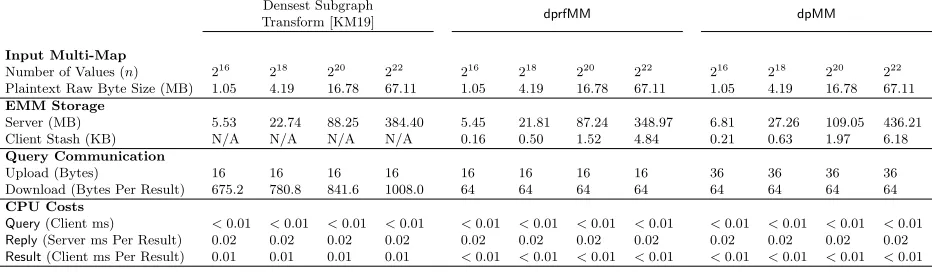
Number of Values (n) 216 218 220 222 216 218 220 222 216 218 220 222 Plaintext Raw Byte Size (MB) 1.05 4.19 16.78 67.11 1.05 4.19 16.78 67.11 1.05 4.19 16.78 67.11
EMM Storage
Server (MB) 5.53 22.74 88.25 384.40 5.45 21.81 87.24 348.97 6.81 27.26 109.05 436.21 Client Stash (KB) N/A N/A N/A N/A 0.16 0.50 1.52 4.84 0.21 0.63 1.97 6.18
Query Communication
Upload (Bytes) 16 16 16 16 16 16 16 16 36 36 36 36
Download (Bytes Per Result) 675.2 780.8 841.6 1008.0 64 64 64 64 64 64 64 64
CPU Costs
Query(Client ms) <0.01 <0.01 <0.01 <0.01 <0.01 <0.01 <0.01 <0.01 <0.01 <0.01 <0.01 <0.01 Reply(Server ms Per Result) 0.02 0.02 0.02 0.02 0.02 0.02 0.02 0.02 0.02 0.02 0.02 0.02 Result(Client ms Per Result) 0.01 0.01 0.01 0.01 <0.01 <0.01 <0.01 <0.01 <0.01 <0.01 <0.01 <0.01
Table 2: Microbenchmarks for server and network costs comparing volume-hiding STE schemes. We denote
n as the total number of values in the input multi-map. If` is the maximum volume of any key, then the first two column constructions must download`results. On the other hand, the number of results fordpMM will be significantly smaller than` on average. The above results apply for any input multi-map structure, query distribution as well as any value`. We denote milliseconds by ms.
3. Return{T1[FKPRF(key||i||0)], T2[FKPRF(key||i||1)]}i∈[X].
dpMM.Resultis identical todprfMMexcept that the server’s response will contain less than` encrypted key-value pairs.
Correctness. The probability that not all values are retrieved is upper bounded by the probability that noise(key)<−l∗(λ). Since noise(key) is distributed according toLap(2/), we obtain that this probability isO(el∗(λ)) which is negligible inλ, asl∗(λ) =ω(logλ).
Security. We note thatdpMMhas almost identical leakage to bothdprfMMandvhMMexcept thatdpMM also leaks the value`(key) +l∗(λ) +Lapkey(2/) for each queriedkey. Additionally,dpMMleaks the number of unique keys m from the size of the cuckoo hash table for the count table. We prove that dpMM is a differentially private volume-hiding STE scheme for multi-maps in Appendix C due to lack of space.
Theorem 9. dpMMis-differentially private volume-hiding.
Efficiency. Note that dpMM has almost identical efficiency to dprfMM except for two major differences. The number of encrypted key-value pairs in the server’s response generated by Reply is 2`(key) +l∗(λ) + Lapkey(2/). Note, thatl∗(λ) +Lapkey(2/) =ω(logλ) except with probability negligible inλ. For keys with volume significantly smaller than the maximum volume `, dpMM achieves much better query complexity. Also, the outsourcedEMMconsists of two cuckoo hash schemes instead of one. So, we get:
Theorem 10. For any α >0, construction dpMM requires(2 + 2α)(m+n) storage on the server. Each query requires1 +`(key) +ω(logλ)communication between the client and the server except with probability negligible inλ. The client storesO(1)private keys as well as at most f(n) =ω(1)key-value pairs. Both the client and server perform O(`(key)) +ω(logλ)computation. Furthermore, the constructiondpMM is lossy with probability negligible inλ.
4.1
Discussion of Differential Privacy
In this section, we present a discussion of when differentially private volume-hiding suffices for security as opposed to volume-hiding. Deciding which security definition is completely dependent on the setting. Consider the case of input multi-maps drawn from a distribution of multi-maps with extremely different volume signatures, In this setting, volume-hiding seems necessary.
volume-hiding would suffice here. Additionally, suppose we wish to hide the identity of queried keys amongst other keys with similar volumes. In this case, differential privacy may also be used as the keys with similar volume will have similar leakage.
To summarize, differentially private volume-hiding is useful when all possible input multi-maps have similar volume signatures. Differentially private volume-hiding can protect input multi-maps that do not have very different volumes. When attempting to protect significantly different input multi-maps, normal volume-hiding security seems necessary. Therefore, the choice of whether to usedprfMMor dpMMdepends on the situation.
5
Experimental Evaluation
In this section, we present our experimental evaluation of our two main volume-hiding STE schemes for multi-maps: dprfMManddpMM. We start by describing the setup of our experiments as well as the choice of parameters of our constructions. Then, we compare bothdprfMManddpMMwith the Densest Subgraph Transform construction described in [KM19].
By performing these experiments, we attempt to answer two important questions. First, are the con-structions dprfMManddpMMmore concretely efficient compared to the previous most practically efficient construction (Densest Subgraph Transform [KM19])? Secondly, what is the total cost ofdprfMManddpMM? We will use multipliers to describe improvements in efficiency. When we say construction A is a 2x im-provement in communication over construction B, we mean that construction A uses half the communication used in construction B.
5.1
Experimental Setup
Our experiments are performed using the same machine for both the client and the server. The machines used for the client and server are Ubuntu PCs with 12 cores, 3.5 GHz Intel Xeon E5-1650 and 32 GB of RAM. All the results of our experiments have standard deviations less than 10% of their average. Network resources costs are measured at the application layer. Both the client and server binaries are built using the gRPC library [GRP18].
Input Multi-Maps. In our experiments, we will consider multi-maps containing n ∈ {216,218,220,222}
total values. We note that all constructions under experimentation consider general multi-map inputs. As a result, their efficiencies do not depend on the structure of the multi-map but are completely determined by the parameters nand`(the maximum volume) of the input multi-map. All keys and values will be 8 byte strings.
Primitives. In all our experiments, we consider PRFs with 16 byte keys as well as 16 byte outputs. In particular, we implement our PRFs using SHA256. We also use SHA256 as the pseudorandom generator for our delegatable PRF construction. We will use AES in CBC mode as our symmetric encryption scheme. Note that encrypting a single key-value pair which is 16 bytes would result in a 32 byte ciphertext. As a result, naive encryption of the input multi-map will result in a 2x overhead in storage.
5.2
Cost of Densest Subgraph Transform [KM19]
In the concrete parameters described in [KM19], it is shown that the number of bins must be at most
size. For each query, ` results will be downloaded to ensure that the construction is volume-hiding. The experimental results of this construction can be found in the first column of Table 2.
5.3
Cost of
dprfMM
We implement thedprfMMconstruction in C++ using OpenSSL for all the underlying cryptographic prim-itives (SHA256 and AES). For the cuckoo hash table sizes, we will set the constantα= 0.3 such that both tables hold a total 2.6nencrypted key-value pairs. We set the number of maximum evictions before being placed into the stash at 5 log2n. A query consists of uploading a single 16 byte PRF output and downloading two encrypted locations per result.
Comparing to the Densest Subgraph Transform [KM19], we see that dprfMMuses smaller server storage overall. Furthermore, as the multi-map increases size,dprfMMstarts using significantly smaller amounts of server storage. For example, for the 222 value multi-map, dprfMM uses approximately 40 MB less server
storage. In terms of query overhead,dprfMMis significantly better. For each result,dprfMMdownloads two encrypted locations resulting in only 64 bytes. This is a 10-16x improvement over the Densest Subgraph Transform [KM19] which requires 675 bytes (10 times more thandprfMM) per result for the multi-map with 216 values and increases to 1 KB (16 times more thandprfMM) per result for the multi-map with 222values.
Looking at the pattern, dprfMMwill have even better query overhead improvements as we consider larger multi-maps. The only tradeoff that is made is that the client must store an additional stash. However, the stash is very small in practice consisting of at most 4 KB. This additional client storage is much smaller than the server storage gains ofdprfMM.
In terms of CPU cost, we note thatdprfMMis almost identical to the Densest Subgraph Transform [KM19]. The main difference is that duringReply, the Densest Subgraph Transform has to decrypt significantly larger strings as opposed todprfMM. As a result, the CPU cost ofdprfMMin Replyis smaller.
5.4
Cost of
dpMM
We also implementdpMMin C++ using OpenSSL for all underlying cryptographic primitives. In particular, we modifydprfMM in two ways to obtain dpMM. First, dpMMadditionally sends an integer during query as well as another PRF for retrieving an entry from the count table costing another 16 byte PRF value. For our experiments appearing in Table 2, we assume close to the worst case in our experiments fordpMMwhere the number of keys ism=n/4 which causes a very large cuckoo hashing table for counts.
The cost of slightly increased server storage fordpMMis offset by the main benefit ofdpMM, which is that the total number of results that will be downloaded is much smaller than the other two constructions. To demonstrate these gains, we consider a natural setting of a multi-map ofn= 220 values andm=n/8 = 217
keys following the Zipf distribution with parameters m and 1. As a result, the volumes of the multi-map from largest to smallest will be (Hn
m, . . . ,
n
m·Hm) whereHm:=
P i∈[m]i
−1 is the harmonic number. In our
case,Hm≈12.36 whenm= 217.
We construct dpMM with a privacy budget of = 0.2 for strong differential privacy guarantees. To pick the value l∗(λ), we will ensure that dpMM is lossy with probability at most 2−64. We know that Pr[Lap(2/) ≤2t/] ≤ e−t. By setting t := 56.1, we can guarantee that the probability that a single key is truncated is Pr[Lap(2/)≤2t/]≤2−64−17. Therefore, the probability that at least one of the m= 217
is truncated is at most 2−64. By our choice, we set l∗(λ) = 5610. Note, we are being very pessimistic as we picked a small privacy budget of= 0.2 and a small truncation probability of 2−64. By choosing larger
privacy budgets or larger truncation probabilities which might be suitable in certain settings,dpMMwould incur smaller query overhead.
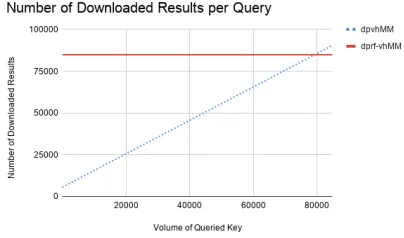
Figure 1: Comparison of number of downloaded results bydprfMManddpMM.
in query communication overdprfMM. Additionally, we note that the Densest Subgraph Transform [KM19] also returns 84,000 results but each result requires communicating 841.6 bytes. As a result, dpMMis an 150-240ximprovement in average query overhead over the Densest Subgraph Transform.
6
Conclusions
In this work, we present a volume-hiding scheme dprfMMthat is practically more efficient than any previ-ous volume-hiding scheme. dprfMMalways uses less server storage compared to the previous construction. Furthermore,dprfMMimproves the communication costs of queries by a factor of 10-16x over the previous best constructions [KM19] when encrypting multi-maps that occupy 1-67 MB in the plaintext and consist of 216-222total values. From an asymptotic perspective, dprfMMis the first construction with both
asymp-totically optimal storage and query overhead. We also present the first formal definition of volume-hiding leakage functions.
In addition, we also introduce the notion of differentially private volume-hidingwhich strikes a better, tunable balance between privacy and efficiency. We presentdpMMthat is able to significantly improve the average query overhead over the previous best volume-hiding schemes [KM19] by a factor of 150-240x when encrypting multi-maps with 216-222total values that occupy 1-67 MB in the plaintext.
Altogether, we significantly further the field of volume-hiding encrypted multi-maps by presenting both conceptual (formal definitions) and algorithmic (constructions that are both asymptotically and practically efficient) contributions.
References
[AKL+18] Gilad Asharov, Ilan Komargodski, Wei-Kai Lin, Kartik Nayak, Enoch Peserico, and Elaine Shi.
OptORAMa: Optimal oblivious RAM. Cryptology ePrint Archive, Report 2018/892, 2018.
[AKM18] Ghous Amjad, Seny Kamara, and Tarik Moataz. Breach-resistant structured encryption. Cryp-tology ePrint Archive, Report 2018/195, 2018. https://eprint.iacr.org/2018/195.
[ANSS16] Gilad Asharov, Moni Naor, Gil Segev, and Ido Shahaf. Searchable symmetric encryption: optimal locality in linear space via two-dimensional balanced allocations. In Proceedings of the forty-eighth annual ACM symposium on Theory of Computing, pages 1101–1114. ACM, 2016.
[ASS18] Gilad Asharov, Gil Segev, and Ido Shahaf. Tight tradeoffs in searchable symmetric encryption. Cryptology ePrint Archive, Report 2018/507, 2018. https://eprint.iacr.org/2018/507.
[BCLO09] Alexandra Boldyreva, Nathan Chenette, Younho Lee, and Adam O’neill. Order-preserving symmetric encryption. InAnnual International Conference on the Theory and Applications of Cryptographic Techniques, pages 224–241. Springer, 2009.
[BCO11] Alexandra Boldyreva, Nathan Chenette, and Adam O’Neill. Order-preserving encryption revis-ited: Improved security analysis and alternative solutions. In Annual Cryptology Conference, pages 578–595. Springer, 2011.
[BDCOP04] Dan Boneh, Giovanni Di Crescenzo, Rafail Ostrovsky, and Giuseppe Persiano. Public key encryption with keyword search. In EUROCRYPT ’04, pages 506–522, 2004.
[BMO17] Rapha¨el Bost, Brice Minaud, and Olga Ohrimenko. Forward and backward private searchable encryption from constrained cryptographic primitives. InProceedings of the 2017 ACM SIGSAC Conference on Computer and Communications Security, pages 1465–1482. ACM, 2017.
[Bos16] Raphael Bost. Sophos: Forward secure searchable encryption. InProceedings of the 2016 ACM SIGSAC Conference on Computer and Communications Security, pages 1143–1154. ACM, 2016.
[CGKO11] Reza Curtmola, Juan Garay, Seny Kamara, and Rafail Ostrovsky. Searchable symmetric en-cryption: improved definitions and efficient constructions. Journal of Computer Security, 2011.
[CGPR15] David Cash, Paul Grubbs, Jason Perry, and Thomas Ristenpart. Leakage-abuse attacks against searchable encryption. InCCS ’15, 2015.
[CJJ+13] David Cash, Stanislaw Jarecki, Charanjit Jutla, Hugo Krawczyk, Marcel-C˘at˘alin Ro¸su, and
Michael Steiner. Highly-scalable searchable symmetric encryption with support for boolean queries. InAnnual Cryptology Conference, pages 353–373. Springer, 2013.
[CJJ+14] David Cash, Joseph Jaeger, Stanislaw Jarecki, Charanjit S Jutla, Hugo Krawczyk, Marcel-Catalin Rosu, and Michael Steiner. Dynamic searchable encryption in very-large databases: data structures and implementation. In NDSS, volume 14, pages 23–26. Citeseer, 2014.
[CK10] Melissa Chase and Seny Kamara. Structured encryption and controlled disclosure. In EURO-CRYPT ’10, pages 577–594. Springer, 2010.
[CT14] David Cash and Stefano Tessaro. The locality of searchable symmetric encryption. InAnnual International Conference on the Theory and Applications of Cryptographic Techniques, pages 351–368. Springer, 2014.
[DMNS06] Cynthia Dwork, Frank McSherry, Kobbi Nissim, and Adam Smith. Calibrating noise to sensi-tivity in private data analysis. In Shai Halevi and Tal Rabin, editors,Theory of Cryptography, pages 265–284, 2006.
[DP17] Ioannis Demertzis and Charalampos Papamanthou. Fast searchable encryption with tunable locality. In Proceedings of the 2017 ACM International Conference on Management of Data, pages 1053–1067. ACM, 2017.
[DPP18] Ioannis Demertzis, Dimitrios Papadopoulos, and Charalampos Papamanthou. Searchable en-cryption with optimal locality: Achieving sublogarithmic read efficiency. In Annual Interna-tional Cryptology Conference, pages 371–406. Springer, 2018.
[GGM86] Oded Goldreich, Shafi Goldwasser, and Silvio Micali. How to construct random functions. J. ACM, 33(4):792–807, August 1986.
![Table 1: This table compares previous volume-hiding encryption schemes for multi-maps from [KM19] withthe constructions of this paper](https://thumb-us.123doks.com/thumbv2/123dok_us/7992148.1326614/4.612.73.540.72.211/table-compares-previous-volume-encryption-schemes-withthe-constructions.webp)