
University of Windsor University of Windsor
Scholarship at UWindsor
Scholarship at UWindsor
Electronic Theses and Dissertations Theses, Dissertations, and Major Papers
2011
Development of a shear test to determine the cyclic behaviour of
Development of a shear test to determine the cyclic behaviour of
sheet materials
sheet materials
Md. Samsul Sarker
University of Windsor
Follow this and additional works at: https://scholar.uwindsor.ca/etd
Recommended Citation Recommended Citation
Sarker, Md. Samsul, "Development of a shear test to determine the cyclic behaviour of sheet materials" (2011). Electronic Theses and Dissertations. 208.
https://scholar.uwindsor.ca/etd/208
This online database contains the full-text of PhD dissertations and Masters’ theses of University of Windsor students from 1954 forward. These documents are made available for personal study and research purposes only, in accordance with the Canadian Copyright Act and the Creative Commons license—CC BY-NC-ND (Attribution, Non-Commercial, No Derivative Works). Under this license, works must always be attributed to the copyright holder (original author), cannot be used for any commercial purposes, and may not be altered. Any other use would require the permission of the copyright holder. Students may inquire about withdrawing their dissertation and/or thesis from this database. For additional inquiries, please contact the repository administrator via email
DEVELOPMENT OF A SHEAR TEST TO DETERMINE THE
CYCLIC BEHAVIOUR OF SHEET MATERIALS
by
Md. Samsul Alam Sarker
A Thesis
Submitted to the Faculty of Graduate Studies
Through the Department of Mechanical, Automotive and Materials Engineering in Partial Fulfillment of the Requirements for the Degree of Master of Applied Science at the University of
Windsor
Windsor, Ontario, Canada 2011
DEVELOPMENT OF A SHEAR TEST TO DETERMINE THE
CYCLIC BEHAVIOUR OF SHEET MATERIALS
by
Md. Samsul Alam Sarker
APPROVED BY:
Dr. S. Das, Outside Program Reader Department of Civil & Environmental Engineering
Dr. J. Johrendt, Department Reader
Department of Mechanical, Automotive and Materials Engineering
Dr. D. Pusca, Co-Advisor
Department of Mechanical, Automotive and Materials Engineering
Dr. D. E. Green, Advisor
Department of Mechanical, Automotive and Materials Engineering
Dr. Biao Zhou, Chair of Defence
Department of Mechanical, Automotive and Materials Engineering
iii
AUTHOR’S DECLARATION OF ORIGINALITY
I hereby certify that I am the sole author of this thesis and no part of this thesis has been
published or submitted for publication.
I certify that, to the best of my knowledge, my thesis does not infringe upon anyone’s
copyright nor violate any proprietary rights, and that any ideas, techniques, quotations, or any
other material from the work of other people included in my thesis, published or otherwise, are
fully acknowledged in accordance with the standard referencing practices. Furthermore, to the
extent that I have included copyrighted material that surpasses the bounds of fair dealing within
the meaning of the Canada Copyright Act. I certify that I have obtained a written permission
from the copyright owner(s) to include such material(s) in my thesis.
I declare that this is a true copy of my thesis, including any final revisions, as approved
by my thesis committee and the Graduate Studies office, and this thesis has not been submitted
iv
ABSTRACT
In many industrial stamping operations, the sheet material is subject to a series of loading
and reverse loading cycles. In order to accurately predict the outcome of such forming processes,
numerical simulation models rely on advanced constitutive models to rigorously reproduce the
cyclic work hardening behaviour of the sheet material.
The objective of this research was to develop a testing facility that is capable of
generating the experimental stress-strain data of sheet materials when they are subjected to cyclic
shearing loads. A suitable specimen geometry and a corresponding loading fixture were designed
and fabricated.
Cyclic shear tests were successfully carried out on four different grades of automotive
sheet steel using this new testing fixture mounted in a universal testing machine. The
experimental data thus generated can be used to determine the material parameters in advanced
constitutive models, in order to virtually simulate metal forming operations and the subsequent
v
DEDICATION
To my parents, my wife Ferdoush Jahan, my daughters Raika Alam and Aniba Alam, for their
vi
ACKNOWLEDGEMENTS
I would like to express my sincere gratitude and profound appreciation to my advisor, Dr.
D.E. Green, for his patience, invaluable supervision, guidance, continuing encouragement,
intellectual discussions, thoughtful insights, and so generously taking his time to discuss all
aspects of this research, and shared expertise in sheet metal forming throughout my graduate
studies and research. His assistance over the course of my research has been invaluable and
immeasurable; without his guidance this project would have been impossible.
I appreciate Dr. D. Pusca sharing her ideas to optimize the fixture model, apply GD&T to
parts and assembly drawings, and for mentoring me during this research. My sincere thanks to
committee member Dr. J. Johrendt for her support, valuable comments, and suggestions to
improve the model. Dr. S. Das is also acknowledged for serving on my thesis committee and
making suggestions to improve this thesis.
I would also like to thank the laboratory technologist Mr. Andy Jenner who built the
cyclic shear test fixture and specimens promptly and his assistance during testing is appreciated.
Mr. Albrecht Conle is greatly appreciated for his assistance, interactive and fruitful discussions
during the experiments. I acknowledge the work of Dr. Thuillier at the Université de
Bretagne-Sud, France, who provided experimental shear test data.
My thanks also to my fellow researcher Mr. Amir for his help and shared expertise
conducting experimental tests, and other colleagues in the CRC lab. They are greatly
appreciated for their interactive and fruitful discussions in sheet metal forming research during
this period of study. Finally, but not least, I would like to express my sincere gratitude to my
parents for encouraging me, and my wife and children for being with me throughout the long
vii
TABLE OF CONTENTS
AUTHOR'S DECLARATION OF ORIGINALITY ... iii
ABSTRACT ... iv
DEDICATION ...v
ACKNOWLEDGEMENTS ... vi
LIST OF FIGURES AND TABLES...x
LIST OF ABBREVIATIONS ...xv
LIST OF SYMBOLS ... xvii
1. INTRODUCTION...1
2. LITERATURE REVIEW ...6
2.1 SPRINGBACK IN STAMPED PARTS ...6
2.2 EXPERIMENTAL SPRINGBACK STUDIES AND SIMULATIVE TESTS ...9
2.3 PREDICTION OF SPRINGBACK ...15
2.3.1 Plasticity and Anisotropic Yield Functions ...15
Hill’s Yield Criteria ...16
Barlat’s Yield Criterion ...16
2.3.2 Hardening Laws ...16
Isotropic Hardening ...17
Kinematic Hardening ...18
Non Linear Kinematic Hardening ...20
Mixed Hardening ...21
Multi-surface Hardening Models ...23
2.3.3 Numerical Simulation of Springback...25
2.3.4 Optimization of Springback Predictions ...29
2.4 EXPERIMENTAL CHARACTERIZATION OF THE CYCLIC BEHAVIOUR OF METAL SHEETS ...31
2.4.1 Tension-Compression Tests ...32
viii
2.4.3 Cyclic Shear Tests...36
2.4.4 Advantages of Cyclic Shear Tests ...44
3. DESIGN OF THE CYCLIC SHEAR TEST FIXTURE AND SPECIMEN ...47
3.1 DESIGN METHODOLOGY ...47
3.2 DESIGN OF A CYCLIC SHEAR TEST FIXTURE ...48
3.2.1 Design of the Cyclic Shear Test Fixture ...49
Fixed Upper Part ...51
Movable Lower Part ...52
Holding Blocks ...53
Socket Head Cap Screws ...54
3.2.2 Optimization of the Cyclic Shear Test Fixture Design ...54
3.2.3 Deformation of the Test Fixture ...55
3.3 DESIGN OF A CYCLIC SHEAR TEST SPECIMEN ...57
3.3.1 Design of the Cyclic Shear Test Specimen ...58
3.3.2 Numerical Simulation of the Cyclic Shear Tests ...60
3.3.3 Optimization of the Cyclic Shear Test Specimen Design ...65
4. EXPERIMENTAL PROCEDURES ...71
4.1 DESCRIPTION OF SHEET MATERIALS ...71
High Strength Low Alloy (HSLA) Steels ...71
Dual Phase (DP) Steels ...72
Transformation Induced Plasticity (TRIP) Steels ...73
4.2 SPECIMEN PREPARATION ...74
4.2.1 Preparation of Tensile Test Specimens ...75
4.2.2 Cyclic Shear Test Specimen Preparation ...76
4.3 TESTING PROCEDURES ...77
4.3.1 Tensile Test Procedures ...78
4.3.2 Cyclic Shear Test Procedures ...79
4.4 SYSTEM CALIBRATION AND STRAIN MEASUREMENTS ...83
4.4.1 System Calibration ...83
4.4.2 Strain Measurements ...86
ix
5. RESULTS AND DISCUSSIONS ...89
5.1 EXPERIMENTAL RESULTS OF TENSILE TESTS ...89
5.1.1 DP600 Tensile Test ...90
5.1.2 DP980 Tensile Test ...91
5.1.3 TRIP780 Tensile Test ...92
5.1.4 HSLA Tensile Test ...93
5.2 EXPERIMENTAL AND SIMULATION RESULTS OF CYCLIC SHEAR TESTS ...95
5.2.1 DP600 Cyclic Shear Test ...96
5.2.2 DP980 Cyclic Shear Test ...102
5.2.3 TRIP780 Cyclic Shear Test ...107
5.2.4 HSLA Cyclic Shear Test ...111
6. CONCLUSIONS ...116
APPENDIX A. CYCLIC SHEAR TEST FIXTURE COMPONENTS AND ASSEMBLY DRAWINGS WITH BILL OF MATERIALS ...119
REFERENCES ...126
x
LIST OF FIGURES
Figure 2.1 Springback simulation of sheet metal cup in stamping ...7
Figure 2.2 Different types of springback (a) wall opening (b) wall curl (c) bow ...8
Figure 2.3 Sidewall curl in a drawn channel section ...8
Figure 2.4 Geometrical model of air bending of sheet metal ...9
Figure 2.5 Bending under tension in a typical stamping (drawing) operation ...10
Figure 2.6 Schematic of Sanchez’ three pin roller set-up for cyclic bending of sheet metal...11
Figure 2.7 Schematic of the draw-bend test, R is the roller radius,Fb is the back force, and Δθ is the springback angle ...13
Figure 2.8 Time-dependent springback in (a) DP600 (b) DP980 (c) TRIP780 strips subject to bending under tension.R/t is the roller radius to sheet thickness ratio,Fb is the back force, and δθ is the time-dependent springback angle ...13
Figure 2.9 Isotropic hardening of the yield surface with plastic deformation, and the corresponding uniaxial stress-strain curve ...18
Figure 2.10 Kinematic hardening showing (a) the transitions, | | of the yielding surface with plastic strain, and (b) the resulting stress-strain curve with shifted yield stress in compression-the Bauschinger effect ...19
Figure 2.11 Comparison of the experimental cyclic stress-strain data for DP600 sheet steel and that predicted with the NKH model ...20
Figure 2.12 Schematic illustrations of combined kinematic and isotropic hardening ...22
Figure 2.13 Schematic illustration of Yoshida-Uemori two-surface model ...24
Figure 2.14 Schematic illustration of the stress-strain behaviour of certain materials ...25
Figure 2.15 Effect of hardening model on the simulated profile of DP 600 channel section (a)at 25% (left) and (b)75% (right) drawbead penetration ...29
Figure 2.16 Schematic of double wedges uniaxial tension-compression test device ...33
Figure 2.17 Schematic of the cyclic tension-compression device developed by Boger et al. ...34
xi
Figure 2.19 Symmetrical shear test specimen geometry used by An. et al., in which L and W
are the dimensions of the gauge area; the white areas are the shear zones and the
grey areas are the clamping zones. ...39
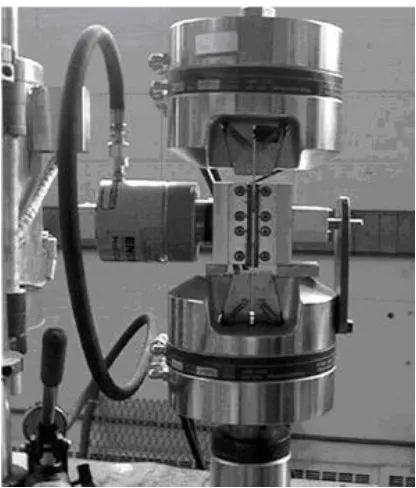
Figure 2.20 Photograph of the simple shear device developed by Thuillier and Manach with a
close-up of the grip system ...41
Figure 2.21 Simple shear test specimen developed by Zang et al., showing the homogeneity of
the strain distribution along three sections of the gauge region (S0, S1, S2) parallel to
the shear direction, for = 0.3 and 0.6, average 1 indicates the entire gauge surface
and average 2 indicates the reduced area in the specimen center, and X denotes the
sample length ...42
Figure 2.22 Shear test facility developed by Meyer et al., showing (a) the jig and specimen (b)
the strain field in the shear zones measured with the ARAMIS system ...43
Figure 3.1 Flow diagram of the design processes for a cyclic shear test facility ...48
Figure 3.2 Photograph of(a)the INSTRON 8562 universal testing machine, (b) a CAD model
of the cyclic shear test fixture, and (c) the details of holding blocks and bolts (d) the
sheet specimen positioned in the testing fixture ...50
Figure 3.3 (a)CAD model of fixed upper part of cyclic shear fixture (b) photograph of fixed
upper part of cyclic shear test fixture ...51
Figure 3.4 (a)CAD model of movable lower part (b) photograph of movable lower part of
cyclic shear test fixture ...52
Figure 3.5 (a)CAD model of holding block (b)photograph of holding blocks of cyclic shear
test fixture with inserted circular knurled blocks ...53
Figure 3.6 (a) CAD model and, (b) photograph of a socket head cap screw ...54
Figure 3.7 Maximum deflection of the fixed upper part of the cyclic shear test fixture (a)
during tension and (b) during compression ...57
Figure 3.8 ASTM B831 shear test specimen for sheet materials ...58
Figure 3.9 (a)CAD model and (b) photograph of the proposed sheet specimen used with the
cyclic shear test fixture ...60
Figure 3.10 Comparison of the predicted stress distribution along the length of the gauge area of
xii
Figure 3.11 Comparison of the predicted strain distribution along the length of the gauge area of
the shear specimen for different mesh sizes ...63
Figure 3.12 Finite element mesh of a half-model of the shear specimen ...64
Figure 3.13 Comparison of the shear strain distribution in the gauge area of the sheet specimen for different numbers of bolt holes ...68
Figure 3.14 Drawing of the optimized cyclic shear test specimen ...70
Figure 3.15 Photograph of inserted knurled blocks on the surfaces of (a) the upper and lower fixtures, and (b) the holding blocks of the cyclic shear test fixture ...70
Figure 4.1 Stress-strain behaviour of different types of DP steels ...73
Figure 4.2 Comparison of the typical stress-strain curves of HSLA, DP and TRIP steels ...74
Figure 4.3 ASTM standards E8, geometry for tensile test specimens ...75
Figure 4.4 Painted tensile test specimens for different grade of sheets with black speckles pattern ...76
Figure 4.5 Photograph of the cyclic shear test specimens (a) without paint (b) painted with a high contrast stochastic pattern ...77
Figure 4.6 Photograph of (a) a clamped tensile specimen ready for testing, (b) the ARAMIS system with stereo cameras focussed on tensile specimen ...79
Figure 4.7 Cyclic shear test (a) experimental test set up with ARAMIS system (b) fixture set up ...80
Figure 4.8 Cyclic shear test (a) specimen set up between fixed upper and lower movable fixture (b) specimen and two shearing gauge zones of the specimen...81
Figure 4.9 ARAMIS 3D sensor unit to measure the volume of calibration panel ...84
Figure 4.10 Calibration panels for (a) 65 mm x 52 mm x 52 mm volume (b) 35 mm x 28 mm x 28 mm ...85
Figure 4.11 Digital images of a random speckle pattern: undeformed pattern as seen from (a) the left and (b) right cameras; deformed pattern as seen from (c) the left and (d) right cameras ...86
Figure 4.12 Photograph of the ARAMIS digital image analysis software showing the strain distribution in the gauge area of a shear specimen ...87
Figure 5.1 Stress-strain behaviour of DP600 sheet steel in tensile test ...91
xiii
Figure 5.3 Stress-strain behaviour of TRIP780 sheet steel in tensile test ...93
Figure 5.4 Stress-strain behaviour of HSLA sheet steel in tensile test ...94
Figure 5.5 True stress-strain curves for different sheet materials in tensile test ...94
Figure 5.6 (a) von Mises effective stress (in GPa) and (b) effective plastic strain predicted in
the gauge region of the DP600 shear specimen after a 2 mm displacement ...97
Figure 5.7 Section A-A in the centre of the gauge area of the shear specimen ...98
Figure 5.8 Predicted shear stresses and shear strains distributions along the gauge length of the
DP600 shear specimen ...99
Figure 5.9 Experimental load-displacement curves obtained by cyclic shear for DP600 steel100
Figure 5.10 Experimental shear stress-shear strain curves for DP600 steel ...100
Figure 5.11 (a) three different sections on the gauge region (b) comparison of the gauge sections
strain distributions obtained from the ARAMIS system for DP600 sheet steel ...101
Figure 5.12 ARAMIS images of the shear strain in the gauge of DP600 specimen after (a)
forward loading and (b) reverse loading ...102
Figure 5.13 Shear strain distributions measured with the ARAMIS system along the centre of
the gauge of the DP600 shear specimen after forward and reverse loading ...102
Figure 5.14 (a) von Mises effective stress (in GPa) and (b) effective plastic strain predicted in
the gauge region of DP980 shear specimen after a 2 mm displacement ...103
Figure 5.15 Predicted shear stresses and shear strains distributions along the gauge length of the
DP980 shear specimen ...104
Figure 5.16 Experimental load-displacement curves obtained by cyclic shear for DP980 steel105
Figure 5.17 Experimental shear stresses - shears strain curves for DP980 steel ...105
Figure 5.18 ARAMIS images of the shear strain in the gauge of DP980 shear specimen after (a)
forward loading and (b) reverse loading ...106
Figure 5.19 Shear strain distributions measured with the ARAMIS system along the centre of
the gauge of the DP980 shear specimen after forward and reverse loading ...106
Figure 5.20 (a) von Mises effective stress (in GPa) and (b) effective plastic strain predicted in
the gauge region of the TRIP780 shear specimen after a 2 mm displacement ...107
Figure 5.21 Predicted shear stresses and shear strains distributions along the gauge length of the
xiv
Figure 5.22 Experimental load-displacement curves obtained by cyclic shear for TRIP780
steel ...109
Figure 5.23 Experimental shear stresses - shear strains curves for TRIP780 steel ...109
Figure 5.24 ARAMIS images of shear strain distribution of TRIP780 sheet steel (a) forward
cyclic loading (b) reverse cyclic loading ...110
Figure 5.25 Shear strain distributions at the centre of the gauge section of TRIP780 steel sheet
during the cyclic loading and unloading condition obtained from ARAMIS system110
Figure 5.26 (a) von Mises effective stress (in GPa) and (b) effective plastic strain predicted in
the gauge region of the HSLA shear specimen after a 2 mm displacement ...111
Figure 5.27 Predicted shear stresses and shear strains distributions along the gauge length of the
HSLA shear specimen ...112
Figure 5.28 Experimental load-displacement curves obtained by cyclic shear for HSLA steel 113
Figure 5.29 Experimental shear stresses - shear strains curves for HSLA steel ...113
Figure 5.30 ARAMIS images of shear strain in the gauge of HSLA specimen after (a) forward
loading and (b) reverse loading ...114
Figure 5.31 Shear strain distributions measured with the ARAMIS system along the centre of
the gauge of the HSLA shear specimen after forward and reverse loading ...114
LIST OF TABLES
Table 3.1 Comparison of the execution times for different mesh densities ...65
Table 3.2 Comparison of the uniformity factor with respect to the number of bolt holes ...69
xv
LIST OF ABBREVIATIONS
AHSS Advanced High Strength Steels
AISI American Iron and Steel Institute
AKDQ Aluminum Killed Draw Quality
ANN-EA Artificial Neural Network Evolutionary Algorithm
ASTM American Society for Testing and Materials
BNC Bayonet Neill–Concelman
BPNN Back Propagation Neural Network
CAD Computer Aided Design
DAP Data Acquisition Processor
DAT Data Acquisition Tool
DIC Digital Image Correlation
DOE Design of Experiments
DP Duel Phase
DQSK Draw Quality Semi-Killed
EA Evolutionary Algorithm
EDM Electrical Discharge Machine
FE Finite Element
FEA Finite Element Analysis
FEM Finite Element Method
GA Genetic Algorithm
GA-BP Genetic Algorithm Back Propagation
GB Gigabyte
HSLA High Strength Low Alloy
HSS High Strength Steel
Hz Hertz
IH Isotropic Hardening
KN Kilo Newton
xvi
MPa Mega Pascal
NAFR Non Associate Flow Rule
NKH Non Linear Kinematic Hardening
PB Pre-stretching and Bending
RAM Random Access Memory
RD Rolling Direction
RIK Rotational Isotropic Kinematic
RS Random Search
SB Simultaneous Stretching and Bending
SD Shearing Direction
SSC Shear Tensile Stress Condition
TD Transverse Direction
TRIP Transformed Induced Plasticity
TSC Tensile Stress Condition
UTS Ultimate Tensile Strength
WS Without Stretching
xvii
LIST OF SYMBOLS
Symbol Description
𝑓 Function
Effective stress (or flow stress)
Engineering stress
True stress
𝑦 Yield stress
𝑦0 Initial Yield stress
Engineering strain
True strain Plastic strain
̅ Effective strain
𝑝 Accumulated effective plastic strain
(𝑝) Isotropic hardening function
τ, Shear stress
γ Shear strain
α-Fe Ferrite
γ-Fe Austenite
Instantaneous tensile load
Initial area
Dp Rate of plastic deformation
L0 Initial Length
Li Instantaneous Length
Natural logarithm
K Strength index of material
l Length of sheared area
Strain hardening exponent
xviii
Unit vector direction of kinematic motion
r Slot radius
w Width of sheared area
t Thickness of sheet metal
B Initial size
F Force
H Height of calibrated volume
L Length of calibrated volume
W Width of calibrated volume
R Bending radius
Ri Isotropic hardening component
S Cauchy stress deviator
Y Radius of yield surface in the deviatoric space
c Tool gap in bending
e Punch displacement in bending
w Die opening in bending
α Springback angle
αb Back stress deviator/tensor
Relative kinematic motion of the yield surface
β Center of the bounding surface
θ Bending angle
∅ Diameter
N-m Newton-meter
∆ρ Springback quantity of bending radius
∆β Springback quantity of bending angle
∆θ Changes in springback angle
δθ Time dependent springback angle
1
1.
INTRODUCTION
Sheet metal forming processes are commonly used to produce a multitude of parts for the
automotive, aerospace, appliance and farm equipment industries. The manufacture of sheet metal
components often requires one or more stamping operations in which the sheet material is
stretched, drawn and bent between two mating dies to give it the desired shape. Stamping has
actually been one of the most cost-effective ways of mass producing parts, especially for
automotive components.
In an age where fuel consumption and weight reduction have become significant
preoccupations, the automotive industry is driven to manufacture the body and structure of
passenger vehicles using either high strength steel, aluminum or magnesium sheets. In view of
the higher cost of magnesium and aluminum, however, the trend has been to use increasing
proportions of high strength steel so that body components can be produced with thinner gauges
without compromising the structural integrity (i.e. the torsional and bending stiffness) and the
crash resistance of the vehicle. In particular, advanced high strength steels (AHSS) such as dual
phase (DP) and transformed induced plasticity (TRIP) steels have now become common
automotive sheet materials, and the trend continues to be for automotive body panels and
structures to be made from steel grades that have increasing tensile strength.
The main challenges of producing sheet metal parts are, first of all, to satisfy the design
specifications in terms of the geometric dimensions and tolerances of the part, and secondly, to
avoid any defects such as excessive thinning, splits, wrinkles, surface damage and inconsistent or
uncontrolled springback. Indeed, after a part has been stamped and then removed from the dies,
2
stresses reach a state of equilibrium. The recovery of elastic deformations is an inevitable
characteristic of metallic materials that can lead to significant changes in the shape of a part. For
instance, bent shapes will tend to unbend, drawn channels will tend to exhibit sidewall curl and
open parts will tend to twist.
Springback is actually a complex phenomenon: the nature and amount of deviation from the
intended part geometry depends on the mechanical properties of the sheet material, on the level
of stresses and strains that are attained in the part at the end of the forming process, and on the
constraints that come from the shape of the part itself. Therefore, as stamped automotive parts
are made from increasingly higher strength sheet materials, the magnitude and complexity of
springback also increases. It is not surprising therefore that the single most costly challenge for
suppliers of automotive stamped parts is to control the springback.
Traditionally, springback has been minimized by stamping prototype parts and then
reworking the dies, and successively repeating this process by trial and error until the parts fit
properly in a checking fixture. However, this way of building dies can be very costly and
time-consuming, even when it is carried out by experienced tool & die makers, and may not always
lead to a well-controlled manufacturing process. Furthermore, building a production die that is
designed with incorrect springback compensation can cause significant difficulties in
downstream operations such as poor fit-up in a welded subassembly. In some cases, tooling
revisions may be required which could delay the start of production. Therefore the prediction of
springback, especially in parts made from AHSS, is of critical importance to suppliers of
automotive stampings.
The competition in the automotive industry is such that stamping dies must be designed and
3
specified by the product designer. This signifies that springback must be known and accounted
for when the dies are designed. The most efficient way for this to be done is to use
state-of-the-art numerical simulation to predict the outcome of a stamping operation. Indeed, commercial
finite element analysis (FEA) software is routinely used to dynamically simulate the stamping
process as well as predict the springback [1] after stamping for many complex automotive parts.
Once springback has been predicted for a virtual model of the part, the shape of the die can be
compensated to eliminate or minimized springback before the dies are built.
The finite element method is widely used in the industry to predict the springback of stamped
parts [1], and consists of building a virtual model of the entire stamping process with all the
tooling surfaces that interact with the sheet metal. The blank and the dies are discretized into a
large number of elements, mechanical properties are assigned to each component and the
kinematics and boundary conditions of the stamping process are virtually reproduced. During the
numerical simulation the die surfaces gradually close into their mating position by a series of
small incremental steps, and as a result of the constraints and forces applied to the blank it
progressively deforms into the desired shape. During each increment, the equations of motion are
solved at each integration point in each element of the blank and the strains and stresses are
computed. After the forming process is simulated, springback is also predicted by virtually
opening the dies and allowing the formed part to elastically unload to its equilibrium position.
The accuracy of the numerical analysis depends on a large number of factors, but in
particular on the constitutive model that is selected to describe the behaviour of the sheet
material. Much research has been devoted to developing constitutive models that are capable of
reproducing the behaviour of sheet materials, and today, various advanced constitutive models
4
springback of AHSS sheets. However, a specific series of material characterization tests must be
carried out for a given sheet material in order to determine the parameters in the constitutive
model that will describe the actual behaviour of this sheet. As constitutive models become more
advanced, they generally have more parameters that need to be determined, which means more
sophisticated characterization tests are required.
During many stamping or drawing operations the sheet metal is subjected to successive
bending and unbending during the forming process, such as when the blank is formed over a
punch or die radius. When a blank is drawn over a die radius one side of the sheet is deformed in
tension while the other side is in compression, and a gradient of deformation develops through
the thickness of the sheet. But once the sheet exits the curved portion of the tooling it straightens
out again, and the side that was in tension becomes loaded in compression, and vice versa for the
opposite side of the sheet. When sheet metal is formed through a drawbead the material
experiences a series of bending-unbending cycles. Forming operations that make use of
drawbeads to control the flow of metal are quite common and lead to cyclic loading and
unloading in specific areas of the part. It is essential therefore, that the constitutive model in the
FEA be able to accurately simulate the actual behaviour of the sheet material when it is
cyclically deformed, because unless the strains and stresses are accurately predicted in the virtual
forming process the strains and stresses (and the part shape) will obviously not be accurately
predicted after springback.
The main objective of this research is to design and build a testing apparatus that will enable
us to experimentally determine the cyclic stress-strain behaviour of sheet materials so that finite
element (FE) analysts seeking to predict the springback of stamped parts can determine the
5
The development of a test to cyclically deform sheet metal specimens involves several steps:
Selecting the type of deformation to impose on the specimen (e.g.
tension/compression, bending/unbending, simple shear etc.).
Designing and optimizing the specimen geometry with a gauge area in which stresses
and strains are uniformly distributed and can easily be measured during a test.
Designing and building a rigid fixture that can be mounted in a testing apparatus and
that can impose the desired type of cyclic loading onto the specimen.
Once the prototype fixture is built and sheet specimens are fabricated, it will be necessary to
carry out tests to verify that the specimens, fixture and testing actually provide the desired
experimental stress-strain data.
This thesis divides into six chapters. Chapter 2 provides a review of springback and the
current constitutive models used to simulate the deformation of anisotropic sheet materials.
Moreover, a literature review of various testing facilities that have been used to experimentally
determine the cyclic behaviour of sheet materials is also provided. Chapter 3 presents a
description of the methodology that was followed to design both the test fixture and the
geometry of the sheet specimen. Chapter 4 presents the experimental work that was done to
verify the effectiveness of the test, including the different sheet materials that were tested, the
testing procedures, the strain measurements and the details of data analysis. Chapter 5 provides
the experimental stress-strain response of the sheet materials that were tested. Finally, Chapter 6
presents the observations made throughout this experimental work as well as some conclusions
6
2. LITERATURE REVIEW
Before one can design a testing apparatus to experimentally determine the cyclic
stress-strain behaviour of AHSS sheets it is necessary to first consider the work that other researchers
have done to characterize and model the cyclic behaviour of sheet materials. This chapter
provides an overview of the literature relevant to this study and divides into four main sections.
The first section briefly describes the types of springback that can develop in industrial sheet
metal components. The next section provides an overview of some simulative tests that have
been developed to experimentally investigate springback. The third section gives a review of
constitutive models (anisotropic yield criteria and hardening laws) used to numerically simulate
sheet metal forming and springback. And the final section describes various experimental testing
facilities that researchers have developed to characterize the cyclic behaviour of sheet materials
in view of obtaining material input data for numerical simulations.
2.1 SPRINGBACK IN STAMPED PARTS
In the automotive industry, high strength steel sheets and low density sheet metals have
become a necessity in order to reduce the weight of the vehicle body-in-white. However, the
increased use of materials with high strength and/or low elastic modulus as well as reduced
gauges leads to a significant increase in the amount of springback in stamped parts. Therefore,
springback has become a major challenge in regards to manufacturing lightweight automotive
components.
During the stamping of a sheet metal component, the sheet material is often subject to
7
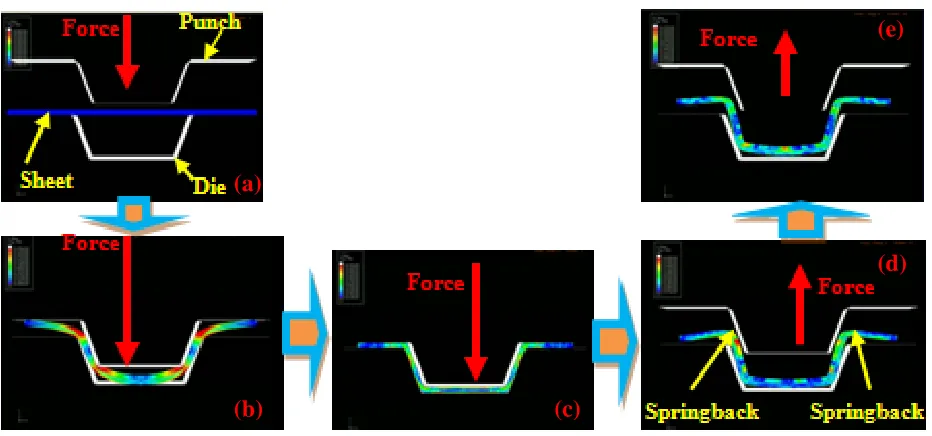
stress distribution in the part after forming, and especially the stress gradient through the
thickness, is responsible for the nature and magnitude of springback. For example, Fig. 2.1
shows the stress distribution in a sheet material at different stages throughout the process of
being formed into a cup and after the part is allowed to springback. The non-uniform distribution
of stress in the part is very evident at each stage.
Figure 2.1Springback simulation of sheet metal cup in stamping
Depending on the type of forming process, the shape of the as-formed part, the sheet
mechanical properties, the selection of industrial process parameters and the stress distribution in
the formed part, the shape distortions due to springback can manifest themselves in a variety of
ways [2]. Because springback is so part and process-dependent, it can be very difficult to control
the geometry and dimensional accuracy of stamped sheet metal components. For example,
springback can cause twisting of the entire part, stretched areas tend to shrink, bent or flanged
edges will unbend to some extent (Fig. 2.2a) and drawn channel sections can exhibit curling of
the sidewalls (Fig. 2.2b and Fig. 2.3). Researchers have defined six common classes of
springback as follows [2]:
(a)
(c) (b)
(e)
8 1) Sidewall opening (Figure 2.2a)
2) Sidewall Curl (Figure 2.2b)
3) Edge line warping or bow (Figure 2.2c)
4) Twist
5) Global shape change
6) Surface distortion
Figure 2.2 Different types of springback (a) wall opening (b) wall curl (c) bow [2]
Figure 2.3 Sidewall curl in a drawn channel section [2]
In order to minimize the distortions due to springback, efforts have typically been made
on two fronts: a) adjustments can be made to critical process factors such as blank holding force,
die clearances, ram velocity, lubrication, drawbead restraining force, etc. [3], and b) springback
is numerically predicted and compensated for at the tool design stage [4, 5]. The first approach is
essentially a pragmatic way to minimize springback due to variations in the mechanical
9
properties of incoming sheets after the stamping dies have been built. This type of springback
correction tends to have a limited impact and is only used to make minor adjustments since the
stress distribution in the part is largely determined by the deformation history of the sheet metal
in the dies. Process changes are rarely sufficient to eliminate springback problems that result
from a poorly designed tool. The second approach endeavours to optimize the forming process
and the design of the dies before they are built, so that the flow of metal during the stamping
process can be as even and uniform as possible and any gradients in residual stresses can be
minimized. Nowadays, this is the most cost-effective approach to springback compensation.
2.2 EXPERIMENTAL SPRINGBACK STUDIES AND SIMULATIVE TESTS
The earliest experimental springback studies consist of simple bending tests. Ogawa et al.
[6] performed V-bending tests to predict the springback of the high strength steel sheets and
observed that springback drastically decreases with increasing bottoming force. Fu and Mo [7]
conducted air bending test on high strength steel sheets and measured the springback angle and
radius. The geometric model of the air bending of sheet metal specimen proposed by Fu and Mo
is shown in Fig. 2.4.
Figure 2.4 Geometrical model of air bending of sheet metal [7]
10
In Fig. 2.4, c is the tool gap, t is sheet metal thickness, w is the die opening, r is the punch
radius, R is the bending radius, b is punch width, e is the punch displacement, and the springback
arc segment is defined by the bending arc segment of sheet metal after removal from the punch.
It is important to mention that in air bending springback can lead to changes of bending radius,
bending arc segment, and bending angle. The difference between the bending radius of a sheet
after unloading (R), and the punch radius (r) is defined as springback quantity of the bending
radius (∆ρ=R-r). The springback angle (∆β=α-θ) is the difference between the unloaded bend
angle (α) and the bend angle before springback (θ).
In many stamping operations, it is common for the sheet metal to be deformed in a plane
strain mode as a result of combined bending and tension. For instance, when sheet metal is
drawn through a drawbead and over the die shoulder radius as a result of the punch action (Fig.
2.5), it becomes subject to bending under tension. In order to thoroughly understand the
springback behaviour of sheet materials that have been deformed in this way a number of
researchers [7, 8] have developed simulative tests that reproduce bending-under-tension
deformation modes, and then have attempted to model the springback behaviour that was
observed experimentally.
11
Sanchez [8] developed a drawbead simulation testing apparatus that can apply both
bending and tension to a sheet specimen using three pin rollers. During testing the sheet metals
are bent, un-bent and bent in the reverse direction in a three-cycle sequence. A schematic of
Sanchez’ experimental binder geometry and theoretical model is shown in Fig. 2.6. During his
experiments, Sanchez observed that springback decreased with increasing tension and became
negligible for tensile forces approaching the tensile strength of the material. He reported that if
the coulomb friction on the pins increases by about 0.01, it would result in noticeably greater
tension forces and smaller curvature after springback [8].
Figure 2.6 Schematic of Sanchez’ three pin roller set-up for cyclic bending of sheet metal[8]
Schilp et al. [9] investigated the effects of three different factors on the springback
response after stretch-bending tests: the stretching method, the stretching length and the
stretching direction. They showed that when the bending radius to the sheet thickness ratio (R/t)
increases, the springback gradually increases and reaches a maximum when the ratio is R/t = 10,
with a 45o bending angle. In order to investigate the stretching effect, Schilp et al. [9]compared
four processes: bending without stretching (WS), pre-stretching and bending (PB), pre-stretching
plus simultaneous stretching and bending (PSB), and simultaneous stretching and bending (SB).
They compared the springback factor maintained a fixed R/t and changed the bending angles of
12
process the amount of springback increases drastically. The springback remained regular values
regardless of bending angle in SB process. As, R/t increases and the bending angle becomes
smaller, the SB process produces less springback than other process. They concluded that,
simultaneous stretching and bending can reduce the springback, and the variation of stretching
length has no distinct effect in the simultaneous stretching and bending process.
Lim et al. [10] conducted an experimental study using a draw-bend test (Fig. 2.7) to
determine the time-dependent springback at room temperature of four AHSS sheets, (DP600,
DP800, DP980 and TRIP780), and three conventional steel sheets (AKDQ, DQSK and HSLA).
After drawing the test strips over the tool radius and unloading them, they measured the
springback angle at regular time intervals up to 6 months after the test; the instantaneous
springback angle was called the time-independent springback angle. When the springback angle
continued to increase over time, it would eventually reach a saturation value; the difference
between the saturated angle and the instantaneous angle was called the time-dependent
springback angle. It was observed that both AHSS and conventional steels showed a decrease in
the instantaneous springback angle with increasing back force and tool radius. In addition, AHSS
with higher yield stress showed larger instantaneous springback angles compared to conventional
steels [10]. All AHSS demonstrated angle changes during the 6 months after testing, but the
conventional steels did not. It was observed that for DP800, DP980 and TRIP780 steels the
maximum time-dependent angle was attained only 2 weeks after testing, but for DP600 steel, the
angle change saturated a long time after testing (Fig. 2.8). Lim et al. also observed that the
13
Figure 2.7 Schematic of the draw-bend test[10].R is the roller radius,Fb is the back force, and
Δθ is the springback angle
Figure 2.8 Time-dependent springback in (a) DP600 (b) DP980 (c) TRIP780 strips subject to bending under tension [10].R/t is the roller radius to sheet thickness ratio,Fb is the back force,
and δθ is the time-dependent springback angle
In order to understand the time-dependent springback of AHSS, Lim et al. investigated
two mechanisms: an elastic deformation and residual stress driven creep. They used a simple
finite element model based on residual stress-driven creep model to simulate their experiments,
but found that the model over-estimated the experimentally measured springback angles by a
factor of two.
14
Wagoner et al. [11, 12, 13, 14, 15, 16] carried out extensive research on springback
prediction using draw bend tests. In order to determine the springback effect, Wagoner et al. [11]
performed two-dimensional stretch draw bend tests adjusting three process parameters: tool
radius, friction and back force. They found that the applied back force dominated the springback
sensitivity that R/t had a modest effect and friction had a minor effect on springback. The
springback decreased with increasing R/t ratio and increasing back force. The springback can be
decreased up to about 90% and 25% by increasing the tensile stress and the R/t ratio,
respectively [12].
Wagoner et al. [14] devised draw-bend tests to measure and predict springback under
controlled conditions. They observed a discrepancy between the simulation and experimental
results. It might have been due to the use of the isotropic hardening model that does not
reproduce the Bauschinger effect. The springback angle is very sensitive to the hardening model.
In order to generate a mixed hardening law that could describe the active yield surface and
bounding surface, Wagoner et al. [15] devised a tension-compression-type model. They showed
that the springback angles were reduced by using a compression-tension or tension-compression
model instead of the isotropic hardening model. The modified nonlinear hardening model
developed by Wagoner et al. [16] showed that the predicted springback angle tends to linearly
decrease with an increasing back force. They concluded that accurate springback simulations
might obtained by a judicious combination of material properties, R/t, and sheet tension.
Carden et al. [17] conducted bending and un-bending tests to measure ‘sidewall curl’.
They reported that the curl is minimized for a variety of steels when R/t = 2, and smaller R/t
15
2.3 PREDICTION OF SPRINGBACK
As mentioned earlier, the most efficient way to build stamping dies that accurately
compensate for springback is to numerically simulate the forming operation and the subsequent
elastic unloading of the part. Such numerical simulations are generally performed with a finite
element code in which the sheet material behaviour is described by an appropriate constitutive
model. In the classical theory of plasticity, a constitutive model is comprised of a flow curve that
defines how the material hardens during plastic deformation, and a yield criterion and a
hardening model. The yield criterion is a function that represents the stress states at which the
material starts to yield, i.e. when the transition from elastic to plastic behaviour occurs, and these
stress states form a convex surface, called the yield surface. The hardening law describes how
the yield surface evolves in stress space as a function of plastic deformation. In this section, the
yield criteria and hardening rules that are most commonly used to simulate sheet metal forming
and springback will be presented.
2.3.1 PLASTICITY AND ANISOTROPIC YIELD FUNCTIONS
The two simplest yield criteria were proposed by Tresca [18 and von Mises [19 and
determine the onset of yielding of isotropic materials [20]. Since most sheet materials display
some level of anisotropy (through the thickness or in the plane), many researchers (Hill 1948,
1979, 1990, 1993, Hosford 1979, Barlat1989, Barlat1991, Barlat1994, Barlat1996, Barlat 2000,
Karafillis1993, Cazacu & Barlat 2003, Banabic & Balan 2003) have proposed plane-stress
anisotropic yield criteria to represent the behaviour of orthotropic sheet materials. Among all
these criteria, Hill’s (1948, 1990), and Barlat’s (1991, 2000) yield criteria are the most widely
16 Hill’s Yield Criteria
Hill [22] was the first to propose a yield criterion for anisotropic materials. Hill’s 1948
yield criterion is an extension of von Mises’ criterion for isotropic materials and describes the
yielding of anisotropic materials using additional material constants. Due to its mathematical
simplicity, Hill’s 1948 quadratic yield function continues to be widely used for metal forming
simulations of orthotropic steel sheets [23].One of Hill’s more recent yield criteria (1990) is also
used when additional precision is required, such as for the prediction of earing in drawn cups.
Barlat’s Yield Criteria
To properly describe the yield and anisotropy of aluminum alloys Barlat et al. [24,25]
proposed a plane-stress yield criterion in 1989 that has been successively modified in 1991,
1996, 2000, and 2003. These yield criteria are widely used for modelling the behaviour of FCC
materials such as, aluminum alloys [26]. Barlat’s Yield 2000 criterion also accurately predicts
the behaviour of sheet steels e.g. DP600, HSLA [27].
These various yield functions describe the initial stress states at which yielding begins but
do not account for the evolutionof material anisotropy during on-going plastic deformation [26].
A hardening law is required to model the evolution of the yield surface.
2.3.2 HARDENING LAWS
At a given material point the yield surface evolves in stress space as a result of work
hardening, and it is important to accurately describe the way in which it evolves because, in the
numerical simulation. The shape of the yield surface determines the direction of the plastic strain
17
The hardening law models the possible changes in shape, size and orientation of the yield surface
at each increment during the plastic deformation.
As was pointed out earlier, cyclic loading is a very common type of loading in sheet
metal forming processes. Since reverse loading can lead not only to elastic unloading but also to
plastic deformation in a reverse direction, the hardening rule should be able to accurately predict
the hardening behaviour for cyclic loading. Over the past few decades, researchers have
developed several hardening models and the most important ones will be described below.
Isotropic Hardening
When the expansion of the yield surface is uniform in all directions in stress space, the
hardening is referred to as isotropic [28]. Indeed, many materials can be considered isotropic in
the annealed state, and the Bauschinger effect and the anisotropy developed due to deformation
may be neglected [29]. This hardening law has been widely adopted in the industry since it is
easy to implement (i.e. it does not require any cyclic testing to be carried out), although it may
give large errors under reverse loading [30]. The yield function equation for isotropic hardening
is written as:
𝑓 ( , 𝑝) = − 𝑦 (𝑝) =0 2.1
where is the effective stress, 𝑝 is the accumulated effective plastic strain, and 𝑦 (𝑝) is the
yield stress which might be of the form :
𝑦𝑝 = 𝑦0 + r (𝑝) 2.2
where 𝑦0 is the initial yield stresses and 𝑟(𝑝) is called the isotropic hardening function.
Fig. 2.9 schematically shows the relationship between the uniaxial stress-strain curve and the
18
yield surface, the yield stress in the reverse loading is equal to that in forward loading. Therefore
isotropic hardening is not able to describe the Bauschinger effect which is often observed under
reverse loading.
Figure 2.9 Isotropic hardening of the yield surface with plastic deformation, and the corresponding uniaxial stress-strain curve [28]
Kinematic Hardening
Kinematic hardening was developed to model the work hardening behaviour of materials
that exhibit the Bauschinger effect (a decrease in the yield stress in compression as a result of
previous loading in tension). Kinematic hardening assumes that the yield surface merely
translates in stress space during plastic deformation (Fig. 2.10), and the translation in one
direction results in a reduction of the yield stress in the opposite direction [31]. Therefore, the
shape and size of the subsequent yield surface do not change during plastic deformation. Fig.
19
Figure 2.10 Kinematic hardening showing (a) the transitions, | | of the yielding surface with plastic strain, and (b) the resulting stress-strain curve with shifted yield stress in compression-the
Bauschinger effect [28]
With continued loading, the material deforms plastically and the yield surface translates.
When load point (1) is achieved the load is reversed, so that the material deforms elastically until
point (2) is reached, when the load point is again in contact with the yield surface. Therefore, the
elastic region is much smaller than that predicted with isotropic hardening. In the case of
kinematic hardening, the equation of the yield surface is written as:
𝑓 ( – α) − 𝑦 = 0 2.3
where α is called the back stress tensor which determines the location of the centre of the yield
surface.
Prager [32] and Ziegler [31] were the first to develop kinematic hardening rules.
However, the classical kinematic hardening model tends to over-predict the Bauschinger effect,
20
loading, such as the smooth transient re-yielding behaviour, work hardening stagnation or the
creep (ratchetting) effect under cyclic stress [33].
Non-Linear Kinematic Hardening
Armstrong and Frederick [34] developed a nonlinear kinematic hardening (NKH) model
by modifying the linear hardening law proposed by Prager [32]. Chaboche [35] also predicted
the smooth transient behaviour by introducing an additional nonlinear back-stress term to
Prager’s linear kinematic hardening model which could not account for the permanent softening
behaviour during the reverse loading. Li [36] developed a pure nonlinear kinematic approach
with finite element implementation to perform a shakedown analysis of materials. The
experimental and simulated cyclic behaviour of a DP600 sheet steel is shown in Fig. 2.11
developed by Taherizadeh et al. [2, 37] using a NHK hardening model.
21
Yoshida et al. [38] identified the material parameters for the NKH model using an
iterative multipoint approximation of the data obtained from uniform bending tests. Chun et al.
[39, 40] and Vladimirov et al. [41] used NKH to determine the anisotropic parameter of sheet
metals. Brunet et al.[42] extended the NKH to the plastic anisotropy and identified the material
constants based on four point bending experiments and a Sequential Quadratic Programming
algorithm.
Mixed Hardening
Many researchers now use a combined isotropic-kinematic hardening (mixed hardening)
model in order to take advantage of both models and more accurately predict the cyclic
behaviour of certain sheet materials. For instance, Yoshida and Uemori [43], Geng et al. [44],
Chaboche [35], Chaboche and Rousselier [45], Khan and Jackson [46] used the mixed hardening
model, since it can reproduce the Bauschinger effect, the smooth elastic-plastic transition upon
re-yielding and the isotropic hardening effect. A schematic of the mixed hardening model is
shown in Fig. 2.12.
In order to improve the prediction capability of reverse loading and springback
behaviour, a modified Chaboche-type combined isotropic-kinematic hardening model was
developed by Chung et al. [47] and Lee et al. [48] to effectively describe the Bauschinger effect
and the transient behaviour. However, Kim et al. [49] reported that the modified Chaboche
model cannot account for the permanent softening behaviour during the reverse loading. Chow et
al. [50] proposed a generalized mixed isotropic kinematic hardening plasticity model coupled
22
Figure 2.12 Schematic illustrations of combined kinematic and isotropic hardening [28]
Taejoon et al. [51] analyzed the time dependent springback behaviour of a 6022-T4
aluminum alloy sheet using a visco-elastic/plastic constitutive law. They also used the combined
isotropic-kinematic hardening law to represent the Bauschinger behaviour and transient
hardening, and the non-quadratic anisotropic yield function Yld2000-2D was applied to account
for anisotropic yield behaviour. Using the results of draw bend tests, they showed that this
constitutive law and formulation are valid for time dependent springback.
Taherizadeh et al. [23] developed a non-associated flow rule (NAFR) with mixed
hardening. They showed that the non-associated mixed hardening model significantly improved
the prediction of springback in the sidewall of drawn channel sections and the prediction of
earing in the cup drawing process. Taherizadeh et al. [37] also suggested that the mixed
23
al. [52] proposed a combined isotropic and kinematic hardening model and used an inverse
approach to identify parameters using the monotonic tensile and cyclic experimental indentation
curves.
A Rotational-Isotropic-Kinematic (RIK) hardening model was developed by Choi [53] to
transform the major effects of micro-mechanical deformation behaviours to a phenomenological
model. The proposed RIK model allows the yield surface to grow (isotropic), to translate
(kinematic) and even to rotate (rotational) as the deformation progresses. The RIK model was
formulated based on the Armstrong-Frederick type kinematic hardening model and on the
rotation of the symmetry axes of anisotropy with the plastic spin theory. The ability of the model
was demonstrated by the multi-path loading of ‘tension-shear’ and ‘reverse-shear’ to reveal the
‘crossing’ and ‘Bauschinger’ effects [53].
Multi-surface Hardening Models
The use of multiple-surface models instead of the single yield surface is an alternate way
to describe the permanent softening and non-symmetric reloading behaviours. Dafalias and
Popov [54] analyzed two-surface kinematic hardening models through complex loading that was
developed by Krieg [55]. Yoshida and Uemori (YU) [43] proposed a two-surface plasticity
model that assumes kinematic hardening of the yield surface within a bounding surface that
expands isotropically and their two-surface model is capable of reproducing the transient
Bauschinger effect, permanent softening and work hardening stagnation in large elasto-plastic
deformation. The YU two-surface model is schematically shown in Fig. 2.13. The inner surface,
or yield surface, determines the elastic domain of the material in stress space and translates in
24
Figure 2.13 Schematic illustration of Yoshida-Uemori two-surface model [43]
In Fig. 2.13, Dp is the rate of plastic deformation, np is the unit vector direction of plastic
strain rate, S is the Cauchy stress deviator, αb is the back stress deviator, Y is the radius of the
yield surface in deviatoric stress space, β is the center of the bounding surface, B is the initial
size, R is the isotropic hardening component, is the relative kinematic motion of the yield
surface with respect to the bounding surface and is the unit vector direction of relative
kinematic motion. Fig.2.14 shows how these particular material responses appear on a
25
Figure 2.14 Schematic illustration of the stress-strain behaviour of certain materials [56]
McDowell [57] and Lee et al. [58] defined two independent hardening parameters for the
kinematic evolution of the yield and bounding surfaces in the YU model. Cardoso and Yoon [59]
proposed another two-surface kinematic hardening model. Hashiguchi [61] used a three-surface
model; Hassan et al. [61, 62], and Mroz [63] used a model with multiple yield surfaces to
describe the cyclic loading. Multi-surface models are capable of describing the Bauschinger
effect and the nonlinear transient behaviour, but require a large number of yield surfaces to
obtain the smooth transient behaviour.
2.3.3 NUMERICAL SIMULATION OF SPRINGBACK
The complexity of predicting springback in stamped components is such that many
researchers around the world have been working for the last few decades to develop numerical
tools and methodologies that enable them to predict springback in a rigorous and reliable
manner. As was discussed in the previous section, the selection of a constitutive model that is
26
However, the accuracy of simulation results depends on many other parameters, such as the
numerical implementation of the constitutive model into a finite element program, the accuracy
of the forming simulation with its specific challenges of modeling contact and friction, as well as
the selection of a host of numerical parameters. In this section, the work of various researchers
will be presented with a view to highlighting the most important aspects of numerical simulation
of springback.
Hußnatter and Merklein [64], Thuillier et al. [65], Lee et al. [48] and Oliveira et al. [66]
reported that springback prediction strongly depends on the accurate simulation and realistic
modeling of the forming operation. To predict springback, Thuillier et al. and Oliveira et al. [65,
66] emphasized that the accuracy of the stress state at the end of the forming simulation is
critical to the accurate prediction of springback. They mentioned that constitutive models should
have a reliable description of the material behaviour, especially in terms of anisotropy and work
hardening during loading and unloading.
Cao [67] reported that springback is connected with several factors such as, tool
structure, sheet material properties, sheet material geometries, friction etc. The relationships
among those factors are complex and non-linear. Therefore, it is difficult to find a mathematical
model that can predict the springback perfectly.
Verma et al. [68] reported that the accuracy of springback prediction depends on the yield
surface shape, the number of integration points, the type of element used in numerical
simulations, the incorporation of permanent softening, and the strain-dependent elastic modulus.
Moreover, it is difficult to conclude with certainty the reasons for inaccuracies since the effects
27
Oliveira et al. [66] used several constitutive work hardening models such as classical
isotropic, non linear kinematic and Teodosiu’s micro structural model in order to predict the
springback of DP600 and mild steel (DC06). They used Swift’s power law to describe the
classical isotropic work-hardening, the Lemaitre and Chaboche law [69] to describe the
non-linear kinematic hardening model and Teodosiu’s micro structural work-hardening model.
However, the effect of drawbead penetration was not studied in their work.
Many researchers such as, Hußnatter and Merklein [64], Lee et al. [48], Banu et al.[70],
Oliveira et al.[66], Vladimirov et al.[71], and Yoshida[72] have shown that the Bauschinger
effect (straining in one direction reduces the yield stress in the opposite direction) has a strong
influence on the prediction of springback. Zhang and Hu [73] calculated the springback by using
three different cyclic material models such as, isotropic, kinematic and directional hardening,
and observed a remarkable difference in results. Campana et al. [74] used a combined
isotropic-kinematic hardening model to predict the forming and springback behaviour of various AHSS
sheets.
Arwidson [75] reported that when the sheet material was subjected to cyclic loading
conditions springback prediction must consider the Bauschinger effect. He showed that the
prediction of springback depends on the accuracy of reproducing both the Bauschinger effect and
plastic shakedown using a combined isotropic/non-linear kinematic hardening (NKH) material
model. He concluded that applying tension drastically reduced springback and the friction in the
normal range encountered in sheet metal forming had little effect on springback [75].
Chun et al. [76, 77] used finite element simulations associated with an anisotropic non
28
drawing in the presence of draw beads. However, their drawbead model predicted an excessively
large compressive stress at the surface of the sheet at the level of the exit bead.
Taherizadeh et al. [78] showed that the springback results are significantly dependent on
the type of hardening model when one compares between pure isotropic hardening (IH) and
combined isotropic-nonlinear kinematic hardening. They also reported that the prediction of
springback is more sensitive to the hardening model than to the yield function[37]. Taherizadeh
et al. [2] conducted further studies to see the effect of drawbead penetration and restraining force
on the prediction of springback (Fig. 2.15). Comparing simulation results with experimental
springback data obtained from straight channel sections drawn in plane strain they showed that
the IH model generally overestimates the amount of springback due to the high stresses derived
by this model. On the other hand, the NKH model was able to predict the springback
significantly more accurately than the IH model. In this work, the channel sidewall profiles
predicted by all models were somewhat different from the experimental springback data because
the hardening parameters used in the hardening model were identified from the cyclic
tension-compression tests in which the amount of reverse strain was fairly small compared to the amount
of plastic strain that the sheet metal underwent during channel forming. These authors
recommended that a large reverse strain in the cyclic characterization test would enable more
![Figure 2.9 Isotropic hardening of the yield surface with plastic deformation, and the corresponding uniaxial stress-strain curve [28]](https://thumb-us.123doks.com/thumbv2/123dok_us/1447159.1177308/37.612.85.535.156.371/figure-isotropic-hardening-surface-plastic-deformation-corresponding-uniaxial.webp)
![Figure 2.10 Kinematic hardening showing (a) the transitions, | |plastic strain, and (b) the resulting stress-strain curve with shifted yield stress in compression-the of the yielding surface with Bauschinger effect [28]](https://thumb-us.123doks.com/thumbv2/123dok_us/1447159.1177308/38.612.85.538.70.330/figure-kinematic-hardening-transitions-resulting-compression-yielding-bauschinger.webp)
![Figure 2.11 Comparison of the experimental cyclic stress-strain data for DP600 sheet steel and that predicted with the NKH model [2, 37]](https://thumb-us.123doks.com/thumbv2/123dok_us/1447159.1177308/39.612.109.503.434.652/figure-comparison-experimental-cyclic-stress-strain-sheet-predicted.webp)
![Figure 2.12 Schematic illustrations of combined kinematic and isotropic hardening [28]](https://thumb-us.123doks.com/thumbv2/123dok_us/1447159.1177308/41.612.149.504.74.374/figure-schematic-illustrations-combined-kinematic-isotropic-hardening.webp)
![Figure 2.14 Schematic illustration of the stress-strain behaviour of certain materials [56]](https://thumb-us.123doks.com/thumbv2/123dok_us/1447159.1177308/44.612.215.402.72.277/figure-schematic-illustration-stress-strain-behaviour-certain-materials.webp)
![Figure 2.16 Schematic of double wedges uniaxial tension-compression test device [33]](https://thumb-us.123doks.com/thumbv2/123dok_us/1447159.1177308/52.612.76.536.484.693/figure-schematic-double-wedges-uniaxial-tension-compression-device.webp)
![Figure 2.19 Symmetrical shear test specimen geometry used by An. et al. [109], in which L and W are the dimensions of the gauge area; the white areas are the shear zones and the grey areas are the clamping zones](https://thumb-us.123doks.com/thumbv2/123dok_us/1447159.1177308/58.612.207.442.73.293/figure-symmetrical-specimen-geometry-dimensions-white-areas-clamping.webp)
![Figure 2.22 Shear test facility developed by Meyer et al. [98] showing (a) the jig and specimen (b) the strain field in the shear zones measured with the ARAMIS system](https://thumb-us.123doks.com/thumbv2/123dok_us/1447159.1177308/62.612.80.536.83.301/figure-facility-developed-meyer-showing-specimen-measured-aramis.webp)
