Digital Online Context. (Under the direction of Dr. Kenneth Zagacki).
Fantasy Theme Analysis is an approach to doing rhetorical criticism that arose in the early 1980s. It provides a lens through which we can view and understand
by
Nicholas Temple
A dissertation submitted to the Graduate Faculty of North Carolina State University
in partial fulfillment of the requirements for the Degree of
Doctor of Philosophy
Communication, Rhetoric, and Digital Media
Raleigh, North Carolina
2011
APPROVED BY:
________________________________ __________________________________ Dr. Victoria J. Gallagher Dr. William Kinsella
________________________________ __________________________________ Dr. Carolyn Miller Dr. Kenneth Zagacki
Chair of Advisory Committee
DEDICATION
BIOGRAPHY
ACKNOWLEDGEMENTS
TABLE OF CONTENTS
LIST OF FIGURES………vii
CHAPTER 1. DISSERTATION OVERVIEW... 1
Introduction...1
Fantasy Theme Analysis ...9
Classical and Modern Connections... 17
Criticism and Response... 25
Fantasy Theme Analysis Digitally Reborn... 33
Moving Forward ... 44
Chapter Summaries... 46
CHAPTER 2. THEORETICALLY GROUNDING A DIGITAL FTA ...51
Introduction... 51
Fantasy Theme Analysis Dramatistically Considered ... 54
Consubstantiality and Fantasy Themes... 57
Casuistic Chaining... 64
Discussion – The Implications of using Burke to ground FTA... 67
Fantasy Themes and the Mass Media ... 72
Agenda Setting Theory and Priming Research... 75
Computer Mediated Communication and Small Group Communication ... 91
CHAPTER 3. THE FANTASIES OF INTERNATIONAL CONFRONTATION:... 101
A Fantasy Theme Analysis of the News Coverage of Iran's Uranium Enrichment ... 101
Introduction...101
The News Media Rhetoric of International Politics...105
Rhetorical Analysis of the Iranian Nuclear Situation ...111
International Conflict and Iran’s Defiance ...112
(Military) Confrontation and Diplomacy ...118
The Rhetorical Vision ...124
Implications and Conclusions...125
CHAPTER 4. SCIENCE AS “OTHER”: ... 131
A Rhetorical Vision of Discussion Board Participants... 131
Introduction...131
Discussion Boards, Computer Mediated Communication, and the Public Sphere.137 Science as Other: A Shared Rhetorical Vision of Science ...143
Science as Truth...147
Scientists as Conspirators ...155
The Implications of a Rhetorical Vision of “Science as Other”...162
Conclusion ...169
Visual Fantasies of Global Warming ... 171
Introduction...171
Scholarly Literature on Global Warming ...174
Metaphor, Metonymy, and Fantasy Themes ...179
Fantasy Themes and Images of Change: This Is Global Warming...185
Cityscapes on Fire and the Reversal of Progress...186
Melting Ice...198
Escalating Towards Destruction...210
A Rhetorical Vision of Humanity’s Power to Change its Environment...220
Implications and Conclusions...222
CHAPTER 6. CONCLUSION... 227
Introduction...227
Research Questions Revisited – Towards an Interdisciplinary, Digital FTA ...230
RQ 1 – How does FTA function in different communication contexts? ...231
RQ 2: To what extent does FTA represent a method that is particularly well suited to digital contexts?...236
RQ 3: To what extent does FTA move us to more scientistic versus inventive ways of doing rhetorical inquiry? What can be done to mitigate this possible move? ...238
Conclusion ...243
LIST OF FIGURES
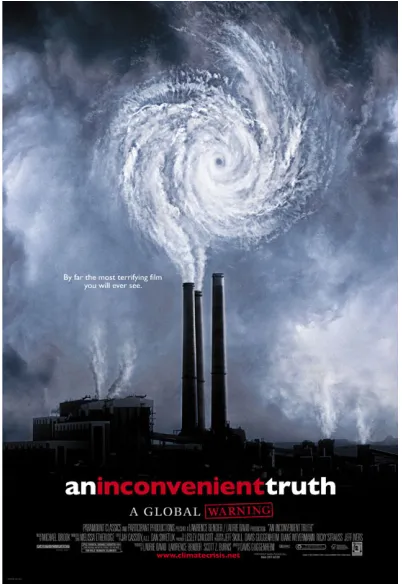
Figure 1: DVD Cover ... 193
Figure 2: Smokestacks ... 194
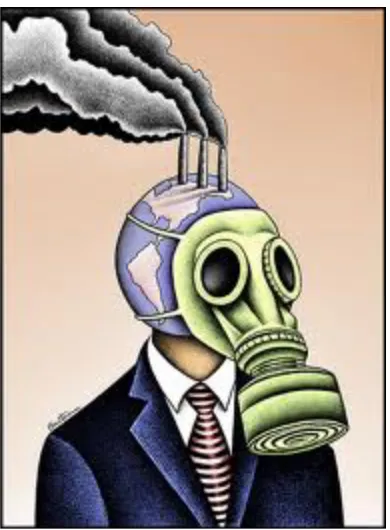
Figure 3: Smokestacks Cartoon ... 194
Figure 4: Hot Smokestacks ... 195
Figure 5: Hot Smokestacks 2 ... 196
Figure 6: Stormy Dwarfed City ... 196
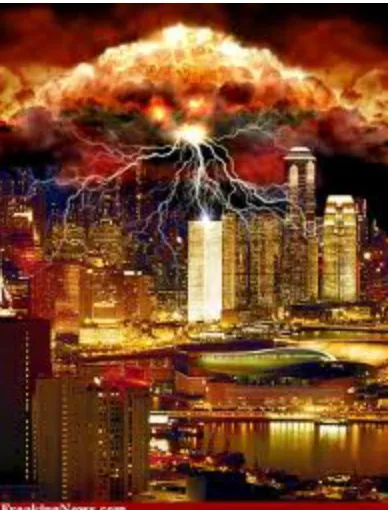
Figure 7: Smokey City... 197
Figure 8: Stormy City ... 198
Figure 9: Melting Ice ... 205
Figure 10: Melting Ice 2 ... 205
Figure 11: Melting Ice 3 ... 206
Figure 12: Shrinking Glacier ... 206
Figure 13: Melting Ice 4 ... 207
Figure 14: Melting Ice 5 ... 207
Figure 15: Polar Bears ... 208
Figure 16: Polar Bears and Melting Ice ... 208
Figure 17: Lone Polar Bear on Ice Island ... 209
Figure 18: Lone Polar Bear on Melting Ice ... 210
Figure 19: Temperature Rise Graph ... 216
Figure 20: Australian Climate Change Searches Graph ... 217
Figure 21: Temperature, CO2, & Sunspot Graph... 218
Figure 22: Surface Temperatures Graphs ... 219
CHAPTER 1. DISSERTATION OVERVIEW
Introduction
Theory building is a difficult process. So too is the process of developing a method of applying the theory. Method can inspire theory and theory can inspire method. There is usually no rhyme or reason to which one precedes the other or if one even springs from the other at all. However, if both are present then the scholarly knowledge that results is usually quite rich. Despite this fact, relatively few new
theories and methods are developed and with good reason. Theory building is slow and sometimes painful. In order to present a new theory or method, one has to be prepared to see incredible amounts of time and energy subjected to intense scrutiny and
criticism. Sometimes this is a good process, as it leads to ironing out the inconsistencies and pushing the theory in a positive direction as it grows and matures. In other cases, critics search for and find fatal flaws in the theory, perhaps shutting the theory building process down or at the very least crippling it.
of social science, this initial emphasis on rhetorical analysis is important to note and is what this dissertation is most concerned with. FTA predates SCT and as such the entire conceptual framework should be rooted in a critical, interpretive, and predominantly rhetorical emphasis.
Within ten years, his method was under attack by Mohrmann (see Mohrmann, 1980, 1982a, and Mohrmann, 1982b), who engaged Bormann in a heated debate over the legitimacy of the method in the 1982 volume of the Quarterly Journal of Speech. While some of the criticisms of FTA proved to be more damning than others,
Mohrmann’s attacks very likely slowed the development of the method and,
subsequently, the theory. It did so by discouraging scholarly work that employed FTA, at least in rhetorical studies, for much of the next decade. Indeed, as a reviewer Mohrmann even required one FTA scholar to revise a publication submission by omitting all FTA terminology (Mohrmann, 1982b). Bormann (1982) responded that actions like this crippled the analysis, but Mohrmann (1982b) contended that the analysis could stand on its own without FTA terminology and was perhaps better for having removed that initial language. What matters here is that developmental research on FTA was slowed by the debate and that other reviewers were probably persuaded to engage in similar censorship.
various scholars in the nearly four decades that it has been around, even in spite of the strong attacks made by Mohrmann and others. In my view, this work has been
extremely valuable. In a response to criticism by Joshua Gunn claiming that the popularity of SCT is in decline, Bormann, Cragan, & Shields (2003) assert that the
number of professional articles and books using SCT exceeds 485. Since the publication of Bormann, Cragan, & Shields’ article, nearly seven years have passed and more
research utilizing both the method1 and the theory has been published.
For me, what is most interesting about the current decade’s work utilizing the concepts of FTA and SCT is not that it continues to exist, but rather how it continues to exist. Methods and theories grow over time, but in slightly different ways. Theories are the more changeable of the two, because theory building generally occurs through the application of that theory. In other words, the more scholars work with a given theory such as SCT, the more it develops; the less scholars work with it, the more it stagnates. Methods such as FTA also tend to grow over time, but their most basic tenets are usually ironed out long before current scholars use them. By their most basic tenets, I mean the skeletal set of rules and vocabulary that can be codified in a textbook.
1 While I understand that there may be some debate over whether FTA should be classified as an approach or as
Granted, the vocabulary can develop as the situation calls for it, and has in the case of FTA, but rarely does one go back to the original vocabulary base and significantly alter it. For example, the unchanging core of FTA involves the use of fantasy themes,
rhetorical visions, fantasy types, symbolic cues, to name a few. Methods and theories are applied in new and different contexts, and sometimes these contexts cause them to move away from their original foundations. Sometimes such growth is fruitful, but sometimes it is not. As will be discussed below, critics of FTA would argue that the latter is true. Specifically, in moving beyond the small group communication origins of FTA to more mass media contexts, scholars utilizing the method have come under critical scrutiny. The validity of such criticism is debatable because quite often, applying methods in new contexts can provide interesting perspectives that may not be evident in methods thought to be more appropriate to those contexts. The focus of this
dissertation, however, is not upon the growth FTA has seen in mass media contexts, although I will certainly discuss that growth in detail and address the criticism of it. What is more interesting to me is how a return to the small group foundation of the method might inform analysis of FTA in a digital online context. In light of the most recent work utilizing FTA, it is precisely this foundation to which we must return because these (small group) roots may make the method particularly applicable in understanding online rhetoric.
of the writing of this dissertation, a quick search of the Communication and Mass Media Complete database inputting the search term “Fantasy Theme Analysis” brings up 35 essays, articles, and book chapters concerning FTA since 2000; of this number, 12 employ data collected from the internet. Although 12 publications do not constitute a majority of 35, they are a third of that total number, more than any other data type. To give an example of the spread of common data types, three were conducted using rhetoric from over a century ago, two were conducted using newspapers, two were conducted using movies, and three were conducted using television. There were other types, but there were not more than one or two of each current data type. While my survey is not in any way a full blown empirical study of database entries, it can be presumed to be a representative sample. Communication and Mass Media Complete is a prominent database for the Communication discipline and while it sometimes does not contain older materials that have not been converted to PDF files yet, it does tend to have the most current published articles as these are regularly converted to digital form as a matter of course.
discusses the importance of online rhetoric explicitly and implores rhetorical scholars to engage in expanded research programs focusing explicitly on rhetoric in the digital media context. I believe that current rhetorical critics who are popularizing FTA again are doing just that. My goal here is to link these otherwise disparate essays and
publications together and provide more focus to that research. In short, I aim to enact a program of research for applying FTA in digital contexts.
The contribution that this dissertation makes is twofold. Broadly speaking, my purpose is to answer Warnick’s (2007) call for new methods to explore online rhetoric. Although the method itself is not new, I will argue that it is particularly well suited to the new digital context and may yet contribute much towards a canon of methodologies designed to study digital rhetoric. In working with FTA in a digital context, I intend to demonstrate how rhetorical scholars might begin to think about applying old critical methods to new contexts, which I hope will lead to further scholarship in developing new methods for such contexts. There is no specific “digital rhetorical criticism method” that may be developed for digital contexts and digital contexts alone, but there are certainly methods both old and yet to be developed that may suit the digital context better than some or even most others. My more specific purpose here will be to explore how FTA can be updated and applied to such digital contexts. In other words, I hope to provide meaningful contributions to building the method. To address these purposes, I propose the following overarching questions:
• To what extent does FTA represent a method that is particularly well suited to
digital contexts?
• To what extent does FTA move us to more scientistic versus inventive ways of doing
rhetorical inquiry? What can be done to mitigate this possible move? The increasing percentage of FTAs conducted on internet based forms of
communication is significant and perhaps even circumvents some of the more damning of the criticisms levied against the method years ago. Before the popularization of the Internet, many FTAs relied upon more static text-‐based sources. Even those that focused on media outlets such as television used fixed media moments in time. As will be discussed below, this was the source of some criticism of the work as it moved away from its origins in small group communication. Fantasy themes certainly exist in many outlets as evidenced by the literature cited below, which is part of the strength of the method. Yet the fact remains that a significant part of the true strength of FTA lies in the orality present at its roots -‐ an orality that lends itself to a distinct immediacy of response. By orality, I mean a secondary orality defined in the same manner as Ong (2002) it when he identified a kind of orality predicated upon print culture where people speak aloud but are think in text. This kind of orality becomes particularly important in a digital context where text is nigh ubiquitous and yet imminently
suited to a highly interactive online context. This potential aptitude could explain the increasing numbers of FTAs conducted using data collected in an online environment. Regardless of its success or lack thereof in other areas, I argue in this dissertation that FTA is particularly well suited to the new digital environment because the text is less fixed, more ephemeral, and less attributed to a specific author. These qualities are more in line with orality, which returns FTA to its foundations in the work of Bales’ small group analysis. FTA could have been introduced before its time, but to argue this point is to discount much of the quality work that scholars have accomplished with it and I do not mean to do that. However, I do believe that the rise of the digital
environment is an exigence to which FTA, perhaps more than any other existing critical method, is particularly well suited to respond due to the similarities between small group communication and computer mediated communication, which I will discuss in more depth in Chapter 2 of this dissertation. Interestingly, the very number of FTAs seems to have risen since the advent and popularity of the Internet. Now more than ever before in its relatively short history, FTA is coming into its own. The current digital communication context provides FTA as a method with the opportunity to grow in new and interesting ways even as it returns to its roots just as I believe Bormann originally intended it to grow, even if he likely did not expect such development to bring it back around full circle.
In order to provide initial support for these arguments, the rest of this
environment. To do that, I will show how others have used FTA and discuss the ways in which they speak to a new digital orality as explored by Lanham in his 1993 book, The Electronic Word: Democracy, Technology, and the Arts. Despite its age, the book is groundbreaking in exposing the ways in which the era of print text is being broken open by the new electronic text, which resembles oral culture more than print culture. Understanding FTA in the context of what I call a kind of ‘digital orality’ is vital, for that is where scholars are pushing it. However, in order to engage in these explorations, I must first discuss the history of FTA and its criticisms. It is crucial to understand what has brought FTA to this point in order to predict how it will continue to grow in a digital environment. Also, an understanding of how other scholars have criticized FTA is important. Some of these criticisms have centered on the relationship between small group and mass media communication; to address these, I will attempt to more clearly outline the difference between these two contexts and how they work together within FTA.
Fantasy Theme Analysis
fantasizing and extrapolates to speaker-‐audience fantasizing and to the dream
merchants of the mass media.” (Bormann, 1972, p. 396). Bormann and those inspired to use FTA after him would spend many years providing the evidence to back up such a grand claim, although some critics of the method would remain unconvinced. The concept of fantasizing caused Bormann to draw the connection between small group communication and the messages that ‘chain out’, or spread through ever larger
audiences up to and including mass media audiences. According to FTA, people in small groups sometimes ‘dramatize’ the content of their conversations. They begin to speak of “characters, real or fictitious, playing out a dramatic situation in a setting removed in time and space from the here-‐and-‐now transactions of the group.” (Bormann, 1972, p. 397). The separation in time and space is the key factor to note in this description. Discussions of what is immediately happening within the group are not considered fantasy themes. Rather, recollections of past events or dreams of what could happen in the future are the stuff of fantasy themes. This is where a group constructs its social reality and develops a common culture. According to Bormann, who was interpreting Bales, this process can and does happen even among zero-‐history groups. As those in the groups in Bales’ studies communicated with one another and fantasy themes
chained out within them, the “…tempo of the conversation would pick up. People would grow excited, interrupt one another, blush, laugh, forget their self consciousness”
person encountering it. It must function to advance some important part of the group drama by highlighting a concept deemed important by those participating in that drama. Indeed, Bormann, Knutson, & Musolf (1997) later add precision to what a fantasy theme is when they describe how fantasy themes function in contexts larger than small groups. They define it a, “message that catches and focuses [people’s] attention until they imaginatively participate in images and actions stimulated by the message” (Bormann, Knutson, & Musolf, 1997, p. 255).
Fantasy themes may be embedded with instructive topoi, moral instructions, metaphorical comparisons, and/or definitions of various concepts important to the group, but they are more than the rhetorical concepts that may compose them. Fantasy themes serve to articulate specific aspects of the group ideology that impact the larger rhetorical vision of the group in tangible ways. They are similar to McGee (1980)’s notion of the “ideograph”, but whereas McGee’s ideographs focus on the macro ideological level of critique, Bormann’s fantasy themes focus on the micro thematic persuasive messages that serve to build such an ideology for a group. The group,
composed of metaphors, topoi, metaphors, and other tropes and figures but they must serve to interpret past events and/or envision future scenarios for the group. Fantasy themes involve the active interpretation of events, rhetorical or otherwise, that are inducted into the group drama. Group members in Bales’ study would engage in both verbal and nonverbal communication as they participated more and more in the construction of their evolving drama.
As Bormann and other scholars conducted research using the method, the lexicon for it began to grow to accommodate growing list of findings. In short, the method became more sophisticated with use. Originally, the primary two terms were fantasy themes and rhetorical visions. Bormann defines rhetorical visions as the composite dramas which form symbolic realities for people by catching on within their groups. According to Bormann, “A rhetorical vision is constructed from fantasy themes that chain out in face-‐to-‐face interacting groups, in speaker-‐audience transactions, in viewers of television broadcasts, in listeners to radio programs, and in all the diverse settings for public and intimate communication in a given society” (Bormann, 1972, p. 398). Rhetorical visions reveal what is important to a given society at a certain point in time. Fantasy themes form the basis of the rhetorical visions and illustrate the concerns of the collective public consciousness. However, one can see again in the definition of the rhetorical vision the roots of the theory in oral interaction. Even television
From fantasy themes and rhetorical visions, Bormann’s work soon revealed the need for another classification that was broader than a specific fantasy theme but narrower than a full-‐on rhetorical vision; he called this classification “fantasy types”. Fantasy types fall on a continuum between fantasy themes and rhetorical visions. They are composed of fantasy themes but are not an allusion to or a label for a whole
rhetorical vision. Instead, they are more of a category or a genre of fantasy themes. A fantasy type, as described by Bormann (1982b), is, “…categorized [by] a family of fantasy themes…[that are] similar in basic storyline, mood, and tone” (p. 295). Movies and novels can be classified into shorthand terms such as ‘horror’, ‘romance’, or ‘sci-‐fi’, and so can fantasy themes. Bormann uses the example of ‘Carter has played dirty politics’ as being enough to trigger associations to multiple fantasy themes including calling Reagan a racist and using the hostage crisis in Iran to avoid primary campaigns, among others (Bormann, 1982b).
Fantasy themes also involve the use of dramatis personae. These are the characters that recur repetitively in the themes and visions. Usually there are heroes and villains composing the drama, either fighting for what is ‘good’ or seeking to
Bush persona and George W. Bush the man. Bush and his aides attempt to manage the Bush persona and at the same time people encountering the persona attribute certain characteristics to it on their own. What ultimately chains out amongst people in their groups is the Bush persona. This persona is dynamic, however, and subject to change with group interaction. The ways in which a society responds to and changes these personae says much about that culture.
composed of fantasy themes. Bormann (1982a) contrasts television coverage with newspaper coverage, saying that newspapers are composed of fantasy themes because they are accounts that take place after the event. Ultimately, he establishes FTA as a method that, while rooted in the immediate nature of small group communication, is still more concerned with how small groups construct their realities based on
narratives of past events and dramatis personae.
analysis served as an important social scientific tool that suggested that the political cartoons did actually link to salient rhetorical visions. Bormann, Kroll, Watters, & McFarland (1984) also utilized this method to study the way in which voters in a
particular city clustered into specific rhetorical communities based on rhetorical vision. There were not many other Q-‐Sorts, however. Despite Bormann’s desire to link
rhetorical and social scientific methods and the success of these two studies, Q-‐Sorts seemed to fall out of mainstream FTA.
This discussion of FTA as it has existed up to the present day has accomplished two things. First and foremost, it has set the stage for a discussion of FTA in the current environment. In order to understand what is being done with the method currently, the history and major precepts of the method must be understood. However, I have also sought to emphasize what I see to be the importance of FTA’s roots in dynamic interaction and a primarily oral style of communication. The dynamic oral interactive roots of the method will become vital when I enter into my discussion of FTA in a digital context. Now I turn to a discussion of FTA in the broader context of the history of rhetoric as a whole. Following that, I address some of the criticisms levied against FTA because these, too, must be understood. As I suggested earlier, they may have slowed research on FTA through the 1990’s, despite Bormann’s responses to them.
Classical and Modern Connections
Although FTA developed more out of small group communication than out of any hard and fast rhetorical theory, it did not develop in a rhetorical vacuum, so to speak. Bormann did not publish his initial essay in any of the social scientific journals or in communication theory journals. He did not present his work as a new methodology for small group communication analysis, although several subsequent researchers including Bormann himself certainly took it in that direction with SCT. Instead, he aimed his work at an audience of rhetorical scholars, publishing it in the Quarterly Journal of Speech and explaining what he saw as a novel method of rhetorical criticism. His methodology was one of several that arose because of an environment created by a 1957 Western Speech special issue devoted to criticism. According to Leff (1980) in an introduction to a similar issue nearly 25 years later, this 1957 issue decried the then current state of criticism and set about reforming the art, “by finding new and more useful approaches to rhetorical criticism” (Leff, 1980, p. 264). After this issue, many novel approaches to the art appeared. Leff said that, “Some of these approaches matured, assumed a fairly well defined form, and generated a substantial body of critical literature” (Leff, 1980, p. 264). FTA was one of these approaches.
Interestingly, many of these approaches seemed to break from classical
FTA specifically deviated from a more classical understanding of rhetoric. FTA is not concerned with any one speaker. It focuses on themes “chained out” by many people, each one of them a rhetor in his or her own right but ultimately never attributed as the source of the themes. This would seem an anathema to ancient scholars of rhetoric. The reason for this is that many of these scholars focused more on the efforts of a lone speaker. The Sophists were well paid public speaking teachers, after all! When Gorgias supposedly convinced a city to erect a gold statue of him, it was he who was the
rhetorician, not a multitude of voices. When Cicero spoke before the Roman Senate and wrote on the joining of eloquence and wisdom, he referred to an Orator Perfectus – not a mob rhetoric. Aristotle’s famous definition of rhetoric as “the faculty of observing in any given case the available means of persuasion” can (and has) be stretched in many ways, but Aristotle’s advice was to a single rhetor.
Socrates could have continued his own variant of small group communication and knowledge production (as was so important to his beloved dialectic) rather than going back into one on one communication. If FTA is to be placed closer to the dialectic end of the dichotomy that Aristotle explored so long ago, then it is still a very important part of the rhetorical tradition. It is, in fact, quite easily arguable that participants in a dialectic are engaged in rhetoric. Bormann, however, carries the dialectic one step further into his rhetorical visions to explain how what comes of such dialectical themes “chaining out” are persuasive in their own right before and even beyond needing to be expressed by a sole rhetor utilizing them as the means of persuasion.
If one follows the argument thus far that FTA is closer to the dialectical end of the scale while maintaining elements of the explicitly rhetorical, then it should also serve to reason that FTA might actively participate in one of the earlier canons of
Vico would have certainly agreed hundreds of years later. He was concerned with the issue of ingenium, which scholars such as Serna (1980, 1983) point out is related to Cicero’s inventio. Inventio as a canon has been divorced from rhetoric at various points in history by scholars such as Peter Ramus, but Vico actively sought to reunite this canon with rhetoric. Through ingenium, the rhetor makes connections between disparate facts. Serna (1983) demonstrates how ingenium actually divorces invention from reason because of these imaginative connections. It does not seem like too much of a stretch to claim that fantasy themes can (or perhaps even must) be the product of a kind of group ingenium. The group, in composing its narrative, draws connections between various dramatic elements, and these connections become the themes that chain out.
It is clear, then, that FTA can trace roots back to ancient and medieval thinking about rhetoric. However, the question arises as to what kind of modern environment might have engendered it? The answer must lie in the modern environment of the 1970s, although the more current environment seems an even more fertile context as I have argued throughout this dissertation. Bormann studied small group communication in an academic environment still focused on a sender – receiver model, despite
exacerbated this concept, and organizations became larger all the time. FTA also flourished during a time when ideology was more and more on the minds of rhetorical scholars. Around ten years after Bormann’s initial publication, McGee (1980) published his now seminal work on the Ideograph. According to his thinking, “Human beings in collectivity behave and think differently than human beings in isolation.” (McGee, 1980, p. 2) He goes on to elaborate his hypothesis that, “If a mass consciousness exists at all, it must be empirically ‘present,’ itself a thing obvious to those who participate in it, or, at least, empirically manifested in the language which communicates it.” (1980, p. 4) For McGee, then, rhetoric is the container as opposed to the thing contained. It surrounds and pre-‐exists any and all communication. This would seem to locate FTA closer to McGee’s side of the critical debate of the 1980s and 1990s, although to automatically place it there would be to act hastily. McGee claims that, “the only way to shape or soften power at the moment of its exercise is prior persuasion” (1980, p. 5). Where, however, does such prior persuasion come from? It must arise from somewhere. The very ideological climate so important to McGee must come into being through
FTA stands among several modern methods of analysis such as Burkean analysis, narrative analysis, myth analysis, and metaphor analysis, among others. It perhaps bears the most similarity to McGee’s ideographs, as indicated above. One could even argue that, in preceding McGee’s notion of the ideograph, FTA perhaps served to inform McGee to some extent. Certainly, the ideograph seems to bear a close
resemblance to the rhetorical visions and fantasy themes. Compare the notion, for example, to McGee (1980)’s argument that, “the political language which manifests ideology seems characterized by slogans, a vocabulary of ‘ideographs’ easily mistaken for the technical terminology of political philosophy” (p. 5). What are these slogans if not fantasy themes of a sort? And yet, McGee’s ideographs stand above and beyond fantasy themes. They are perfected themes, of a sort, in that they bear a closer resemblance to Burke’s and Weaver’s “God” terms. McGee (1980) provides several examples of ideographs such as “property”, “religion”, “right of privacy”, “freedom of speech”. Any of these could be a fantasy theme under the correct conditions, but seem to supersede what a small group could come up with quickly. These are the themes that define a people, a culture, and a nation more than fantasy themes, which seem to be more transient and situationally based. Certainly, fantasy themes can and do chain out to very broad contexts, but it takes much work to put them at the ideological level that McGee elaborates on. FTA thus enters the critical field at a different point than
with the ideographs, but are not upon closer inspection. Many rhetorical visions are a bit more specific than the near god terms McGee describes. Both methods, however, do define communities by uniting in-‐groups and separating such groups from out-‐groups. In addition, both methods operate under the logic that rhetoric is more of an
amalgamation of fragments than a finished text. McGee (1990) in particular later complains that too much emphasis has been placed on the term “criticism” in “rhetorical criticism”, which would move the process into more of a philosophical realm. He instead advocates for an emphasis on the rhetoric, positing the term “critical rhetoric” as an improvement. He argues that, “rhetors make discourses from scraps and pieces of evidence...The apparently finished discourse is in fact a dense reconstruction of all the bits of other discourses from which it was made. It is fashioned from what we can call ‘fragments’” (MgGee, 1990, p. 279, emphasis in original). The logic of rhetorical fragments is foundational to both McGee and Bormann’s approaches to rhetorical criticism.
Narrative and myth analysis, on the other hand, again go broader than FTA while maintaining roots in human drama. For example, Fisher elaborates on “narrative
What rhetorical vision do such themes lead to? Certainly, coherence amongst themes is important, but such coherence isn’t necessary. For example, the American ideological left and right may have themes that contrast with regard to foreign policy, but the overall rhetorical vision could still be that the United States has a right or responsibility to “police” the world. This vision could be the summation of contrasting but ultimately identical themes. Does this demonstrate narrative coherence? Not quite. Yet it works within the analytical structure of the method.
We can see how FTA connects to many theories and methods across time. As an approach to rhetorical analysis, it both fits within and responds to that history.
Although it maintains a more postmodern outlook on rhetoric in which rhetoric is splintered among a large host of anonymous voices, it still bears some resemblance to the dialectic of Plato and Aristotle. Both Plato and Aristotle believed that a kind of powerful social truth could arise from the dialectic, and FTA continues this tradition of belief by showing us the rhetorical visions – or “truths” – of groups of people on a variety of subjects. As a postmodern form of dialectical analysis, FTA responds to a rhetorical situation wherein there are more voices acting anonymously to produce a powerful rhetoric. The digital context of communication has given us this. Power no longer exclusively lies with the single speaker, but more and more rests with a collective. When empowered single speakers do address audiences, they must do so with a focus on how the collective of rhetors will respond.
Criticism and Response
As I explained from the outset, the most damning criticism of FTA came in 1982 from Mohrmann in the Quarterly Journal of Speech. Within that year’s volume of the journal, Mohrmann and Bormann engaged in a debate over the merit of the method that was encouraged by the journal’s editors at the time (Mohrmann, 1982b). This was a debate that had been percolating for some time, having first appeared at the 1978 meeting of the Minneapolis Convention of the Speech Communication Association (Bormann, 1982b). Here Mohrmann made his arguments against FTA that would later become the basis of his 1982 articles. The debate was a heated one because, as
Bormann perceived it, Mohrmann was, “…less interested in holding fantasy theme criticism within proper limits as he was in destroying it completely, root and branch.” (Bormann, 1982b, p. 288).
after making an extended analogy to a situation involving a Playboy magazine and comparing an analysis of the fantasy chaining process to Freudian perspective, Mohrmann (1982a) concluded that, “…the baby must be thrown out with the bath water because interpretation is so dependent on Freud.” (p. 116). Bormann (1982b) responded by insisting that the Freudian basis to Bales’ work could indeed be ignored for being irrelevant to FTA. He said that he did not find Bales work to be a complete theory, and concluded that, “…the only thing for which we are indebted to Bales is his finding of the dynamic process of sharing group fantasies.” (Bormann, 1982b, p. 303) Thus, Bales’ work served as the inspiration and according to Bormann, to use the major premises of that work to judge FTA was unfair and ill-‐conceived. Mohrmann called this a ‘cavalier rejection’ of the Freudian basis and said that it is unacceptable because, “If theoretical linchpin is not to be found in Freud’s speculation, where is it to be
discovered,” (Mohrmann, 1982b). Bormann’s argument seemed to hold more weight here because Mohrmann placed an overemphasis on Freud. Any ties to Freud were tangential at best and not readily evident in the workings of FTA. Still, Mohrmann’s question was important, and I believe that an answer to it might be found in the work of Kenneth Burke, whose notion of Dramatism maps onto FTA fairly well. More
appropriately, not only serves to ground method but also to challenge it and provide for growth.
Mohrmann (1982a) also accuses the fantasy theme approach of tending towards circular argument and yielding a confining and unnecessary taxonomy. This taxonomy and the hierarchy that is contained within it have produced formulaic and predictable criticism, according to Mohrmann. As Mohrmann argued, “…the fantasy theme
approach simply is a new circularity, one in which a naming of parts is its own raison d’etre.” (Mohrmann, 1982, p. 125). Bormann (1982b) notes that Roderick Hart made the same criticism and even accused FTA of re-‐labeling old concepts, and while his response is more directed at Hart, it also addresses Mohrmann. Essentially, he does acknowledge that the charge of re-‐labeling old concepts would be a valid one if indeed FTA had taken Freudian concepts as its basis, which it did not. Bormann asserts that new concepts added more precision to his method of analysis and explains that, “Once we started surveying the rhetorical landscape we found a complexity that forced us to develop new technical terms to describe it adequately.” (Bormann, 1982b, p. 297) Here again I concur with Bormann, as any program of research and analysis from Aristotle to Burke requires a certain vocabulary in order to be useful.
Cragan, & Shields (2001) embrace this aspect of the criticism levied against both FTA and SCT, claiming that replicable research is the hallmark of good social science research, which they have been trying to merge with rhetorical criticism methodology all along. Here I take issue with these researchers, for it seems that they have fully embraced what Nothstine, Blair, & Copeland (1994) refer to as the ideology of professionalism that has permeated the humanities. This ideology results in the increasing influence of scientism, wherein those in the social sciences and humanities attempt to emulate practices in the “hard” sciences (p. 23). One is encouraged to describe methods and view data from a neutral standpoint based on what it can
contribute to theory, as opposed to what it can teach us and our students. According to these authors, rhetorical inquiry and criticism especially has more pedagogical roots in that specific examples illustrate informative methods of looking at instances of
persuasion. As they state, “Mainstream rhetorical criticism finally capitulated to the ideology of professionalism, a victim of the disciplinary call to unity, scientizing itself and compromising or discarding altogether its earlier defense of a pragmatic,
pedagogical, public oriented grounds that rhetorical inquiry and criticism started on. My goal is to move FTA more towards these original grounds, although it may be impossible to ever completely separate it from the scientistic. Such an endeavor may not even be worthwhile, as there is much FTA has to offer as is.
Before moving on to Mohrmann’s third and final major criticism of FTA, it is important to discuss the relationship between FTA and SCT. It is hard to distinguish between the two, and in fact there is a lot of slippage between them. Reading
publications that are more explicitly FTA such as Bormann’s founding 1972 article and those that are more representative of SCT such as the Bormann, Cragan, & Shields (2001) does not lead one to any meaningful distinctions other than an increased
proliferation of concepts over time such as Fantasy Types and symbolic cues– as we see in Mohrmann’s above criticism. Indeed, if one looks at Table 3 in the 2001 article, “Rhetorical Communities Studied Using SCT – By Author”, one finds articles that are more explicitly FTA and those that lend themselves more towards what is thought of as SCT. Although not one of Mohrmann’s initial criticisms, this slippage between the method and the development of the later theory can prove problematic. The distinction I see is that studies utilizing SCT move away from the pedagogical, public oriented viewpoint of rhetorical criticism, focusing very explicitly on theory building. Bormann and other FTA/SCT researchers make the need for theory building clear in nearly every piece describing the state of the theory (See: Bormann, 1983; Bormann, 1986;
theme seems to be that rhetorical methodology informs the theory, and the empirical methodology verifies it. FTA is an arm of SCT, with both using the same terminology and conceptual framework. The difference lies in the approach to exploring those concepts.
Nothstine, Blair, & Copeland would likely express discomfort at the overt scientism in FTA as a result of the focus that led to its evolution into SCT. However, scientism has its place in validating both theory and methodology, and research under the SCT heading has become a part of the Communication Theory canon. What I would argue is that FTA, while connected to SCT, should focus more on the pedagogical and the public orientation. FTA should allow the critic to explore fantasy themes as they chain out across various contexts and discover underlying rhetorical visions. These results need not be cookie cutter or even replicable, although those of a more empirical mindset may wish to verify the rhetorical findings with social scientific research. FTA should not be divorced from SCT, but neither should it have the same scientistic goals. Ultimately, what we see in FTA and SCT is an interesting case study of what one conceptual framework looks like in two disciplinary contexts -‐-‐ that of rhetorical
inquiry and that of social science. What is normally seen as a dichotomy becomes in this case a dialectic bridged by a single taxonomy of conceptual terms.
Mohrmann’s third criticism proved to be too difficult to answer at the time. While FTA scholars could dismiss criticisms of an arbitrary new taxonomy and wave away any discomfort with potential Freudian roots, they could not so easily overcome the charge that one of their more fertile grounds for criticism, the mass media, was in fact incompatible with the foundations of their critical method. In this respect, it is possible that FTA, at least as it was initially conceptualized, overstepped its bounds. As a method of understanding the rhetoric of small groups, it worked. When applied to the mass media, it became more questionable. Some would say that it simply did not work. However, FTA has found purchase in a new medium that did not exist at the time of Mohrmann’s criticism: the internet. The internet answers Mohrmann’s critique by returning FTA to the small group roots which Mohrmann himself emphasized. Here is where I believe Mohrmann most hit the nail on the head when he pointed out that the roots of the research were in a dynamic, transactional model of communication. The mass media environment that existed when FTA was first conceived was not conducive to FTA’s particular style of analysis. Bormann seemed to realize this in his comments about the impossibility of fantasy themes in a televised environment. Now, however, the visual communication of television, the audio communication of the radio, and the textual communication of the written word have all come together in one medium that uses these various technologies to create an intimate atmosphere in which people can communicate much as they would in small groups. Small group communicative
for dynamic and fluid communication. In what follows, I explore how FTA works in a digital internet environment and how current scholars are studying this phenomenon.
Fantasy Theme Analysis Digitally Reborn
According to Lanham (1993), with the coming of the electronic text, printed communication has become more interactive than ever before. Indeed, calling
There are many ways that Lanham equates electronic text to the original oral rhetorical style of the ancient Greeks including, for example, the revived importance of memory (albeit in the form of computer memory). What is important for the present discussion is not the high rhetorical style, however, but the ways in which electronic text comes to be more equated with dynamic oral group interaction. In addition to the above inherent qualities of electronic text, Lanham cites the strong return of gestures through the iconography that has grown to prominence in an internet environment. Lanham wrote this work in 1993, meaning that the iconographic power of computers was a far cry from what it is now over a decade later, and yet his words were incredibly prophetic. The internet is full of visual gesture. All one need do is find a message board to see that people usually pair at least one picture with their post called a ‘user icon’. Sometimes they have more than one picture in the recurring text below their posts, called a ‘signature’. On top of this, most are proficient at embedding visuals within their posts. One example of a website that utilizes user icons extensively is
Visual forms – lines, colors, proportions, etc. – are just as capable of articulation, i.e. of complex combination, as words. But the laws that govern this sort of articulation are altogether different from the laws that govern language. The most radical difference is that visual forms are not discursive. They do not present their constituents successively, but simultaneously, so the relations determining a visual structure are grasped in one act of vision. Their complexity, consequently, is not limited, as the complexity of discourse is limited, by what the mind can retain from the beginning of an apperceptive act to the end of it. (Langer in Lanham, 1998, p. 77, emphasis Langer’s)
The other major difference in electronic text is the fact that it is truly more dynamic and interactive because of this ability to alter it upon a whim and add such icons, fonts, typefaces, etc. According to Lanham (1993), “The book is seen as static, inelastically linear, sluggish; the new cinematographic form as dynamic, interactive simultaneous, swift” (p. 33). To the book I would like to add the traditional newspaper and television broadcast. These are not nearly as static as the book, and indeed
electronic formatting has added much to both media, but once set down and/or