1 | P a g e
ENERGY EFFICIENT CLUSTER FORMATION IN
WIRELESS SENSOR NETWORKS BASED ON MULTI
OBJECTIVE BAT ALGORITHM
Dr. V. Krishnaveni
1, S.Varadhaganapathy
2 1Associate Professor in Computer Science,
Kongu Arts and Science College (Autonomous), Erode, Tamil Nadu
2Professor and Head, Department of Information Technology,
Kongu Engineering College(Autonomous), Perundurai, Tamil Nadu
ABSTRACT
The most challenging task in the design of wireless sensor networks (WSN) is increasing the lifetime of sensor
nodes. The most crucial factor to increase the lifetime of wireless sensor networks is to reduce the energy
consumption. In this paper, a Multi Objective Bat algorithm is used to find the optimal cluster formation and routing
model in wireless sensor networks. The proposed Energy Efficient Multi Objective Bat algorithm (EEMOB)
optimizes the energy consumption in wireless sensor networks by selecting the best fittest node as cluster head and
modeling of the communication distance by Bat’s loudness parameter. The proposed method outperforms the
LEACH clustering protocol. It also extends the lifetime of sensor networks and achieves good reliability. The
experimental results show that this scheme achieves considerable improvement in accuracy and convergence when
compared to LEACH.
Keywords:
Wireless Sensor Networks, Multi Objective Bat Algorithm, Energy Aware, Cluster
Formation.
I INTRODUCTION
Wireless sensor network (WSN) is a spatially distributed, homogenous, self organized autonomous sensor to
monitor the physical or environmental conditions such as pressure, temperature, humidity etc [1]. The most
2 | P a g e
crucial challenge in the deployment of WSN is to preserve the energy with maximum allowable coverage.
Furthermore the research community has been paid much attention in grouping of sensor nodes into clusters and to
select leader for every cluster known as cluster-head (CH). Till now, many clustering algorithms for ad-hoc
networks[3] have been proposed with a main objective to care about node reachability, generate stable clusters,
route stability etc. but they have not provided much concern about design goals of WSN such as network lifetime,
coverage.
In this paper, we propose an Energy aware multi objective Bat algorithm for cluster head selection and to increase
the lifetime and coverage in WSN among participating nodes. The nodes inside the cluster can only send the data to
the nearest cluster head thus reducing the communication cost. CH is identified by the sensor nodes that are richer in
resources. The main objective of CH is to increase the network scalability, localize the route set up and reduce the
size of routing table [4]. The scheduling activities inside the cluster are done by CH and it will also limit the scope
of bandwidth consumption, inter cluster interaction to cluster heads etc. Sensors are arranged in round robin fashion
and the time for transmission and reception of packets is determined so that redundant transmission can be avoided
and collision of packets can be preserved. CH spends more energy while communicating with the sink node and
rotation of CH in each node is determined by election process.
In this paper, a multi objective bat algorithm is used that can be applied to both equal and unequal clustering.
Furthermore, it minimizes the communication distance, maximizes the energy, coverage and network lifetime.
II LEACH PROTOCOL
One of the mostly used clustering and routing protocol for WSN is Low Energy Adaptive Clustering Hierarchial
Protocol. LEACH divides the network into number of clusters and optimally selects the cluster head thereby proving
its efficiency. These cluster heads are selected based on the nodes having higher residual energy. The other nodes
join to the cluster based on minimum distance to the cluster head. Each CH directly communicates with base station.
This protocol operates in two phases; the first phase is “setup phase” in which clusters are formed and cluster head is
selected based on CSMA advertisement messages. The second phase is “steady phase” in which the data packets are
transferred from CH to base station. LEACH undergoes a number of rounds. Let us consider the percentage of CH
selected will be “S” , and T(k) be the threshold value. If number of CH is less than T(k), then sensor k becomes CH
of current round. The T(k) is given by
T(k) = k (1)
0 otherwise
3 | P a g e
2.1 Disadvantages of LEACH Protocol
Although LEACH protocol increases the network lifetime, it still has some disadvantages. The three main
disadvantages are discussed here:
1. In this protocol, CHs are selected randomly so there may be a possibility of two or more CHs formed close to
each other. If more number of CHs are selected in a small area, huge amount of energy will be lost and it is
proportional to the number of CHs present in that area. CH communicates with base station in a single hop count
which causes LEACH protocol not applicable to large scale WSN.
2. The LEACH protocol gives homogeneous distribution of nodes, which is not very realistic since some scenario
needs random deployment of nodes in the cluster.
3. The LEACH restricts the selection of CH that was not previously selected in the 1/S rounds. This causes the high
energy nodes to lose their potential chances to select as cluster head.
III BAT SWARM ALGORITHM
In 2010, Yang proposed a bat algorithm based on Swarm intelligence known as Bat Swarm Optimization (BSO)
algorithm. It can be applied to non linear global optimization problems. The basic idea behind this is inspired from
bat’s natural behavior. Bats have a well defined echolocation system that is used for identifying the bat’s prey,
avoiding obstacles and sense the distance in darkness. It emits a sound called echolocation and waits for reply back
from the surrounding objects. The steps involved in the BSO are as follows:
Step 1: Initialization
Initialize the generation counter c=1
Initialize the population of n bats as p
Define the loudness ai , pulse rate R
Set the initial velocities V(j=1,2,..n)
Set the pulse rate as R
Step 2: Determine the location of bats and update the velocities
Until termination criteria satisfied, generate new solutions by adjusting the frequency
Update the velocities, locations
Step 3: Rank the bats and find the current Xc*=c=1;
Step 4: Post processing and result visualization.
Let us consider jth bat moves randomly with fixed frequency f and with velocity vj.The movement of virtual bat is
4 | P a g e
fj = fmin+ (fmin- fmax)* α (2)
= -1+( X*) (3)
= + (4)
where α is the random vector drawn from uniform distribution α [0,1], X* is the current best solution, it is located
after comparing all the location among all bats and fj is the frequency drawn from[0,1]. The local search to identify
the current location is given by
= + (5)
Where is the random number [-1,1] and is the loudness at this step. When a bat identifies its prey it will
increases its pulse emission rate and decrease its loudness. It is expressed mathematically as follows:
β (6)
= [1-exp(-γc)] (7)
0 and 0 as t (8)
β is a constant factor and γ is also a constant factor where γ>0.
IV ENERGY EFFICIENT MULTIOBJECTIVE BAT ALGORITHM
The idea behind the multi objective bat algorithm is to increase the coverage ratio and minimize the energy
consumption for both nodes and CH. In this model all nodes are elected as CH depending on the confidence level of
the node. The efficiency of the proposed model depends upon the nodes sensing range. The cluster formation
depends upon the distance between the nodes and it should be less than bat’s sensing range. The cluster head is
nominated as the best when it consumes minimum energy, has minimum distance as well as effectively met the
threshold of sensing range. The multi objective function either has to minimize or maximize the objective function
given by Minimize or Maximize F(x)=( (x),…., (x)). The two main objective functions of the proposed model
are as follows:
Maximize the total coverage of sensor network,
Minimize the amount of energy consumed,
Objective 1:
(x)=max(coverage)
If the sensor node lies within the sensing range of the cluster, then the coverage probability will be 1 else it will be
zero. The Euclidean distance is used to calculate the distance between CH and sensor node. It is given by
D= (9)
where x and y are coordinates of node j. Coverage area of network in the sensor network is identified by the union of
5 | P a g e
C(x,y)= (10)
where C(x,y) is the coverage, D is the Euclidean distance and R is the sensing range. The first objective of
maximum coverage is called by following expression:
(x)=max (11)
where Aj is the area covered by j th cluster head node, n is the total number of nodes and a is the WSN area.
Objective 2:
(x)=max(Residual energy)
This is based on first order radio frequency energy model [5]. It is divided into two parts,
Initialize all the nodes based on first order radio energy model.
The messages with l bits are transmitted from the node at a distance d1 hence the energy consumed is given by
(l,d1) calculated based on first order energy model.
Let us consider the first order radio model dissipates energy as E, is the total energy needed for amplifier,
is the running energy for transmitter circuitry, is the transmitter amplifier energy. The energy can be
mathematically expressed as follows:
(l,d1)= + (12)
(l,d1)= (13)
d2= (14)
where E is the dissipated energy to run the transmitter/ receiver is the transmission in free space of amplifier
and is the amplifier parameter of transmission, d2 is the threshold value of transmission distance. Similarly
the reception dissipation energy for l bits of message is given by . is the energy needed for transmitter
circuitry. is calculated as follows:
= =E* l (15)
Finally the total amount of energy consumed for wireless network is calculated as follows:
= + (16)
6 | P a g e
is the total amount of energy needed for CH to receive data from sensors, is the total amount of energy
needed for CH to base station, is the total energy needed for data diffusion CH and is the total energy
needed for all sensors to send data to CH.
In WSN deployment, there are totally n nodes distributed in m*m region, suppose there are C clusters then average
of n/C nodes per cluster will be present. Each CH distributes its energy signals to the base station. The energy
dissipated in CH during a single frame is given as follows:
= [l * E * ] + [l * E + l * * ] + [l * * ] (18)
where [l * E * ] is the total energy consumed by CH to receive l bits from the sensor nodes, is the data
aggregation cost per signal where as energy consumed by non cluster head is given as follows:
= l * E + l * * (19)
where is the distance from node to CH, the energy dissipated in cluster per round is given as follows:
= + (20)
For each round the network total residual energy is calculated as follows:
= C * (21)
where C is number of clusters used in each round and the second objective can be calculated using the formula
(x)=max ( ) (22)
V SIMULATION
The Energy Efficient Multi Objective Bat algorithm is simulated using MATLAB. The network model is deployed
in 200*200 , the base station is fixed, motionless device that is located in the region of (100,200). The CH is
selected based on the node with maximum remaining energy and the cluster formation is based on multi objective
bat algorithm. The simulation parameters of multi objective bat algorithm are given in table 1.
Table1 Multi objective bat algorithm parameters
Parameters Value
No of nodes 200
Number of generations 100
Loudness ai 0.8
Packet size(sensor-CH) 300 bits
Packet size(CH-BS) 7200 bits
Pulse emission rate R 0.7
7 | P a g e
Performance Analysis
The proposed multi objective bat algorithm (MOB) is compared with LEACH protocol and the metrics such as
sensor networks lifetime, coverage, residual energy and throughput are analyzed and described in the following
section. The result analysis shows that the proposed scheme provides better optimization compared to LEACH
clustering protocol.
(a) Sensor Networks Lifetime
The proposed model analyze the network life time by considering the number of iterations against death of first
nodes, 50% of nodes and last nodes. It is compared with the LEACH protocol and identified that MOB provides
better optimization than the LEACH protocol. The figure 1 depicts the sensor network’s life time of proposed
scheme and LEACH protocol.
Figure 1. Sensor network’s lifetime
(b)
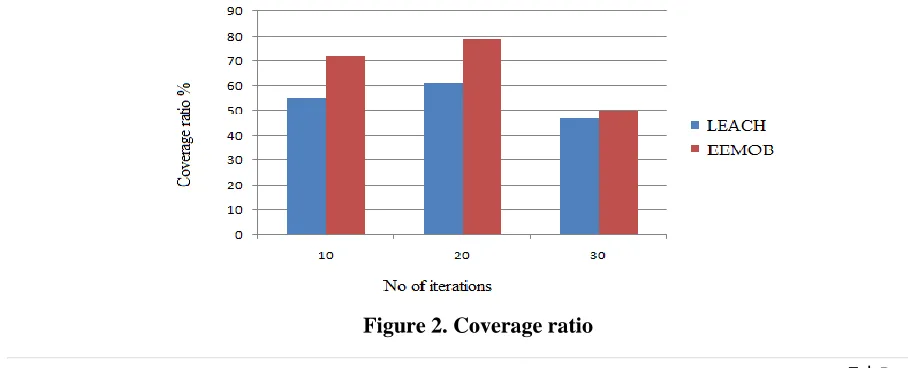
Coverage Ratio:
The most prominent challenge in some critical applications is coverage ratio. Increasing the coverage ratio is much
important than increasing the life time of sensor network.
8 | P a g e
The proposed scheme provides an optimized CH selection where as in LEACH protocol the CH selection is not
uniform and suffers from drastic loss of energy. The figure 2 depicts the coverage ratio of LEACH and MOB against
number of iterations.
(c) Residual Energy:
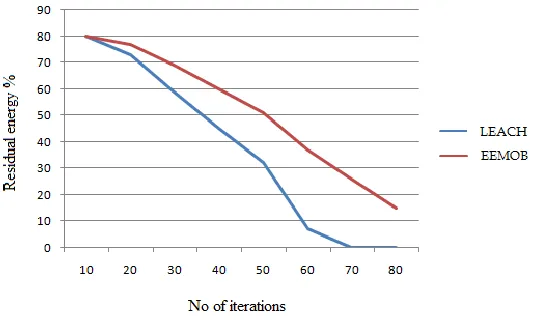
Residual energy is defined as total sum of available energy in the sensor network against the networks lifetime[6].
From the proposed result it has been verified that MOB provides stable, energy efficient clustering model for sensor
network. It selects the optimum number of cluster and CH that have maximum residual energy. The following figure
3 depicts the residual energy comparison of proposed scheme with LEACH protocol.
Figure 3. Residual energy against number of iterations
(d) Throughput:
The CH collects the information from sensor nodes and transfer those information to BS(Base Station). This ensures
success rate of packet transmission across the network. From the result it has been identified that proposed system
outperforms the LEACH protocol and it provides stable and efficient throughput thus it optimally increases the
cluster formation. The figure 4 depicts the throughput analysis on MOB and LEACH protocol.
9 | P a g e
VI CONCLUSION
In this paper, the Energy Efficient Multi Objective Bat optimization algorithm has been discussed. The parameters
taken into account for performance analysis are sensor networks’ life time, coverage, residual energy and
throughput. The proposed model selects the best nodes as cluster heads thereby it optimizes the sensor network by
reducing the energy consumption and increasing the coverage, throughput and networks’ lifetime. Thus it provides
the energy efficient cluster modeling scheme for WSN. Hence the proposed scheme outperforms the existing
LEACH clustering protocol and it can have significant applications in the real life scenarios.
REFERENCES
[1] Akyildiz, Ian F., Weilian Su, Yogesh Sankarasubramaniam, and Erdal Cayirci. “Wireless sensor networks: a survey.” Computer Networks Journal, vol. 38, no. 4 pp. 393-422, 2002.
[2] Alazzawi, L., and A. Elkateeb. "Performance evaluation of the WSN routing protocols scalability." Journal of
Computer Systems, Networks, and Communications, vol. 2008, 2009
[3] Xu, R., Wunsch, D.I.: Survey of clustering algorithms. IEEE Transactions on Neural Networks 16(3), 645–678
(2005)
[4] Lambrou, T., Panayiotou, C.: A survey on routing techniques supporting mobility in sensor networks. In: 5th
International Conference on Mobile Ad-hoc and Sensor Networks, MSN 2009, pp. 78–85 (December 2009)
[5] Heinzelman, Wendi Rabiner, Anantha Chandrakasan, and Hari Balakrishnan. “Energy-efficient communication
protocol for wireless micro sensor networks” the 33rd Annual Hawaii International Conference on, pp. 10-pp.
IEEE, 2000.
[6] Kaur, Harpreet, and Ameeta Seehra. "performance evaluation of energy efficient clustering protocol for cluster
head selection in wireless sensor network." International Journal of Peer to Peer Networks, Vol.5, No. 3, 2014.
[7] Trong-The Nguyen, Chin-Shiuh Shieh, Mong-Fong Horng,Truong-Giang Ngo, and Thi-Kien Dao. “Unequal
Clustering Formation Based on Bat Algorithm for Wireless Sensor Networks”. Advances in intelligent system
and computing, DOI: 10.1007/978-3-319-11680-8_53, Springer, 2015.
[8] Heinzelman, W., Chandrakasan, A., Balakrishnan, H.: An application-specific protocol architecture for wireless
microsensor networks. IEEE Transactions on Wireless Communications 1(4), 660–670 (2002)
[9] Marwa Sharawi, Eid Emary, Imane Aly Saroit, Hesham El-Mahdy. “WSN’s Energy-Aware Coverage Preserving
Optimization Model based on Multi-Objective Bat Algorithm” Conference on Evolutionary computation,
DOI:10.1109/CEC.2015.7256927,IEEE, 2015.
[10] Yi-Ting Chen, Ming-Te Tsai, Bin-Yih Liao, Jeng-Shyang Pan, and Mong-Fong Horng. “An Echo-Aided Bat Algorithm to Construct Topology of Spanning Tree in Wireless Sensor Networks” Intelligent data analysis and