CONTENT-BASED IMAGE RETRIEVAL USING
FEATURES EXTRACTED FROM ORDERED-DITHER
BLOCK TRUNCATION CODING
Sarika S. Musale
1, Lukesh Kadu
2, Swati Deshpande
3 1,2,3Dept of Information Technology, Mumbai University, (India)
ABSTRACT
This report provides a comprehensive survey of the technical achievements in the research area of image retrieval, especially content-based image retrieval, an area that has been so active and prosperous in the past few years.Content Based Image Retrieval (CBIR) is an efficient retrieval of relevant images from large databases based on features extracted from the image. This report proposes a system that can be used for retrieving images related to a query image from a large set of distinct images.Also presents a technique for content-based image retrieval (CBIR) by exploiting the advantage of low complexity ordered-dither block truncation coding (ODBTC) for the generation of image content descriptor. In the encoding step, ODBTC compresses an image block into corresponding quantizers and bitmap image. Two image features are proposed to index an image, namely, color co-occurrence feature (CCF) and bit pattern features (BPF), which are generated directly from the ODBTC encoded data streams without performing the decoding process. The CCF and BPF of an image are simply derived from the two ODBTC quantizers and bitmap, respectively, by involving the visual codebook. Experimental results show that the proposed method is superior to the block truncation coding image retrieval systems and the other earlier methods, and thus the ODBTC scheme is not only suited for image compression, because of its simplicity, but also offers a simple and effective descriptor to index images in CBIR system.
Keywords: Bit pattern feature, color co-occurrence feature, content-based image retrieval, ordered
dither block truncation coding.
I. INTRODUCTION
Content-based image retrieval (CBIR), also known as query by image content (QBIC) and content-based visual
information retrieval (CBVIR) is the application of computer vision to the image retrieval problem, that is, the
problem of searching for digital images in large databases.
"Content-based" means that the search will analyze the actual contents of the image. The term 'content' in this
context might refer colors, shapes, textures, or any other information that can be derived from the image itself.
Without the ability to examine image content, searches must rely on metadata such as captions or keywords.
Such metadata must be generated by a human and stored alongside each image in the database.
An image retrieval system returns a set of images from a collection of images in the database to meet users’
etc. An image retrieval system offers an efficient way to access, browse, and retrieve a set of similar images in
the real-time applications. Several approaches have been
developed to capture the information of image contents by directly computing the image features from an image
[1].
The image features are directly constructed from the typical Block Truncation Coding (BTC) or
halftoning-based BTC compressed data stream without performing the decoding procedure. These image retrieval schemes
involve two phases, indexing and searching, to retrieve a set of similar images from the database. The indexing
phase extracts the image features from all of the images in the database which is later stored in database as
feature vector. In the searching phase, the retrieval system derives the image features from an image submitted
by a user (as query image) [2].
II. REVIEW OF LITERATURE
Content-Based Image Retrieval Using Features Extraction:
The use of images in human communication is hardly new. Content-based image retrieval (CBIR), a technique
for retrieving images on the basis of automatically-derived features such as color, texture and shape. Feature
(content) extraction is the basis of content-based image retrieval. In a broad sense, features may include both
text-based features (key words, annotations) and visual features (color, texture, shape, faces) [3].
The history of the content-based image retrieval can be divided into three phases:
· The retrieval based on artificial notes.
· The retrieval based on vision character of image contents.
· The retrieval based on image semantic features.
All current CBIR systems, allows users to formulate queries by submitting an example of the type of image
being sought, though some offer alternatives such as selection from a palette or sketch input. The system then
identifies those stored images whose feature values match those of the query most closely, and displays
thumbnails of these images on the screen Error! Reference source not found. Some of the more commonly used
types of feature used for image retrieval are described below.
III. COLOR RETRIEVAL
The color feature is one of the most widely used visual features in image retrieval. It is relatively robust to
background complication and independent of image size and orientation. In image retrieval, the color histogram
is the most commonly used color feature representation. Statistically, it denotes the joint probability of the
intensities of the three color channels. Several methods for retrieving images on the basis of color similarity
have been described in the literature, but most are variations on the same basic idea. Each image added to the
collection is analyzed to compute a color histogram which shows the proportion of pixels of each color within
the image. The color histogram for each image is then stored in the database. The matching process then
retrieves those images whose color histograms match those of the query most closely. The matching technique
most commonly used, histogram intersection, was first developed by Swain and Ballard [1991]. Variants of this
IV. TEXTURE RETRIEVAL
Texture refers to the visual patterns that have properties of homogeneity that do not result from the presence of
only a single color or intensity [5]. The ability to retrieve images on the basis of texture similarity may not seem
very useful. But the ability to match on texture similarity can often be useful in distinguishing between areas of
images with similar color (such as sky and sea, or leaves and grass). A variety of techniques has been used for
measuring texture similarity. Alternative methods of texture analysis for retrieval include the use of Gabor
filters and fractals. Texture queries can be formulated in a similar manner to color queries, by selecting
examples of desired textures from a palette, or by supplying an example query image. The system then retrieves
images with texture measures most similar in value to the query. A recent extension of the technique is the
texture thesaurus, which retrieves textured regions in images on the basis of similarity to automatically-derived
code words representing important classes of texture within the collection [4].
4.1 Shape retrieval
The ability to retrieve by shape is perhaps the most obvious requirement at the primitive level. Unlike texture,
shape is a fairly well-defined concept. Shape matching of three-dimensional objects is a more challenging task –
particularly where only a single 2-D view of the object in question is available [4]. In general, the shape
representations can be divided into two categories, boundary-based and region-based. The former uses only the
outer boundary of the shape while the latter uses the entire shape region.The most successful representatives for
these two categories are Fourier descriptor and moment invariants [5].
V. REPORT ON PRESENT INVESTIGATION
5.1 Problem Definition
Problems with traditional methods of image indexing [Enser,1995] have led to the rise of interest in techniques
for retrieving images on the basis of automatically-derived features such as color, texture and shape.
A technique for content-based image retrieval (CBIR) for the generation of image content descriptor. In the
encoding step, compresses an image block into corresponding quantizers and bitmap image. Two image features
are proposed to index an image, namely, color co-occurrence feature (CCF) and bit pattern features (BPF).The
CCF and BPF of an image are simply derived from the two quantizers and bitmap, respectively. The ODBTC
scheme is not only suited for image compression, because of its simplicity, but also offers a simple and effective
descriptor to index images in CBIR system.
1. Color Co-Occurrence Feature (CCF):
The color distribution of the pixels in an image contains huge amount of information about the image contents.
The attribute of an image can be acquired from the image color distribution by means of color co-occurrence
matrix. This matrix also represents the spatial information of an image. Color Co-occurrence Feature (CCF) can
be derived from the color co-occurrence matrix.
2. Bit Pattern Feature (BPF):
BPF characterizes the edges, shape, and image contents. The binary vector quantization produces a
5.2 Methodology
Two image features are proposed to index an image:
1. color co-occurrence feature (CCF)
2. bit pattern features (BPF)
Which are generated directly from the ODBTC encoded data streams without performing the decoding process.
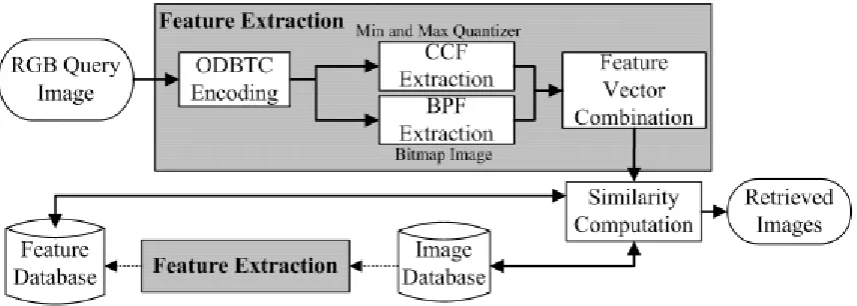
The CCF and BPF of an image are simply derived from the two ODBTC quantizers and bitmap. Figure 3.1
shows the Block diagram of the proposed image retrieval method.
Figure 3.1 Block diagram of the proposed image retrieval method.
5.3 Ordered- Dither Block Truncation Coding:
The main advantage of the ODBTC image compression is on its low complexity in generating bitmap image by
incorporating the Look-Up Table (LUT), and free of mathematical multiplication and division operations on the
determination of the two extreme quantizers. The traditional BTC derives the low and high mean values by
preserving the first-order moment and
second-order moment over each image block, which requires additional computational time. Conversely,
ODBTC identifies the minimum and maximum values each image block as opposed to the former low and high
mean values calculation, which can further reduce the processing time in the encoding stage. In addition, the
ODBTC yields better reconstructed image quality by enjoying the extreme-value dithering effect. At the end of
the ODBTC encoding, the bitmap image, bm, the minimum quantizer, Xmin, and maximum quantizer, Xmax
,are obtained and considered as encoded data stream.
5.4 Color Co-occurrence Feature (CCF)
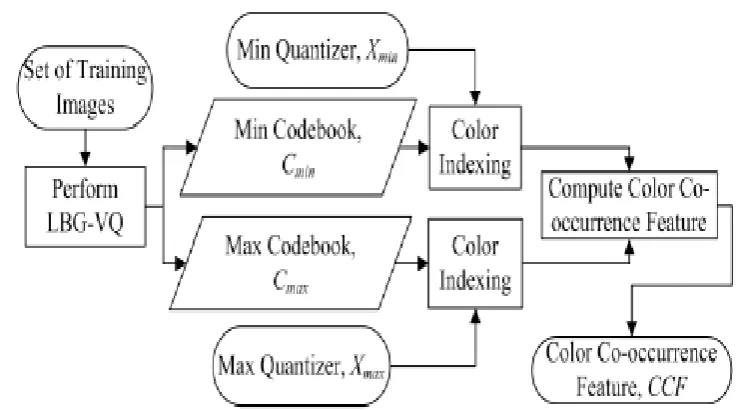
Color Co-occurrence Feature (CCF) can be derived from the color co-occurrence matrix. Figure 3.2 shows the
schematic diagram for deriving the CCF. In the proposed scheme, CCF is computed from the two ODBTC color
quantizers. The minimum and maximum color quantizers are firstly indexed using a specific color codebook.
The color co-occurrence matrix is subsequently constructed from these indexed values. Subsequently, the CCF
is derived from the color co-occurrence matrix at the end of computation. In general, the color indexing process
on RGB space can be defined as mapping a RGB pixel of three tuples into a finite subset of codebook index.
CBIR task.
Figure 3.2 Block diagram for computing the color co-occurrence feature.
5.5 Bit Pattern Feature (BPF)
Another feature, namely Bit Pattern Feature (BPF), characterizes the edges, shape, and image contents. Figure
3.3 shows the schematic diagram for deriving the BPF. The binary vector quantization produces a representative
bit pattern codebook from a set of training bitmap images obtained from the ODBTC encoding process. Let Q =
{Q1, Q2. . .QNb } be the bit pattern codebook consisting Nb binary code word. These bit pattern codebooks are
generated using binary vector quantization with soft centroids, and many bitmap images are involved in the
training stage.
Figure 3.3 Block diagram for computing the bit pattern feature.
The bitmap of each block bm (i, j ) is simply indexed based on the similarity measurement between this bitmap
and the code word Qq. Subsequently, the BPF is simply derived as the occurrence probability of the bitmap
image mapped into the a specific bit pattern codeword Qq.
Similar to that of the CCF, the BPF only needs a simple computation, making it suitable for real applications
5.6 Implementation Plan
Analysis :
The proposed image retrieval methods introduce two image features to index an image:
1. color co-occurrence feature (CCF)
2. bit pattern features (BPF)
The similarity between two images (i.e., a query image and the set of images in the database as target image)
can be measured using the relative distance measure [6]. The similarity distance plays an important role for
retrieving a set of similar images. The query image is firstly encoded with the ODBTC, yielding the
corresponding CCF and BPF. The two features are later compared with the features of target images in the
database. A set of similar images to the query image is returned and ordered based on their similarity distance
score, i.e. the lowest score indicates the most similar image to the query image. The average precision P(q) and
average recall R(q)measurements for describing the image retrieval performance are defined in [7] as below:
System requirement specification:
a) Software requirement:
MATLAB 7.0
MySQL 2000
b) Hardware requirement:
Pentium 4 2.66 Ghz/AMD Athlon 2800+ processor.
256MB RAM (Minimum)/512MB RAM (Recommended).
40 GB+ Hard Disk.
Color Monitor.
5.7 Summary
The extent to which CBIR technology is currently in routine use is clearly still very limited. In particular, CBIR
technology has so far had little impact on the more general applications of image searching, such as journalism
or home entertainment. Only in very specialist areas such as crime prevention has CBIR technology been
adopted to any significant extent. The process of designing of CBIR system has been successfully carried out
and the expected outcome is achieved. The main functions that a CBIR should perform are:
Constructing feature vectors from the image based on its content and storing it in the database. Similarity
comparison and segmentation.
Retrieving the images based on the feature vectors.
In this study, an image retrieval system is presented by exploiting the ODBTC encoded data stream to construct
competitive candidate in the color image retrieval application. Another feature can be added by extracting the
ODBTC data stream, to enhance the retrieval performance.
The extent to which CBIR technology is currently in routine use is clearly still very limited. In particular, CBIR
technology has so far had little impact on the more general applications of image searching, such as journalism
or home entertainment. Only in very specialist areas such as crime prevention has CBIR technology been
adopted to any significant extent. This is no coincidence – while the problems of image retrieval in a general
context have not yet been satisfactorily solved, the well-known artificial intelligence principle of exploiting
natural constraints has been successfully adopted by system designers working within restricted domains where
shape, color or texture features play an important part in retrieval.
The process of designing of CBIR system has been successfully carried out and the expected outcome is
achieved. The main functions that a CBIR should perform are:
Constructing feature vectors from the image based on its content and storing it in the database.
Similarity comparison and segmentation.
Retrieving the images based on the feature vectors.
In this study, an image retrieval system is presented by exploiting the ODBTC encoded data stream to construct
the image features, namely Color Co-occurrence and Bit Pattern features. The proposed scheme can provide the
best average precision rate compared to various former schemes in the literature. As a result, the proposed
scheme can be considered as a very competitive candidate in color image retrieval application.
The experimental results demonstrate that the proposed method is not only superior to the former BTC-based
image indexing schemes, but also the former existing methods in the literature related to the content based
image retrieval. To achieve higher retrieval accuracy, another feature can also be added.
This technique is devoted to improving existing techniques involved in feature extraction, similarity matching
and reducing the overall computation time of image retrieval system while increasing the accuracy.
The main contributions of the technique are listed below:
1. Design and development of a multistage model for image retrieval to improve the retrieval accuracy by
filtering down irrelevant images at each stage.
2. The accuracy of region based image retrieval system is improved by introducing novel region codes based
matching scheme.
For the further studies, the proposed image retrieval scheme can be applied to video retrieval. The video can be
treated as sequence of image in which the proposed ODBTC indexing can be applied directly in this image
sequence. The ODBTC indexing scheme can also be extended to another color space as opposed to the RGB
triple space. Another feature can be added by extracting the ODBTC data stream, not only CCF and BPF, to
enhance the retrieval performance. In the future possibilities, the system shall be able to bridge the gap between
explicit knowledge semantic, image content, and also the subjective criteria in a framework for human-oriented
VI. ACKNOWLEDGEMENT
I sincerely feel that the credit of Dissertation report could not be narrowed down to only one individual. This
work is an integrated effort of all those concern with it, through whose able cooperation and effective guidance I
could achieve its completion.
I express my gratitude to Principal V.C.Kotak and Head of Department, for their generous appreciation,
persistent and encouragement. I am gladly thankful to my guide Ms. Swati Deshpande and my co-guide Mr.
Lukesh Kadu for being kind enough to spare their valuable time, provide insights and guidance on topic
Content-Based Image Retrieval Using Features Extracted From ordered-dither block truncation coding. I owe a
special acknowledgment to them for giving me a lot of their time during the period of preparing this project. I
could never had done it without their support, technical advice and suggestions, thorough reading of all the
work. The blessing, help and guidance given by them time to time shall carry me a long way in the journey of
life on which I am about to embark.
I would like to thank the Review Committee for their invaluable suggestions and feedback without which our
work would have been very difficult. I am also thankful to the management and laboratory staff of SAKEC for
their valuable support. Last but not least, I sincerely thank to those from teaching and non-teaching staff from
SAKEC who were somehow attached with my endeavour.
REFERENCES
[1] Content-Based Image Retrieval Using Features Extracted From Halftoning-Based Block Truncation
Coding Jing-Ming Guo, Senior Member, IEEE, and Heri Prasetyo
[2] Content-Based Image Retrieval Using Error Diffusion Block Truncation Coding Features Jing-Ming
Guo, Senior Member, IEEE,Heri Prasetyo,and Jen-Ho Chen
[3] Image Retrieval: Current Techniques, Promising Directions, and Open Issues Yong Rui and Thomas S.
Huang Department of ECE & Beckman Institute, University of Illinois.
[4] http://www.engineersgarage.com/contribution/content-based-image-retrieval-matlab-project.
[5] J. R. Smith and S.-F. Chang, Automated binary texture feature sets for image retrieval, in Proc.
ICASSP-96,Atlanta, GA, 1996.
[6] G. Qiu, “Color image indexing using BTC,” IEEE Trans. Image Process.,vol. 12, no. 1, pp. 93–101, Jan.