Scholarship@Western
Scholarship@Western
Electronic Thesis and Dissertation Repository
8-24-2015 12:00 AM
Working Harder, Working Smarter, or Doing Both? How the
Working Harder, Working Smarter, or Doing Both? How the
Interpretation of Combined Learning and Performance Goals
Interpretation of Combined Learning and Performance Goals
Affects Complex Task Performance
Affects Complex Task Performance
Meredith J. WoodwarkThe University of Western Ontario
Supervisor Dr. Gerard Seijts
The University of Western Ontario Graduate Program in Business
A thesis submitted in partial fulfillment of the requirements for the degree in Doctor of Philosophy
© Meredith J. Woodwark 2015
Follow this and additional works at: https://ir.lib.uwo.ca/etd
Part of the Organizational Behavior and Theory Commons
Recommended Citation Recommended Citation
Woodwark, Meredith J., "Working Harder, Working Smarter, or Doing Both? How the Interpretation of Combined Learning and Performance Goals Affects Complex Task Performance" (2015). Electronic Thesis and Dissertation Repository. 3124.
https://ir.lib.uwo.ca/etd/3124
This Dissertation/Thesis is brought to you for free and open access by Scholarship@Western. It has been accepted for inclusion in Electronic Thesis and Dissertation Repository by an authorized administrator of
WORKING HARDER, WORKING SMARTER, OR DOING BOTH? HOW THE
INTERPRETATION OF COMBINED LEARNING AND PERFORMANCE GOALS
AFFECTS COMPLEX TASK PERFORMANCE
(Thesis Format: Monograph)
by
Meredith Jacqueline Woodwark
Graduate Program in Business Administration
A thesis submitted in partial fulfillment
of the requirements for the degree of
Doctor of Philosophy
The School of Graduate and Postdoctoral Studies
The University of Western Ontario
London, Ontario, Canada
Abstract
Goal setting research has shown that on novel, complex tasks people perform better with
learning goals than performance goals. In practice, people must often learn and perform at
the same time to adapt to change. Does setting both types of goals simultaneously enhance
complex task performance compared to singular goals? This dissertation consists of two
studies – one qualitative and one quantitative – using a complex business simulation that
examine setting simultaneous learning and performance goals (“combined goals”) for highly
complex tasks. The first study is a cognitive interview study where I examine how people
interpret assigned singular goals (learning or performance) vs. combined goals at various
difficulty levels. I examine 1.) how people understand the relationship between combined
goals; 2.) how combined goals affect their behaviour; and 3.) the different ways people focus
on combined goals. The second study is a laboratory experiment which examines how
combined goals affect performance under dynamic conditions. I hypothesize that combined
goals that emphasize learning more than performance will result in higher performance than
singular goals or combined goals that emphasize performance.
The results of both studies suggest that regardless of the goals people are assigned, they focus
on the performance goal more than the learning goal or both goals equally. Combined goals
appear to have a strong goal hierarchy where performance goals are the dominant goal and
learning goals are the background goal. In terms of task performance, as predicted people
who consistently focus on both goals equally – particularly early in the task – perform better
than those who switch or focus on only one. Also as predicted, assigned combined goals that
emphasize learning over performance result in the highest performance. Overall, the results
suggest that how people interpret combined goals within a goal hierarchy influences the
goals they focus on which in turn influences task performance. This dissertation highlights
the role of an individual’s goal hierarchy in understanding how combined goals influence
complex task performance. The concept of goal interpretation and the influence of goal
hierarchy on goal focus have broader implications for understanding how and why other
iii
Keywords
Goal setting, learning goals, performance goals, multiple goals, simultaneous goals, complex
iv
Acknowledgments
I was fortunate to have Dr. Gerard Seijts as my supervisor. I continually learned from his
expert grasp of goal setting which greatly influenced this work. Gerard afforded me the
courtesy of being open and honest with me as he would a peer. He always pushed me to do
better work and encouraged me to strive for excellence. He was also very generous in sharing
his knowledge and experiences as a teacher, which helped me enormously this past year.
Gerard, the experience of working with you has made me stronger as a researcher and as a
teacher. Thank you sincerely for seeing this through with me.
This dissertation has its genesis in a course term paper I wrote in the winter of 2012 for Dr.
Alison Konrad. Without her encouragement and support I would not have pursued these
ideas. Alison, I am deeply grateful for your faith that I could develop unconventional ideas
about goal setting into a viable dissertation and contribution. Your on-going support
throughout the process has been invaluable. Thank you for getting and keeping me going.
Dr. Fernando Olivera was the person who quite rightly convinced me of the importance of
doing not just the laboratory experiment but also the cognitive interview study in order to
better understand goal interpretation. Fernando, without your insight this dissertation would
be greatly impoverished. Thank you kindly for all your assistance and flexibility, as well as
your kind encouragement and support through my many struggles along the way.
Dr. Kenneth Goh actually helped me start my dissertation before he even arrived at Ivey! He
kindly agreed to let me conduct my interviews in his as yet unoccupied office when no other
rooms were available. It was a generous gesture to a graduate student whom he had barely
met. Kenneth, you removed the final barrier I faced to getting started on this dissertation and
I am truly grateful. Thank you for helping me out once again, this time to finish it off.
Dr. John Meyer and Dr. Kevin Tasa kindly agreed to serve on my exam committee. They
agreed to do so at the end of summer right before a busy new term when I’m sure the last
thing they wanted to do is read another dissertation. Thank you both for your time, insightful
v
wise advice and experienced perspective throughout my degree. Debbie, I would not have
made it this far without you. Thank you for showing me how to make it through the process.
Running my lab study required the expertise and assistance of many people. I am grateful
for the support and time of Lisa Bitacola, Anna Sycheva, Akhila Ramaraju, all of my study
participants, and all of the Ivey IT staff. In particular I would like to thank Jimmy Bowers
whose technical solution which allowed me to run the simulation in the new lab was a
godsend. Thank you all for your many contributions to my research.
I gratefully acknowledge the support and understanding of my colleagues in the OB/HRM
group and the MBA program at the School of Business and Economics at Wilfrid Laurier
University. In particular, I would like to thank Dr. Laurie Barclay for her flexibility as well
as her frequent reminder that “The best dissertation is a done dissertation.”
The most meaningful and enduring part of any degree experience is the friendships you make
along the way. I have been fortunate that this has been true for all my degrees. For this last
one I have been especially blessed. Close friends are nice to have for undergraduate and
master’s degrees, but they are absolutely critical for long, challenging doctoral degrees.
Karin, Jen, Karen, Krista, Jeannette, Charan, Asad, Jason and many other friends: you have
been my lifeblood. I am forever thankful for your support and feel incredibly blessed that
sharing this experience together has brought such phenomenal people into my life.
My love of learning comes from my parents. They have inspired my curiosity and
encouraged my pursuit of knowledge every step of the way. Mom and Dad, for everything
you have done that enabled me to pursue this dream and take on this challenge, thank you
from the bottom of my heart. And to my brother Jon and his family (IJKLM), thanks for
letting me come to play at your place when I really needed some fun.
Most of all, I have my wonderful husband, Dr. Tristan Walker, to thank for his endless
support and encouragement – and the occasional well-deserved butt-kicking – along the way.
Thank you for the very long list of ways in which you have supported me through this
journey. I have learned an enormous amount from you over the years, my love. Most
vi
vii
Table of Contents
Abstract ... ii
Acknowledgments... iv
Table of Contents ... vii
List of Tables ... xii
List of Figures ... xiv
List of Appendices ... xv
Chapter 1 ... 1
1 Introduction ... 1
1.1 Why study multiple goals?... 1
1.2 Why study combined learning and performance goals? ... 4
1.2.1 Business context... 4
1.2.2 Learning goals ... 5
1.2.3 Performance goals ... 6
1.2.4 Sequential argument... 6
1.2.5 Simultaneous argument ... 7
1.3 Theoretical implications of combined goals ... 12
1.3.1 Goal interpretation process ... 13
1.4 Overview of studies and research questions ... 16
1.4.1 Study one: Cognitive interview study ... 16
1.4.2 Study two: Laboratory experiment ... 17
1.5 Contributions... 18
1.5.1 Theoretical ... 19
1.5.2 Practical... 20
viii
2 Introduction ... 22
2.1 Literature Review... 22
2.1.1 Goal setting theory ... 22
2.1.2 Complex tasks ... 24
2.1.3 Learning goals ... 25
2.1.4 Multiple goals ... 29
2.1.5 Combined learning and performance goals ... 32
2.1.6 Goal interpretation ... 35
Chapter 3 ... 39
3 Conceptual Model Development and Study One ... 39
3.1 Conceptual Model Development ... 39
3.1.1 Combined goals and goal focus ... 40
3.1.2 Combined goals and the goal interpretation process ... 42
3.1.3 Effective goal conditions ... 46
3.1.4 Summary ... 47
3.2 Study One Introduction ... 47
3.3 Method ... 48
3.3.1 Design ... 49
3.3.2 Task ... 50
3.3.3 Goal manipulations ... 52
3.3.4 Participants ... 52
3.3.5 Procedure ... 53
3.3.6 Interview questions ... 54
3.3.7 Measures ... 54
ix
3.5.1 Study design and task characteristics ... 57
3.5.2 Combined goals ... 61
3.5.3 Goal mechanisms ... 70
3.5.4 Goal interpretation process ... 82
3.6 Revised combined goal interpretation process model ... 88
3.6.1 Revised definitions... 88
3.7 Discussion ... 91
3.7.1 Implications for study two ... 91
3.7.2 Implications for understanding of combined goals ... 94
3.8 Strengths and limitations... 97
Chapter 4 ... 99
4 Study Two Introduction ... 99
4.1 Hypotheses ... 100
4.1.1 Assigned goals and task performance H1... 101
4.1.2 Summary of H1 ... 111
4.1.3 Effective goal condition H2 ... 112
4.1.4 Summary of H2 ... 120
4.1.5 Goal interpretation H3 ... 120
4.1.6 Summary of H3 ... 129
4.2 Method ... 130
4.2.1 Design ... 130
4.2.2 Experimental task... 132
4.2.3 Goal manipulations ... 132
4.2.4 Participants ... 132
x
4.3 Results ... 141
4.3.1 Goal interpretation measures ... 141
4.3.2 Descriptive statistics ... 146
4.3.3 Manipulation checks ... 149
4.3.4 Correlation matrix for key variables ... 153
4.3.5 Hypothesis tests ... 155
4.4 Discussion ... 187
4.4.1 Assigned goals and task performance ... 187
4.4.2 Effective goal condition ... 191
4.4.3 Goal interpretation ... 195
4.4.4 Strengths and limitations... 197
Chapter 5 ... 200
5 Introduction ... 200
5.1 Overview ... 200
5.2 Main findings ... 201
5.2.1 Study one research questions ... 201
5.2.2 Study two research questions ... 204
5.2.3 Final goal interpretation process model ... 208
5.3 Overall contributions ... 212
5.4 Overall strengths and limitations ... 214
5.5 Theoretical and practical significance ... 215
5.6 Areas for future research ... 220
5.7 Conclusion ... 224
References ... 226
xii
List of Tables
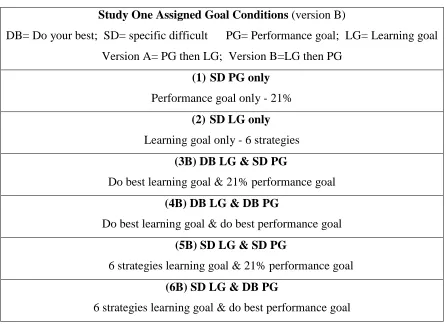
Table 1: Study one assigned goal conditions ... 50
Table 2: Perceptions of task complexity and dynamism ... 57
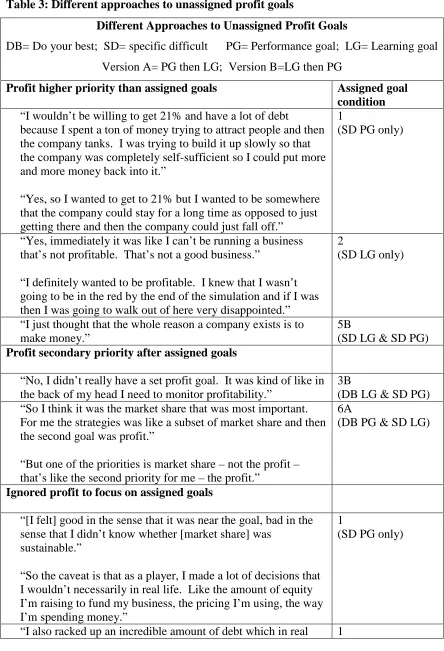
Table 3: Different approaches to unassigned profit goals ... 60
Table 4: Top performers’ reactions with and without a performance goal... 63
Table 5: Relationship between learning and performance goal when combined ... 64
Table 6: Hierarchical relationship between learning and performance goals ... 65
Table 7: Prioritization of performance goals over learning goals ... 68
Table 8: Prioritizing the learning goal over the performance goal ... 68
Table 9: Retrospective valuing of the learning goal ... 69
Table 10: Effects of performance and learning goals ... 72
Table 11: Participant reported goal focus (single or dual) by condition ... 76
Table 12: Previous thematic findings extended to combined goals ... 78
Table 13: New themes by goal condition ... 81
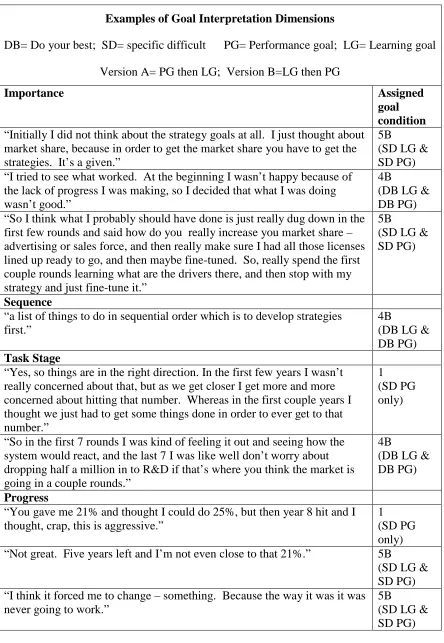
Table 14: Examples of goal interpretation dimensions... 86
Table 15: Study two assigned goal conditions ... 100
Table 16: Summary of H1 ... 112
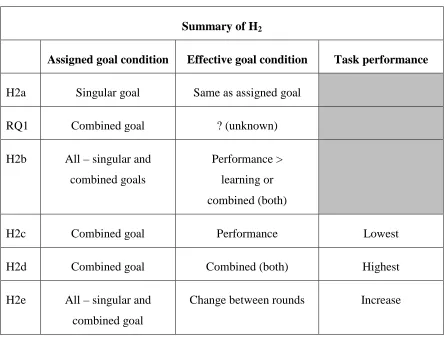
Table 17: Summary of H2 ... 120
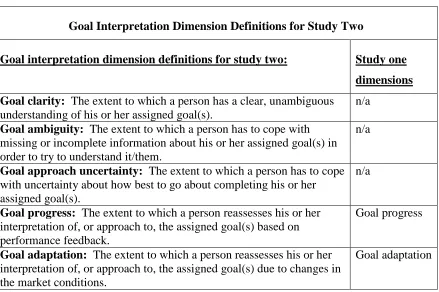
Table 18: Goal interpretation dimension definitions for study two ... 121
xiii
Table 21: Goal interpretation dimension definitions from pre-test ... 139
Table 22: PCA pattern matrix results for original goal interpretation items ... 142
Table 23: PCA structure matrix results for original goal interpretation items ... 143
Table 24: Round 13 goal interpretation factors and reliability ... 144
Table 25: Final goal interpretation dimension definitions ... 145
Table 26: Final sample size by condition ... 147
Table 27: Market share percentage by condition without controls ... 148
Table 28: Summary of H1 findings ... 162
Table 29: Effective goal condition across rounds by assigned single goal condition ... 164
Table 30: Effective goal condition round 2 ... 172
Table 31: Effective goal condition round 7 ... 172
Table 32: Effective goal condition round 10 ... 173
Table 33: Effective goal condition round 13 ... 174
Table 34: Summary of H2 findings ... 180
xiv
List of Figures
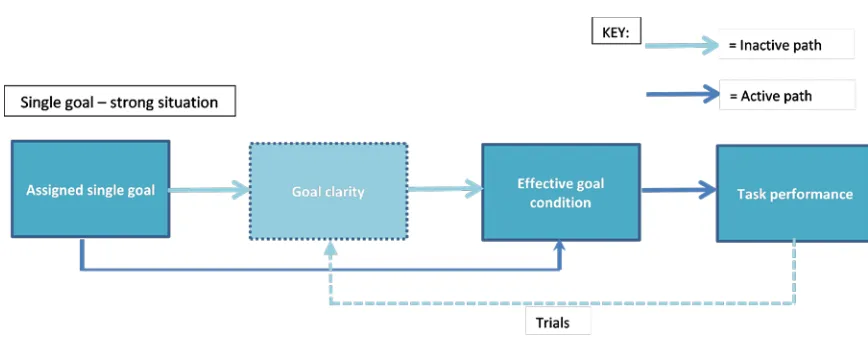
Figure 1: Single goal condition conceptual model ... 44
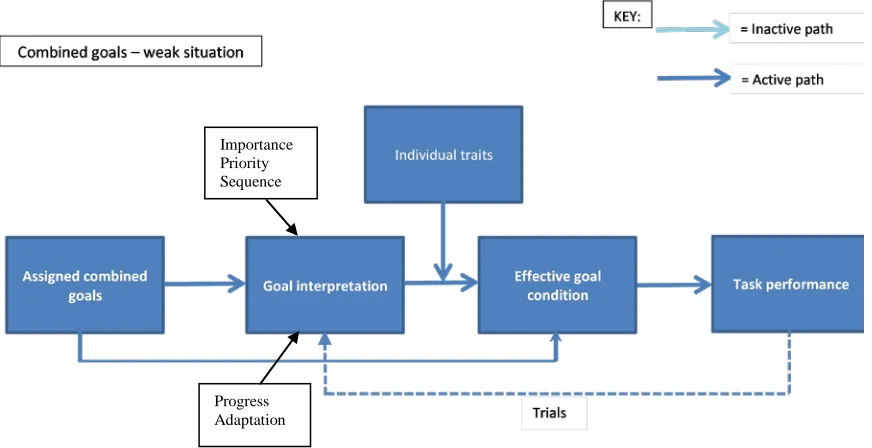
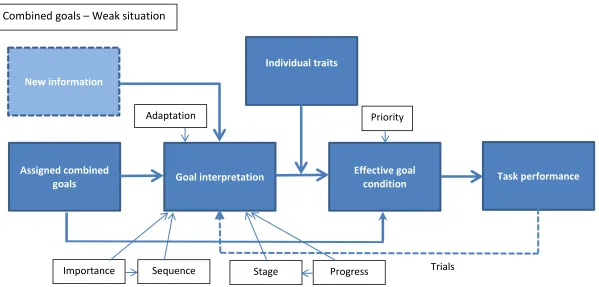
Figure 2: Combined goal condition conceptual model ... 46
Figure 3: Revised combined goal interpretation process conceptual model... 90
Figure 4: Study two correlation matrix of key variables ... 154
Figure 5: Market share performance by condition across rounds ... 161
Figure 6: Effective goal condition by experimental condition at round 2 ... 167
Figure 7: Effective goal condition by experimental condition at round 7 ... 168
Figure 8: Effective goal condition by experimental condition at round 10 ... 169
Figure 9: Effective goal condition by experimental condition at round 13 ... 170
xv
List of Appendices
Appendix A: Study one goal manipulations ... 239
Appendix B: Pre-reading background case ... 242
Appendix C: Study one semi-structured interview protocol... 248
Appendix D: Study one draft goal interpretation items ... 251
Appendix E: Study two goal manipulations ... 253
Appendix F: Manipulation checks and exclusion criteria items ... 257
Appendix G: Control variable items ... 259
Appendix H: Moderating variable items... 260
Appendix I: Mediating variable items ... 261
Appendix J: Other variable items ... 263
Chapter 1
1
Introduction
"The dreams which lure us into the adventures from which we learn are always at bottom the same. Science becomes dangerous only when it imagines that it has reached its goal. What is wrong with priests and popes is that instead of being apostles and saints, they are nothing but empirics who say "I know" instead of "I am learning.""
— George Bernard Shaw (1975)
In Preface to the play, The Doctor's Dilemma (1911), xc.
1.1 Why study multiple goals?
Given that goal setting is one of the most heavily researched topics in all of
organizational behaviour (OB) with over a thousand published studies (Locke & Latham,
2013c; Miner, 2003), one might argue that the last thing the field needs is another goal
setting dissertation, particularly one about conscious goals. If any area of OB research
could be said to have “reached its goal”, goal setting would be the most likely candidate.
Yet, if we are to keep science from being dangerous as Shaw cautions, we must always
keep learning, even when it comes to a mature field like goal setting. Undoubtedly we
know a tremendous amount about goal setting; however, even a mature literature has its
empirical gaps and theoretical limitations. In the case of a managerial intervention as
powerful and as universally applied as goal setting, those remaining gaps and limitations
constitute important areas of inquiry nonetheless.
For a quarter of a century now, goal setting researchers have repeatedly called for
research into multiple goals (Locke & Latham, 1990, 2002, 2006, 2013c); yet, this call
has gone largely unheeded (Locke & Latham, 2013b). The topic of multiple goals raises
fundamental questions about goal complexity: what happens when goals become more
complex, when they go from singular to multiple? Does much of what we know about
known mechanisms by which singular goals function work the same way when there is
more than one goal? There are a plethora of unanswered questions about the common
phenomenon of multiple goals.
These are important questions for goal setting theory because the evidence is mounting
that the phenomenon of multiple goals may be more common than previously recognized.
For instance, goal setting researchers now recognize the fact that people can set personal
goals in addition to assigned goals, even in a laboratory setting (Masuda, Locke, &
Williams, 2014). In fact, these self-set goals can actually be a different goal type than the
goal assigned (Seijts & Latham, 2011). Furthermore, setting personal goals in addition to
assigned goals also happens spontaneously in organizations (Porter & Latham, 2013).
Consequently, it may be that truly singular goals - where people pursue one and only one
goal on the same task at a time – are rare, even in laboratory studies intended to study
singular goals. Given the complexity of goals in organizations (Donde, Dennis, Reuben,
& McDaniel, 2000), and the promotion of multiple goal based techniques such as the
balanced scorecard (Kaplan & Norton, 1995), singular goals may be rarer still in
organizational settings. It is therefore no wonder that research into multiple goals has
long been and continues to be considered a high priority area for goal setting research.
Importantly, however, the concept of multiple goals presents a key theoretical challenge
to goal setting theory. Goal setting theory argues that one of the main goal mechanisms
by which goals function is goal focus (Locke & Latham, 1990). According to the theory,
a goal increases performance over no goal because the goal serves to direct or focus
attention on the goal content (Locke & Latham, 1990). Goal setting theory further argues
that goals work because they result in non-goal areas being ignored (Latham & Locke,
2013). As Latham and Locke argue, “goal setting results in a singleness of purpose”
(Latham & Locke, 2013, p. 572). In fact, that goals result in non-goal areas being
ignored is one of the main concerns of critics of the wide-spread practice of goal setting
in organizations (Ordóñez, Schweitzer, Galinsky, & Bazerman, 2009a).
This concept of goal focus becomes critically important to understand as goal setting
Specifically, does this “singleness of purpose” (Latham & Locke, 2013, p. 572) persist in
the case of multiple goals? If yes, how is the goal that is focused on determined? If there
is only a single goal focus, are there in fact multiple goals? Alternatively, if this
“singleness of purpose” does not persist, how does goal focus operate when there are
multiple possible purposes rather than just one: simultaneously, sequentially,
alternatingly? Do different people focus on multiple goals the same way? The bottom
line is that multiple goals are clearly more complex than singular goals.
With its “singleness of purpose” (Latham & Locke, 2013, p. 572) explanation about how
goal focus operates, goal setting theory therefore faces a conundrum when it comes to
explaining how the key mechanism of goal focus works when goals are more complex.
Whereas the object of goal focus is clear in the case of singular goals, the object(s) of
goal focus is less clear in the case of multiple goals. Conceivably, this means that
individuals with the same assigned multiple goals could focus on different goal(s), or
focus on the goals in different patterns over time. Multiple goal researchers have recently
developed a typology of multiple goals which outlines the various relationships between
multiple goals (Sun & Frese, 2013). Despite this typology, there is little by way of
theoretical explanations or empirical investigations into how the mechanism of goal focus
works in complex goals. The research that has examined this has focused on
multitasking - how people manage goals across several tasks.
This dissertation explores the question of what happens to goal focus when goals are
complex, specifically when there are multiple goals in relation to only one task. I
develop and test a deductively derived conceptual model - informed by the current
literature - of how goal focus is determined through a process of goal interpretation. To
do this, I have selected the case of simultaneously assigned learning and performance
goals as a simple but practically relevant example of a multiple goal. The possibility of
combining learning and performance goals is a topic which goal setting researchers have
long argued is important to empirically examine (Locke & Latham, 2002, 2006, 2013b,
2015; Seijts & Latham, 2005, 2006, 2012), but about which only one study has been
published to the best of my knowledge (Masuda et al., 2014) . Additionally, this
well as combined learning and performance goals specifically - to both goal setting
theory and to goal setting practice. In particular, this dissertation introduces the process
of goal interpretation as a way of explaining how people understand combined learning
and performance goals, how it influences the goal(s) they focus on, and ultimately how
combined learning and performance goals influence complex task performance.
The following section outlines the purpose and benefits of studying combined learning
and performance goals. In addition to being a specific case of multiple goals to examine,
there are several important reasons to study combined learning and performance goals.
1.2 Why study combined learning and performance goals?
1.2.1
Business context
Today’s business environment is a moving target. We live and work in a “world in flux”
(Ignatius, 2013, p. 12) which brings with it a myriad of new challenges for business
leaders and employees. In today’s turbulent times, the ability for people to continually
adapt is considered a business imperative (Ignatius, 2013). Quite simply, “the world of
work in the 21st century is characterized by ever-changing dynamic environments”
(Latham, 2012, p. 143). Consequently, organizational members across a broad range of
industries face the reality of having to respond to the ever-changing demands of our work
world.
Business success today, therefore, means meeting competitive goals in the context of
continuous change (McGrath, 2013). Though the times are always changing, goals must
still be met. While change can bring both threats and opportunities, what is certain is that
contextual change – or dynamic complexity - necessarily renders tasks more complex
(Campbell, 1988; Wood, 1986). Dynamic complexity reflects “changes in the states of
the world which have an effect on the relationships between task inputs and products”
(Wood, 1986, p. 71). In other words, dynamic complexity makes the relationship between
how a task is accomplished and the outcome produced less predictable.
Because a dynamic context makes completing tasks more complex, it also makes
organizational members manage task complexity is pivotal to predicting how change will
affect outcomes. Though their targets may be constantly moving, people must
nevertheless figure out a way to hit them or face failure.
1.2.2
Learning goals
One way for people to cope with the need to hit moving targets is to learn. A changing
environment prompts the need to acquire new knowledge and skills that have become
relevant to the task at hand (Audia, Locke, & Smith, 2000; Wood, 1986). Learning is a
process through which people develop new abilities and is typically defined in the
management literature as “a relatively permanent change in knowledge or skill produced
by experience” (Weiss, 1990, p. 172). But, how do you learn to hit a moving target when
you are also under pressure to hit it? How do people succeed at both learning highly
complex tasks and achieving difficult goals in the face of constant change?
One answer that has emerged in the goal setting literature for how to effectively cope
with highly complex tasks is to set learning goals instead of performance goals. Unlike
performance goals which focus people on the achievement of a specific outcome,
learning goals are process oriented and focus people on the identification of effective
strategies that will contribute to a particular outcome (Winters & Latham, 1996). For
example, whereas a performance goal is asking someone to hit the bull’s eye on a moving
target three times in a row, a learning goal is asking someone to identify and implement
three strategies that will help them hit the target.
Learning goals are effective because they prompt adaptive behaviours such as planning,
information search, and strategy development that lead to learning and ability acquisition
over time (Seijts & Latham, 2001; Seijts, Latham, Tasa, & Latham, 2004; Winters &
Latham, 1996). Although performance goals also affect strategy search, they do so by
prompting effort or motivation rather than cognition and are therefore less effective when
learning new strategies is required rather than activating ones already known (Earley,
Connolly, & Ekegren, 1989; Earley, Connolly, & Lee, 1989; Wood & Locke, 1990).
developing the knowledge and skills required to succeed at new complex tasks. In short,
learning goals prompt people to work smarter.
1.2.3
Performance goals
Contrastingly, performance goals influence motivational processes by increasing a
person’s attention, effort, and persistence towards the desired outcome (Locke & Latham,
1990, 2004). This approach is effective on relatively simple tasks – like hitting a fixed
target - where the required strategies for success are already known. When the task
becomes more complex – like when the target starts to move - the existing strategies are
no longer effective and performance goals typically cease to enhance task performance.
By focusing attention on outcome attainment rather than strategy development,
performance goals tend to result in a less systematic and less effective strategy
development process. For example, in the pressure to meet the desired outcome, people
can resort to an ineffective approach to strategy development which results in lower
quality strategy use (Cianci, Klein, & Seijts, 2010; Seijts et al., 2004).
While performance goals are effective at prompting people to work harder, the outcome
focused rather than learning focused approach they trigger results in less effective
strategies and hence lower performance. A meta-analysis of learning versus performance
goal studies showed that the effectiveness of learning goals over performance goals
increases as the task becomes more complex (Seijts, Latham, & Woodwark, 2013).
Collectively, studies suggest that performance goals prompt people to work harder but
can prevent them from working smarter. Thus, for people who have yet to acquire the
knowledge and skills to complete a highly complex task successfully, learning goals are
more effective at enhancing performance than performance goals. When we still need to
learn, working smarter is more effective than working harder.
1.2.4
Sequential argument
Goal setting researchers have therefore argued that once a person has acquired the
necessary knowledge and skills to successfully complete a task, learning goals should be
replaced by performance goals in order to maximize performance (Seijts & Latham,
goals only after ability has been acquired, people can focus their attentional resources on
effective strategy development and avoid the unsystematic strategy search for that can be
brought on by performance pressure (Seijts & Latham, 2005, 2012). A sequential
approach of learning goals followed by performance goals therefore adjusts goal type to
the appropriate stage of ability development. Once people have learned new knowledge
and skills through experience, they can apply them to the task at hand.
Secondly, once the required new knowledge and skills have been acquired, learning goals
are no longer necessary. In fact, at this stage learning goals may even be detrimental to
performance because they are distracting rather than motivating (Brown & Latham,
2002). Instead, once the requisite ability has been developed, task performance will be
predicted by motivational factors like effort and persistence rather than learning. Hence,
learning mechanisms should be activated first followed by motivational mechanisms after
ability has been acquired.
In summary, the current recommendation in the goal setting literature for maximizing
performance on a highly complex task requiring learning is first to set a specific high
learning goal followed second by a specific high performance goal once learning is
complete (Seijts & Latham, 2005, 2012). This proposed sequential approach, however,
has not been empirically tested with assigned goals, however, only with achievement
goals (Miron-Spektor & Beenen, 2015).
1.2.5
Simultaneous argument
Because environmental changes trigger the need to learn, researchers have argued that
learning goals are particularly advantageous under changing conditions (Seijts & Latham,
2005, 2012). If today’s business climate is characterized by continuous – and sometimes
dramatic - change, then the need to learn is also continuous. In this context, the use of
learning goals may therefore always be warranted to ensure that strategies continue to be
revised and developed. Without continuous learning, people may perpetuate the use of
ineffective strategies and fail to adopt effective new ones. Hence, an on-going focus on
In this context, what is the role of performance goals? Are they no longer relevant or
beneficial? If people need to finish learning before performance goals are appropriate,
but environmental change requires that we never stop learning, then when – if ever – are
performance goals applicable? Can complex task performance under dynamic conditions
ever improve by also working harder while we continue to work smarter?
To date, the literature has focused on the relative effect of setting learning goals versus
performance goals, an ‘either-or’ examination that compares the benefit of learning
versus motivational mechanisms on task performance. One of the purposes of this
dissertation is to examine the largely unexplored possibility that “[learning and
performance goals] may even work better when they are combined” (Locke & Latham,
2013b, p. 625), that is when they are used simultaneously in relation to the same task.
The key question is whether, by triggering both learning and motivational mechanisms at
once, simultaneously combining learning and performance goals changes performance
compared to a learning goal alone on a highly complex individual task. In other words,
can working harder at the same time ever enhance the effect of working smarter?
It is important to note that the scope of this dissertation is limited to conscious, assigned
goals. This focus is appropriate because these goals are more controllable than
subconscious goals and are therefore more managerially relevant. If learning and
performance goals can work better in combination, it is important for managers to know
in order to set goals that will maximize task performance. Notably, only one study on
combined learning and performance goals has been published to date in the management
literature (Masuda et al., 2014).
The real-world need to understand the implications and effects of combined learning and
performance goals (hereinafter “combined goals”) in organizations is important for many
reasons. Firstly, while research has shown that learning and performance goals are
distinct, it is unclear whether they are distinct in their organizational use. There is
mounting evidence that organizations may already use combined goals. For example,
Latham and Locke observed that when Jack Welch was CEO of General Electric he
approach which has been credited with the organization’s strong performance under his
leadership (Latham & Locke, 2007). More recently, a field study conducted during the
economic turbulence of the financial crisis found that companies’ use of learning and
performance goals were highly correlated (Porter & Latham, 2013). This suggests that in
practice learning and performance goals may be less distinct in their usage than they have
been in research. Nonetheless, in order to remain relevant, goal setting research must
examine the effects of goals as they are applied in practice.
Findings that learning and performance goals are used simultaneously likely reflect the
fact that in organizational life people regularly face the need to both learn and perform at
the same time, and often in relation to the same task. Even when people face new and
complex tasks where the need to learn is most salient, they are often required to meet
minimum performance standards at the same time. For example, when new employees
make development plans we know they should set learning goals to assist with mastering
novel tasks. Typically, however, employees must also set performance goals in relation
to those same novel tasks. Thus, having combined goals that explicitly reflect the need
for both types of goals may be more effective than goals that focus on one goal type but
overlook the other.
Secondly, in addition to being under constant pressure to adapt to change, organizations
and employees are also under constant pressure to perform. While the literature
recommends setting learning goals first and performance goals second, that may be a
practically challenging recommendation. Switching from learning goals to performance
goals means managers need to be able to identify when learning is complete enough to
switch. But even the most masterful performer can continue to raise the bar and find
better ways of doing things, so learning is rarely truly complete. Furthermore, although
learning goals are more effective than performance goals on complex tasks, this is partly
due to the fact that people in learning goal conditions can take longer to complete the task
due to more extensive information searching (Seijts et al., 2004). Therefore, due to time
and performance pressures, organizations may simply not have the luxury of setting only
substantial learning is required. Consequently, organizations often face the need to meet
both learning and performance demands simultaneously.
Thirdly, there are strong reasons to expect that adding a performance goal to a learning
goal may enhance performance. Although learning goals focus people on the process of
effective strategy development, people must rely on performance feedback to assess
whether their strategies are effective or not (Seijts et al., 2013). In the absence of a
performance goal, the ‘effectiveness’ of strategies is difficult if not impossible to evaluate
clearly. This is because judging the effectiveness of strategies is fundamentally
dependent upon performance feedback. Without a specific target to compare their
performance to, people cannot assess whether a strategy is effective enough to meet
expectations. Consequently, a performance goal may serve as a reference point to
evaluate whether learning is sufficient to meet expectations.
Furthermore, adding a performance goal to a learning goal may have affective as well as
motivational impacts. In the presence of a performance goal to which they are
committed, people will focus more effort on the task and persevere longer than they
would otherwise, thereby achieving higher performance. Part of the reason why
performance goals are motivating, however, is that people enjoy meeting goals
(Plemmons & Weiss, 2013). Goal attainment satisfies needs such as the need for
achievement and positive self-evaluation (Bandura & Locke, 2003). Thus, performance
may improve by adding a performance goal because it provides a sense of
accomplishment as well as the accompanying positive affect and self-evaluation that a
learning goal may not.
A combined goal, therefore, may allow people to better appreciate their
accomplishments. This may be particularly true of high ability individuals since the
positive effect of learning goals on task performance may be lower in high ability
individuals (Latham, Seijts, & Crim, 2008). High ability individuals may perform better
in a performance goal condition because they are able to learn the task effectively on
learning goal demotivating. For those individuals, then, a combined goal may result in
higher performance than a single learning goal.
Reasons such as these may be behind an unexplained finding relevant to the subject of
combined goals: the tendency to self-set a performance goal when only a learning goal is
assigned. In addition to assigned goals, goal setting researchers recognize that people can
also have self-set goals (Locke & Latham, 1990). For example, if an assigned goal is
perceived as too challenging, an employee may set a slightly lower goal instead. On the
other hand, if the assigned goal is too easy, an employee may set a higher goal.
Typically, a self-set goal simply revises the difficulty level of the assigned goal to adjust
for current performance. Self-set goals are therefore highly predictive of task
performance (Locke & Latham, 1990; Masuda et al., 2014; Seijts & Latham, 2011) .
Research shows that self-set goals can also be the opposite goal type from the assigned
goal. For example, in the case of an assigned learning goal, a self-set goal may actually
be a performance goal. In an experimental study, Seijts and Latham reported a
serendipitous finding that “75% of participants self-set a performance goal even though
they were committed to a learning goal” (2011, p. 201). In that study, the correlation
between self-set goals and performance was positive and significant (r=0.31, p<0.001) (Seijts & Latham, 2011).
The prevalence of self-setting a performance goal while committed to a learning goal
suggests that the self-set performance goal may serve a distinct function from that of the
assigned learning goal. It also suggests a natural inclination for the two goal types to be
combined. More importantly, however, the finding obtained by Seijts and Latham
suggests that “people are able to keep in mind their desired performance level even when
their primary focus is on a learning goal, and they can do so without hurting task
mastery” (2011, p. 201). This finding suggests that when learning and performance goals
are combined the normally detrimental effects of a performance goal may not necessarily
outweigh the beneficial effects of a learning goal on task performance. Whether this is
the case when the performance goal is assigned rather than self-set is an empirical
Finally, in the one exploratory study published in the management literature examining
the effects of combined goals on individual task performance (Masuda et al., 2014) initial
support was found for the effectiveness of combined goals. Using a moderately complex
Excel task where participants were provided with a list of effective task strategies to
implement, Masuda et al. examined the effects of goal type (learning vs. performance)
and goal difficulty level (specific difficult, do best, no goal) in a four-trials repeated
measures experimental design. The results showed that performance was higher when a
combined goal was set rather than only a learning goal, except when both goals were at
the specific, difficult level. Because Masuda et al.’s study used a moderately complex
task and only required participants to implement already identified strategies, the
question of whether assigning combined goals is beneficial or detrimental to performance
on a highly complex task where one must both identify and implement strategies remains
unanswered. Masuda et al.’s results, however, support that further research on the effects
of combined goals is warranted.
Consequently, for all the above reasons, there is strong justification for exploring the
effects of combined goals on highly complex tasks. In a dynamically complex work
environment where many employees face high task complexity and high learning
demands, and where employees are faced with the expectation to both learn and perform
simultaneously, it is vital to understand how the two goal types affect task performance
so that recommendations for their effective combination – or separation – can be
developed based on empirical evidence. Finally, it is appropriate to examine the effects
of combined goals first on individual tasks so that their effects at that level can be
understood before examining their effects at higher levels of analysis.
1.3 Theoretical implications of combined goals
The topic of combined goals presents interesting theoretical questions that are rarely
raised in goal setting research because the emphasis has been on singular goals (Austin &
Vancouver, 1996). The limited empirical work on other types of multiple goals has
examined the topic of multiple goals primarily in relation to multiple tasks. This line of
research has brought to light cognitive practices specifically related to multitasking like
(Emsley, 2003; Kernan & Lord, 1990; Northcraft, Schmidt, & Ashford, 2011). The
research has shown that there are cognitive practices that occur with multiple goals that
do not occur with singular goals, such as prioritizing, sequencing, and making trade-offs
between tasks (Sun & Frese, 2013).
Studies related to multiple goals, however, tend to be one-offs that examine a specific
phenomenon (e.g. trade-offs). Consequently, there is little theory based on programmatic
research that addresses the conceptual consequences for goal setting theory of multiple
goals compared to singular goals. This is a limitation since we know there are practices
like prioritization and trade-offs of time and effort that are unique to multiple goals. It is
also a limitation because, as outlined above, it is unclear how the mechanism of goal
focus functions in the case of multiple goals. Given these gaps in our understanding of
how multiple goals affect performance, the lack of theory about multiple goals is
particularly concerning since they characterize many - if not most - people’s work lives.
This reality is why the need for research on multiple goals is deemed so pressing (Locke
& Latham, 2013b). The question is how can we extend goal setting theory to explain the
common phenomenon of multiple goals? We know that multiple goals present important
new considerations, but how do we incorporate those theoretically?
1.3.1
Goal interpretation process
Accordingly, I argue that there is a need to develop theory that addresses the issues raised
by multiple goals. Specifically, I argue that in the case of multiple goals there is a
cognitive process of goal interpretation that must occur which incorporates the practices
that are unique to multiple goals. Because a combined goal in relation to the same task
constitutes a simple case of a multiple goal, combined goals present the opportunity to
examine whether a goal interpretation process occurs and, if so, to illustrate it. Thus, this
dissertation examines the proposed goal interpretation process on an exploratory basis.
The initial conceptual model is informed by the current literature and is outlined at the
beginning of chapter three. By way of introduction, the key arguments of the conceptual
I argue that typically in goal setting research goal interpretation is not apparent because
specific singular goals create high goal clarity. A specific single goal eliminates
ambiguity about the goal, so there is little variance in its interpretation. This is partly
why specific difficult goals result in higher performance than do best goals: because there
is less variance in performance since the target is objectively clear rather than
subjectively defined. Thus, specific difficult goals result in lower variance in
performance than ‘do your best’ goals do because they provide more clarity about
expectations (Locke & Latham, 1990). In fact, specific singular goals create so much
goal clarity that they are considered strong situations that negate the impact of individual
differences which might otherwise prompt differences in goal interpretation (Adler &
Weiss, 1988).
Multiple goals inherently present people with more choices about how to pursue their
goals than singular goals do. For instance, in the case of a combined goal people can
chose to focus on one goal but not the other, to focus on one goal and then the other, to focus on both goals equally at the same time, or to adjust their goal focus over time as
they go through the task. The specific approach people select will depend on how they
interpret the combined goal. Thus, combined goals, like multiple goals in general, likely
do not result in the same uniform approach that singular goals do (Kernan & Lord, 1990).
Furthermore, under dynamic conditions, multiple goals also raise the issue of how
people’s interpretations of their combined goals may change over time.
Understanding how people interpret their combined goal is important because it can
effectively alter the goal(s) a person actually pursues from the ones originally assigned.
For example, if a person believes that only one of the two goals in a combined goal is
important, then the person will only focus on only one of the goals and effectively have a
singular goal instead of a combined one. Goal interpretation, in other words, can alter a
person’s actual goal condition compared to the assigned one due to different degrees of
overlap between the goal assigned and the mental representation of the goal that the
Even if both of the assigned goals are pursued, however, differences in the sequence in
which the combined goals are pursued (as well as any changes across time) mean that the
same combined goal condition may not have the same effect across individuals.
Consequently, understanding people’s interpretations of combined goals and how they
change over time is important to understanding the effect of combined goals on task
performance since those differences can effectively alter the goal condition people act on.
In short, assigned goal conditions alone may not tell the whole story of the effect of
combined goals on complex task performance due to differences in goal interpretation.
It is important to understand the sources of any differences in goal interpretation. For
instance, we know that multiple goals introduce the possibility of goal conflict because
they require managers to prioritize and make trade-offs (Edmister & Locke, 1987;
Emsley, 2003). Goal conflict complicates decision-making, which can lead people with
multiple goals to experience increased tension (Emsley, 2003). Consequently, in several
studies multiple goals have been associated with significant deterioration in performance
(Emsley, 2003; Locke, Smith, Erez, Chah, & Schaffer, 1994; Yearta, Maitlis, & Briner,
1995). Some goals, however, can be mutually supportive rather than conflicting, so
making progress on one goal contributes to progress on another too (Sun & Frese, 2013).
Proximal and distal goals are an example of this type of multiple goal. Thus, a person’s
understanding of the nature of the relationship between multiple goals may be an
important aspect of how multiple goals are interpreted (Austin & Vancouver, 1996).
The characteristics of the individual pursuing multiple goals may impact goal
interpretation as well (Sheldon & Emmons, 1995). Whereas singular goals create strong
situations, multiple goal conditions (including combined goals) may not. This is because
multiple goals are more ambiguous and less clear than singular goals (Emsley, 2003;
Kernan & Lord, 1990). Thus, individual difference variables may also affect how
multiple goals are interpreted. For example, in the case of combined goals, people must
decide whether to pursue both the learning goal and the performance goal, whether to do
so simultaneously or in sequence, and whether to change their approach over time.
Because all these sources of variation do not occur for singular goals, combined goals
In light of the important differences between singular and multiple goals, research into
the effects of combined goals on task performance must consider the effect of goal
interpretation and individual differences. Based on existing theory and my findings from
study one, I develop a theoretical framework to understand how combined goals lead to
goal interpretation, how individual difference variables may influence combined goal
interpretations, and how goal interpretation differences may affect highly complex task
performance.
1.4 Overview of studies and research questions
This dissertation consists of two studies using two different methods: cognitive
interviews and a laboratory experiment. In both studies participants are senior business
undergraduate students who complete a highly complex, repeated measures,
computer-based business simulation task computer-based on the early development of the cellular phone
industry in the US (Perspectives Visuals & Audia, 1997). Participants play the role of the
CEO of a cellular phone company and have to identify and implement effective strategies
to increase the company’s market share. Over the 13 rounds, there is substantial
environmental change in the task environment. Most importantly, the regulatory
restrictions in the market are lifted after round eight. As a result, the strategies that are
effective in increasing market share change throughout the task. Consequently,
participants must continue to learn new effective strategies throughout the simulation in
order to be successful.
1.4.1
Study one: Cognitive interview study
This study used a cognitive interview technique to explore in detail how combined goals
are understood. This method allowed me to explore how participants pursued their goals
and why they selected the manner they did. Participants were randomly assigned to one
of six goal conditions, two of which were specific difficult singular goals (learning vs.
performance) and four of which were combined goals of different difficulty combinations
(do best vs. specific difficult).
The purpose of the study was twofold. Firstly, the interviews allowed me to investigate
interpretation process occurred, whether goal interpretation changed over time, and how
goal interpretation influenced the way participants approached the task. It also allowed
me to identify factors that influenced goal interpretation. Secondly, the results of study
one were used to identify required changes to the design, method and instruments of the
proposed study two before it was conducted. Thus study one served as a pilot for the
laboratory experiment. The methodology and findings of study one are reported in
chapter three.
1.4.1.1 Study one research questions
In addition to any required design changes for study two, the research questions for study
one were as follows:
• How do people with combined goals understand the relationship between the two
goals? Does it vary between-individuals?
• Do people have different interpretations of combined goals? If so, what are they? How do different interpretations affect the goals people focus on when they have
assigned combined goals?
• Do the approaches people take to their combined goals change over time as they
go through the task? If so, what are the factors that trigger those changes? Are
there common patterns that emerge? In particular, how does environmental
change relate to any changes in how people approach their combined goal?
• What are the mechanisms that operate when people have combined goals? Is
there anything different between singular and multiple goals? Do different
combined goals have different effects on people?
1.4.2
Study two: Laboratory experiment
The primary purpose of the proposed laboratory experiment was to examine the effect of
singular versus combined goals of varying difficulty combinations on complex task
performance. A laboratory experiment was appropriate because the effects of different
combined goals on task performance could be isolated and measured objectively.
Furthermore, since the study employs a managerially relevant and realistic
because goal setting research conducted in a laboratory typically shows high
generalizability to field contexts (Locke, 1986), the findings from this study are expected
to generalize to field settings. As in study one, participants completed the simulation task
after being randomly assigned to one of the same six goal conditions. The secondary
purpose of this study is to examine how goal interpretation varies and how it affects task
performance.
1.4.2.1 Study two research questions
The laboratory experiment was designed to answer the following research questions:
• On a complex and dynamic task requiring learning, does a combined goal
increase or decrease task performance compared to having a singular learning
goal?
• If a combined goal can be beneficial to performance, which difficulty level of
combined goals results in the highest performance?
• If a combined goal can be detrimental to performance, which difficulty level of
combined goals results in the lowest performance?
• What goal(s) do people with combined goals focus on? Does it change
throughout the task? How does goal focus influence task performance?
• Does goal interpretation influence the effect of a combined goal on task performance? How?
1.5 Contributions
First and foremost, this dissertation contributes to our understanding of combined
learning and performance goals and their effects on complex task performance. As one
of the first studies on combined goals - and the first using a dynamically complex task
where the need to learn is on-going - this dissertation contributes to the literature on goal
setting both in theory and in practice. It responds to a call from goal setting researchers
to investigate the effects of combined goals (Latham & Locke, 2007; Locke & Latham,
2002, 2006). Because of the two different methods used – one quantitative and one
goals. Together, the two studies allow me to explain not only the effects of combined
goals on performance, but also provide more insight into why they have such effects. As
a specific case of multiple goals, this dissertation also contributes more broadly to the
literature on multiple goals which, despite almost a quarter of a century of repeated calls
for research attention, remains a poorly understood everyday reality in today’s work
world.
1.5.1
Theoretical
Although the possibility of combined goals has long been considered, researchers have
not outlined why the use of combined goals may be justified. I argue that the context
most relevant to the use of combined goals is a dynamically complex one where the need
for learning is ongoing. Because this characterizes the work world of the 21st century
(Latham, 2012), this context is not only theoretically appropriate but practically relevant
as well. Thus, I provide a theoretical rationale for the potential use of combined goals that
is pertinent to the contemporary work world, and therefore highlight why combined goals
is an important topic for future research.
My primary theoretical contribution is to articulate the ways in which the effects of
combined goals differ from those of singular goals, why this is so, and the implications of
these differences. I examine how people understand the relationship between learning
goals and performance goals when they are assigned together. I introduce the concept of
goal interpretation to explain why the way in which people pursue combined goals varies
more than with singular goals, and to explain how this variation occurs. In my theoretical
framework, I outline the dimensions of goal interpretation that influence how combined
goals are interpreted. I also demonstrate how goal focus varies between-individuals and
across time. Further, I relate these different goal focus patterns to task performance on a
highly complex dynamic task. Overall, I provide a theoretical framework to understand
the phenomenon of combined goals which posits that goal interpretation mediates the
relationship between the combined goals that are assigned and the effective goals that are
actually pursued. The framework argues that the effective goals will be more predictive
I also contribute more broadly to the literature on multiple goals by explaining why they
are unlikely to be strong situations in the way that specific singular goals are. My
theoretical framework argues that individual difference variables may moderate the
relationship between goal interpretation and the effective goal(s) pursued. This is
important to the study of multiple goals because it suggests that individual differences
play a more important role than they do with singular goals. Since multiple goals are
prevalent in organizations but most goal setting research has focused on singular goals,
this further suggests that the role that individual difference variables play in the effects of
goals in practice may be more important than previously recognized.
1.5.2
Practical
Coping with high dynamic task complexity, as well as the demands of multiple goals, are
real challenges in today’s business environment. The question of how to facilitate the
constant learning required under dynamic conditions while simultaneously maximizing
performance is an important question for employees, managers and organizations. This
dissertation examines a largely unstudied but potentially powerful option – combined
learning and performance goals – that may help practitioners do just that. Understanding
the effect of combined goals on performance is an important practical question because
setting combined goals may be more feasible and more appropriate for a dynamic
environment than setting sequential learning and performance goals. Thus,
understanding whether the potential benefits of combined goals are outweighed by the
known benefits of singular learning goals is an important question for the organizational
practice of goal setting. The results of the second study answer this question overall.
They also provide guidance about the most effective combined goal difficultly levels, as
well as combinations to be avoided to prevent performance deterioration. To the extent
that combined goals are actually in organizational use now, the results of this study show
whether that practice should be continued – and how best to do so – or discontinued
depending on the particular combined goal in question.
Moreover, the results of these studies show the importance of understanding goal
interpretation in relation to multiple goals like combined goals. This information will
support the effectiveness of multiple assigned goals. In the battle to cope with dynamic
complexity in the workplace to remain competitive, today’s businesses have a need for
learning as well as performance goals. To make both kinds of goals effective, however,
managers need to understand how employees perceive learning goals versus performance
goals so a balance can be struck between the two imperatives.
Overall, the results of this dissertation provide insights and clear recommendations for an
issue that is faced by managers in organizations on a daily basis: how best to promote
high performance levels on dynamically complex tasks while still enabling high levels of
learning through the use of goal setting, specifically combined goals.
1.6 Outline
Having laid out the rationale for studying combined goals and the specific research
questions, the remainder of this dissertation is structured as follows. Chapter two reviews
the relevant literatures in relation to combined goals. Chapter three outlines the
conceptual model and rationale, methodology and findings of study one - the cognitive
interview study - along with a discussion of the results. Chapter four outlines the
rationale, hypotheses, methodology and findings of study two - the laboratory experiment
- along with a discussion of the study results. Chapter five provides a discussion of the
results of both studies taken together as well as their implications for the proposed model,
and outlines potential future research areas. All study materials are contained in the
Chapter 2
2
Introduction
This section reviews the literature relevant to the study of combined goals and complex
task performance: goal setting theory, complex tasks, learning goals, multiple goals,
combined learning and performance goals, and goal interpretation.
2.1 Literature Review
2.1.1
Goal setting theory
Goal setting theory is one of the most dominant – if not the most dominant – theory of
work motivation (Latham & Pinder, 2005; Miner, 2003). In essence, a goal reflects a
desire to achieve a certain end state (Locke & Latham, 1990). Goals are motivating
because they create a discrepancy between the existing state of affairs and the desired
state. Thus, goals prompt people to act to resolve this discrepancy, provided they have
the requisite commitment and self-efficacy (Locke & Latham, 1990).
A goal condition is a state an individual experiences. In goal setting theory, goal
conditions come in one of two goal types: performance or learning.1 A performance goal
condition is one that is defined by the desired outcome or performance level to be
achieved according to an objective measure (Seijts & Latham, 2005). A learning goal
condition is one that defines the goal by the identification and implementation of
effective strategies to achieve an outcome (Winters & Latham, 1996). In short,
performance goals describe the desired results directly, while learning goals describe the
desired process necessary to develop the ability to eventually achieve results.
The central finding of goal setting theory is that performance is highest when a specific
difficult goal is set rather than an easy goal, a “do best” goal, or no goal at all (Locke &
Latham, 2002). This finding is robust across a broad spectrum of settings and has been
1
extensively replicated in laboratory and field studies. Moreover, this finding holds not
just for individuals but also for teams and departments (Latham & Locke, 2007).
The effect of specific difficult goals on performance is explained by four mediating
mechanisms: attentional focus (or direction), effort, persistence and task strategies (Locke
& Latham, 2002). The primary benefits of specific difficult performance goals are
motivational in that they serve to focus attention and increase effort and persistence
towards goal achievement. Thus, people with specific difficult goals will focus more on
their goal, put in more effort, and persevere longer than those with less difficult goals.
They will also avoid putting attention and effort into non-goal areas since “goal setting
results in a singleness of purpose” (Latham & Locke, 2013, p. 572).
The fourth mechanism, task strategies, is primarily cognitive. People with specific,
difficult goals will draw on their existing knowledge and skills that are relevant to the
task in order to attain their goals. The will also make greater use of general task strategies
such as planning and strategy refinement (Locke & Latham, 1990). Thus, the
effectiveness of the task strategies used when pursuing specific challenging goals
mediates the effect of the goal on task performance (Locke & Latham, 2002).
Noteworthy moderators of the relationship between goals and task performance include
goal commitment (Hollenbeck, Williams, & Klein, 1989), feedback, ability, and task
importance (Locke & Latham, 2002, 2004). People perform better when they are
committed to their goals, but commitment is especially important to performance when
goals are difficult. Also, people who receive feedback about their performance perform
better than those who do not (Earley, Northcraft, Lee, & Lituchy, 1990). The effect of
goal setting on performance is limited by a person’s ability level, so goals are more
predictive of performance for people with high rather than low task ability. Goals that are
perceived as important receive higher commitment and result in higher performance than
those that are not.
Finally, self-efficacy also mediates the relationship between a specific difficult goal and
task performance since people with higher self-efficacy have higher goal commitment