IJEDR1402201
International Journal of Engineering Development and Research (www.ijedr.org)2556
Capacitor Placement in Distribution System Using
Ant Colony Optimization Algorithm
1
Raviraj R. Nirmal,
2Alpesh S. Adeshara
1M.E. Scholar, 2Lecturer1Electrical Engineering Department, 1
V.V.P. Engineering College, Rajkot, INDIA
1[email protected] , 2[email protected]
________________________________________________________________________________________________________
Abstract— Electric power supply system comprises of generating units that produce electricity, high voltage transmission
lines & distribution lines that deliver the electricity to consumers. Losses mainly occur in distribution system due to variation in the load and the low voltage level at which electricity reaches to consumer. To optimize reactive power we must minimize total active power loss and control of voltage. This can be achieved by placing capacitor at proper locations in electrical distribution system. The optical capacitor placement problem involves determination of the location, number and size of capacitor to be placed. This paper describes a comparative study of capacitor placement problem using fuzzy logic approach described in "Cost Saving in Distribution System Using Fuzzy Techniques" and a novel method which solves problem using Ant Colony Optimization algorithm. Both the methods were applied as a simulation on a 15 bus radial system. It has been proved with the results that ACO method solves the problem with higher accuracy and also in a smaller span of time.
Index Terms— Capacitor Placement, Fuzzy Logic, ACO
________________________________________________________________________________________________________
I.INTRODUCTION
The behavior of insects has been intensively researched and studied in science and computer technology. The goal always is to find algorithms which are inspired by the insect behavior. Such algorithms can be used to solve the optimization problems. Optimization problems are mostly NP-Hard problem which can have several solutions. Ants communicate using a indirect method by using pheromone details without using the visual aids. By these Ants finds the shortest path between the nest and the food source. Artificial ants can imitate this behavior [1], in solving the complicated and complex problems. One of such concept is Ant Colony Optimization (ACO) [2].
Ant Colony Optimization has been widely applied to solving various complex and combinatorial optimization problems such as Travelling Salesman Problem [3, 4,], Weapon-Target Assignment problems (WTA) [5, 6], Quadratic Assignment Problem (QAP) [2], etc.
In the case of a electrical distribution system, due to the inductive load reactive current components arise. Reactive current produces power loss and results in the increased ratings of a distribution system. Capacitors are commonly used in the distribution systems for reactive power compensation to improve voltage profile, improve power factor, reduce power losses and to increase the maximum power flow via lines, cables and transformers. These benefits are greatly dependent on how capacitors are placed in the electrical distribution system. The general capacitor problem is how to determine the optimal locations and sizes to install capacitors at the buses of the electrical distribution systems [1]. The economic benefits obtained from the loss reduction weighted against capacitor costs while keeping the operational and power constraints with in required specified limits.
This paper aims to get designed a economical distribution system with minimum power loss achieved with the help of the capacitor placement. Study has been carried out on a 15 bus radial distribution system. The problem has been already solved with the help of the fuzzy logic approach and the results obtained are compared here with the novel approach using Ant colony optimization Algorithm to solve the given problem statement.
This paper is organized as follows. Section II describes the mathematical model of the problem of optimal capacitor placement. In Section III, gives the overview of the basic ACO Algorithm. In Sections IV, it describes the proposed ACO algorithm for capacitor bank placement. In Section V, it shows the comparative study of the results obtained with fuzzy logic approach and the proposed work. Finally, it presents the conclusions in Section VI.
II.PROBLEMFORMULATION
Capacitor placement problem basically determines the location and sizes of capacitors in order to minimizing the active losses. An Alternate, application can be correction of the power factor, increase the capacity of transmission lines. In this work, the function to be optimized is defined as the function to maximize the annual cost savings of the distribution system. This is achieved with the finding of the capacitor locations. In the form of the mathematical equation the problem can be written as[7]:
Maximize S = [Ke ΔE+ Kk ΔK-KC ΔC]………..1 Where
IJEDR1402201
International Journal of Engineering Development and Research (www.ijedr.org)2557
ΔE = reduction in energy loss in $/yr;Δ K = KVA enhancement in $/yr; ΔC = size of capacitor.
Ke = factor to convert kVA enhancement to $ Kk = factor to convert energy loss in $/kWh KC = cost of capacitor in $
III.ANTCOLONYOPTIMIZATION
A.Basic ACO
Initially ants wander in different pats in the search of the food source. Upon finding the food source the ants return to the nest and on the way they lay down the pheromone trails in the different paths. During return journey the amount of the pheromone that various ants leave depend on the quality and quantity of the food. As soon as other ants find such path they are likely to follow the trail rather than travelling in a random fashion.
As the times passes the pheromone level starts to evaporate, so this decreases the attractive strength. If an ant takes more time to travel while going and coming back to nest, it gives more time to pheromones to evaporate. As a result the shortest path from nest to the food source is followed more frequently and thus a locally optimized solution is converged which is the main advantage of the pheromone evaporation. Pheromone actions make the Ant Colony Optimization algorithm for finding the shortest and the most visited reliable path for the journey from nest to food source. If there are no evaporation action of the pheromone levels, than the path selected by the first ants would tend to be excessively attractive to the following ants. In such cases, the exploration of the solution space would be constrained.
Thus as soon as one ant finds a shortest path from the colony to a food source, other ants are more likely to follow the same path and this positive feedback eventually results in leading all the successive ants in following a single path. The basic idea of the ant colony algorithm is to mimic this behavior with "simulated ants" walking around the graph which represents a method to solve a given problem.
B.ACO – A brief idea
(a) (b) (c) Figure 1 – Natural ACO
1. In Figure 1 (a), At initial stage all ants are in nest. No pheromone in the surrounding environment. 2. In Figure 1 (b) ants starts journey from nest to food source. Ants follow both the possible paths.
3. As shown in figure 1 (c), the ants that have taken short path have arrived earlier than the ants which followed the longer path. So while returning the probability to take short path is higher.
So pheromone level on the shortest path is more as it has been visited by larger number of ants. This gives an idea of the natural ACO algorithm. It proves to be an effective tool for solving complex combinational problems of the real world.
IV.THEPROPOSEDAPPROACH
This section describes the proposed work of solving the capacitor placement problem using Ant Colony Optimization Algorithm [8].
A.Mathematical model of Problem
We have to optimize the annual cost saving function described with the help of a mathematical equation shown below. Maximize S = [Ke ΔE+ Kk ΔK-KC ΔC][1-ΔV]
IJEDR1402201
International Journal of Engineering Development and Research (www.ijedr.org)2558
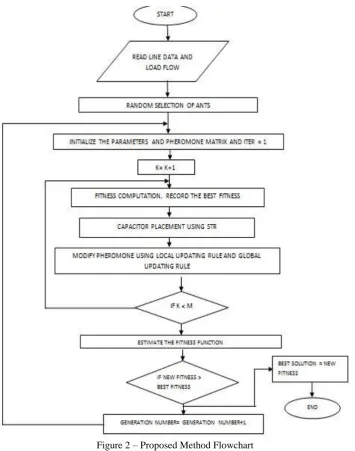
ACO algorithm works with the input parameters fed to the Matlab code. A Matlab code has been written for solving the given problem. ACO has been converged after the completion of the 100 cycles to find the optimize solution. Following are the main steps of proposed algorithm.Step 1 MATLAB Initialization. Step 2 Main.m is run for GUI.
Step 3 ACO is called from Main function. Step 4 Random number generation. Step 5 Various Initialization.
Step 6 Random Path visit by Ants i.e capacitors. Step 7 Pheromone updation locally and globally.
Step 8 Final Calculations of cost saving & Log file creation.
Figure 2 – Proposed Method Flowchart C.The Pheromone Updation
As per natural ACO by the guidance of the pheromone intensity, the ants select preferable path. Finally the favourite path rich of pheromone level become the best tour path for all the ants. This becomes the most optimized solution for a given problem. At initial stage each capacitor is placed on one of the buses in a 15 bus distribution system. And for every case the value of the cost function as well the level of reactive power loss is calculated. This forms the local pheromone updating rule. After the completion of the 100 iterations a best optimized solution for a given problem is constructed with the help of the records stored after the completion of each local updating rule. This forms a global updating rule which finalize the optimize location of the capacitor as a part of the final solution.
D.Input parameters
IJEDR1402201
International Journal of Engineering Development and Research (www.ijedr.org)2559
Reduction in Energy Loss in $/year KVA Enhancement in $/year2100 20
3300 30
1400 50
6500 80
2600 30
4700 60
6800 40
8900 60
2500 20
6800 30
5300 50
8800 80
4300 30
4600 60
5500 40
Table 5.1 Input Parameters used in the implementation
Ke is the factor to convert KVA enhancement in to Dollors whose value is 0.06. Kc represents the cost of the capacitor which is taken as 3 $. Kk is the input parameter which is a factor to convert energy loss in terms of $/year. All the input parameters have been taken from a paper which has solved the capacitor placement problem on a 15 bus radial distribution system using Fuzzy Logic approach [7].
Following table provides the size of capacitors used in the placement process. As shown in the table below for a 15 bus radial distribution system 5 capacitors are to be placed for optimal annual cost savings. For 15 bus system ACO requires 15 capacitors for the calculation so rest all the values are considered to be 0.
Size of Capacitor 274
193 143 265 145 0 0 0 0 0 0 0 0 0 0
Table 5.2 Size of Capacitors V.COMPARATIVESTUDYOFRESULTS
The proposed method described in the paper has been implemented using a Matlab code. These results are for Intel® Core ™ 2 Duo CPU E4500 @ 2.2GHz-2.2GHz, 0.99GB of RAM with system loaded with .net framework 3.5, MATLAB R2010A with Microsoft Windows 7 Premium.
Following gives location of the capacitors which needs to be placed on the 5 buses out of the 15 total buses in the distribution system.
Capacitor Placed Bus Number
1 5
2 9
3 6
IJEDR1402201
International Journal of Engineering Development and Research (www.ijedr.org)2560
5 10
Table 3 – Capacitor Placement Result
Following table gives the comparative idea of the results obtained from the Fuzzy Logic approach and the proposed method using ACO for solving the capacitor placement problem in a electrical distribution system.
Method of Implementation Annual Cost Value ($)
Fuzzy Logic Method 9001420
Proposed Approach – Using Ant Colony
Optimization Algorithm 10009940
Table 4 – Comparison of Fuzzy and ACO Approach
As we can see from the results that using ACO approach gives more optimized value of the annual cost saving function. Also Fuzzy logic technique provides results in 20 minutes duration, where as proposed algorithm implemented in Matlab provides results in just 4 minutes time. So it can be concluded that for capacitor placement in a electrical distribution system Ant Colony Optimization algorithm is more efficient and accurate as compared to the Fuzzy Logic method.
VI.CONCLUSION
The Ant Colony Optimization Algorithm has been proved to a effective tool for solving the combinational problems such as capacitor placement problem. The proposed work here has been compared with the Fuzzy Logic approach and it has been found that proposed approach provides results in much lesser time as compared to other methods. Also proposed approach has been implemented with a novel idea of creating a pheromone matrix for getting the optimized results.
REFERENCES
[1] E. Bonabeau, M. Dorigo, and G. Theraulaz, “Swarm intelligence from natural to artificial systems,” Oxford University Press, 1999.
[2] A. Colorni, M. Dorigo, and V. Maniezzo, “Distributed optimization by ant colonies,” Proc. of ECAL91-European Conference on Artificial Life, pp. 134-142, 1991.
[3] M. Dorigo, V. Maniezzo, and A. Colorni, “The ant system: Optimization by a colony of cooperating agents,” IEEE Transactions on System, Man, and Cybernetics, Part B, Vol.26, pp. 29-41, 1996.
[4] T. St¨utzle and H. H. Hoos, “Max-min ant system,” Future Generation Computer System, Vol.16, pp. 889-914, 2000. [5] M. F. M. Junior and M. C. P. Filho, “Optimal power flow in distribution networks by newton’ s optimization methods,”
in Proceedings of the 1998 IEEE International Symposium on Circuits and Systems, Montrey, CA, 1998. [6] M. Dorigo and T. Stützle, Ant Colony Optimization. MIT Press, 2004.
[7] Y.-C. Huang, H.-T. Yang, and C.-L. Huang, “Solving the capacitor placement problem in a radial distribution system using tabu search approach,” IEEE Transactions on Power Systems, vol. 11, no. 4, pp. 868–873, 1996
[8] T. Ghose, S. Goswami, and S. Basu, “Energy loss reduction in distribution system by capacitor placement through combined ga-sa technique,” in TENCON ’98 - IEEE Region 10 International Conference on Global Connectivity in Energy, Computer, Communication and Control, vol. 2, 1998, pp. 502–505.
[9] Yan-Fu Chow, Member IEEE "Cost Saving in Distribution System Using Fuzzy Techniques" - IEEE TRANSACTIONS ON POWER DELIVERY, VOL. 15, NO. 2, JANUARY 2008.
[10] Chung-Fu Chang " Reconfiguration and Capacitor Placement for Loss Reduction of Distribution Systems by Ant Colony