S
C
H
O
O
L
O
F
M
A
N
A
G
E
M
E
N
T
WORKING PAPER SERIES
Internet Usage and Competitive
Strategy: A Large Firm Study
Patrick Foley
Email [email protected]
Danny Samson
[email protected]
17/2003
Internet Usage and Competitive Strategy: A large firm study
Mr. Patrick Foley
School of Management, Victoria University, Melbourne Australia
Professor Danny Samson
Department of Management, University of Melbourne, Melbourne Australia
Email:
Internet Usage and Competitive Strategy: A large firm study
Abstract
Using 281 of Australian’s top 1000 companies this study examined the effect a firm’s strategy had on the adoption of internet-enabled business practices (IBP). Four strategies were explored Product Leadership, Operational Excellence, Customer Intimacy and Commodity Seller. Firms with a product leadership strategy were the most likely to adopt internet-enabled business practices (IBP) even when size, monopoly position and industry turbulence were controlled for. Different strategies had different adoption patterns with Commodity Seller having the lowest overall adoption rate.
Keywords
value chain, competitive strategy, internet adoption, industry, large Australian organisations
Introduction
Porter (2001) suggests that the basic tool for understanding how the Internet may affect companies is the value chain. This study used the value chain as a theoretical framework to develop a research instrument. This instrument was used to explore the extent to which Internet-enabled business practices (IBP) are used within large Australian organisations and to what extent a firm’s competitive strategy explains their adoption. In addition to firm strategy other industry variables were used. These were a firm’s monopoly position, size and industry turbulence.
The Value Chain
The process view of organisations sees an organisation as a system made up of subsystems, each with inputs, transformation processes and outputs that involve the acquisition and consumption of resources. These resources typically consist of money, labour, materials, equipment, buildings, land, administration and management. Porter contends it is how value chain activities are carried out that determines costs and affects profits (Porter 2001).
can be divided into two broad types: primary activities, which involve the physical creation of the product, its sale and transfer to the buyer, and after-sales service; and support activities, which support the primary activities by providing purchased inputs, technology, human resources, and various firm-wide functions. When a company competes within any industry it performs a number of discrete but interconnected value creating activities. Since every activity involves the creation, processing, and communication of information the Internet can have a pervasive influence on the value chain. To illustrate; these activities, which also have points of connection with the activities of suppliers and customers, could include operating a sales force, component fabrication and product delivery. The Internet's great advantage is its ability to link activities so that real-time data created in one activity is widely available. The data is disseminated not only within the company but also to suppliers and customers (Porter 2001).
Value Disciplines
The Treacy and Wiersema (1995) strategy model consists of three value disciplines. These are: 1. Operational Excellence
2. Product Leadership 3. Customer Intimacy
To measure strategy in the sample companies three scales were developed based on Treacy and Wiersema (1995) strategy model. Their model can be seen as refining elements of Porter’s (1980) generic strategy model (Day 1997). However, they focus on the processes or competences of an organisation believing that all successful companies have one thing in common: the ability to focus on a single "value discipline". Their model is different from Porter’s in that they argue that organisitions must not only excel in at least one value discipline but also meet a minimum threshold of competence in the other two. These value disciplines can be seen as placing different emphasis on each of the nine generic activities within Porter’s value chain (Kaplan & Norton 2001). Treacy and Wiersema’s (1995) model has a number of advantages. First, it can be linked to the value chain more easily than it can be to Porter’s generic strategies (Kaplan & Norton 2001). Second, it also explicitly explores how organsiations that use different strategies have differing information needs (Weill & Broadbent 1998).
The three value disciplines in the model roughly correspond to Porter’s cost leadership and product/service differentiation respectively. Their model has the advantage of explicitly separating the differentiation part of Porter’s model into product leadership and customer intimacy.
Treacy and Wiersema (1995) argue that operationally excellent companies deliver a combination of quality, price and ease of purchase that no one else in their market can match. They are not product or service innovators, nor do they cultivate one-to-one relationships with customers. They execute extraordinarily well, and their proposition to customers is guaranteed low price or hassle-free service, or both. These organisations win by cost and are very similar to Porter’s cost leadership generic strategy, though less emphasis is placed by Treacy and Wiersema (1995) on market share and other advantages. Dell would be a company that has an operationally excellent value discipline.
Companies pursuing product leadership continually push products into the realm of the unknown, the untried, or the highly desirable. Reaching that goal requires that that these organisations be not only creative but able to recognise and embrace ideas that originate both inside and outside the company Most importantly the must be able to commercialise ideas quickly. To do so, product leadership organisations’ business and management processes are engineered for speed (Treacy & Wiersema 1995). Product leadership is similar to Porter’s second generic strategy differentiation based on product. Sony would be a company that has a product leadership value discipline.
Value Disciplines and Internet –enabled Business Practices
Weill and Broadbent (1998) suggest that the business processes, management systems, and information needs inherent in each of the value disciplines lead to different business and information technology needs. Therefore the different value disciplines also lead to different types of information technology portfolios. The different Internet enabled businesses practices are supported by different types of information technology portfolios within the organisations. The absence of an Internet enabled business practice can be taken as an indication of the lack of the prerequisite information technology portfolio within an organisation or the inability or lack of desire to leverage it.
Weill and Broadbent (1998) argue that operational excellence requires transactional systems that are fast, robust and cost-effective, with strong emphasis on systems that automate transactions and reduce costs. They suggest that businesses that complete predominantly on product leadership put more energy into managing flows of ideas, including the inter-relationships between many different parts of the organisation, such as R&D, engineering, information technology and marketing. Here, systems to support the management of ideas are concerned with context and communication, rather than with the content of the data, as in transactional systems. Product leadership often involves more emphasis on support of high performance teams that might be physically dispersed. If Weill and Broadbent’s contention is correct then product leaders them may have a different Internet-enable business practices and emphasis than those organisations emphasizing operational excellence.
Though there may be some differences in Internet-enable business practices between firms with an emphasis on operational excellence and product leadership, the greatest difference, according to Weill and Broadbent, is with organisations pursuing a customer intimacy strategy. They suggest that this strategy requires greater attention to the storage, analysis and availability of more extensive information on customers than is necessary simply to complete business transactions. This strategy emphasises customer relationship building over the pursuit of transaction efficiency. In addition more comprehensive customer databases are required and as well powerful analytical tools are used to extract information to manage customer’s relationships more proactively. The focus for this strategy is on integrating all the different points of customer contact to present a consistent face to the customers. However, a customer intimacy strategy is more than just providing a consistent face to the customer. It is becoming “customer-centric”.
Prahalad and Ramaswamy (2000; 2002) see customers as a new source of competence for the corporation and discusses the importance of establishing a co-creation connection with them. In contrast to the customer-centric view they see the traditional efficiency-driven view of value creation as company-centric. This perspective sees the value creation as a process of cost-effectively producing goods and services and that this perspective often conflicts with what consumers value - the quality of their experiences with goods and services. They see the Internet as not only the ultimate self-service technology but also a source of corporate indifference to the consumer experience. They suggest that Internet enabled customer practice can only be customer-centric when the customer experience is managed with at least the same care as costs. Customer Intimacy will be more successful when there is an emphasis on customer-centric, customer experience enhancing and co-creation enabling. However as Porter (2001) has indicated the Internet-enabling of business processes is most often for efficiency-driven reasons. Prahalad and Ramaswamy (2002) warn that such an efficiency driven orientation can encourage a company-centric orientation and damage the company-customer relationship by encouraging the view of consumers as passive target markets. Therefore a customer intimacy strategy is more likely to be associated with more external market orientated Internet-enable business activities. It might even have a stronger relationship when the emphasis is on market oriented Internet-enable practices and not internally oriented.
Large Australian Organisations: The Study Sample
business environment was illustrated by the fact that by October only 813 organisations were available to be surveyed due to mergers, takeovers and corporate failures.
The respondents to the survey were CEOs or a member of the senior executive group. A total of 281 valid responses were received (35 per cent valid response rate). The organisations represented all major industry groups. It is important to note that, given the size of these organisations by revenue and tangible assets, the following discussion of Internet practices relates only to large Australian firms.
Instruments and Variables
As a way of exploring how the Internet interacts with a company’s value chain, Porter (2001) listed 32 prominent applications under the five headings of the primary activities in the value chain and four headings of the support activities. These were turned into questions and piloted with groups of MBA students working in industry. The initial reaction was that the terms were too technical and focus groups were held to simplify the questions while maintaining as much of Porter’s original wording as practical. After a pilot study, 10 items were selected and these broadly cover Porter’s nine generic activities (see Table 1 below). Therefore the Internet-enabled business practices (IBP) ranged from those that were internally focused support activities, sharing and dissemination of organisation information, to those that were more externally focused primary activities on-line sales channels including web sites and internet marketplaces.
In the study the CEO or one of their direct reports were asked to rate, on aone to seven scale, the extent to which they used the 10 different internet enabled business practices within their organisations. The questions formed a main scale with two subscales. These subscales indicated an external market orientation and an internal knowledge and information management Internet enabled practice orientation. The two subscales mainly consist of value-chain primary items and support items respectively. The full scale and the two subscales had alpha reliabilities of .87, .85 and .75 respectively. Though these subscales were highly correlated (r 270 = .67 p< .01) their alpha was higher than their correlation so there is evidence for discriminate validity between the two scales.
As the mean score in Table 2 below illustrates the most common Internet business practice is
sharing and dissemination of organisation information followed by knowledge directors and procedure and process manuals. Both are support actives and the four next highest are primary activities that show an external market orientation. The lowest reported internet-enabled business practice was self-service personnel, benefits and training.
Table 1 Internet-enabled Business Practices (IBP)(n= 262 to 266)
Mean SD Alpha External Market Orientation (Mainly Primary Activities) (MIBP)
Real-time transaction of orders (availability/delivery time) 3.77 1.81 Internet-enabled linkage of purchase, inventory, and forecasting systems with
suppliers 3.76 1.76
Co-ordination of delivery arrangements 3.66 1.78
On-line sales channels including web sites and internet marketplaces 3.60 1.91 Collaborative product design/service coordination across locations 3.56 1.71
Sharing and dissemination of competitor information 3.53 1.68 .85 Internal Knowledge and Information Orientation (Mainly Support Activities)
(IIBP)
Sharing and dissemination of organisation information 5.34 1.40 Knowledge directories, and procedure or process manuals 4.89 1.56 Customer self-service via web sites and intelligent service request processing 3.56 1.88 Self-service personnel, benefits administration or training 3.47 1.75 .75
Total Scale (TIBP) .87
dissemination of organisation information not only had the highest score but also the lowest standard deviation. The practice that had the greatest variation in the sample was on-line sales channels including web sites and internet marketplaces with a mean score of 3.60 and a standard deviation of 1.91.
To measure strategy in the sample companies, three scales were developed based on Treacy and Wiersema’s (1995) strategy model. Organisations were asked “to what extent do the following statements best describe your workplace’s competitive strategy?” Items for each scale and their factor loading are shown in Table 2 below. In addition to product leadership (ProLead), operational excellence (OpExcel), customer intimacy (CustInt) a fourth scale was constructed to measure a price taker or commodity seller (ComSel) position. The reliability, Cronbach Alpha’s, for the four scales were .84, .79, .75 and .72 respectively.
Table 2 Treacy and Wiersema Value Discipline and Commodity Seller Scales Product Leadership Operational Excellence Customer Intimacy Com. Alpha h. Is "first to marker with new products/services .905
g. Produces a continuous stream of state -of-the
art products/services .835
i. Responds to early market signals conc erning areas of opportunity
.731 j . Develops products/services which are
considered the best in the industry
.663 .84
a. Increases operating efficiencies; .846 c. Focuses on increasing productivity .820 b. Develops new process innov ations that
reduce costs
.759 .79
e. Develops customer loyalty .840
f Has the flexibility to quickly respond to customer needs
.781 d. Tailors and shapes products/services to fit
customers' needs
.697 .75
l. Prices below competitors .865
m. Produces products/services for lower -priced market segments
.833 k. Produces products/services at a cost level
lower than that of our
.679 .72 Seller Product Leadership Operational Excellence Customer Intimacy Com. Alpha h. Is "first to marker with new products/services .905
g. Produces a continuous stream of state -of-the
art products/services .835
i. Responds to early market signals conc erning areas of opportunity
.731 j . Develops products/services which are
considered the best in the industry
.663 .84
a. Increases operating efficiencies; .846 c. Focuses on increasing productivity .820 b. Develops new process innov ations that
reduce costs
.759 .79
e. Develops customer loyalty .840
f Has the flexibility to quickly respond to customer needs
.781 d. Tailors and shapes products/services to fit
customers' needs
.697 .75
l. Prices below competitors .865
m. Produces products/services for lower -priced market segments
.833 k. Produces products/services at a cost level
lower than that of our
.679 .72 Seller
Internet-enabled Business Practices and Organisational Strategy
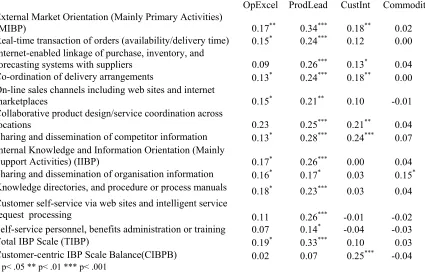
Table 3 Internet-enabled Business Practices and Organisational Strategy (n=262-268)
OpExcel ProdLead CustInt Commodity
External Market Orientation (Mainly Primary Activities)
(MIBP) 0.17** 0.34*** 0.18** 0.02
Real-time transaction of orders (availability/delivery time) 0.15* 0.24*** 0.12 0.00
Internet-enabled linkage of purchase, inventory, and
forecasting systems with suppliers 0.09 0.26*** 0.13* 0.04
Co-ordination of delivery arrangements 0.13* 0.24*** 0.18** 0.00
On-line sales channels including web sites and internet
marketplaces 0.15* 0.21** 0.10 -0.01
Collaborative product design/service coordination across
locations 0.23 0.25*** 0.21** 0.04
Sharing and dissemination of competitor information 0.13* 0.28*** 0.24*** 0.07
Internal Knowledge and Information Orientation (Mainly
Support Activities) (IIBP) 0.17* 0.26*** 0.00 0.04
Sharing and dissemination of organisation information 0.16* 0.17* 0.03 0.15*
Knowledge directories, and procedure or process manuals 0.18* 0.23*** 0.03 0.04
Customer self-service via web sites and intelligent service
request processing 0.11 0.26*** -0.01 -0.02
Self-service personnel, benefits administration or training 0.07 0.14* -0.04 -0.03
Total IBP Scale (TIBP) 0.19* 0.33*** 0.10 0.03
Customer-centric IBP Scale Balance(CIBPB) 0.02 0.07 0.25*** -0.04
* p< .05 ** p< .01 *** p< .001
Industry Variables
The full IBIS world database for 2000 (n = 2539) was used to calculate the concentration ratio for each class of sample organisation. A weighted measure was calculated for organisations that were coded only to the sub-division level. As industry concentration increased, due to the size of the companies in the sample, then it is argued that the market monopolist position (MonPos) of the organisation in the study would also increase. Since incumbent monopolists have less incentive to invest in new technology than new entrants (Tripsas 1997) a monopolist position was expected to have a negative correlation with TIBP adoption. The correlation was very weak and only approached significance at a two-tailed level; however, it was in the direction expected (r246 = -0.12 p = .06).
Industry turbulence (InTurb) was calculated using a scale developed by Miller (Lee & Miller 1999). The scales assessed the degree of product obsolescence, the rate of changes in industry marketing practices and technologies and the degree of predictability of customers' demands and competitors' activities. The scale had an acceptable reliability of .70 with the sample of Australian organisations. The correlation was significant and in the direction expected (r246 = 0.34 p< .001).
The log of tangible assets was used to calculate firm size (Size).
Industry turbulence (IndTurb) was measured as the level of uncertainty, that is, the degree of change and unpredictableness in a firm’s competitive market. Uncertainty was measured using a five anchored 7 point Likert scale based on those of Kandwalla (1977) and (Miller 1988). It had a reliability , Cronbach Alpha, of .71
A standard multiple regression analysis was conducted between TIBP score and MonPos, InTurb, Size, Prodlead, OpExcel, Custint and Commodity. Altogether 21% (19% adjusted) of TIBP variation was accounted for by the seven variables (R2 = .211 adj R2 = .188 (F(7,238) = 9.108, p < .001)). The standardized regression weights (Betas) for InTurb, Size, MonPos and Prodlead were significant. Of the 21% (19% adjusted) explained variance, InTurb explained 6.5%, Size and MonPos explained .02% each, with Prodlead explaining about 3.5%. OpExcel, CustInt and Commodity were not significantly related to the TIBP adoption score.
-.200 .742 -.270 .787
-1.308 .518 -.155 -2.522 .012 -.119 -.161 -.145
.291 .065 .272 4.454 .000 .341 .277 .256
.101 .038 .160 2.647 .009 .092 .169 .152
.222 .069 .225 3.214 .001 .309 .204 .185
9.622E-02 .077 .079 1.243 .215 .153 .080 .072
-3.615E-02 .077 -.032 -.471 .638 .121 -.031 -.027
8.269E-02 .059 .082 1.393 .165 .089 .090 .080
(Constant) M onPos InTurb Size ProdLead Op Excel CustInt Commodity M odel
1
B Std. Error Unstandardized
Coefficients
Beta Standardized
Coefficients
t Sig. Zero-order Partial Part
Correlations
As Table 3 illustrated at the zero correlation, there seems to be meaningful variation between strategies and adoption of different internet-enabled business practices. At the scale level Prodlead and OpExcel are both significantly associated with TIBP adoption. All partial correlation coefficients for the three strategies constructs Prodlead, OpExcel, Custint predictors were smaller than their zero level correlations. This was due to their shared covariance. The association between the strategy variables and TIBP adopted also seem to be mediated by firm size and monopolistic position and Industry Turbulence. The two best predictors of IBP use is perception of high industry turbulence and a strong product leadership strategy followed by a low monopoly position. . A firm’s product leadership strategy emphasis explains IBP adoption even after controlling for industry effects.
References
Day, G. S. 1997, “Maintaining the Competitive Edge: Creating and Sustaining Advantages in Dynamic Competitive Environments” in Wharton on dynamic competitive strategy. Eds. G. S. Day, D. J. Reibstein & R. E. Gunther , John Wiley, New York. Ch. 2.
Kaplan, R. S. & Norton, D. P. 2001, The strategy-focused organization : how balanced scorecard companies thrive in the new business environment, Harvard Business School Press, Boston, Mass. Khandwalla, P. N. 1977, The design of organizations, Harcourt Brace Jovanovich, New York.
Lee, J. & Miller, D. 1999, "People matter: commitment to employees, strategy and performance in Korean firms." Strategic Management Journal, vol. 20, no.6, pp. 579-593.
Miller, D. 1988, "Relating Porter's business strategies to environment and structure", Academy of Management Journal, vol. 31, no. 2, pp. 280-309.
Porter, M. E. 1980, Competitive strategy: techniques for analyzing industries and competitors: with a new introduction, Free Press, New York.
Porter, M. E. 2001, "Strategy and the Internet", Harvard Business Review, vol. 79, no.3, pp. 62-79. Prahalad, C. K. & Ramaswamy, V. 2000, "Co-opting Customer Competence", Harvard Business Review, vol. 78,no. 1, pp. 79-88.
Prahalad, C. K. & Ramaswamy, V. 2002, "The Co-Creation Connection", Strategy and Business, Second Quarter, vol.27, pp. 1-12.
Treacy, M. & Wiersema, F. 1995, Discipline of Market Leaders: Choose Your Customers, Narrow Your Focus, Dominate Your Market, Harper Collins Publishers, New York.
Tripsas, M. 1997, "Unraveling the process of creative destruction: complementary assets and incumbent survival in the typesetter industry", Strategic Management Journal, vol. 18(Special Issue), pp. 119-142. Weill, P. & Broadbent, M. 1998, Leveraging the new infrastructure: how market leaders capitalize on information technology, Harvard Business School Press, Boston, Mass.
Acknowledgements
The project was supported by the Australian Research Council, the Business Council of Australia, the Committee for the Economic Development of Australia and IBISWorld. The views expressed in this paper represent those of the authors and not necessarily the views of the collaborative partners.