Figure 1: Three (3)of the possible translations of the sentence”The man gave the woman a book”
in the Tagalog sentence”Nagbigay ng libro sa babae ang lalaki”(The man gave the woman a book). According to Schachter and Otanes (1972) as mentioned in Kroeger (1993),”the sentences include exactly the same components, are equally grammatical, and are identical in meaning”. On the other hand, as briefly explained in Section 3, adverbial and nominal phrases may take pre-verbal position.
For Tagalog sentences, dependency-based syntactic parsing is preferred over phrase-structure based analysis because dependency analysis does not rely on word positions(Tsarfaty et al., 2010), instead, sentence representations are based on links between words, called dependencies.
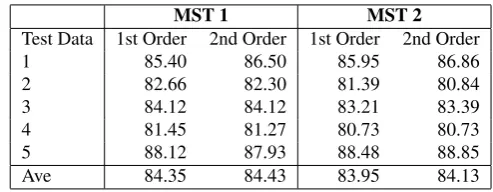
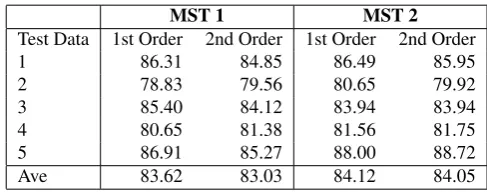
Due to limited resource, this work deals only with unlabeled data. Our corpus are annotated with dependency heads but do not include dependency relations of the word (e.g.NMOD, ROOT). We look into theunlabeled attachment scores(UAS), or the number of correct heads, as well as
complete scores. We also look into the number of sentence heads correctly predicted. The free word order nature of Tagalog may put a verb at the initial position or after a nominal or adverbial element in the sentence.
We briefly introduce dependency parsing in section 2, section 3 briefly explains sentence structures in Tagalog and section 4 discusses the how heads are assigned to words in a sentence. Sections 5 describes the experiment set-up and results. Finally, we discuss some issues found in the parsing results in section 6.
2 Dependency Parsing
Dependency analysis creates a link from a word to its dependents. When two words are con-nected by a dependency relation, one takes the role of the head and the other is thedependent
(Covington, 2001). The straightforwardness of dependency analysis has been used in other NLP tasks such as word alignment (Ma et al., 2008) and semantic role labeling (Hacioglu, 2004). De-pendency parsers developed were either graph-based (McDonald and Pereira, 2006) or transition-based parsers (Nivre and Scholz, 2004; Yamada and Matsumoto, 2003). Syntactic analysis for different languages also use dependency parsers such as in Japanese (Kudo and Matsumoto, 2001; Iwatate et al., 2008), English (Nivre and Scholz, 2004), Chinese (Chen et al., 2009; Yu et al., 2008) to mention some.
The task of dependency-based parsing is to construct structure for an input sentence and iden-tify the syntactic head of the word in the sentence(Nivre et al., 2007). Figure 2 shows a sentence with dependency arcs (below) and its equivalent dependency tree structure(top). Each word in the sentence has one syntactic head except for the root or the head of the sentence. Dependency trees can be projective or non-projective. It is projective if no arcs cross over when drawn above the sentence, while it is non-projective when there are edges crossing each other. Non-projective dependency is a result of parsing languages with more flexible word order such as German and Czech(McDonald and Pereira, 2005).
In this work, we applied the graph-based maximum spanning tree(MST) parser of McDonald and Pereira (2006) on Tagalog language. In MST, a sentence asx=x1· · ·xnis represented as a set of verticesV =v1· · ·vnin a weighted directed graphG. A dependency treeyof a sentence is a set of edges(i, j), where(i, j) ∈ E in the graphG,E ⊆ [1 :n]×[1 :n]and edge(i, j)
exists if there is a dependency from wordxito wordxjin the sentence. Themaximum spanning
treeof graphGis a rooted treey⊆E that maximizes the scoreP(i,j)∈ys(i, j), wheres(i, j)is
the score of a dependency treey. For detailed explanation of MST, please refer to McDonald and Pereira (2006).
3 Tagalog Sentences
3.1 Pre-verbal Position
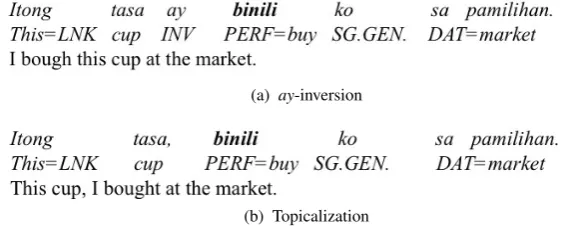
As shown in Fig. 1, Tagalog NP complements take flexible position in the sentence. However, nominal and adverbial elements may take pre-verbal position (Kroeger, 1993) such as the sen-tences in Fig. 3.
(a) ay-inversion
(b) Topicalization
Figure 3: Sentences with pre-verbal elements (Source: Kroeger, 1993, p. 123)
(a) Predicate Adjective
(b) Predicate NP
Figure 4: Examples of sentences with non-verbal predicate (Source: Kroeger, 1993, p. 131)
4a has an adjective”bago”(new) as predicate while sentence 4b has the NP”opisyal sa hukbo”
(officer in the army) as predicate.
Other linguistic explanations of Tagalog structures can be found in (Kroeger, 1993). Nagaya (2007) also explains Tagalog syntax and pragmatics and how they interact in Tagalog clauses.
4 Dependency Heads
From the part-of-speech annotated corpora available, we manually assigned heads to words in the sentences. Deciding”What heads what?”may sound simple, however, often it is not. Nivre (2005) discussed some criteria in distinguishing the head and dependent relations. For Tagalog, we applied ahead-complement,head-modifier,head-specifierrelations principle.
In general, predicate comes before its complements, thus, annotating such sentences is straight-forward, such as in Fig. 5 for the sentence ”Bumili ang lalaki ng isda sa tindahan” (The man bought a fish at the store). The verb bumili (bought, actor focus) heads the complements
lalaki(man),isda(fish) andtindahan(store) andang,ngandsaare dependents of the noun they specify. Head-specifier relation refer to the determiner and noun relation.
Figure 5: Dependency relations between words in the sentence ”Bumili ang lalaki ng isda sa tindahan”
4.1 Modifiers
(a) ”a good kid” (b) ”smart kid ”
Figure 6: Dependencies for modifiers and nouns
Figure 7: Dependency structure for the sentence with ”ay”- inversion
4.2 Sentence Head
In case of a verbal predicate, the head of the VP phrase is the head of the sentence. However, Section 3 explains different positions of verb in a sentence. One pre-verbal position of a sentence is the use of lexemeay. The sentence in Fig. 5 can be written as”Ang lalakiay bumiling isda sa tindahan”as in Fig. 7. The meaning of the sentence did not change; however, the nominative argument ang lalakiis placed before the verbbumili(bought). According to Kroeger (1993),ay
could be treated as a kind of sentence-level auxiliary. In this case, if a sentence is in anay-inversion format,ayis assigned as theheadof the sentence instead of the verb. The nominative argument marked by determiner angbecomes a sibling of the verb. Sentences with non-verbal predicates follow the basic head-modifier rule in case it is adjectival or PP predicates, making the head of the modified phrase the head of the sentence.
5 Experiment
5.1 Data
The sentences used in the experiment were extracted from POS annotated Tagalog corpora con-sisting of novels and short articles. We only chose sentences of lengths L, for4≥L≤20. Longer
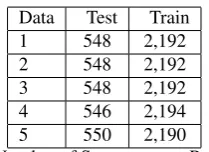
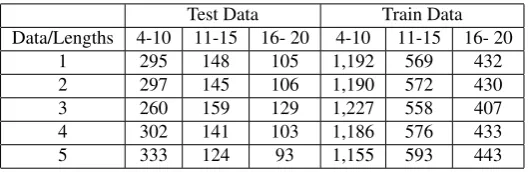
sentences have tendencies of lower accuracies while shorter sentences tend to perform better (Mc-Donald and Nivre, 2008). A total of 2,741 sentences were used for the experiments. The total number of sentences were then divided into 5 parts for a 5-fold cross validation. Table 1 gives the data distribution in the 5-fold cross validation while Table 2 shows the distribution of the Test and Training data by sentence lengths. Compared to other treebanks, Tagalog data set is relatively small; however, this is the start in building Tagalog Dependency Treebank for future work.
Table 1: 5-fold Cross Validation Data Distribution
Data Test Train
1 548 2,192
2 548 2,192
3 548 2,192
4 546 2,194
5 550 2,190
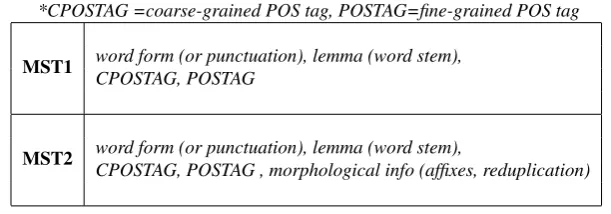
Table 4: Parser Features
*CPOSTAG =coarse-grained POS tag, POSTAG=fine-grained POS tag
MST1 word form (or punctuation), lemma (word stem),CPOSTAG, POSTAG
MST2 word form (or punctuation), lemma (word stem),CPOSTAG, POSTAG , morphological info (affixes, reduplication)
Table 5: Test results using manually assigned POS tags
MST 1 MST 2
Test Data 1st Order 2nd Order 1st Order 2nd Order
UAS Complete UAS Complete UAS Complete UAS Complete
1 0.787 0.253 0.792 0.246 0.788 0.239 0.790 0.239
2 0.785 0.251 0.788 0.261 0.772 0.228 0.775 0.242
3 0.781 0.206 0.783 0.204 0.771 0.201 0.777 0.202
4 0.779 0.222 0.783 0.250 0.779 0.248 0.777 0.231
5 0.755 0.230 0.761 0.246 0.759 0.241 0.755 0.235
Ave 0.777 0.232 0.781* 0.241 0.773 0.231 0.774 0.229
* atα= 0.05, MST1 2nd order UAS is significant
number of correct heads assigned to each word.Completedependency analysis is also computed, or the number of sentences with (all) correct dependencies.
Affixes and reduplication information have helped in deciding the POS tags (Manguilimotan and Matsumoto, 2009), thus we expected the same for parsing. However, this is not the case. In Table 5, results show that 2nd-order MST1 features obtained the highest accuracy in bothUAS
andcompletescores for manually-tagged data compared to the test results using MST2 features. It is to be noted that MST1 features do not include affix and reduplication information while MST2 has these features as described in Table 4. This may imply that correct POS information have helped choose the head of the word and the use of other morphological information have harmed the performance of the parser. On the other hand, the auto-tagged POS data in Table 6 shows different results. The 2nd-order MST2 has the highestUASbut 2nd-order MST1 and 1st-order MST2 has the highest incomplete scores. The error in POS tagging (about 11%) have affected the parsing results, but the morphological information (MST2) may have helped in choosing the correct head of the word.
Table 6: Test results using auto-assigned part-of-speech tags
MST 1 MST 2
Test Data 1st Order 2nd Order 1st Order 2nd Order
UAS Complete UAS Complete UAS Complete UAS Complete
1 0.767 0.213 0.770 0.218 0.767 0.218 0.778 0.211
2 0.756 0.228 0.760 0.233 0.758 0.226 0.756 0.220
3 0.761 0.178 0.761 0.187 0.753 0.187 0.761 0.184
4 0.748 0.217 0.749 0.213 0.759 0.222 0.760 0.215
5 0.733 0.202 0.737 0.219 0.741 0.221 0.740 0.219