Tree-Structured Named Entity Recognition on OCR Data: Analysis, Processing
and Results
Marco Dinarelli, Sophie Rosset
LIMSI-CNRS
B.P. 133, 91403 Orsay Cedex, France [email protected], [email protected]
Abstract
In this paper we deal with named entity detection on data acquired via OCR process on documents dating from 1890. The resulting corpus is very noisy. We perform an analysis to find possible strategies to overcome errors introduced by the OCR process. We propose a preprocessing procedure in three steps to clean data and correct, at least in part, OCR mistakes. The task is made even harder by the complex tree-structure of named entities annotated on data, we solve this problem however by adopting an effective named entity detection system we proposed in previous work. We evaluate our procedure for preprocessing OCR-ized data in two ways: in terms of perplexity and OOV rate of a language model on development and evaluation data, and in terms of the performance of the named entity detection system on the preprocessed data. The preprocessing procedure results to be effective, allowing to improve by a large margin the system we proposed for the official evaluation campaign on Old Press, and allowing to outperform also the best performing system of the evaluation campaign.
Keywords:Named Entity detection, old newspapers, automatic OCR correction
1.
Introduction
In the last few years a lot of data have been acquired with Optical Character Recognition (OCR) techniques with the aim of giving easier access to historical documents via au-tomatic content extraction systems. Unfortunately, OCR-acquired data contain many mistakes due to the OCR tech-nology limitations. This makes development of typical con-tent extraction systems, e.g. named entities or relations be-tween entities, a very challenging task. Models more or less robust to noisy data are already available, nevertheless the level of noise in OCR-ized data is much higher than data used typically for these tasks. This is indeed reflected by systems performances (Claire Grover and Ball, 2008; Miller et al., 2000; Byrne, 2007).
In order to deal with such noisy data, the best solution is to analyse and pre-process them, so that to detect mistakes introduced by OCR process and to find a strategy to correct or, at least, overcome the errors.
While there is a vast literature on content extraction tasks like Named Entity Recognition (NER) (e.g. (Grishman and Sundheim, 1996), (Sekine and Nobata, 2004)), there is much less work on OCR-ized data in general, and on content extraction on OCR acquired data in particular. In this paper we present an analysis of a corpus acquired via OCR process on French historical newspapers. Our work has been done on the data provided for the 2011 Quaero evaluation on Named Entity Recognition in Old Press (Gal-ibert et al., 2012). The annotation made on this corpus followed the Extended Named Entity definition fully de-scribed in (Grouin et al., 2011; Rosset et al., 2011), with the difference that, for each entity realizing-surface containing OCR errors, a special attribute containing the correction is added to the annotation. For example:
<pers.ind correction="Le Moine"> <name.last> LE Moibte. </name.last> </pers.ind>
We propose a three steps procedure to correct or overcome, or at least reduce, mistakes introduced by OCR in a prepro-cessing step. The evaluation of corrections made on input data is overall evaluated with a measure of perplexity of the language model built on training data. Our analysis is sim-ilar to that of (Lopresti, 2008), however in such work only an analysis of the effect of OCR mistakes on results was performed, no strategy to overcome or correct mistakes was applied.
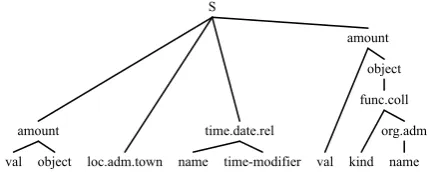
After the preprocessing, data are used to train a Named En-tity Recognition system. The task is made harder also by the fact that the named entities annotated on OCR-ized data have a tree-structure (Grouin et al., 2011).
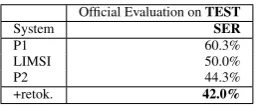
We present comparative results of our system different steps of preprocessing, as well as comparative results with the same system trained and evaluated on manually tran-scribed broadcast data (Dinarelli and Rosset, 2011b), so that to show the gain we achieve with each preprocessing step, and the overall gain. The final results on the evaluation test set outperform the best system of the official evaluation campaign.
The remainder of the paper is organized as follows: in the next section we describe the system used for tree-structured named entity detection, in section 3. we provide an analy-sis and a description of the corpus which are at the baanaly-sis of the preprocessing procedure we propose for correcting OCR-ized data, such procedure is described in section 4.. In section 5. we describe and comment the experiments performed in order to evaluate our preprocessing procedure and the named entity detection system on OCR-ized data. We conclude the paper drawing some conclusions in sec-tion 6..
2.
Tree-Structured Named Entity
Recognition System
Figure 3: A schema of the two steps implemented in our system for tree-structured named entity detection
likeCha,mbors, orCha.mbors. In contrast, many punctu-ation marks are added or substituted between tokens, both as separated tokens or attached to other tokens. This last point introduces difficulties in designing automatic process-ing strategies for cleanprocess-ing the data.
The original corpus provided for the evaluation is made of 231documents containing the OCR-ized text. Each file is organized in blocks of text, corresponding to the text rec-ognized by the OCR system in each input picture (see (Gal-ibert et al., 2012) for a complete description of this aspect). The evaluation data set is made of64documents with the same structure, and for which the reference annotation of named entities was not available during the evaluation cam-paign. We split the original corpus in training and devel-opment data sets, made of173and58documents, respec-tively. As usual, the development data are used to validate and tune our preprocessing procedure and the NER sys-tem parameters. Once the best settings have been fixed, the complete system developed for the evaluation data set (64documents) is trained on the whole corpus (173 + 58 documents).
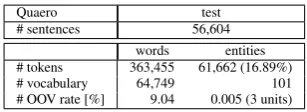
Some statistics for training, development and evaluation data sets are reported in table 1 and 2. In particular the number of tokens and the vocabulary for entities, aim at showing the amount of words that are actually annotated in any entity, they are thus calculated at components level, and after the segmentation applied using BIO markers to create a one-to-one correspondence with words. In order to see complete statistics on the data see (Galibert et al., 2012). Taking a look to such statistics gives immediately an idea of the problems that must be faced when dealing with noisy data such like OCR data: first, the ratio between the size of the vocabulary and the total number of words (130,379 vs. 970,952 for the training set) is very large, meaning that there is a huge number of words occurring very few times; second, the percentage of words annotated with entities (16.72% in the training set) is small, meaning that the annotation is quite sparse indeed; third, the Out Of Vocabulary words (OOV) ratio in terms of words, which is always above9%, is again quite large. All these are conse-quences of the noise introduced by the OCR process, and give evidence of how hard is performing traditional NLP tasks on this kind of data.
4.
Error Correction Procedure
The analysis and considerations of the previous section are at the base of our preprocessing procedure, which is based
Quaero training dev
# sentences 150,991 52,522
words entities words entities
# tokens 970,952 162,353 (16.72%) 330,966 49,670 (15.01%)
# vocabulary 130,379 119 61,818 102
# OOV rate [%] – – 9,59 0.03 (5 units)
Table 1: Statistics on the training and development sets of the Quaero Old Press corpus
Quaero test
# sentences 56,604
words entities # tokens 363,455 61,662 (16.89%)
# vocabulary 64,749 101
# OOV rate [%] 9.04 0.005 (3 units)
Table 2: Statistics on the test set of the Quaero Old Press corpus
on three error correction steps applied iteratively to the original data:
1. re-segmentation of sentences which consists in con-catenating two lines if the first ends with a dash char-acter.
2. re-tokenization of words which consists in removing noise errors, mentioned in previous section, and sepa-rating words from punctuation characters.
3. correction of OCR errorswhich is made by exploiting the reference correction provided for entity surface to-kens, and a manual correction of the most occurring words overall the corpus.
4.1. Re-segmentation of sentences
Sentence segmentation is usually performed based on syn-tactic chunks and punctuation. Given the characteristics of our data, as discussed in previous section, they are both un-feasible in our case. Syntactic chunks would be most prob-ably erroneously detected, while punctuation is not reliable in our data. As we said in previous section, many punctu-ation marks are added or substituted by the OCR process. Thus, without a corrected reference text, it is not trivial to found a strategy for sentence segmentation using traditional approaches, without falling into the problem of erroneous segmentation due to the mistaken syntactic chunks or punc-tuation.
Re-segmentation of sentences consists in our case, in sim-ply concatenating two lines if the first ends with a dash character, which most probably means that the word was truncated in the text to start a new line.
tokens are actually just noise, i.e. they are only made of non-alphanumeric symbols.
4.2. Re-tokenization of words
Re-tokenization of words consists in removing noise er-rors, mentioned in previous section, and separating words from punctuation characters. Note that in removing noise errors there is no risk of removing punctuation since, as mentioned earlier, noise errors never involve punctuation. For the same reason, separating punctuation from words should be beneficial for tokenization, since it creates two new tokens that are actually correct, e.g. like inle,château (“the,castle”) which becomesle , château(“the , castle”), although a comma in that position is likely to be an OCR error.
As an example of noise error correction, fromCha‘mbors we remove the‘character to haveChambors. Beyond the simplicity of the example, it seems reasonable that apply-ing this kind of processapply-ing is safe, since non-alphanumeric characters are not statistically likely to appear in tokens made of alphanumeric characters.
4.3. Correction of OCR Errors
Correction of errors introduced by the OCR process is made exploiting the reference correction provided for en-tity realizing-surface and a manual correction of the most occurring OOV words with respect to a given French dic-tionary.
Concerning the exploitation of the reference correction, given an annotation of an entity like:
<pers.ind correction="Le Moine"> <name.last> LE Moibte. </name.last> </pers.ind>
and ignoring for the moment the mistake of the case in the articleLE, which is not really an issue, weMoibtewith
Moineat the character level with and edit distance align-ment. This allows us to such assubstitution ofnwithbt. In order to perform correction, we apply the opposite op-eration with respect to the error. Using the same example, in order to correct Moibte, we apply a substitution of bt withn. Since when applying corrections to unseen data we don’t really know if the word contains an error or not, we take into account also the context of the mistakes, in par-ticular we use the previous and the following characters. This information is used to construct error patterns and to apply the corresponding corrections to words matching the same pattern. Thus, whenever we found a word presenting the patternibte, we correct such pattern withine, ingnoring character case.
Concerning the manual correction of OOV words with re-spect to a French dictionary, we extracted the word dic-tionary of the whole training data (all231documents, see section 3.), sorted by decreasing order of number of occur-rences. From such dictionary we selected all OOV words, which thus were also sorted by decreasing number of oc-currences. The list being very large (19,696entries), and containing many tokens occurring only once or twice, con-sidering also time constraints, we manually corrected the top300entries. This resulted in correcting almost half of
the total number of OOV words, i.e. the top300most oc-curring OOV words cover almost half of the total occur-rences of OOV words.
Aligning the original mistaken OOV words with their manually-corrected version at character level, we extracted patterns for correction in the same way as described above. All the correction patterns were then applied to unseen data in order to correct OCR mistakes.
5.
Evaluation
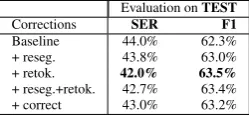
In this section we provide an evaluation of our preprocess-ing procedure and of the Named Entity Recognition system on OCR-ized data, at each step of the preprocessing proce-dure:
1. baselineEvaluation on the original unprocessed data
2. reseg.Evaluation on the data after re-segmentation of sentences
3. retok.Evaluation on the data after re-tokenization
4. reseg.+retok. Evaluation on data after performing both re-segmentation and re-tokenization
5. correct Evaluation on data after performing all the preprocessing steps, resegmentation, retokenization and correction of OCR mistakes
Taking into account the characteristics of our data, in par-ticular the sparseness of the annotation of named entities, as well as the small percentage of reference corrections of entity realizing-surface with respect to the total number of entities, we performed the evaluation of our procedure in terms of the perplexity of a language model on the develop-ment and evaluation data, and in terms of the performance of the Named Entity Recognition system. These two evalu-ations are described in the two following sections.
5.1. Evaluation of the Procedure for Error Correction
In order to evaluate the different preprocessing procedure in terms of perplexity of language model, we extracted text, without entities, from the training, development and test data sets at each steps of the preprocessing procedure. When evaluating on the test set, the whole training cor-pus was actually used (training + development). In order to avoid confusion, we indicate withTRNandtrainthe data used against the development and the test data sets, re-spectively. A language model was then trained on the TRN and train data.
The language model used to evaluate the corrections is trained with the SRI language modeling toolkit (Stolcke, 2002). The evaluation metric is the perplexity of the lan-guage model on a given data set. Given a sentence W = w1, ..., wN, the perplexity of a stochastic language model, represented as a probability distributionp, is defined as:
P P L(W) = 2H(W), H(W) =− N
X
i=1
Cyril Grouin, Sophie Rosset, Pierre Zweigenbaum, Karen Fort, Olivier Galibert, and Ludovic Quintard. 2011. Proposal for an extension or traditional named entities: From guidelines to evaluation, an overview. In Proceed-ings of the Linguistic Annotation Workshop (LAW). Mark Johnson. 1998. Pcfg models of linguistic tree
repre-sentations.Computational Linguistics, 24:613–632. J. Lafferty, A. McCallum, and F. Pereira. 2001.
Condi-tional random fields: Probabilistic models for segment-ing and labelsegment-ing sequence data. In Proceedings of the Eighteenth International Conference on Machine Learn-ing (ICML), pages 282–289, Williamstown, MA, USA, June.
Daniel Lopresti. 2008. Optical character recognition errors and their effects on natural language processing. In Pro-ceedings of the second workshop on Analytics for noisy unstructured text data, AND ’08, pages 9–16, New York, USA. ACM.
John Makhoul, Francis Kubala, Richard Schwartz, and Ralph Weischedel. 1999. Performance measures for in-formation extraction. InProceedings of DARPA Broad-cast News Workshop, pages 249–252.
David Miller, Sean Boisen, Richard Schwartz, Rebecca Stone, and Ralph Weischedel. 2000. Named entity ex-traction from noisy input : Speech and ocr. In Proceed-ings of the sixth conference on Applied natural language processing, pages 316–324.
Sophie Rosset, Olivier Galibert, Guillaume Bernard, Eric Bilinski, and Gilles Adda. 2008. The LIMSI participa-tion to the QAst track. InCLEF 2008 workshop, Aarhus, Denmark, September.
Sophie Rosset, Cyril Grouin, and Pierre Zweigen-baum, 2011. Entités Nommées Structurées : guide d’annotation Quaero. LIMSI–CNRS,
Orsay, France. http://www.quaero.
org/media/files/bibliographie/ quaero-guide-annotation-2011.pdf. Satoshi Sekine and Chikashi Nobata. 2004. Definition,
Dictionaries and Tagger for Extended Named Entity Hi-erarchy. InProceedings of LREC.