International Journal of Scientific Research in Computer Science, Engineering and Information Technology © 2019 IJSRCSEIT | Volume 4 | Issue 4 | ISSN : 2456-3307
Copper and Copper Oxide Nanoparticles : Applications in Catalysis
Mayur Khedkar, Pratik E. P. Michael, Shoeb R. Khan*
Department of Chemistry, Hislop College, Nagpur, Maharashtra, India
ABSTRACT
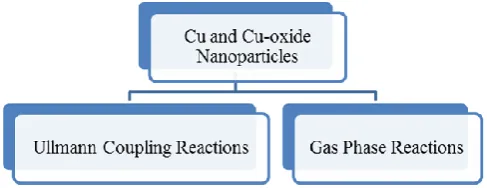
Copper and Copper oxide nanoparticles (Cu NPs) have attracted considerable interest because of their catalytic, optical, mechanical and electrical conducting properties. The earth-abundant and inexpensive copper metal, have generated a great deal of interest specially in the field of catalysis. This paper discusses the uses of Cu and Cu-oxide NPs as catalysts for Ullmann type reactions and Gas Phase Reactions. We believe that this article will provide the necessary background information for further study and applications of Cu-based nanoparticles in catalysis.
Keywords : Copper, Nanoparticles, Ullmann reaction, Gas Phase Reaction
I. INTRODUCTION
Metal and metal oxide nanoparticles exhibit special properties and potential applications. Nanoparticles offer high surface to volume ratio and its size, dispersal, and morphology are the main reason for the novel and enriched properties.1 Among various
metal nanoparticles, inexpensive copper
nanoparticles have attracted considerable interest because of their catalytic, optical, mechanical and electrical conducting properties.2 Cu is relatively
non-toxic to human beings, but is toxic towards many micro-organisms and hence can be used for antimicrobial treatments.3 Because of their variable
oxidation states (Cu0, CuI, CuII, and CuIII), it has a
great scope in photo catalytic degradation of organic pollutants and catalytic organic transformations.4
Cu nanoparticles are initially formed and subsequently oxidized to form highly crystalline and stable Cu2O. Copper (I) oxide (Cu2O) also called
cuprous oxide is a p-type metal oxide semiconductor with promising applications in solar energy
conversion and catalysis.5 In addition to this copper
has high melting and boiling point which makes it thermally stable. Hence, Cu is compatible with high temperature and high pressure chemical reactions,
like vaporphase reactions, microwave-assisted
reactions, continuous flow reactions, and various organic transformations.6
II. METHOD OF PREPARATION of Cu-NPs
Preparation of highly active, selective, stable, robust, and inexpensive Cu nanoparticles is always a challenge in the field of research. The technique for the synthesis of Cu NPs are rely on the same methods that have been used to prepare other metal NPs,7 which mainly include either “bottom-up” or “top
size, and composition of the nanoparticle. While both approaches have their pros and cons, the bottom-up approach has become more prominent as it offers greater scope for controlling the shape and size of the resulting nanomaterial.8
Generally physical and chemical methods have been used to synthesize copper nanoparticles. The most common approach for synthesizing Cu NPs is by creating microemulsions. However, this method requires large amounts of surfactants and organic solvents which increases the cost of production.9
Microwave irradiation,10 aerosol techniques, laser
ablation, and radiolysis are common physical methods to synthesize nanoparticles but the use of
expensive instruments and excessive energy
consumption limits their application.11 Chemical
treatment for the synthesis of Cu NPs involves wet chemical, reverse micelle, biosynthesis and ionic liquid assisted methods.12 In comparison to above
methods, green synthesis of the Cu NPs is more safer and environmental friendly technique. Existing literature reports the use of Terminalia arjuna bark,10
leaf broth of Azadirachta indica,13 Capparious
zeylanica14 and vitis vinifera15 as well as various other
plant extract, were used as reducing and capping agent for the successful synthesis of Cu NPs. The uses of microorganism like Pseudomonas stutzeri bacteria and Aspergillus fugi have also been reported in the literature for the Cu NPs synthesis.16
III. APPLICATIONS OF Cu-NPs IN CATALYSIS
The catalytic activity of Cu NPs depends on composition of the nanoparticles as either the pure copper or the oxides; copper oxide nanoparticles have lower catalytic activity as compared to pure Cu NPs.5
The activity is also affected by the method and condition of its preparation and the size of nanoparticles, smaller the particle size, greater the catalytic activity.17 They are quit striking for this
purpose because they often allow reactions to be
carried out under green and sustainable reaction conditions. This section primarily focused on catalytic applications in Ullmann coupling reaction and gas phase reactions.
IV.ULLMANN COUPLING REACTIONS
Coupling reactions such as Suzuki, Heck and
Sonogashira reactions, and C−S, C−O, C−B, and C−Se
bond formation reactions are some of the important coupling reactions in organic synthesis. Several transition metal catalysts have been developed and employed for these conversions. Cu and Cu-based NPs emerged as an efficient, cost-effective and reliable option for many reported methods, and can be used for green and sustainable chemistry.18
The classical Ullmann reaction involves the conversion of iodobenzene to biaryl compound using various Cu nanoparticles (C-C bond formation reaction) (Figure 1). In 1998, Gedanken pointing out that different particle size of Cu NPs led to different catalytic activity, which could be due to the different surface areas, which decreases with increasing the particle size.19
Figure 1. Classical Ullmann coupling reaction of iodobenzene
formation) of aryl iodide. Many protocols have been developed for Ullmann type O- and N-arylation reactions. Wang and Co-worker reported the use of Nano copper oxide catalyst for the C–O cross-coupling of phenols with aryl halides under ligand-free conditions (Figure 2). The catalyst can be reused for five times under DMSO as solvent and Cs2CO3
and KOH as a suitable bases for the cross coupling reactions with phenyl iodides and bromides, respectively.20
Figure 2. Ullmann C–O cross-coupling of phenols with aryl halides
Y. Kim et al. reported the Ullmann cross-coupling reaction of aryl halides and phenols with a catalytic amount of Cu2O nanocubes as recyclable catalyst and
Cs2CO3 as the base in THF at 150 °C.21 They have
examined a wide variety of substrates with C–I, C–Br, and C–Cl bonds, with various phenol to obtain their respective aryl ethers.
Ullmann-type N-arylation was recently explored by
Pai and Chattopadhyay for arylation of N
-heterocycles using Cu nanoparticles in the presence of K3PO4 as a base (Figure 3).22 The arylation occurs
under mild condition using Cu-NPs and can be used for synthesis of N-arylindole, N-arylimidazoles, N -arylpyrazole, N-arylindazole with aryl iodides in good to excellent yields.
Figure 3. Ullmann-type N-arylation of NH-heterocycles with aryl halides
V. GAS PHASE REACTIONS
The best solvent from Green Chemistry point of view
is no solvent i.e Solvent free reactions.23
Consequently, reactions in the gas phase can be conducted in the complete absence of solvents. In this regards catalysts possessing nanostructured frameworks have major role in such gas-phase reactions by enabling the formation of high interfacial areas between the catalyst and reactants. Thus nanostructured support materials such as zeolites and mesoporous metal oxides extensively used as nanocatalytic species.24 Mechanism wise the
nanoporous materials allow reactants trapped in the pores and hence increased contact time with reacting molecules giving product without use of any solvent. In this context, the Cu-Nano and Cu-O Nano particles are widely used in gas phase reactions like NOx Reduction, CO Oxidation and Water gas Shift reaction.
a. NOx Reduction
NOx is one of the air pollutant generated from burning fuel. Thus its reduction (NOx to N2) has gain
considerable attention in recent past (Figure 4). Cu/zeolite nano structured materials prepared by inserting Cu ions into the zeolite structure using a simple ion-exchange reaction with conventional zeolites can serve as highly efficient catalysts for the selective catalytic reduction of NOx.25
Figure 4. NOx reduction reaction.
b. CO Oxidation
Carbon monoxide (CO) is also one of the very dangerous air pollutant. The Cu-based nanomaterials have been employed in the catalytic oxidation of CO to CO2 (Figure 5).
Figure 5. CO oxidation reaction.
Zhou and Coworker have synthesized CuO nanocrystals with different shapes, including CuO NPs, nanobelts, and nanoplatelets, prepared by precipitation methods.26 All forms of these CuO
nanocrystals were tested as catalysts for the conversion of CO to CO2, revealing a direct
relationship between the catalytic reactivity of the CuO nanostructures and the exposed crystal planes, which vary with the crystal shape. The mesoporous CuO nanowalnut-shaped particles are also explored for the same reaction. Chung and group have reported CuO/CeO2 materials, prepared by co-precipitation of nitrates.27
c. Water-Gas Shift Reaction
H2 is an important gas in the chemical industry and
also used as fuel. The water-gas shift (WGS) reaction is an attractive approach for H2 production.28 This
transformation could be performed using oxide-supported Cu nanomaterials, in which intense synergistic effects between Cu and the oxide support have been observed (Figure 6).
Figure 6. General representation of Water gas shift reaction catalysed by Cu-Nano particles.
Tang et al. explored the WGS reaction over a binary model Cu/ZrO2. Successively Cu/ZnO/Al2O3 and oxide NPs in catalysis. The Cu-NPs are efficient and multipurpose catalysts that can be used to promote a wide range of organic transformation that go well beyond their traditional roles as metal catalysts. Various diaryl ethers and N-substituted heterocyclic compounds can be effectively prepared by Ullmann-type N-arylation and O-arylation respectively. We further discussed the role of Cu-NPs in gas phase reactions like NOx Reduction, CO Oxidation and Water gas Shift reaction. We believe that this review will serve to stimulate research in the field of Cu nanocatalysis and material science.
VII. REFERENCES
[1]. E. Roduner, Chem. Soc. Rev. 2006, 35, 583.
[2]. G. Evano, N. Blanchard, M. Toumi, Chem. Rev.
2008, 108, 3054−3131.
[3]. N. M. Zain; A. G. F. Stapley; G. Shama, Carbohydrate Polymers, 112, 2014, 195-202. [4]. M. B. Gawande, A. Goswami, F. Felpin, T.
Asefa, X. Huang, R. Silva, X. Zou, R. Zboril, R.
S. Varma, Chem. Rev. 2016, 116, 3722−3811.
[5]. M. Yin, C. Wu, Y. Lou, C. Burda, J. T.
Koberstein, Y. Zhu, S. O’Brien, J. Am. Chem.
Soc. 2005, 127, 9506-9511.
[6]. R. Rupanwal, A. Kulshrestha, N. Singh, N. Sahni, M. Shujauddin, R. Khare, J. Pandey,
International Journal of Scientific &
Engineering Research, 2017, 8, 1479-1496.
[7]. A. Umer, S. Naveed, N. Ramzan, M. S. Rafique,
[8]. D. Mijatovic, J. C. T. Eijkel, A. V. D. Berg, Technologies for Nanofluidic Systems: Top-Down vs Bottom-Up-A Review. Lab Chip 2005,
5, 492−500.
[9]. S. Pal, U. Jana, P. K. Manna, G. P. Mohanta, R. Manavalan, Journal of Applied Pharmaceutical Science, 2011, 01 (06), 228-234.
[10]. S. Yallappa, , J. Manjanna, M. A. Sindhe, N. D. Satyanarayan, S. N. Pramod, K. Nagaraja. Spectrochimica Acta Part A: Molecular and Biomolecular Spectroscopy, 2013, 110, 108–15. [11]. K. N. Thakkar, S. S. Mhatre, R. Y. Parikh.
Nanomedicine: Nanotechnology, Biology and Medicine, 2010, 6 (2), 257–262.
[12]. N. Ojha, G. V. Zyryanov, A. Majee, V. N. Charushin, O. N. Chupakhin, S. Santra,
Coordination Chemistry Reviews, 2017, 353, 1–
57.
[13]. N. Nagar, V. Devra, Materials Chemistry and Physics, 2018, 213, 44-51.
[14]. K. Saranyaadevi, V. Subha, R.S.E. Ravindran, S. Renganathan, Int. J. Chem. Tech. Res. 2014, 6 (10) 4533-4541.
[15]. J.K.V.M. Angrasan, R. Subbaiya, Int. J. Curr. Microbiol. App. Sci. 2014, 3 (9) 768-774.
[16]. M. I. Din, R. Rehan, Analytical Letters, 2017, 50:1, 50-62.
[17]. M. Samim, N. K. Kaushik, A. Maitra, Bull. Mater. Sci., 2007, 30, 535–540.
[18]. C. Sambiagio, S. P. Marsden, A. J. Blackera, P. C. McGowan, Chem. Soc. Rev., 2014, 43, 3525-3550.
[19]. N. A. Dhas, C. P. Raj, A. Gedanken, Chem. Mater. 1998, 10, 1446-1452.
[20]. J. Zhang, Z. Zhang, Y. Wang, X. Zheng, Z. Wang, Eur. J. Org. Chem. 2008, 5112–5116. [21]. J. Y. Kim, J. C. Park, A. Kim, A. Y. Kim, H. J.
Lee, H. Song, K. H. Park, Eur. J. Inorg. Chem. 2009, 4219–4223.
[22]. G. Paia, A. P.Chattopadhyay, Tetrahedron
Letters, 2016, 57, 140-3145.
[23]. G. G. Jernigan, G. A. Somorjai, J. Catal. 1994,
147, 567−577.
[24]. R. Silva, A. V. Biradar, L. Fabris, T. Asefa, J.
Phys. Chem. C 2011, 115, 22810−22817.
[25]. S. Brandenberger, O. Krocher, A. Tissler, R. Althoff, Catal. Rev.: Sci. Eng. 2008, 50,
492−531.
[26]. K. B. Zhou, R. P. Wang, B. Q. Xu, Y. D. Li,
Nanotechnology 2006, 17, 3939−3943.
[27]. L. C. Chung, C.T. Yeh, Catal. Commun. 2008, 9,
670−674.
[28]. C. Ratnasamy, J. P. Wagner, Catal. Rev.: Sci.
Eng. 2009, 51, 325−440.
[29]. Q. L Tang, Z.P. Liu, J. Phys. Chem. C 2010, 114,