A Rough Set Formalization of Quantitative Evaluation with Ambiguity
Patrick Paroubek
∗and Xavier Tannier
∗†∗LIMSI-CNRS, 91403 Orsay, France †Univ. Paris-Sud, 91403 Orsay, France
{pap,xtannier}@limsi.fr
Abstract
In this paper, we present the founding elements of a formal model of the evaluation paradigm in natural language processing. We propose an abstract model of objective quantitative evaluation based on rough sets, as well as the notion of potential performance space for describing the performance variations corresponding to the ambiguity present in hypothesis data produced by a computer program, when comparing it to the reference data created by humans. A formal model of the evaluation paradigm will be useful for comparing evaluations protocols, investigating evaluation constraint relaxation and getting a better understanding of the evaluation paradigm, provided it is general enough to be able to represent any natural language processing task.
Keywords:evaluation, formalization, rough sets
1.
A Set Model of Objective Quantitative
Evaluation
To our knowledge, no formal framework exists for studying the evaluation paradigm; we propose to lay the foundation for such model based on the mathematical notion of “rough sets”(Skowron et al., 2002), particularly adapted for reason-ing about ambiguity in natural language. Natural language is ambiguous for a large part and an extra amount of am-biguity is brought by the evaluation paradigm where, a ref-erence data, created by humans, is compared to hypothesis data, yielded by a computer program.
We propose to consider the notion of potential perfor-mance space, for describing the perforperfor-mance variations cor-responding to the ambiguity present in the hypothesis data. A formal model of the evaluation paradigm will be useful for comparing evaluations protocols, investigating evalua-tion constraint relaxaevalua-tion and getting a better understanding of the evaluation paradigm, provided it is general enough to be able to represent any natural language processing task. With the evaluation paradigm, a computer output is com-pared to a reference dataset of human origin. The underly-ing hypothesis is that similarity of the two datasets of suf-ficiently large size should be considered as a proof that the computer computer model is a faithfull emulation of the human processing.
In our terminology, the “control task” is the information processing task whose performance we wish to assess, when done by some computer system. For instance in In-formation Retrieval (IR), given a set of documents and a query, the control task is the identification of the documents which are relevant with respect to the given query.
Control tasks can vary greatly in nature. Identifying ob-jects or classes of obob-jects present in the input data is one of the most straighforward control task, e.g. POS tagging (Paroubek, 2007) or named entity recognition (Nadeau and Sekine, 2007). In some cases, the instances of objects of in-terest are identified and the systems has only to identify the class they belong to (e.g.IR or Word Sense Disambiguation (Edmonds and Kilgarriff, 2002)). But the control task can also be much more complex in nature, for instance when the aim is to identify objects, primitive relations holding
between objects and higher level relations holding between primitive relations, like for parsing (de la Clergerie et al., 2008), anaphoric resolution (Vilain et al., 1995) or image recognition (Unnikrishnan et al., 2007). In other cases, we are only interested by the final product of the transforma-tion of the objects and relatransforma-tions identified in the input data, like in Machine Translation.
A control task is thus a process that links test data units produced by a segmentation of the input data to output data units, possibly organized in a hierarchy. Output units can be seen as annotating the input units, which caused their cre-ation what ever their nature,e.g. in a translation task from French to English, “The” can be considered as annotating “Le” in the sentence “Le restaurant est ferm´e” (The
restau-rant is closed.) and in a parsing task, the syntactic
depen-dencies can be considered as annotating the input sentence. Assuming that the test data is the result of a segmentation process of an input medium (character stream, speech sig-nal, etc.) represented byS ={si/0 ≤i ≤N ∈N}, and the set of annotation labels byA, themlayers of relations graphsρresulting from the annotation process can be ex-pressed as follows1:
ρ=
m
∪
j=1
ρj, m∈N
ρ1=
q
∪
k=1
{rl/l∈N, rl⊂ P(Sk×A)}
ρi= u
∪
k=1
{r⊂ P((S∪ρx1)×(S∪ρx2)
· · · ×(S∪ρxk)×A),1≤xk < i}
(1)
ρ0represents the first layer of annotation of the test data and
ρithe successive layers of annotations, which can address other annotations from any layer.
Note that while the annotation graph model from LDC (Bird and Liberman, 2000) encodes the direct relationship between annotations and events from the various linear in-put streams, we represent in our model the potentially re-cursive structure of the annotations.
1
re-information associated to the definition of a set2. A rough
set can be numerically characterized with theaccuracy of
approximationcoefficient (Komorowski et al., 1999).
Let A = (U;A)be aninformation system(i.e. a subset of U ×A) and letB ⊆ A andX ⊆ U. X can be ap-proximated with the information contained inB, by con-structing the B-lower and B-upper approximations ofX :
BX andBX respectively, whereBX ={x/[x]B ⊆X}
andBX = {x/[x]B ∩X 6= ∅}3. With this notations the
accuracy approximation coefficient is:
αB(X) = |
BX|
|BX| (7)
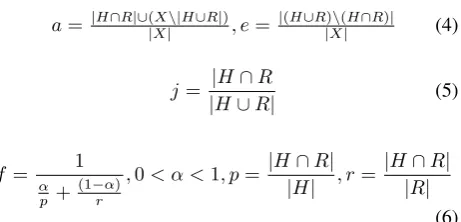
H andRdefined in section 1. areinformation systems. In the evaluation process, if we consider an equivalence re-lation ≈ instead of of an equality relation, H (and R if it contains ambiguous annotations) approximate the theo-retical hypothesis (and reference) sets with respect to the equivalence criteria≈. The accuracy approximation coeffi-cient can serve to quantify the amount of change induced in the performance space by using an equivalence relation in-stead of an equality relation (see section 3.2.). For instance, among all the previous measures of section 2., if we con-sider precisionp(cf eq. 6), its valuep≈will be as follows:
p.(1−α≈(H))≤p≈≤p.(1 +α≈(H)) (8)
H H H H H H
fn
X R
tp tn
tp tp
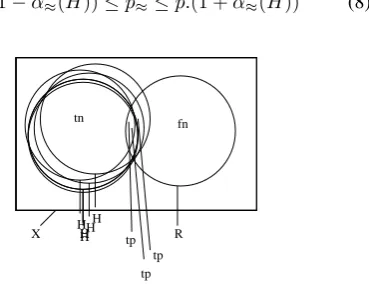
Figure 2: Rough sets and quantitative evaluation with am-biguity.
3.1. Measuring Ambiguity
A corollary to introducing ambiguity in the evaluation pro-tocol is the wish to gauge how much a systems uses this possibility to improve its performance value. One will want to know whether the system has clearly identified problem-atic annotation cases, difficult even for human annotators or whether its simply tried to improve its chances at find-ing a correct answer by providfind-ing a larger number of an-swers. This can be evaluated by the measure ofdecision, proposed (Paroubek et al., 1998) to assess the level of an-notation disambiguation, by measuring the average number of tokens completely disambiguated. The resulting value
2See http://chc60.fgcu.edu/EN/HistoryDetail.aspx?c=12 for
history and tutorials on rough sets
3
[x]Bdenotes the equivalence class of the B-indicernibility
re-lation for elementx,i.e.the subset ofXmade of all the elements indiscernible from x according to the attribute setB.
is located in the interval[0,1]and provides a uniform mea-surement for both complete and partial tagging disambigua-tion schemas (Pak and Paroubek, 2010).
In more general terms,decisionDis then the ratio between the number of all the equivalence classes of size1, over the total number of equivalence classes defined by the equiva-lence relation over the annotations.
D=|{x/|[x]≈|= 1}|
|H/≈| =
|{x/[x]≈={x}}|
|H/≈|
The decisionmeasure will give us the means to quantify
how far we are from a fully deterministic system.
3.2. The Potential Performance Space
Relaxing the task constraints or modifying the reward func-tion (or both) necessarily leads to modificafunc-tion of the mea-surements takens, and if ambiguity annotation is allowed, the hypothesis data may contain ambiguous annotations, it is then legitimate to ask oneself, what would have become of the performance of the considered systems, if it had at-tempted full disambiguation, what is the limit performance range defined by failures or successes at disambiguating the remaining (partially) undecided annotations. In that con-text, the possible variation range of the evaluation parame-ters defines what we call thepotential performance space. The measure spaceSM is the structure formed by the col-lection of vectors constituted by the different measures of an evaluation process. For example, the combined preci-sion/recall values form a two-dimensional euclidian space. Inside this spaceSM, the potential performance space PPS, is the subspace formed by the collection of possibly acces-sible vectors, with respect to the given evaluation protocol defined by its equivalence relation.
The amount of variability in performance associated with partially disambiguated hypothesis data can be quantified with the accuracy approximation coefficient defined in for-mula 7 of section 3. for rough sets. The set of true positive hypothesis items is then approximated by its lower and up-per approximations as defined by the reference items and the ambiguity resolution applied to ambiguous hypothesis items (see figure 2).
αR(tp) = |Rtp|
|Rtp| (9)
Figure 3: Evolution of Potential Performance Space (PPS) of precision measure according to decisions.
potential performance limitations or improvements. In par-ticular, information about the boundaries of the space, what is the best or worse performance, reachable from a given measure point if ambiguity would be fully resolved.
Reward function Depending of its aims, an evaluation
can be more or less strongly related to a particular applica-tive context. As a results, it is sometimes needed to bias the performance measures to take into account some speci-ficity of the applicative context, for instance privileging re-call over precision in security-oriented information retrieval by acting on the value of theβparameter of the F-measure. This is a notion ofreward functionin the process of evalua-tion performance computaevalua-tion. While the equality or equiv-alence relation defined by the protocol tells us which items are correct annotation items, the reward function tells us what bonus do we get by finding the correct annotation, or finding an annotation that is a “reasonable” approximation of the correct one. Both modifying the equality relation or the reward function has an impact on the performances measured, but the implications are different. While the
equality functionis a technology-oriented (intrinsic
evalua-tion), the reward function is a user-oriented (extrinsic eval-uation). It has no theoretical link with the operational se-mantics of the control task or its representation. Changing the reward function does not change the comparisons re-sults between reference and hypothesis data.
4.
Applying the Model to Real Evaluations
In this section, we show that our model can represent well known evaluation protocols from different domains of nat-ural language processing (Paroubek et al., 2007).4.1. Classification
For this kind of task, the purpose is to segment a data set in order to highlight parts of this set that belong to specific classes (predefined or not), and possibly to provide rela-tions existing between these parts.
Dn D2 D3
D8 D9 D7
D4 D5
D6 D10
D1
... ...
Dn D2 D3
D8 D9 D7
D4 D5
D6 D10
D1
... ...
. . .
Q1 Q2 . . .
D
D
non−relevant document
relevant document
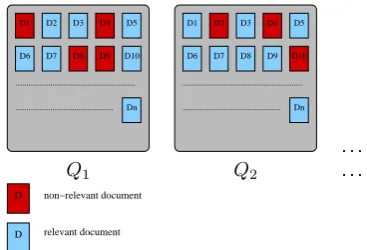
Figure 4: Classification of the set of documents among two parts (relevant and non relevant) for each query: forQ1, D1, D4, D8 and D9 are relevant; forQ2, D2, D4 and D10 are relevant.
We take the examples of information retrieval, named entity recognition, temporal annotation and parsing.
Information retrieval Classical information retrieval
aims at finding full documents that are relevant to a given queryQ. The document collectionCis the input data (the retrieval unit is the entire document level). Here we con-sider a simplified instance of the general model presented in the previous section, in a sense that the segmentation of the test data into units to be annotated is provided, it is made of the documents themselves, see Figure 4.
This is a classification task, since the aim is to produce a partition of the collection, between relevant and non-relevant documents, with respect to the query. In practice the evaluation data contains several queries, but since in general they are considered independent of each other, the evaluation resolves to a series of single query evaluation. In other words, variables introduced in Section 1. are in-stanciated in the following way:
S : the structuration corresponds to the exist-ing document boundaries,
A : a set of two labels: relevant for the query
ornot relevant for the query
ρ=ρ1 : a singleton made of one unary relation that
tag the relevance of each documents.
Named entity recognition The following steps can be
identified concerning named entity recognition:
1. Identification: finding which data units of the test set need to be annotated.
2. Categorization: finding the appropriate relation to an-notate a data unit from the test set,e.g. tagging word sequences with labels for locations, persons, organisa-tions, etc.
Element of comparison between the passage annotation scheme and PARC, SD and GR, three other syntactic an-notation schemes used for English parsing evaluation are provided in (Paroubek et al., 2009).
The PASSAGE annotation model:
S : the segmentation into words units of the in-put stream
A : the set of chunk and relation labels
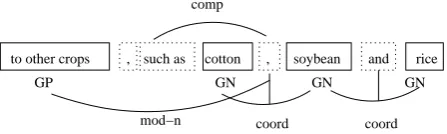
ρ1 : the relations between words and their chunk labels, or relations for which at least one argument is word (e.g. coordinating relation for whose coodinating conjunction argument is always a single word not in-cluded in any chunk, see Figure 8)
ρ2 : the relations linking chunks only
ρ : ρ1∪ρ2
4.2. Transduction
Lastly, a very different type of applications is the set of ap-plications producing an output that is not an enrichment (or annotation) of an existing test set, but a new object ob-tained by transformation from or in response to another object. Examples of transduction applications are: ma-chine translation, speech synthesis, automatic summariza-tion, language generation (Koller et al., 2010) or machine dialogue.
For all these examples,Tis a document seen as a sequence of characters to be either translated, synthetized, summa-rized, etc. S is the existing segmentation into language units, whileAis the result of the operation: the translation of a language unit into the target language, the synthesis of a language unit into sound generation instructions, etc. R
is the set of links between language units in the test set and elements fromA.
S : the segmentation of the input stream into transduction source units
A : the corresponding transduction target units labels
ρ=ρ1 : relations between source and target units Note that we can consider multilingual alignment tasks (chuang Chiao et al., 2006) to be degenerate cases of trans-duction task, where the target labels are provided as input data and the systems under test need only to identify the relation between source and target units.
5.
Conclusion
We have first proposed a model of objective quantitative evaluation for natural language processing based on rough sets, distinguishing the annotation equivalence relation (in-trinsic criteria) and the reward function (ex(in-trinsic criteria), second we presented the notion of potential performance space to describe the effect that resolving the remaining ambiguity of the hypothesis data would have on the per-formance range. We have also shown that the accuracy approximation coefficient used to quantifies the level of “roughness” of a rough set can be used to describe the amount of variability of the potential performance space corresponding to the ambiguity present in the hypothesis data. Our future work will concern using and refining our model in order to obtain, from the formal representation,
results that help compare, design and validate evaluation protocols.
6.
References
Steven Bird and Mark Liberman. 2000. A formal frame-work for linguistic annotation. Speech Communication, 33:23–60.
Yun chuang Chiao, Olivier Kraif, Dominique Laurent, Thi Minh, Huyen Nguyen, Nasredine Semmar, Franois Stuck, Jean V´eronis, and Wajdi Zaghouani. 2006. Eval-uation of multilingual text alignment systems: the ar-cade ii project. InProceedings of the Fifth LREC, pages 1975–1979, Genoa, Italy, may.
Philip Edmonds and Adam Kilgarriff. 2002. Introduction to the special issue on evaluating word sense disambigua-tion systems. Nat. Lang. Eng., 8:279–291, December. Alexander Koller, Kristina Striegnitz, Andrew Gargett,
Donna Byron, Justine Cassell, Robert Dale, Johanna Moore, and Jon Oberlander. 2010. Report on the sec-ond nlg challenge on generating instructions in vir-tual environments (give-2). In Proceedings of the In-ternational Natural Language Generation Conference
(INLG), Dublin.
Jan Komorowski, Lech Polkowski, and Andrzej Skowron. 1999. Rough sets: A tutorial. In Lec-ture Notes of the 11th European Summer School
in Logic Language and Information (ESSLLI).
http://folli.loria.fr/cds/1999/esslli99/courses/skowron.html. Vincent Labatut and Hocine Cherifi. 2011. Accuracy
mea-sures for the comparison of classifiers. In Proceedings of the 5th International Conference on Information
Tech-nology, Amman, Jordan, May.
Bernardo Magnini, Amedeo Cappelli, Fabio Tamburini, Cristina Bosco, Alessandro Mazzei, Vincenzo Lom-bardo, Francesca Bertagna, Nicoletta Calzolari, Anto-nio Toral, Valentina Bartalesi Lenzi, Rachele Sprug-noli, and Manuela Speranza. 2008. Evaluation of nat-ural language tools for italian: Evalita 2007. In Nico-letta Calzolari (Conference Chair), Khalid Choukri, Bente Maegaard, Joseph Mariani, Jan Odjik, Stelios Piperidis, and Daniel Tapias, editors,Proceedings of the
Sixth LREC, Marrakech, Morocco, may. European
Lan-guage Resources Association (ELRA). http://www.lrec-conf.org/proceedings/lrec2008/.
C. D. Manning and H. Sch¨utze. 2002. Foundation of
Sta-tistical Natural Language Processing. Massachusetts
in-stitute of Technology Press, 5`eme edition.
M. Marcus, B. Santorini, and M.A. Marcinkiewicz. 1993. Building a large annotated corpus of english: the penn treebank. Computational Linguistics, 19.
E. de la Clergerie, O. Hamon, D. Mostefa, C. Ayache, P. Paroubek, and A. Vilnat. 2008. Passage: from french parser evaluation to large sized treebank. In ELRA,
edi-tor,In proceedings of the sixth LREC, Marrakech,
Mor-roco, May.
David Nadeau and Satoshi Sekine. 2007. A sur-vey of named entity recognition and classification.
Journal of Linguisticae Investigationes, 30(1). URL
Alexander Pak and Patrick Paroubek. 2010. Twitter as a corpus for sentiment analysis and opinion mining. In Nicoletta Calzolari (Conference Chair), Khalid Choukri, Bente Maegaard, Joseph Mariani, Jan Odijk, Stelios Piperidis, Mike Rosner, and Daniel Tapias, editors,
Pro-ceedings of the Seventh LREC, pages 1320–1326,
Val-letta, Malta, may. European Language Resources Asso-ciation (ELRA).
Patrick Paroubek, Josette Lecomte, Gilles Adda, Joseph Mariani, and Martin Rajman. 1998. The grace french part-of-speech tagging evaluation task. InProceedings
of the First LREC, pages 433–441, Granada, Spain, May.
ELDA.
Patrick Paroubek, Isabelle Robba, Anne Vilnat, and Chris-telle Ayache. 2006. Data, annotations and measures in easy - the evaluation campaign for parsers of french. In
proceedings of the fifth LREC, pages 315–320, Genoa,
Italy, May. ELRA.
Patrick Paroubek, St´ephane Chaudiron, and Lynette Hirschman. 2007. Principles of evaluation in natu-ral language processing. Traitement Automatique des
Langues (TAL), 48(1):7–31.
Patrick Paroubek, Eric de la Clergerie, Sylvain Loiseau, Anne Vilnat, and Gil Francopoulo. 2009. The passage syntactic representation. In Proceedings of the 7th In-ternational Workshop on Treebanks and Linguistic
The-ories, pages 91–102, Gr¨oningen, January. Netherlands
Graduate Schools of Linguistics (LOT).
Patrick Paroubek, 2007.Evaluation of Text and Speech Sys-tems, volume 36 ofText, Speech and Language
Tech-nology, chapter Evaluating Part Of Speech Tagging and
Parsing, pages 97–116. Kluwer Academic Publisher. ISBN-10: 1-4020-5815-2, ISBN-13: 978-1-4020-5815-8.
Zdzisław Pawlak. 1982. Rough sets.International Journal
of Information and Computer Sciences, 11(5):341–356.
Philip Resnik and David Yarowsky. 2000. Distinguish-ing systems and distDistinguish-inguishDistinguish-ing senses: New evaluation methods for word sense disambiguation. Natural
Lan-guage Engineering, 5(3):113–133. Cambridge
Univer-sity Press.
Sylvain Schmitz and Joseph Le Roux. 2008. Feature Uni-fication in TAG Derivation Trees. In Claire Gardent and Anoop Sarkar, editors, TAG+9, pages pages 141–148, T¨ubingen, Allemagne. 12 pages, 4 figures.
Andrzej Skowron, Jan Komorowski, Zdzislaw Pawlak, and Lech Polkowski, 2002. Rough sets perspective on
data and knowledge, pages 134–149. Oxford University
Press, Inc., New York, NY, USA.
R. Unnikrishnan, C. Pantofaru, and M. Hebert. 2007. To-ward objective evaluation of image segmentation algo-rithms. IEEE Transactions on Pattern Analysis and
Ma-chine Intelligence, 29(6):929–944, June.
Marc Verhagen, Robert Gaizauskas, Franck Schilder, Mark Hepple, Graham Katz, and James Pustejovsky. 2007. SemEval-2007 - 15: TempEval Temporal Relation Iden-tification. InProceedings of SemEval workshop at ACL 2007, Prague, Czech Republic, June. ACLP.
Marc Vilain, John Burger, John Aberdeen, Dennis
Con-nolly, and Lynette Hirschman. 1995. A model-theoretic coreference scoring scheme. InMUC6 ’95: Proceedings
of the 6th conference on Message understanding, pages
45–52, Columbia, Maryland, USA. ACL.
Anne Vilnat, Patrick Paroubek, Eric Villemonte de la Clerg-erie, Gil Francopoulo, and Marie-Laure Gu´enot. 2010. Passage syntactic representation: a minimal common ground for evaluation. In Nicoletta Calzolari (Confer-ence Chair), Khalid Choukri, Bente Maegaard, Joseph Mariani, Jan Odijk, Stelios Piperidis, Mike Rosner, and Daniel Tapias, editors,Proceedings of the Seventh LREC, Valletta, Malta, May. European Language Resources As-sociation (ELRA).
Rebecca Watson, John Carroll, and Ted Briscoe. 2005. Efficient extraction of grammatical relations. In Pro-ceedings of the Ninth International Workshop on Parsing
Technologies (IWPT), pages 160–170, Vancouver,