Computational Linguistics and Chinese Language Processing
Vol. 17, No. 1, March 2012, pp. 65-86 65 © The Association for Computational Linguistics and Chinese Language Processing
A Comparative Study of Methods for Topic Modeling in
Spoken Document Retrieval
Shih-Hsiang Lin
+,∗and Berlin Chen
#,∗Abstract
Topic modeling for information retrieval (IR) has attracted significant attention and demonstrated good performance in a wide variety of tasks over the years. In this paper, we first present a comprehensive comparison of various topic modeling approaches, including the so-called document topic models (DTM) and word topic models (WTM), for Chinese spoken document retrieval (SDR). Moreover, different granularities of index features, including words, subword units, and their combinations, are also exploited to work in conjunction with various extensions of topic modeling presented in this paper, so as to alleviate SDR performance degradation caused by speech recognition errors. All of the experiments were performed on the TDT Chinese collection.
Keywords: Information Retrieval, Document Topic Models, Word Topic Models,
Spoken Document Retrieval.
1.
Introduction
Due to the advances in computer technology and the proliferation of Internet activity, huge volumes of multimedia data, such as text files, broadcast radio and television programs, lectures, and digital archives, are continuously growing and filling networks. Development of intelligent and efficient information retrieval techniques to provide people with easy access to all kinds of information is now becoming more and more emphasized. Meanwhile, with the rapid evolution of speech recognition technology, substantial efforts and very encouraging results on spoken document retrieval (SDR) also have been demonstrated in the recent past. Although most retrieval systems participating in the TREC-SDR evaluations claimed that speech recognition errors do not seem to cause much adverse effect on SDR performance
+ Voice Division Research Center, Delta Electronics E-mail: [email protected]
# Department of Computer Science & Information Engineering, National Taiwan Normal University E-mail: [email protected]
66 Shih-Hsiang Lin and Berlin Chen
when merely using imperfect recognition transcripts derived from one-best recognition results from a speech recognizer (Garofolo et al., 2000; Chelba et al., 2008), this is probably attributed to the fact that the TREC-style test queries tend to be quite long and contain different words describing similar concepts that can help the queries match their relevant spoken documents. Furthermore, a query word (or phrase) may occur repeatedly (more than once) within a relevant spoken document, and it is not always the case that all of the occurrences of the word would be misrecognized totally as other words. We, however, believe that SDR would still present a challenge in situations where the queries are relatively short and there exists severe deviation in word usage between the queries and spoken documents.
Among several promising information retrieval approaches, statistical language modeling (LM) (Ponte & Croft, 1998), aiming to capture the regularity in human natural language and quantify the acceptability of a given word sequence, has continuously been a focus of active research in the last decade (Miller et al., 1999; Hofmann, 2001). The basic idea is that each individual document in the collection is treated as a probabilistic language model for generating a given query. A document is deemed to be relevant to a query if its corresponding document language model generates the query with higher likelihood. In practice, the relevance measure for the LM approach is usually computed by two different matching strategies, namely, literal term matching and concept matching (Lee & Chen, 2005). The unigram language model (ULM) is perhaps the most representative example for literal term matching strategy (Miller et al., 1999). In the ULM approach, each document is interpreted as a generative model composed of a mixture of unigram (multinomial) distributions for observing a query, while the query is regarded as observations, expressed as a sequence of indexing words (or terms).
A Comparative Study of Methods for Topic Modeling in 67 Spoken Document Retrieval
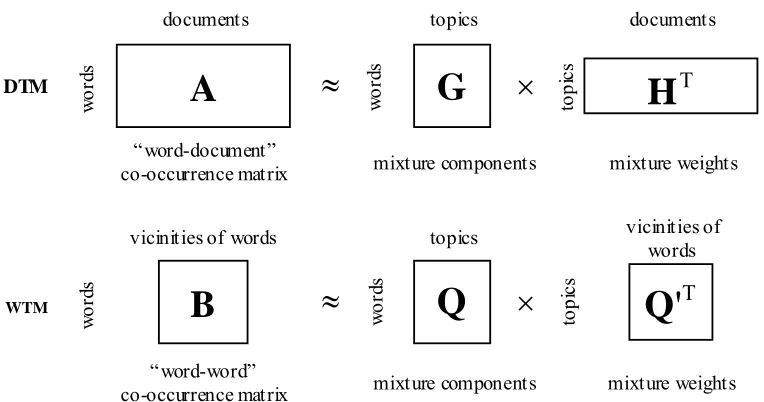
allocation model (PAM) and correlated topic model (CTM), do not necessarily offer further retrieval benefits (Zhai, 2008; Blei & Lafferty, 2009). On the other hand, rather than treating each document as a whole as a document topic model (DTM), such as PLSA and LDA, the word topic model (WTM) (Chen, 2009) attempts to discover the long-span co-occurrence dependence “between words” through a set of latent topics, while each document in the collection consequently can be represented as a composite WTM model in an efficient way for predicting an observed query. Interested readers can refer to Griffiths et al. (2007), Zhai (2008), and Blei and Lafferty (2009) for a thorough and updated overview of the major topic-based language models that have been successfully developed and applied to various IR tasks.
Although most of the above approaches can be equally applied to both text and spoken documents, the latter presents unique difficulties, such as speech recognition errors, problems posed by spontaneous speech, and redundant information. A straightforward remedy, apart from the conventional approaches target at improving recognition accuracy, is to develop more robust representations of spoken documents for spoken document retrieval (SDR). For example, multiple recognition hypotheses, beyond the top scoring ones, are expected to provide alternative representations for the confusing portions of the spoken documents (Chelba et al., 2008; Chia et al., 2008). Another school of thought attempts to leverage subword units, as well as the combination of words and subword units, for representing the spoken documents, which also has been shown beneficial for SDR. The reason for the fusion of word- and subword-level information is that incorrectly recognized spoken words often include several subword units that are correctly recognized. Hence, the retrieval process based on subword-level representations may take advantage of partial matching (Lin & Chen, 2009).
With the above inspiration in mind, we first compare the structural characteristics of various topic models for Chinese SDR, including PLSA and LDA, as well as WTM. The utility of these models is thoroughly examined using both long and short test queries. Moreover, different granularities of index features, including words, subword units, and their combinations, are also exploited to work in conjunction with various extensions of topic modeling presented in this paper, so as to alleviate SDR performance degradation caused by imperfect recognition transcripts. To our knowledge, there is little literature on leveraging various topic decompositions together with various granularities of index features for topic modeling in SDR.
A Comparative Study of Methods for Topic Modeling in 75 Spoken Document Retrieval
Mandarin Chinese is phonologically compact; an inventory of about 400 base syllables provides full phonological coverage of Mandarin audio if the differences in tones are disregarded. On the other hand, an inventory of about 13,000 characters provides full textual coverage of written Chinese. Each word is composed of one or more characters, and each character is pronounced as a monosyllable and is a morpheme with its own meaning. As a result, new words are generated easily by combining a few characters. Such new words also include many proper nouns, like personal names, organization names, and domain-specific terms. The construction of words from characters is often quite flexible. One phenomenon is that different words describing the same or similar concepts can be constructed of slightly different characters. Another phenomenon is that a longer word can be arbitrarily abbreviated into a shorter word. Moreover, there is a many-to-many mapping between characters and syllables; a foreign word can be translated into different Chinese words based on its pronunciation, while different translations usually have some syllables in common, or may have exactly the same syllables. Statistical evidence also shows that, in the Chinese language, about 91% of the top 5,000 most frequently used polysyllabic words are bi-syllabic, i.e., they are pronounced as a segment of two syllables. Therefore, such syllable segments (or syllable pairs) definitely carry a plurality of linguistic information and make great sense to be used as important index terms.
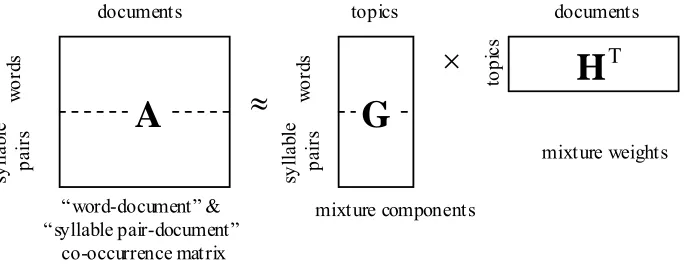
The characteristics of the Chinese language mentioned above lead to some special considerations for SDR. Word-level index features possess more semantic information than syllable-level ones; thus, word-based retrieval enhances the precision. On the other hand, syllable-level index features are more robust against the Chinese word tokenization ambiguity, Chinese homophone ambiguity, open vocabulary problem, and speech recognition errors; therefore, the syllable-level information would enhance the recall. Accordingly, there is good reason to fuse the information obtained from index features of different levels. It has been shown that using syllable pairs as the index terms is very effective for Chinese SDR, and the retrieval performance can be further improved by incorporating the information from word-level index features.
A Comparative Study of Methods for Topic Modeling in 77 Spoken Document Retrieval
recognizer provided Chinese word transcripts for our Mandarin audio collections. To assess the performance level of the recognizer, we spot-checked a fraction of the spoken document collection set (about 40 hours), and obtained error rates of 35.38% (in word), 17.69% (in character), and 13.00% (in syllable). Since Dragon’s lexicon is not available, we augmented the LDC Mandarin Chinese Lexicon with 24,000 words extracted from Dragon’s word recognition output, and used the augmented LDC lexicon (about 51,000 words) to tokenize the manual transcripts for computing error rates. We also used this augmented LDC lexicon to tokenize the text queries in the retrieval experiments.
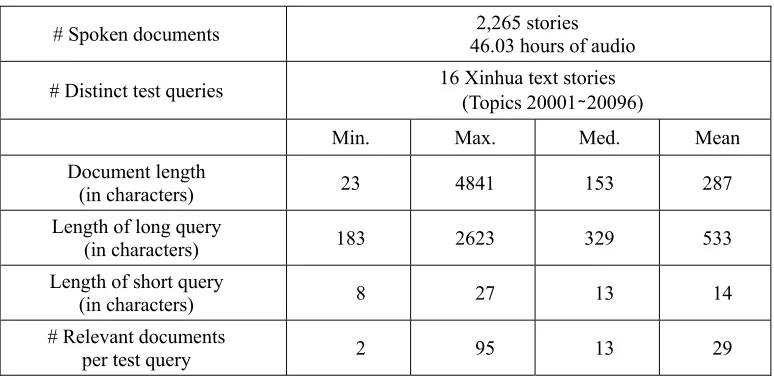
Table 1. Statistics for TDT-2 Collections Used for Spoken Document Retrieval
# Spoken documents 46.03 hours of audio 2,265 stories # Distinct test queries 16 Xinhua text stories (Topics 20001∼20096)
Min. Max. Med. Mean
Document length
(in characters) 23 4841 153 287
Length of long query
(in characters) 183 2623 329 533
Length of short query
(in characters) 8 27 13 14
# Relevant documents
per test query 2 95 13 29
The retrieval results are expressed in terms of non-interpolated mean average precision (mAP) following the TREC evaluation (Harman, 1995), which is computed by the following equation:
1 1 ,
1 1
mAP L Ni ,
i i j i j j L = N = r
= ∑ ∑ (17)
where L is the number of test queries, Ni is the total number of documents that are
relevant to query Qi, and ri j, is the position (rank) of the j-th document that is relevant to
query Qi, counting down from the top of the ranked list.
4.2
Model Implementation
A Comparative Study of Methods for Topic Modeling in 79 Spoken Document Retrieval
5.2
Experiments on DTM and WTM
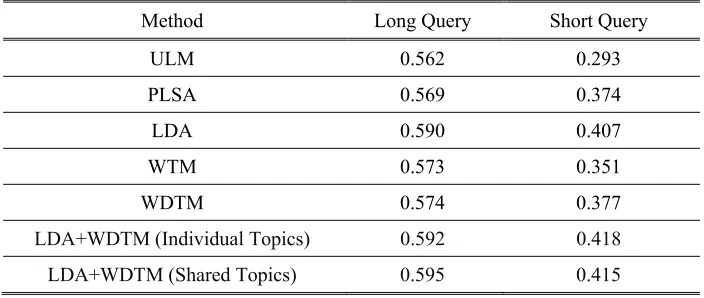
In the next set of experiments, we assessed the utility of various topic models for SDR, including PLSA, LDA, and WTM, as well as WDTM. The corresponding retrieval results are shown in Table 3. It is worth mentioning that all of these topic models were trained without supervision and had the same number of latent topics, which was set to 32 in this study. A detailed analysis for the impact of the model complexity of PLSA and WTM on SDR performance can be found in Chen (2009). On the other hand, both WTM and WDTM had the same context window size S set to 21. Since this project set out to investigate the
effectiveness of various topic models for SDR, the interpolation weights α and β defined in (18) were optimized for each respective topic model with a two-dimensional grid search over the range from 0 to 1 and in increments of 0.1. Consulting Table 3, we find that all of these topic models give moderate but consistent improvement over the baseline ULM model when long queries are evaluated. One possible explanation is that the information need already might have been stated fully in a long query, whereas additional incorporation of the topical information into the document language model does not seem to offer many extra clues for document ranking. On the contrary, the retrieval performance receives great boosts from the additional use of the topical information when the queries are short. This implies that incorporating the topical information with the literal term information for document modeling is especially useful when the query is inadequate to address the information need.
Table 3. Spoken document retrieval results achieved by various topic models.
Method Long Query Short Query
ULM 0.562 0.293
PLSA 0.569 0.374
LDA 0.590 0.407
WTM 0.573 0.351
WDTM 0.574 0.377
LDA+WDTM (Individual Topics) 0.592 0.418 LDA+WDTM (Shared Topics) 0.595 0.415
80 Shih-Hsiang Lin and Berlin Chen
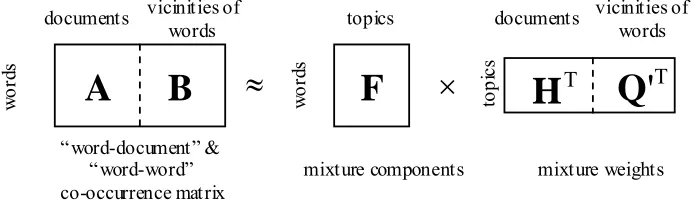
as the training example since they achieved better retrieval performance in the previous experiment. It is also worth mentioning that the row “LDA+WDTM (Individual Topics)” shown in Table 3 indicates that each topic model was trained individually and their respective document-ranking scores were combined in the log-likelihood domain. On the contrary, the row “LDA+WDTM (Shared Topics)” in Table 3 denotes the hybrid of DTM and WTM in both model training and testing (cf. Section 3.1). As is evident, the fusion of LDA and WDTM (i.e., with either individual sets of topics or a shared set of topics) is beneficial to the retrieval performance. This provides an additional 1% absolute improvement for the case of using short queries, as compared to that using LDA alone. Nevertheless, the joint exploration of “word-document” and “word-word” latent topic information (i.e., with a shared set of topics) in the training phrase does not provide any added benefit compared to the results obtained by training LDA and WDTM individually (i.e., with individual sets of topics). This is an interesting phenomenon and awaits further exploration. Readers may refer to Chen, et al. (2010) for an attempt that applies a similar idea to the speech recognition task.
To go a step further, we attempted to investigate the more subtle interaction effects among the topic model PTopic
(
wi MD)
, the document model PULM(
wi| MD)
, and the background model PULM(
w |i MC)
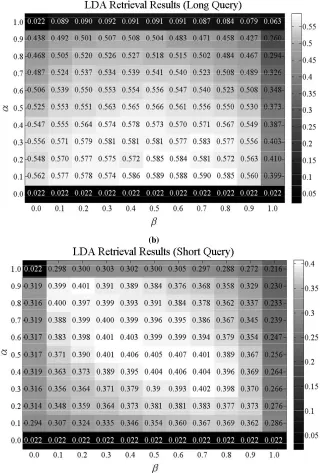
in (18) by varying the values of the interpolation weights α and β . Here, LDA was taken as an example topic model since it exhibits the best performance among the topic models compared in this paper. The retrieval results are graphically illustrated in Figure 4, where the horizontal and vertical axes denote the values ofα and β , respectively. As seen in the results revealed in Figure 4, additional incorporation of PULM
(
wi| MD)
and PULM(
w |i MC)
into LDA is beneficial for retrieval. In an extreme case, when both the values of α and β are set to one, as shown in the top right corner of Figure 4, the retrieval model is based merely on the topical information, which has poor retrieval performance, especially for the case using long queries. One possible reason is that a long query may contain several common non-informative words and using the topical information alone will let the query become biased away from representing the true theme of the information need, probably due to these non-informative words. This argument again can be verified by examining the rightmost columns of Figure 4, where using the background model PULM(
w |i MC)
can absorb the contributions of the common (or non-informative) words made to document ranking, thus giving better retrieval performance.Looking at each row of Figure 4, we see that smoothing LDA with the document model
(
)
ULM i| MD
A Comparative Study of Methods for Topic Modeling in 81 Spoken Document Retrieval
information need stated by the short query is already concise, and the importance of the role that PULM
(
w |i MC)
plays in filtering out or deemphasizing common (or non-informative) words is less pronounced.Figure 4. Detailed spoken document retrieval results achieved by LDA with respect to different types of queries.
(a)
82 Shih-Hsiang Lin and Berlin Chen
5.3
Experiments on using Subword-level Index features
In the fourth set of experiments, we evaluated the performance of the topic models when syllable pairs were utilized instead as the index terms. Here, we took LDA and WDTM as the example topic models, and the corresponding models are denoted by Syl_LDA and Syl_WDTM, respectively. The fusion of words and syllable pairs for topic modeling was investigated as well. Notice that Word_LDA denotes LDA using words as the index terms, which was termed LDA in the previous sections.
The retrieval results of Syl_LDA and Syl_WDTM are shown in Table 4, where the results achieved by ULM and using syllable pairs as the index terms (denoted by Syl_ULM) are also depicted for comparison. Several observations can be made from Table 4. First, the topic models (Syl_LDA and Syl_WDTM) again are superior to the unigram language model when the syllable-level information is used in place of the word-level information (denoted by Syl_ULM). Syl_LDA results in absolute improvements of about 8% and 3% over Syl_ULM when evaluated using the long and short queries, respectively. Second, the topic models with the syllable-level information perform worse than those with the word-level information. This may be due simply to the fact that syllable pairs are not as good as words in representing the semantic content of the queries and the documents. Third, the fusion of the word- and syllable-information for topic modeling (each topic model was trained individually beforehand) demonstrates much better retrieval results (cf. the last two rows of Table 4) as compared to that of the topic models with merely the word-level information (cf. Table 3).
Table 4. Spoken document retrieval results achieved by LDA and WDTM, respectively, using syllable pairs along with the combination of words and syllable pairs.
Method Long Query Short Query
Syl_ULM 0.492 0.274
Syl_LDA 0.571 0.302
Syl_WDTM 0.536 0.299
Word_LDA+Syl_LDA 0.613 0.412
Word_WDTM+Syl_WDTM 0.575 0.383
A Comparative Study of Methods for Topic Modeling in 83 Spoken Document Retrieval
in the construction of the latent topic distributions for LDA (denoted by Syl_LDA (Corr.)) is better than that only using syllable pairs to construct the latent topic distributions (denoted by Syl_LDA). On the other hand, such an attempt slightly hurts the performance of LDA using words for the final document ranking (denoted by Word_LDA (Corr.)). This phenomenon seems to be reasonable because the semantic meanings carried by words would probably see interference from syllable pairs when we attempt to splice these two distinct index term streams together for constructing the latent topic distributions of LDA. It can be observed that Syl_LDA (Corr.) significantly outperforms all other topic models in the case of using long queries (cf. Tables 3, 4, and 5). This demonstrates the potential benefit of using the syllable-level information in topic modeling for SDR if we can carefully delineate the syllable-level information. Nevertheless, in the case of using short queries, Syl_LDA (Corr.) does not perform as well as LDA using words as the index terms to construct the latent topic distributions (denoted by Word_LDA). We conjecture that one possible reason is that the topical information inherent in a short query cannot be unambiguously depicted with limited syllable pairs. In order to mitigate this deficiency, we combined Word_LDA with Syl_LDA (Corr.) to form a new retrieval model (denoted by Word_LDA + Syl_LDA (Corr.)), which yields the best results of 0.636 and 0.431 for long and short queries, respectively. One should keep in mind that these results were obtained using the erroneous speech transcripts of the spoken documents (i.e., the SD case). This also reveals that Word_LDA + Syl_LDA (Corr.) can make retrieval using the speech transcripts achieve almost the same performance as ULM using the manual transcripts (i.e., the TD case) when the queries are long, and can perform even better than the latter for short queries.
Table 5. Spoken document Retrieval results achieved by correlated LDA, using words (Word_LDA(Corr.)), syllable pairs (Syl_LDA(Corr.)), and their combination (Word_LDA + Syl_LDA(Corr.)).
Method Long Query Short Query
Word_LDA (Corr.) 0.577 0.349
Syl_LDA (Corr.) 0.618 0.356
Word_LDA+Syl_LDA (Corr.) 0.636 0.431
6.
Conclusions
84 Shih-Hsiang Lin and Berlin Chen
the baseline model on the Mandarin SDR task. Our future research directions include: 1) training the topic models in a lightly supervised manner through the exploration of users’ click-through data, 2) investigating discriminative training of topic models, 3) integrating the topic models with the other more elaborate representations of the speech recognition output (Yi and Allan, 2009; Chelba et al., 2008) for larger-scale SDR tasks, and 4) utilizing speech summarization techniques to help estimate better document models and topic models.
Acknowledgement
This work was sponsored in part by “Aim for the Top University Plan” of National Taiwan Normal University and Ministry of Education, Taiwan, and the National Science Council, Taiwan, under Grants NSC 101-2221-E-003 -024 -MY3, NSC 99-2221-E-003-017-MY3, NSC 98-2221-E-003-011-MY3, NSC 100-2515-S-003-003, and NSC 99-2631-S-003-002.
Reference
Blei, D.M., Ng, A.Y., & Jordan, M. I., (2003). Latent Dirichlet allocation. Journal of Machine Learning Research, 3, 993-1022.
Blei, D. & Lafferty, J., (2009). Topic models. In A. Srivastava and M. Sahami, (eds.), Text Mining: Theory and Applications. Taylor and Francis, 2009.
Blei, D., Carin, L., & Dunson, D., (2010). Probabilistic topic models. IEEE Signal Processing Magazine, 27(6), 55-65.
Chelba, C., Hazen, T. J., & Sarclar, M., (2008). Retrieval and browsing of spoken content. IEEE Signal Processing Magazine, 25(3), 39-49.
Chen, B., (2009). Word topic models for spoken document retrieval and transcription. ACM Transactions on Asian Language Information Processing, 8(1), Article 2.
Chia, T. K., Sim, K. C, Li, H. Z. & Ng, H. T., (2008). A lattice-based approach to query-by-example spoken document retrieval. In Proceeding the ACM SIGIR Conference on R&D in Information Retrieval, 363-370.
Dempster, A. P., Laird, N. M., & Rubin, D. B., (1977). Maximum likelihood from incomplete data via the EM algorithm. Journal of the Royal Statistical Society, Series B, 39 (1): 1-38.
Garofolo, J., Auzanne, G., & Voorhees, E., (2000). The TREC spoken document retrieval track: A success story. In Proceeding the 8th Text REtrieval Conference. NIST, 107-129.
Griffiths, T. L. & Steyvers, M., (2004). Finding scientific topics. In Proceeding of the National Academy of Sciences, 5228-5235.
A Comparative Study of Methods for Topic Modeling in 85 Spoken Document Retrieval
Harman D., (1995). Overview of the Fourth Text Retrieval Conference (TREC-4). In Proceeding the Fourth Text Retrieval Conference, 1-23.
Hofmann, T., (2001). Unsupervised learning by probabilistic latent semantic analysis. Machine Learning, 42, 177-196.
LDC, (2000). Project topic detection and tracking. Linguistic Data Consortium. http://www.ldc.upenn.edu/Projects/TDT/.
Lee, L. S. & Chen B., (2005). Spoken document understanding and organization. IEEE Signal Processing Magazine, 22(5), 42-60.
Meng, H., Chen, B., Khudanpur, S., Levow, G. A., Lo, W. K., Oard, D., Schone, P., Tang, K., Wang, H. M., & Wang, J., (2004). Mandarin-English information (MEI): investigating translingual speech retrieval. Computer Speech and Language, 18(2), 163-179.
Miller, D. R. H., Leek, T., & Schwartz, R., (1999). A hidden Markov model information retrieval system. In Proceeding ACM SIGIR Conference on R&D in Information Retrieval, 214-221.
Ponte, J. M. & Croft, W. B., (1998). A language modeling approach to information retrieval. In Proceeding the ACM SIGIR Conference on R&D in Information Retrieval, 275-281. Wei, X., & Croft, W. B., (2006). LDA-based document models for ad-hoc retrieval. In
Proceeding the ACM SIGIR Conference on R&D in Information Retrieval, 178-185. Lin, S. H. & Chen B., (2009). Topic modeling for spoken document retrieval using word- and
syllable-level information. In Proceedings of the third workshop on Searching spontaneous conversational speech, 3-10.
Chen, K. Y., Chiu, H. S. & Chen B., (2010). Latent topic modeling of word vicinity information for speech recognition. In Proceeding of the 35th IEEE International Conference on Acoustics, Speech, and Signal Processing, 5394-5397.
Ypma, J., Basten, T. & Lafferty, J., (2002). Expectation-propagation for the generative aspect model. In Proceeding Conference on Uncertainty in Artificial Intelligence, 352-359. Zhai, C. X., (2008). Statistical language models for information retrieval (Synthesis Lectures