S
pecific Language Impairment is the diagnostic category for children who fail to develop age-appropriate language despite being apparently normal in other respects. By defi-nition, these children are thought to have no obvious hear-ing, cognitive, or neurological deficits, yet they learn to talk relatively late. When they do begin to talk they produce fewer utterances than expected for their age and intelli-gence; and they exhibit deficits in several aspects of language including phonology, morphology and syntax (see Box 1). The fact that these children are also impaired in compre-hending language suggests that their problem is not merely a peripheral one related to the production of speech.SLI has recently attracted considerable attention as a source of evidence about the biological and genetic bases of grammar. The central problem in the study of language ac-quisition is to explain how a child can acquire language in a relatively short period of time, given the complexity of lan-guage and the nature of the input to which children are ex-posed1–4. The standard view, derived from the work of
Chomsky, is that the input to the child is impoverished, and that languages are only learnable because knowledge of grammatical structure – ‘universal grammar’ – is innate. Some researchers working within this framework have taken SLI as evidence that specific components of this in-nate grammatical capacity can be damaged. For example, the fact that the children’s use of past tense morphology is impaired is attributed to a deficit in the morphological component of grammar5. The fact that at least some forms
of SLI have a heritable component has prompted further speculation that components of grammar may have specific
genetic encodings5–7. Pinker, for example, has suggested
that ‘the syndrome shows that there must be some pattern of genetically guided events in the development in the brain…that is specialized for the wiring in of linguistic computation’ (Ref. 5, p. 324). This view of SLI was sum-marized previously by Gopnik7.
That people are born knowing ‘universal grammar’ and that language necessarily involves rules are themselves con-troversial claims8–10and so it is not surprising that attempts
Specific language
impairment:
a deficit in grammar
or processing?
Marc F. Joanisse and Mark S. Seidenberg
Specific Language Impairment (SLI) is observed in children who fail to acquire age-appropriate language skills but otherwise appear to be developing normally. There are two main hypotheses about the nature of these impairments. One assumes that they reflect impairments in the child’s innate knowledge of grammar. The other is that they derive from information-processing deficits that interfere with several aspects of language learning. There is considerable evidence that SLI is associated with impaired speech processing; however, the link between this deficit and the kinds of grammatical impairments observed in these children has been unclear. We suggest that the link is provided by phonology, a speech-based code that plays important roles in learning linguistic generalizations and in working memory.
M.F. Joanisse and M.S. Seidenberg are at the Neuroscience Program, University of Southern California, USC Neuroscience HNB-18, Los Angeles, CA 90089-2520, USA. tel: +1 213 740 9174 fax: +1 213 740 5687 e-mail: marcj@gizmo. usc.edu
Box 1. Elements of language
affected in SLI
Children with SLI are usually impaired in using several aspects of language, including some or all of the following: Phonology:refers to the organization of speech sounds into segments. Affected children have difficulty producing words with complex clusters of consonants (like spectacle), or analysing the phonological structure of a word (such as say-ing what sound follows the /p/ in split).
Morphology: refers to the structure of words and mechanisms for creating related words such as affixingand compounding. English-speaking children with SLI are often impaired at tasks involving the generation of past tenses or plurals, particularly for novel words such as wugand blick. Syntax:refers to the structure of sentences. Affected children have difficulty analysing sentences with complex syntactic structures, such as datives (Sally showed Henry to Bill) and passives (Frank was hit by Bob).
to explain SLI in these terms have also generated con-siderable debate. (See two excellent recently published overviews of SLI research11,12for additional discussion of many of the issues discussed here.) We will argue in this re-view that the main question about SLI is whether the deficit is, in fact, limited to grammar. An alternative view is that these impairments are sequelae of information processing deficits that broadly interfere with language learning. In particular, there is good evidence that SLI is associated with impairments in the processing of speech; that these impair-ments affect the development of phonological represen-tations; and that degraded phonological representations are the proximal cause of deviant acquisition of morphology and syntax, by virtue of their roles in learning and working memory. This view differs from how grammarians interpret SLI, but is consistent with an older clinical tradition in which developmental language impairments have been rec-ognized as dysphasias that are often accompanied by deficits in perception and learning13,14.
Varieties of childhood language impairment
One issue that must be confronted at the outset is the con-siderable ambiguity about SLI as a diagnostic category. It is clear that language is a complex system, the acquisition and use of which are highly dependent on various aspects of per-ception, cognition, learning and motor performance. It is therefore not surprising that language development can be impaired in a variety of ways. Box 2 provides a typology of developmental language impairments proposed by Rapin and Allen15. It is unlikely that all of these patterns of im-pairment have a common cause and the extent to which the deficits are limited to language is unclear. Terms such as ‘specific language impairment’, ‘developmental language impairment’ and ‘developmental dysphasia’ are applied to children whose behavioral profiles and etiologies vary con-siderably. In this respect, these categories are like the term ‘dyslexia’, which is broadly applied to children with reading impairments but differentiates into subtypes associated with different behavioral patterns and etiologies16. Like language impairment, dyslexia often co-occurs with (and may be caused by) other cognitive and perceptual deficits. As Rapin
and Allen’s taxonomy suggests, there is a subtype of lan-guage impairment in which deficits in phonology and syn-tax co-occur; they are the children typically labeled ‘SLI’ and the focus of this article.
Grammatical impairments in SLI
Grammatical accounts of SLI have focused on deficits in morphology and syntax. Children with SLI have difficulty producing and comprehending morphologically complex words, such as the past tense and plural inflections in English (e.g. baked, books). They understand the concepts of pastness and plurality, but their ability to express these con-cepts using grammatical morphemes is impaired. This phe-nomenon is not limited to English; SLI speakers of other languages exhibit impairments in using other aspects of morphology such as case marking in Hebrew17,
grammati-cal aspect in Japanese18and compound words in Greek19.
A grammatical account of this deficit20holds that SLI
children are missing the abstract grammatical principle of inflection, which is necessary for determining linguistic re-lationships such as subject-verb agreement and grammatical case assignment. As a result, these children fail to proceed beyond an early ‘optional infinitive’ stage in acquisition, during which the application of inflectional rules is not obligatory. On this view, their errors follow from a lack of knowledge that morphological marking is obligatory.
A different account of this morphological deficit was proposed by Pinker and Gopnik, who assert that it derives from an inability to learn inflectional rules5–7,21. Because
they lack the capacity to formulate rules, SLI children can only learn morphological marking through rote learning of individual inflected words. This account is consistent with the observation that children with SLI produce some cor-rectly-inflected forms (such as baked) as well as irregular forms (such as took) but perform poorly when asked to gen-erate inflected forms for novel words (such as wug)6. On this
account, SLI provides evidence that language involves rules, that this rule-forming capacity can be congenitally im-paired, and that the deficit may be genetically transmitted.
Syntactic impairments have also been demonstrated in SLI. These include difficulties with complex structures such
Clinical Language Subtypes proposed by Rapin and Allena, as
reported in Bishopb. Many of these subtypes are likely to be
excluded from studies of SLI.
Verbal auditory agnosia (‘word deafness’):severe comprehension deficit, in which affected child is poor at understanding spoken language. Language production is poor.
Verbal dyspraxia:deficit in using speech articulators. Language production is poor, though comprehension is relatively normal.
Phonological programming syndrome:deficit in producing speech sounds, though oral-motor ability is normal. Compre-hension is relatively normal.
Phonological–syntactic deficit:poor phonological and syntac-tic abilities. Both production and comprehension are impaired.
Lexical–syntactic deficit syndrome:word-finding difficulties,
accompanied with difficulty using sentences in connected speech. Comprehension of abstract meanings is poor. Similar to the popular definition of SLI.
Semantic–pragmatic deficit syndrome:production and com-prehension of grammar is normal, but the ability to understand and produce meaningful utterances is impaired.
References
aRapin, I. and Allen, D. (1987) Developmental dysphasia and autism in pre-school children: characteristics and subtypes, inProceedings of the First International Symposium on Specific Speech and Language Disorders in Children, Association of All Speech Impaired Children
bBishop, D.V.M. (1997) Uncommon Understanding: Development and Disorders of Language Comprehension in Children, Psychology Press
as dative/double-object alternations (‘Bill showed the dog to the cat’versus ‘Bill showed the dog the cat’) and reversible passives (‘the ship sank the submarine’versus ‘the ship was sunk by the submarine’)22. A study by van der Lely and Stollwerck23 identified deficits in the ability to use syntactic principles governing anaphoric reference (e.g. ‘Bill says that Bobby is watching himself ’ versus ‘Bill says that Bobby is watching him’). In the first sentence, ‘himself ’ can only refer to Bobby, and not Bill; in the second sentence, ‘him’ cannot refer to
Bobby, though it can optionally refer to Bill. Generative theory suggests that there is a universal set of binding prin-ciples governing such constructions24. Van der Lely and Stollwerck suggested that this aspect of grammar was af-fected in their subjects. Results of this kind suggest that the deficits of children with SLI are not limited to morphology and may include several aspects of sentence grammar.
These accounts share the idea that SLI involves im-paired grammar. However, there is disagreement among them concerning the nature of the impairment, specifically the incidence of different types of grammatical deficits, their relative frequencies and how often they co-occur, and whether other aspects of language are also affected. SLI is said to involve ‘selective’ impairments to specific com-ponents of grammar, but few studies have looked equally carefully at a broad range of linguistic and non-linguistic abilities in the same subjects.
Perceptual deficits in SLI
It is clear that SLI children’s behavioral impairments extend well beyond grammar (see Box 3). In particular, there is considerable evidence that they have subtle impairments in speech perception. In several studies, they performed poorly on tasks that require discriminating phonological features such as consonant voicing (the difference between baand
pa) and place of articulation (baversus ga)25, failing to show
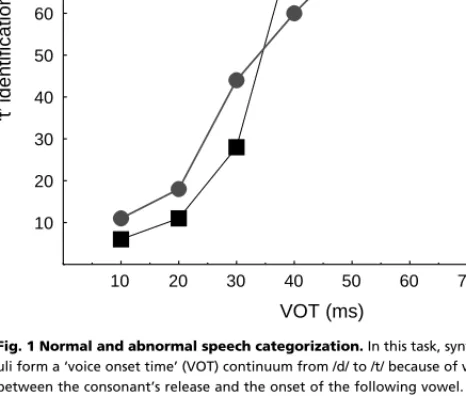
the normal categorical perception effects associated with such stimuli (Fig. 1). Whereas the grammar approach treats this deficit as unrelated to the children’s linguistic impair-ments, the alternative account holds that it is their proximal cause: SLI children learn language deviantly because they misperceive speech.
The basis for this speech processing deficit is unclear. Tallal has proposed that the impairment involves the pro-cessing of rapid, sequential information26,28. Spoken lan-guage involves perceiving a complex, rapidly changing, fast-fading auditory signal, and thus an impaired capacity to resolve aspects of this signal would greatly interfere with learning language. Tallal’s theory predicts selective impair-ments in perceiving speech sounds that rely on short (less than 50 ms), transient acoustic cues such as the voicing of stop consonants (e.g. the difference between doand to). It also predicts that speech sounds that are discriminated by longer acoustic cues (longer than 100 ms) such as vowels and fricatives (e.g. the initial sounds in sueand shoe) should be unimpaired. Tallal’s studies have also identified impair-ments in perceiving rapid stimuli in the visual and tactile modalities in these children, suggesting that the deficit is not speech-specific. In addition, this work has suggested that the language abilities of children with SLI can be improved by adaptively training them to discriminate rapid and sequential auditory signals, including speech and non-speech sounds28.
Tallal’s research has generated considerable interest but it has also raised many methodological and theoretical ques-tions and it continues to be the focus of intensive investi-gation. There is little consensus as to the exact charac-terization of this perceptual deficit, and there may be considerable variability within the SLI population with re-gard to it (see Ref. 11, Chapter 3 for a review). In addition, processing deficits similar to those described by Tallal have
SLI children can also exhibit impairments of non-linguistic abilities, although the relationship of these deficits to their impaired language is unclear. They could be a cause or consequence of the language deficit, or simply an unrelated co-occurrence.
Oral-motor control (dyspraxia):while diagnoses of SLI preclude individuals with gross motor deficits (dysarthria), difficulties in planning and executing complex oral-motor programs appear to be significantly impaired in a handful of casesa,b.
Speech perception:the ability to discriminate and categorize speech sounds is diminished (e.g. Ref. c; see also Fig. 1).
Working memory: children with SLI have shorter working memory spans, in both speech and non-speech modalitiesd–f.
Analogical reasoning:the ability to reason through analogy is impaired, even in tasks for which language plays a minimal roleg–i.
Visual imagery:children with SLI perform worse than controls in tasks such as the mental rotation of imagesi.
References
aVargha-Khadem, F. and Passingham, R.E. (1990) Scientific correspondence Nature346, 226
bVargha-Khadem, F. et al.(1995) Praxic and non-verbal cognitive deficits in a large family with a genetically transmitted speech and language disorder Proc. Natl. Acad. Sci. U. S. A. 92, 930–933
cElliott, L.L., Hammer, M.A. and Scholl, M.E. (1990) Fine-grained auditory discrimination in normal children and children with language-learning problemsJ. Speech Hear. Res. 32, 112–119
dGathercole, S.E. and Baddeley, A.D. (1990) Phonological memory deficits in language disordered children: Is there a causal connection? J. Mem. Lang.29(3), 336–360
eKirchner, D. and Klatzky, R. (1985) Verbal rehearsal and memory in language-disordered children J. Speech Hear. Res.28, 556–564
fTallal, P. et al. (1981) A re-examination of some non-verbal perceptual abilities of language-impaired and normal children as a function of age and sensory modality J. Speech Hear. Res. 24, 351–357
gNelson, L., Kamhi, A. and Apel, A. (1987) Cognitive strengths and weaknesses in language-impaired children: one more look
J. Speech Hear. Disord.52, 36–43
hEllis-Weismer, S. (1985) Constructive comprehension abilities exhibited by language-disordered children J. Speech Hear. Disord.
28, 175–184
iJohnston, J. and Ellis-Weismer, S. (1983) Mental-rotation abilities in language-disordered children J. Speech Hear. Res. 26, 397–403
been observed in children whose language is not impaired; Krauss et al.28showed that both a group of children with SLI and a group of learning-impaired children with no lan-guage difficulties had aberrant evoked response potentials (ERPs), recorded from scalp electrodes, consistent with a deficit in perceiving rapid sensory information. Similarly, Ludlow et al.29observed a deficit in perceiving rapid audi-tory information in both children with SLI and hyperactive children who had no observable language impairment. Thus, if this deficit causes SLI, it is unclear why some chil-dren who have it do not develop impaired language. Another challenge for the ‘timing’ hypothesis is evidence that SLI children are also impaired in discriminating speech sounds that are not differentiated by rapidly changing acoustic cues, such as vowels and fricatives30. This suggests that they have problems perceiving acoustic differences between sounds rather than processing short rapid stimuli.
How common are perceptual deficits in SLI?
Some researchers have failed to observe abnormal speech perception in children with SLI, raising further questions about its relevance to their language impairments. Such null results need to be interpreted cautiously, however. A serious concern is whether the tasks that yielded null results pro-vided adequate tests of the children’s perceptual capacities. For example, Gopnik21investigated only subjects’ abilities to discriminate and repeat minimal pairs of words (e.g. bat
and bad); this task does not capture much of the complexity of perceiving continuous speech and may have been simple enough for even perceptually impaired children to perform. There is an extensive literature on speech perception im-pairments in SLI using tasks that provide sensitive measures of subtle aspects of auditory processing25,26,29–31. Some stud-ies using such measures have revealed apparently normal auditory perception in some children with SLI but again the results must be interpreted cautiously. For example, Bernstein and Stark31examined language-impaired children who had demonstrated abnormal auditory perception at a younger age, and found that for some of these children this impairment had resolved even though their language deficits persisted. The authors suggested that a language deficit could result from a perceptual deficit occurring at a critical point in language development, even though it would not necessarily be present at a later stage in development. Phonological deficits and SLI
Granting that at least some language-impaired children have abnormal speech perception, how can these deficits be related to their impaired language? We propose that the link between the two is provided by phonology. The child must learn the phonological inventory and other phonological regularities of the language to which he/she is exposed. Im-paired perception of speech interferes with the development of phonological representations, which in turn affects other aspects of grammatical development17. Consistent with this account, many language-impaired children, particularly those who also manifest syntactic difficulties15, exhibit abnormal phonology as revealed by poor repetition of nonsense words32, misarticulating or deleting phonemes from words33, difficulty in identifying words with similar
phonemes (e.g. recognizing that batand ball have the same first sound)34and poor ‘phonological awareness’, as measured by tasks requiring them to analyse a word into its constituent segments35.
How could an impairment in phonological represen-tation yield the particular kinds of grammatical impairments observed in SLI? Consider first the deficit in inflectional morphology. The rule governing past tense formation in English is as follows: If the final phoneme of a present tense verb is a voiceless consonant, then add /t/; if it is a voiced consonant or a vowel, then add /d/; and if it is an alveolar stop (/t/ or /d/) insert an unstressed vowel as well as /d/. This is illustrated in (1–3) below; phonetic transcriptions are in parentheses:
(1) bake →baked (beyk-t), rip →ripped (rIp-t) (2) try →tried (traj-d), file →filed (fajl-d) (3) bait →baited (bejt-Id), seed →seeded (sid-Id) The past tense rule illustrates the fact that many mor-phologicalrules have important phonological components; they do not merely involve concatenating an affix to a base form. There are three phonological realizations (‘allo-morphs’) of the English past tense morpheme; which form is appropriate for a given verb is entirely determined by the identity of the final phoneme. In order to learn and use the rule, children must be able to analyse phonologically the al-ternation and the conditions under which particular forms occur. Performing this analysis would clearly be more diffi-cult in the face of a perceptual impairment like the one demonstrated in Fig. 1, because of the relatively weak per-ceptual salience of the morpheme and because ill-formed phonological representations developed as a result of such a
10 20 30 40 50 60 70 80 VOT (ms) 10 20 30 40 50 60 70 80 90 100 ‘t’ identifications (%) Controls SLI
Fig. 1 Normal and abnormal speech categorization.In this task, synthetic speech stim-uli form a ‘voice onset time’ (VOT) continuum from /d/ to /t/ because of variation in the lag between the consonant’s release and the onset of the following vowel. In normally-devel-oping children and adults, the perception of these items is sharply categorical, with a steep slope at the boundary. Children with SLI typically have weak or distorted categorical per-ception, characterized by curves with shallower slopes and poorer performance at end-points. These data are from Joanisse et al.(unpublished data). Other studies showing similar effects include those described in Refs 25,30.
deficit would weaken the ability to analyse and learn how subtle aspects of phonology such as the abstract notions of alveolar and continuant features govern the realization of the past tense inflection.
There are several lines of evidence consistent with this account. Hoeffner and McClelland36used a connectionist model of past tense learning to examine the effects of phonological impairment. The model learned to map from the semantics of a verb to its phonological form. It was trained with either a normal phonological representation or one that was systematically degraded. Like children with SLI, the impaired network had difficulty applying the past tense rule to verbs, even though it was able to repeat accu-rately words presented to it. Thus the simulation showed that impairing phonology has a significant impact on the capacity to generalize morphological forms. The model also tended to produce a disproportionate number of overgener-alization errors (e.g. eatedrather than ate), which is also con-sistent with SLI. Moreover, it demonstrated how the ability to produce a past tense form like paidcan be impaired in children who are nevertheless capable of producing phono-logically similar forms like raid.Thus, a phonological im-pairment can be severe enough to interfere with the more difficult task of generating the past tense of a word while supporting the simpler task of repeating a word. Finally, the model also tended to produce errors of omission (failing to produce a form where appropriate) rather than errors of commission (producing a form where it is not appropriate), consistent with the behavior of SLI children. The network acquired some knowledge of the past tense alternation, and could produce some appropriate forms. Its knowledge was imperfect, however, and errors tended to involve defaulting to the more basic, uninflected form.
Additional support is provided by studies of morpho-logical impairments following brain injury. Ullman et al.37 have observed morphological deficits in patients with Broca’s aphasia and Parkinson’s Disease consistent with those in SLI; affected patients have difficulty using morphological rules, particularly when applying them to nonsense words (e.g. strimped). Joanisse and Seidenberg (unpublished data) explored the possibility that these patients’ deficit is caused by a phonological impairment by training a connectionist model on English past tense formation, and simulating the effects of damage to brain areas responsible for phonological processing. Damage to phonological representations had a larger impact on generalization than on learning individual verbs. Their results are consistent with the morphological deficits observed in aphasic patients, and further illustrate the importance of phonological representations in learning and using morphology.
Finally, the idea that the deficit in inflectional mor-phology is secondary to a phonological impairment is also supported by evidence concerning related impairments in reading. Perhaps the leading hypothesis about developmen-tal dyslexia is that it is usually secondary to a phonological impairment38. Dyslexic children fail to develop segmental phonological representations, which interferes with learn-ing the correspondences between spelllearn-ing and sound. Like the past tense, the pronunciations of most words are rule governed (e.g. gave,save,pave; mint,hint,lint) but there are
many exceptions such as haveand pint. Both behavioral and simulation modeling research indicate that being able to represent knowledge of spelling–sound correspondences in a way that supports generalization (the pronunciation of novel letter strings such as mave) can be impaired as a result of poor phonological representations16,38. Thus, both phonologically impaired dyslexics and SLI children exhibit impaired use of phonology and impaired acquisition of lin-guistic regularities. The relationship between the two types of impairment is poorly understood; SLI children are typi-cally dyslexic but many dyslexics do not have other language impairments. Whether phonological dyslexia represents a milder form of the impairment in SLI is the focus of current research.
Salience and frequency effects
Phonological aspects of inflectional morphology are also implicated in studies showing that the perceptual salience of these morphemes affects SLI children’s performance. In English, inflectional morphemes happen to be word-final and unstressed. Thus, it is hard to determine whether the impaired use of these morphemes reflects their grammatical status or their lack of perceptual salience. Cross-linguistic studies by Leonard et al.17,39and others have clarified this issue considerably. Italian- and Hebrew-speaking children with SLI have less difficulty with grammatical morphemes that occur in stressed syllables than with ones in unstressed syllables. Clearly an information-processing impairment that affects the development of phonological represen-tations will have a greater effect on phonemes that are not perceptually salient.
Gopnik7,21 has challenged the claim that perceptual salience is relevant, citing the case of an apparently acousti-cally salient grammatical morpheme that children with SLI still find difficult. Japanese marks the honorific past tense with -mashita, which is more salient than English past-tense morphology. Japanese SLI children were claimed to be just as impaired on this form as on less salient mor-phemes. However, the study cited by Gopnik tested eight Japanese SLI children on only two instances of the -mashita
morpheme, and failed to apply the proper controls to deter-mine whether such a deficit represents a deviant pattern in the development of Japanese; thus, the study’s authors acknowledge that it should be treated as preliminary18. Nevertheless, the case of -mashitais a useful illustration of the non-obvious complications governing the acquisition and use of many morphemes. As in English, the regular (non-honorific) Japanese past tense morpheme exhibits al-lomorphy, surfacing as either -taor -da, as illustrated in (4). Also as in English, the perceptibility of this morpheme is weak, because of its duration and word-final position.
(4) kai - ta (write; past tense) yon - da (read; past tense)
(5) kaki- mashi - ta (write; hon-past tense) yomi- mashi - ta (read; hon-past tense)
Comparing the cases in (4) to the honorific past tense versions of the same words in (5) reveals that although -mashita is highly perceptible in isolation, the verb stems
-mashi-. It might therefore be difficult for a child with dis-ordered phonology to segment the -mashi morpheme, which requires recognizing the commonalties between yon-da and
yomi-mashita, in order to determine where the verb root ends and the grammatical morpheme begins.
The studies by Leonard and others provide strong evidence that children with SLI are impaired in learning aspects of morphology that lack perceptual salience. However, it is clear that other factors must be relevant as well. Consider, for example, the /-s/ morpheme in English, which is used to mark both plural nouns (cats) and third person singular verbs (bakes). Leonard et al.39found that children with SLI were much better at producing it as a plural noun marker (79% correct) than as a third person verb marker (7% correct). This effect cannot be solely due to perceptibility because the two morphemes are phonologi-cally identical and occur in similar phonological contexts. However, the two do differ greatly in terms of how often they occur in everyday usage. The third person morpheme (bakes) is used relatively rarely (4.3% of the time in adults) while the plural noun morpheme (cats) is relatively frequent (26.7% of the time in adults). (These frequency data are drawn from Ref. 39, and represent how frequently the plural or third person (-s) form occurs, as a percentage of overall noun or verb frequencies in the database.) Hence SLI children will have had many more exposures to the plural than the third person marker, enhancing their ability to learn some forms, while making other forms more difficult to learn. This is not surprising, given that fre-quency of exposure has a large impact on learning in people as well as in connectionist networks of the type described above8.
Syntactic deficits
The syntactic impairments observed in SLI can also be re-lated to phonology, in particular the role of phonological information in sentence processing. Comprehension rou-tinely requires holding information in memory while other processing operations continue. Sentences cannot be under-stood word by word because they exhibit structural dis-continuities. In (6), for example, the noun phrase the manis associated with the verb likes which appears eight words later:
(6) The man who is wearing a large green hat likes Mary.
Studies of processes that occur as such sentences are read or heard indicate that information is retained in a phonological form41,42; phonology is particularly relevant to briefly retaining information concerning the literal se-quence of words in a sentence. This plays a role in resolving several kinds of ambiguities, illustrated by sentences (7,8) in which the comprehender must determine who liked and who left:
(7) The intern who the president liked left.
(8) The intern who liked the president left.
One view of these phenomena is that language compre-hension involves using a limited capacity working memory system41–43. Although these theories differ in detail, they share the idea that partial results of comprehension
processes are stored in a phonological code. Given the evi-dence concerning phonological representation and process-ing deficits in SLI, it is not surprisprocess-ing that several studies have demonstrated working memory deficits in these chil-dren32,44. Because working memory is particularly relevant to processing complex sentence structures in normal chil-dren and adults42,43, it follows that SLI children with im-paired phonology should exhibit impairments in sentence processing, consistent with the behavioral literature. A more recent theory45holds that working memory is not a separate storage system; rather, the neural network responsible for processing sentences itself has limited capacities. When words are recognized in reading or listening they activate phonological codes that facilitate retaining and integrating information over time. As in the standard account, phono-logical anomalies affect the processing of more complex structures.
Phonological information may also be relevant to the acquisition of syntactic knowledge11. Consider for example the van der Lely and Stollwerck study23 indicating that children with SLI have difficulty comprehending sentences such as (9 and 10) below:
(9) Mowgli says Baloo Bear is tickling him.
(10) Mowgli says Baloo Bear is tickling himself.
It is doubtful that the children’s problem with (9) and (10) relates to the perceptual salience of himand himself. However, these sentences are representative of the kinds of structures that place significant demands on working mem-ory. Moreover, the difference between (9) and (10) turns on configural (i.e. hierarchical rather than linear) aspects of syntax that affect whether an anaphor can or cannot refer to a particular noun phrase. Impairments in working memory, stemming from phonological coding deficits, could there-fore make it difficult for a child to learn the grammatical principles that differentiate the two sentence types. Cor-roborative evidence is again available from studies of read-ing disability: Shankweiler and colleagues have found strong correlations between perceptual-phonological deficits and syntactic processing abilities in dyslexics46. This account also explains why children with SLI are less impaired – though not completely normal – in processing sentences such as (11) in which non-syntactic information (about gender) provides a basis for inferring an interpretation.
(11) Mowgli says Mother Wolf is tickling him.
Because children with SLI are aware that him never refers to females like Mother wolf, they can use this type of information to resolve sentences like (11), without re-sorting to the more complex strategy of analysing syntactic relations.
van der Lely and Stollwerck concluded that their results reflect an impairment specific to the use of the binding principles rather than a more general difficulty understand-ing the meanunderstand-ing of words and sentences. However, SLI sub-jects in this study were well above chance in correctly label-ing sentences like (9) and (10), in most cases better than 75% correct. This would suggest that affected children do have some knowledge of the relevant grammatical princi-ples, but that other factors, such as a limitation on working
memory, are interfering with the ability to use this knowl-edge in sentences.
Conclusion
Recent interest in SLI by linguists has greatly increased our knowledge of the grammatical deficits in language-impaired individuals. However, the basis for these impairments is as yet unclear. Some have assumed that these grammatical im-pairments must result from genetic and neurobiological anomalies that affect the development of ‘universal gram-mar’, the innate grammatical module of the brain. They have further assumed that the other deficits exhibited by these children are unrelated co-occurring symptoms. We have briefly summarized some of the kinds of evidence that suggest how linguistic impairments could follow from more basic information-processing deficits that interfere with learning and memory. The challenges that confront this ap-proach are to gain a better understanding of the nature of perceptual deficits in SLI and how they could lead to the specific problems in learning language that have been de-scribed in linguistic research.
References
1Chomsky, N. (1965) Aspects of the Theory of Syntax, MIT Press
2Gold, E.M. (1967) Language identification in the limit Inf. Control 10, 447–474
3Chomsky, N. (1986) Knowledge of Language, MIT Press
4Pinker, S. (1989) Learnability and Cognition: The Acquisition of Argument Structure, MIT Press
5Pinker, S. (1989) The Language Instinct, Harper Collins
6Gopnik, M. and Crago, M. (1991) Familial aggregation of a developmental language disorder Cognition39, 1–50
7Gopnik, M. (1997) Language deficits and genetic factors Trends Cognit. Sci.1, 5–9
8Seidenberg, M.S. (1997) Language-acquisition and use: learning and applying probabilistic constraints Science 275, 1599–1603
9Elman, J. et al. (1996) Rethinking Innateness, MIT Press
10Saffran, J., Aslin, R. and Newport, E. (1996) Statistical learning by 8-month old infants Science274, 1926–1928
11Bishop, D.V.M. (1997) Uncommon Understanding: Development and Disorders of Language Comprehension in Children, Psychology Press
12Leonard, L. (1997) Children with Specific Language Impairments, MIT Press
13Benton, A. (1964) Developmental aphasia and brain damage Cortex1, 40–52
14Ewing, A.W.G. (1930) Aphasia in Children, Oxford University Press
15Rapin, I. and Allen, D. (1987) Developmental dysphasia and autism in pre-school children: characteristics and subtypes, inProceedings of the First International Symposium on Specific Speech and Language Disorders in Children, Association of All Speech Impaired Children
16Manis, F. et al.(1996) On the basis of two subtypes of developmental dyslexia Cognition 58, 157–195
17Leonard, L.B. and Eyer, J.A. (1996) Deficits of grammatical morphology in children with specific language impairment and their implications for notions of bootstrapping, in Signal to Syntax(Morgan, J. and Demuth, K., eds), Erlbaum
18Fukuda S. and Fukuda, S. (1994) Developmental language impairments in Japanese: a linguistic investigation, in McGill Working Papers In Linguistics(Vol. 10) (Matthews, J., ed.), pp. 150–177, McGill University Department of Linguistics
19Dalalakis, J. (1994) Familial language impairment in Greek, in McGill Working Papers in Linguistics(Vol. 10) (Matthews, J., ed.), pp. 216–228
20Rice, M.L. and Wexler, K. (1996) A phenotype of specific language impairment: extended optional infinitives, in Towards a Genetics of Language(Rice, M.L., ed.), pp. 215–237, Erlbaum
21Gopnik, M. and Goad, H. (1997) What underlies inflectional errors in SLI? J. Neurolinguistics10(2–3), 109–237
22van der Lely, H.K.J. and Harris, M. (1990) Comprehension of reversible sentences in specifically language impaired children J. Speech Hear. Disord.55, 101–117
23van der Lely, H.K.J. and Stollwerck, L. (1997) Binding theory and grammatical specific language impairment in children Cognition62, 245–290
24Chomsky, N. (1981) Lectures on Government and Binding, Foris
25Elliott, L.L., Hammer, M.A. and Scholl, M.E. (1990) Fine-grained auditory discrimination in normal children and children with language-learning problems J. Speech Hear. Res. 32, 112–119
26Tallal, P. (1990) Fine-grained discrimination deficits in language-learning impaired children are specific neither to the auditory modality nor to speech perception J. Speech Hear. Res.33, 616–617
27Tallal, P. et al. (1996) Language comprehension in language-learning impaired children improved with acoustically modified speech Science
272, 81–84
28Krauss, N. et al. (1996) Auditory neurophysiologic responses and discrimination deficits in children with learning problems Science273, 971–973
29Ludlow, C. et al. (1983) Auditory processing skills of hyperactive, language-impaired and reading-disabled boys, in Central Auditory Processing Disorders: Problems of Speech, Language, and Learning
(Katz, J. and Lasky, E., eds), pp. 163–184, Baltimore: University Park
30Stark, R.E. and Heinz, J.M. (1996) Vowel perception in children with and without language impairment J. Speech Hear. Res. 39, 860–869
31Bernstein, L.E. and Stark, R.E. (1985) Speech perception development in language-impaired children: a four-year follow-up J. Speech Hear. Disord.50, 21–30
32Gathercole, S.E. and Baddeley, A.D. (1990) Phonological memory deficits in language disordered children: is there a causal connection?
J. Mem. Lang.29, 336–360
33Leonard, L.B. (1982) Phonological deficits in children with developmental language impairment Brain Lang.16, 73–86
34Bird, J. and Bishop, D.V.M. (1992) Perception and awareness of phonemes in phonologically impaired children Eur. J. Disord. Commun.27, 289–311
35Kamhi, A.G. and Catts, H. (1986) Toward an understanding of developmental and reading disorders J. Speech and Hear. Disord. 51, 337–347
36Hoeffner, J.H. and McClelland, J.L. (1993) Can a perceptual processing deficit explain the impairment of inflectional morphology in development dysphasia? A computational investigation Proceedings of the 25th Annual Stanford Child Language Research Forum
(Clark, E.V., ed.), pp. 39–45, Centre for the Study of Language and Information, Stanford, California
37Ullman, M. et al. (1997) A neural dissociation within language: evidence that the mental dictionary is part of declarative memory and
Outstanding questions
• How selective are the linguistic impairments in SLI? More thorough studies are needed that carefully examine multiple aspects of language in individual subjects.
• What other perceptual, memory, learning, and motoric capacities are impaired along with language?
• How much variation is there among children categorized as SLI in studies of grammatical impairments?
• What is the nature of the perceptual deficit in SLI? There is conflicting evidence as to whether it is limited to a few speech sounds or extends to all types of speech contrasts. Does the deficit also extend to non-linguistic aspects of audition or other modalities?
• What is the nature of the genetic mechanisms involved in some cases of SLI? What is the relationship between genetic anomalies and brain development? Why do certain genetic anomalies lead to particular linguistic and cognitive deficits?
• What is the relationship between SLI and developmental dyslexia? One possibility is that developmental dyslexia involves a milder type of phonological impairment that leaves language-learning intact but has considerable impact on reading.
E
volution has furnished humans with several different senses, each tuned to a distinct form of energy and providing a unique window through which to experience the environ-ment. The possession of multiple sensory systems provides considerable behavioural flexibility since input from one mo-dality can substitute for another under circumstances of specific sensory deprivation. In darkness, for example, auditory and tactile cues might supplant visual information. Such poly-sensory capability also permits the integration of different sen-sory streams. Combining sensen-sory inputs is clearly advantageous since it supplies information about the environment that is un-available from any single modality, influencing the perception of events in the surroundings and our subsequent responses. The many behavioural consequences of multimodal in-tegration have been investigated extensively with respect toorienting and attentive behaviours, primarily concerned with the determination of stimulus location (for reviews, see Stein and Meredith1; Driver and Spence2, this issue). In addition to facilitating the detection of, and orientation to, stimuli in the environment3,4, the integration of different sensory cues has also been shown to influence localization judgements. Spe-cifically, when two or more sensory events are in close tem-poral proximity, albeit in slightly distinct spatial locations, they are generally perceived as emanating from a common source5–7. Typically, the modality with the best spatial resolution (e.g. vision’s superiority over audition) has the greatest influence on the location of the fused percept. Such crossmodal influences on localization are perhaps best typified by the ventriloquist’s illusion. The ventriloquist speaks without moving his lips but it is his puppet that seems to be talking.
Crossmodal
identification
Gemma A. Calvert, Michael J. Brammer and Susan D. Iversen
Everyday experience involves the continuous integration of information from multiple sensory inputs. Such crossmodal interactions are advantageous since the combined action of different sensory cues can provide information unavailable from their
individual operation, reducing perceptual ambiguity and enhancing responsiveness. The behavioural consequences of such multimodal processes and their putative neural mechanisms have been investigated extensively with respect to orienting behaviour and, to a lesser extent, the crossmodal coordination of spatial attention. These
operations are concerned mainly with the determination of stimulus location. However, information from different sensory streams can also be combined to assist stimulus identification. Psychophysical and physiological data indicate that these two
crossmodal processes are subject to different temporal and spatial constraints both at the behavioural and neuronal level and involve the participation of distinct neural substrates. Here we review the evidence for such a dissociation and discuss recent neurophysiological, neuroanatomical and neuroimaging findings that shed light on the mechanisms underlying crossmodal identification, with specific reference to
audio–visual speech perception.
G.A. Calvert is at the Centre for Functional Magnetic Resonance Imaging of the Brain, University of Oxford, John Radcliffe Hospital, Headington, Oxford, UK OX3 9DU. M.J. Brammer is at the Department of Biostatistics and Computing, Institute of Psychiatry, London, UK. S.D. Iversen is at the Department of Experimental Psychology, University of Oxford, UK. tel: +44 1865 222738 fax: +44 1865 222717 e-mail: gemma@ fMRIB.ox.ac.uk
that grammatical rules are processed by the procedural system J. Cogn. Neurosci. 9, 266–276
38Manis, F. et al. (1997) Are speech perception deficits associated with developmental dyslexia? J. Exp. Child Psychol.66, 211–235
39Leonard, L.B. et al.(1987) Specific language impairment in children: a cross-linguistic study Brain Lang.32, 233–252
40Francis, W.N. and Kucera, H. (1982) Frequency Analysis of English Usage: Lexicon and Grammar, Houghton–Mifflin
41Baddeley, A., Vallar, G. and Wilson, B. (1987) Sentence comprehension and phonological memory: some neuropsychological evidence, in
Attention and Performance Vol. 12: The Psychology of Reading
(Coltheart, M., ed.), pp. 509–529, Erlbaum
42Just, M.A. and Carpenter, P.A. (1992) A capacity theory of comprehension:
individual differences in working memory Psych. Rev.99, 122–149
43Waters, G. and Caplan, D. (1992) The capacity theory of sentence comprehension: critique of Just and Carpenter Psych. Rev. 103, 761–772
44Montgomery, J.W. (1995) Examination of phonological working memory in specifically language-impaired children Appl. Psycholinguist.
16, 355–378
45Christiansen, M.H. and MacDonald, M.C. Fractionated working memory: even in pebbles, it’s still a soup stone Behav. Brain Sci.(in press)
46Shankweiler, D. et al.(1995) Cognitive profiles of reading-disabled children: comparison of language skills in phonology, morphology and syntax Psychol. Sci. 6,149–156