General rights
Copyright and moral rights for the publications made accessible in the public portal are retained by the authors and/or other copyright owners and it is a condition of accessing publications that users recognise and abide by the legal requirements associated with these rights.
•Users may download and print one copy of any publication from the public portal for the purpose of private study or research. •You may not further distribute the material or use it for any profit-making activity or commercial gain
•You may freely distribute the URL identifying the publication in the public portal ? Downloaded from orbit.dtu.dk on: Aug 25, 2016
Developing the Social Life Cycle Assessment - addressing issues of validity and usability
Jørgensen, Andreas; Hauschild, Michael Zwicky; Jørgensen, Michael Søgaard
Publication date: 2010
Document Version
Publisher's PDF, also known as Version of record
Link to publication
Citation (APA):
Jørgensen, A., Hauschild, M. Z., & Jørgensen, M. S. (2010). Developing the Social Life Cycle Assessment: -addressing issues of validity and usability. Kgs. Lyngby: DTU Management. (PhD thesis; No. 15.2010).
Developing the Social Life Cycle Assessment
- addressing issues of validity and usability
Andreas Jørgensen
PhD Thesis, February 2010
Developing the Social Life Cycle Assessment - addressing issues of validity and usability
PhD thesis, November 2010 Author: Andreas Jørgensen
DTU Management Engineering Produktionstorvet, building 426 DK-2800 Kgs. Lyngby
Phone: +45 45254800 E-mail: [email protected] Print: Schultz Grafik A/S
- Why do you want to develop a new manipulation tool?
[Asked when presenting the idea of developing the Social Life Cycle Assessment to a potential supervisor at the Copenhagen Business School]
i Summary
This thesis seeks to add to the development of the Social Life Cycle Assessment (SLCA), which can be defined as an assessment method for assessing the social impacts connected to the life cycle of a product, service or system. In such development it is important to realise that the SLCA is only appealing to the extent that it does what it is supposed to do. In this thesis, this goal of SLCA is defined as to support improvements of the social conditions for the stakeholders throughout the life cycle of the assessed product, system or service. This effect should arise through decision makers following the ‘advise’ of the assessment. In order for a positive effect to arise from following a decision, the preferred alternative has to be associated with more favourable social impacts than the other assessed alternatives, indicating that the assessment has to validly represent the consequences of each alternative. But to create an effect, validity is not enough; the SLCA furthermore has to be usable in a decision making context. It has been the aim of this thesis to identify the issues which may hinder the validity and usability of the SLCA and to propose procedures to incorporate in the SLCA alleviating the problems.
With regards to the usability of SLCA, a study was conducted addressing 8 Danish companies’ interest and possibility in using SLCA. Here it was shown that the interest in SLCA was limited to external purposes, most notably comparative assertions for marketing purposes. However, it was also shown that the companies’ ability to obtain data throughout their products’ life cycles was very limited, for example because suppliers were unwilling to hand over this information to the
companies or because the goods were bought on open markets furnished by a large number of unidentified suppliers. These issues were found to potentially limit the use of SLCA in companies to applications with very limited life cycle perspective. Mitigation of this data availability problem may show to be very difficult for companies, since the only way seem to be to lower the demand for the validity of the data included in the SLCA. If the SLCA is then used for external purposes, the company would run the risk of taking credit for the results given by a potential untrue assessment, which, if being the case and later discovered, may be highly incriminating for the company. It is furthermore discussed that other user groups, such as governments and intergovernmental organisations, may have other demands for SLCA and therefore also other possibilities.
The usability of SLCA is only addressed in this study, whereas the three consecutive studies focus on the validity of SLCA. The reason for this overemphasis on validity is that the usability inevitably will be addressed in the development of SLCA, whereas this in not the case with regards to validity.
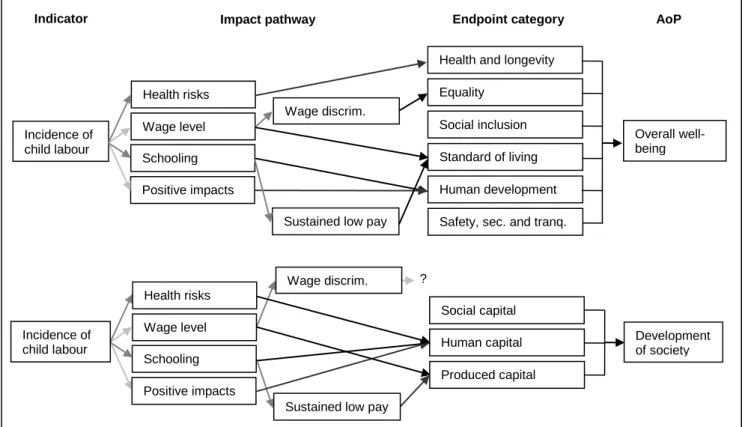
The first of these studies addresses the validity of impact pathways in SLCA, which denotes the cause effect relationship between indicator and the ‘Area of Protection’ (AoP), representing the underlying issue of importance assessed in the SLCA. The study is based on two examples from the existing work on SLCA: One considers whether the type of indicators included in SLCA
approaches can validly assess impacts on the one of the two definitions of AoPs in SLCA, being the well-being of the stakeholder, and the other example addresses whether the ‘incidence of child labour’ is a valid indicator to assess impacts on the AoPs. Both examples show a poor validity of the impact pathways. The first example shows that depending on the definition of ‘well-being’ the assessment of impacts on the well-being of the considered stakeholder can not be performed exclusively with the objective indicators which are presently used in SLCA approaches. Objective indicators are indicators designed to measure impacts which can, at least potentially, be measured without the involvement of the impacted stakeholder. If well-being is understood as something pertaining to the experience of the individual, subjective indicators are needed, which are indicators that focus on the experiences or feelings of the impacted stakeholder.
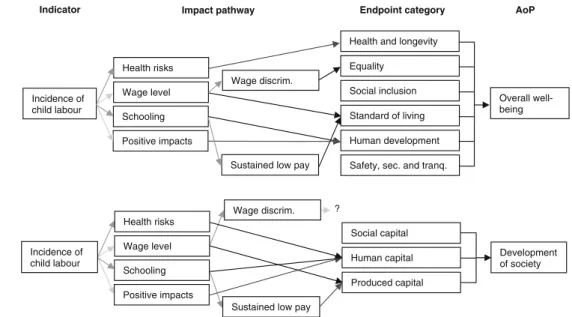
The second example shows that the mere fact that a child is working tells little about how this may damage or benefit the AoPs, implying that the normally used indicator; ‘incidence of child labour’ lacks validity in relation to predicting damage or benefit on the AoPs of SLCA. More valid
indicators should rather focus on, among others, the health impacts of child labour and its impacts on schooling outcomes. However, even though the indicators proposed in both examples may improve the validity of the assessment, a problem is that in both cases, the indicators demand more detailed data, which may limit their usability.
The second study begins by considering that the SLCA as presented here should assess the consequences of a decision. This can be expressed as the difference between how the world is or will be because of the decision and how the world would look like had it not been for this decision. At this point it is important to realise that social impacts on individuals do not only happen in product life cycles, but in all aspects of their life. Thus, if a decision implies that a worker participates in a product life cycle, the worker will, if the decision is not taken, have to do something else, which will equally impose some impacts on him or her.
When assessing the consequence of a decision for the worker it is thus this difference between these two situations, the ‘implemented’ vs. the ‘non-implemented’ decision which should be considered. More or less same argument goes for the product user. The study attempts to model the impacts of the ‘non-implemented’ decision in relation to the worker and the product user and finds that when the non-implemented decision situation means that the product is not produced at all, it is often associated with increased levels of unemployment. Literature on unemployment suggests that unemployment causes decreased health levels, increased poverty, family tension and violence and crime, but that the impacts may vary with context of the unemployed. If the non-implemented decision implies that a product user will no longer use a product the non-implemented decision may lead the user to choose another products associated with another life cycle and thereby other social impacts or choose to spend his or her time on something not related to product life cycles, which will equally impose social impacts on the user.
The assessment of the impacts of the non-implemented decision is discussed and found to be difficult due to the complexity of identifying what this non-implemented situation amounts to. However, it is argued that some relatively simple assessments may be performed which may still improve the validity of the assessment in comparison to simply ignoring the impacts of the non-implemented decision, however inaccurate they may be.
The third and unfinished study addresses the possible influence of the context on the validity of SLCA. Here two examples are analysed. One relating to the context variability of proposed endpoint categories in SLCA where it is shown on the basis of literature that what influences the well-being of the individual (one of the suggested AoPs in SLCA) differs across respondents and geographical groups, implying that the importance of the various suggested endpoint categories varies with context.
The second example addresses the data collection procedures through social audits. Through an interview with a social auditor it is suggested that the auditor varies the procedures for carrying out the audit in order to get the most valid result. For example, the auditor has to take into account the various tricks a company in a given context normally uses to cheat the auditor. However, this conclusion is based on only one interview and must therefore be considered as uncertain.
Both cases thus points to that context plays a role for how the methodology in relation to endpoint categories and data collection procedures needs to take account of the context in order to get a valid assessment and it is therefore argued that not only may data be site-specific in SLCA, so may methodology if the context variation should be accounted for.
iii The results of the studies addressing the problems of validity in SLCA all suggest measures of improvement which entail more laborious, and thereby probably also less usable, assessments, whereas the study addressing usability concludes that from a company perspective a less laborious approach is needed. It thus seems that there is a trade-off between validity and usability and it is therefore discussed to what extent compromises can be made. Here it is argued that different users may be imagined who may have different possibilities and demands in terms of requirements to work and validity of the assessment and that several different SLCA approaches should be available fitting these different possibilities and demands to increase the overall use of SLCA. However for all of these different approaches it is argued that the assessment should as a minimum be more accurate than no assessment at all. If this is not the case, SLCA can hardly be regarded as decision support. This minimum requirement is discussed in more detail and it is found that while inclusion of other measures proposed for increasing the validity of SLCA is for the user of the SLCA to decide, the assessment of the impacts of both the implemented and non-implemented life cycle situations, addressed in the second validity related study, must always be included. However, since this validity demand only establishes very few requirements to the user, this methodological ‘openness’ may potentially be used to consciously select indicators or data in favour of one alternative. To mitigate this possibility for manipulation, a more comprehensive demand is considered which is to always include an assessment of the completeness and uncertainties in SLCAs accessible to the public. This, however, requires knowledge about how certainty and completeness is established in SLCA, calling for further studies into the validity of SLCA
procedures. Several studies addressing this issue are proposed. A final discussion summarises the findings and concludes that due to raised difficulties in SLCA about data availability and issues like the assessment of the non-implemented decision, SLCA may never gain the same popularity as ELCA.
Resumé
Denne afhandling søger at bidrage til udviklingen af den sociale livscyklusvurdering (SLCA), som kan defineres som en vurderingsmetode til at vurdere de sociale påvirkninger knyttet til produkters, services og systemers livscyklus. Når man går i gang med en sådan udvikling, er det vigtigt at holde sig for øje, at udviklingen af SLCA kun er interessant i det omfang, metoden opfylder sit mål. I denne afhandling er målet blevet defineret til, at SLCA skal kunne forbedre de sociale vilkår for de interessenter, som bliver påvirkede af det vurderede produkt, system eller services livscyklus. Denne effekt skal opnås ved, at beslutningstageren følger vurderingens ’råd’. For at en positiv effekt kan ske ved at følge et råd, skal det alternativ, som bliver valgt af beslutningstageren føre til mere favorable sociale konsekvenser end de andre vurderede alternativer som beslutningen står imellem. Dette indikerer, at vurderingen skal repræsentere konsekvenserne for hvert alternativ så validt som muligt. Men for at den ønskede effekt kan opstå er validiteten af vurderingen ikke nok; vurderingen skal også være brugbar i en beslutningskontekst. Målet for denne afhandling er derfor at identificere emner, som kan hindre brugbarheden og validiteten af SLCA og at foreslå procedurer til at afhjælpe disse problemer.
For at adressere brugbarheden af SLCA blev 8 danske virksomheder interviewet omkring deres interesse i og mulighed for at bruge SLCA. Dette studie viste, at interessen for SLCA var begrænset til eksterne formål, især komparative analyser til brug i markedsføring. Det blev dog også
konkluderet, at virksomhedernes muligheder for at skaffe de nødvendige data om deres produkters livscyklusser var meget begrænsede, for eksempel fordi leverandører ikke var villige til at udlevere data til de interviewede virksomheder, eller fordi varerne var købt på åbne markeder med et stort antal uidentificerede leverandører. Dette vil potentielt begrænse brugen af SLCA i en
virksomhedssammenhæng til applikationer med meget begrænset livscyklusperspektiv. Det kan være vanskeligt at afhjælpe dette problem, da den eneste måde synes at være at sænke kravene til validiteten af data, der indgår i SLCA. Hvis en virksomhed benytter en sådanne data til eksterne formål, vil virksomheden løbe den risiko at markedsføre sig på forkert grundlag, som hvis det bliver opdaget, kan være stærkt belastende for virksomheden.
Derudover bliver det diskuteret, at andre brugergrupper, såsom regeringer og mellemstatslige organisationer, kan have andre krav til SLCA og derfor også andre muligheder.
Brugbarheden af SLCA er kun adresseret i dette ene studie. De følgende tre studier fokuserer på validiteten af SLCA. Grunden til dette større fokus på validiteten er, at brugbarheden af SLCA uundgåeligt vil blive berørt under udviklingen af SLCA, hvorimod dette ikke er tilfældet med hensyn til validiteten.
Det første studie beskæftiger sig med validiteten af de årsagssammenhænge, som antages at være mellem indikatorer og AoP (’Area of Protection’), som repræsenterer det grundliggende område, der måles på i SLCA. Studiet er baseret på to eksempler fra eksisterende SLCA metodeforslag: Et eksempel handler om, hvorvidt foreslåede indikatorer validt kan vurdere påvirkninger af
interessenters velvære, som er en af to definitioner af AoP i SLCA. Det andet eksempel analyserer, om ’forekomsten af børnearbejde’ er et validt mål for påvirkninger af SLCAs AoP’er. Begge eksempler viser en mangel på validitet af de antagne årsagssammenhænge. Det første eksempel viser at afhængigt af definitionen på velvære, kan påvirkninger af interessenter ikke måles udelukkende ved at bruge objektive indikatorer, som anvendes i de eksisterende SLCA metoder. Objektive indikatorer er indikatorer beregnet til at måle påvirkninger, der potentielt kan måles uden inddragelse af den berørte interessent. Hvis velvære forstås som noget, der vedrører individets oplevelse, er subjektive indikatorer nødvendige. Subjektive indikatorer fokuserer på, hvordan individet oplever påvirkningen.
v Det andet eksempel viser, at den omstændighed at et barn arbejder fortæller meget lidt om, hvordan AoP’erne bliver påvirket, hvilket indebærer, at ’forekomsten af børnearbejde’, som er den normalt anvendte indikator for børnearbejde, mangler validitet i forhold til at kunne måle effekten på AoP’erne. Derimod vil indikatorer, som fokuserer på bl.a. de sundhedsmæssige virkninger af børnearbejde og dets indvirkning på barnets skolegang give mere valide resultater. Men selv om de indikatorer, der foreslås i begge eksempler kan forbedre validiteten af vurderingen, kræver disse indikatorer mere detaljerede data, hvilket kan begrænse indikatorernes anvendelighed.
Det andet studie tager udgangspunkt i, at SLCA, som den bliver præsenteret her, skal vurdere konsekvenserne af en beslutning relateret til produkt livscyklusser. Dette kan udtrykkes som forskellen mellem, hvordan verden er eller vil blive som følge af beslutningen, og hvordan verden ville se ud, hvis det ikke havde været for denne beslutning.
Sociale konsekvenser for individer forekommer ikke kun i produktets livscyklus, men i alle situationer af den berørtes liv. Hvis en beslutning leder til, at en arbejder bliver inddraget i en produktlivscyklus, vil arbejderen, hvis beslutningen ikke bliver taget, blive nødt til at gøre noget andet. Dette andet vil ligeledes have konsekvenser for ham eller hende. Konsekvensen af en beslutning er således forskellen mellem disse to situationer; den ’implementerede’ og den ’ikke-implementerede’ beslutning. Samme argument får betydning for produktbrugeren, som ligeledes må gøre noget andet hvis denne ikke bruger produktet. Studiet forsøger at analysere virkningerne af den ’ikke-implementerede’ beslutning i forhold til arbejderen og produktbrugeren og konkluderer, at når den ikke-implementerede beslutningssituation betyder, at produktet ikke bliver fremstillet, er det ofte forbundet med øget arbejdsløshed. Litteratur om arbejdsløshed viser, at arbejdsløsheden ofte leder til dårligere fysisk og psykisk helbred, øget fattigdom, familiespændinger, vold og
kriminalitet, men at disse konsekvenser varierer alt efter konteksten.
I forhold til produktbrugeren vil den ikke-implementerede beslutning medføre, at produktbrugeren ikke længere vil bruge produktet, hvilket leder til, at brugeren enten vælger et andet produkt, som vil udsætte brugeren for andre påvirkninger og være forbundet med en anden livscyklus, eller brugeren kan vælge at bruge sin tid på noget, der ikke relaterer til produkter, hvilket også vil have konsekvenser for brugeren.
At vurdere påvirkningerne af den ikke-implementerede beslutning bliver fundet vanskelige, da det viser sig problematisk at identificere, hvad denne situation leder til for arbejderen og
produktbrugeren. Det konkluderes dog, at nogle relativt simple analyser kan udføres, som stadig kan forbedre validiteten af vurderingen i forhold til blot at ignorere konsekvenserne af de ikke-implementerede beslutning.
Det tredje og uafsluttet studie adresserer kontekstens mulige indflydelse på validiteten af SLCA. To eksempler bliver diskuteret. Et ser på variationen af, hvordan AoP bliver påvirket i forskellige kontekster. Her bliver det påvist på baggrund af litteraturstudier, at hvad der er vigtigt for den enkeltes velvære, som er en af de foreslåede AoP’er i SLCA, adskiller sig på tværs af individer og geografiske områder, som dermed indikerer, at det forslåede AoP er kontekstafhængigt.
Det andet eksempel omhandler indsamlingen af data igennem såkaldte sociale audits. Et interview med en auditør sandsynliggør, at auditører varierer procedurerne for udførslen af auditet for at få et så validt resultat som muligt. For eksempel tog den interviewede auditør i sin procedure højde for de forskellige tricks en virksomhed i en given kontekst normalt brugte for at snyde auditøren. Konklusion er dog kun baseret på et interview, og må derfor betragtes som noget usikker. I begge tilfælde er det påvist, at konteksten spiller en rolle for validiteten af vurderingen, og der bliver derfor argumenteret for, at denne variation bør inkorporeres i SLCA.
Resultaterne fra disse studier omhandlende validiteten af SLCA peger alle på ændringer, som vil gøre SLCA mere arbejdskrævende at bruge, hvilket antageligt også vil føre til en mindre
brugbarhed af SLCA. Samtidig peger studiet af SLCAs brugbarhed på, at der er behov for en mindre krævende SLCA. Det ser derfor ud som om, at en afvejning mellem graden af validitet og brugbarhed af SLCA er nødvendig. I forlængelse heraf bliver det diskuteret, hvordan kompromisser mellem disse krav kan nås. Som tidligere nævnt kan forskellige brugere af SLCA have forskellige muligheder for at anvende SLCA og varierende krav til validiteten af vurderingen, hvilket indikerer, at flere SLCA metodologier bør laves, således at de passer til forskellige muligheder og krav for derved at øge den samlede brug af SLCA. Dog bliver der argumenteret for, at et minimumskrav til validiteten af vurderingen må være, at vurderingen skal være mere nøjagtig end det tilfældige valg. Hvis dette ikke er tilfældet, kan SLCA næppe ses som et beslutningsstøtteværktøj. På basis af dette minimumskrav bliver det konkluderet, at det er nødvendigt altid at inkludere vurderingen af både den implementerede og den ikke-implementerede beslutning i SLCA, hvorimod inkluderingen af alle de andre forslag til forbedringen af validiteten af vurderingen kan besluttes af brugeren af SLCA. Disse meget løse krav til vurderingen kan dog føre til et bevist valg og fravalg af data og indikatorer for at favorisere et beslutningsalternativ. For at mindske denne risiko for manipulation er det foreslået, at en vurdering af SLCA’ens fuldstændighed og sikkerhed altid bør medtages, hvis denne er offentligt tilgængelig. Dette kræver dog, at man har viden om, hvordan fuldstændighed og sikkerhed er opnået i en SLCA, hvilket peger på flere studier af validiteten af SLCA metodikken. Flere studier som adresserer dette emne er foreslået.
En afsluttende diskussion opsummerer resultaterne og konkluderer, at på grund af de nævnte
vanskeligheder med SLCA blandt andet i forhold til tilgængeligheden af data og vurderingen af den ikke-implementerede beslutning, vil SLCA måske aldrig nå samme popularitet som ELCA.
vii Preface
The idea for this thesis was born in a supermarket out of confusion. Confusion about whether to choose biodynamic bananas over fair trade and about whether to go for the EU flower labelled rather than the allergy-friendly shampoo in order to buy the product which was doing ‘the most good’. As a response I imagined a label condensing all of these concerns into one, allowing the consumer to choose more easily, and hopefully pushing the producer to ‘make better products’. My interest in the idea grew and being a student of the Technical University of Denmark and having had a course in ‘life cycle assessment’, it was obvious to me from the start that when being
interested in such a complete overview of the consequences of a product, the life cycle perspective was essential. I therefore in the spring 2006 contacted Michael Hauschild, my previous teacher in the life cycle assessment course, and aired the idea of working with the development of such a label in a PhD project. His response was positive, but he argued that in order to develop such label it was necessary to have a well founded methodological basis. On the environmental area, he argued, such methodology already existed manifested in the relatively established (environmental) life cycle assessment (ELCA), but since my idea was also to include aspects related to the ‘human living conditions’ in the label, the focus should be on developing a methodological basis for the
assessment of these ‘human costs’; a social life cycle assessment (SLCA) in contrast to the existing ELCA. I agreed to this approach and in the matter of a few days we had arranged an application for a university funded PhD scholarship which was granted during the summer 2006.
The result of this PhD scholarship is this thesis, which because of shifts in focus did not come to relate specifically to the labelling situation but to the development of SLCA in a more general sense.
Apart from a few chapters and discussions not previously presented, this thesis is more or less a summary of main findings in the published and submitted articles where I have been the first author written during the project, presented here as a coherent whole. With this focus and due to the limited length of the thesis, the findings in the articles are presented in a very short form where some discussions given in the articles have been shortened or in some cases left out. The articles are presented in their entirety in the appendices 2 to 5. A complete overview of articles and conference presentations to which I have contributed during the PhD project is given in appendix 1.
The PhD project was performed in the period from September 2006 to February 2010, including 6 months of leave to participate in an EU project.
I would like to thank my two supervisors Michael Hauschild and Michael S. Jørgensen, both from the Department of Management Engineering at the Technical University of Denmark. Also, I would like to thank the Department of Environmental Technology at the Technical University of Berlin, especially Marzia Traverso, Anne Lehmann and Matthias Finkbeiner, for a motivating and in all regards fantastic stay in the period from July 2009 to October 2009.
Kgs. Lyngby, February 3rd 2010
ix
Content
1 Introduction ... 1
1.1 What is the SLCA? ... 1
1.1.1 System boundaries ... 2
1.1.2 Area of Protection, impact categories and indicators ... 2
1.1.3 The collection of data ... 3
1.1.4 Impact assessment ... 4
1.2 The need for SLCA development ... 4
1.3 Identification of the goal of SLCA, the criteria of success for its development and purpose of study ... 5
2 The usability of SLCA – taking a company perspective ... 8
2.1 Results ... 8
2.2 Implications for the development of SLCA ... 10
3 The validity of SLCA... 12
3.1 The validity of impact pathways in SLCA... 14
3.1.1 Example 1: The well-being of the stakeholder ... 14
3.1.2 Example 2: Indicators on child labour ... 15
3.1.3 Implications for the development of SLCA ... 16
3.2 Addressing the baseline in SLCA ... 18
3.2.1 Implications for the development of SLCA ... 20
3.3 The influence of the context on the validity of SLCA ... 22
3.3.1 Well-being and context ... 22
3.3.2 The data collection ... 23
3.3.3 Implication for the development of SLCA ... 25
4 How should SLCA be developed? ... 26
5 Topics for future research ... 30
6 References ... 33
7 Appendix 1: Publications, posters and oral presentations ... 39
8 Appendix 2: Methodologies for Social Life Cycle Assessment ... 41
9 Appendix 3: Relevance and Feasibility of Social Life Cycle Assessment from a Company Perspective ... 51
10 Appendix 4: Assessing the validity of impact pathways for child labour and well-being in Social Life Cycle Assessment ... 63
1
1
Introduction
Since the environmental movement in the 60’s it has been increasingly clear due to man’s
increasing number and technological power that nature could no longer be seen as having infinite resources and being an infinite sink for waste and emissions. To ensure mankind’s continued wellfare it was obvious that some degree of control was needed with the goal of ensuring that not only should present generations be able to meet their needs, future generations should as well, as it was formulated in the Brundtland Report (Brundtland 1987). Our development should in other words be sustainable, and ensuring the availability of the natural resources for future generations was here seen as a key concern. But evidently mankind’s wellfare is not only dependent on natural resources; it is also dependent on well-functioning societies. Thus, nature cannot be seen as the only resource, the functioning of society can equally be seen as a resource to preserve or enhance, and accordingly the idea arose that sustainability has three dimensions, which besides an environmental dimension includes a social and economical dimension, representing the resources in society. Going from this theoretical level to a more practical, to plan for a sustainable development we are faced with the need to make decisions taking us in a more sustainable direction. As a response to this the environmental life cycle assessment (ELCA) has been developed. The ELCA is as its name suggests a life cycle oriented environmental assessment methodology1
But based on the assumption that sustainable development is not only about preserving the
environment but also the social and economical resources, the idea arose to develop parallel product assessment methodologies on these areas.
focused on products, system or service (from here on simply termed ‘products’) meaning that it is an assessment methodology which attempts to include all material inputs and outputs to and from the assessed product from its cradle (often material extraction) over product production, and use to its grave (disposal). Based on this inventory of material inputs and outputs and knowledge of the various inputs’ and outputs’ impact on the environment an environmental ‘profile’ of the product can be made, illustrating the environmental impacts the product will have throughout its life cycle, enabling the decision maker to choose solutions resulting in fewer environmental impacts than the alternatives (for more information on ELCA, see for example Wenzel et al. 1997).
The overall idea behind this study is to contribute to the development of the methodology for assessing the social ‘costs’ of a product’s life cycle. However, in the last 5 years there has been an increased interest in the development of such a methodology, often named the social life cycle assessment (SLCA). The development undertaken in this study therefore does not start from scratch but rather builds on existing work. In the following an overview of this existing work on the
development of SLCA will be given. The overview is primarily based on Jørgensen et al. (2008), which can be seen in its entirety in appendix 2.
1.1 What is the SLCA?
SLCA can be characterised as a methodology, or in other words some procedural steps, which if followed leads to an assessment of the social impacts of a product over (parts of) its life cycle. With some small variations, the SLCA is in literature considered to include more or less the same procedural steps as an ELCA, outlined in the ISO 14044 (2006) which is the international standard for performing an ELCA, including a goal and scope definition, inventory analysis, an impact assessment and an interpretation. Much can be said about each of these phases, but in short the purpose of each of these is as follows:
• The goal definition addresses what is to be assessed and why the assessment is performed.
1 Much in line with the LCA tradition, ‘methodology’ will here be understood a series of procedural steps which may be followed to obtain a specific result. Methodology, tool and approach will thus here be used interchangeably.
• The scope definition addresses the choices made in order to perform the assessment and the limitations of the assessment.
• The purpose of the inventory analysis is to collect the data as outlined through the goal and scope definition
• In the impact assessment, the inventory data is through models ‘translated’ into impacts. • In the interpretation the outcome of the previous phases in accordance with the goal
definition of the study
In the following it will be outlined in more detail how the various SLCA approaches have addressed; the setting of systems boundaries and selection or definition of impacts to include in relation to the scope definition; in relation to the inventory assessment how the data is to be collected; and in relation to the impact assessment how inventory data is translated into impacts. The merits and shortcomings of the presented approaches will not be discussed here. In Jørgensen et al. (2008) (appendix 2) several other issues have also been addressed, which due to the lack of relevance for this thesis have been omitted here.
1.1.1 System boundaries
As mentioned, SLCA assesses a product’s life cycle, but since a life cycle in principle is infinite there is in SLCA a need for establishing boundaries for the system to assess2. Two different
suggestions are given to this issue: With the goal to support management decisions, the approaches presented by Méthot (2005) and Dreyer et al. (2006) narrow their focus to those parts of the life cycle that the company performing the assessment can influence directly. The application of the SLCA thereby justifies that only the company and its closest suppliers and distributors are assessed. Another approach has been to in principle include the entire life cycle, but preclude processes that do not significantly change the overall conclusions of the study (Weidema 2005; Spillemaekers et al. 2004; Barthel et al. 2005).
1.1.2 Area of Protection, impact categories and indicators
When assessing the social impacts associated to a product’s life cycle, there are several elements which need to be considered. First of all there is a need to consider what is meant by social impacts. This has in existing work on SLCA been defined and delimited by the definition of the so-called Area of Protection (AoP) 3
2
Other possibilities are given in input-output LCA. IO-LCA has also very recently been applied to SLCA, see Andrews et al. (2009).
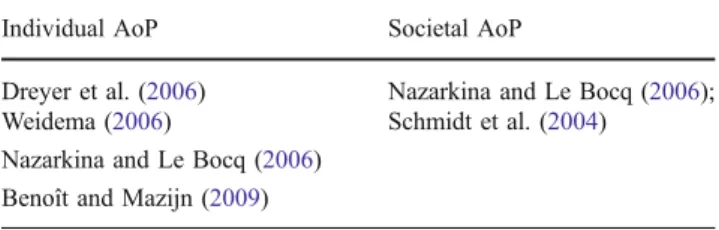
which denotes underlying themes of concern the assessment centres on. The AoP of SLCA has by Dreyer et al. (2006) and Weidema (2006) been defined quite
unanimously as everything affecting ‘human health and well-being’. Schmidt et al. (2004) on the other hand propose ‘societal wealth’. But in both cases, the AoP is a rather abstract phenomenon and it is evident that to perform an SLCA something more concrete and operational is needed. As a response to this, most of the publications on SLCA include a list of more concrete social issues to address in the SLCA, often termed impact categories, which in some cases are further
operationalised into social indicators. The impact categories can, depending on their ‘location’ in relation to the impact pathways be at both midpoint and endpoint. For example, the impact category job creation is normally not considered a goal in itself, but through contributing to the family
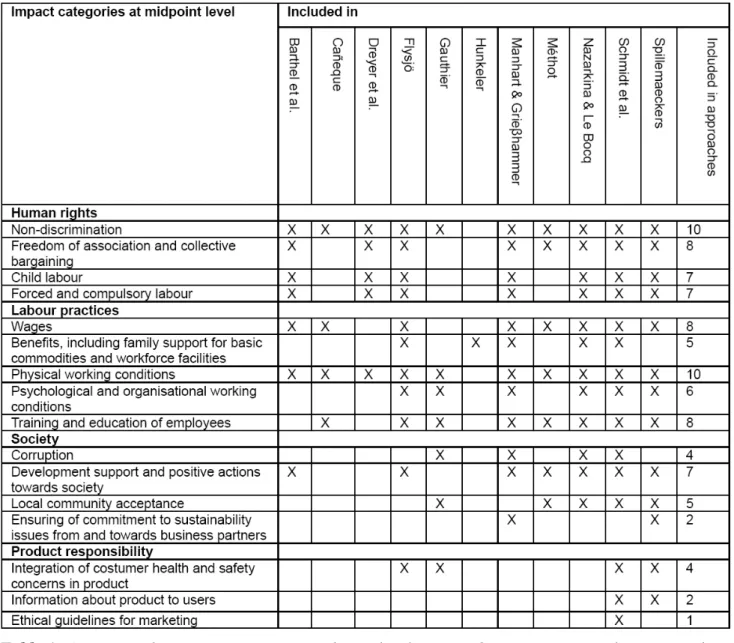
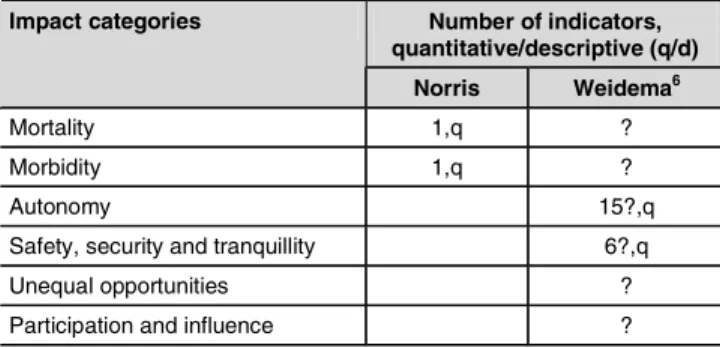
income and subsequent poverty reduction it may improve the family’s health conditions, which may be considered as an end goal. In this example, the job creation could thus be considered being at midpoint level, whereas health condition at endpoint. Both are included in the tables below:
3 AoP is a term originally defined in environmental LCA to represent the classes of environmental endpoints that society wants to protect (Udo de Haes et al. 1999)
3
Table 1: Overview of impact categories at midpoint level proposed in existing SLCA literature. The
table is based on Jørgensen et al. 2008.
Table 2: Overview of impact categories at endpoint. The table is based on Jørgensen et al. 2008.
1.1.3 The collection of data
Having established the impact categories and indicators needed to perform the assessment, data is needed throughout the assessed life cycle for each of the indicators included. A debate which arose at this point was that contrary to ELCA, where it is generally accepted that the environmental
impacts arise mainly because of the nature of the processes that occur in the life cycle4, Spillemaeckers et al. (2004) and Dreyer et al. (2006) claimed that social impacts as the ones proposed above have no relation to the processes themselves but rather to the conduct of the companies performing the processes. In other words, it is often assumed that there is a causal link between process and environmental impact, but for social impacts it is argued that the causal link is not from process to social impact, but from conduct of the company to the social impact. This implies that two companies producing exactly the same products and, based on the argument above, having comparable environmental impacts can have completely different resulting social impacts making the use of generic process related data as used in ELCA irrelevant or at best very uncertain to apply. Dreyer et al. (2006) and Spillemaeckers et al. (2004) argue instead that until frequently updated databases on the conduct of the companies included in the life cycle is available, site specific data has to be collected. Spillemaeckers et al. (2004) nuance this view by arguing that risk assessments of each company or other stakeholder included in the life cycle can be performed to reduce the work load of collecting site specific data for the whole life cycle. Other scholars on the other hand maintain the process oriented approach in SLCA as a basis for the data collection (see e.g. Barthel et al. 2005)
1.1.4 Impact assessment
As can easily be imagined an assessment utilising in some cases more than 50 different social indicators related to very different impact categories, as illustrated in table 1 and 2 above, will easily result in a rather obscure result on which it may be difficult to base any decision. A more comprehensible assessment of the impacts may thus be needed, and different approaches have been opted for by various scholars. From an overall perspective two different approaches can be
deduced; a subjective and a theoretical assessment of the impacts. In the subjective approach each indicator score is given a subjectively defined weight allowing for adding indicator scores together yielding, in some cases, a single assessment score (see e.g. Schmidt et al. 2004). The more
theoretically oriented approach is very similar but tries to establish weights based on research on how much each type of indicator score contributes to damage to the AoP and utilises these relationships to create a more condensed assessment result (see e.g. Weidema 2006).
But even though the idea of introducing an impact assessment in SLCA is probably inspired by ELCA the concept seems to have slightly different functions, partly reflecting that the indicators in many SLCA approaches collect information about impacts or behaviour predisposing impacts rather than on the kind of fundamental behaviour which would parallel the physical flows which are inventoried in ELCA. Indicator scores in SLCA are thus more understandable in themselves (because they can be related to directly) making the ‘interpretation’ of the indicator scores less essential in SLCA, whereas indicator scores in ELCA have to be ‘translated’ into impacts or potential impacts to give meaning to most decision makers.
1.2 The need for SLCA development
As it can be deduced from the introduction above, SLCA is still at a relative early stage where different approaches are considered on all levels of the methodology, both in terms of boundary setting, AoP, impact categories and indicators and data collection method, as well as impact assessment (to mention the elements touched upon in this short overview). But despite their
differences, several approaches were tested in case studies and were able to give life cycle oriented assessments of the social impacts of a product. It thus seems that there are already methodologies
4 According to the ISO 14044 (2006) processes are a set of interrelated or interacting activities that transforms inputs into outputs.
5 for performing what this study should contribute to develop, and it is therefore reasonable to ask whether there is in fact a need for further development.
To answer this question, some ‘criteria of success’ for the development of SLCA have to be established, enabling the assessment of the quality of SLCA methodologies.
In order to establish these criteria of success, it is important to point out that the development of SLCA deals with the development of a tool, and that tools are only interesting to the extent that they do what they are supposed to do. This project is in other words within what Ziman (1996, 1998) terms ‘industrial science’, directed towards solving a specific problem or task, as opposed to
‘academic science’, where the ‘pursuit of truth’ is seen as a goal in itself (Ziman ibid.). To establish these criteria of success there is thus a need for defining the specific task or problem SLCA is to solve or mitigate.
Somewhat surprisingly, very little explicit focus has been paid to the question of what SLCA is to solve or mitigate.
This thesis will therefore in the following define the overall purpose of developing SLCA which will lead to the formation of some criteria of success with which SLCA should comply in order for it to be ‘satisfactorily developed’. However, it should be noted that different stakeholders may have different opinions about what purpose SLCA has. The proposed definition is therefore to a high degree reflecting the author’s notions.
1.3 Identification of the goal of SLCA, the criteria of success for its development and purpose of study
As mentioned above, very few explicit claims have been made about what problem SLCA is to solve or mitigate; however, one exception to this exists. In the recently published ‘Guidelines for Social Life Cycle Assessment of Products’ (Benoît & Mazijn 2009) it is stated that: “The ultimate objective for conducting an SLCA is to promote improvement of social conditions and of the overall socio-economic performance of a product throughout its life cycle for all of its
stakeholders”. In other words, the purpose of SLCA is defined as to improve social (including socio-economic) conditions for the stakeholders in the life cycle5. Accordingly, SLCA is to be more than just a ‘fell good’ tool; it should be a ‘do good’ tool, and ensuring a positive effect of SLCA on the assessed stakeholders is in this thesis taken to be the goal for the development of SLCA. This implies that the quality of an SLCA approach should be assessed from the perspective to what extent it is able to support the achievement of this goal.
As a point of departure in analysing the effect of SLCA it may be asked: How may this effect come about? To answer this question an idea of what it is that SLCA does is needed. As mentioned above, it is here assumed that the goal of SLCA is to provide decision support. This decision support may either create a change through decision makers following the ‘advise’ of the assessment, or in several other more indirect manners, for example through creating incentives in the market for companies to perform well on the issues included in the SLCA; through increasing the awareness among SLCA users and audience about the social impacts of various activities; or through its development and use to feed into the academic or public debates, etc. This thesis will address the ‘direct effect’ outlined above. The reason is primarily that this issue seem to lie within the ‘SLCA methodology boundaries’, as the question relates directly to the assessment that SLCA should provide, whereas the other questions seem to be related to fields of study much less related to the SLCA methodology in itself. Furthermore, intuitively it also seems that ensuring that SLCA has the
5 Stakeholders in the life cycle are here defined as the individuals affected by the product throughout its life cycle. Based on Jørgensen et al. (2008) this is considered to include the workers in the life cycle, the community in which the life cycle is taking place, and the product user.
necessary attributes for a positive effect to arise in a decision making context will not necessarily hamper any benefits from the other more indirect potential effects.
The effect addressed here is thus the potential positive effect of decision makers following the advice given by the applied SLCA methodology. In order for a positive effect to arise from following a decision, the alternative chosen on the basis of the assessment has be associated with more favourable social impacts than the other assessed alternatives between which the decision is to be made. When speaking about SLCA creating a positive effect what is meant is thus the effect arising as a consequence of decision makers choosing an alternative having the most favourable social impacts, not that the assessment in itself creates any positive effect. Thus, in order for a decision to create a positive effect for the stakeholders in the life cycle of the assessed product, the SLCA should validly6 illustrate the social consequences the alternatives have7,8
However, the fact that the SLCA from a methodological point enables the user to perform valid assessments of the consequence of decision alternatives, will not create the kind of effect addressed here in itself; the SLCA furthermore has to be usable in a decision making context, which is then a second criterion of success for the development of SLCA. It therefore seems that to create this kind of effect, the SLCA should both enable valid assessments of the true consequences of a decision and at the same time be usable.
. If this is not the case, the assessment will not enable the decision maker in choosing the alternative having the most favourable social impacts. Validity of the assessment is thus a criterion of success for the
development of SLCA as it is a necessary precondition for SLCA to have a positive effect.
The purpose of this thesis is thus to add to the development of a SLCA, which both enables the assessment of the social consequences of a decision as validly as possible and which at the same time is as usable as possible in a decision making context. This will be done by addressing in a non-exhaustive way the two questions:
• Which issues may hinder the usability and validity of the SLCA?... and
6 An assessment will in this thesis be defined as ‘valid’ if the assessment measures what we intend to measure. An assessment methodology is valid if it allows for valid assessments. The degree to which an assessment is valid in other words defines the correspondence between reality and the assessment result. Validity is not to be confused with ‘reliability’ which ‘merely’ relates to reproducibility or the degree to which the result will always be the same if the assessment methodology is applied on the same situation. An assessment methodology can thereby be highly reliable without being valid whereas the opposite not is possible (Carmines & Zeller 1979).
7
A question which arises is how we can validly assess social consequences. For this to make sense, we have to make a series of assumptions about the social world. First of all we have to assume that there is only one reality in the social world, i.e. that the consequences are real and that they can be examined and communicated accurately. If not, it does not make sense to say that an assessment of the social world resembles the reality of the social world. The social world is in other words in this SLCA framework assumed real, measurable, communicable and independent of our measurements. With the goal of developing an SLCA that assesses the real consequences, it may also be questioned whether it makes sense to develop an SLCA without these metaphysical assumptions, since if it is assumed that the assessment is in itself constructing a reality, there seems to be few arguments why the SLCA should be better than any other kind of thinkable assessment in terms of assessing reality and hence why it should have any particular weight in a decision making context.
The nature of the social world will not be discussed in any depth here but it should however be mentioned that opposite viewpoints are widespread throughout academia implying that several research paradigms within the social sciences would contest these assumptions. See for example Burrell & Morgan (1979) for a discussion of different research paradigms within the social sciences.
8 This thesis will thus relate to the development of a ‘consequential’ SLCA rather than an ‘attributional SLCA. Consequential (S)LCA attempts to establish the consequences of a decision, and thus in principle includes an
assessment of changes in all systems affected by a decision (Weidema 2003), typically that a process is included in the assessment if it is part of the product life cycle, disregarded whether a change occurs with regards to the process as a consequence of choosing the product.
7 • What procedures should be incorporated in the SLCA alleviating these problems?
This research approach can be criticised for being too technocratic. Technocratic in the sense that it assumes that the developer purely by shaping the technology9
But even though that the findings from a ‘top-down’ inspired study will not be able to guarantee that an SLCA lives up to a predefined purpose, the study may still come up with some necessary conditions for this to happen. In this relation it is also important to mention that this study will most likely be supplemented by more ‘bottom-up’ oriented approaches to the development of SLCA since this approach has until now been the most prevailing in the publications on SLCA.
(the SLCA) can decide how it will interact with its surroundings; in this case create a positive effect on the stakeholders in the life cycle of the assessed product. It has for example been argued many times that in order to understand how technology gets adopted and used in society, it is not enough to understand technology in itself. In other words, it is (in most cases) not the developer or designer who decides the way in which the developed technology will be used, nor is it the user that fully decides for him- or herself how to use the technology. There will most often be a ‘disagreement’ and room for ‘negotiation’ between the user and technology where a mutual adaptation will be taking place. User and technology are so to speak located in an interplay where they together define how the technology will be used (Akrich 1992, Akrich et al. 2002a,b). The ‘top-down’ approach taken here where the purpose of SLCA has been identified on beforehand and used as a guide for its development, in comparison to a more ‘bottom-up’ inspired approach where a method is developed after which its merits are studied through case studies, could therefore be argued to put too much emphasis on the power of the developer.
Another issue which will be clearer later is that very different issues will influence to what extent SLCA meets its purpose. This study will thus analyse very different issues which could lead to the critique that the study is too broad and that the study preferably should focus more thoroughly on a narrower range of issues. Here it is important to remember that the development of SLCA is still at its infancy, as it was concluded in the review above, and at this point it seems more relevant to discuss the overall lines, than digging deep into an issue, which later in SLCA’s development may show to be less central.
In the following chapters the question of usability of SLCA will first be addressed, followed by three chapters addressing issues of validity of the SLCA.
2
The usability of SLCA – taking a company perspective
This chapter is based on parts of Jørgensen et al. (2009a), which can be read in its entirety in appendix 3.
The purpose of this chapter is to address the usability of SLCA, which can be done in different ways. One method is to provide a potential user with an SLCA methodology and after application interview the user about the usability. Another way, which was chosen here, was to interview potential users about their potential use of SLCA. One problem here is that SLCA is not yet a well-defined methodology, as argued above, but based on its similarity to ELCA it is possible to outline several potential applications of SLCA and equally the tasks a user must be able to perform in order to make use of these applications. It is in other words possible to address the attractiveness of the different functionalities of SLCA and raise the question about the feasibility for the potential users in performing the necessary tasks for providing these functionalities. This analysis will not try to weigh these ‘costs and benefits’ of using SLCA against each other but merely attempt to outline what kind of functionality the SLCA should be able to provide and at the same time identify aspects which should be mitigated in the SLCA methodology to increase its usability.
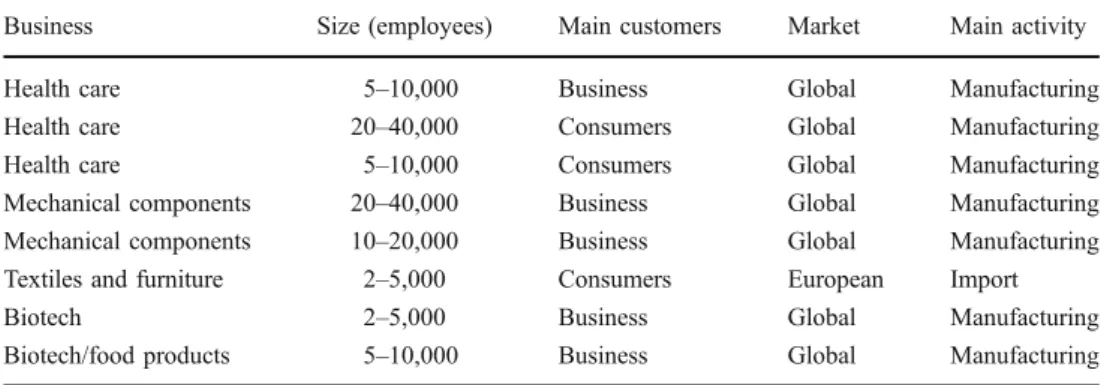
Several different potential user groups may be identified. This chapter addresses the issues of attractiveness and feasibility of SLCA from a company perspective through a series of eight semi-structured interviews with larger Danish companies, all of which potentially have the capacity and will to use comprehensive social assessment methodologies.
2.1 Results
To address the attractiveness of the SLCA, it was necessary to address the companies’ positions towards the functionalities of SLCA, as mentioned above. From an overall perspective SLCA would, if developed as a parallel to ELCA, be able to fulfil the same overall functionalities. These are often considered as being; a comparative assertion where the two products providing similar functionalities are compared with regards to their social impacts; and a ‘hot-spot’ identification where the most significant social impacts in the life cycle identified. Within these overall lines some functionalities could be found, which the companies found attractive.
First of all, some of the companies found the comparable assertion attractive, as sketched above. Apart from this, some companies also mentioned the assessment of the social impacts related to the use stage10
The interviews also showed that the companies did not find the identification of the most significant social impacts in the product chain an attractive functionality of the SLCA. Almost all companies already had their own satisfactory screening tools for identifying potential ‘hot-spots, for example through various relatively simple risk assessment tools and social auditing procedures.
of a product as an attractive functionality, which potentially could be supported by an SLCA including also (or in this case only) the assessment of the use stage. Finally, one company had experienced a dilemma where they had to choose between imposing different (negative) social impacts on their stakeholders and searched for guidelines that could legitimate their actions in these situations. Weighting different environmental impacts against each other is a part of ELCA and again taking SLCA to parallel ELCA, this may potentially be supported by an SLCA.
Taken together there was therefore an impression that SLCA was to some extent found attractive for external purposes, i.e. purposes where the company demonstrated or, in the case of the
weighting, justified the social impacts of their product’s life cycle to the outside world, whereas for internal and management oriented uses SLCA was found unattractive by the interviewed
companies.
10 The life cycle of a product is normally divided in the stage where raw materials are extracted; the production stage; the use stage where the product is used; and the disposal stage. In between these stages various transport stages may occur.
9 But as noticed above to what extent SLCA is usable is not only a question about what is attractive, it is also a question of what is feasible for the company to do. As it has already been suggested in previous literature (Schmidt et al. 2004, Manhart & Grieβhammer 2006) data availability may be a demanding issue in relation to performing an SLCA. As noted in section 1.1.3 it is important to remember that it is generally assumed in the SLCA community that social impacts in the life cycle of a product or service are related to the management of the production processes or the use of the product and less to the nature of the processes or products themselves (Dreyer et al. 2006;
Spillemaeckers et al. 2004)11. In order to know how something is produced, it must at least be known where it is produced and preferably also under which conditions, information which cannot be determined from knowledge of the product and a bill of materials and list of production
processes. The availability of this information and, hence, the interviewee’s possibilities for getting knowledge about their product chains is central. It was therefore investigated during the interviews to what extent the companies were able to get information about their life cycle. What became apparent during these interviews was that companies were able to get information about their first up- or downstream tier, but further than that most companies were unable or unwilling to go. This could be either because of the unwillingness of suppliers to hand over this information to the companies; because the goods were bought on open markets furnished by a large number of unidentified suppliers; or some companies even considered it ‘bad business practice’ since it indicated a lack of trust in their supplier to check its own suppliers.
Considering these results together it seems that even though the comparative assertion was the functionality of SLCA found most attractive by the companies, it may face significant problems, considering the difficulties of getting knowledge about the remote up- and downstream tiers. This problem was emphasised by the need for site specific data in SLCA, making the data collection very time and resource consuming. Even if it is assumed that proxy data can be established on the social impacts of the life cycle in its various steps, for example through knowledge about the
country in which the up- or downstream tier is located, even this information could be more than the company was able to obtain, making the comparative assertion problematic.
The use stage assessment and the weighting functionality of SLCA on the other hand would not face the same problems, as the data requirements in both cases are much more limited.
It thus seems that the interviewed companies’ use of SLCA will be restricted to applications with very limited or no life cycle perspective.
11
It has been claimed that social impacts relate entirely to the conduct of the company in contrast to environmental impacts relating to the nature of the process. This to some extent makes sense since it seems that there are no cases where certain social impacts will necessarily arise from certain processes, whereas when it comes to some
environmental impacts the conduct of the company may influence efficiencies but still to produce e.g. a ton of iron, inevitably requires one ton of iron. The necessity to which social impacts and some environmental impacts occur as a consequence of a process therefore seems different. However, looking at it from a statistical perspective it seems reasonable to expect that certain processes will tend to be correlated with certain impacts. Consider for example different types of work related injuries, which is an often included impact category in SLCA (see section 1.1.2). In this case, it seems reasonable to expect e.g. a higher number of cuts and bruises for a mechanic than for an office worker. The job function of a mechanic or an office worker will in other words presumably tend to be correlated to these types of impacts in certain ways. In other cases, the correlation between social impact and process may be less strong, for example in relation to ‘discrimination towards employees’, which is another often included impact category in SLCA (see section 1.1.2).
No empirical studies addressing these issues have yet been made, however if these hypotheses can be accepted and if statistical correlations are sufficient it implies that using process related data in SLCA will probably give a highly uncertain but not entirely random assessment for many types of social impacts.
2.2 Implications for the development of SLCA
A problem with the focus on the intention of using SLCA in this study is that it may be a very unstable phenomenon to address, since company intentions may change overnight. It may therefore be argued that the main outcome of the study is the point that it cannot be expected that SLCA will necessarily be highly used in companies, especially because of the rather clear indications that the issue of access to data should be seen as a central aspect for the usability of SLCA.
How to develop SLCA so that it more easily utilises accessible data is not an easy task, since it seems that knowledge about far up- and downstream tiers are needed, which companies in many cases are not able to get information about, not even issues like the location of their suppliers. Thus, at least with their present motivation, maybe the only way to increase data availability would be to utilise probably highly uncertain generic process related data with the price of a large decrease in the validity of the assessment (see footnote 11). In line with this and seen with the benefit of hindsight, it would have been beneficial to have addressed more thoroughly how accurate the assessment had to be (even though this obviously is a rather complex question to address). A
potential problem with using very inaccurate data for a company for external purposes would be the risk to take credit for the results given by a potential untrue assessment, which, if being the case and later discovered, may be highly incriminating for the company; the assessment may in other words ‘backfire’. Rather the company would probably prefer not to embellish themselves on the basis of an assessment building on large uncertainties, as would most likely be the case here. These issues may, however, be for future studies to address.
But if this hypothesis is accepted, it seems that the possibilities for using SLCA may be different for other user groups, for example governments and intergovernmental organisations or
non-governmental organisations (NGOs). Considering for example the use of SLCA in non-governmental and intergovernmental organisations, it may be expected that the focus will be on obtaining decision support, for example in relation to which system to implement in a society. In such a case, the issue of ‘backfiring’ is probably smaller, as it may be expected that the governments and
intergovernmental organisations will not make use of the SLCA to embellish a certain system but rather to get as accurate decision support as possible. And in this regard, in some cases, even uncertain data may be the best obtainable and thus better than no data at all, which will not
necessarily be the case for the companies, as argued above. The limitations in companies to obtain the needed data for the comparative assertions and the potential lower levels for what is acceptable for governments and intergovernmental organisations, thus points to the possibility that SLCA will develop to become more prominent in a regulatory decision context rather than in a company context.
Another point which could also have been interesting to address in the interviews regards the product perspective of the SLCA. As it was discussed in footnote 11, it seems reasonable to assume that even though social impacts may in some cases be statistically correlated to the process, social impacts and process will not have a strong causal connection as it is to some extent the case with environmental impacts. This may to some extent make product oriented social assessments less ‘relevant’ than it does to perform product oriented environmental assessments: An ELCA intuitively makes sense if it is assumed that there are causal connections between the process and impacts, meaning that the product ‘directly causes’ its environmental impacts. In SLCA the situation is different because the processes included in a product’s life cycle can to a large extent be seen as ‘bystanders’ to the impacts arising in the production, i.e. the processes does not in themselves cause these social impacts. Obviously the impacts are ‘indirectly caused’ by the processes since if the production did not need to take place, then the workers would not need to work at the company meaning that they would not be exposed to the social impacts from this work. To what extent this
11 degree of ‘directness’ of cause is important for the attractiveness of SLCA was not addressed here and may be for future studies to address, however, during the interviews this postulate was to some extent supported or at least not falsified by the specific interest from two medical companies in the use stage assessment with the purpose to demonstrate the (probably) beneficial effects of their products in this stage, which is to a large extent an effect created by the nature of the product implying a more direct causality between product and impact.
3
The validity of SLCA
As already concluded in the study above, given the limited ‘types’ of potential users included in the study and their potential changing motivations, the study only gives a very limited insight in how SLCA should be developed to increase the usability of SLCA. Many other studies could be imagined as noted above, which could shed light on other potential user groups’ preferences, such as governments’, intergovernmental organisations’ and NGOs’.
In the following this issue will, however, be laid aside and instead the issue of validity of SLCA will be addressed. The reason for this change is that the more ‘common’ approach to SLCA
research is directed towards application, as pointed out in section 1.2 above. As this is the case, the issue of usability will to some extent inevitably be addressed in these studies. In comparison to these studies, the study above can merely be seen as a kind of ‘shortcut’ to some insight in the preferences of the potential users without having to develop and apply an SLCA methodology. But with regards to the issue of validity of SLCA, the research approach directed towards application will offer very little: Validity can in general be checked in two ways: Either the assessment result can be checked against an already validated standard, or the validity of the assumptions on the basis of which the assessment is made can be checked. In this case no validated standard exists with which case study results can be compared. This implies that the only way to ensure validity of the assessment results is to ensure that the assumptions and theories on which the assessment are valid; an issue which will not necessarily be addressed in research approaches directed towards application. The goal for these studies addressing the validity of SLCA in this section and in section 3.2 and 3.3, is thus to check the theories and assumptions underlying or embedded in the SLCA methodology and where relevant suggest methodological improvements.
To perform such an assessment of the validity of the assumptions and theories on which the SLCA is based, an overview of how such theories and assumptions are included in the assessment is needed.
From the defined goal of SLCA above it was found that the SLCA should validly assess the
consequences of a product’s life cycle in relation to the defined AoP. To assess these consequences, impacts on individuals and societies affected by the life cycle of the product must be assessed. To get a completely valid assessment, a complete overview of which individuals and societies are affected in what way by the product life cycle is thus needed. To know in what way individuals and societies are impacted, we need; a complete overview of how these individuals and societies may be impacted; an assessment of the occurrence of these impacts; and finally, to the extent relevant an assessment of how these impacts affect the defined AoP.
On this basis we can thus conceptualise the issue of obtaining a valid assessment of impacts on the AoP as a question of:
1. Identifying the individuals and societies impacted as a consequence of the product’s life cycle
2. Identifying the complete range of impacts on these individuals and societies 3. Assessing the complete range of impacts on these individuals and societies 4. Assessing how these impacts affects the AoP
Item 1 and 2 relate to the boundary setting and through the definition of the AoP to the identification of the impact categories to include in the assessment. This relates to the scope definition as was introduced in section 1.1. Item 3 relates to the inventory analysis, whereas item 4 relates to the impact assessment. Each of these items will involve reviewing several theories and assumptions, of which some will be analysed in the following. Section 3.1 will primarily address
13 the issue of the assumed causality between indicators and AoP, thereby mainly related to item 4, but will also address critically the issue of how the AoP is defined in SLCA. Section 3.2 will primarily address the issue of setting the boundary for the systems and types of impacts to assess in SLCA and thereby relate primarily to item 1 and 2. Finally, Section 3.3 will address the context
dependency of SLCA which in this case primarily relates to item 3 and 4.