Open Research Online
The Open University’s repository of research publications
and other research outputs
Students’ Perceptions And Experiences Of Anxiety In
An Online Collaborative Project
Thesis
How to cite:
Hilliard, Jake (2017). Students’ Perceptions And Experiences Of Anxiety In An Online Collaborative Project. MRes thesis The Open University.
For guidance on citations see FAQs.
c
2017 The Author Version: Version of Record
Copyright and Moral Rights for the articles on this site are retained by the individual authors and/or other copyright owners. For more information on Open Research Online’s data policy on reuse of materials please consult the policies page.
Students’ perceptions and experiences of
anxiety in an online collaborative project
Jake R. Hilliard BSc, MSc
Thesis presented in partial fulfilment of the
requirements for the degree of Master of Research
in Educational Technology at
The Open University
i
Abstract
This study explored students’ perceptions and experiences of anxiety in an online collaborative project. Using a mixed methods approach, data derived from an online survey of students from the UK Open University (n=76) followed by purposefully sampled semi-structured interviews among survey respondents who agreed to be interviewed (n=11). The results revealed that: a) anxiety was a commonly experienced emotion among survey respondents, with many perceiving these feelings to be greater before or at the start of the collaborative project and then gradually decreasing throughout; b) anxiety derived from various sources which were all related to ‘uncertainty’; c) different learners perceived anxiety to have facilitative, debilitative, and neutral impacts on their participation and performance in the collaborative activity; d) learners used a range of coping strategies in order to manage anxiety, with problem-focused coping being more frequently reported than either emotion-focused coping or avoidance coping strategies; and e) getting to ‘know’ participants before the start of the collaborative project and being able to express and share feelings and emotions were seen as important for supporting anxious learners. Recommendations, aimed at reducing feelings of anxiety and improving learner experience in online collaborative projects, are discussed and future research in this field is suggested.
ii
Acknowledgements
I would like to express my sincerest gratitude to each of my three supervisors, Dr. Karen Kear, Dr. Helen Donelan and Dr. Caroline Heaney. Your guidance,
encouragement, and support have been invaluable in writing this thesis. I would also like to express my dearest thanks to all of the students who participated in my research.
iii
Table of Contents
Abstract ... i Acknowledgements ... ii List of Tables... iv List of Figures ... v1. Aims and Objectives ... 1
1.1 Introduction ... 1
1.2 Aims and Objectives ... 3
2. Literature Review ... 4
2.1 Emotion ... 4
2.2 Anxiety ... 8
2.3 Research Questions ... 16
3. Context, Methods, and Data Collection ... 17
3.1 Study Context ... 17
3.2 Methodological Approach ... 18
3.3 Research Design ... 19
3.4 Research Techniques and Instruments ... 21
4. Collecting and Analysing the Data ... 26
4.1 Data Collection and Analysis: An Overview ... 26
4.2 Data Collection ... 27
4.3 Data Analysis ... 29
4.4 Measures Taken to Enhance the Quality of the Research ... 32
4.5 Ethical Considerations ... 32
5. Findings and Analysis ... 34
5.1 Quantitative Findings from Online Survey ... 34
5.2 Qualitative Findings from Online Survey and Interviews ... 39
6. Interpreting the Data ... 50
6.1 Discussion ... 50 6.2 Limitations ... 60 6.3 Future Research ... 60 7. Conclusions ... 62 8. References... 64 9. Appendices ... 74
iv
List of Tables
Table 1. Methods of data collection and analysis mapped to research
v
List of Figures
Figure 1. Marks allocation for online collaborative project. ... 18
Figure 2. Explanatory mixed methods design: (a) traditional participant selection
model, and (b) adapted participant selection model for current study (adapted from Creswell and Plano Clark, 2011). ... 20
Figure 3. Diagram of data collection procedures. ... 28
Figure 4. Feelings of anxiety before and during the online collaborative project. 34
Figure 5. Perceived reasons for anxiety before and during the online collaborative
project. ... 36
Figure 6. Impact of feelings of anxiety on participation and performance in the
online group project. ... 37
Figure 7. Ways in which feelings of anxiety affected participation and
1
1. Aims and Objectives
1.1 Introduction
Online learning in higher education (HE) has grown significantly in recent years, with increasing numbers of learners choosing to study using this mode of learning (Barkley et al., 2014). The methods used to deliver these programs are also going through an evolution. Whilst early online instruction adopted highly teacher-centred approaches (i.e.one way transmission of knowledge from teacher to student), a greater emphasis is now placed on using more learner-centred models (i.e. active learning through interaction with fellow students) (Barkley et al., 2014). These changes reflect reforms in educational policy aimed at improving the quality of teaching and learning in HE (e.g. the recent Teaching Excellence Framework in the United Kingdom). They also aim to equip learners with a range of employability skills, such as teamwork competencies, creative and critical thinking, and collaboration skills, which are seen as essential for working in the 21st century ‘knowledge age’ (Binkley et al., 2012).
The use of online collaborative learning methods has now been adopted by many distance learning institutions. At the Open University (OU) in the United Kingdom (UK), for example, this approach is advocated and used in many of their online courses (Rienties and Toetenel, 2016; Cross et al., 2012). As Haresnape (2015, p.20) states, ‘The prevailing learner-centred approach at the Open University uses ICT to encourage active exploration, collaboration and reflection, in an attempt to build understanding’. At the centre of such an approach is communication. And the use of synchronous (e.g. videoconferencing) and asynchronous (e.g. forums and wikis) tools allow online students to interact with
2
each other, work in teams, share ideas, provide peer feedback, and solve problems together. The resulting sense of belonging and community that such collaboration can foster is a key goal for many educators due to the positive impacts it can have on learner motivation, confidence, and satisfaction (Kear, 2011).
Despite the benefits of using online collaborative methods, online learning environments can seem cold, unfriendly, and impersonal when compared to face-to-face learning environments (e.g. due to the lack of facial expression and other cues) (Vrasidas and Zembylas, 2003). Learners can also experience a sense of ambivalence when learning in online groups due to factors such as working in an unknown environment, communicating with ‘strangers’, time-lags between sending and receiving messages, and uncertainty over the commitment demands required when taking part (Kear, 2011; Donelan et al., 2010; Brindley et al., 2009). Recent research has also highlighted that learners in online collaborative settings can experience a range of negative emotions when undertaking this form of learning. For example, Capdeferro and Romero (2012) have shown that learners can experience increased levels of frustration in these settings, and Allan and Lawless (2003) described the stress caused by collaborating with others online. Due to the deleterious impacts negative emotions can have on motivation, learning, and academic achievement, further exploration has been encouraged to gain a greater understanding of the role of these emotions within online collaborative settings (Capdeferro and Romero, 2012; Allan and Lawless, 2003).
One of the most frequently cited negative emotions associated with online learning is anxiety (Angelaki and Mavroidis, 2013; O’Regan, 2003). The complexities of online group work, such as interacting with others, negotiating roles
3
and responsibilities, and working to achieve individual and team goals, are far different from traditional, teacher-centred, online learning approaches. Numerous studies have shown that anxiety experienced in online collaboration can stem from a multitude of sources related to working in a team, such as interacting with others, fear of being judged, and worry of letting others down (Symeonides and Childs, 2015; Duncan et al., 2013; Allan and Lawless, 2003). The majority of studies reporting these findings, however, have not specifically focussed on anxiety but have rather investigated emotions in general or explored student experiences of online collaboration more broadly. Due to the scarce research investigating anxiety in online collaborative contexts, a more in-depth exploration of the sources of this emotion is needed. Questions regarding how anxiety influences participation and performance in online collaborative learning, how students cope with this emotion, and what support could be provided to help anxious learners, have also not been answered. Research exploring these areas would have a significant impact on our current knowledge of anxiety in online collaborative learning as well as help tutors and course designers create anxiety-reduced collaborative learning environments.
1.2 Aims and Objectives
The primary aim of this present study was, therefore, to investigate students’ perceptions and experiences of anxiety in an online collaborative project. In order to achieve this, the objectives of the study were as follows: a) to identify the causes of anxiety; b) to examine the impact of anxiety on student participation and performance; c) to understand how students cope with anxiety; and d) to explore how students experiencing anxiety could be supported further.
4
2. Literature Review
This literature review is split into three main parts. Firstly, the role of emotions in learning, online learning environments, and online collaboration will be discussed. Secondly, the concept of anxiety will be outlined and previous literature related to this emotion in online and online collaborative learning contexts will be explored. And thirdly, the research questions that this study aims to answer will be presented.
2.1 Emotion
2.1.1 Emotion and Learning
Emotion has often been thought of as antithetical to thinking and learning (Cleveland-Innes and Campbell, 2012). However, within the last two decades a ‘reconceptualisation of emotions’ in the educational process has occurred (Rienties and Rivers, 2014, p.2). The traditional notion of a cognitive versus emotional divide has changed, as both emotion and cognition are seen to be inextricably linked and essential for leaning (McLaughlin, 2003). Emotions are now viewed as having a vital role in student motivation, self-regulation and academic achievement (Rienties and Rivers, 2014).
Understanding and defining what is meant by the term emotion is an extremely difficult task. The lack of a clear definition for this complex phenomenon, as well as the multiple perspectives it has been studied from, have played a large part in the confusion, and negativity, often surrounding emotions and effective
5
teaching and learning (Cleveland-Innes and Campbell, 2012). Artino et al. (2012, p.e149) define emotion1 as:
‘…an acute, intense, and typically brief psycho-physiological change that results from a response to a meaningful situation in an individual’s environment.’
According to Lazarus' (1991) Cognitive-Motivational-Relational theory (CMRT), when faced with an emotional encounter (or meaningful situation) the emotions experienced by an individual will depend on how he or she cognitively evaluates (i.e. appraises) the situation in relation to their personal well-being. More specifically, Lazarus (1991) distinguishes between primary (potential relevance of encounter in relation to personal goals; whether the encounter is appraised as beneficial, harmful or threatening) and secondary (perceived options and prospects for coping with the event) appraisals, and states that these processes result in the identification of a core relational theme2 that is distinct to each specific emotion (see
Lazarus, 1991, for a detailed overview of CMRT). Lazarus (1991), like many emotional theorists (e.g. Pekrun et al., 2002), categorises emotions by their valance, i.e. whether they are positive or negative3.
In academic environments, positive emotions, such as pride, joy and excitement, have been found to be associated with: greater satisfaction and
1 The term emotion is often confused, or used interchangeably, with the terms affect and mood. Emotion
and mood, however, are usually seen as sub-sets of affect. Moods differ from emotion as they are generally seen to be less intense and last for a longer duration (Artino et al., 2012).
2 A core relational theme summarises the relationship between the person and the environment in relation
to a particular type of harm or benefit (Lazarus, 1991). For example, the core relational theme of anxiety is ‘ambiguous danger’.
3 There is no agreed upon number of emotions and differences in numbers and types exists between
6
engagement in learning environments; enhanced abilities to envision successful learning outcomes; greater self-regulation; the development of creative ways of thinking; and the employment of more advanced learning strategies (D’Errico et al., 2016; Pekrun et al., 2002, 2011). In contrast, negative emotions, such as anxiety and anger, may result in a less fulfilling learning experience with lower achievement (Valiente et al., 2012). The view that all positive emotions are ‘good’ and all negative emotions are ‘bad’ is, however, overly simplistic. Research has shown that positive emotions do not always have beneficial impacts on learning, motivation, and performance, and negative emotions do not always have detrimental effects (Pekrun, 2006; Lazarus, 2000). For instance, a negative emotion such as anger can have facilitating impacts on learner engagement, which can lead to enhanced learning and performance (Pekrun, 2006).
2.1.2 Emotion and Online Learning
Online learning has often been viewed as less emotional, more impersonal, and lacking in emotional richness (e.g. lack of body language, facial expressions, and gestures) when compared to face-to-face contexts (Vrasidas and Zembylas, 2003; Rice and Love, 1987). Recently, however, research has shown that emotions are commonly experienced in online education. For instance, both positive (e.g. joy enthusiasm, excitement, pride) and negative (e.g. anxiety, fear, and stress) emotions have been reported by students in online courses (e.g. Symeonides and Childs, 2015; Zembylas, 2008). It has been claimed that there are few differences between the emotions experienced in online settings and those experienced in face-to face contexts (Daniels and Stupnisky, 2012). It may, therefore, not be surprising that emotions are thought to play a powerful role in the social and
7
academic aspects of online education (Symeonides and Childs, 2015; Artino, 2012).
2.1.3 Emotion and Online Collaborative Learning
With pedagogical shifts in teaching and learning, a greater emphasis is now placed on collaborative learning methods in online contexts (Barkley et al., 2014). These approaches, based on social constructivist theories of learning, encourage students to construct knowledge through interaction, co-construction, and negotiation with their peers (Chiong and Jovanovic, 2012); instead of simply acquiring knowledge through transmission from their lecturer. Harasim (2012, p.88) defines online collaborative learning as:
‘…educational applications that emphasize collaborative discourse and knowledge building by the Internet; learners work together online to identify and advance issues of understanding, and apply their new understanding and analytical terms and tools to solving problems, constructing plans or developing explanations for phenomena.’
The pedagogical advantages of this constructivist approach have been discussed at length elsewhere (e.g. see Barkley et al., 2014); briefly, however, online collaboration has been found to have a positive influence on learning outcomes (Means et al., 2009) and is seen as important for developing employability and twenty-first century skills (Webb, 2014).
The addition of collaboration (i.e. whole group discussion) or group work (i.e. discussion and collaboration in smaller groups) to the online environment increases
8
the complexity of learning situations and despite its benefits this may result in an increased cognitive load which could impede learning (Kear and Heap, 2007). Furthermore, the group work element of online learning can provide an additional source of emotion itself. For instance, interaction between peers may evoke positive emotions, such as enjoyment and enthusiasm, as well as induce negative emotions, such as anxiety and fear (McConnell, 2005; O’Regan, 2003). Research has shown that many aspects of online collaboration can elicit negative emotions, for instance, personality clashes (Donelan and Kear, 2017), social comparison in messages (Light et al., 2000), and ‘free riders’ (Capdeferro and Romero, 2012). Furthermore, intense emotions, such as increased levels of anxiety, can be also evoked due to the unfamiliar nature of these learning environments (especially in those who have not studied using this approach previously).
2.2 Anxiety
2.2.1 Conceptualisation of Anxiety
Anxiety4 is considered to be a negative emotion and has been of great interest to
educational researchers’ for decades due to its potential detrimental impacts on the learning process. Spielberger (1972, p.482) defines anxiety as:
‘…an unpleasant emotional state or condition which is characterized by subjective feelings of tension, apprehension, and worry, and by activation or arousal of the automatic nervous system’
4 Anxiety has often been used interchangeably with other emotional states such as ‘stress’ and ‘worry’
throughout literature, with these terms often being used to refer to the same phenomenon (Putwain, 2007).
9
As with all emotions, anxiety is subjective to each individual, and there is great inter-individuality in the way we appraise and react to anxious encounters. In relation to Lazarus' (1991) CMRT, anxiety is evoked if an individual appraises a situation to be threatening to their values, goals, and beliefs, in ambiguous conditions (Lazarus, 1991). According to Lazarus (1991), this emotion is future oriented (i.e. it is anticipatory emotion about events that have not yet taken place) and occurs when there is no obvious agent of threat (i.e. absence of blame).
Although various types of anxiety have been described, most theories have drawn a distinction between trait and state anxiety. Trait anxiety can be viewed as a stable personality dimension predisposing individuals to interpret a situation as threatening (Spielberger, 1966). Whereas state anxiety is a situational, subjective emotional state and is not an enduring feature of an individual’s personality (Spielberger, 1966). Anxiety evoked from taking part in an online collaborative project, could therefore be seen as a type of state anxiety.
Two components of state anxiety have been identified in literature: worry and emotionality (Morris et al., 1981)5. The worry component of anxiety refers to
cognitive aspects. For example, negative thoughts about the situation at hand and potential consequences (Morris et al., 1981). In response to a threatening situation, an individual may have worrying thoughts about their inability to deal with the situation and the immediate danger that they may face. The emotionality component concerns indications of autonomic arousal (e.g. increased heart rate and sweaty palms) and unpleasant feelings of tension and nervousness (Morris et al., 1981).
10
2.2.2 Anxiety in Online and Online Collaborative Learning
Evidence highlighting that anxiety is an emotion experienced by learners in online learning environments has derived from both quantitative and qualitative approaches. Predominantly, enquiry into anxiety in online and distance learning contexts has focused on computer anxiety (i.e. fear of using, or possibility of using, a computer) (e.g. Saadé and Kira, 2009), internet anxiety (i.e. fear or apprehension of using the internet) (e.g. Thatcher et al., 2007), computer-mediated communication anxiety (i.e. the fear or apprehension of information technology to communicate with others) (e.g. Fuller et al., 2016), and more recently, wiki anxiety (i.e. fear or apprehension of using or editing a wiki) (e.g. Cowan and Jack, 2014). Research into these areas has primarily adopted a positivist approach, using various self-report measures to examine learners’ anxiety when operating, or learning how to operate, computers, the internet, and various types of computer-mediated communication.
Although used to a lesser extent, qualitative methods, such as interviews and emotional journals, and mixed methods approaches, such asself-administered surveys using both open and closed questions, have also described experiences of anxiety in online and online collaborative learning settings. Such research has often had the intention of exploring specific emotions (e.g. Anxiety: Bolliger and Halupa, 2012; Frustration: Capdeferro and Romero, 2012; Stress: Allan and Lawless, 2003), emotions in general (e.g. Zembylas, 2008; O’Regan, 2003), or describing students’ overall experiences of learning in these settings (Donelan and Kear, 2017; Potts, 2011). In the remainder of this section, the literature relevant to anxiety in online collaborative contexts will be examined. This will focus on the following
11
areas: reasons for anxiety; impacts of anxiety on learner participation and performance; how students cope with anxiety; and the ways anxiety can be reduced and anxious learners can be supported.
Reasons for anxiety
Studies that have discussed feelings of anxiety in online distance learning environments have often identified the sources of this emotion. After interviewing 11 online learners, O’Regan (2003) found that anxiety was caused by a number of factors in this setting. These included: working in an unknown environment; delays in the online system; using the internet; and exposing work to an unknown audience. Zembylas (2008) found similar findings from a group of 20 learners taking part in an online master’s level program at the OU of Cyprus. The unknown study methodology (learners were new to online learning), use of the library system, the internet, and the amount of time required to study, were identified as the main origins of anxiety. Although these studies have provided valuable knowledge about the reasons for anxiety in online distance learning environments, they were not specifically aimed at exploring collaborative contexts.
Investigation into online collaborative environments has shown that anxiety can stem from various aspects of group work and collaboration, such as: judgement from peers (Symeonides and Childs, 2015; Duncan et al., 2013); being misinterpreted (Symeonides and Childs, 2015); talking ‘publically’ in an open forum (Symeonides and Childs, 2015); low self-efficacy (Hartnett, 2015); delays in messages being answered or acknowledged (Allan and Lawless, 2003); letting other students down (Allan and Lawless, 2003); reduced flexibility and convenience of online study (Brindley et al., 2009); worries over completing tasks and overall
12
achievement (Yoshida et al., 2013); and being dependent on others (Allan and Lawless, 2003). The inclusion of assessment (e.g. group and individual grading) in the collaborative learning process has also been shown to cause tension between individual endeavour and group requirements (Macdonald, 2003) leading to worry about how own marks could be affected by others (Donelan and Kear, 2017). It is clear from the existing literature that anxiety can stem from various sources in online collaborative learning. However, an in-depth exploration of an assessed, online, collaborative activity could provide further understanding of the origins of this emotion.
Impact of anxiety on participation and performance
Investigation into how anxiety impacts participation and overall performance in online collaboration is extremely limited. It is often perceived that anxiety will have negative and debilitative impacts on the learning process, however, the idea that this emotion can also have positive and facilitative effects has been discussed for numerous decades (e.g. Alpert and Haber, 1960). Falkner et al. (2013) have provided evidence for such facilitative effects in a face-to-face collaborative context. After interviewing 10 undergraduate students from a Computer Science course, it was revealed that a number of learners perceived anxiety to have a positive impact when completing collaborative learning activities. The facilitative properties of anxiety are thought to help individuals cope with new tasks and lead to enhanced levels of effort and persistence (Strack et al., 2017), thus aiding learning and achievement. Debilitative anxiety, on the other hand, is associated with increased negative expectations and reduced academic performance (Strack et al., 2017).
13
In a study by Oliveira et al. (2011), anxiety was found to be one of the patterns associated with less successful online collaborative working. However, whether anxiety resulted in a lack of success or whether a lack of success caused anxiety was not highlighted by the authors. Johnson and Johnson (2009) also suggest that low levels of anxiety are needed for promotive interaction (i.e. individuals encouraging each other’s efforts to help the group complete tasks and reach goals) in cooperative learning. A search of literature failed to identify any studies adopting an interpretivist approach that have reported how anxiety impacts learners’ participation and performance when undertaking an online collaborative learning activity. Further enquiry into this area will help gain a more comprehensive understanding of how anxiety impacts the learning process and academic achievement in an online collaborative environment.
Coping with anxiety
During the secondary appraisal of the CMRT, Lazarus (1991) suggests that an individual will evaluate the controllability of the emotion-provoking encounter and his/her resources and options available for coping with the situation. How the emotion encounter is appraised can result in different coping responses. Lazarus and Folkman (1984, p.141) define coping as ‘…constantly changing cognitive and behavioural efforts to manage specific external and/ or internal demands that are appraised as taxing or exceeding the resources of the person’. Although a wide range of coping strategies have been identified, these can be categorised into three broad higher order coping dimensions: problem-focused; emotion-focused, and avoidance coping (Endler and Parker, 1990; Lazarus and Folkman, 1984). Problem-focused strategies are aimed at actively managing or resolving the situation (e.g. seeking information, increasing efforts, planning, and managing
14
priorities). Emotion-focused coping is aimed at regulating or dealing with the emotional distress in the mind (e.g. seeking emotional support, positive reframing, venting, acceptance, and wishful thinking). Avoidance coping involves behavioural (e.g. removing self from situation) and psychological (e.g. denial, blocking, or mental distancing) efforts to avoid stressful situations.
In online learning contexts, very few studies have explicitly investigated coping responses of learners. Symeonides and Childs (2015) and Zembylas (2008) described how the use of peer support helped students manage anxiety. For instance, Symeonides and Childs (2015) highlighted that one learner coped with trepidation bygaining emotional supportfrom a fellow learner during stressful times throughout the academic year. And another learner found reading fellow student’s self-discourses of their struggles on the online course helpful in alleviating anxiety. Other coping responses found by Symeonides and Childs (2015) included: retreating from the online environment; only posting information that was ‘worth sharing’ on the forum; and ‘forcing’ oneself to interact with others. Seeking tutor support has also been described by other scholars as a coping response used by learners in online environments (Angelaki and Mavroidis, 2013). However, reluctance to seek emotional and psychological support from tutors has also been found due to not wanting to trouble tutors or fear of personal embarrassment (Symeonides and Childs, 2015; Xu et al., 2014). Having a greater understanding of how students cope with anxiety in online collaboration may greatly aid the support that can be offered to these individuals.
15
Reducing anxiety
A number of scholars have provided suggestions to help reduce negative emotions, such as anxiety, in online learning contexts (e.g. Jung et al., 2015) . A common theme among these is the creation of a supportive learning environment. Zembylas (2008) recommends that fostering quality communication with fellow learners (student-to-student communication) and tutors (student-to-tutor communication) will help reduce negative emotions associated with online learning. This is a view shared by Allan and Lawless (2003) who believe that establishing good relationships and trust between learners is essential in creating a ‘safe’ learning culture. To help achieve such relationships, ice-breaker activities and face-to-face meetings, if possible, before or at the start of the learning experience are seen as beneficial (Symeonides and Childs, 2015; Allan and Lawless, 2003). Social presence, defined as ‘…the degree to which a person is perceived as a ‘real person’ in mediated communication’ (Gunawardena and Zittle, 1997, p.9), could also be further developed by creating personal profiles (e.g. with photos and short resumes) (Kear et al., 2014) and encouraging meetings through video-conferencing or social media such as Facebook (Jung et al., 2015).
Encouraging learners to express and share their feelings and emotions is also advocated by many scholars (e.g. through emotional journals or in ‘safe spaces’). Xu et al. (2014) believe that this will help learners better support one another and cope with the negative emotions experienced in online learning settings. Learners will also be able to share successful coping strategies with their peers. Other suggestions to help reduce negative emotions include: encouraging the use of emphatic talk amongst learners (i.e. taking greater car when communicating and ensuring responses are appropriate) (Allan and Lawless,
16
2003); ensuring tutors act as facilitators (Symeonides and Childs, 2015); and using worked examples with novice learners (Jung et al., 2015). Although scholars have suggested numerous strategies to help reduce negative emotions experienced in online learning environments, gaining a student perspective of how anxious learners could be supported further in online collaboration may yield new findings that could be of great benefit to these students.
2.3 Research Questions
From the above literature review, it is clear that there is currently a lack of research exploring anxiety in online collaborative learning. New insight in this area will be of great value to educators and institutions who have adopted, or who are looking to adopt, this pedagogical approach. It will also advance knowledge in the growing area of emotion in online learning, the need for which has been advocated by numerous scholars (e.g. Garrison, 2017; Artino, 2012; Zembylas, 2008). The overarching research question of this study was: What are students’ perceptions and experiences of anxiety in an online collaborative project? This question was answered through four sub-questions:
1. What are students’ perceived reasons for anxiety in an online collaborative project?
2. How does anxiety in an online collaborative project impact student participation and performance?
3. What strategies do students use to cope with anxiety in an online collaborative project?
4. How can students experiencing anxiety be more effectively supported in online collaborative projects?
17
3. Context, Methods, and Data Collection
This chapter begins with a brief overview of the study context. The methodological approach that was adopted for the study is then outlined and justified. This is then followed by a description of the research design and the methods selected for data collection.
3.1 Study Context
The study was undertaken using students from the UK OU. More specifically, the module context was a level 2, 60-credit, undergraduate module called
Communication and Information Technologies (module code: T215). As part of the T215 module, students are required to work in groups of between 5 and 8 to complete a group project. This involves producing: a wiki resource about online communication and a website for a specific ‘client’ (e.g. clients have included a community theatre and walking club). To complete the project, groups are provided with various online tools: 1) WordPress for web development; 2) a forum for group discussion; and 3) a wiki to document decisions made and to complete the wiki resource element. A student’s overall grade for the project is made up of individual and group marks from the creation of the website and wiki resource; and there is a further split into marks awarded for the product (wiki and website) and process (e.g. peer feedback on the wiki and collaboration in the forum) (see Figure 1). Students are also required to write a very shortreflective report on the collaboration involved in the project.
18
Based on the study context outlined above, the next section of this chapter discusses the methodological approach used to explore students’ perceptions and experiences of anxiety in the online collaborative project.
3.2 Methodological Approach
In this study, an interpretive research paradigm was adopted. The interpretive paradigm argues that it is not possible to understand why people do what they do, without understanding how people interpret and make sense of the world (Hammersley, 2013). And this active interpretation, of both themselves and the environment, is shaped by their distinctive cultural orientations (i.e. their beliefs, attitudes, and practices) based on the particular cultures in which they live
19
(Hammersley, 2013). Therefore, understanding the meanings people bring to situations and behaviour is key to the interpretive research paradigm. From an ontological perspective, the interpretivist researcher adopts a relativist position which assumes that each individual experiences the world differently based on their own subjective experiences (Levers, 2013). Epistemologically, interpretivist researchers claim that meaning is socially constructed and is based on an individual’s interaction with the world (Heaviside, 2017).
3.3 Research Design
The ontological and epistemological stance taken by this study may suggest that a qualitative research methodology be used. However, although the central component of this research came from qualitative data, a mixed methods research methodology was utilised. It was thought that this approach would help enhance the findings of the study and provide a more comprehensive portrait of experiences and perceptions of anxiety in the online collaborative project than could be generated by one method alone (Bryman, 2016).
The mixed methods design selected for this study was the Explanatory Sequential Design (Creswell and Plano Clark, 2011). In this two phased approach, the quantitative method of data collection and analysis precedes the qualitative phase. The collection and analysis of quantitative and qualitative data is then followed by an interpretation of both types of data, with an emphasis of using qualitative data to explain quantitative findings. More specifically, the ‘participant selection model’ (Figure 2a) outlined by Creswell and Plano Clark (2011) was used in this study. The chief rationale for selecting this mixed methods model is that the initial quantitative phase is designed to help purposefully select participants for the
20
in-depth, qualitative, second phase of the research (Creswell and Plano Clark, 2011). Although quantitative data were used for this purpose, it was also used explore reasons for student anxiety as well as the impact of anxiety on participation and performance in the online collaborative project. The exact design used in this study was, however, slightly adapted from this model, as qualitative data was also concurrently collected with quantitative data in the first phase (see Figure 2b). Although this data was not analysed until the second phase, it did help inform participant selection along with the quantitative data.
participant Qual selection Quan data collection, analysis and results Qual data collection, analysis and results Interpretation Quan Qual Quan and Qual (1) data collection, analysis and results Qual (2) participant selection Qual (2) data collection, analysis and results Survey Interviews Interpretation Quan Qual a) b)
Figure 2. Explanatory mixed methods design: (a) traditional participant selection
model, and (b) adapted participant selection model for current study (adapted from Creswell and Plano Clark, 2011).
21
3.4 Research Techniques and Instruments
3.4.1 Online Survey
Research Technique
An online survey was used in the first phase of the mixed methods design. This was aimed at gaining an initial understanding of students’ perspectives and experiences of anxiety in the online collaborative project (mapped with the following research questions: Q1, Q2, and Q4, see Section 2.3; mapping illustrated in Chapter 4, Section 4.1), and to purposefully recruit participants for the second phase of the study.
Surveys, administered in various ways (i.e. self-administered, postal, telephone or online), have frequently been used when investigating student views, perceptions and experiences of online learning and computer-mediated communication (e.g. Angelaki and Mavroidis, 2013; Capdeferro and Romero, 2012). For the first phase of this mixed methods study, an online survey was utilised. This approach to administering the survey has many advantages when compared with other methods, such as being cheaper and requiring less time and resources during data collection (McPeake et al., 2014). It also allows data to be exported to statistical packages which will significantly facilitate the data analysis process (McPeake et al., 2014). Another major advantage of this technique is that it allows access to populations separated by large geographical distances (Wright, 2005). This was essential in this study due to its focus on individuals from a distance learning environment.
Numerous limitations have also been highlighted regarding online surveys (e.g. see Bryman, 2016; McPeake et al., 2014), and these have often been
22
concerned with sampling (e.g. difficulties establishing a sample frame, low response rates, and self-selection bias) and access (e.g. gaining access to the community) (Wright, 2005). As students from the T215module at the UK OU were used in this study, there were no issues surrounding generating and gaining access to a sample. It has been suggested that online surveys produce lower response rates compared to administering surveys in other ways (Nulty, 2008), however, this is not a unanimous position as research has also found better response rates when using such methods (Lonsdale et al., 2006). Furthermore, due to the UK OU being a distance learning institution the use of an online survey was seen as a suitable survey mode.
The over saturation of online survey research can lead to lower survey response rates (McPeake et al., 2014). However, the UK OU Student Research Project Panel (SRPP), who provide approval to any research involving OU students or graduates, ensured that anyone undertaking the online survey in this study had not completed more than two surveys within the last 12 months. A number of strategies were also used to enhance survey completion rates (McPeake et al., 2014; Nulty, 2008), including: keeping the survey brief without threatening the integrity of the data collected; stating an estimated completion time in the introductory email; sending at least two reminders to non-respondents; and extending the duration of the survey’s availability.
Research Instrument
The final survey comprised 14 items (Appendix A). Of these, 13 had closed response options, and one question had an open-ended response. Three types of closed questions were used in the survey: rating scales (i.e. a 5-point scale ranging
23
from 1 ‘Strongly agree’ to 5 ‘Strongly disagree’); multiple response; and dichotomous. In addition, all 13 closed questions or statements had an optional ‘Additional comments’ box, providing respondents the opportunity to explain and qualify their responses. It was thought that having this additional qualitative element to the survey would help gain a greater understanding of participants’ quantitative responses. Furthermore, it gave a ‘voice’ to those individuals who may not wish to participate in interviews, and helped further aid the purposeful selection of participants for this second phase of data collection. When creating the research instrument, thorough consideration was given to guidelines and principles of effective survey design (e.g. Lumsden, 2007).
3.4.2 Interview
Research Technique
For the second phase of the study interviews were used. These were aimed at gaining deeper understanding of anxiety from students who had experienced this emotion. This research technique is based on the assumption that knowledge is socially constructed, or reconstructed, by the interaction between the researcher and the informant (Patton, 2002). And such a constructivist view of knowledge creation is in line with the overarching philosophical position of this study, described in Section 3.2. Interviewing also has a long tradition in understanding individuals’ thoughts and feelings, and can provide ‘insightful accounts’ of emotion at ‘a fine-grained level’ (Rienties and Rivers, 2014, p.14).
Advocates of interviews believe they can act as a ‘…window into the minds of informants and/ or as a window on to the social worlds in which informants live’ (Hammersley and Gomm, 2008, p.89). Believing that interviewing will allow for
24
‘direct’ explanations for human action and the opportunity to access and explore participants’ experiences, perspectives, beliefs and orientations (Kvale, 1996). The use of interviews has, however, attracted criticism in recent years. And this has led to what has been coined the ‘the radical critique of interviews’ (Murphy et al., 1998, p.120). Proponents of this critique argue that interviews are ‘contextually situated’ (Murphy et al., 1998, p.120) and are therefore unable to tell us anything outside of the context of the interview regarding people’s stable attitudes and perspectives that govern their behaviour.
However, Hammersley (2003) states that ‘…the radical critique of interviewing should not be adopted uncritically’ (p. 124) and ‘…does not justify abandoning the standard uses of interview material, even less interviews as a data source’ (p. 125). In line with Hammersley and Gomm (2008), it is also thought that more caution is necessary when interview data is used in research and recommendations outlined by these authors should be followed to ensure that interview data is not undermined. For instance, the nature of the questions should always be deliberated as they are often difficult for the informant to answer. It is also advised that interview data should be compared or triangulated to other sources (Hammersley and Gomm, 2008).
Telephone interviews were selected for this study due to the distance learning environment in which the students were based. This mode of interview can significantly reduce costs when participants are geographically dispersed (Bryman, 2016). Additionally, due to the nature of the topic being discussed it was thought that individuals might prefer to be contacted over the telephone rather than by interviewing face-to-face. As noted by Bryman (2016), the telephone interview may
25
help informants feel more relaxed, and disclose more sensitive information. This mode of interview has also been found to produce data of a similar amount and quality when compared to face-to-face interviews (Sturges and Hanrahan, 2004).
Research Instrument
To direct the interaction of the telephone interviews, a pre-planned interview guide was created (Appendix B). This adopted a semi-structured approach, using open-ended questions, and was aimed at gaining a detailed understanding of students’ perspectives and experiences of anxiety in the online collaborative project (mapped with all four research questions; see Section 2.3). This approach allowed key topics and issues (e.g. in relation to research questions and findings from the survey) to be pursued, whilst, at the same time, allowing the participants freedom to explore their own thoughts. The final version of the interview guide comprised 11 primary questions, and 10 of these had probing questions aimed at eliciting more information and elaboration from the informants. When creating the guide, recommendations outlined by Bryman (2016) were followed.
26
4. Collecting and Analysing the Data
This chapter provides a full description of how data was collected and analysed in this study. It then moves on to discuss the various measures that were taken to ensure quality, and finally concludes with a discussion of relevant ethical considerations.
4.1 Data Collection and Analysis: An Overview
A summary of data collection and analysis methods, mapped to research questions, is shown in Table 1.
Table 1. Methods of data collection and analysis mapped to research questions.
Methods of data
collection Methods of data analysis
Research questions (see section 2.3) Online Survey (quantitative) Descriptive and inferential analysis of closed questions Q1 and Q2 Online Survey (qualitative) Thematic analysis of
open questions Q1, Q2, and Q4
Telephone Interviews
Thematic analysis of
27
4.2 Data Collection
4.2.1 Online surveys
In the 2016/ 2017 academic year, 422 students were registered at the start of the T215 module. From this, 290 (68.7%) were contacted about taking part in the research project. The remaining 31.3% were not contacted as they had either taken part in educational research within the previous 12 months or had asked not to be contacted about such research. After the completion of the T215 online collaborative project, an email (Appendix C) was sent to these students inviting them to take part in the online survey (created using Qualtrics); this was undertaken by the Institute of Educational Technology Student Statistics and Survey Team at the UK OU. Three reminder emails (Appendix D) were also sent out after 2, 3 and 4 weeks from this date. The survey closed 4 weeks and 5 days after being sent to students, and a final response rate of 26.2% (76 respondents) was achieved. Respondents completed the survey anonymously, but anyone willing to take part in the second phase of the study (the interviews) provided their email address. The respondents ranged in age from 22 years to 70 years (M = 37.39 years, SD = 10.76 years) and the majority were male (80.3%). The demographics of the survey respondents were consistent with the course cohort (Appendix E). Figure 3 provides for an overview of online survey data collection procedures.
28 10% response rate 17% response rate 25.5% response rate 26.2% response rate 11 interviews completed
0 Weeks 2 Weeks 3 Weeks 4 Weeks 4 Weeks
& 5 days 8 Weeks 14 Weeks
Phase 1
Phase 2
Fi
ni
sh
Start
Fi
ni
sh
Start
Survey data
collection
Quantitative and Qualitative
Interview data
collection
Qualitative Remi nd er em a il s e nt Remi nd er em a il s e nt Remi nd er em a il s e nt S urv ey em a iled t o 29 0 s tu de n ts Int erv iew inv it ati on em a iled t o 30 s tud en ts29
4.2.2 Interviews
From the 76 respondents to the online survey, 40 (52.63%) provided their email addresses, indicating their willingness to take part in a follow-up interview. A purposive sampling method was used to select potential informants. For respondents to be selected, they must have clearly indicated that they had experienced feelings of anxiety before and/or during the online collaborative project (either though qualitative or quantitative survey responses) (see Appendix F for sampling criteria). From this selection process, 30 respondents were sent an invitation email outlining the purpose of both the study and interview (Appendix G), and 11 of these replied and returned a signed copy of a consent form (Appendix H) which was attached to the invitation email (see Appendix I for informant profiles). The other 19 students did not respond to the invite.
Telephone interviews with the 11 informants each lasted for approximately 30 minutes (see Appendix J for a sample of an interview transcript). All interviews were completed at a time that was convenient for the informant and were recorded using a digital voice recorder. A financial reward (a £20 Amazon voucher) also given to each of the participants who completed an interview.
4.3 Data Analysis
Analysis of both quantitative and qualitative data was undertaken in this mixed methods investigation. Due to the philosophical stance taken by this study, any statistical analysis of closed questions from the online survey was aimed at developing a general understanding of student perceptions and experiences of anxiety in the online group project and acted as a springboard for further exploration through open-ended survey responses and interview data.
30
4.3.1 Quantitative Analysis
In this study, both descriptive and inferential statistics were used. Initially, data from the online survey were exported to Microsoft Excel 2013 (Microsoft Corporation, Redmond, Washington, USA). Frequencies (n, %) of all closed questions were then calculated and transformed into graphs using the same computer program. A Wilcoxon signed-rank test was used to detect significant differences in perceptions of anxiety before and during the online collaborative project. A Spearman’s correlation coefficient was also calculated to explore the bivariate relationships amongst these items as well as at relationship between perceptions of how anxiety impacted participation and performance. In accordance with Cohen (1988), correlation coefficient effect sizes of 0.1, 0.3, and 0.5 represented small, moderate and large associations, respectively. All inferential statistics were completed using conventional statistical software (SPSS). Statistical significance was set at P < 0.05.
4.3.2 Qualitative Analysis
Qualitative analysis was conducted on data collected from open-ended survey responses and semi-structured interviews, and was undertaken using thematic analysis (Braun and Clarke, 2006). Braun and Clarke (2006) state that thematic analysis involves identifying, analysing and reporting patterns (themes) within data. A theme ‘…captures something important about the data in relation to the research question and represents some level of patterned response or meaning within the data set’ (Braun and Clarke, 2006, p. 82).
In this study, the primary method of identifying themes within the qualitative data was through an inductive or ‘bottom up’ approach. This form of thematic
31
analysis is described as a ‘…process of coding the data without trying to fit it into a pre-existing coding frame, or the researcher’s analytic preconceptions’ (Braun and Clarke, 2006, p.12). It is important to acknowledge that questions in both the online survey and interview were guided by the research questions of the investigation. And this, for instance, may have been influenced by the researcher’s own theoretical interest in the topic and therefore impacted how participants responded and how data were interpreted.
The thematic technique used in this study followed the six-phase procedure outlined by Braun and Clarke (2006). In the first stage, data were read and re-read with the aim of becoming familiar and immersed in the qualitative content. Although open-ended survey responses were already in written text form, interview data were transcribed verbatim by an external transcriber. As recommended by (Braun and Clarke (2006), more time was spent familiarising oneself with this data set. Initial ideas were also identified and refined during this stage. During the second stage, data were systematically worked through and interesting features coded. A total of 45 codes were generated during this phase (Appendix K). The third stage involved sorting codes into potential themes. During this stage, five initial themes were identified and an initial thematic map was produced (Appendix K). In the fourth stage, themes were reviewed further and two of the initial themes (Different impacts on participation and performance and Different coping strategies employed) were collapsed into one theme (Anxiety affects students differently) (Appendix L). It was thought that both of these initial themes were characterised by how students responded to feelings of anxiety. In stage five, themes were refined and a detailed analysis of each theme was completed. The final stage involved selecting extracts that would help illustrate the themes and provide a voice to survey respondents and
32
informants in a written report. All data were analysed using the qualitative analysis software NVivo 11.
4.4 Measures Taken to Enhance the Quality of the Research
Quality criteria for mixed methods research outlined by Bryman (2014) were followed throughout this study. First, the project was completed in a technically competent manner, ensuring sampling, survey and interview guide design and implementation, analysis of quantitative and qualitative data, and inferences made were carried out proficiently. Second, the qualitative and quantitative components of the mixed methods design have been clearly articulated and there is transparency regarding how data was collected and analysed. Third, research questions for the study have been clearly linked to the different research methods used. Fourth, the type of mixed methods research design has been outlined and a clear rationale has been provided. Last, findings from the two components of the research (qualitative and quantitative) have been brought together and integrated in the discussion section of the report.
4.5 Ethical Considerations
Ethical approval from the UK OU’s Human Research Ethics Committee (HREC) (Ref: HREC/2017/2479/Hilliard; Appendix M) was gained on 31st January 2017. An
application to the SRPP was also completed and approval was granted on 3rd
February 2017.
Before consenting to participate, students were made fully aware of the purpose of the investigation and that the decision on whether to participate or not would have no effect on any aspect of their module or university study. All students
33
were informed that information obtained in the research would be used for a postgraduate research project and may be used in future written reports and publications. Participants were also made fully aware of their right to withdraw from the study at any time and that the data they had provided up to this point would be destroyed. To help support students who may have felt anxious during the online group work in T215, advice and support on how to cope with anxiety was provided to students at the following times: on the invitation email for the online survey; at the end of the online survey; and at the end of the telephone interview. Any information gathered from participants was strictly confidential and no names of participants were used. All interviews were transcribed by the same external transcriber and a confidentiality agreement (Appendix N) was signed before this began. A password protected computer was also used to store all collected data.
34
5. Findings and Analysis
In this chapter, the main findings of both the online survey and interviews are presented. Quantitative results from the online survey are given first, followed by qualitative findings from both the open ended survey responses and interviews.
5.1 Quantitative Findings from Online Survey
5.1.1 Prevalence of anxiety
In the online survey, students were asked to respond to statements about whether they felt anxious before or during the online collaborative project (using a 5 point-scale from 1 ‘Strongly agree’ to 5 ‘Strongly disagree’). Figure 4 illustrates students’ responses to these statements. A Wilcoxon signed-rank test indicated that median ranks for feelings of anxiety during the online collaborative project (Mdn = 3) were significantly higher than median ranks before the online collaborative project
35
(Mdn = 2, z = -2.911, p < 0.01, r= - .33). This indicates that respondents were more anxious before than during the online collaborative project (56.6% of respondents selected either ‘Strongly agree’ or ‘Agree’ before the project, compared to 38.2%
during the project). A significant positive relationship between feelings of anxiety before and during the online collaborative project was also found (rs= .51, p < .001).
5.1.2 Perceived reasons for anxiety
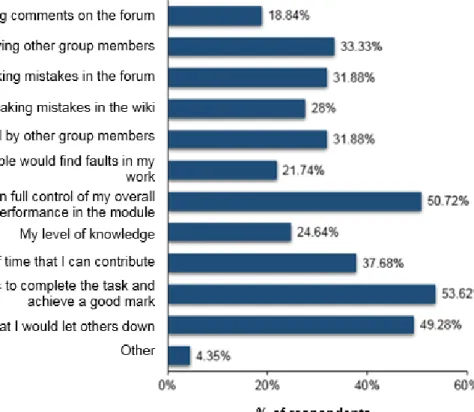
A multiple response question asked students to identify the cause(s) for anxiety in the online collaborative project. From the 76 respondents, 69 (90.8%)selected one or more of the responses. From these, the largest perceived cause of anxious feelings was ‘Relying on others to complete the task and achieve a good mark’ (as illustrated in Figure 5). The second and third most common perceived causes were ‘not being in full control of my overall performance in the module’ and the ‘Worry that I would let others down’, respectively. Four respondents selected the ‘Other’
option. Although one stated ‘I did not experience anxiety’ (Respondent 59, Male, 30-39 years) the other three provided the following causes for anxiety: ‘Others would not complete the tasks on time’ (Respondent 75, Male, 40-49 years), ‘Not being able to approach anybody for guidance’ (Respondent 58, Male, 65 and over) and ‘I suffer with anxiety in general everyday life anyway’ (Respondent 72, Male, 30-39 years).
36
5.1.3 Impact of anxiety on student participation and performance
Figure 6 shows how students believed their anxiety impacted participation and performance in the online collaborative project. More respondents perceived anxiety to have a positive impact (31.6% selected either ‘Positive’ or ‘Very positive’ response options) than a negative impact (23.7% selected either ‘Negative’ or ‘Very
negative’ response options). A large portion also perceived anxiety to have no impact on participation (30.3% selected the ‘Neutral’ response option), whilst 14.5% of respondents stated they did not experience anxiety. When asked how anxiety had impacted their performance, a greater percentage of respondents perceived anxiety to have a positive impact (32.9% selected either ‘Positive’ or ‘Very positive’ response options) than a negative impact (18.4% selected either ‘Negative’ or ‘Very
negative’ response options). Again, there was a large percentage of respondents who thought anxiety did not have an impact on their performance (31.6% selected
Figure 5. Perceived reasons for anxiety before and during the online collaborative
37
the ‘Neutral’ response option), and 17.1% of respondents reported that they did not experience anxiety. A significant positive relationship was found between how respondents perceived anxiety to impact participation and performance (rs= .80, p
< .001).
A multiple response question was used to gain an understanding of the ways in which feelings of anxiety affected respondents’ participation and performance. Out of the 76 respondents, 71.1% selected one of more of the response options. From these, the four most selected ways participation and performance were affected related to not wanting to initiate discussion on the forum, only taking on tasks they were confident in, posting lower numbers of comments in the forum, and a large number of respondents selected the ‘Other’ response option (as illustrated in Figure 7). From the 20 respondents who selected this, 9 explicitly stated that anxiety impacted participation and performance by making them try harder and be
Figure 6. Impact of feelings of anxiety on participation and performance in the online
38
more proactive. For example, Respondent 46 (Male, 40-49 years) wrote ‘I did try to cover up my anxiety by getting involved with everything I could’, whilst Respondent 68 (Male, 50-59 years) stated ‘It [anxiety] made me try harder and attempt to engage more with fellow students’. Comments made by all 20 respondents who selected the ‘Other’ option are shown in Appendix O.
Figure 7. Ways in which feelings of anxiety affected participation and
39
5.2 Qualitative Findings from Online Survey and Interviews
Four main themes emerged through thematic analysis of open-ended online survey responses and interviews: 1) uncertainty causes students to feel anxious; 2) anxiety affects students differently; 3) there is a change in anxiety throughout the collaborative process; and 4) ways anxious students can be supported. Each theme is described below and a thematic map is presented in Appendix L.
5.2.1 Uncertainty causes students to feel anxious
Uncertainty was a major cause of anxiety for students. Comments highlighted that before or at the start of the project uncertainty was often due to working with ‘strangers’ and being reliant on these ‘unknown others’ to successfully complete the project and achieve a good grade.
‘…I just didn’t know them, I didn’t know what their aims were, I didn’t know anything about them, I didn’t know their capabilities. And for those reasons that’s where my anxiety stemmed from.’ (Informant I)
‘…if I mess up a project and it is off my own back that’s fine I’m the one that is responsible, but when there are other people responsible and you don’t know who they are, what they are like, it is just really nerve-wracking.’ (Informant G)
Another commonly cited uncertainty was that of non-active group members. Comments highlighted that this led to worry about how overall grades may be impacted and apprehension about having to do additional work.
40
‘Failure was looming with 50% of the students not playing an active role in the group. It was so bad at times I actually thought it was setup on purpose!’ (Survey respondent)
It was apparent that many students experienced anxious feelings due to the fear of negative evaluation or judgement from other group members. Comments were often linked to the peer feedback activity in which learners had to provide feedback on draft wiki pages created by two group members. Learners worried their comments may be misinterpreted or cause offense.
‘I was a little nervous as to what people would think of my contribution – might it be rubbish in comparison to theirs’ (Survey respondent)
…I hated the feedback, that was the worst part of it... putting that across [areas for improvement] was so hard in a positive way without coming across as I don’t know, I know better or something, which I certainly don’t, it was so difficult to phrase it correctly and not to, as I thought I might, upset people.’ (Informant B)
Numerous learners expressed uncertainty of their own ability or level of knowledge (i.e. related to subject matter or, to a lesser extent, use of online tools). This caused worries about letting others down, keeping up with the group, and making mistakes.
41
‘My main fear is I am going to let the group down and then I am going to show myself up for the idiot that I am!’ (Informant C)
Uncertainty of the amount of time and effort that could be committed to the collaborative project was a further anxiety for a number of learners. Comments noted that before starting the project some students perceived collaborative learning to be a time-consuming activity that reduces the flexibility of online learning, and that having full-time jobs and families meant that students worried that they may not be able to fully contribute.
‘I felt somewhat anxious as to whether I could dedicate enough time to the activity.’ (Survey respondent)
‘I have a very busy life/work and I fit study in when I can to fit my family. I felt that I had to organise my life around others.’ (Survey respondent)
5.2.2 Anxiety affects students differently
There was a substantial difference in how anxiety affected students in the online collaborative project. This was considered through two sub-themes; coping, and participation and performance
Coping
Being more proactive was the most common coping strategy employed. Learners who conveyed being proactive commented that anxiety made them work harder, plan their time more thoroughly, take on bigger roles within the group, seek information from tutors, monitor other group member’s contributions more