
Developmental Biographies of Olympic
Super-Elite and Super-Elite Athletes: A Multidisciplinary
Pattern Recognition Analysis
Arne Güllich1, Lew Hardy2, Ludmilla Kuncheva2, Stewart Laing3, Matthew Barlow2, Lynne Evans4, Tim Rees5, Bruce Abernethy6, Jean Côté7, Chelsea Warr3, and Lizzie Wraith8
1University of Kaiserslautern, Germany
2School of Sport, Health and Exercise Sciences, Bangor University, Wales 3UK Sport, UK
4School of Sport, Cardiff Metropolitan University, Wales 5Bournemouth University, UK
6Faculty of Health and Behavioural Sciences, University of Queensland, Australia 7School of Kinesiology and Health Studies, Queen’s University, Canada
8English Institute of Sport, University of Bath, UK
Correspondence: Arne Güllich, [email protected] Abstract
This multidisciplinary study used pattern recognition analyses to examine the developmental biographies of 16 Great British Olympic and World Champions (“Super-Elite”) and 16 matched international athletes who had not won major medals (“Elite”). Athlete, coach and parent interviews (260 total interview hours) combined in-depth qualitative and quantitative methods. A combination of demographics, psychosocial characteristics, coach and family relationships, practice, competition, and performance development discriminated Super-Elite from Elite athletes with > 90% accuracy. Compared to Elite athletes, Super-Elite athletes were characterized by: (1) An early critical negative life experience in close proximity to significant positive sport-related events; (2) higher relative importance of sport over other aspects of life, stronger obsessiveness/perfectionism, and sport-related ruthlessness/selfishness; (3) conjoint outcome and mastery focus, and use of counterphobic and/or “total preparation” strategies to maintain/enhance performance under pressure; (4) coaches who better met their physical and psychosocial needs; (5) coming back after severe performance setbacks during adulthood, and career “turning points” leading to enhanced determination to excel; (6) more pronounced diversified youth sport engagement, and prolonged extensive sport-specific practice and competitions; and (7) continued performance improvement over more years during adulthood, eventually attaining their (first) gold medal after 21 ± 6 practice years. The findings are discussed relative to potential causal interactions and theoretical implications.
Keywords
elite, super-elite, development, biography, psychosocial characteristics, pattern recognition analysis
Introduction
The findings reported in this paper are part of a larger, UK Sport-sponsored, project. The first
output from the project was a review of the international research literature with regard to the
Journal of Expertise 2019. Vol. 2(1) © 2019. The authors license this article under the terms of the Creative Commons Attribution 3.0 License. ISSN 2573-2773
underpinnings of success at elite and super-elite levels of performance (Rees et al., 2016). This review highlighted current understanding of what was known and what was thought likely to be true. Clearly, the development of super-elite performance does not rely on any singular factor, but on the interplay of a multitude of factors, including characteristics of the performer, of the environment, and of practice, training, and competition history. More specifically, the review identified a number of plausible contributors to the distinction between Super-Elite and Elite athletes: birthdate, anthropometrics, physiology, personality, psychological skills, birthplace and place of early development, social support, coach-athlete interactions, athlete services, and practice/training histories. The review concluded with a list of issues and research questions that represented the research team’s best estimate of what needed to be known next—it is these research questions that the current study addressed.
Understanding what discriminates performers within the top margin of the performance
continuum is pivotal, both from a theoretical and an applied perspective. Earlier studies compared developmental participation patterns (but not all the other aspects mentioned above) of world top-ten athletes (Güllich, 2018a; Güllich & Emrich, 2014; Hornig, Aust, & Güllich, 2016; Johnson,
Tenenbaum, & Edmonds, 2006; Moesch, Elbe, Hauge, & Wikman, 2011) and international medalists (Güllich, 2014, 2017, 2018b) with national-class athletes or of world top-ten athletes with peers who achieved a regional or lower competition level (Baker, Côté, & Abernethy, 2003; Da Matta, 2004; Duffy, Baruch, & Ericsson, 2004; Hornig et al., 2016). The overarching aim of the wider UK-Sport project was to examine the holistic developmental biographies of Great British Olympic and World Champions and matched counterparts who had regularly represented Great Britain but had not won major international medals. The study methodology comprised two parts: a qualitative part that examined psychosocial aspects of athletes’ biographies; and a quantitative part that examined demographics, and practice, training, and competition histories. Findings from qualitative group comparisons of the psychosocial data have been reported in Hardy et al. (2017; the second
output of the wider project). In the present paper, we investigated the extent to which potential non-linear relationships and interactions among a broad range of different features contributed to explaining the distinction between Super-Elite and Elite athletes. We report the results of pattern
recognition analyses of the full multi-disciplinary dataset, identifying and comparing patterns of the athletes’ developmental biographies as
discriminators between Super-Elite and Elite athletes. Specifically, we investigated the question: To what extent does the interplay between the following characteristics contribute to
discriminating between Super-Elite and Elite athletes: birthdate; place of birth and early development; family characteristics and experiences; availability and quality of
opportunities for practice and coaching; coach-athlete interactions; psychosocial experiences, personality characteristics, psychological skills, and their potential backgrounds; developmental
participation in sport-specific and non-specific coach-led practice, peer-led sports play and competitions; characteristics of the “micro-structure” of practice; participation in athlete services; the age structure of the athletic career, including age of specialization; and the
development of athletes’ competitive performance throughout youth and adulthood.
Previous Research
A considerable number of generic and sport-specific frameworks of talent development have been proposed in recent decades, such as the frameworks of “long-term athlete development” (LTAD, Balyi & Hamilton, 2000), “stages of talent development” (Bloom, 1985), the “developmental model of sport participation” (DMSP, Côté, Baker, & Abernethy, 2007; Côté, Murphy-Mills, & Abernethy, 2012), “dynamics of talent
development” (Davids, Araújo, Vilar, Renshaw, & Pinder, 2013), “deliberate practice” (Ericsson, Krampe, & Tesch-Römer, 1993), the
“differentiated model of giftedness and talent” (Gagné, 1985, 2015), the “three-dimensional athlete development model” (Gulbin & Weissensteiner, 2013), the “Munich model of giftedness” (Heller, Perleth, & Lim, 2005), the “environment of athletic talent development”
(Henriksen, Stambulova, & Roessler, 2010), “career transitions in talent development” (Stambulova, 2009), the “life-span model of acquisition and retention of expert perceptual-motor performance” (Starkes, Cullen, &
MacMahon, 2006), and the “actiotope model of giftedness” (Ziegler, 2005).
Despite their increasing complexity, all these frameworks exhibit some common tenets, in that they describe some initial, untrained state of an individual, an acquisition process through practice, including early performance progression and efficacy of practice, and some eventual state of individual peak performance. The frameworks also align in acknowledging the necessity of extensive, multi-year, domain-specific practice under a teacher’s or coach’s supervision, the role of
individual personality characteristics, psychological skills (e.g., conscientiousness, motivation, self-regulation) and socio-environmental factors (e.g., opportunities, supportive social environment) that enable and moderate the acquisition process. More recently, the relevance of athletes’ relative birthdate and size of birthplace have been added to the international discussion (see below).
Of particular relevance to the present study, these theorists postulated non-linear relationships and complex interactions between individual aspects. However, as far as elite sport is concerned, research has predominantly used mono-disciplinary approaches, investigating singular aspects
separately while typically using univariate, linear analyses (for reviews, see Fransen & Güllich, 2018; Rees et al., 2016).
Early Specialization Versus Diversification
There is widespread consensus that the
development of elite and super-elite performance involves extensive sport-specific practice over many years under the supervision of a coach (e.g., Ericsson, Krampe, & Tesch-Römer, 1993; Smith & Smoll, 2017). Nonetheless, the combination of such practice with non-organized sports play and
diversified experience with various sports during childhood and adolescence may also be beneficial to long-term specific performance development (for reviews, see Davids, Güllich, Shuttleworth, & Araújo, 2017; Rees et al., 2016). The concepts of “early specialization”, involving intense
sport-specific organized childhood practice to the
exclusion of non-organized play and engagement in other sports, and “early diversification”, involving little sport-specific organized practice but extensive non-organized play and engagement in diverse sports during childhood, are reflected in the
frameworks of Deliberate Practice (DP; Ericsson et al., 1993) and the DMSP (Côté et al., 2007,
2012)—respectively, the most-cited frameworks in the sport science literature (Bruner, Erickson, Wilson, & Côté, 2010). While the DP model aligns with the “early specialization” approach, the DMSP suggests that diversified childhood engagement may reduce the costs and risks associated with “early specialization” (e.g., overuse injuries, dropout), and may benefit the long-term motivation of athletes and facilitate the transfer of motor skills and physical conditioning across related sports (Côté et al., 2007; 2012).
Empirical studies involving Super-Elite and Elite athletes have shown that many athletes did accumulate extensive sport-specific practice over many years, but also engaged in different sports and non-organized sports play during childhood and adolescence. Super-Elite athletes did not typically accumulate more sport-specific practice than Elite athletes until early adulthood, but had more diversified involvement during their early development (for reviews, see Davids et al., 2017; Güllich, 2017, 2018; Rees et al., 2016).
Psychological Characteristics
There is evidence that elite and super-elite
performance is related to certain personality traits, psychological skills and motivational orientations. A substantial number of studies have variously indicated that Elite and Super-Elite athletes display high levels of conscientiousness, perfectionism, dispositional optimism, hope, confidence,
perceived control, resilience and mental toughness (for reviews, see Rees et al., 2016; Weinberg & Gould, 2015; Woodman & Roberts, 2015). More successful athletes are also better able to produce high performance in high-pressure situations (Fletcher & Sarkar, 2012; Gould, Dieffenbach, & Moffett, 2002; Gucciardi & Gordon, 2013; Hardy et al., 2017; Jones, Hanton, & Connaughton, 2002). Furthermore, successful athletes clearly have high levels of motivation (Gould et al., 2002; Hemery,
1991; Jones et al., 2002; Mahoney, Gabriel, & Perkins, 1987; Orlick & Partington, 1988). However, the respective roles of intrinsic, self-determined motivation versus extrinsic motivation (Chantal, Guay, Dobreva-Martinova, & Vallerand, 1996; Cresswell & Eklund, 2005; Fortier,
Vallerand, Briere, & Provencher, 1995; Gogarty & Williamson, 2009; Hardy et al., 2017; Mallett & Hanrahan, 2004), and of task versus ego orientation (i.e., defining competence relative to mastery and personal improvement versus comparison with others; Bush & Salmela, 2002; Gould et al., 2002; Hardy et al., 2017; Harwood, Hardy, & Swain, 2000; Hemery, 1991; Oldenziel & Gagné, 2003; Pensgaard & Roberts, 2003) for the achievement of elite and super-elite performance are somewhat contentious in the literature.
Coach-athlete Relationship
Recent research on the coach-athlete relationship has largely focused on one of two different approaches: the nature of the relationship itself; or the leadership and support provided by the coach. Research into the nature of successful coach-athlete relationships has been dominated by Jowett’s 3 + 1 Cs model which proposes that successful coach-athlete relationships share four characteristics: closeness, commitment,
complementarity, and co-orientation (for reviews, see Jowett, 2017; Jowett & Ntoumanis, 2004). Research on coaches’ leadership and support behaviors has largely relied on one of Smith and Smoll’s model of reactive and spontaneous coach behaviors (Smith, Smoll, & Hunt, 1977),
Chelladaurai’s model of leadership behaviors (Chelladurai & Saleh, 1980), or Bass’s (1985) model of transformational leadership (for reviews, see Arthur, Wagstaff, & Hardy, 2016; Smith & Smoll, 2017). However, these three approaches can all be criticized to some extent for regarding coaching as something that is done to the athlete, rather than a mutually cooperative activity. In the present study, we utilized a social support
perspective on the coach-athlete relationship to better understand the extent to which the coach met the needs of the athlete via the provision of tangible, informational, emotional, and esteem forms of support (Arnold, Edwards, & Rees,
2018; Rees, Freeman, Bell, & Bunney, 2012; Rees & Hardy, 2000).
Size of Birthplace
A number of studies have suggested that birthplaces with smaller populations are over-represented among more successful athletes (e.g., Bruner, MacDonald, Pickett, & Côté, 2011; Côté, MacDonald, Baker, & Abernethy, 2006;
MacDonald, Cheung, Côté, & Abernethy, 2009). However, data from UK elite athletes (Allen & Dunman, 2010) indicated that places of
childhood/adolescent development may be more critical than birthplace. Based on these studies, it has been speculated that the environment of smaller locations may provide more opportunities for informal physical play with more heterogeneous peers, and more supportive social relationships.
Relative Age
The “relative age effect” (RAE) refers to the observation that relatively older athletes within an age year are over-represented among elite sport populations. Early researchers hypothesized that relatively older athletes were physically superior during early development and were therefore more likely to engage in sport and be selected into teams and squads within the competitive sport system. Although some studies have provided support for the RAE, others have shown inconsistent, or contradictory findings (for reviews, see Cobley, Baker, Wattie, & McKenna, 2009; Rees et al., 2016). Furthermore, research has suggested that the RAE may disappear when elite athletes are
compared to non-elite athletes rather than the general population (Delorme, Boiche, & Raspaud, 2010 a, b), which suggests that early self-selection to engage in sports, rather than selection effects within the sport system were the primary causal influence. Finally, more recent research (Jones, Lawrence, & Hardy, 2018; McCarthy & Collins, 2014; McCarthy, Collins, & Court, 2016) has suggested that relatively younger athletes who manage to remain in the system eventually become advantaged in comparison to their relatively older peers, potentially because they develop the
resilience to compensate for their relatively lagged early physical development.
Study Aim
Although there is consensus that the development of elite and super-elite performance relies on a number of multi-disciplinary factors, most of the studies discussed above were conducted from mono-disciplinary perspectives. Indeed, excepting some descriptive studies and reviews, very few studies have utilized multi-disciplinary
approaches, and to the best of our knowledge none have combined both detailed multi-disciplinary approaches and non-linear, multivariate analyses to compare Elite and Super-Elite athletes. The present study addresses this gap, by using state-of-the-art pattern recognition analyses (Duda, Hart, & Stork, 2001; Hastie, Tibshirani, & Friedman, 2003) to compare Elite and Super-Elite athletes on a broad spectrum of features from a multi-disciplinary perspective.
Methods
The study involved athlete, coach, and parent interviews, combining in-depth qualitative
interviews with highly structured quantitative interviews. The methods are described in more detail in Hardy et al. (2017), and we only summarize the central aspects here.
Participants
Four very well-known Olympic and World Champions agreed to act as project ambassadors and allowed us to send signed letters from them to other athletes encouraging them to sign up as participants. Thirty-two former Great British international athletes (20 females) from seven Olympic individual and team sports (centimeter, grams, and seconds sports; game sports; and “other types of sports,” according to the categorization of Güllich & Emrich, 2014) volunteered as participants.
Sixteen athletes were defined as Super-Elite
serial medalists (Table 1): Athletes who had been Olympic and/or World Champion several times post-1996 or had been Olympic or World Champion once and had won at least one more gold medal at another important international championship (Commonwealth Games, or
Table 1. Description of the international careers of the Super-Elite (n=16) and Elite (n=16) subsamples. Super-Elite Elite M (±SD) M (±SD)
Age of career peak performance (a) (years) 27.9 (4.5) 22.5 (3.4)
Period of international career (b) (years) 13.9 (4.5) 9.1 (3.3)
Number of senior international competitions (b) 136.4 (101.5) 59.4 (50.3) Period from first to last important senior int. championships
(years) 13.0 (4.5) 7.3 (2.9)
Period from first to last senior international medal (years) 8.7 (5.5)
Number of senior international championships (c) 15.3 (6.0) 6.7 (4.2)
Number of top ten places 11.4 (4.5) 3.1 (3.3)
Number of medals 8.5 (5.1) 1.2 (1.5)
Number of gold medals 4.6 (3.8) 0.0 (0.0)
Note:(a) Super-Elite: first Olympic / World Championship gold medal. (b) Including important international championships (Olympic Games, World Championships, Commonwealth Games and European Championships) and international non-championship competitions (e.g. World Cup, Grand Prix, multi-nation tournaments, invitational meetings etc.). (c) Olympic Games, World championships, Commonwealth Games and European Championships.
European Championships; there was one exception to this rule who had won a World Championship plus various other
Olympic/World Championship medals). These Super-Elite athletes had competed at 15.3 ± 6.0 (mean ± standard deviation) important
international championships over a period of 13.0 ± 4.5 years, winning 8.5 ± 5.1 medals including 4.6 ± 3.8 gold medals (ranges omitted to protect athletes’ anonymity).
The other 16 athletes were matched to the Super-Elite athletes on sport, discipline, gender, age and era of their international career. They were defined as Elite: funded athletes who had competed at 6.7 ± 4.2 important international championships over 7.3 ± 2.9 years. Some of them (n=9) had actually won minor medals at international championships (e.g., silver or bronze at the Universiade, European Championships, Commonwealth Games), but none had been an Olympic or World Champion. Table 1
characterizes the subsamples in more detail.
Coach and parent interviews were conducted primarily to complement, enrich, and
consolidate the information gathered from athletes, not for reliability testing purposes. Each athlete was asked to nominate one coach and one parent whom we could contact to interview. In some cases, parents had died and the athlete nominated another close relative.
Very occasionally, an athlete declined to nominate a parent or coach or it proved impossible to interview the relevant person (e.g., moved away from Europe, was seriously ill, or had died). Subsequently, the coaches of 28 athletes and the parents of 25 athletes were interviewed.
Measures
The research questions were developed through a one-year series of eight workshops involving eight world authorities in talent research, twelve British world class coaches, and the UK Sport Performance Directorate team. Drawing on a review of the international research literature (see Rees et al., 2016), delegates at these workshops discussed the most important questions for future research, methodologies to investigate them, and an importance x
expectancy (of successfully answering the question) rating for each question. The procedure resulted in the research questions outlined by Rees and colleagues (2016). The research questions clearly suggested a mixed-method approach combining highly structured quantitative and relatively unstructured qualitative interview sequences. The feature subsets and variables are defined in Table 2.
Table 2. Definition of the feature subsets and variables.
Feature subsets, variables, and their definition Demographics
Month of birth: 1 = January; 12 = December
Size of the athlete’s places of birth, primary and secondary school and the place where they lived during stages “Fundamentals” and “Emerging Commitment”: number of inhabitants
Access and perceived quality of training facilities: 1 = very poor; 5 = provided everything I needed
Parents’ qualification and occupation: Classification and composite score 0 to 14 [based on UK National Statistics Socio-Economic Classification (www.ons.gov.uk/methodology/classificationandstandards)]
Age gap from youngest and oldest sibling
Family structure: Complete, parents divorced/separated, a parent died Private or public primary and secondary school
Psychosocial features (from qualitative interview: 0 = definitely did not possess; 4 = definitely did possess) Sibling rivalry during development
Family strongly valued a culture of striving and achievement
Experienced a significant negative life event during early development Experienced a significant positive sport-related event during early development Strong need to succeed
Table 2 - continued.
Psychosocial features (continued)
Ability to “push yourself to your maximum” in practice and competition Strong conscientiousness
Obsessiveness and/or perfectionism in the pursuit of the sport career Ruthlessness and/or selfishness in the pursuit of sport-related goals Mastery and outcome focus
Performance under pressure based on “total preparation” and/or “counterphobia” Sport was more important than other aspects in life
The coach met the athlete’s physical and psychological needs A career “turning point” led to enhanced motivation and focus Career age structure
Age at start and end of UK Sport’s four developmental stages: “Fundamentals,” “Emerging Commitment.” “Commitment to Excellence” and “Mastery.”
Age when started each of: organized practice, regular practice (2 sessions/week) and competitions in the main sport Age when started to be a full-time athlete; and when being fully funded
Age when achieving: first national championships (either junior or senior), international senior championships, international senior medal, career peak performance (Super-Elite: first gold)
Age of start and cessation of each of: peer-led play in the main sport and in other sports, coach-led practice in other sports Age of specialization in the main sport: Focus on main sport to the exclusion of other sports (or when other sports dropped below 30 hours/year)
Number of competitions / championships
For each age year, annual number of championships and non-championship competitions (e. g. cups, grand prix, multi-nation tournaments, invitational meetings) at several performance levels: world level (Olympic Games, world championships, world cup), Commonwealth, European, national level and below
Volume of coach-led practice and peer-led sport play
For each age year, annual months of involvement and mean weekly hours of each of: Coach-led practice and peer-led play in the athlete’s respective main sport and in other sports
“Micro-structure” within coach-led main-sport practice: Proportions of practice (sessions/week, hours/week) focused on technical and tactical skills, speed/agility, power/strength and endurance
Athlete services
Participation in athlete services at the age of start of the “Commitment to Excellence” stage and of achieving the career peak performance: Physiotherapy/massage, sports physician care, strength and conditioning, performance diagnostics (biomechanics, physiology), nutritional counselling, sport psychology and performance lifestyle counseling: Whether or not participated; rated impact on performance: 1 = very low, 4 = very high
Performance development
Win-loss-record (game sports: % matches won; non-game sports: % podium) in stages “Fundamentals,” “Emerging Commitment,” “Commitment to Excellence” and “Mastery”
For each age year, participation and placings in championships and non-championship competitions at world, European, Commonwealth, national level and below; determination of annual greatest success
Severe year-to-year setbacks of performance: Annual greatest success decreased by at least one success level (international top ten, national top ten, below)
Severe year-to-year performance setback after performance near career peak performance: Super-Elite: After international minor medal or top ten placing; Elite: after international top ten placing
Interview Procedure
Face-to-face interviews were conducted in 2011-13 by three highly-trained and
experienced postdoctoral interviewers from the research team (cumulative research experience > 60 years). Athlete interviews were preceded by thorough media research to prepare
individualized outline athlete biographies and timelines (e.g., via public media, UK Sport’s data base, and autobiographies, including basic
demographics, performance data, successes, performance setbacks, injuries, comebacks, changes of coach, family background, and youth development). The quantitative section relied on prepared standardized charts derived from the procedures described by Côté, Ericsson and Law (2005) and Güllich and Emrich (2006, 2014). The interview guide for the qualitative psychosocial section ensured that each
open-ended primary questions and elaboration prompts, but not always in the same order. Rather, athletes were asked to tell the interviewer their life story starting from the earliest time they could recall. The interviewer then interwove open questions relating to the themes of interest into the conversation as appropriate to the material being discussed. Finally, after the coach and parent interviews, we went back to the athletes with a brief telephone interview to fill in any remaining gaps. Athlete interview length was 3:54 ± 0:35 hours, with a break between sections. Coach interview length was 2:24 ± 0:36 hours, and parent interview length was 1:43 ± 0.38 hours. The verbatim transcription of the approximately 260 interview hours produced 2.4 million words on 8,400 text pages. Ethical approval was received from the UK Sport Ethics Committee.
Reliability and Validity
Test-retest reliability of the quantitative part of the interview had been previously tested in elite and super-elite samples over three weeks (n=38; Hornig et al., 2016) and three years (n=244; Güllich & Emrich, 2014) and found to be good to very good (0.80 ≤ rtt ≤ 1.00). External validity of recalled
practice volumes was examined by comparison with athletes’ (n=29) daily training logs through an entire one-year season (0.81 ≤ r ≤ 1.00; Güllich & Emrich, 2014). Trustworthiness of the qualitative interviews was established through a multi-month process incorporating member checking and participant approval, communicative validation to consensus by two interviewers, followed by further communicative validation to consensus involving two further experts who acted as “critical friends”, and the reporting of results through the
participants’ own voices (cf. Hardy et al., 2017).
Data Analysis
As noted above, full details of the qualitative analysis of the psychosocial section of the interviews were reported in Hardy et al. (2017). However, in summary, a combination of
standard inductive/deductive analysis (Weber, 1985) and inductive grounded theory analysis (Glaser & Strauss, 1967) was used. The five broad themes that defined the deductive
component were: (1) positive and negative critical events; (2) personality; (3) motivation, commitment, and desire to compete; (4) the athlete’s experience of pressure and emotional regulation; and (5) other contextual and environmental factors. Inductive content analysis then identified 18 features that were potentially influential to the athletes’
development (Table 2).
Following this content analysis, for the present analysis, each athlete was rated by the same two qualitative researchers who coded the athlete data with regard to the extent to which he/she possessed each psychosocial
characteristic that had emerged from the qualitative analysis. In agreeing these ratings, a five-point Likert scale was used to represent whether an athlete’s coded data indicated that the athlete “definitely possessed” the particular characteristic (scored 4), “probably possessed" the characteristic (3), “it was unclear whether the athlete possessed the characteristic or not” (scored 2), the athlete “probably did not
possess” the characteristic (1), or “definitely did not possess” the characteristic (0).
Disagreements between the raters were very rare, but were discussed until a consensus was reached, and challenged by the same two “critical friends” who had challenged the rest of the qualitative analyses.
The quantitative data were compiled into an Excel spreadsheet and the recoded qualitative (psychosocial) data added to it. After the deletion of features that contained missing values (less than 3%), the complete data set comprised 32 objects (participants), with 336 features (variables; see Table 2).
The data were analyzed using pattern recognition analysis. Pattern recognition analysis was developed in bioinformatics to solve the problem of classifying objects on the basis of features that they possess. The
following is a non-technical description of pattern recognition analysis (for technical details, the reader is referred to Duda et al., 2001; Hastie et al. 2003; and Witten, Frank, & Hall, 2011). The essence of pattern recognition analysis is that modern computational power is used to iteratively analyze a large number of
features and find which features best distinguish between two different classes of objects. In the present case, the features are the 336
characteristics recorded from our sample of Super-Elite and Elite athletes, and these two groups constitute the classes of objects that we want to distinguish. In very simple terms, the computer programs that run these analyses can learn to select features (characteristics), and classify which classes (groups) objects (athletes) belong to, using a number of very different procedures. The more these different procedures agree on the most discriminatory features, the more confidence one can have in the results. In the current analyses, we present the results obtained using four different selection procedures and four different classification procedures. This is a conservative approach, because the procedures used to select and classify objects are very different (see below).
The present data set is termed “wide” because there are far more features (athlete characteristics) than there are objects (athletes). We acknowledge that—as is the case with any study on wide data—the results should be interpreted with due caution. The methods which we used here have been successfully used before for wide data in various domains, a prime example of which is bioinformatics (Saeys, Inza & Larranaga, 2007). We have taken every care to ensure the best possible use of the data by applying cross-validation in all analyses. All the analyses reported were performed using WEKA open source software issued under the GNU General Public License, available at
www.cs.waikato.ac.nz/ml/weka (Hall, Eibe, Holmes, et al., 2009). WEKA is a collection of machine learning algorithms for data mining tasks, widely used in pattern recognition analysis and machine learning (Witten et al., 2011).
Feature ranking and selection is a very complex process. There are a large number of different procedures that can be used for feature selection. The four used in the present analyses were: Support Vector Machine (SVM; Burges, 1998); Relief-F (Kira & Rendell, 1992); Fast Correlation Based Filter (FCBF; Yu & Liu, 2003); and Correlation Attribute Evaluation
(Hall, 1999). These procedures use very
different criteria to select features. For example, SVM builds a linear function of the features that separates the classes. The hyperplane
represented by the function is calculated to maximize the distance to the nearest points in each group. Conversely, Relief-F chooses objects from the data set randomly and updates the features’ weights based on the features of the nearest neighbor. The weight (relevance) of a feature increases progressively if objects from the same class are close to one another in the “feature space” and far from the objects in the alternative class. However, the most important points for the reader to note are that all four of the procedures used are well-established, and greater confidence can be placed in a feature the more times it is selected by different procedures. In the present analyses, features were selected using two different degrees of stringency: 1) they were ranked in the top 20 discriminatory features for at least two out of the four feature selection methods used; or 2) they were ranked in the top 20 discriminatory features for at least three out of the four feature selection methods used. Any exceptions to these general rules are explicitly noted in the main text. We used these two different degrees of stringency because different risks accompany the different
strategies. The risk with a less stringent feature selection procedure is that some features are selected that ought not to be selected, thereby adding “noise” to the data so that optimal classification accuracy is not achieved. The risk with a more stringent strategy is that some features that contain important information are not selected thereby resulting in a sub-optimal fit because all of the available information has not been used.
To evaluate the accuracy of the selected features, two classification experiments were performed. In the first experiment, four different classifiers were applied to the features selected according to the criteria noted above. In the second experiment, the same four classifiers were used in a process called “fitting,” in which the accuracy of different subsets of selected features is further tested to find the best fitting subset. Like feature selection procedures, there
are many different classifiers and, also like feature selection, one can place greater confidence in results that can be replicated across different classification procedures. The following classifiers were chosen for the present analyses: Naïve Bayes classifier (NB; Hand & Yu, 2001); SVM classifier (as used in the feature selection; Burges, 1998); nearest neighbor classifier (1-nn; Duda et al., 2001); and decision tree classifier (J48; Breiman, Friedman, Olshen & Stone, 1984).
The protocol used in both feature selection and classification was leave-one out. In essence, this means that one object (athlete) is withdrawn from the object set (participants) while the classifier program uses its classification procedure to attempt to identify (learn) the patterns of features that best discriminate between the two sets of objects. The program then applies these features to the object that was removed to test whether or not it can correctly classify it. The original object is then replaced in the data set, the next object is randomly removed, and the process is repeated. After all the iterations have been completed, a set of features can be identified that best discriminates between the two groups of athletes and its accuracy can be reported.
An important disclaimer must be made here. The classification accuracy with the selected data set may be slightly optimistically biased because WEKA’s leave one out protocol for feature selection allows the program to see the whole data set (Smialowski, Frishman & Kramer, 2010). In other words, the object set aside for testing has been “seen” at some stage during the training phase, when feature selection was carried out. The effect of this so-called “peeking” is mitigated by using the leave-one-out protocol in both feature selection and
classification. Nonetheless, one cannot make the claim that the classification accuracy on unseen data will perfectly match the one achieved for seen data set (Kuncheva & Rodríguez, 2018).
Results
We first present the classification accuracy of each feature subset and then report descriptive data for Super-Elite and Elite athletes within
each feature subset in subsequent sections. Unsurprisingly, Super-Elite and Elite athletes were similar on a number of characteristics and differed in others. We therefore describe the variables that were similar among both
subsamples (and did not contribute significantly to discriminating them) and subsequently those that contributed significantly to discriminating Super-Elite from Elite athletes within each feature subset. Finally, the interacting features that the pattern recognition analysis revealed as the most robust discriminators between Super-Elite and Super-Elite athletes are defined.
Classification Accuracy
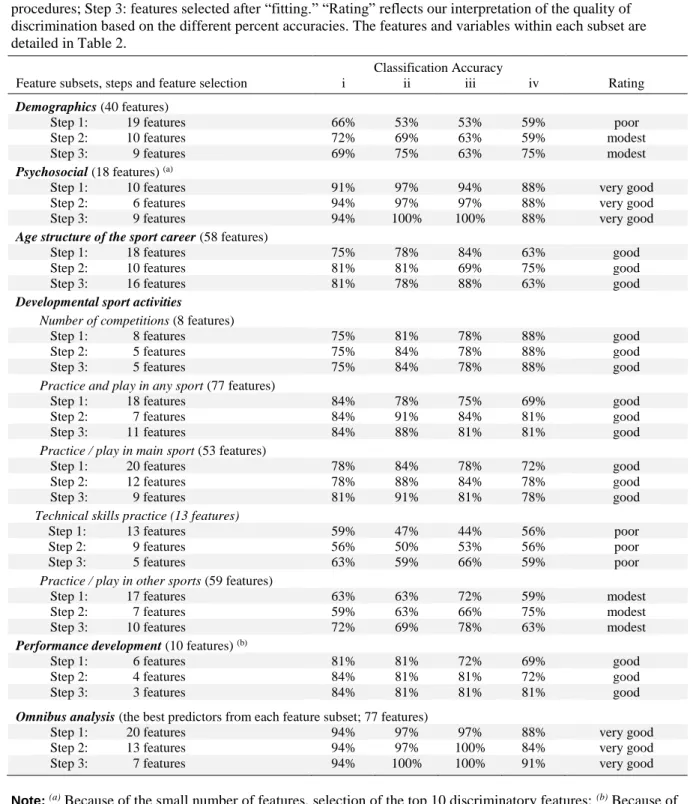
The results of the pattern recognition analyses are shown in Table 3, which outlines the classification accuracy of each feature subset with regard to discriminating between Super-Elite and Super-Elite athletes. The analyses identified sets of features displaying classification
accuracies we would categorize as: poor (e.g., proportion of technical skills practice); modest
(e.g., demographics; practice and play in other sports); good (e.g., age structure of the sport career; development of competitive
performance; number of competitions; practice and play in any sport; practice and play in the athlete’s main sport); or very good (e.g., psychosocial features; omnibus analysis).
Table 3. Classification accuracy for the most important discriminatory features between Super-Elite and Elite athletes within each feature subset and overall (omnibus analysis; in each case percent accuracy) based on: (i) Naïve Bayes %, (ii) Support Vector Machine %, (iii) Nearest Neighbor %, and (iv) Decision Tree classifier %). Step 1: features selected by at least two selection procedures; Step 2: features selected by at least three selection procedures; Step 3: features selected after “fitting.” “Rating” reflects our interpretation of the quality of discrimination based on the different percent accuracies. The features and variables within each subset are detailed in Table 2.
Classification Accuracy
Feature subsets, steps and feature selection i ii iii iv Rating Demographics (40 features)
Step 1: 19 features 66% 53% 53% 59% poor
Step 2: 10 features 72% 69% 63% 59% modest
Step 3: 9 features 69% 75% 63% 75% modest
Psychosocial (18 features) (a)
Step 1: 10 features 91% 97% 94% 88% very good
Step 2: 6 features 94% 97% 97% 88% very good
Step 3: 9 features 94% 100% 100% 88% very good
Age structure of the sport career (58 features)
Step 1: 18 features 75% 78% 84% 63% good
Step 2: 10 features 81% 81% 69% 75% good
Step 3: 16 features 81% 78% 88% 63% good
Developmental sport activities
Number of competitions (8 features)
Step 1: 8 features 75% 81% 78% 88% good
Step 2: 5 features 75% 84% 78% 88% good
Step 3: 5 features 75% 84% 78% 88% good
Practice and play in any sport (77 features)
Step 1: 18 features 84% 78% 75% 69% good
Step 2: 7 features 84% 91% 84% 81% good
Step 3: 11 features 84% 88% 81% 81% good
Practice / play in main sport (53 features)
Step 1: 20 features 78% 84% 78% 72% good
Step 2: 12 features 78% 88% 84% 78% good
Step 3: 9 features 81% 91% 81% 78% good
Technical skills practice (13 features)
Step 1: 13 features 59% 47% 44% 56% poor
Step 2: 9 features 56% 50% 53% 56% poor
Step 3: 5 features 63% 59% 66% 59% poor
Practice / play in other sports (59 features)
Step 1: 17 features 63% 63% 72% 59% modest
Step 2: 7 features 59% 63% 66% 75% modest
Step 3: 10 features 72% 69% 78% 63% modest
Performance development (10 features) (b)
Step 1: 6 features 81% 81% 72% 69% good
Step 2: 4 features 84% 81% 81% 72% good
Step 3: 3 features 84% 81% 81% 81% good
Omnibus analysis (the best predictors from each feature subset; 77 features)
Step 1: 20 features 94% 97% 97% 88% very good
Step 2: 13 features 94% 97% 100% 84% very good
Step 3: 7 features 94% 100% 100% 91% very good
Note:(a) Because of the small number of features, selection of the top 10 discriminatory features; (b) Because of the small number of features, all features were selected.
Demographics
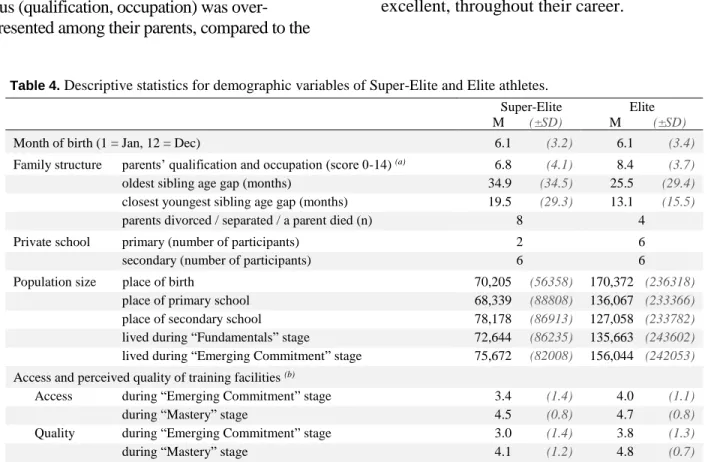
Descriptive data on Super-Elite and Elite athletes’ demographics are presented in Table 4. Both groups had comparable birth months—i.e., no RAE was observed. A relatively high socio-economic status (qualification, occupation) was over-represented among their parents, compared to the
age-matched general population. In particular, 52 % had high managerial/professional occupations and/or were employers of 25+ people (versus 25% in the general population). Furthermore, access to quality facilities was moderate, not excellent, throughout their career.
Table 4. Descriptive statistics for demographic variables of Super-Elite and Elite athletes.
Super-Elite Elite M (±SD) M (±SD)
Month of birth (1 = Jan, 12 = Dec) 6.1 (3.2) 6.1 (3.4)
Family structure parents’ qualification and occupation (score 0-14) (a) 6.8 (4.1) 8.4 (3.7)
oldest sibling age gap (months) 34.9 (34.5) 25.5 (29.4)
closest youngest sibling age gap (months) 19.5 (29.3) 13.1 (15.5)
parents divorced / separated / a parent died (n) 8 4
Private school primary (number of participants) 2 6
secondary (number of participants) 6 6
Population size place of birth 70,205 (56358) 170,372 (236318)
place of primary school 68,339 (88808) 136,067 (233366)
place of secondary school 78,178 (86913) 127,058 (233782)
lived during “Fundamentals” stage 72,644 (86235) 135,663 (243602)
lived during “Emerging Commitment” stage 75,672 (82008) 156,044 (242053)
Access and perceived quality of training facilities (b)
Access during “Emerging Commitment” stage 3.4 (1.4) 4.0 (1.1)
during “Mastery” stage 4.5 (0.8) 4.7 (0.8)
Quality during “Emerging Commitment” stage 3.0 (1.4) 3.8 (1.3)
during “Mastery” stage 4.1 (1.2) 4.8 (0.7)
Note:(a) Composite score of parents’ highest qualification and occupation; the reference value of the parents’ peers in the entire
population was 5.4 ± 4.4. (b) 1 = very poor, 5 = provided everything I needed.
Super-Elite athletes were discriminated from Elite athletes, in that they were more likely to be born and spend their early years in locations with a smaller population, and also to attend a state (as opposed to private) primary school. Super-Elite athletes experienced poorer access to facilities during the “Emerging Commitment” stage and poorer quality facilities at the age of their (first) peak performance compared to Elite athletes. Furthermore, Super-Elite athletes were more likely to have experienced their parents’ separation or a parent’s death and they also had a greater age distance to younger and older siblings.
Psychosocial Features
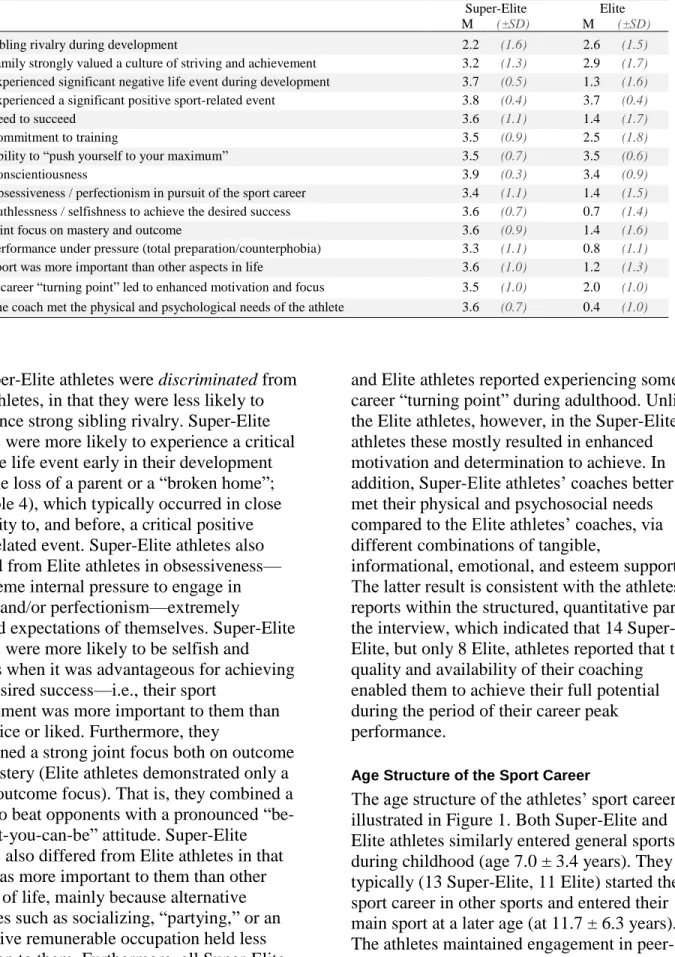
Table 5 highlights the descriptive data on the psychosocial features. Super-Elite and Elite athletes came from families who strongly valued a culture of striving and achieving, while
experiencing moderate sibling rivalry. Super-Elite and Super-Elite athletes were also equally characterized by a strong commitment to training, conscientiousness, and an ability to “push themselves to their maximum” in training and competition. Furthermore, both groups equally experienced significant positive sport-related events during their early development.
Table 5. Descriptive statistics for psychosocial features of Super-Elite and Elite athletes. 0 = definitely did not possess; 4 = definitely did possess.
Super-Elite Elite
M (±SD) M (±SD)
Sibling rivalry during development 2.2 (1.6) 2.6 (1.5)
Family strongly valued a culture of striving and achievement 3.2 (1.3) 2.9 (1.7)
Experienced significant negative life event during development 3.7 (0.5) 1.3 (1.6)
Experienced a significant positive sport-related event 3.8 (0.4) 3.7 (0.4)
Need to succeed 3.6 (1.1) 1.4 (1.7)
Commitment to training 3.5 (0.9) 2.5 (1.8)
Ability to “push yourself to your maximum” 3.5 (0.7) 3.5 (0.6)
Conscientiousness 3.9 (0.3) 3.4 (0.9)
Obsessiveness / perfectionism in pursuit of the sport career 3.4 (1.1) 1.4 (1.5)
Ruthlessness / selfishness to achieve the desired success 3.6 (0.7) 0.7 (1.4)
Joint focus on mastery and outcome 3.6 (0.9) 1.4 (1.6)
Performance under pressure (total preparation/counterphobia) 3.3 (1.1) 0.8 (1.1)
Sport was more important than other aspects in life 3.6 (1.0) 1.2 (1.3)
A career “turning point” led to enhanced motivation and focus 3.5 (1.0) 2.0 (1.0)
The coach met the physical and psychological needs of the athlete 3.6 (0.7) 0.4 (1.0)
Super-Elite athletes were discriminated from Elite athletes, in that they were less likely to experience strong sibling rivalry. Super-Elite athletes were more likely to experience a critical negative life event early in their development (e.g., the loss of a parent or a “broken home”; see Table 4), which typically occurred in close proximity to, and before, a critical positive sport-related event. Super-Elite athletes also differed from Elite athletes in obsessiveness— an extreme internal pressure to engage in sport—and/or perfectionism—extremely
elevated expectations of themselves. Super-Elite athletes were more likely to be selfish and ruthless when it was advantageous for achieving their desired success—i.e., their sport
achievement was more important to them than being nice or liked. Furthermore, they
maintained a strong joint focus both on outcome
and mastery (Elite athletes demonstrated only a strong outcome focus). That is, they combined a desire to beat opponents with a pronounced “be-the-best-you-can-be” attitude. Super-Elite athletes also differed from Elite athletes in that sport was more important to them than other aspects of life, mainly because alternative activities such as socializing, “partying,” or an alternative remunerable occupation held less attraction to them. Furthermore, all Super-Elite
and Elite athletes reported experiencing some career “turning point” during adulthood. Unlike the Elite athletes, however, in the Super-Elite athletes these mostly resulted in enhanced motivation and determination to achieve. In addition, Super-Elite athletes’ coaches better met their physical and psychosocial needs compared to the Elite athletes’ coaches, via different combinations of tangible,
informational, emotional, and esteem support. The latter result is consistent with the athletes’ reports within the structured, quantitative part of the interview, which indicated that 14 Super-Elite, but only 8 Super-Elite, athletes reported that the quality and availability of their coaching enabled them to achieve their full potential during the period of their career peak performance.
Age Structure of the Sport Career
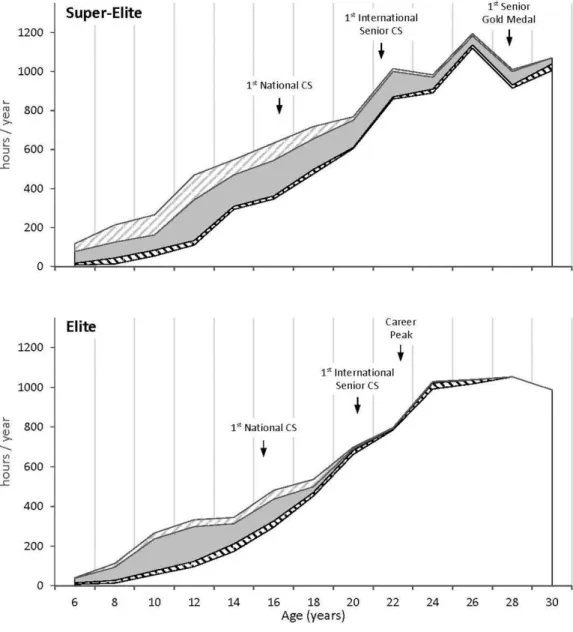
The age structure of the athletes’ sport career is illustrated in Figure 1. Both Super-Elite and Elite athletes similarly entered general sports during childhood (age 7.0 ± 3.4 years). They typically (13 Super-Elite, 11 Elite) started their sport career in other sports and entered their main sport at a later age (at 11.7 ± 6.3 years). The athletes maintained engagement in peer-led play in their respective main sport as well as
coach-led practice and peer-led play in other sports primarily until late adolescence. They also specialized relatively late—primarily in late adolescence/early adulthood. Furthermore, they similarly achieved participation in their first national championship during late adolescence and their first senior international championship during early adulthood, and the years they took to reach these career “milestones” were also comparable.
Super-Elite athletes were discriminated from Elite athletes, in that Super-Elite athletes spent more years in the “Fundamentals” stage, took more years to reach the “Commitment to Excellence” stage, specialized later, and both became full-time athletes and received full
funding at an older age than Elite athletes (Figure 1). However, Super-Elite athletes took fewer years from starting “regular main-sport practice” to their first national championships.
While Elite athletes reached their career peak performance at age 22.5 ± 3.4 years, Super-Elite athletes achieved their (first)
international gold medal at age 27.9 ± 4.5 years. Super-Elite athletes took 20.9 ± 6.5 years from entering sports to their (first) career peak
(compared to Elite athletes: 15.4 ± 4.5 years). In particular, they took 6.6 ± 2.4 years after their first senior international championship until achieving their (first) peak performance (Elite athletes: 2.1 ± 3.0 years).
Figure 1. Age structure of the career of Super-Elite (above) and Elite athletes (below). CS = championship. Mean
Developmental Sport Activities
Figure 2 presents the amounts of each type of sport activity undertaken during development. Super-Elite and Super-Elite athletes similarly performed primarily moderate practice intensity in their main sport up to early adulthood. They did, however, engage in a wide range of diversified sport activities through childhood and adolescence, including 4.9 ± 2.1 different sports in different settings (coach-led practice in organized settings and peer-led sport
play in non-organized settings). For example, at the age of their first national championships, Super-Elite athletes had accumulated 835 ± 457 main-sport practice hours over 2.8 ± 1.9 years (Elite: 749 ± 762 hours over 2.3 ± 2.4 years), but 3,933 ± 6,057 (Elite: 1,675 ± 1,820) hours of sport activities other than main-sport practice (i.e., main-sport non-organized play plus other-sports non-organized practice and non-organized play: Figure 2).
Figure 2. Volume of developmental sport activities of Super-Elite (above) and Elite athletes (below). For each defined age, the graphs display the sum of annual hours in coach-led practice plus peer-led sports play in the athlete’s main sport plus in other sports. Mean values (standard deviations omitted for clarity).
Super-Elite athletes were discriminated from Elite athletes, in that they accumulated more total organized practice and non-organized play in any sport, in particular more main-sport practice, through the (much longer) interval from their first senior international
championship until their (first) career peak performance compared to Elite athletes. This implies that the proportion of sport activities performed in this interval among the total sport activities through their entire career was greater in Super-Elite than in Elite athletes. For
example, Super-Elite athletes performed 6,805 ± 2,939 main-sport practice hours through the 6.6 ± 2.4 years after their first senior international championship until achieving their (first) peak performance, compared to 2,385 ± 4,186 practice hours through 2.1 ± 3.0 years among Elite athletes.
The diversified juvenile sport engagement was also even more pronounced among Elite than Elite athletes. For example, Super-Elite athletes were likely characterized by a combination of less organized main-sport practice before age 11 years, more
non-organized play in any sport before age 15 years and before their first national championship, a greater proportion of sport activities other than main-sport practice at 15-21 years (Super-Elite 35.0 ± 41.2%; Elite 17.5 ± 14.2% of total sport activity), but less non-organized play from then on, compared to Elite athletes (Figure 2).
“Microstructure” of sport-specific practice.
Super-Elite and Elite athletes did not differ in the “micro-structure” within the organized, coach-led practice in their respective main sport. In the entire sample, 28.4 ± 21.7% of the
practice time focused on skills practice and 71.6 ± 21.7% on physical conditioning (speed/agility, power/strength, endurance) during their first year of “Commitment to Excellence”; the proportions were 27.4 ± 20.5% and 72.6 ± 20.5% in the year of their (first) peak performance.
Use of athlete services. The subsamples were also similar in their use of athlete services. During their first year of “Commitment to
Excellence,” 25 athletes used some athlete service involving 3.3 ± 2.8 service disciplines. The most utilized service disciplines were physiotherapy/massage (17), strength and conditioning (16), and sports physicians (13). Athletes rated the impact of the services on their performance as 2.8 ± 0.8 on a scale from 1 (very low) to 4 (very high). During their year of (first) peak performance, 31 athletes used some athlete service involving 6.3 ± 2.2 service disciplines. The most utilized service disciplines were physiotherapy/massage (29), performance analysis (26; biomechanics and/or physiology), nutritional counselling (25), strength and conditioning (23), sports physicians (23), and sport psychology (22). Just as during the “Commitment to Excellence” stage (above), athletes perceived the impact of the services on their performance as positive, but not excellent (3.0 ± 0.7).
Participation in Competitions and Performance Development
Descriptive data on participation in competitions and performance development are shown in Table 6. The two subsamples had a similar competitive performance development up to early adulthood: they were successful in about ⅔ of their competitions, but also experienced quite frequent defeats, a finding consistent with the observation that they took comparable numbers of years (Figure 1) and practice amounts (Figure 2) until their first national championships and first senior international championships.
Career development withinadulthood
discriminated Super-Elite from Elite athletes. While their win-loss record was comparable from the “Fundamentals” through the
“Commitment to Excellence” stage, it was 81.2 ± 21.5% among Super-Elite versus 44.5 ± 31.2% among Elite athletes during the
“Mastery” stage. Within the period from their first senior international championship until their (first) career peak performance, Super-Elite athletes participated in more international high-level championships and non-championship competitions, attaining 6.0 ± 2.8 (vs. 0.7 ± 1.2) top-ten placings, including 3.8 ± 2.7 (vs. 0.2 ± 0.5) minor medals at international
championships before eventually achieving their first international gold medal. In this context, Super-Elite athletes were also more likely to experience severe year-to-year performance setbacks after attaining international
achievements: i.e. after winning international minor medals (n=11) or top ten placings (n=2; Elite athletes n=3 after international 6th-9th
place; Table 6). Super-Elite athletes had these
setbacks at age 24.5 ± 5.7 years, i.e. 4.1 ± 2.3 years before their first gold medal. It is also noteworthy that, even after achieving gold, Super-Elite athletes performed another 6,746 ± 5,490 practice hours and participated in 44.5 ± 39.5 further international competitions including 6.6 ± 4.8 major international championships over 5.3 ± 4.1 more years.
Table 6. Descriptive statistics for the number of competitions and championships and for the performance development of Super-Elite and Elite athletes.
Super-Elite Elite
M (±SD) M (±SD)
Number of competitions / championships
Until 1st national championships
up to national level non-championship competitions 53.4 (57.6) 46.0 (54.7)
below national level championships 4.3 (8.0) 3.5 (6.9)
1st national championships to 1st senior international championships
up to national level non-championship competitions 54.1 (80.3) 49.1 (57.5)
up to national level championships 48.8 (50.2) 41.4 (58.2)
international non-championship competitions 21.0 (28.6) 12.0 (14.8)
1st senior international championships to career (first) peak performance
up to national level non-championship competitions 23.5 (37.2) 31.8 (88.6)
up to national level championships 42.6 (75.4) 9.5 (16.5)
international non-championship competitions 59.2 (49.9) 11.3 (16.8)
international championships 10.1 (5.4) 1.9 (3.9)
Performance development
Win-loss record (non-game sports: % podium; game sports: % games won)
“Fundamentals” stage 72.9 (37.0) 68.1 (42.6)
“Emerging Commitment” stage 66.5 (23.0) 65.4 (34.7)
“Commitment to Excellence” stage 63.6 (36.5) 60.7 (24.5)
“Mastery” stage 81.2 (21.5) 44.5 (31.2)
International junior championships (number of participants)
participation 10 10
top ten placing 8 6
gold medal 1 1
Year-to-year performance setbacks before career (first) peak performance (number of participants)
after performance near career peak level 13 3
total before career (first) peak performance 15 9
Number of year-to-year setbacks
after performance near career peak level 1.2 (0.8) 0.2 (0.4)
Table 7. The most robust discriminators between Super-Elite and Elite athletes as revealed in the omnibus analysis of the pattern recognition analysis (classification accuracy: very good [91-100%]).
Super-Elite were more likely to …
▪ Have attended a state (as opposed to private) primary school.
▪ Have experienced a significant negative life event during development years; have experienced parents’ separation or a parent’s death.
▪ Have been obsessive and/or perfectionistic and ruthless and/or selfish in the pursuit of their success goals.
▪ Have been both mastery and outcome focused.
▪ Have perceived sport as more important than other aspects in life; have experienced a significant “turning point” during adulthood that enhanced their motivation and focus.
▪ Have been coached by coaches who met their (psychological and physical) needs.
▪ Have performed greater amounts of organized practice in their main sport and in other sports and more main sport practice and play between their first senior international championships and their career (first) peak performance; have performed greater proportions of all activities accumulated until their career (first) peak performance within the interval between their first senior international championships and their career (first) peak performance. (a)
▪ Have participated in more total international competitions before their career (first) peak performance; have participated in more senior international championships after their first senior international championships up to their career (first) peak performance. (a)
▪ Have experienced greater total numbers of substantial year-to-year performance setbacks, in particular substantial setbacks after having performed “near career peak performance” level.
Note:(a) In association with Super-Elite’s significantly later age of (first) peak performance and, in particular, more years from their first senior international championship until their (first) peak performance.
Omnibus Analysis
The sets of features revealed by the pattern recognition analyses as the overall most robust discriminators between Super-Elite and Elite athletes are highlighted in Table 7.
Additional Observations
Finally, it is worthy of note that, at a descriptive
level, Super-Elite athletes also differed from Elite athletes in that they were much more likely to exhibit a strong need to succeed (Table 5). In addition, unlike Elite athletes, Super-Elite athletes maintained or even increased performance levels under pressure, in association with a “counterphobic” attitude and/or “total preparation.” All Super-Elite athletes reported experiencing high levels of pressure and anxiety in high-level championships. Through their “counterphobia” they were drawn to, purposefully “tackled,” and in some way even enjoyed, high-pressure situations—the situations they thrived in. Their greater “total preparation” implied that Super-Elite athletes felt they had done everything possible in their preparation before major championships, providing a sense of being fully prepared (for more details, see Hardy et al., 2017).
Discussion
This study compared serial international gold medalists—the “black swans” among
international elite athletes—with international athletes who did not win medals at major international championships across a broad, multidisciplinary range of variables from demographics, psychosocial features,
developmental sport activities, athlete services, career age structure, and performance
development. The findings reaffirm that the development of international athletes rests on the interplay of a diverse set of factors, not any singular factor. In this context, we suggest that the characteristics that were similarly high among both Super-Elite and Elite athletes may be interpreted as important pre-conditions for establishing the potential to become
international athletes, but the effects were “neutralized” between the subsamples. These characteristics include: developing in a family valuing a culture of striving and achievement; positive sport-related experiences during early development; strong commitment to training, conscientiousness, and an ability to “push yourself to your maximum” in competition and practice; diversified juvenile sport engagement and late specialization; extensive sport-specific coach-led practice over many years; multi-year experiences in high-level international
competitions; and many successes, but also experiencing defeats to a considerable extent during development.
Among international athletes similarly possessing these characteristics, Super-Elite athletes were discriminated from Elite athletes by a number of factors, involving an interplay of demographics, psychosocial characteristics, practice, competitions, and performance development, with an accuracy of up to >90%. Although it is, of course, difficult to establish
causal links through the retrospective design of this study, it seems unlikely that these
discriminating factors are unrelated to actual achievement. It is also important to emphasize that the findings from pattern recognition analyses represent potentially complex interactions among several discriminating attributes, not just “main” effects or linear combinations of those attributes.
Considered together, the present findings suggest the hypotheses that an early, difficult and painful, loss together with the close proximity of significant positive sport-related events were foundational to finding/choosing sport as a compensatory activity. The resultant strong, deep-seated, need to succeed presumably led to an extraordinary and persistent
motivational “drive” to excel, together with strong obsessiveness/perfectionism, selfishness/ ruthlessness, and the relative importance of sport in athletes’ lives (cf. Freud, 1999; Hardy et al., 2017; van Yperen, 2009; Winner, 1996).
Importantly, Super-Elite athletes resembled Elite athletes in their practice, competitions, and performance development up to early adulthood, and only contrasted with them during adulthood. Plausibly, their psychological make-up
presumably fueled their persistent striving within adulthood, and they continued extensive practice and competitions over more years, even after performing at the very upper margin of the performance continuum and achieving the maximum goal possible—an Olympic or World Championship gold medal. This is, again, consistent with the observation that “turning points” during adulthood led to enhanced, rather than decreased, focus and determination in Super-Elite athletes, and the related finding that
they tolerated and came back after severe year-to-year performance setbacks. In this context, a persistent, potentially unsatiated need to
succeed, together with a sense of still “not having got the best out of oneself,” coincided with the athlete’s narrowed focus on an athlete’s lifestyle with alternative involvements holding little attraction to them—i.e., reduced subjective opportunity costs (Kurzban, Duckworth, Kable, & Myers, 2013).
Besides greater sustainability, Super-Elite athletes’ engagement was also characterized by greater efficacy of sport-specific practice within adulthood, in that they engaged in comparable annual training volumes but continued to improve in performance at a very high level over more years. This may be interpreted as an interplay between their strong mastery focus, perfectionism, coaches better meeting their needs, and better performance under pressure, with their early development in smaller locations, and their pronounced, diversified, multi-sport juvenile engagement. Juvenile, diversified, multi-sport engagement raises the probability that athletes choose a sport for which they are particularly talented (Güllich & Emrich, 2014). Such diversified experience has also been shown to facilitate prolonged
engagement in sport (Butcher, Lindner, & Johns, 2002). Perhaps even more importantly, among adult elite athletes at a very high
performance level, a more pronounced juvenile diversified, multi-sport engagement has been demonstrated to benefit their potential for (later) long-term learning and skill refinement at a very high performance level (for reviews, see Davids et al., 2017; Güllich, 2017, 2018). Specifically, experiencing diversified practice designs and learning modes has been suggested to facilitate the evolvement of particularly efficient,
individual modes of learning.
Growing up in smaller locations has been suggested to provide more supportive social relationships, opportunities for informal physical play, and more heterogeneous team-mates and opponents in sports (Côté et al., 2006; MacDonald et al., 2009). Whether Super-Elite athletes’ perception of poorer access to quality facilities was a correlate of the smaller locations

![Table 7. The most robust discriminators between Super-Elite and Elite athletes as revealed in the omnibus analysis of the pattern recognition analysis (classification accuracy: very good [91-100%])](https://thumb-us.123doks.com/thumbv2/123dok_us/10624843.2949825/18.918.114.802.115.419/discriminators-athletes-revealed-analysis-recognition-analysis-classification-accuracy.webp)
