ISSN: 2089-9823 DOI: 10.11591/edulearn.v12i4.8487 631
The Effectiveness of Students’ Worksheet Based on Multiple
Representations to Increase Creative Thinking Skills
Nur Balqis Mutia, Zuhdan Kun PrasetyoDepartment of Science Education, State University of Yogyakarta, Indonesia
Article Info ABSTRACT
Article history: Received Mei 15, 2018 Revised Jul 29, 2018 Accepted Aug 15, 2018
This research aimed to analyze the effectivity of students’ worksheet based on multiple representation in order to increase creative thinking skills for second years students of junior high school. It used quasi-experiment with nonequivalent control group design. The population of this research was students of class VII SMPN 3 Langsa, academic year of 2017/2018. Then, the samples were students of class VII-1 and VII-2 elected using simple random sampling method. Basically, the effectivity can be seen from students’ creative thinking skills analyzed by using average n-gain and independent sample T test. Furthermore, the result showed that there was an average difference for n-gain and significant score between control class and experiment class. Therefore, the students’ worksheet based on multiple representations can be used for increasing creative thinking skills of students. Keywords:
Creative thinking skills Multiple representations Students’ worksheet
Copyright © 2018 Institute of Advanced Engineering and Science. All rights reserved.
Corresponding Author: Nur Balqis Mutia,
Departement of Science Education, State University of Yogyakarta,
Jl. Colombo No. 1, Caturtunggal, Kec. Depok, Kabupaten Sleman Daerah Isitimewa Yogyakarta, Indonesia. Email: [email protected]
1. INTRODUCTION
The educational paradigm changes over time. This is the impact of globalization that has changed aspects of people's lives. In order to survive and stay ahead, it is necessary to increase the competitiveness of human resources who have the knowledge and competence to change the various resources that exist in the environment [1]. One effort that can be done to improve the quality of human resources is by improving the quality of education. Through education, students are also expected to pass the challenges of the 21st century they will face. Various kinds of skills must be educated for them so that they are able to create survival. The competencies that must be possessed by 21st century human resources are critical thinking and problem solving skills, communication and collaboration skills, creativity and innovation skills, information and communication technology literacy, contextual learning skills, informations and media literacy skills [2]. In Indonesia, improving the quality of education has also been done with the enactment of Curriculum 2013 aimed at producing productive, creative, innovative and affective Indonesian society through strengthening attitudes, skills and integrated knowledge [3].
The ability to think creatively is one of the skills that must be owned by the 21st century generation. The ability to think creatively is the ability to understand problems and find solutions with divergent strategies or methods [4]. With this thinking skills, there will be mental activity associated with sensitivity to a problem, considering new information and unusual ideas with an open mind, and making correlation in problem solving [5]. Creative thinking skills are produced from interactions between individuals and their environment [6]. Someone who thinks creatively has a high level of imagination, able to produce innovative original ideas and able to modify an idea and product [7]. For science education, the creativity is considered to be important as a basis for the development of science. There are several activities that can encourage the development of creative thinking skills by providing opportunities for students to be able to think
imaginative/divergent and lead to scientific activities [8]. There are many aspects of creative thinking include fluency, flexibility, originality and elaboration [9]. Fluency is characterized by the number of ideas, answers, ways or suggestions for solving questions-based problem [10]. Besides that, flexibility is characterized by the number of ideas or answers generated varies [11]. Then, originality is characterized by the ability to answer a problem with several different answers but all are true [12]. Elaboration is characterized by the ideas which are developed circumstantially [13].
The education that used to focus on teacher-centered has changed to be student-centered where the active contribution of students is needed in learning activities. The role of the teacher as a facilitator to guide and lead students to gain knowledge with the activities they do. One of the efforts to make learning activities more optimal is by enabling learners through the use of student worksheets. It is a teaching material that can support learning activities and serves to help students carry out learning activities well [14]. Then, students’ worksheet can be used as a guide for students for observation, experimentation, and demonstration activities in order to facilitate the process of investigation or problem solving [15].
As one of the learning resources that can be developed by teachers, students’ worksheets can be arranged and designed in accordance with the conditions and situations of learning activities to be faced [16]. However, based on the results of observations at SMPN 3 Langsa, it is known that the learning activities of science education are still oriented teacher-centered. The use of teaching materials is limited with only textbooks which created learning activities become monotonous and boring. Many students are not enthusiastic when following the science lesson characterized by the lack of their curiosity. This is because teachers feel the difficulty and time limitations to develop teaching materials in accordance with the needs of students, so the teachers still use textbooks and teaching materials commonly used in schools.
One of the efforts to create a fun learning in science education and to optimize students is using the students’ worksheet. The students’ worksheet developed in accordance with the conditions and learning situations that will be faced by learners can achieve the desired learning objectives. The creative thinking ability of learners can also be developed by using multi-representation learner's worksheets. Multiple representation is a way of representing the same concept with different formats, including verbally, graphically and numerically [17]. Multiple representation-based learning can create a more meaningful learning atmosphere because of the active role of students, can help students to find knowledge and solve problems and help them to understand the issues and evaluate its results [18]. The multiple representation-based learning model consists of orientation, exploration-imagination, internalization and evaluation phases [19]. In the orientation phase, teachers provide apperception and motivation for students using learning media such as images or video related to the problem to be studied. In the exploration-imagination phase, students seek information via the internet or textbooks after teachers introduce the concept verbally or demonstration. In the internalization phase the learner is given an independent task to trace the ability of its representation. The final phase of evaluation is a phase where teachers provide feedback on students for the overall learning activities [20]. The creative thinking skills of students can be developed through multiple representation-based learning models. This is because creative thinking involves the application of imagination to find solutions to a problem [21].
Based on the explanation above, we optimize the learning process by using students’ worksheet based on multiple representations. In addition we also need to understand the effectiveness of multiple representations-based student worksheets to improve their creative thinking skills.
2. RESEARCH METHOD
This research have been conducted on February until March 2018 at SMPN 3 Langsa. The method used for this research is quasy experiment with nonequivalent control group design [22]. Population of this research is students of class VII SMPN 3 Langsa in academic year 2017/1018, while the samples are class VII-1 and VII-2 elected among twelve of class VII in that school. It used method of simple random sampling for selecting class VII-1 as class of experiment and VII-2 as class of control. The research design used was pretest-posttest control group where students in class of control and class of experiment were given creative thinking ability test before and after learning by using students’ worksheet based on multiple representations for topic of environmental pollution. The class of experiment is taught by using a students’ worksheet based on multiple representation developed by the researcher while the control class is taught by using the worksheet commonly used in the school. The development of students’ worksheets is done by adopting a 4-D developing model consisting of define, design, develop and disseminate [23]. Furthermore, the worksheets that have been developed are assessed by a team of experts consisting of 2 lecturers, 2 science teachers and 2 peers for review.
Data were collected by using technique of pretest and posttest. The test is developed with essay question adjusted with aspects of creative thinking skills. Validity of test of creative thinking skills is analyzed using the eqution Aiken’s V.
V = ∑ 𝑠
[𝑛 (𝑐−1)] Description:
V = content validity coefficient s = r - lo
r = score given by validators lo = low validity score n = sum of validators c = sum of rating category
Range for Aiken’s V score is from 0 to 1.00. The valid question should has score of V ≥ 0.50 [24].
The effectiveness of students’ worksheet based on multiple representation was analyzed by identifying the difference of average n-Gain between class of control and class of experiment after learning process by using the developed worksheet and statistical examination with independent sample T test. Then, the score of pretest and posttest were calculated using the following formula:
Score = ∑ 𝑚𝑎𝑥𝑖𝑚𝑢𝑚 𝑠𝑐𝑜𝑟𝑒∑ 𝑜𝑏𝑡𝑎𝑖𝑛𝑒𝑑 𝑠𝑐𝑜𝑟𝑒 × 100
The score calculation is used to indicate n-Gain between class of control and class of experiment. Analysis of effectiveness on students’ worksheets is determined from the deviation score between pretest and posttest in accordance with the following formula [25]:
𝑛 − 𝐺𝑎𝑖𝑛 =% 𝑝𝑜𝑠𝑡𝑡𝑒𝑠−% 𝑝𝑟𝑒𝑡𝑒𝑠𝑡
100−% 𝑝𝑟𝑒𝑡𝑒𝑠 with additional criteria as following:
Table 1. Interpretation of n-Gain Score n-Gain Score Interpretation
g < 0.3 Low
0.7 > g ≥ 0.3 Medium
g ≤ 0.7 High
Interpretation of n-Gain Score shown in Table.1. Before it continue with independent sample T test, there is very important to do precondition test as initial calculation. The test involves normality and homogenity with SPSS version 22. Normality test using Komogorov-Smirnov and homogenity test using Levene test and both of them at siginificant level of 0.05. After the prerequisite test is obtained, it is followed by examining the effectiveness of students’ worksheet based on multiple representations to increase creative thinking ability by using independent test sample T test at significant level of 0.05. Acceptance criteria H0 if the significant is greater than 0.05 (≥ 0.05). The research hypothesis for t-test are:
H0: Students’ worksheet based on multiple representations cannot significantly increase creative thinking skills in class VII junior high school students.
H1: Students’ worksheet based on multiple representations can significantly increase creative thinking skills in class VII junior high school students.
3. RESULTS AND ANALYSIS
3.1. Students’ Worksheet Based on Multiple Representation on Topic of Environmental Pollution to Increase Creative Thinking Skills
Students’ worksheet developed using four syntax of learning model based on multiple representation are orientation, exploration-imagination, internalization and evaluation. This worksheet is arranged by three sub-topic in topic of environmental pollution which are water pollution, air pollution and soil pollution.
Each activity on the sub topic of the material fulfill the entire learning syntax with a multiple representation learning model in which the creative thinking ability of students can be trained in the exploration-imagination and internalization phase. Students’ worksheet based on multiple representations are validated by expert teams of expert lecturers, science teachers and peers. The criteria for the assessment of students; worksheet based on multiple representations include the feasibility of content, language, presentation, graphics, the characteristics of the students’ worksheet and component of students’ worksheet.
Students’ worksheet based on multiple representations get 86.77% given by expert lecturers, 93.23% given by science teachers and 91.94% of peer review. According to the results of the assessment, the students’ worksheets based on multiple representations of the topic environmental pollution in order to increase creative thinking skills are valid and can be used in class of experiment.
3.2. Validity of Instrument
Validity test of essay question to evaluate creative thinking skills is driven by validators using the Aiken’s V equation. The result of the test will be shown in Table 2 as following:
Table 2. Result of Validity Test for Essay Question Calculated by Aiken’s V Question Number Aiken’s V Category
1 0.65 Valid 2 0.78 Valid 3 0.82 Valid 4 0.73 Valid 5 0.80 Valid 6 0.67 Valid 7 0.75 Valid 8 0.78 Valid
Based on Table 2 above, it can be indicated that Aiken’s V calculation for each question can be declared as valid items with significant value which is greater than 0.50.
3.3. Calculation Score of Pre-test and Post-test
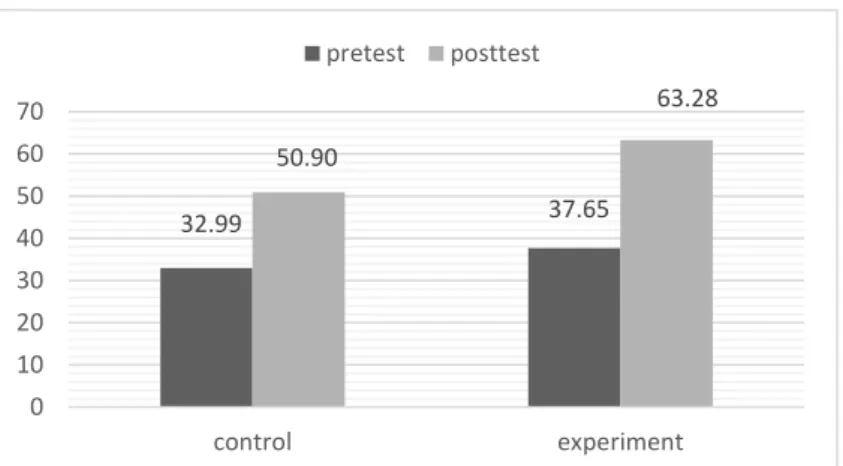
Creative thinking skills of students is identified by observing the difference of n-Gain between class of control and class of experiment. According to data of analysis, average score for pretest and posttest can be seen in Figure 1.
Figure 1. Average Score for Pre-test and Post-test of Creative Thinking Skills
Based on Figure 1 above, it can be understand that average score for pretest of class of control is similar with class of experiment, therefore it can be concluded that students of control class have the same skills like students of exeriment class at initial test. Meanwhile, there is an improvement of creative thinking skills before and after learning with the different average scrore between class of control and class of experiment. The use of students’ worksheet based on multiple representations showed the higher average score for posttest that class of control that still used usual worksheets. Then, the increasing of average score
32.99 37.65 50.90 63.28 0 10 20 30 40 50 60 70 control experiment pretest posttest
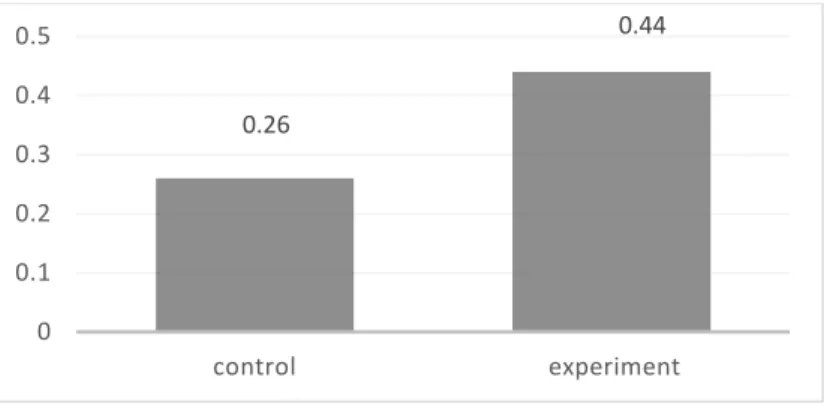
for post-test both in class of cotrol and class of experiment was analyzed using n-Gain, where the result will be shown in Figure 2.
Figure 2, Average n-Gain for Class of Control and Class of Experiment
According to Figure 2, it indicated that the average score of n-Gain for class of experiment is higher than class of control. From the data, it poved that n-Gain for class of experiment is 0.44 categorized as “medium”, while the n-Gain for class of control is 0.22 categorized as “low”. The difference explained that the use of students’ worksheet based on multiple representations is more effective to increase creative thinking skills of students.
After that, the average score of n-Gain is continued with statistical test of independent sample T test. Before doing the test, it began with test for normality and homogenity by using test of Kolmorgorov-Smirnov and Levene, where the resuld of this advanced test can be seen in Table 3.
Table 3. Normality Test with Kolmogorov-Smirnov Classes Number of Data Sig
Control 34 0.142
Experiment 30 0.150
Based on the data in Table 3, there is score of significancy both for class of control and class of experiment is greater than 0.05, while the significancy calculated by test of Levene obtained 0.074 which is higher than 0.05. Therefore, it can be concluded that the data of both classes are normally distributed with the same variants (homogen). After initial test is fulfilled, it continued by indipendent sample T test, where the average score of this test on n-Gain of creative thinking skills will be shown in Table 4.
Table 4. Independent Sample T Test
t df Mean difference Sig. (2 tailed)
-2.950 60.131 -.15325 0.005
Data in Table 4 showed that indipendent sample T test on average n-Gain of creative thinking skills has the significancy of 0.005 which is less than 0.05. Because of the significancy which is less than 0.05, so H0 is rejected and H1 is approved. Hence, it can be concluded that the use of students’ worksheet based on multiple representation can significantly increase student cretive thinking skills.
According to the results of data analysis, it can be said that the students’ worksheet based on multiple representation can increase the ability of creative thinking in class VII of junior high school students. The effectiveness of the use of student worksheets can be seen from the improvement of creative thinking skills for class of experiment is higher than class of control. This is because in the developed worksheets, the creative thinking skills of students can be trained through the existing phase in the learning based on the multiple representation. In learning with multiple representation models, there is an exploration-imagination phase that enhances the creative thinking ability of students [26]. Learning with emphasis on the process of imagination can also enhance the creativity of students because the process can generate their
0.26 0.44 0 0.1 0.2 0.3 0.4 0.5 control experiment
ability of representation [27]. The use of student worksheets in learning activities can also motivate students [28]. If students have high learning motivation, then there is also high creativity of students [29].
4. CONCLUSION
The use of students’ worksheet based on multiple representations in order to increase creative thinking skills is effective in accordance with the result of statictical test. It showed that there is a difference significancy of posttest for class of control commonly used worksheets in the school and class of experiment used the students’ worksheet based on multiple representations.
REFERENCES
[1] BSNP. Report of the National Professional Certification Agency 2010 (in bahasa). Jakarta: National Education Standards Agency (in bahasa), 2010.
[2] P21. Framework for 21st Century Learning. Wahington DC, Partnership for 21st Century Skills, 2011.
[3] Ministry of Education and Culture of the Republic of Indonesia (in bahasa). Curriculum Concepts and Implementation 2013. Jakarta: Ministry of Education and Culture of the Republic of Indonesia (in bahasa) : Jakarta, 2014.
[4] Siswono, T. Y, “Efforts to Improve Students' Creative Thinking Ability Through Submitting Problems,” Accredited Journal, Journal of Mathematics and Science Education, FMIPA Yogyakarta State
University, vol. 1, pp. 1-9, 2005.
[5] Moma, L, ”Development of Instrument for Mathematical Creative Thinking Ability for Middle School Students
,”
Delta-Pi: Journal of Mathematics and Mathematics Education, vol. 4, no. 1, 2016.
[6] Sari, I. M., Sumiati, E., & Siahaan, P, “Analysis of Junior High School Students' Creative Thinking Ability in Basic Technology Education (PTD) Learning,” Journal of Science Teaching, vol. 18, no. 1, pp. 60-68, 2013.
[7] Ministry of Education Malaysia, Integrated Curriculum for Secondary Schools: Curriculum Specifications Science form 2. Kuala Lumpur: Curriculum Development Centre, 2002.
[8] Hadzigeorgiou, Y., Fokialis, P., & Kabouropoulou, M, “Thinking About Creativity in Science Education,” Creative Education, vol. 3, no. 05, pp. 603-611, 2012.
[9] Sung, H. Y., & Hwang, G. J, “A Collaborative Game-Based Learning Approach to Improving Students' Learning Performance in Science Courses,” Computers & Education, vol. 63, pp. 43-51, 2013.
[10] Sumarmo, U., Hidayat, W., Zukarnaen, R., Hamidah, M., & Sariningsih, R, “Ability and Disposition of Logical, Critical, and Creative Mathematical Thinking (Experiments on High School Students Using Problem-Based Learning and Think-Talk-Write Strategies),” Journal of Science Teaching, vol. 17, no. 1, pp. 17-33, 2012.
[11] Fajriah, N & Asiskawati, E. “Students' Creative Thinking Ability in Mathematics Learning Using a Realistic Mathematics Education Approach in Middle School,” EDU-MAT Journal of Mathematics Education, vol. 3, pp. 157-165, 2015.
[12] Silvia, F., Risnita, & Syaiful. “Development of Creative Thinking Skills Rubric in Solving Mathematics Problems for Grade VIII Junior High School Attaufiq Jambi,” Edu-Sains: Journal of Mathematics and Natural Sciences University of Jember, vol. 4, pp. 10-21, 2015.
[13] Munandar, U, Development of Creativity in Gifted Children. Jakarta: Rineka Cipta, 2012.
[14] Kusumaningrum, S., & Djukri, D, “Development of Project Based Learning Model (PjBL in bahasa) Learning Tools to Improve Science and Creativity Process Skills,” Journal of Science Education Innovation, vol. 2, no. 2, pp. 241-251, 2012.
[15] Utami, W. S., Sumarni, I., Ruja, I. N., & Utaya, “The Effectiveness of Geography Student Workshet to Develop Learning Experiences for High School Students,” Journal of Education and Learning, vol. 5, pp. 315-321, 2016. [16] Rohaeti, E., Endang, W. LFX., & Regina, T. P, “Development of Student Science Worksheets (LKS) for Chemical
Science for Middle School,” Journal of Educational Innovation, vol. 10, pp. 1-11, 2009.
[17] Waldrip, B., Prain, V., & Carolan, J, “Learning Junior Secondary Science through Multi-Modal Representation,”
Electronic Journal of Science Education, vol. 11, pp. 89-107, 2006.
[18] Abdurrahman, Liliasari, Rusli, A., & Waldrip. B, “Implementation of Multi Representation Based Learning to Improve Mastery of the Concept of Quantum Physics,” Educational horizon, Th. XXX, pp. 30-45, 2011.
[19] Sunyono, Yuanita, L., & Ibrahim, M, “Supporting Students in Learning with Multiple Representations to Improve Student Mental Models on Atomic Structure Concepts,” Science Education International, vol. 26,no. 2, pp. 104-125, 2015.
[20] Wati, N. K & Iriani, R, “The Influence of Simayang Type II Learning Model Assisted by PhET Media Against Learning Outcomes and the ability of Student Visual Representation on Acid Base Solution Material,” Quantum, Journal of Science Education Innovation, vol. 7, no. 2, pp. 121-126, 2016.
[21] Coughlan, Ann. Learn to Learn: Creative Thinking and Critical Thinking. DCU Student Learning Resources. 2007.
[22] Sugiyono, Metode Penelitian Kuantitatif, Kualitatif dan RnD. Bandung: Alfabeta, 2010.
[23] Thiagarajan, S., Semmel, D. S & Semmel, M. I, Instructional Development for Training Teachers of Exceptional Children. Indiana: Indiana University, 1974.
[25] Hake, R. R, “Interactive-Engagement versus Traditional Methods: A Six-Thousand-Student Survey of Mechanics Test Data for Introductory Physics Courses,” American Journal of Physics, vol. 66, no.1, pp. 64-74, 1998.
[26] Sunyono, Multiple Representation Learning Model, Yogyakarta: Media Akademi, 2015.
[27] Haruo, O., Hiroki, F., & Manabu, S, “Development of a Lesson Model in Chemistry Through “Special Emphasis on Imagination Leading to Creation (SEIC),” Chemical Education Journal (CEJ), vol. 13, no. 1, pp. 1-6, 2009. [28] Asdaniar, Hala, Y., & Taiyeb, A. M, “The Influence of the Use of Student Concept Map Based Worksheets
Against Motivation and Learning Outcomes of Class VII Students of Awangpone Junior High School 1,” Jurnal
Bionature, vol. 17, no. 2, pp. 102-106, 2016.
[29] Bhakti, Y. B., & Astuti, I. A. D, “The Influence Process of Science Skill and Motivation Learning with Creativity Learn,” Journal of Education and Learning (EduLearn), vol. 12, no. 1, pp. 30-35, 2018.