heuristic approach to automated packing. PhD thesis,
University of Nottingham.
Access from the University of Nottingham repository:
http://eprints.nottingham.ac.uk/11625/1/mvh_corrected_thesis.pdf
Copyright and reuse:
The Nottingham ePrints service makes this work by researchers of the University of Nottingham available open access under the following conditions.
· Copyright and all moral rights to the version of the paper presented here belong to the individual author(s) and/or other copyright owners.
· To the extent reasonable and practicable the material made available in Nottingham ePrints has been checked for eligibility before being made available.
· Copies of full items can be used for personal research or study, educational, or not-for-profit purposes without prior permission or charge provided that the authors, title and full bibliographic details are credited, a hyperlink and/or URL is given for the original metadata page and the content is not changed in any way.
· Quotations or similar reproductions must be sufficiently acknowledged.
Please see our full end user licence at:
http://eprints.nottingham.ac.uk/end_user_agreement.pdf A note on versions:
The version presented here may differ from the published version or from the version of record. If you wish to cite this item you are advised to consult the publisher’s version. Please see the repository url above for details on accessing the published version and note that access may require a subscription.
to Automated Packing
Matthew Hyde, BSc
Thesis submitted to The University of Nottingham
for the degree of Doctor of Philosophy
This thesis presents a programme of research which investigated a genetic programming hyper-heuristic methodology to automate the heuristic design process for one, two and three dimensional packing problems.
Traditionally, heuristic search methodologies operate on a space of potential solu-tions to a problem. In contrast, a hyper-heuristic is a heuristic which searches a space of heuristics, rather than a solution space directly. The majority of hyper-heuristic research papers, so far, have involved selecting a heuristic, or sequence of heuristics, from a set pre-defined by the practitioner. Less well studied are hyper-heuristics which can create new heuristics, from a set of potential components.
This thesis presents a genetic programming hyper-heuristic which makes it pos-sible to automatically generate heuristics for a wide variety of packing problems. The genetic programming algorithm creates heuristics by intelligently combining components. The evolved heuristics are shown to be highly competitive with human created heuris-tics. The methodology is first applied to one dimensional bin packing, where the evolved heuristics are analysed to determine their quality, specialisation, robustness, and scalability. Importantly, it is shown that these heuristics are able to be reused on unseen problems. The methodology is then applied to the two dimensional packing problem to determine if automatic heuristic generation is possible for this domain. The three dimensional bin pack-ing and knapsack problems are then addressed. It is shown that the genetic programmpack-ing hyper-heuristic methodology can evolve human competitive heuristics, for the one, two, and three dimensional cases of both of these problems. No change of parameters or code is required between runs. This represents the first packing algorithm in the literature able to claim human competitive results in such a wide variety of packing domains.
My sincere thanks go to my two supervisors, Professor Edmund Burke, and Professor Gra-ham Kendall, for the encouragement and flexibility they have given to me over the last three years. Through their support and trust, I have had the opportunity to direct my part in an interesting and very challenging project, and to enjoy myself along the way.
Secondly, I have no doubt that this thesis is stronger because of the working relationship I have had with Dr John Woodward, on the Engineering and Physical Sciences Research Council (EPSRC) project that has funded this PhD. I greatly valued our meetings, and his advice. I would like to also thank Dr. Gabriela Ochoa, for her support in the final stages of the PhD, especially helping me to ensure that I have included all the relevant literature.
My thanks also go to the EPSRC, whose funding made this project possible. In addition, many thanks go to the rest of the academic and administrative staff at the Auto-mated Scheduling, optimisAtion and Planning (ASAP) research group. I cannot imagine a more interesting, diverse, and friendly group of people to work alongside, and I have learned a lot from all of you.
Contents
List of Figures viii
List of Tables xii
1 Introduction 1
1.1 Structure of Thesis . . . 6
1.2 Academic Publications Produced . . . 9
2 Literature Review 11 2.1 Introduction . . . 11
2.2 Hyper-Heuristics . . . 12
2.2.1 Hyper-Heuristics to Choose Heuristics. . . 14
2.2.2 Hyper-Heuristics to Create Heuristics. . . 21
2.3 One Dimensional Packing . . . 25
2.3.1 Problem Definitions . . . 25
2.3.2 Previous Work . . . 26
2.4 Two Dimensional Packing . . . 30
2.4.1 Problem Definitions . . . 30
2.4.2 Exact Methods . . . 32
2.4.3 Heuristic Methods . . . 33
2.4.4 Metaheuristic Methods . . . 34
2.5 Three Dimensional Packing . . . 36
2.5.1 Problem Definitions . . . 36
2.5.2 Exact Methods . . . 37
2.5.3 Heuristic and Metaheuristic Methods . . . 38
2.6 Complexity Status . . . 40
2.7 Genetic Programming . . . 41
2.7.1 Program Structure . . . 42
2.7.2 Initialisation . . . 42
2.7.3 The Five Preparatory Steps . . . 43
2.7.4 Genetic Operators . . . 45
2.7.5 Theoretical Concepts . . . 48
2.7.6 Achievements of Genetic Programming . . . 49
2.8 Conclusion . . . 50
3 Evolving Heuristics for the One Dimensional Bin Packing Problem 52 3.1 Introduction . . . 52
3.2 The First-Fit Heuristic . . . 53
3.3 Methodology . . . 54
3.3.1 How The Heuristic is Applied . . . 54
3.3.2 Structure of the Heuristics . . . 56
3.3.3 Simple Example of a Heuristic Constructing a Solution . . . 57
3.3.4 Heuristics Producing Illegal Solutions . . . 59
3.3.5 How the Heuristics are Evolved . . . 61
3.4 Results . . . 65
3.4.1 Individual Results . . . 65
3.4.2 Statistical Tests . . . 69
3.4.3 Comparison with First-Fit and Best-Fit, Employing the Basic Fitness Function . . . 70
3.4.4 Comparison with First-Fit and Best-Fit, Employing the Second Fit-ness Function . . . 72
3.4.5 Comparison with First-Fit and Best-Fit, Removing the≤Function . 74 3.5 Conclusion . . . 76
4 The Reusability of Evolved Online Bin Packing Heuristics 79 4.1 Introduction . . . 79
4.2 The Best-Fit Heuristic . . . 80
4.3 Methodology . . . 82
4.3.1 How The Heuristic is Applied . . . 82
4.3.2 Structure of the Heuristics . . . 84
4.3.3 Simple Example of a Heuristic Constructing a Solution . . . 85
4.3.4 How the Heuristics are Evolved . . . 87
4.4 Results . . . 90
4.4.1 Example of an Evolved Heuristic . . . 90
4.4.2 The Quality of Evolved Heuristics . . . 92
4.4.3 Specialisation of Evolved Heuristics . . . 93
4.4.4 Robustness of Evolved Heuristics . . . 95
4.5 Conclusion . . . 97
5 The Scalability of Evolved Online Bin Packing Heuristics 99 5.1 Introduction . . . 99
5.2 Methodology . . . 100
5.2.1 How the Heuristic is Applied . . . 100
5.2.2 Structure of the Heuristics . . . 102
5.2.3 How the Heuristics are Evolved . . . 104
5.3 Results . . . 106
5.3.1 Performance past the training range . . . 107
5.3.3 Two Evolved Heuristics . . . 111
5.4 Conclusion . . . 117
6 Evolving Heuristics for Two Dimensional Strip Packing 120 6.1 Introduction . . . 120
6.2 Representation . . . 122
6.3 Methodology . . . 125
6.3.1 How the Heuristic is Applied . . . 125
6.3.2 The Structure of the Heuristics . . . 127
6.3.3 Example of the Packing Process . . . 130
6.3.4 How the Heuristics are Evolved . . . 134
6.4 Results . . . 136
6.4.1 Explanation of Benchmark Algorithms . . . 136
6.4.2 Comparison with Metaheuristics and the Best-Fit Heuristic . . . 139
6.4.3 Comparison with Reactive GRASP . . . 139
6.4.4 Example Packings . . . 140
6.4.5 Results with Parsimony Pressure and Cache of Heuristic Evaluations 142 6.5 Conclusion . . . 144
7 A Hyper-Heuristic for 1D, 2D and 3D Packing Problems 147 7.1 Introduction . . . 147
7.2 Problem Descriptions . . . 149
7.2.1 The Knapsack Problem . . . 149
7.2.2 Knapsack Packing in Two and Three Dimensions . . . 149
7.2.3 The Bin Packing Problem . . . 150
7.2.4 Bin Packing in Two and Three Dimensions . . . 150
7.3 Representation . . . 151
7.3.1 Bin and Corner Objects . . . 151
7.3.2 Valid Placement of Pieces . . . 153
7.3.3 Extending a Corner’s Surfaces . . . 153
7.3.4 Filler Pieces . . . 154
7.3.5 Bin Packing, and Packing in Lower Dimensions . . . 155
7.4 Methodology . . . 156
7.4.1 How the Heuristic is Applied . . . 156
7.4.2 The Structure of the Heuristics . . . 159
7.4.3 How the Heuristics are Evolved . . . 160
7.5 The Data Sets . . . 162
7.5.1 One Dimensional Instances . . . 163
7.5.2 Two Dimensional Instances . . . 164
7.5.3 Three Dimensional Instances . . . 165
7.6 Results . . . 166
7.6.1 An Example Calculation . . . 167
7.6.2 Bin Packing Results . . . 169
7.6.3 Knapsack Results . . . 171
8 Conclusion 175 8.1 Context . . . 175 8.2 Summary of Work . . . 177 8.2.1 Chapters 3 - 5 . . . 177 8.2.2 Chapter 6 . . . 178 8.2.3 Chapter 7 . . . 178
8.3 Extensions and Future Work . . . 180
8.3.1 Evolving Reusable Heuristics for Two and Three Dimensional Packing 180 8.3.2 Specialisation and Robustness of Two Dimensional Packing Heuristics 181 8.3.3 Intelligently Select which Allocations to Consider . . . 181
8.3.4 Improve the Three Dimensional Packing Representation . . . 181
8.3.5 Employ Higher Level Functions and Terminals . . . 182
8.3.6 Evolving one General Packing Heuristic . . . 182
8.4 Final Remarks . . . 183
List of Figures
1.1 A diagram which clarifies one of the key themes of this thesis. One of the motivations for hyper-heuristic research is to automate the heuristic design process. This thesis presents methodologies which allow the human to be replaced by genetic programming at the algorithm design stage, while cur-rently a human must still specify the potential components of the heuristic to be built. Such an automated system means that human involvement in heuristic design can stop earlier in the process. . . 3 1.2 A conceptual graph of the potential advantage of hyper-heuristic systems
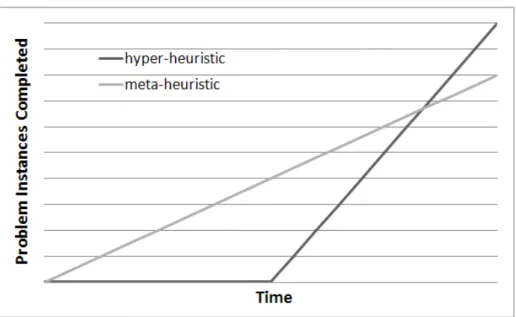
which generate heuristics. A metaheuristic system can begin to obtain solu-tions to instances immediately. The hyper-heuristic cannot during the evo-lution, but once a heuristic is evolved it can obtain solutions to problem instances quickly. In the long run, the hyper-heuristic system as a whole requires less time because it produces one quick constructive heuristic. . . . 5 1.3 The structure of the thesis over the chapters 3 through to 8. The diagram
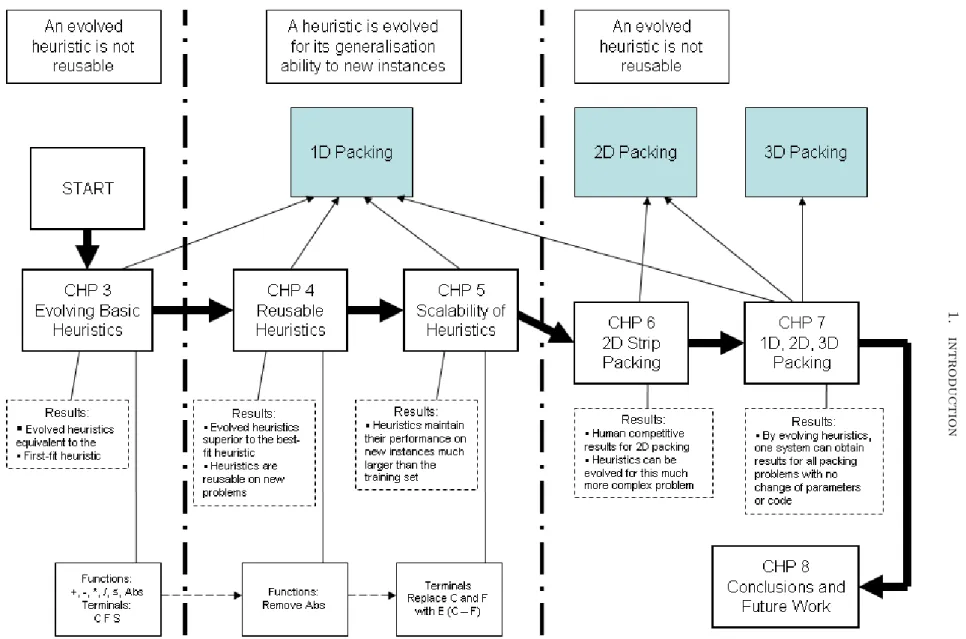
shows that the thesis progresses from evolving non-reusable heuristics, to evolving reusable heuristics, and then back again to systems which evolve one heuristic per instance. The diagram also shows which chapters relate to which problem domains, and that chapter 7 presents results on all three domains . . . 7 2.1 The relationship between a hyper-heuristic, the domain specific heuristics,
and a problem instance [252] . . . 15 2.2 A diagram showing where the heuristics from table 2.1 would place a piece
of size 60. Next-fit only has access to the highest indexed bin and an empty bin, and it chooses the empty bin in this case because the piece does not fit into the highest indexed bin . . . 28 2.3 An example tree structure representing a program that calculates the space
left in the bin in figure 2.4 . . . 43 2.4 The features of a one dimensional bin to which the tree in figure 2.3 could
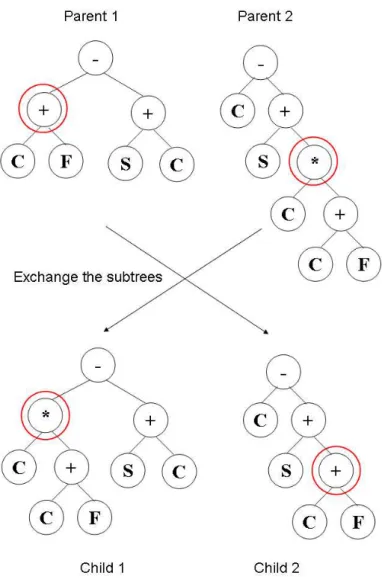
be applied to . . . 43 2.5 An example of a genetic programming crossover operation being performed
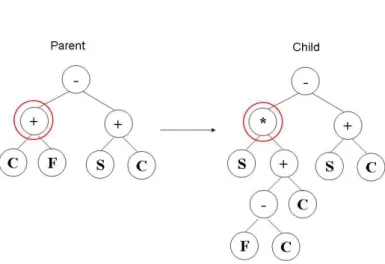
2.6 An example of a genetic programming mutation operation being performed. Only one parent tree is necessary, and one child tree is produced. The subtree rooted at the circled node is deleted, and a new subtree is grown at the same
point, by randomly selecting each node . . . 48
3.1 Pieces remaining to be packed, and a partial solution . . . 54
3.2 The first piece is put into the third bin because it is the first bin with enough space to accommodate it . . . 54
3.3 The second piece is put into the fourth bin . . . 54
3.4 The final two pieces are put into the first and fifth bins . . . 54
3.5 An example heuristic used in the analysis in section 3.3.3, to pack the pieces in figures 3.6 to 3.9 . . . 57
3.6 A partial solution. We will use the heuristic in figure 3.5 to pack the four remaining pieces . . . 58
3.7 The piece of size 70 is packed into the first bin for which the heuristic returns a positive number, the fifth bin . . . 58
3.8 The piece of size 85 is packed into the sixth bin . . . 58
3.9 The piece of size 30 is packed into the third bin . . . 58
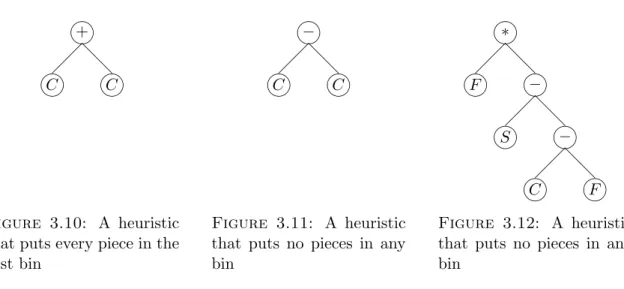
3.10 A heuristic that puts every piece in the first bin . . . 60
3.11 A heuristic that puts no pieces in any bin . . . 60
3.12 A heuristic that puts no pieces in any bin . . . 60
3.13 Tree A . . . 66 3.14 Tree B . . . 66 3.15 Tree C . . . 66 3.16 Tree D . . . 66 3.17 Tree E . . . 68 3.18 Tree F . . . 68
4.1 The start of the example of section 4.2, the piece of size 70 will be packed next by the best-fit heuristic . . . 81
4.2 The piece of size 70 is packed into the fourth bin because it has the least free space of all the bins that the piece fits into . . . 81
4.3 The next piece is packed into the third bin after all the bins are considered 81 4.4 The final two pieces are packed into the second and first bins . . . 81
4.5 An example heuristic, used in the example packing described in section 4.3.3 and figures 4.6 to 4.9 . . . 85
4.6 The initial partial solution from section 4.3.3. The heuristic in figure 4.5 will pack the first three pieces. . . 86
4.7 All of the bins are scored by the heuristic, the bin on the far right scores the highest with 34500. A new empty bin is opened because the existing one receives the piece. . . 86
4.8 The newly opened bin on the far right scores the highest with 32250. Again, a new empty bin is opened because there must always be one available. . . 86
4.9 For the third time, the empty bin receives the piece. The heuristic appears to prefer to place each piece into a new bin. . . 86
4.10 Diagram of the piece size distributions of each class of instances created for the experiments of chapter 4 . . . 89 4.11 An example heuristic, evolved onT10−90 . . . 91
5.1 The results forH100,H250, andH500on the validation instances. The vertical
axis shows the amount of bins by which the 30 heuristics from each group beat best-fit on average. The horizontal axis shows the number of pieces packed. The results shown are the average amount of bins required by the heuristics over the 20 validation instances. . . 107 5.2 The results for the heuristics evolved on 100, 250, and 500 pieces of the
train-ing instances, on the first 500 pieces of each of the 20 validation instances. This is a ‘zoomed in’ view of the same data displayed in figure 5.1. The vertical axis shows the amount of bins by which the 30 heuristics from each group beat best-fit on average. The horizontal axis shows the number of pieces packed. The results shown are the average results of the 30 heuristics over the 20 instances. . . 109 5.3 The functionC/(E−S), which represents the best-fit heuristic when applied
in the fixed framework used in this chapter. The defining feature is the ‘wall’ which exists on the boundary of where the piece size matches the ‘emptiness’ of the bin. Behind this wall the piece size is larger than the emptiness, so the piece does not fit in the bin. The bin which receives the maximum score will be the bin with the least emptiness out of all of the bins that the piece fits into. . . 113 5.4 A heuristic requiring 41448.4 bins on average over the validation set, thus
outperforming best-fit. The graph is in the same format as figure 5.3, but rotated to put the ‘high emptiness’ side in the foreground. The heuristic has much the same structure as best-fit, however the corner curls up at the end as the piece size gets small and the emptiness gets large. There is also a ‘ridge’ in the landscape running in front of the wall, where certain combinations of piece size and emptiness are rated higher than those adjacent to the ridge on both sides. . . 114 5.5 A heuristic requiring 40573.3 bins on average over the validation set, thus
outperforming best-fit. This is the same heuristic as is displayed in figure 5.6 115 5.6 A heuristic requiring 40573.3 bins on average over the validation set. This is
the same heuristic as is displayed in figure 5.5 . . . 116 6.1 Bin structure after two pieces have been packed . . . 123 6.2 The middle bin of figure 1 has been replaced by two new bins due to the
third piece being packed into it . . . 123 6.3 As no piece can fit into bin three of figure 2, the base of bin three has been
raised, to combine it with bin two . . . 123 6.4 When the fourth piece is packed into the second bin, the heights of bin two
and three are the same and they have been combined . . . 123 6.5 An example heuristic, which is analysed in section 6.3.3 by packing the pieces
6.6 The pieces that the heuristic in figure 6.5 will pack for the example described
in section 6.3.3 . . . 131
6.7 The current partial solution, the heuristic will choose a piece from figure 6.6 to be placed in this solution . . . 131
6.8 All of the locations where piece one from figure 6.6 can be placed . . . 131
6.9 Allocation A from figure 6.8 in detail . . . 131
6.10 Allocation C from figure 6.8 in detail . . . 131
6.11 Both of the potential allocations for piece two . . . 133
6.12 The new partial solution after the allocation which received the highest score has been performed . . . 133
6.13 Packing of instance c5p3 to a height of 91. Packed by the heuristic evolved with population 64 . . . 141
6.14 Packing of instance c5p3 to a height of 91. Packed by the heuristic evolved with population 256 . . . 141
6.15 The heuristic that packed figure 6.13 . . . 141
6.16 The heuristic that packed figure 6.14 . . . 141
7.1 An initialised bin with one ‘corner’ in the back-left-bottom corner of the bin 152 7.2 A bin with one piece placed in the corner from figure 7.1 . . . 152
7.3 The three surfaces defined by the corner that is in the Y direction of the piece152 7.4 The three surfaces defined by the corner that is in the X direction of the piece152 7.5 An invalid placement of a new piece, because it exceeds the limit of the corner’s XZ surface in the Z direction . . . 153
7.6 An invalid placement of a new piece, because it exceeds the limit of the corner’s YZ surface in the Z direction . . . 153
7.7 A piece which reaches the limit of two surfaces of the corner that it was put into . . . 154
7.8 The three surfaces of the corner with the smallest available area . . . 155
7.9 A filler piece is put into the corner from 7.8, the surfaces of two corners are updated . . . 155
List of Tables
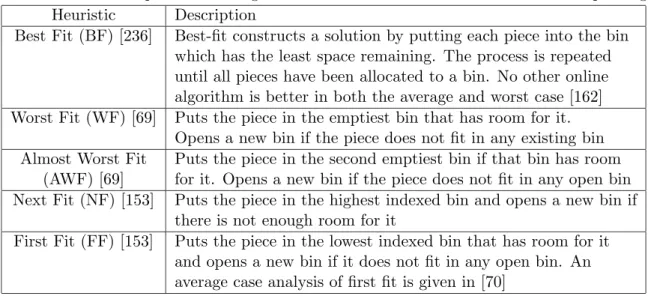
1.1 A summary of the implementation details for the genetic programming sys-tem presented in each chapter. The parameters subtly change over time due to experience, experimentation, and the capabilities of freely available genetic programming code . . . 8 2.1 A description of existing constructive heuristics for one dimensional bin packing 27 3.1 The functions and terminals used in chapter 3, and descriptions of the values
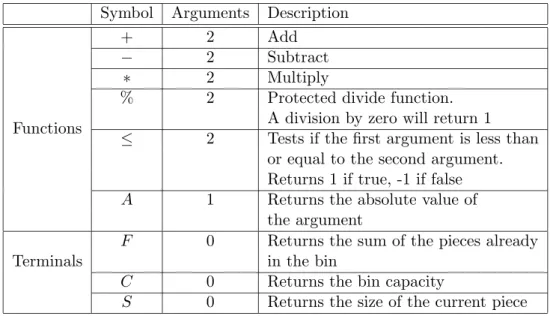
they return . . . 56 3.2 Genetic programming initialisation parameters for chapter 3 . . . 61 3.3 The performance of 20 heuristics, each evolved on all 20 instances using the
basic fitness function which is shown in equation 3.3, section 3.3.5 . . . 71 3.4 The performance of 20 heuristics each evolved on one instance, using the
basic fitness function which is shown in equation 3.3, section 3.3.5 . . . 72 3.5 The performance of 20 heuristics each evolved on all 20 instances using the
second fitness function which is shown in equation 3.4, section 3.3.5 . . . . 73 3.6 The performance of 20 heuristics each evolved on one instance, using the
second fitness function which is shown in equation 3.4, section 3.3.5 . . . . 74 3.7 The performance of 20 heuristics each evolved on all 20 instances, without the
≤function included in the function set, and with the second fitness function, which is shown in equation 3.4, section 3.3.5 . . . 75 3.8 The performance of 20 heuristics each evolved on one instance, without the
≤function included in the function set, and with the second fitness function, which is shown in equation 3.4, section 3.3.5 . . . 77 4.1 The functions and terminals used in chapter 4, and descriptions of the values
they return . . . 85 4.2 Genetic programming initialisation parameters for chapter 4 . . . 88 4.3 Summary of the results obtained by the heuristic shown in figure 4.11
com-pared to the results of best-fit. The result shown is the total bins used over the 20 instances. . . 92 4.4 The performance of each set of evolved heuristics tested against best-fit . . 93
4.5 A comparison of the performance of six sets of evolved heuristics with the heuristic sets evolved on their respective super-class and super-super-class. The entries in the table state whether the set is better, worse, or the same as its super-class (or super-super-class) set. The values in brackets represent the probabilities that the performance values of both heuristic sets come from underlying populations with the same mean. For example, row 4 (labelled H10−29) shows that theH10−29 set is better on theV10−29instances than the
set evolved on its super-class (H10−49) and the set evolved on its
super-super-class (H10−89) . . . 94
4.6 Summary of the illegal results when heuristic sets are each tested on three unrelated validation sets, containing piece sizes they did not pack in their evolution. A cross represents at least one illegal result, a circle represents no illegal results . . . 96 5.1 The functions and terminals used in chapter 5, and descriptions of the values
they return . . . 102 5.2 The values returned by the standard protected divide function and the
mod-ified protected divide used in the experiments of this chapter. . . 103 5.3 Genetic programming initialisation parameters for the experiments of chapter 5105 5.4 The number of bins used on average by the three groups of 30 evolved
heuris-tics over the set of problems with 100,000 pieces, compared to the number used by best-fit . . . 108 6.1 The functions and terminals used in chapter 6, and descriptions of the values
they return . . . 128 6.2 The values returned by the standard protected divide function, the
modi-fied protected divide used in the previous chapter, and the further modimodi-fied function used in this chapter. . . 129 6.3 Initialisation parameters of the experiments of chapter 6 . . . 134 6.4 The benchmark problem instances used in this chapter . . . 136 6.5 Results of our evolved heuristics compared to recent metaheuristic and
con-structive heuristic approaches, and the reactive GRASP approach. The re-sults are highlighted, in bold type, where the hyper-heuristic system finds a heuristic which has equal or better results than the metaheuristic approaches and the best-fit algorithm for that instance. The GRASP algorithm is gener-ally the best approach, the bold values are intended to show how the evolved heuristics compare to the other approaches . . . 137 6.6 Difference in performance of the best evolved heuristics for each instance and
the reactive GRASP, the figures represent the extent to which the GRASP performs better than the evolved heuristics. . . 140 6.7 A comparison of the time taken to evolve the heuristics using the previous
implementation, and the improved implementation. . . 143 7.1 The functions and terminals used in chapter 7, and descriptions of the values
7.2 Initialisation parameters of the experiments of chapter 7 . . . 161 7.3 A summary of the 18 data sets used in the experiments of this chapter . . . 163 7.4 The individual instance results for the Thpack9 bin packing data set . . . . 168 7.5 Summary of bin packing results, and the percentage improvement over the
best results in the literature . . . 169 7.6 Summary of knapsack results, and the percentage improvement over the best
Chapter 1
Introduction
Many combinatorial problems of practical interest are intractable, which, put quite simply, means that the search space they create is too large to search exhaustively. For this reason, heuristics are created to obtain reasonably good solutions in a reasonable amount of time. Heuristics provide no performance guarantees, but, when well designed and implemented, they are methods which are generally recognised as able to produce good solutions most of the time. The research into metaheuristics, over the last few decades, has shown that more advanced search technology is often required to obtain the high levels of solution quality. The term metaheuristic refers to a class of heuristic methods [50]. The term was first used by Glover in [122] to describe tabu search, and is subsequently defined in 1997 as “a master strategy that guides and modifies other heuristics to produce solutions beyond those that are normally generated in a quest for local optimality” [123]. In other words, they utilise various methods to avoid the search being drawn into local optima at the expense of finding the global optimum. Genetic algorithms, simulated annealing, and tabu-search are three well known examples of metaheuristics.
To develop a (meta)heuristic search system, one could analyse the problem and choose the best search paradigm to use from the literature. Another option would be to utilise knowledge of the structure of the problem to create a new heuristic. Often, it is not obvious which heuristic to choose because of either the complexity of the problem, or the lack of knowledge of the circumstances in which the existing heuristics are effective.
In addition to the difficulty of selecting an appropriate heuristic, a (meta)heuristic implementation often cannot be applied to problem domains other than those which they are specifically created for, or even to different instances of the same problem [47]. For example, a (meta)heuristic methodology developed for the university course timetabling
problem may not perform well on the exam timetabling problem. Furthermore, a system developed for the course timetabling problem in one university, may not work well for the same problem in a different university. There are features of the problems (and problem instances) that make them fundamentally different from each other, such as the number of students, the size of rooms and other available resources. The methodologies effective for one set of constraints may not be effective when the constraints are changed. In other words, the implementation of these search methodologies is often bespoke in nature, and this makes them potentially expensive systems, as they cannot be reused once developed for a given application. The relative expense of bespoke systems, and the difficulty involved in the selection of an appropriate heuristic, both serve as motivations for hyper-heuristic research.
A hyper-heuristic can be defined as a heuristic which searches a space of heuristics, rather than a solution space directly [47, 52, 74, 239]. In other words, it is a heuristic which chooses between a set of heuristics. The aim is to automate the decision of which heuristic(s) to use for a given problem.
The term hyper-heuristic has been coined relatively recently [47, 52, 74, 252]. However, the first research into methods which search a heuristic space dates back to the early 1960s, when Fisher and Thompson developed a hyper-heuristic method for the job shop scheduling problem [106, 107]. At every decision point, one of the heuristics was applied to the current solution based on a dynamic weighting. The weighting was increased if the heuristic obtained a better solution, and decreased if not. Therefore, if a heuristic produced an improvement, it was more likely to be chosen again. This hyper-heuristic was found to be better than applying a randomly chosen heuristic. Also, randomly choosing a sequence of heuristics was found to obtain better results than any one heuristic could achieve alone, providing early evidence that using combinations of existing heuristics during the search could be beneficial.
Recently, many metaheuristics have been employed as hyper-heuristics. For exam-ple, simulated annealing [87], genetic algorithms [77, 134, 132, 133, 241, 263], tabu search [52], and an ant algorithm [51]. These methods all require a set of heuristics to choose from, which must be supplied by the practitioner. However, if the problem is new, there may be no pre-existing heuristics available, or the existing heuristics may be sub-standard. Even if there are heuristics available, better quality heuristics may be hard to discover manually if they are counterintuitive in nature. These issues and circumstances serve as the motivation
Figure 1.1: A diagram which clarifies one of the key themes of this thesis. One of the motivations for hyper-heuristic research is to automate the heuristic design process. This thesis presents methodologies which allow the human to be replaced by genetic programming at the algorithm design stage, while currently a human must still specify the potential components of the heuristic to be built. Such an automated system means that human involvement in heuristic design can stop earlier in the process.
for research into hyper-heuristic systems whichcreateheuristics, rather than select between pre-existing heuristics.
The subject of this thesis is a hyper-heuristic system which automatically designs heuristics, using a genetic programming algorithm. A set of potential components must be defined by the user, and the system searches the space of all heuristics that can be created from the given components. While the specification of the components is not automated, it is a process which requires less human input than to specify a set of fully functional heuristics. Fukunaga states that humans excel at identifying good potential components of methods to solve problems, but combining them seems to be a more difficult undertaking [112]. This concept is central to the motivation for the work in this thesis, and is depicted graphically in figure 1.1. As problems in the real world become more complex, identifying ways to automate this process may become fundamental to the design of heuristics, because it will become more difficult to manually combine their potential components in ways that fully exploit the structure of a complex problem.
There are a number of advantages of such an approach. There is a possibility of discovering new heuristics which are unlikely to be invented by a human analyst, due to their counterintuitive nature. Another advantage is that a different heuristic can be created for each individual instance, meaning that the result obtained on each is more likely to be
better than that obtained by one general heuristic. Human created heuristics are designed to perform well over many problems, because it would take too long to manually develop a new heuristic for every individual instance. This thesis will show examples of counterintuitive heuristics, which nevertheless perform better than those created by humans. The results also show that a heuristic can indeed be automatically created for each instance, meaning that the results of the hyper-heuristic as a whole are mostly superior to those of a comparable human created heuristic.
The heuristics can be seen as ‘disposable’, if they are created to obtain a result for one instance. In this case, the hyper-heuristic is searching the heuristic space to indirectly find a good solution in the solution space. However, the process outputs a heuristic as well as a solution, and this heuristic could be reused on new problems. Therefore, this thesis also investigates the circumstances in which it is possible to apply the automatically created heuristic to unseen problems and still obtain good results.
Evolving a disposable heuristic can take in the order of minutes or hours depending on the size of the problem instance being solved. Every evaluation of an individual in the population requires the training instance to be solved by the individual. A fitness is assigned to the individual based on the result. If the problem being solved is large then this increases the total time required for the evolution. It would be quicker to apply a one-pass constructive heuristic, but its result is generally worse than the result of a heuristic which has been evolved on the instance. Also, the time to apply a metaheuristic, searching the space of solutions, would be of the same order of magnitude as applying the hyper-heuristic to search the space of heuristics.
If the system is capable of evolving heuristics that can be reused on new problem instances, the run time issues change. One motivation for hyper-heuristic research is that once a heuristic is evolved, and specialised to a class of instances, it can obtain solutions to new instances very quickly. Examples of this will be shown in this thesis. The time necessary for evolution of a heuristic, means that in the short term it can be more efficient to run a metaheuristic search. However, if many problems must be solved, then the total time taken for the metaheuristic runs will soon become larger than the time to evolve a quick heuristic and then run it multiple times. This is shown graphically in figure 1.2.
A key concept is that one-pass constructive heuristics ‘tailored’ to a class of prob-lem instances can obtain better results, more quickly, than more complex metaheuristic algorithms. Historically, one-pass constructive heuristics in the literature are intended to
Figure 1.2: A conceptual graph of the potential advantage of hyper-heuristic systems which generate heuristics. A metaheuristic system can begin to obtain solutions to instances immediately. The hyper-heuristic cannot during the evolution, but once a heuristic is evolved it can obtain solutions to problem instances quickly. In the long run, the hyper-heuristic system as a whole requires less time because it produces one quick constructive heuristic.
be used on any problem instance. The literature contains many worst case and average case performance analyses for these heuristics over all problems. However, in many cases, a practitioner is interested in the performance on their special case, which will contain a certain structure that a bespoke heuristic can exploit. The focus on general heuristics could be because a bespoke heuristic has little value outside of the problem set it is designed for, and therefore it is expensive to design. Research into hyper-heuristics aims to reduce that cost by automating the design process.
The domain of cutting and packing will be used in order to demonstrate the potential of genetic programming to automatically create heuristics. Cutting and packing problems involve assigning a number of small items to one or more larger items. This can represent situations where shapes must be cut from larger stock sheets efficiently, or where boxes must be packed into larger containers while minimising waste. Heuristics for this domain are well studied, both empirically and theoretically, and the literature shows that a vast array of heuristics, metaheuristics, and exact methods have been created and analysed. This thesis shows that this process of heuristic creation can be automated.
While not being a defining characteristic, the issue of generality is central to hyper-heuristic research. Generality, in this case, means the ability to successfully apply the system to a number of problem domains. To show the generality of this genetic programming system, we will use the different problem domains of knapsack packing and bin packing. A knapsack problem is one where a subset of the set of small items must be chosen to fit into one larger item. Each small item has a value associated with it, as well as a size. The objective is to find the subset which has the maximum total value, while still fitting into the larger item. A bin packing problem involves assigning all of the small items, each to one of a number of large items. The objective is to minimise the number of large items needed to accommodate all of the small items.
The knapsack and bin packing problems can be defined in one, two, and three dimensions. In this thesis, the genetic programming system will be applied to problems of each dimensionality. Finally, the developed system will be shown to operate on both knap-sack and bin packing problems, of any dimensionality, without any change in parameters. Indeed, it is the first system in the literature that is able to claim human competitive results in such a wide variety of packing domains.
In summary, this thesis will investigate the quality, specialisation, robustness, scalability, and potential for reuse of the automatically generated heuristics. It will be shown that they can be generated for a number of different problem domains, and that the results they obtain can be human competitive.
1.1 Structure of Thesis
The thesis is structured as follows. Chapter 2 presents a review of the relevant literature for genetic programming, hyper-heuristics, and one, two, and three dimensional packing. Chapters 3 to 5 present work on one dimensional bin packing. Heuristics are evolved in Chapter 6 for two dimensional strip packing. Chapter 7 presents the most recent work, a hyper-heuristic system which evolves heuristics for the one, two, or three dimensional bin packing or knapsack problem.
Figure 1.3 presents an overview of the thesis, showing the themes and problem domains addressed in each chapter. The diagram is intended to be read from the ‘start’ box to the ‘conclusions and future work’ box, following the arrows. The main results of each chapter are attached to each chapter’s box, and for chapters 3 to 5, the diagram shows
t r o d u c t io n 7
Figure 1.3: The structure of the thesis over the chapters 3 through to 8. The diagram shows that the thesis progresses from evolving non-reusable heuristics, to evolving reusable heuristics, and then back again to systems which evolve one heuristic per instance. The diagram also shows which chapters relate to which problem domains, and that chapter 7 presents results on all three domains
Table 1.1: A summary of the implementation details for the genetic programming system presented in each chapter. The parameters subtly change over time due to experience, experimentation, and the capabilities of freely available genetic programming code
Feature Chapter 3 Chapter 4 Chapter 5 Chapter 6 Chapter 7 GP Code Author’s Code ECJ
Population Size 1000 1024 64, 128, 256 1000
Generations 50
Initialisation Grow Ramped half and half Protected Divide x 0 = 1 x 0 = x 0.5 x 0 = x 0.001
Selection Roulette Wheel Tournament
Crossover 90% 85%
Mutation 0% 10%
Reproduction 10% 5%
how the genetic programming functions and terminals change as improvements to the one dimensional bin packing system were made. The diagram also displays the problem domains for which the heuristics in each chapter are evolved for. The diagram is partitioned into three sections, showing that the heuristics evolved in chapter 3 are not reusable, while in chapters 4 and 5 the thesis investigates how reusable the heuristics are after they have been evolved. In chapters 6 and 7, the focus returns to successfully evolving heuristics specialised to one problem instance, which enables the genetic programming system as a whole to achieve good results on a variety of problem domains.
The implementation details of the genetic programming system subtly change throughout the thesis, due to experience and experimentation. Table 1.1 gives a summary of the main changes that occur. Chapters 3 and 4 use genetic programming code written by the author, while the subsequent chapters use the freely available ECJ (Evolutionary Computation in Java) package, available at http://www.cs.gmu.edu/∼eclab/projects/ecj/.
1.2 Academic Publications Produced
The following academic papers and one book chapter have been produced as a result of this research. For each publication, the chapter number is given for where the work is presented in this thesis.
• Chapter 3
E.K. Burke, M.R. Hyde and G. Kendall. 2006. “Evolving Bin Packing Heuristics with Genetic Programming”, In Runarsson, Thomas., Beyer, Hans-Georg., Burke, Edmund., J.Merelo-Guervos, Juan., Whitley, Darrell., and Yao, Xin., eds.: LNCS 4193, Proceedings of the 9th International Conference on Parallel Problem Solving from Nature (PPSN 2006). Reykjavik, Iceland. September, 2006. Springer Lecture Notes in Computer Science, Volume 4193. pp. 860–869.
• Chapter 4
Burke E. K., Hyde M., Kendall G., and Woodward J. 2007. “Automatic Heuristic Generation with Genetic Programming: Evolving a Jack-of-all-Trades or a Master of One”, InProceedings of the ACM Genetic and Evolutionary Computation Conference (GECCO 2007). London, UK. July 2007. pp. 1559–1565.
Burke E. K., Hyde M., Kendall G., Ochoa G., Ozcan E., and Woodward J. 2009. “Ex-ploring Hyper-heuristic Methodologies with Genetic Programming”, In C. Mumford and L. Jain, eds.: Computational Intelligence: Collaboration, Fusion and Emergence, Intelligent Systems Reference Library. Springer. ISBN:978-3-642-01798-8.
• Chapter 5
Burke E. K., Hyde M., Kendall G., and Woodward J. 2007. “Scalability of Evolved On Line Bin Packing Heuristics”, In Proceedings of the IEEE Congress on Evolutionary Computation (CEC 2007). Singapore. September 2007. pp. 2530–2537.
• Chapter 6
Burke E. K., Hyde M., Kendall G., and Woodward J. 2010. “A Genetic Programming Hyper-Heuristic Approach for Evolving Two Dimensional Strip Packing Heuristics”. IEEE Transactions on Evolutionary Computation. Accepted, to Appear.
• Chapter 7
Allen S., Burke E. K., Hyde M., and Kendall G. 2009. “Evolving Reusable 3D Packing Heuristics with Genetic Programming”. InProceedings of the ACM Genetic and Evo-lutionary Computation Conference (GECCO 2009). Montreal, Canada. July 2009. pp 931–938.
Chapter 2
Literature Review
2.1 Introduction
This chapter will provide a review of the relevant literature for the areas of work studied in this thesis. There are three main areas of work relevant to this thesis. They are hyper-heuristics, packing problems, and genetic programming.
The first area of work to be covered is hyper-heuristics. This term can be used to define a heuristic that searches a space of heuristics, rather than a space of solutions directly. Hyper-heuristics can be classified into two main types. The first type chooses one heuristic, or a sequence, from a pre-defined set. The second type automatically creates heuristics from a set of potential components. The hyper-heuristic developed for packing problems developed in this thesis falls into the second category.
The packing problems that we use to evaluate the hyper-heuristic are the one, two, and three dimensional bin packing problems, the two and three dimensional knapsack problems, and the two dimensional strip packing problem. In this chapter we review the previous work on packing problems by organising the subjects into three sections. Section 2.3 presents the one dimensional packing literature, section 2.4 presents two dimensional packing, and section 2.5 presents three dimensional packing.
Genetic programming is an evolutionary computation technique which evolves computer programs. This technique is employed in this thesis to evolve heuristics for the various packing problems outlined above. Section 2.7 is a brief introduction to genetic programming, providing an explanation of the main concepts. References to more detailed explanations are also provided.
heuris-tics to be automatically generated by a genetic programming hyper-heuristic. The aim of this chapter is to put this contribution in context, and provide information about other approaches to the same problems.
2.2 Hyper-Heuristics
Hyper-heuristics can be defined as heuristics that search a space of heuristics, as opposed to searching a space of solutions directly [239]. The term “Hyper-Heuristics” is relatively new, however the basic idea has been around since the 1960’s. For example, in 1961 (and again in 1963), Fisher and Thompson presented an algorithm which combines local job shop scheduling rules using a probabilistic learning technique [106, 107]. This can be classed as a hyper-heuristic because the learning algorithm chooses which of two heuristics to apply, and the chosen heuristic then selects the next job for the machine.
Research in this area is motivated by the “goal of raising the level of generality at which optimisation systems can operate” [47], and by the assertion that in many real-world problem domains, there are users who are interested in “good-enough, soon-enough, cheap-enough” solutions to their search problems, rather than optimal solutions [47]. In practice, this means researching systems that are capable of operating over a range of different problem instances and sometimes even across problem domains, without expensive manual parameter tuning, and while still maintaining a certain level of solution quality.
The ‘No Free Lunch’ theorem [278, 279] shows that all search algorithms have the same average performance over all possible discrete functions. This would suggest that it is not possible to develop a general search methodology for all optimisation problems as, over all possible discrete functions, “no heuristic search algorithm is better than random enu-meration” [277]. However, it is important to recognise that this theorem isnot saying that it is not possible to build search methodologies which are more general than is currently possible. It is often the case in practice that search algorithms are developed for a spe-cific group of problems, for instance timetabling problems [243]. Often the algorithms are developed for a narrower set of problems within that group, for instance university course timetabling [54, 41] or exam timetabling problems [42]. Indeed, algorithms can be spe-cialised further by developing them for a specific organisation, whose timetabling problem may have a structure very different to that of another organisation with different resources and constraints [7, 244]. At each of these levels, the use of domain knowledge can allow the
algorithms to exploit the structure of the set of problems in question. This information can be used to intelligently guide a heuristic search.
In the majority of cases, humans develop heuristics which exploit certain features of a problem domain, and this allows the heuristics to perform better on average than random search. Hyper-heuristic research is concerned with building systems which can automatically exploit the structure of a problem they are presented with, and create new heuristics for that problem, or intelligently choose from a set of pre-defined heuristics. In other words, hyper-heuristic research aims to automate the heuristic design process, or automate the decision of which heuristics to employ for a new problem.
The advantage of an automated heuristic design process, is in making optimisation tools and decision support available to organisations who currently solve their problems by hand, without the aid of computers. Examples of such organisations could be, for example, a primary school with a timetabling problem, or a small delivery company with a routing problem. It is often prohibitively expensive for them to employ a team of analysts to build a bespoke heuristic, which would be specialised to their organisation’s problem. A more general system which automatically creates heuristics would be applicable to a range of organisations, potentially lowering the cost to each. It may be that there is a trade-off between the generality of such a system, and the quality of the solutions it obtains. However, organisations for whom it is too expensive to commission a bespoke decision support system, are often not interested in how close solutions are to optimal. They are simply interested in how much better the solutions are than those they currently obtain by hand. For example, consider a small organisation that currently solves its delivery scheduling problem by hand. This organisation may find that the cost of commissioning a team of humans to design a heuristic decision support system, would be far greater than the benefit the company would get in terms of better scheduling solutions. However, the cost of purchasing an ‘off the shelf’ decision support system which can automatically design appropriate heuristics, may be lower than the resulting reduction in costs to the organisation. If the solutions are good enough, and they are cheap enough, then it begins to make economic sense for more organisations to take advantage of heuristic search methodologies. Hyper-heuristic research aims to address the needs of organisations interested in“good-enough soon-enough cheap-enough”solutions to their optimisation problems [47]. Note that “good enough” often means solutions better than they currently obtain by hand, “soon enough” typically means solutions delivered at least as quick as those obtained by hand, and “cheap enough” usually
means the cost of the system is low enough that its solutions add value to the organisation. There are two classes of hyper-heuristic, explained in sections 2.2.1 and 2.2.2. One class aims to intelligently choose heuristics from a set of heuristics which have been provided. The other class aims to automatically generate heuristics from a set of components. It is this second class that is the focus of the work presented in this thesis.
2.2.1 Hyper-Heuristics to Choose Heuristics.
In the majority of previous work, the hyper-heuristic is provided with a set of human created heuristics. These are often heuristics taken from the literature, that have been shown to perform well. When using this type of hyper-heuristic approach, the hyper-heuristic is used to choose which heuristic, or sequence of heuristics, to apply, depending on the current problem state.
On a given problem instance, the performance of existing heuristics varies. There-fore, it is difficult to determine which single heuristic will obtain the best result. When using a hyper-heuristic approach, the strengths of the individual heuristics can potentially be automatically combined. However, for such an approach to be worthwhile, the combina-tion should “outperform all the constituent heuristics” [241]. An optimisacombina-tion system which intelligently chooses heuristics for the problem at hand can be said to operate at a higher level of generality than the individual heuristics. This is because the system can potentially be applied to many different instances of a problem, and maintain its performance.
A possible hyper-heuristic framework is used in [47, 74, 75, 76, 134, 252]. This is shown in figure 2.1, and has a “domain barrier” between the domain specific heuristics and the hyper-heuristic. This points out the difference in the responsibilities in the model, be-tween the hyper-heuristic and the domain specific heuristics. The hyper-heuristic maintains only knowledge of how many heuristics it has to call upon, and the results of the evaluation of the solutions they obtain.
This idea enabled a tabu-search hyper-heuristic to be applied to the two very different domains of nurse scheduling and university course timetabling in [52]. Different sets of local search heuristics were used for each of the two problems, but the hyper-heuristic was left unchanged. The hyper-heuristic maintains a ranking of its low level heuristics based on their performance, and applies the one with the highest rank at each decision point. If a heuristic is applied and does not result in a better solution, it is placed in
Figure 2.1: The relationship between a hyper-heuristic, the domain specific heuristics, and a problem instance [252]
the tabu list and therefore is subsequently not used for a number of iterations. The tabu search hyper-heuristic receives no information about the domain in which it is operating. A domain barrier thus makes it possible to apply a hyper-heuristic to a different problem domain without requiring modification. Similar work on a tabu search hyper-heuristic was presented by Kendall and Mohd Hussin [161]. An improved version of this algorithm is outlined in [160], and tested on a real world timetabling problem from the University Technology MARA.
Another example of a hyper-heuristic that maintains a domain barrier is the choice function hyper-heuristic [74, 252]. At each decision point, the choice function evaluates the domain specific heuristics and chooses the best one [74]. The choice function has three terms. The first is a measure of the recent effectiveness of the heuristic, the second is a measure of the recent effectiveness of pairs of heuristics, and the third measures the time since the heuristic was last called. These three terms represent a trade-off between exploration and exploitation, they make it more likely for good heuristics to be used more frequently, but the third term adds the possibility of diversification. Good results are obtained over the domains of sales summit scheduling, presentation scheduling, and nurse scheduling. Applying the choice function on parallel hardware is investigated in [235].
While the domain barrier has been implemented in the framework above, it is not a defining feature of a hyper-heuristic. A hyper-heuristic may or may not be domain specific.
Often the hyper-heuristic receives little or no information about the problem domain, but it does receive information about the performance of the heuristics being applied. The heuristics must be domain specific because they must operate on instances of the problem domain to obtain a solution.
Many existing metaheuristics have been employed successfully as hyper-heuristics. Both a genetic algorithm and a learning classifier system have been applied to the one-dimensional bin packing problem. The learning classifier system hyper-heuristic [242] selects between eight heuristics every time a piece is to be packed. The percentage of pieces left in four different size ranges is calculated, in addition to the percentage of pieces left in relation to the total number of pieces. The problem state is represented as these two features, which are then compared to a set of rules determining which heuristic will be used to pack the next item. This method learns which heuristics should be used when different features are present. Subsequent work evolves similar rule sets using a genetic algorithm hyper-heuristic [241]. This work shows that it is not only a learning classifier system which can generate rules, and that good results can be obtained by assigning reward to rule sets only when the final outcome of the packing is known. Terashima-mar´in et al. extend this approach onto the two dimensional stock cutting problem by applying a highly similar learning classifier system [262], and genetic algorithm [264]. A comparison of the two hyper-heuristics for this problem is subsequently given in [265].
Work on a genetic algorithm hyper-heuristic for a trainer scheduling problem is presented in [77, 132, 133, 134]. In this problem, geographically distributed courses are to be scheduled over a period of several weeks, and the courses are to be delivered by a number of geographically distributed trainers [134]. The genetic algorithm chromosome is a sequence of integers that each represent a heuristic. The work is further extended in [134] to incorporate an adaptive length chromosome, so that the length of the sequence of heuristic calls can be modified. Then the results are further improved in [132] by better directing the genetic algorithm in its choice of whether to add or remove genes. A tabu method is added to the genetic algorithm in [133], which means genes are no longer physically added or removed. Instead, they are not used for a number of generations if they do not produce an improvement in the objective function.
An ant algorithm hyper-heuristic is used in [51] for the project presentation schedul-ing problem. A standard ant algorithm is applied to a search space of heuristics by repre-senting each heuristic as a node in a graph, where an edge between two nodes means one
can be applied after the other. The ants traverse the graph, each producing a solution using the heuristic associated with each node they travel through. An ant lays pheromone on the path it took after a full solution has been constructed, in proportion to the quality of the solution. Thus, the good sequences of heuristics become reinforced. Another ant algorithm hyper-heuristic is presented in [79]. The ant colony algorithm optimises a sequence of five heuristics, each with five parameters. Results are obtained on the two dimensional bin packing problem, making them relevant to the work in this thesis. In their earlier work, Cuesta-Canada et al. employ the term ‘hyper-heuristic’ to refer to the set of five heuristics, rather than to the ant algorithm which searches the space of these heuristics.
Simulated annealing is employed as a hyper-heuristic in [87] for the shipper ratio-nalisation problem, determining space-efficient sizes for reusable containers. The simulated annealing algorithm is based on the tabu search hyper-heuristic presented in [52], with the difference that once the heuristic is selected by the tabu search, the move it gener-ates is accepted according to the simulated annealing algorithm. A simulated annealing hyper-heuristic is also employed in [13] to automate the design of planograms, which are the two dimensional diagrams used to plan shelf space allocation. Greedy and choice func-tion hyper-heuristics are also investigated in this paper but the simulated annealing had superior performance. Bai et al. present further work inspired by a real world problem in [11], where a collaboration with Tesco informs a study on fresh produce inventory con-trol. Three hyper-heuristics are implemented for this problem, including the tabu search simulated annealing hyper-heuristic previously presented in [87], and in addition to this, metaheuristic and heuristic approaches are also compared. Issues of memory length in a simulated annealing hyper-heuristic are addressed in [12].
The set of domain specific heuristics that the traditional hyper-heuristic chooses between are usually a combination of mutational and hill climbing heuristics. Including heuristics from these two classes means that the search can explore new areas of the search space, and also exploit good areas. Work by Ozcan et al. in [216] explores three different frameworks, which aim to better make use of the strengths of both classes of heuristic. In the first framework, if the hyper-heuristic chooses a mutational heuristic, a hill climbing heuristic is applied immediately afterwards to exploit the diversification before the next heuristic is chosen. In the second framework, only mutational heuristics are available to the hyper-heuristic, and a single hill climbing heuristic is applied immediately after a mutational heuristic is applied, this framework is similar to a memetic algorithm. The third framework
completely separates the sets of mutational and hill climbing heuristics. At each step, the hyper-heuristic chooses and applies a mutational heuristic, and then chooses and applies a hill climbing heuristic.
A hyper-heuristic for timetabling problems is presented in [55], using a tabu search to find a sequence of simple graph colouring heuristics to solve the problem. A genetic algorithm hyper-heuristic is used in [263] for the examination timetabling problem. Using a direct encoding of the problem has been found to be restrictive. For this reason, the genetic algorithm chromosome encodesinstructions and parameters for guiding a search algorithm, rather than encoding a particular solution. An example of the limitations of a particular direct representation can be found in [240].
Bilgin et al. investigate combinations of seven heuristic selection mechanisms and five move acceptance criteria [23], and the results are also tested on examination timetabling benchmarks. This work shows that many hyper-heuristics in the literature can be viewed as a combination of one heuristic selection mechanism and one acceptance criteria, and that a different combination of these components can be classed as a different hyper-heuristic. Ersoy et al. present similar work using a hyper-heuristic to choose between hill climbers in a memetic algorithm [94]. This, again, shows that a hyper-heuristic can be used to optimise a component of an existing metaheuristic algorithm, not just to choose between fixed algorithms.
Two genetic algorithm hyper-heuristic strategies are analysed for the job shop scheduling problem in [85]. One strategy evolves the choice of which priority rule from twelve to use for conflict resolution at a given iteration. The other evolves the sequence in which the machines are considered by a ‘shifting bottleneck’ heuristic. This can be called a hyper-heuristic because the space of ordering heuristics is searched for one which minimises the makespan. Storer et al. present work which is highly relevant to hyper-heuristic research, also on the job shop scheduling problem. They state, “Search spaces can also be generated by defining a space of heuristics” [256], which is a fundamental principle of hyper-heuristic research. Specifically, they do this by parameterising existing heuristics and searching the space of parameters. Their subsequent research on how to successfully search such a space is presented in [257].
Hart and Ross have also developed a hyper-heuristic approach for the job shop scheduling problem [136]. They use a genetic algorithm, where each gene represents a combination of scheduling algorithm and heuristic. The scheduling algorithm generates
a set of schedulable operations, and the heuristic determines which among those will be chosen. Zhang and Dietterich use reinforcement learning to learn heuristics for the job shop problem, and their approach is tested on a NASA space shuttle payload processing problem, as well as an artificial problem set. Fang et al. present a genetic algorithm for the job shop scheduling problem, which can be labelled a hyper-heuristic as the genome represents an ordering of the jobs [98]. A subsequent proposed extension to the open shop scheduling problem, in the same paper, involves the genome representing an ordering of both the jobs and the specific tasks that they consist of. They later present the results of this extension in [99]. This paper further expands the hyper-heuristic theme of the work, by encoding into the genome the choice of heuristic that is used to schedule each specific task. In the previous work, a fixed heuristic was used and only the ordering was evolved. The chromosome encodes pairs of values representing which heuristic from eight to apply to which remaining job. The heuristic chooses an operation from the job and places it at the earliest time available in the solution.
Cowling and Chakhlevitch [73] state that the performance of a hyper-heuristic relies very much on the choice of low level heuristics. They address the question of how the set of low level heuristics should be designed. Related to this, is the problem of ensuring that the set of low level heuristics is varied enough to ensure an efficient search, but not so large that it contains heuristics that are not necessary. Further work by the same authors addresses this problem, by introducing learning mechanisms into a hyper-heuristic to avoid using heuristics which do not make valuable contributions [59]. This reduces computational effort, because the under performing heuristics do not then slow the search down.
A case based reasoning hyper-heuristic is presented in [53] for the course timetabling problem, and then again in [56], where it is shown that the hyper-heuristic can operate over both the exam timetabling and the course timetabling domains. This hyper-heuristic works by comparing the current problem to problems encountered before, and applying the same heuristics that have worked well in similar situations. Tabu search is employed in [46] to search for the best combination of two well known graph based heuristics for constructing exam timetabling solutions. The tabu search mechanism is based on that presented in [52] The knowledge gained from this hyper-heuristic is then used to inform two hybrid graph based approaches to the same problem, one which inserts a certain percentage of one heuris-tic into the heurisheuris-tic list, and one in which case based reasoning remembers heurisheuris-tics that have been successfully used on similar partial solutions.
Highly related to the case based reasoning approach is the COMPOSER algorithm [126]. COMPOSER essentially consists of a set of condition-action rules which are learned while working through a representative training set [126]. This algorithm is applied to deep space network scheduling in [124, 125]. The algorithm developed by Fink [105] chooses among three solution methods which apply heuristics in different ways, and is inspired by the PRODIGY architecture that COMPOSER utilises. The solution methods are chosen based on a statistical analysis of their past performance. This is different to case based reasoning, as it does not rely on any prior knowledge of a particular problem domain. This approach focuses on selecting a method to be used throughout the whole search, with no opportunity for switching methods while the search is performed.
Pisinger and Ropke present a hyper-heuristic that can operate over five different variants of the vehicle routing problem [222]. The approach employs adaptive large neigh-bourhood search, a method which selects a heuristic to destroy part of the solution and a heuristic to rebuild it. Adaptive large neighbourhood search is a paradigm rather than a specific algorithm, it requires an acceptance criteria to be specified as well as the heuristics which drastically modify the solution. The acceptance criteria used in this paper is sim-ulated annealing, but any metaheuristic could be used. The paradigm has similarities to variable neighbourhood search [135], which can also be considered a hyper-heuristic. This is because adaptively changing the neighbourhood of the search can be seen as intelligently selecting an appropriate heuristic.
Wah presents a population based method of learning by examples [273], to create new heuristics. This work led to the development of the TEACHER (TEchniques for the Automated Creation of HEuRistics) learning system, which uses similar genetics based learning to design heuristics [274, 147, 149]. The system is for use in knowledge lean environments, and as such is highly related to the work presented here. An important part of the system is the partitioning of the problem domain into subclasses before creating a heuristic for each. This relates directly to results in this thesis, which show that it is beneficial to evolve a heuristic on a subclass of problems, representative of those on which it will be used in the future. In [274], the system is applied to improve two circuit testing solvers, and more examples of TEACHER applications are given in [148, 247, 261].
The concept of a heuristic to choose heuristics is closely related to the concept of multimeme algorithms [168]. In a memetic algorithm, a meme represents a local search heuristic or some other move operator. The results in [168] show the benefits of using more
than one meme when performing a search. This can also be thought of as a hyper-heuristic employing a number of low level heuristics during a search.
2.2.2 Hyper-Heuristics to Create Heuristics.
Less well studied in the literature is the class of hyper-heuristics which aim to create a heuristic from a set of potential components. This is distinct from the class described in section 2.2.1, in which the hyper-heuristic is given a set of complete functioning heuristics, and must then choose between them. The created heuristic may be ‘disposable’ in the sense that it is created just for one problem instance, and is not intended for use on unseen instances. Alternatively the heuristic may be created for the purpose of re-using it on new unseen instances of a certain problem class.
There are a number of potential advantages of this approach. Every problem instance is different, and obtaining the best possible result for an instance would ideally require a new heuristic or a variation of a previously created heuristic. It would be inefficient for a human analyst to create a new heuristic for every problem instance. Human created heuristics are rarely applicable to only one problem instance, they are usually created for a class of instances, or for all problem instances.
For example, ‘best-fit’ is a human created heuristic for one dimensional bin pack-ing [162], and performs well on a wide range of bin packpack-ing instances. Indeed, it was created as a general heuristic for any bin packing instance. Over a narrower set of instances however, with piece sizes defined over a certain distribution, best-fit can be outperformed by heuris-tics which are ‘tailored’ to the distribution of piece sizes [49]. Poli, Woodward and Burke [232] also employ genetic programming to evolve heuristics for bin packing. The structure within which their heuristics operate is based on matching the piece size histogram to the bin gap histogram, and is motivated by the observation that space is wasted when placing a piece in a bin leaves a smaller available space than the size of the smallest piece still to be packed. Their work also differs from that presented in this thesis because they use linear genetic programming, and the problem addressed is offline bin packing (see section 2.3.2) rather than online. However, the motivation for the work is the same, to automate the process of designing heuristics for bin packing.
If the heuristic design process is automated, a computer system could produce a good quality heuristic for an instance in a practical amount of time. This heuristic
could even produce a solution that may be better than that which can be obtained by any current human created heuristic. This is because it would have been created specifically for that instance rather than as a general heuristic. Automating the heuristic design process offers the chance to easily, and flexibly, specify the range of instances that a heuristic will be applicable to, and then obtain that heuristic with minimal human effort spent in the process.
A good heuristic for a given problem instance may be counterintuitive, especially if the instance is complex. Another advantage of automated heuristic design, therefore, is that a heuristic may be created which performs well on the instance, but was unlikely to have been created by a human analyst.
Fukunaga presents an automated heuristic discovery system, for the SAT problem, in [112, 113]. The most successful heuristics for SAT can be expressed as different combina-tions of a particular set of components. It is stated that human researchers are particularly good at identifying good components, but the process of combining them could benefit from automation [112]. The paper uses an evolutionary algorithm to evolve human compet-itive heuristics consisting of these components. Some issues and potential objections from [112] are resolved in [113], by implementing the system in ‘Lisp’ for quicker evaluation, and showing that good heuristics can still be evolved without initialising the population with complex hand coded heuristics and components.
Bader-El-Din and Poli [9] observe that the approach of Fukunaga results in heuris-tics consisting of other nested heurisheuris-tics. This results in heurisheuris-tics which are composites of those in early generations, and which are therefore relatively slow to execute. Bader-El-Din and Poli present a different heuristic generation methodology for SAT, which makes use of traditional crossover and mutation operators to produce heuristics which are more parsimo-nious, and faster to execute. A grammar is defined, which can express four existing human created heuristics, and allows significant flexibility to create completely new heuristics. Sub-sequent research by the same team of researchers has shown that a hyper-heuristic system can evolve constructive heuristics for timetabling problems [10]. The evolved heuristics are not intended to be reusable, and the system is presented as an online learning method, which can often obtain better results than other constructive algorithms and hyper-heuristic approaches.
Keller and Poli present a linear genetic programming hyper-heuristic for travelling salesman problems in [159]. At its simplest level, the system evolves sequences of 2-opt

![Figure 2.1: The relationship between a hyper-heuristic, the domain specific heuristics, and a problem instance [252]](https://thumb-us.123doks.com/thumbv2/123dok_us/1995613.2796423/30.892.320.652.118.426/figure-relationship-heuristic-domain-specific-heuristics-problem-instance.webp)