Introduction
Notes taken from many sources, including IEEE Computer Society Online Cisco Course, Mani Subramanian, Chu‐Sing Yang, Raouf Boutaba, and many more
1
Outline
2
Introduction to Network Management
What is Network Management?
Challenges on the Network
Management
SNMP Family
Typical problem
Remote user arrives at regional
office and experiences slow or no
response from corporate web
server
Next step
Where do you begin?
Where is the problem?
What is the problem?
What is the solution?
Without proper knowledgement
of
network management
,
these questions are difficult to
answer
Corp NetworkRegional O
ffices
The Case for Management
With proper management tools
and procedures in place, you may
already have the answer
Consider some possibilities
What configuration changes were
made overnight?
Have you received a device fault
notification indicating the issue?
Have you detected a security
breach?
Has your performance baseline
predicted this behavior on an
increasingly congested network
link?
Corp Network Regional Offices
The Case for Management
Solving Problem Procedure
an accurate
database
of your
network’s topology, configuration,
and performance
a solid understanding of the
protocols and models
used in
communication between your
management server and the
managed devices
methods and tools
that allow you
to interpret and act upon gathered
information
5 Response Times High Availability Predictability SecurityAn aside: Network Operations
Centre
Copyright© Tim Moors 2014
Image fromhttp://www.research.att.com/areas/visualization/projects_software/photo_global_center.jpg
Others athttp://royal.pingdom.com/?p=296 NOC aka “Network Operations Center”
NOC vs NM
Typically NOC = Network
Operations
Center
NM = Network Management
what is done at/from a NOC
so named in most written material,
e.g. text books
Management can get very broad
and fuzzy, very fast.
An aside: Why NM/NOC is
challenging
Complex:
Communication networks are complicated and
change rapidly. Information hidden to ease design may be
needed for debugging.
Distributed systems are hard to control
: synchronised and
consistent state. Fault management systems must work
when the rest of the network doesn't.
Internet
pushes functionality to ends, away from NM reach
collection of Autonomous Systems => heterogeneous &
many responsible parties
Vendor competition:
Users want it, vendors don't
7
What is Network Management?
8
Network Management
the process of overseeing a network and
taking corrective action when necessary to
ensure performance
and availability
What is Network Management?
9
Operations
Managing operations involves implementing and
overseeing procedures for ensuring that a network
runs
smoothly. It also involves monitoring the
network and
addressing problems that occur
Administration
Administrative functions associated with a network
include keeping records of the devices on a network
and
of their use
What is Network Management?
10
Maintenance
Maintenance tasks associated with network
management include repairing and upgrading
network components as required, and
implementing
measures to ensure that network
devices run optimally
Provisioning
Provisioning refers to the assignment of
resources – such as hardware components – to
support required services and users.
Effective Network Management
11
Reduces Cost
lower
operating
costs and less spending on
unnecessary
network equipment.
Improves the Reliability and Availability
minimizing disruptions through both proactive and
reactive measures.
Boost Revenue for ISPs
Challenges affecting NM?
12
Managing
the delivery of
a large number of network
services, each of
which has specific requirements,
such as those associated with bandwidth and
connections
Ensuring that the individual requirements of
services are met without compromising overall
network
performance.
Scalable and adaptable
Number of users and various services
Ongoing reconfiguration and upgrades
Monitoring Tools
Network Management Activities
13
Network Management Activities
14
Network Monitoring
15
Management Station
Local Area Network
Statistics
Alarms
Status
ON
OFF
Network Monitoring
16
Management Station
Local Area Network
Statistics
Alarms
Status
ON
OFF
Data collected on the
status of devices
E.g., to probe link status :
operational or not ?
Network Monitoring
17
Management Station
Local Area Network
Statistics
Alarms
Status
ON
OFF
An alarm is sent any time
a problem occurs in the network
Network Monitoring
18
Management Station
Local Area Network
Statistics
Alarms
Status
ON
OFF
Statistics are sent on a
regular basis to the management
station which collates and
stores them, e.g. traffic levels
A Standardized Approach
World
‐
wide
Industry
Agreement
on
Single
Set
of
Specifications
Include “all” the Players:
Buyers
Standards Bodies
Implementers Groups
Interoperability through:
Open Interoperable Interface
Protocol-neutral information models
Network Management: Principles and Practice © Mani Subramanian 2010
Network Management Standards
Standard Salient PointsOSI/CMIP 1. International standard (ISO/OSI)
2. Management of data communications network - LAN and WAN 3. Deals with all 7 layers
4. Most complete
5. Object oriented
6. Well structured and layered
7. Consumes large resource in implementation
SNMP/Internet 1. Industry standard (IETF)
2. Originally intended for management of Internet components, currently adopted for WAN and telecommunication systems 3. Easy to implement
4.Most widely implemented
TMN 1. International standard (ITU-T)
2. Management of telecommunications network 3. Based on OSI network management framework
4. Addresses both network and administrative aspects of management
5. eTOM industry standard for business processes for implementing TMN using
FrameWorx(formerly NGOSS) framework
IEEE 1. IEEE standards adopted internationally 2. Addresses LAN and MAN management 3. Adopts OSI standards significantly 4. Deals with first two layers of OSI RM
Web-based Management
1. Web-Based Enterprise Management (WBEM) 2. Java Management Extension (JMX)
3. XML-Based Network Management
Network management standards
SNMP:
Simple
Network
Management Protocol
Internet
roots
(SGMP)
started
simple
deployed,
adopted
rapidly
growth:
size,
complexity
currently:
SNMP
V3
de
facto
network
management
standard
For example:
OSI CMIP
Common
Management
Information Protocol
designed 1980’s: the
unifying net
management
standard
too slowly
standardized
SNMP
adopted
by
IETF
(Internet
Engineering
Task
Force)
A subsidiary of the IAB (
I
nternet
A
ctivities
B
oard)
Standardizes TCP/IP networks management
Adopted
SNMP
(
S
imple
N
etwork
M
anagement
P
rotocol)
Long-term Plan: migrate to OSI (CMIS - CMIP)
In practice: upgraded SNMP versions such as SNMPv2 and SNMPv3
Internet
IETF
OSI
Architecture and Model
Network Management: Principles and Practice © Mani Subramanian 2010 Network Management Information Model Organization Model Functional Model Communication Model
Figure 3.1 OSl Network Management Model
Organization
• Network management components • Functions of components
• Relationships
Information
• Structure of management information (SMI) • Syntax and semantics
• Management information base (MIB)
• Organization of management information • Object-oriented
23
Communication
• Transfer syntax with bidirectional messages • Transfer structure (PDU)
Functions
• Application functions (FCAPS) Configure components Monitor components Measure performance Secure information Usage accounting
SNMP
Architecture and Model
Network Management: Principles and Practice © Mani Subramanian 2010 Network Management Information Model Organization Model Functional Model Communication Model
•
Organization• Same as OSI model • Information
• Same as OSI, but scalar
24
• Communication
• Messages less complex than OSI and unidirectional
• Transfer structure (PDU) • Functions (FCAPS) • Application functions • Fault management • Configuration management • Account management • Performance management • Security management
Network Management: Principles and Practice © Mani Subramanian 2010
TMN
Architecture
• Addresses management of
telecommunication
networks
• Based on OSI model
• Superstructure on OSI network
• Addresses network, service, and business
management
Network Management: Principles and Practice © Mani Subramanian 2010
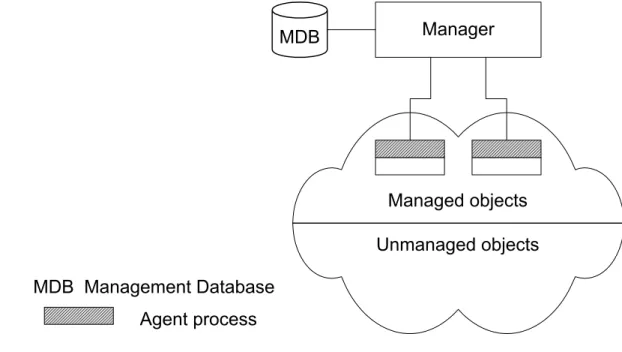
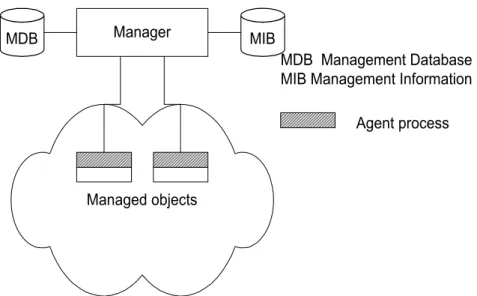
Organizational Model
• Manager
• Sends requests to agents • Monitors alarms
• Hosts applications • Provides user interface • Agent
• Gathers information from objects • Configures parameters of objects • Responds to managers’ requests • Generates alarms and sends them to
managers • Managed object
• Network element that is managed • Hosts management agent
• All objects are manageable or unmanaged
26
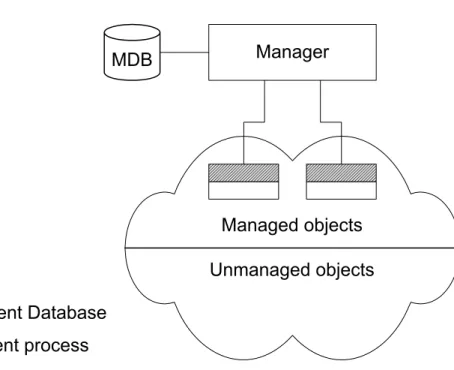
Manager
Managed objects Unmanaged objects
Figure 3.2 Two-Tier Network Management Organization Model
Agent process
MDB
MDB Management Database
Manager
Managed objects Unmanaged objects
Figure 3.2 Two-Tier Network Management Organization Model
Agent process
MDB
MDB Management Database
Network Management: Principles and Practice © Mani Subramanian 2010
Two-Tier Model
• Agent built into network element
Example: Managed hub, managed router • An agent can manage multiple elements
Example: Switched hub, ATM switch • MDB is a physical database
• Unmanaged objects are network elements that are not managed - both physical (unmanaged hub) and logical (passive elements)
27
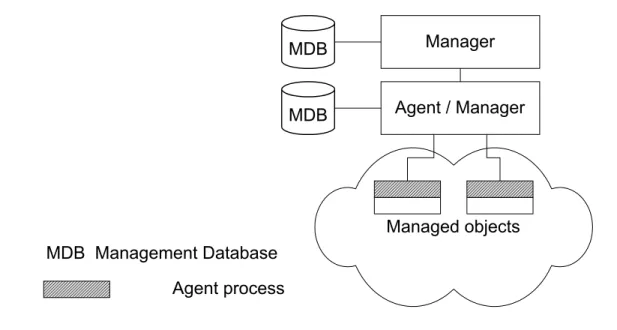
Agent / Manager
Managed objects
Agent process
Manager
Figure 3.3 Three-Tier Network Management Organization Model MDB
MDB
MDB Management Database
Network Management: Principles and Practice © Mani Subramanian 2010
Three-Tier Model
•
Middle layer
plays the
dual role
• Agent to the top-level manager
• Manager to the managed objects
• Example of middle level: Remote monitoring
agent (RMON)
28
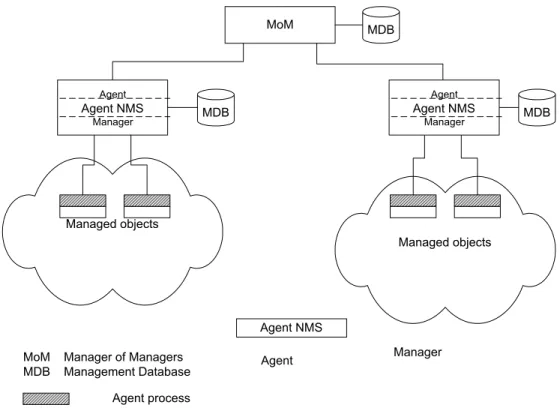
MoM Agent Agent NMS Manager Managed objects Managed objects
Figure 3.4 Network Management Organization Model with MoM Agent process
MDB
MDB MDB
MoM Manager of Managers
MDB Management Database Agent
Manager Agent NMS
Agent
Agent NMS
Manager
Network Management: Principles and Practice © Mani Subramanian 2010
Manager of Managers
•
Agent NMS manages the domain
• MoM presents integrated view of domains
• Domain may be geographical, administrative,
vendor-specific products, etc.
29
Infrastructure for network management
30 managed device managed device managed device managed devicemanaged devices
contain
managed objects
whose
data is gathered into a
Management
Information
Base
(MIB)
constructed in accordance to
Structure of
Management
Information (
SMI
)
managing entity data managing entity agent data agent data agent data agent data network management protocolImplementing a Standardised Network Management
Solution
Network
Management Station
NMS Describe each network
component and its operations
Network Internet
LAN LAN LAN
Network
SNMP overview:
4 key parts
Management
information
base
(MIB):
distributed information store of network management data
Structure
of
Management
Information
(SMI):
data definition language for MIB objects
SNMP
protocol
convey manager<->managed object info, commands
security,
administration
capabilities
major addition in SNMPv3
(More later)
The Managed Network
Network
Host Node Link
Devices
Network
Elements
Management Agents
Network
Host Node LinkNMS
Requests
Traffic
Level
Management Agents
Alarms
Link Down
Unusual
Activity
Device’s Components or
Objects
Management Agent
Map of Objects
MIB
ipRouteTable OBJECT-TYPE ipRouteDest OBJECT-TYPE ipRouteEntry OBJECT-TYPEINFORMATION MODEL
MANAGEMENT INFORMATION BASES
(MIBs)
MIBs
•
describe the
structure of the management
data
of a device subsystem;
•
they use a
hierarchical namespace
containing
object identifiers (OID)
•
Each OID identifies a variable that can be
read or set via SNMP
•
MIBs use the notation defined by Structure of
Management Information (
SMI
), a subset of
ASN.1
Information Model:
Analogy
• Figure in a book uniquely identified by
• ISBN, Chapter, and Figure number in that hierarchical order
• ID: {ISBN, chapter, figure}
• The three elements above define the
syntax
•
Semantics
is the meaning of the three entities according to
Webster’s dictionary
•
The information comprises syntax and semantics
about an object
Network Management: Principles and Practice © Mani Subramanian 2010
Structure of Management Information (
SMI
)
Network Management: Principles and Practice © Mani Subramanian 2010
Example
sysDescr: { system 1 } Syntax: OCTET STRING Definition: "A textual description of the entity. "
Access: read-only Status: mandatory
39
Purpose:
defines for a managed object
syntax
,
semantics
of management data,
well-defined, unambiguous
Plus additional
information
such as
status
structure
base data types:
straightforward, boring
OBJECT-TYPE
data type, status, semantics of managed object
MODULE-IDENTITY
groups related objects into MIB module
Basic Data Types
INTEGER Integer32 Unsigned32 OCTET STRING OBJECT IDENTIFIED IPaddress Counter32 Counter64 Guage32 Time Ticks Opaque
Management Information Base (
MIB
)
Network Management: Principles and Practice © Mani Subramanian 2010
• contains
information about objects
• organized by grouping of related objects
• defines relationship between objects
• it is NOT a physical database. It is a
virtual
database that is compiled into
management module
40MIB
ipRouteTable OBJECT-TYPE ipRouteDest OBJECT-TYPE ipRouteEntry OBJECT-TYPEInformation Base View:
An Analogy
Network Management: Principles and Practice © Mani Subramanian 2010
• Fulton County library system has many branches • Each branch has a set of books
• The books in each branch is a different set
• The information base of the county has the view (catalog) of all books
• The information base of each branch has the catalog of books that belong to that branch. That is, each branch has its view (catalog) of the information base
• Let us apply this to MIB view
41
MIB View
and Access of an Object
• A managed object has many attributes – its information base
• There are several operations that can be performed on the objects
• A user (manager) can view and perform only certain operations on the object by invoking the management agent
• The view of the object attributes that the agent perceives is the MIB view • The operation that a user can perform is the MIB access
Management Information Base (MIB)
Objects
MIB
Object Groups
Network Access Layer
IP Layer
Transport Layer Application Layer
The managed objects are stored as groups of objects in the so-called
MIB or Management Information Base.
The operation that a user can
perform is the MIB access A managed object has many attributes – its information base
The viewof the object attributes that the agent perceives is the MIB view
A user (manager) can view and perform
only certain operations on the object by invoking the management agent
Network Management: Principles and Practice © Mani Subramanian 2010
Management Data Base (
MDB
) / Management Information Base (
MIB
)
• Distinction between MDB and MIB
•
MDB physical database
; e.g.,
Oracle, Sybase
•
MIB virtual database
; schema
compiled into management
software.
• An NMS can automatically discover a
managed object, such as a hub, when
added to the network
• The NMS can identify the new object
as hub only after the MIB schema of the
hub is compiled into NMS software.
Manager
Managed objects
MDB MIB
Agent process MDB Management Database MIB Management Information Base
Figure 3.6 Network Configuration with Data and Information Base
Managed Objects
Network Management: Principles and Practice © Mani Subramanian 2010
•
Managed objects can be• Network elements (hardware, system) • Hubs, bridges, routers, transmission • Software (non-physical)
• Programs, algorithms •Administrative information
• Contact person, name of group of objects (IP group)
44 Root
Level 1 Level 2 Level 3
Figure 3.7 Generic Representation of Management Information Tree
Management Information Tree
question:
how to name every possible
standard object (protocol, data, more..)
in every possible network standard
??
answer:
ISO Object Identifier tree:
hierarchical naming of all objects
each branchpoint has name, number
1.3.6.1.2.1.7.1 ISO ISO-ident. Org. US DoD Internet udpInDatagrams UDP MIB2 management
example
naming
Network Management: Principles and Practice © Mani Subramanian 2010
OSI
Management Information Tree
• iso International Standards Organizationitu International Telecommunications Union dod Department of Defense
• Designation: • iso 1 • org 1.3 • dod 1.3.6 • internet 1.3.6.1 45
•
Type
• Name
• Syntax
• Definition
• Status
• Access
• Instance
Object Type and Instance
• Example of a circle • “circle” is syntax
• Semantics is definition from dictionary “A plane figure bounded by a single curved line, every point of which is of equal distance from the center of the figure.”
Network Management: Principles and Practice © Mani Subramanian 2010
46
Object ID Name Type Comments
1.3.6.1.2.1.7.1 UDPInDatagrams Counter32 total # datagrams delivered at this node
1.3.6.1.2.1.7.2 UDPNoPorts Counter32 # underliverable datagrams: no application at port
1.3.6.1.2.1.7.3 UDPInErrors Counter32 # undeliverable datagrams:
all other reasons
1.3.6.1.2.1.7.4 UDPOutDatagrams Counter32 # datagrams sent 1.3.6.1.2.1.7.5 udpTable SEQUENCE one entry for each port
in use by app, gives port #
and IP address
The System Group
sys (1)
MIB (1)
desc
object ID
up time
System time
Operating system
Version number
Management
Package ID
Manufacturer
All system group objects are “mandatory”
The Interfaces Group
intf (2)
MIB (1)
IF desc
IF mtu
IF out-errors
All interfaces group objects are “mandatory”
Transmission
Unit
0
1
1
0
Example Object Description: MIB (1)
sys(1)
MIB (1)
Status
Access
Object Descriptor
Syntax
Definition
intf(2) adr trs(3)
IP(4) ICM(5) TCP(6) UDP(7) EGP(8)
IF desc IF mtu IF out-errors
IF in-errors
r w rw na
ON/OFF
r w rw na
r
Textual description of rules
Counts incoming PDUs with...Integer
Description Identifier
IF in-errors 1.3.6.1.2.1.2.1349
MIBs index
(http://en.wikipedia.org/wiki/Management_information_base#SNMPv1_MIB_tables)
•
large number of MIBs defined by both standards
organizations like the
IETF
, private enterprises and others:
•
IETF maintained
–
There are
318 RFCs
in the first 5000 RFCs from the IETF
that
contain MIBs
. This list is a mere fraction of the MIBs that have
been written:
–
SNMP - SMI
:
RFC 1155
— Defines the Structure of Management
Information (SMI)
–
MIB-I
:
RFC 1156
— Historically used with
CMOT
, not to be used
with
SNMP
–
SNMPv2-SMI
:
RFC 2578
— Structure of Management Information
Version 2 (
SMIv
2)
–
MIB-II
:
RFC 1213
— Management Information Base for Network
Management of
TCP/IP-based internets
–
SNMPv2-MIB
:
RFC 3418
— Management Information Base (MIB)
for the
Simple Network Management Protocol (SNMP)
–
TCP-MIB
:
RFC 4022
— Management Information Base for the
Transmission Control Protocol (TCP)
–
UDP-MIB
:
RFC 4113
— Management Information Base for the
User Datagram Protocol (UDP)
–
IP-MIB
:
RFC 4293
— Management Information Base for the
Internet Protocol (IP)
–
IF-MIB
:
RFC 2863
— The Interfaces Group MIB
–
ENTITY-MIB
:
RFC 4133
— Entity MIB (Version 3)
–
ENTITY-STATE-MIB
:
RFC 4268
— Entity State MIB
–
ALARM-MIB
:
RFC 3877
— Alarm Management Information Base
(MIB)
–
…
51
MIBs index
The MIB: A Collection of Object Descriptions
MIB
Status Access Object Desc Syntax Definition ON/OFF type Descriptiondesc / ID text. desc r w rw na Status Access Object Desc Syntax Definition ON/OFF type Descriptiondesc / ID text. desc r w rw na Status Access Object Desc Syntax Definition ON/OFF type Descriptiondesc / ID text. desc r w rw naStatus
Access Object Desc Syntax DefinitionON/OFF
type
Descriptiondesc / IDtext. desc
r w rw na
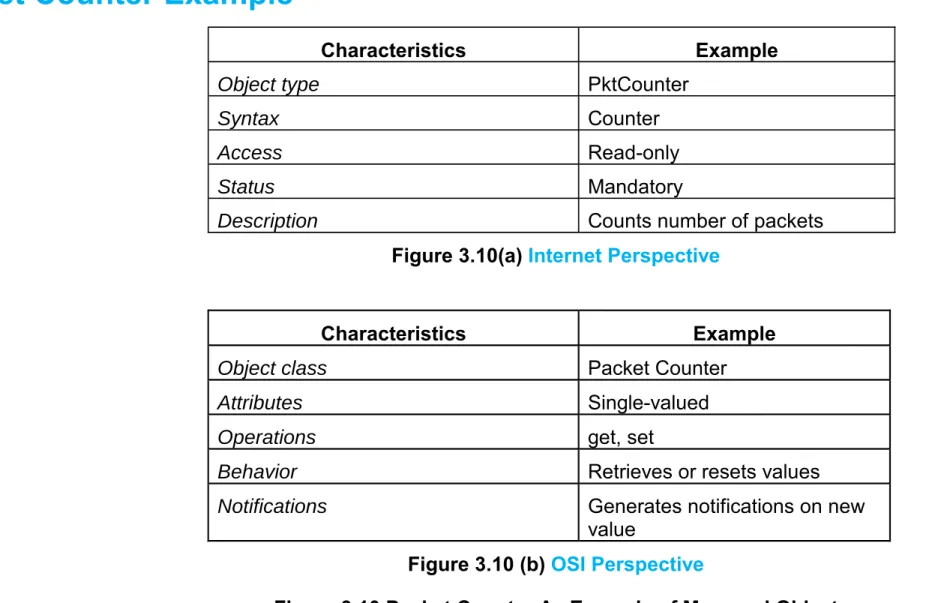
Status Access Object Descriptor Syntax Definition ON/OFF type Descriptiondesc / ID text. desc r w rw na 52Characteristics Example Object type PktCounter
Syntax Counter Access Read-only Status Mandatory
Description Counts number of packets Figure 3.10(a) Internet Perspective
Characteristics Example
Object class Packet Counter Attributes Single-valued Operations get, set
Behavior Retrieves or resets values Notifications Generates notifications on new
value
Figure 3.10 (b) OSI Perspective
Figure 3.10 Packet Counter As Example of Managed Object
Packet Counter Example
Network Management: Principles and Practice
Internet vs. OSI Managed Object
Network Management: Principles and Practice © Mani Subramanian 2010
•
Scalar
object in
Internet
vs.
Object-oriented
approach in
OSI
•
OSI
characteristics of
operations, behavior, and notification
are part of communication model
; in
Internet
: get/set and
response/alarm
• Internet syntax is absorbed as part of OSI attributes
• Internet access is part of OSI security model
• Internet status is part of OSI conformance application
• OSI permits creation and deletion of objects; Internet does
not: Enhancement in SNMPv2
Summary on MIBs
examined how the information in a
MIB is constructed in accordance with
the rules set out in the SMI
- Structure of Management Information - so that
all management systems can use it.
An MIB
contains information about manageable objects
in the network
element
The
object descriptor
is made of two parts: the
object descriptor
and the
object identifier
which is read from the
registration tree
.
The
syntax
field can have a number of different values:
Integer, octet string,
null, constructed types
or it can be one of a set of
defined types
There are
8 different object groups
and each object that can be described in
an MIB belongs to one of these groups.
Each network element supports only the groups that apply to it.
THE PRESENTATION PROBLEM:
ASN.1
The presentation problem
Q:
does perfect memory-to-memory
copy solve
“
the communication
problem
”
?
A:
not always!
problem:
different data format, storage conventions
struct {
char code;
int x;
} test;
test.x = 256;
test.code=
‘
a
’
a
00000001
00000011
a
00000011
00000001
test.code
test.x
test.code
test.x
host 1 format
host 2 format
A real-life presentation problem:
aging 60’s
hippie
2012 teenager
grandma
Groovy!
?
?
?
?
?
?
?
?
58Presentation problem:
potential
solutions
1.
Sender learns receiver
’
s format. Sender
translates into receiver
’
s format. Sender
sends.
– real-world analogy?
– pros and cons
?
2.
Sender sends. Receiver learns sender
’
s
format. Receiver translate into
receiver-local format
– real-world-analogy
– pros and cons?
3.
Sender translates host-independent
format. Sends. Receiver translates to
receiver-local format.
– real-world analogy?
Solving the presentation problem
1.
Translate
local
‐
host
format
to
host
‐
independent
format
2.
Transmit
data
in
host
‐
independent
format
3.
Translate
host
‐
independent
format
to
remote
‐
host
format
2012 teenager aging 60’s hippie grandma presentation service presentation service presentation service“Groovy!”
“It is pleasing
to me!”
“It is pleasing
to me!”
“Cat’s pajamas!”
“Awesome, dude!”
!
!
!
!
!
!
!
!
60ASN.1: Abstract Syntax Notation 1
•
ISO standard
X.680
–
used extensively in Internet
–
like eating vegetables, knowing this
“
good for you
”
!
•
defined data types
, object constructors
–
like SMI
•
BER:
Basic Encoding Rules
–
specify how ASN.1-defined data objects to be transmitted
–
each transmitted object has
Type,
Length,
TLV Encoding
Idea:
transmitted
data
is
self
‐
identifying
T:
data type, one of ASN.1-defined types
L:
length of data in bytes
V:
value of data, encoded according to ASN.1 standard
1
2
3
4
5
6
9
Boolean
Integer
Bitstring
Octet string
Null
Object Identifier
Real
Tag Value Type
TLV encoding:
example
Length, 5 bytes
T
ype=4, octet string
Length, 2 bytes
Type=2, integer
lastname ::= OCTET STRING weight ::= INTEGER
{weight, 259} {lastname, “smith”}
module of data type declarations written in ASN.1
instances of data type specified in module
Basic Encoding Rules (BER) 3 1 2 2 h t i m s 5 4
transmitted
byte
stream
V
alue, 5 octets (chars)
V
alue, 259
Abstract Syntax Notation One (ASN.1)
Network Management: Principles and Practice © Mani Subramanian 2010
•
ASN.1 is more than a syntax; it’s a language
• Addresses both syntax and semantics
• Two types of syntax
•
Abstract syntax
: set of rules that specify data type and
structure for information storage
•
Transfer syntax
: set of rules for communicating
information between systems
•
Makes application layer protocols independent of lower
layer protocols
• Can generate machine-readable code: Basic Encoding
Rules (BER) is used in management modules
Backus-Nauer Form (BNF)
Definition:
<name> ::= <definition>
Rules:
<digit> ::= 0|1|2|3|4|5|6|7|8|9
<number> ::= <number> | <digit> <number> <op> ::= +|-|x|/ <SAE> ::= <number>|<SAE>|<SAE><op><SAE> Example: • 9 is primitive 9 • 19 is constructof 1 and 9 • 619 is constructof 6 and 19
• BNF is used for ASN.1 constructs
• Constructs developed from primitives • The example illustrates how numbers areconstructed from the primitive <digit> • Simple Arithmetic Expression entity
(<SAE>) is constructed from the primitives <digit> and <op>
Network Management: Principles and Practice © Mani Subramanian 2010
65
Simple Arithmetic Expression
<SAE> ::= <number> | <SAE><op><number>
Example: 26 = 13 x 2
Constructs and primitives Type and Value
• Assignments
• <BooleanType> ::= BOOLEAN • <BooleanValue> ::= TRUE | FALSE • ASN.1 module is a group of assignments person-name Person-Name::= { first "John", middle “T", last "Smith" }
Data Type: Example 1
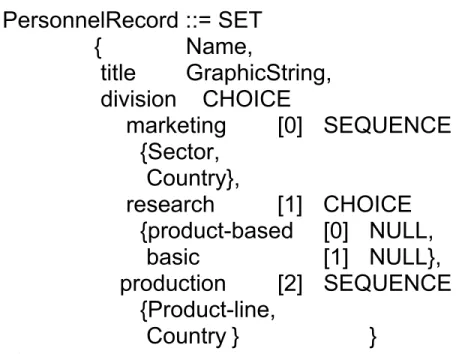
Network Management: Principles and Practice © Mani Subramanian 2010
• Module name starts with capital letters • Data types:
• Primitives: NULL, GraphicString • Constructs
• Alternatives : CHOICE
• List maker: SET, SEQUENCE
• Repetition: SET OF, SEQUENCE OF: • Difference between SET and SEQUENCE
PersonnelRecord ::= SET { Name, title GraphicString, division CHOICE marketing [0] SEQUENCE {Sector, Country}, research [1] CHOICE {product-based [0] NULL, basic [1] NULL}, production [2] SEQUENCE {Product-line, Country } } etc.
Figure 3.13 ASN.1 Data Type Definition: Example 1
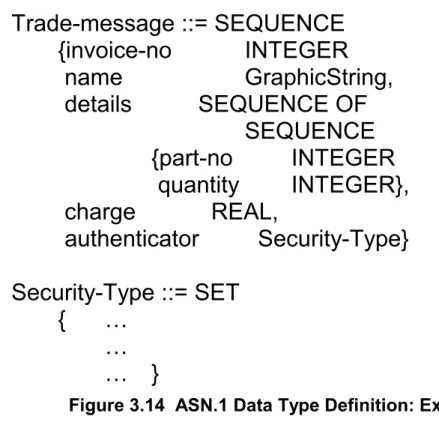
Data Type: Example 2
Network Management: Principles and Practice © Mani Subramanian 2010
• SEQUENCE OF SEQUENCE makes table of rows
Trade-message ::= SEQUENCE {invoice-no INTEGER name GraphicString, details SEQUENCE OF SEQUENCE {part-no INTEGER quantity INTEGER}, charge REAL, authenticator Security-Type} Security-Type ::= SET { … … … }
Figure 3.14 ASN.1 Data Type Definition: Example 2
NETWORK MONITORING AND
CONTROL (FCAPS)
Recall: Network Monitoring and
control
Management Station
Local Area Network
Statistics
Alarms
Status
ON
OFF
Introduction-
Network Monitoring
Observes and analyzes
the status and behavior
of the end systems, intermediate systems and
subnetworks that make up the configuration to be
managed
Performance monitoring
Availability
Response time
Accuracy
Throughput
Utilization
Fault monitoring
Identifies faults as quickly as possible
Identifies the cause of the fault to take corrective action
Fault isolation
Accounting monitoring
Gathers usage information for each resources
Introduction
-
Network Control
concerned with
modifying parameters
and
causes actions
to be taken by the end
systems, intermediate systems, and
subnetworks
FCAPS involve both monitoring and control
Network
monitoring
Performance monitoring
: Measure and record system behaviour
Fault monitoring
: Detect, isolate and correct abnormal operation
Accounting monitoring
: Enable charging for resource use
The emphasis in network
control
Configuration control
: Set parameters that govern behaviour
Security control
: support the application of security policiesFCAPS
•
Broadly speaking answers the following
questions:
•
What happens when things go wrong? Faults (
F
)
•
Assumes network already exists - how was it planned,
installed, configured for local conditions? Configuration (
C
)
•
Who pays/paid for it? Accounting (
A
)
•
Need to monitor performance, e.g. to inform planning, detect
faults, etc? Performance (
P
)
•
How is it secured (e.g. against fraud)? How is security
configured? Monitoring to detect security events? Security (
S
)
Functional Model (FCAPS)
OSI Functional Model Fault Management Configuration Management Performance Management Security Management Accounting ManagementNetwork Management: Principles and Practice © Mani Subramanian 2010
• Configuration management
• Set and change network configuration component parameters • Set up alarm thresholds
• Fault management
• Detection and isolation of failures in network • Trouble ticket administration
• Performance management
• Monitor performance of network
• Security management
• Authentication • Authorization • Encryption
• Accounting management
• Functional accounting of network usage
NETWORK MONITORING TOOLS
Network Monitoring Tools
75
A key part of network management is
monitoring
.
Using various monitoring
tools
which obtain and compile information about network activity
and
performance
Example
a monitoring tool might help you determine why
network
performance is slow or why a user has difficulty
accessing a
server
Through proper monitoring and analysis of the results,
you
can
keep track of
a network's performance
, and
anticipate, recognize, and correct problems before they
disrupt network services.
Network Monitoring Tools
76
You can use different network monitoring tools for
various purposes
:
to
capture
and
analyze
traffic
to
log
information about network events
to
alert
you to specified events
to
monitor
interfaces, such as routers, switches, and
servers
to
alert
you about areas where traffic is congested
to assist in constructing
performance
baselines
to determine upgrade and
forecast
needs, and
Network Monitoring Tools
77
Can be classified based on their
usage
:
status monitoring
ping & nslookup
traffic monitoring
Monitor the quality of the network,
ping
route monitoring
Network Monitoring Tools
78
Can be classified based on their
applicability:
LAN monitoring
Remote Monitoring
‐
RMON, pathping, OpManager,
Solarwinds
QoS monitoring
QoS parameters, load balancing
Bandwidth monitoring
NetFlow
analyzer
WAN Monitoring
Network Monitoring Tools
79
Software
‐
based throughput testers to
measure
network throughput
These tools send large data packets from one
destination
to another, measuring how long it
takes to transfer the packets
Connectivity
Software tools
built
‐
in tools provided in Windows and
UNIX operating
system
tools you install as add
‐
ins – to
troubleshoot connectivity
issues
Network Monitoring Tools
Tasks
to perform as a
Network Admin
:
identifying inbound and outbound protocols
determining whether the protocols acknowledge each
other
and whether they communicate in a unidirectional or
bidirectional fashion
identifying open and closed ports
checking traffic that passes through the firewall
tracing packets on the network, and
analyzing
bandwidth usage
e.g.
restrict traffic based on port, you can implement
port filtering
Network Monitoring Tools
SNMP
82
Simple Network Management Protocol
collects information from network devices,
for
diagnostic
and maintenance purposes.
SNMP
is a simple request
SNMP
83
Consists of two components
Agent
Software
installed on network devices, such as
servers, routers,
switches, and printers
Agents collect information from devices
and send it to an
SNMP
manager
Management
Systems
Central management server
Logs the information send by Agents
Alert the IT
SNMP
84
SNMP versions:
SNMPv1
1988
Operates over UDP,
Not secure, plain text transactions
Get, GetNext, Set and Trap
SNMPv2
1993
New commands, GetBulk and Inform
SNMPv3
2002
Enhanced security features
Overview
85