Measuring Reflectance
Peter D. Hiscocks
Syscomp Electronic Design Limited Email: [email protected]
September 16, 2011
Introduction
The digital camera has tremendous potential for measuring and documenting light pollution. However, mea-surements using a digital camera require a low-cost, simple, reliable standard of luminance (candelas per square meter) for calibration.
As shown in another paper [1], an integrating sphere [2] can be used to create this standard luminance. The luminance of the sphere port is given by [3]:
L=
Eρ
π candela/metre
2 (1)
where
L is the luminance of the port in candelas per square metre
E is the illuminance of the port in lux
ρ is the reflectance of the white-painted interior of the sphere
If the reflectance of the interior surface of the sphere (ρ) is known then one can use a readily-available,
inex-pensive luxmeter to measure the illuminanceEat the sphere port exit and calculate the corresponding luminance
L. This value may then be used to calibrate a camera.
Measurement Techniques for Reflectance
Equation 1 applies to the reflectance of a surface in a diffuse field: one where there is no preferred direction to the illumination. The integrating sphere is ideal for generating such a field, but since we don’t know the luminance at the exit port, we can’t use that method to determine the reflectance.
Jupp [4] points out that the luminance reflectance1 may be determined very simply by comparison with a
standard, as in equation 2. ρt=ρr Lt Ls (2) where
ρt is the reflectance of the target, ie, the unknown surface.
ρs is the reflectance of the standard
Lt is the luminance of the target surface
LS is the luminance of the standard surface
According to Jupp, this is the reflectance factor obtained with an integrating sphere..., so it applies to our requirement.
Fortunately, a reflectance standard is readily available in the form of the 18% Grey Card. The Grey Card is widely used by photographers to check exposure and white balance and is available from photo supply stores for a modest cost. For example, two CPM Gray Cards (note spelling) are available from Henry Camera in Toronto for about $15.
The ratio of luminances can be obtained by an instrument that measures light intensity where the field of view of the instrument is entirely filled by the illuminated area. If the same instrument is used to measure both luminances, then it need not be calibrated.
1Jupp uses the term radiance reflectance. Radiance is the related to the illumination energy over all bandwidths, luminance is the energy
Figure 1: Front View
The Instrument
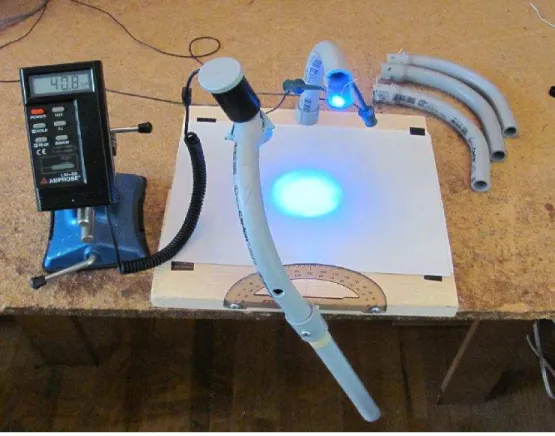
Figure 1 shows a front view of the instrument for measuring reflectance.
The light detector is the photodetector from an Amprobe LM-80 luxmeter. The Amprobe LM-80 is particularly attractive for this application because it has a maximum sensitivity of 0.01 lux, an order of magnitude better than
many luxmeters.2. The light detector views the illuminated area through a 3 inch length of tubing so that the field
of view is restricted to about 5◦, within the area illuminated by the light source. The detector tube is lined with
matte black paper to minimize off-axis light.
The light source is attached to a fixed arm. The light detector is on an arm that can rotate to various angles. Both arms are constructed using half-inch plastic electric conduit, right angle sections. The rear arm is a friction fit in a conduit adaptor, so that various light sources can be easily exchanged. The front arm rotates around a single screw, with an access hole to view the protractor angle readout.
The light source in figure 1 is a white LED. In the background are three additional light fixtures, with red, green and blue LEDs.
Figure 2(a) shows the sensor. It is removed from its luxmeter illuminance housing, trimmed at the corners (to fit) and then bolted together to contain the photopic visiblity filter. It is pressed into a receptacle that has been sculpted by Dremel tool in the end of the plastic tubing. Figure 2(b) shows the sensor in place in its housing. A plastic film can prevents stray light from reaching the sensor. The sensor installation is reversible: the sensor can be returned to the luxmeter housing. To check alignment, the sensor is removed and the target area viewed through the sensor tube.
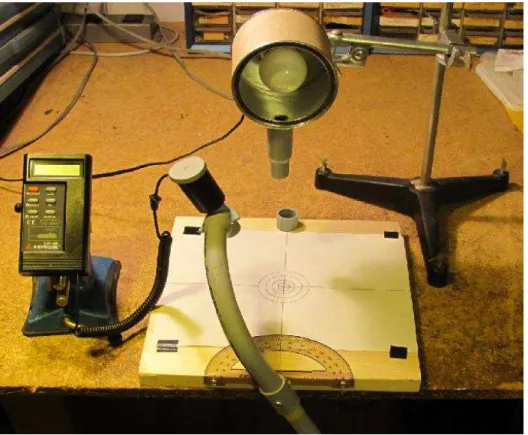
Figure 3 shows a 40-watt frosted bulb incandescent lamp source. The bulb is contained in a repurposed peanut can. An aperture on one side directs the illumination to the instrument surface. A small length of pipe constrains the area illuminated. In operation, a plastic lid (with metal cover) is snapped over the container. The incandescent source gets very hot very quickly and can only be operate for a few seconds at a time, but that’s sufficient to take a reflectance reading.
(a) Sensor (b) Installed
Figure 2: Sensor Installation
Figure 3: Incandescent Lamp Source
Results
The material of interest in this study is the painted metal surface used in the integrating sphere. The inside of the
integrating sphere was painted with several coats of a matte white metal spray paint Cloud 33. An 8.5 inch by 11
inch aluminum panel was treated with the same paint and used to measure reflectance.
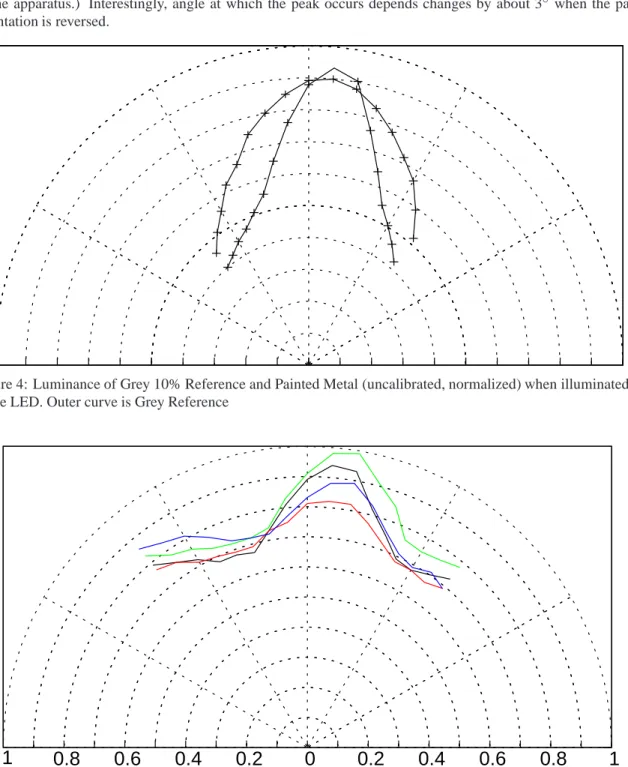
Figure 4 shows the luminance of the 18% reference grey panel and white-painted metal panel, vs angle. The two curves have been normalized for comparison. Notice that the grey reference is ’fatter’, that is, it radiates more evenly over angles.
3Krylon Outdoor Spaces 42904 Cloud (SHERWIN-WILLIAMS CANADA INC. KRYLON Products Group Vaughan, ON L4K 4T8. The
The painted panel shows some specular behaviour. (The peak is not exactly at 90◦because of misalignment
in the apparatus.) Interestingly, angle at which the peak occurs depends changes by about 3◦ when the panel
orientation is reversed.
Figure 4: Luminance of Grey 10% Reference and Painted Metal (uncalibrated, normalized) when illuminated by white LED. Outer curve is Grey Reference
0.8
0.6
0.4
0.2
0
0.2
0.4
0.6
0.8
1
1
Figure 5: Reflectance of Painted Metal. From bottom to top in the area of the peak, the curves are for the Red, Blue, White and Green LED illumination.
Figure 5 shows the reflectance at various angles for different colours of illumination. The peak value in red is about 0.8, the peak value in green is nearly 1.0.
Light is reflected from these surfaces at all angles, so the aggregate reflectance must be taken as an average of the reflectance at different angles. A reflectance measurement at one specific angle can be very misleading of overall behaviour. Figure 5 indicates a typical 20% difference between maximum and minimum reflectance.
Material Light Average Material Light Average
Source Reflectance Source Reflectance
Painted Metal White LED 0.77 Painted Metal Incandescent 40W 0.76
Painted Metal Red LED 0.73 White bond paper White LED 0.84
Painted Metal Green LED 0.81 Matte black paper White LED 0.086
Painted Metal Blue LED 0.78
Unfortunately, Sherwin Williams does not quote the LRV (light reflectance value) for Krylon paint. However, the values of reflectance for white paint on metal that are given in the literature are comparable with the values measured in this exercise, as listed below.
Reference Comment
Knighton [6] ’White Paint’, no details given. Average of about 0.95 except below 450nM, where the
reflectivity drops dramatically.
Ducharme [7] ’Krylon flat white spray paint’, on black acrylic plastic surface. No wavelength data. Value
0.849.
Zhang [8] ’Aluminum with coating of white paint’, no other details given. Essentially constant at 0.80
from 400 to 700nM.
Reflectance of Panels in a Diffuse Field
There is an alternative, completely different method of measuring reflectance. Jupp [4] indicates that reflectance may be determined by the ratio of reflected to incident illuminances:
ρ=E
r
Ei
(3) where:
Er is the reflected illuminance in lux
Ei is the incident illuminance in lux
ρ is the illuminance reflectance of the surface.
This measurement must be taken in a diffuse field of illumination. Indirect sunlight from a clear sky at early afternoon is (approximately) a diffuse field. Consequently, one can measure the incident and reflected illuminance with a luxmeter, and obtain the reflectance of the material.
For this measurement, it is important to understand the behaviour of a light field in the vicinity of a luminescent
panel4.
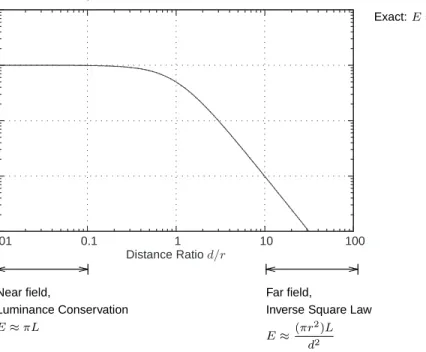
Consider the situation shown in figure 6, measuring the illuminanceElux from a diffusing panel of luminance
Lcandelas/metre2. The panel is circular in outline with radiusrmetres. The illuminance meter (luxmeter) is
moved away from the panel at distancedmetres.
Close to the panel, in the so-called near field, the illuminance reading does not change with distanced. As the
meter moves away, on the one hand, the emitted light is spread over a larger area. On the other hand, the meter
sees a large area of the panel. The two effects cancel.
At a large distance from the panel, where the radius is small compared to the measuring distance, the inverse square law applies. This is the so-called far field, and the illuminance decreases as the square of the distance.
For equation 3 to work correctly in the calculation of reflectance, the illuminance meter must be in the near field of the panel.
There is one additional practical effect to consider: as the illuminance meter comes close to the panel it shadows the light source and the illuminance decreases. As a result, the measuring technique is to move the illuminance meter head upward from the panel. At first, as the shadowing is reduced, the illuminance reading increases. Then, for a few centimetres of movement, the reading is constant: the sensor is in the near field of the reflected light of the panel. The illuminance at this point is the value used in the calculation of reflectance.
. . . . . . . . . . . . . . . ... ... ... ... . . . . ... . . . . . . . . . . . . . . . . . . . . . . . . . . . . . . . . . . . . . . . . . . . . . . . . . . . . . . . . . . . . . . . . . . . . . . . . . . . . . . . . . . . . . . . . . . . . . . . . . . . . . . . . . . . . . . . . . . . . ... . . . . . . . . . . . . . . . . . . . . . . . . . . . . . . Far field,
Inverse Square Law Near field, Luminance Conservation E≈πL E≈ (πr 2)L d2 Exact:E=πL r2 r2+d2 Detector Source r d . . . . . . . . . . . . . . . . . . . . . . . . . . . . . . . . . . . . . . . . . . . . . . . . . . . . . . . . . . . . . . . . . . . . . . . . . . . . . . . . . . . . . . . . . . . . . . . . . . . . . . . . . . . . . . . . . . . . . . . . . . . . . . . . . . . . . . . . . . . . . . . . . . . . . . . . . . . . . . . . . . . . . . . . . . . . . . . . . . . . . . . . . . . . . . . . . . . . . . . . . . . . . . . . . . . . . . . . . . . . . . . . . ... ... ... ... 0.001 0.01 0.1 1 10 0.01 0.1 1 10 100 Distance Ratiod/r Relative Illuminance, lux
Figure 6: Light Field
Moving further movement away from the panel into the far field, the illuminance decreases. It’s also necessary to make sure that there are no significant shadows from the operator.
We measured the incident and reflected illuminance with three panels, each 8.5 inches by 11 inches. The panels were placed on a horizontal surface, exposed to indirect (diffuse) illumination from a clear sky at about
2PM in the afternoon5.
The Amprobe LM-80 luxmeter measuring head was modified with cardboard extension tube 10cm long by 5cm diameter to restrict the viewing angle. The measuring head was attached to 40cm small diameter rod to minimize shadowing by the operator. Results of the measurements are shown in the table:
Material Reflectance
18% Grey Card 0.181
Krylon Painted Metal on Aluminum 0.804
Matte Black Card 0.088
Notice that the reflectance of the grey card measures very close to its true value. This is a useful check on the validity of the method. The reflectance of the painted metal panel is within 4% of the value measured in the reflectance apparatus with the white LED source. The discrepancy might be due to the different spectral content of diffuse sunlight and white LED.
Conclusions
This paper describes two methods of measuring the reflectance of a painted metal panel. The methods give results that are consistent with each other and measurements by others.
For measurements using the instrument and 18% grey card as a standard there is significant difference in the reflectivity of the panel under different colours of LED illumination. The reflectivity under a white LED is very nearly equal to the reflectivity under illumination of a 40 watt incandescent lamp. A single-figure measurement of reflectivity should be taken by measuring reflectivity over a range of angles and averaging the result.
5A subsequent measurement at 7PM generated reflectance values that were obviously incorrect: greater than 1 for the painted metal panel.
The error was created by non-uniform sky illumination. The sky was significantly brighter at eastern and western horizons than at the zenith. The time of day is clearly important.
For measurements taken in natural sunlight, care must be taken that the sky illumination is acceptably diffuse. The equipment cost and effort of this method are minimal, but it is more difficult to obtain consistent, repeatable results.
References
[1] Measuring Luminance with a Digital Camera Peter D. Hiscocks, August 2011
http://www.ee.ryerson.ca/~phiscock/
[2] Integrating Sphere for Luminance Calibration Peter D. Hiscocks, August 2011
http://www.ee.ryerson.ca/~phiscock/
[3] Derivation of the relationship between illuminance E and luminance L for a Lambertian reflective surface,
L=Eρ/π. Yi Chun Huang
http://www.yichunhuang.com/files/teaching/landa/lambertian_luminance. pdf
[4] Issues in Reflectance Measurement David L B Jupp
CSIRO Earth Observation Centre
Discussion Draft August 1996 updated April 1996
http://www.eoc.csiro.au/millwshop/ref_cal.pdf
[5] Luminosity function
http://en.wikipedia.org/wiki/Luminosity_function
[6] A Mixture of Barium Sulphate and White Paint is a low cost Substitute Reflectance Standard for Spectralon Nick Knighton, Bruce Bugbee
http://www.usu.edu/cpl/PDF/Barium_Sulfate.pdf
[7] Design of an Integrating Sphere as a Uniform Illumination Source Alfred Ducharme, Arnold Daniels, Eric Grann, Glenn Boreman IEEE Transactions on Education, Vol 40, No. 2, May 1997, pp 131-134 [8] Measurement and Statistical Modelling of BRDF of Various Samples
Hanlu Zhang, Zhensen Wu, Yunhua Cao, Geng Zhang
http://www.if.pwr.wroc.pl/~optappl/pdf/2010/no1/optappl_4001p197.pdf
[9] Light Measurement Handbook Alex Ryder
http://files.intl-light.com/handbook.pdf
[10] Photometry John W.T. Walsh